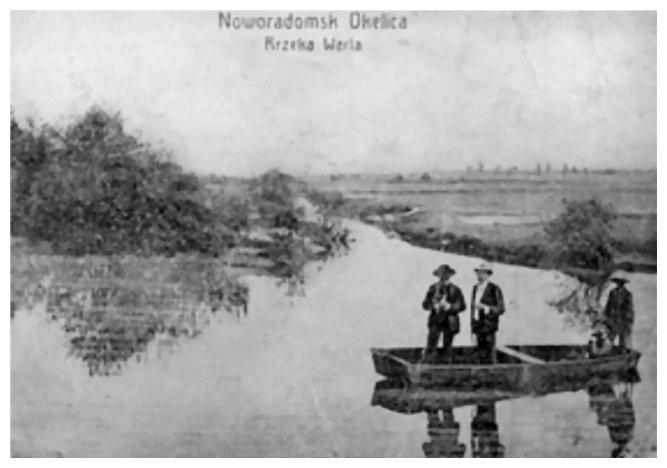
Radomsk Vicinity (the Warta River)
|
by Shlomo Krakowski
Translated by Sara Mages
| For the few survivors of our holy community of Radomsk in Israel, who only remember the public life of the city's Jews during the period between the First and Second World Wars, I hereby bring up some memories of Jewish life in the city (especially the cultural-spiritual life) in the period preceding this, that is, at the end of the last century. |
If we talk about public life according to today's concepts, there was no such life then, neither in Radomsk nor in any other city in Congress Poland, except in the large cities like Warsaw, Lodz, etc. Back then we knew nothing about any spiritual-cultural movement other than the Hasidut, which was many times stronger than it is today. We still did not know what a political party was, and anyway, there weren't many of them. The Jewish street remained as it was, day after day, without any difference between yesterday, today and tomorrow. The Jew of that time, even though he was completely immersed in his family life and worries of his livelihood, which was as difficult as parting the Red Sea, liked to hear a little news of what was happening in the big world, and was especially interested in politics and the wars that broke out from time to time in the world. The news reached him through special channels such as in Beit HaMidrash between Mincha and Maariv prayers, the shtiebel, the mikveh, etc., and that was enough for him. There were no newspapers then. Throughout the vast Russia, with its three million Jews (Congress Poland was also one of its countries), there wasn't a single newspaper in Yiddish. Two newspapers appeared in Hebrew at the time: Ha-Tsfira[1] in Warsaw and HaMelitz[2] in St. Petersburg. We did not know yet how to buy a newspaper. Anyone who wanted to read a newspaper had to subscribe to it in advance, and if my memory serves me correctly, only about five copies of Ha-Tsfira (the day after its publication and one or two of HaMelitz) were received in the city. On Tuesday and sometimes on Wednesday. These few newspapers were read by all those who knew Hebrew in the city, because each newspaper had two or three partners. In those days, subscribing to a newspaper alone was a luxury that not everyone could afford. My father z”l was one of the few subscribers of Ha-Tsfira, and he always had a one or two partners to the newspaper. After the partners finished reading it, I took the newspaper with me to Beit HaMidrash, where I was studying at the time, for the “educated” young men and it was passed from hand to hand until everyone finished it. But that was only on the days when I was the first to receive the newspaper. It also happened that I received the newspaper a few days after it arrived in the city, or that I did not receive it at all. There were Jews in the city who thought it would be better for them to occasionally drop a few groszy into the hand of the postman, Lensky, a gentile with a large mustache who did not particularly dislike a strong drink, and to receive the newspaper from him before he handed it over to its owner, than to send the advance subscription fee to Warsaw every quarter of the year. After my repeated protests and appeals to Lansky about this subject, and my threats that I would report the matter to the postmaster, had no effect on him and he continued his act of deception, I also got wise and started to drop a few groszy to his hand every now and then so that he wouldn't give the newspapers to others. This trick was effective, but only for a short time, because he immediately returned to his evil ways. He took money from me and others as well... until I finally found better advice. Every day I walked from our apartment at the end of Przedborska Street to the post office on Kaliska Street where I received the newspaper.
In several “progressive” homes in the city they preferred to read a Polish newspaper, even though
[Page 30]
the fathers of the family knew Hebrew. Their excuse was that also their family members, who don't know Hebrew, would be able to read it. There were even homes in Radomsk where they read the Kurier Warszawski [Warsaw Courier], the most widely circulated newspaper in those days. This newspaper reeked of open anti-Semitism even though its publisher, Leventhal, was an annihilated Jew, or maybe just because of that. These few families constituted the city's Jewish intelligentsia and its “bourgeoisie.” These heads of these families were not much different from the rest of the city's Jews. Some were quite well-known Torah scholars who spent their youth on the benches of Beit HaMidrash. There were even former Hasidim who traveled several times a year to see the Rebbe but became heretic... Indeed, not everyone went to the same extreme. There were those who, despite all their “progress,” remained within the camp, such as R' Berish Freszter, R' Leizer Reichtman, R' Leizer Pelbner and his son Yisraelka of the wealthiest in the city. They were partners in a kind of a “bank” and contractors for the Warsaw-Vienna railway. They carried out all the work and repairs along the entire length of the railway, in accordance with the concession they had from the railway authorities. They were observant Jews who conducted their daily lives according to the spirit of the Torah and tradition. On the Sabbath they came to pray at the rabbi's Beit Midrash. Later, R' Berish Freszter installed his own synagogue in his big house on Kaliska street corner of ¯abia Street (the one that later passed to the hands of Dovid Bugjski). This synagogue housed the first Zionist Association in the city before the First World War, and “Beit-Yaakov” after that. These two, Freszter and Reichtman, were known in the city for their great generosity. The family of R' Leizer Pelbner, and even more his wife Keila, excelled in their generosity. They raised and educated their sons to Torah and secular education. Since there were no Jewish schools in Poland at the time, R' Berish Freszter and Yisraelka Reichtman sent their sons to a high school in Frankfurt am Main in Germany. I don't remember if it was a community school or a private one, and if they also taught Jewish studies there.
Besides these two, there were several other Jews in the city who were known as “educated.” They read Jewish Apocrypha books, sent their sons to Fabian School (a liberal gentile who was considered a sympathizer of the Jews) with two high school classes (there was a school in the city, a government elementary school, whose principal was Wolski, but the Jews did not send their sons to this school). For Judaic studies they fulfilled their duty at the cheder of Yoel Sztatler, father of Berish Sztatler, who was called
|
|
Radomsk Vicinity (the Warta River) |
the Olkuszy teacher after the city of his origin, Olkusz. He was an innocent and honest old Jew, but because of his knowledge of the Hebrew language, which he taught to his students, he was considered a heretic by many. Only a very few of the city's Jews dared to risk their good name and hand over their sons to him. Of them, I remember R' Hirshel Banker, a learned man, a Hasid who became a “heretic.” He was among the wealthiest in the city, owner of a house with a large garden and a hotel on the corner of the Powiatowa and Kaliska streets (across from Gabriel Goldberg's house) and one of the community's public activists. Every Sabbath he came to the synagogue and sat next to the rabbi in the eastern wall. And I still remember R' Lizer Reichman and Avraham Epsztajn, both forest merchants (they were in-laws), Pulman, Dunski, Hasenberg and others. These Jews, although they had already tasted the taste of Europe and were in constant contact with Polish estates owners around the city, still remained within the camp and were somewhat active in the community's public life. But there were also those, albeit very few, who went so far as to avoid any contact with the rest of the city's Jews, such as the elderly Chaim Baum and his son Daniel, and Yeshaya Rojewicz who owned two factories. He was a simple Jew who amassed a fortune, and as his wealth grew his Jewishness gradually shrank until nothing remained of it except his appearance on Yom Kippur at the synagogue for a few hours, and in this he fulfilled his duty. But this Jew was severely punished by the Heavens. One of his sons, Leon, “fell into bad ways.” He was caught up in the Zionist idea and became the assistant of Moshe Lewkowicz, the Zionists' leader for several years, to the displeasure of his father and the members of his family. And of the same kind was also the elderly Mitelman, father of Dr. Mitelman, Henrik and Kuba. He was a sickly insurance agent who rarely left his house. And there were two more Levy brothers, Zinwel and Herschel, and the families Sheper or Sperber, and Rapel of the Freszter and Reichtman clerks. They, and a number of other Jews like them, constituted the city's intelligentsia, but they were only a small handful. Most of the Jews in the city were Hasidim: the Radomsk Hasidim, Ger, Sochaczew, Alexander and many more. Among them were many scholars, educated and pious, among them were those who stood out from the entire community such as the three sons-in-law of Tiferet Shlomo z”l [Shlomo HaKohen Rabinowicz]: R' Yechiel Landau, R' Yisrael Kron, and R' Lipman Litmanowicz and his son Mendel, R' Shmuel the judge (father of Yisraelka Shmuel's who was also a judge in the city in a later period), Michael Shochet. There were several other Jews who were no longer alive at period I am talking about, but I remember them from previous years, such as, my last two teachers – R' Avraham Yitzchak and R' Hirsh Yosef (both were judges), R' Pinchas Wolf the teacher, R' Noah Shochet, R' Raphael Rapoport, R' Avraham'le Zilber (the hunchback) and many more. There were several dozen Jews who flocked after the Popular Hasidut of Radoshitz, Rozprza and more, but their presence in the city was not noticeable.
At the head of public life stood the community representatives – the dozorim. They were elected once every three years. The elections were held at the synagogue or in Beit HaMidrash, in the presence of the District Clerk or the District Minister, and for the most part without their influence on the course of the elections and their results. The influence on the elections was sometimes also held by a handful of ordinary people, loud Jews who campaigned for one candidate or another and tipped the scales in his favor. The candidates were almost always the same people, as is today so then, whoever went up to the podium did not get off it… And if it ever happened that one of them failed and was not elected, it was only for a short time, because if he only managed to acquire a “suitable side” in the next election, he was elected again. It was a kind of a “possession,” and all the townspeople knew that only Avraham Lubelski a tailor who rose to greatness (he later moved to Lodz), Hirsh Banker, Yosef Hirsh Shatz, Leizer Tebtzer, Fishel Dynsky, Gabrial Golberg and several more people can be elected as dozorim. The main role of the community l representatives was to impose the community tax on the Jewish population and to assess it from time to time. They also served as “liaisons” between
[Page 31]
the Jewish population and the authorities, represented it at time of need, and they set all the important community matters.
Besides the dozorim were gabbaim,[3] who headed benevolent institutions, or the educational and cultural institutions, so to speak, that existed in the city at that time. As I remember, the main activity of these “institutions” was expressed only in the fact that each had a house of prayer (a minyan), apart from Chevra Kadisha that it is impossible to complain about it that it was not active… At the head of Chevra Kadisha stood Nechemia Orbach, Mordechai Gliksman (“Skalka”), and also one of my uncles Bril Kamelgarn. My second uncle, Till, was the gabbai of Chevra Kadisha in an earlier period, but don't remember him anymore. There was also Bikur Cholim [visiting the sick], but apart from its minyan, I don't remember any actual activity of this association. There was also Talmud Torah in the city, and its teacher was Herschel Kortsava, father of the well-known Mordechai Zelig, but I prefer not to talk about this institution. It is known which scholars of Torah and Judaism these institutions produced in the cities of Poland in those days, and our city, Radomsk, did not “lag behind” in this sense from other cities.
In the years preceding the period I am telling about, there was in Radomsk, like in other cities, an institution known by the name Hekdesh. It was a “hospitality house” for poor beggars, who wandered from city to city. In the Hekdesh they found a place to sleep after their “working day.” I only remember that the building that housed the Hekdesh on Przedborska Street at the corner of Dluga Street already stood in its ruins, without doors, windows and a roof. In my days, the cheder of R' Avraham the teacher took the place of the Hekdesh. R' Avraham was a teacher of young children, and almost half of the city's schoolchildren received their first education in his cheder. He was a Jew with severe asthma who did not stopped coughing for a moment. He lived in the rabbi's courtyard, which always housed several chadarim from teachers for young children to teachers of Gemara, Tosafot and interpreters. I myself spent most of my childhood in this yard, starting in R' Avraham's cheder and finishing in the cheder of the teacher R' Hirsh Yosef. R' Abraham's apartment had two rooms, he lived in one of them with his family and the cooked, ate and slept there. His wife sat there and had done her work, the work “decorating” head covers for the city's women and also received her clients there. In addition, a large pot which was always full of boiling water stood there, and they sold tea to all the neighborhood residents. The second was the cheder with two tables, one for him and the second for his assistant, and benches that were always filled to the brim with boys. This Jew knew how to utilize this room, which remained redundant and without any need after the students left it at the end of their studies, in the most effective way. Meaning, he will enjoy it in this world and will also have good in the next world. He turned it into a kind of Hachnasat Orchim[4] for the poor from outside the city. For this purpose he had about a dozen mattresses, which were placed somewhere outside the room during the day and served as a place for games for young students. In the evening, he brought them inside, arranged them on the floor, and about a dozen poor people slept on them for two kopecks a night, and these guests changed almost every night. In the morning they removed the mattresses, and the boys came to their place… (I brought this episode for those who have not yet experienced the taste of the cheder, to give them an idea of ??the nature of the “kindergarten” which their ancestors spent their first years of study).
But there was also Hachnasat Orchim society in the city. It was Hachnasat Orchim society of the students of the Beit HaMidrash. We had three societies in Beit HaMidrash: Kinyan Sefarim for the purchase of books, Tikun Sefarim for the repairing books that have been torn from excessive use, and Hachnasat Orchim which was intended for exceptional individuals from among the poor who visited the city. These were decent Jews, scholars and respectable people who, for the most part, left adult daughters in their homes without a dowry, without any possibility of marrying them off. For this purpose they left their cities and wandered throughout the country until they had collected the amount needed and returned to their homes. There were also those among them for whom “begging” was already their constant occupation, and until now they were forced to stay overnight at R' Avraham the teacher with a mixed group of people. When such a poor man came to Beit HaMidrash, he immediately turned the society's gabbai who knew how to evaluate each and every one of the poor and give a known amount according to his value. There were also poor people who, in addition to the gift of money they received from the treasury, also received a list of important homeowners in the city. They no longer collected alms from house to house only according to the list, and there they received larger alms. At night, these “important” poor people sometimes found a place on the benches of the Beit HaMidrash, and under their heads was the sack containing a tallit and tefillin, a few shirts, etc., which they carried with them on their wanderings.
The sources of income for these societies, apart from monthly membership fees imposed on each young man, were mainly donations of grooms before their wedding ceremony. It was a Jewish custom to send to each groom on the eve of his wedding several students of Beit HaMidrash who set with him until the wedding ceremony and rejoiced with him. In addition, each of the above societies sent a pair of students to the groom with a letter of request, or in a “song,” according to the groom's worth, and the groom made their contributions to the society, each according to his ability. (this method was used as a source of income not only by the students of Beit HaMidrash, but also for all the societies in the city).
Apart from the aforementioned institutions I don't remember any other institutions in the city. There were no other educational institutions apart from Talmud Torah. There were only private chadarim, about fifteen or twenty, where all the city's children were educated. The chadarim in which I studied were: the aforementioned R' Avraham the teacher, R' Moshe Kroza, R' Yehezkel Zinwal (son-in-law of Eliezer'l Shochet) who later moved to Lodz, R' Yoel Hecharesh (in Israel are the children of his fourth generation, brother and sister, and they are Mr. Starobinsky son of Tuvia-Leizer Starobinsky and his sister, daughter-in-law of the city's last rabbi who is in Haifa). R' Avraham Yitzchak the judge, and the last R' Hirsh Yosef who was also a judge. In addition to the aforementioned teachers: R' Yehoshua, R' Lipman, R' Yekil the lame, R' Henoch of Przedborz (made aliyah to Israel in 1913), R' Moshe Lipa's, R' Pinchas Wolf, R' Mordechai Yosef, R' Yoske Landau, my brother-in-law - son-in-law of my father-in-law R' Bril Witenberg z”l, and R' Aharon Hirsh of Dzialoszyn. Children of the wealthy studied in these chadarim and continued their studies at Beit HaMidrash. The poorest of them left for places of study in other cities. There, they studied in Batei Midrash, ate yamim[5] or were hungry… Yeshivot, such as those in Volozhin, Kovno-Solodovka, Mir, Tlez, and others, were not in Congress Poland, apart the two yeshivot in Lomza and Makow. But these two were at the other end of the country, and I don't remember a single boy from Radomsk who wandered as far as these cities. These yeshivot were known to us only from the visits of their emissaries who came several times a year to collect the monthly commitment fees from the city's residents and also preached several sermons at the synagogue or iat Beit HaMidrash.
Most of the city's boys, who finished the last cheder and were unable to reach the highest level of the chadarim due to their parents' poverty, became apprentices to the city's craftsmen. These crafts were extremely limited, there were only tailors, shoemakers, bakers, milliners, seamstresses, watchmakers, carpenters, etc. There was no light industry in the city. In the few factories, such as the furniture factories for the production of chairs, of the Thonet brothers or the Cohen brothers from Vienna, or in the factories of Rosewicz, the Jewish worker had no foothold. Even if these factories agreed to accept Jewish workers, there was not a single Jew who agreed to engage in this work. It was different for young women. Many young women, even the daughters of important homeowners, engaged in
[Page 32]
the work they found in the aforementioned chair factories. However, they also did not work inside the factories but in their homes. The work was weaving chairs from reeds that the city's young women were trained in. There were families blessed with several daughters, who earned their entire livelihood from this work. Apart from that, there was no other work for them. Many young women worked as “housekeepers,” but they were mostly from the simple and poor people. There were no milliners or seamstresses because they were not needed. Dresses for women were then sewn by tailors (men). The level of education of the young people was very low in those days, both in terms of knowledge of our special culture and in terms of general culture. There was no decent library in the city. There was only the library of Moshe the bookbinder, the son of R, Yeshaya Peretz the bookbinder. This library provided spiritual nourishment for all the city's youth, the students of the Beit HaMidrash, the apprentices and even the housekeepers (the maids, as they were called then).
Moshe the bookbinder lived with his father, Yeshaya Peretz (who spoke through his nose in a terrible way), and both worked in bookbinding. Moshe traveled to Warsaw several times a year and brought various books that the townspeople ordered from him, mainly books written by rabbis and scholars. Very rarely he brought several books of Yiddish tales like the books of “Shomer” [Nahum Meir Schaikewitz], Isaac Mayer Dick, Ozer Blushtein and others. He lent these books to his readers for a monthly fee, and they passed from hand to hand. A short time later the books became torn and worn-out rags to the point that they could not be picked up. He did not agree to bring books in Hebrew. He did not want to risk himself, not materially because of the small number of readers of Hebrew books, but more out of fear of the wrath of the jealous parents who would surely tear him apart like a fish if they found out that he was providing their sons with books that were unsuitable for reading. Acceptable books - weren't such a terrible thing. No man in town cared if his daughter, or even his wife, were reading the book Mayśe-bikhl[6]. It was a normal and acceptable pastime. But it was forbidden to mention a Hebrew book.
There was another such “library” in the city, owned by two brothers whose names I had forgotten. One of them was lame and the other hunchbacked, and they lived with their widowed mother on Kaliska Street. This library contained only Hebrew books, but in very small quantities due to the poverty of its owners. It was only used by the students of the Beit HaMidrash. But we were not satisfied with what we had, and since we longed for a Hebrew book, we had to resort to various means to somehow reach the private libraries of the few educated people in the city. When such a book came into the hands of one of us, it was passed from hand to hand. Purchasing a Hebrew book openly was impossible. As mentioned, Moshe the bookbinder did not want to risk it. There was only one way for the students of the Beit Midrash to purchase a Hebrew book, through the traveling booksellers who often came to the city, especially on the anniversary of the passing of Tiferet Shlomo and Chesed Le'Avraham z”l. The main trade of these Jews was in books written by rabbis and teachers such as: chumases, machzorim, tefillin, mezuzot, sashes, tzitziyot, etc. They arranged their goods on long tables in Beit HaMidrash or in its courtyard, and around them stood the usual shoppers and chose what they wanted. However, under the tables, in the sacks where they kept most of their merchandise, there was also some prohibited merchandise, which was intended for special buyers who always stood by the tables at times when there were no regular buyers there. A book bought by one student was read by all the students of Beit HaMidrash. I once bought the book Daniel Deronda by George Eliot with the translation of David Frischmann. After reading it, I lent it to one of my friends and the book came back two years later... In this way, I had the opportunity to read about two dozen books in exchange for a book that was passed from person to person until it eventually came back to me. The same thing was with the newspapers: thanks to Ha-Tsfira that we received in our home, I had the opportunity to read HaMelitz and several other Polish and Russian newspapers. All my friends had done the same. And it did not matter to us which newspaper, from which direction, because the main thing for us was the reading, the “what” wasn't important to us. We were so thirsty about reading a newspaper, and by that, I mean only the educated group of Beit Midrash students. One of us obtained the Polish newspaper “Rola,” with its distinctly anti-Semitic content, from a gentile neighbor. We even got hold of the dry newspaper, Petrovska Gubernia ve Domosti (a collection of official publications). Our neighbor, Wolf Birnsweig, had a subscription to the newspaper because he was the supplier of the battalion that was stationed in our city, but did not read it for the simple reason that he did not know any Russian. This newspaper was also a commodity for us to trade... The newspapers passed from hand to hand until they were torn from much use.
But the city's youth as a whole, the apprentices and the few clerks, did not feel any need for either a newspaper or a book. They didn't have free time for that because they worked until late in the evening. The craftsmen, as well as the shopkeepers, spent the Sabbath partly sleeping and partly dancing with young women, on walks on the “New Road” (later Pobiatowa Street), or to “Rigel” (on the road to Kamiensk). A small portion found their “Sabbath pleasure” in Mayśe-bikhl.
This was the face of Jewish youth in general in those days. This was the case in Radomsk, and this was the situation in most Polish cities, and only a few cities were exempt from this rule. When we read every day in the newspapers about the vibrant Jewish life in the cities of the well-known “Pale of Settlement,” especially in the cities of Lithuania and Poland. About Hovevei Zion movement that encompassed all their communities, their Torah institutions, yeshivot and cultural institutions, our hearts were filled with envy, and we felt great sadness and despair.
We were a small group of young people, whose desire for a new content for our gray lives filled all our thoughts, and we pondered and never stopped discussing and questioning it. But we were unable to help ourselves, and there was not a man among us with the energy and initiative to guide us and show us the way. And so we degenerated and walked without any hope for better days. There was one attempt to improve the situation, but it failed before it saw the light of day. This was when a group of people arose in Warsaw and wanted to imitate the “Society for the Promotion of Culture among the Jews,” which was then located in Petersburg and whose stronghold was spread over all the cities of the “Pale of Settlement.” The purpose of the society was to establish schools for Jewish children, libraries, and support poor young people who aspired to acquire an education, etc. But the society's operations did not reach the cities of Poland. I do not know for what reason, whether because the society's regulation did not allow it, or for some other reason.
And so, a few people in Warsaw came up with the idea of ??founding a parallel company that would operate only in Polish cities. At that time, Hirsch David Nomberg left Radomsk and moved to Warsaw. This was after he lost all the dowry that he received from his father-in-law Mordechai Shapira in the grocery store he had for a short time in Banker's house. R' Mordechai Shapira accused him of failure and because of this, or because of other things that were not to his father-in-law's liking, a quarrel broke out between them. Nomberg was expelled from his father-in-law's house and was forced to leave the city and move to Warsaw. When he learned about the newly founded company and its goals, he tried to help us and indeed succeeded in influencing the company's directors (by the way, this company did not last long, it died before it could even begin any activity) to come to our aid. There was a woman in town, her name was Rapel, the wife of the Freszter and Reichtman clerk firm's clerk. She was engaged and had connections with the company, or its founders, and they assigned her the task of organizing the matter. With her help, our group of five or six young men was founded (not just the students of Beit HaMidrash, I was the only one of them) with the goal of studying to the point where we would be qualified after a few years to go to Geneva and enter the
enter the
[Page 33]
university there, For this purpose, we were to send one or two students to prepare us. But unfortunately for us, the group was located in Pietrzków, where the Kazakh group was founded, and also in Lodz, which registered all those who enrolled for studies, and this candidate was a true believer! When the great news was heard, he also informed Radom about it, that summer the whole idea was over before we even received the first lesson...
And here, one day appeared in Ha-Tsfira a notice about a Jew named Dr. Theodor Herzl in Viena, of the editors of the newspaper Neue Freie Presse [“New Free Press”]. He conceived and came up with the idea of ??purchasing Eretz Yisrael from the Turkish governor Abdul Hamid, and to establish a “safe haven” for the Jews there with the consent and assistance of all the governments of the world. For this purpose, he was going to found a bank, with the help of which he hoped to collect the necessary amount to realize this idea. He appealed to all Jews around the world to help with this great undertaking and to immediately begin actions to establish Zionist associations in every city and town and to recruit members for these associations.
I cannot say that this “sensational” news aroused among the audience in Radomsk is the necessary resonance that such news could, and should, arouse. The general public, apart from a few distinguished individuals, remained indifferent to the whole matter. This news did not reach most of the city's Jews, those who were far from reading newspapers. The Jews will not agree, and if they do, the gentiles will not agree. Religious Judaism, as we know, was not the only one that remained indifferent, but immediately declared war on all those who advocated the idea. The only ones who were very impressed by the news and enthusiastic about the idea were, apart from those mentioned above, a few people in the city, several students of Beit HaMidrash had already been attracted to the idea of ??Hovevei Zion. This was caused to a certain extent by the fact that the news was published in Ha-Tsfira .and the editor of the newspaper at that time, R' Nahum Sokolov, z”l treated it seriously and with dignity, in contrast to his previous position until then. There was a very big difference in the spirit of the two Hebrew newspapers of the time: Ha-Tsfira and HaMelitz.
While HaMelitz advocated nationalism and Hovevei Zion, which occupied the largest part of the newspaper, most of the material in the : Ha-Tsfira was devoted to local questions and educating the people. The part of the love of Hovevei Zion movement and life in Eretz Yisrael occupied little space in the newspaper. On the contrary, Sokolov sometimes treated these matters with a bit of disdain. And then, Ha-Tsfira began to respond to the idea of Dr. Herzl z”l, that is, to the Zionist idea, in a completely different tone.
It was time to act and begin the practical work, but it soon became clear to us that it was not so easy. The young men, who were most enthusiastic about the idea, backed down one by one when things came to fruition and when they encountered opposition from their parents. The parents, most of whom were Hasidic or just ordinary Jews, who viewed the whole matter in a completely negative light, opposed it most vigorously. Even the parents who were less opposed to the idea itself did not agree to their sons engaging in this They saw it as a waste of time and the cancellation of studies it could lead to.
There were only three of us who were allowed to act freely, without any opposition from our parents. My father was indeed a member of the Radomsker Hasidim and the Shabbat he prayed in the rabbi's minyan. In matters of commerce or family, he did not do anything without asking the rabbi and without his consent. He was one of those who advocated the method: “take hold of this, and also from this you shall not withdraw your hand.” And while he was a religious and God-fearing Jew in the full sense of the word, he also loved to read secular books in Hebrew and Polish and also wrote beautifully in Hebrew. He loved to purchase for himself, at every opportunity, a Hebrew book or a collection of Haskalah literature. He was also one of the few Hovevei Zion in the city. At first, I was a little hesitant to come out publicly and join the Zionists and help them in any way I could, because I did not know how far my father's “enthusiasm” reached. But to my surprise, my fears were unfounded, and my father did not bother me at all.
The second one, who also had a free hand in the Zionist activity, was my relative, Azriel Prezrowski son of Itzy Prezrowski, a textile merchant. The third was my brother-in-law, R' Avramachi Minski z”l. He provided great service to the first Zionist activists in the founding of the association. My father-in-law, R' Bril Witenberg z”l, Avramachi's stepfather, was the first mohel [circumciser] in his city and its surroundings. He listed before him all those circumcised by him (then their number had already reached several thousand) and Avramachi loved to take care of these lists. He put them in order and added, as much as possible, various details about the circumcised, like the parents' names, their occupation, date of birth, etc. Over time, he became a kind of “living encyclopedia” for all the city's natives, so much so, that the municipality began to exploit him and use his book whenever necessary. Over time a special “Jewish table” was established in the city for all Jewish matters, and Avramachi became its director... When Moshe Lewkowicz set out to found the first Zionist association in the city, he relied heavily on Avramachi's card index…
Apart from the three of us, I don't remember any of students of Beit HaMidrash who dared to reveal the secret that they were Zionists, even though they were loyal Zionists. Because, if Avraham Moshe Kalka (brother of Yehoshua and Henoch) dared to admit that he was a Zionist, his father, R' Tuvia Kalka, the zealous Amshinover Hasid, would have kicked him out of his house. And the same is true for Moshe Luria the son of Yoske Luria and Yekil Sofer son of R' Leib Fishel Sofer. Although neither of them was among the educated, they were devoted Zionists and would willingly cooperate with the Zionists if they were not afraid of their fathers. To be honest, I must note here that it was not only among the circles of zealous Hasidic Jews that Zionism in Radomsk encountered some resistance in the early days, but even among the Jewish intelligentsia in the city. Almost all of the city's intellectuals we listed above stood at a distance and did not openly join the new association.
Among the first founders of the association were Jews whom no one believed were capable of grasping this idea. Here is Moshe Lewkowicz z”l, the first chairman of Radomsk Zionists, a Jew who until then was unknown in the city. He returned to Radomsk from Lodz, where he lived for several years, only shortly before that. A simple Jew, not very close to our sources. He did not know Hebrew at all (we agreed that I would teach him Hebrew and he would teach me to play the violin), but for some reason it did not work out). And it was precisely this man who devoted himself entirely to Zionist work, even to the point of neglecting his difficult livelihood. He was a wonderful conversationalist. It was possible to sit with him for hours and listen with great interest to his pleasant conversations. His influence on the few Zionists in the city, in the early days of Zionism in Radomsk, was immense. He was a founder of the Zionist Association and remained its chairman throughout its existence.
And here is the aforementioned Lion Rozewicz, the son of an assimilated family who had no ties with the city's Jews. His father and his older brother avoided any contact with them. Adam, who did not receive a Jewish education, was one of the first to join the association and was among its most active
On the other hand, the first to join the Zionist Union were people who, in their education and in their Jewish worldview, were far from Lion Rozewicz and others like him, as far away as the east is from the west, such as Avraham Bril, Avraham Moshe
[Page 34]
Waksman, Meir Szitenberg, Reuven Liberman and others. They did not join as members but were known in the city as enthusiastic Zionists. A Jew like Kopel Glidman (son of Avraham Leib Glidman, who was the shamash of Tiferet Shlomo z”l), a religious Jew, a passionate follower of the Rebbe, and at the same time a poor and oppressed Jew who served the community and was dependent on its opinion. As the shamash of Beit HaMidrash he devoted himself with all his heart and soul to the Zionist idea. He did not hesitate to conduct vigorous propaganda in its favor, without fear or hesitation, among all those who attended Beit HaMidrash.
And when I mention here several names of the first Zionists in Radomsk, I find it my duty to also mention a “Zionist” of a different type, and he is – Michael the “water drawer.” He was a very simple man who certainly did not know the shape of a letter, and I'm sure he did not even know what Zion was, where is it and what they are going to do with this Zion… This Jew was always one of the first to bring the few pennies he had earned from his hard work, whether as membership dues or as a payment on account for a Colonial Bank's share, etc. In this manner the Zionist Association of Radomsk was founded, with only individuals from all walks of life registered as members. The vast majority of the city's residents remained on the sidelines, some of whom viewed the Zionist idea positively, but did not dare to openly join the association.
What was the scope of the Zionist association activities in Radomsk after its founding? As I recall, its activities were very limited. All the work was expressed in the sale of the shekels and the reading of the “Return Letters“[7] of Dr. Bernstein-Cohen z”l before the members by Moshe Lewkowicz. In contrast to other cities, there was no strong opposition to Zionism, neither on the part of the Hasidim nor on the part of the laborers, who were few in the city, nor even on the part of the city's rabbi. All opposition to Zionism in Radomsk was passive and did not provoke any reaction. Even the “courtyard” in Radomsk did not take any part in the war on Zionism.
The Radomsker Hasidut stood always on the side and implemented this line all the years until the Second World War. I had a brother in Lodz in whose home the high politics of Radomsker Hasidut was cooked. I know that at every time when the war broke out in Lodz between the Hasidim and the national camp, or between Gerer Hasidim and the Alexander Hasidim. This happened often especially during election days, and there were always attempts by the warring parties to pull the Radomsker Hasidim into the war, but it always didn't help.
To our great regret, Zionism did not last long, neither in Radomsk nor throughout Great Russia. The final end came several years later. The Tsarist regime, in waging a heavy war on the Jewish and socialist workers' movements, also dealt a severe blow to Zionism. Whether out of not knowing the differences between these two movements, or out of malice... After a short period of Zionist activity, the movement was banned throughout Russia and was outlawed, forcing it to go underground. Admittedly, the best Zionists did not so easily lay down their weapons and surrender to the harsh decree, and by all sorts of means they knew how to continue the work despite the official ban. However, it goes without saying that the work could not have been as fruitful as in previous years. By the outbreak of the First World War, the Zionist movement was no longer as visible on Jewish streets as in its early years.
And behold, the First World War broke out and the Nazis' forefathers, either for political reasons in order to win the opinion of the Jewish people on their side or due to other factors, decided to loosen the leash and allow Zionist work again. It goes without saying that the reaction from the Jewish street was not long in coming. A great awakening arose, and Zionist associations began to spring up frequently in all Polish cities and, as usual, the first associations were founded in the large cities. There were indeed exceptional cities that were more responsive to the mitzvah, among them very small cities. However, in most places, the Zionist revival began somewhat slowly, whether due to a lack of “activists” or other reasons, and one of these cities was Radomsk.
At that time I returned to Radomsk as a refugee. In the first year of the war when echoes of the national awakening, which encompassed the Jewish population in most Polish cities, also reached our city. Its veteran Zionists had already begun to speak of the need to renew the Zionist work. When I returned to Radomsk I became a regular worshipper at Kopel's Beit Midrash. I took my place at a table that stood at the Eastern Wall on the right and all who sat there were my old acquaintances, and they were all Zionists: Berish Sztetler, Mendel Fajnzilber, Yiztchak Pacanowski Hillel Zombek (who was then the gabbai of Beit HaMidrash), Berish Shtitski, and also the two Gold brothers Nachman and David. Every Sabbath during the prayer, we only discussed this problem: how to rebuild the ruins of the Zionist association in the city and renew our days as before. But we did not get any action at all. What was missing was the motivating factor that would breathe life into the dry bones...and here he came.
It was on a wintery Friday morning in the second week of the war. When I entered the shop of my brother-in-law Yekil Witenberg z”l, I saw there a man unknown to me. When I entered the shop, Witenberg turned to the man as he was pointing at me: “Here comes a Zionist Jew who my you can beat as hard as you want. To this day, there is no Zionist association in Radomsk, and he alone is to blame for this.” It was Dr. Meir z”l chairman of the Central Committee of Polish Zionists, which was founded in Warsaw at that time. Dr. Klomel was one of those that it was said about them: “I have seen members of the caste of the spiritually prominent, and they are few”[Sukkah 45b]. He was one of the greatest leaders of Polish Zionism, a scholar from a Lithuanian yeshiva, Doctor of Philosophy, and most importantly, a Zionist at heart and soul. In his private life he was a paper merchant and had several clients in Radomsk such as Witenberg, Peinsky, Gelberd and others. Their ties were severed because of the war, and he came to renew them.
Dr. Klomel started hitting me one by one... How is it that a community such as Radomsk, a large and important Jewish city, is not ashamed to remain indifferent and frozen in its tracks while the entire nation, in all its diaspora, has already risen to life? And for a long hour he did not stop giving me moral advice, and his words were really emotional and passionate. In the end, we agreed: since he had to be in Radomsk on the Shabbat (he was a religious Jew and did not travel on Shabbat), he would give us a “Zionist” speech and rouse the people from their slumber.
I immediately recruited several young men who happened to enter the shop, David Kalay, Yakel Aronowicz (later Doctor Aronowicz) and a few others, and we started with the preparations. It was not long before word of the important guest and his lecture spread quickly throughout the city. The next day, on Sabbath evening, several dozen townspeople, mostly young, gathered at the “Kultura” hall, I think that was its name. It was located on Steshalkowska Street at the Szpeltin home and was given to us with the help of Yosil Pajerman who was one of the youth activists and I had some influence on him.
Dr. Klomel gave us a very beautiful and interesting lecture, which, as I recall, left a strong impression on those gathered. The lecture ended at about six o'clock, and since the train to Warsaw did not leave until eleven and we did not want to leave Dr. Klomel alone for the entire evening. It was decided between us to host him at one of the homes and spend the evening with him. We chose the home of Moshe Lewkowicz who for some reason was not present at the lecture. Mendel Fajnzilber, David Kalay and I were chosen as Dr. Klomel's companions. The whole affair started anew at Moshe Lewkowicz's home. Dr. Klomel taught us another chapter on Zionism until that evening it was decided to establish a new Zionist association in the city. And here the question of location arose, because getting an apartment in Radomsk back then was not one of the easiest things. But this question was also quickly resolved. Sitting with us at the time was Moshe Bugajski, the son of David Bugajski, who was once Lewkowicz's student and came that evening to his former teacher. When he heard how we were debating the question of an apartment for the association, he gave us good advice. In his father's house
[Page 35]
is the synagogue that years ago belonged to the Zionists. The minyan of Bikur Cholim (or any other association) is now located there, and since this association is not paying rent for several months, his father is about to evict it, but he hesitates because: what will people say? He advised us to approach his father with a proposal, and he is sure that in such a case, that is, to leave the synagogue in place but to replace the sign, his father would gladly agree.
We found his advice correct, and the next day a three-person delegation was sent to David Bugajski: Mendel Fajnzilber, Yekil Witenberg and Moshe Reichtman, and the matter ended with great success. Since then “Beit Yakov” was established.
These are my memories of our city Radomsk from the last five years of the last century, apart from the last lines about the founding of the “Beit Yakov” association, of which I was privileged to be among its founders and directors. It is possible that some details in these memoirs are not entirely accurate, it is possible that some important figures from the city who should be mentioned here were not remembered out of forgetfulness, and vice versa, it is possible that some things that were emphasized by overemphasis may seem to others to be less important, or not important at all. I didn't mean to write “history.” I just wanted to contribute, among others, my meager part in presenting a “commemoration” in memory of our pure martyrs who were destroyed and devoured by the Nazi predatory beasts, may their names be blotted out.
Translator's footnotes
by Rabbi Yechiel Wajntraub
Translated by Sara Mages
| God, the God of Spirits, will visit all our townspeople and will bind in the bond of life the entire holy community - men, women, and children - who were executed for no fault of their own, by an impure and world-destroying people. May the God of Israel preserve the memory of this community of holy and pure. |
Yoel Dayan
R' Yoel was one of the judges at the Radomsk court in the days of R' Shlomo HaCohen. R' Yoel was a great scholar of the grandsons of R' Yoel Sirkish, author of Bach (Bayit Chadash on Shulchan Aruch). He was a close associate of Rabbi' Shlomo HaCohen and his confidant.
Avraham Sofer
He was an excellent writer and a great scholar. His sayings were spoken by all many years after his passing, and a lot of money was paid for his books. He had one daughter and the rabbi, author of Tiferet Shlomo, ordered to call her “Bubale” [darling] until her wedding ceremony, and from then on, she would be called “Primit.” She was later the wife of Rabbi Yakov-Dovid zt”l.
R' Shmuel Zelwer
R' Shmuel was one of Radomsk's judges until his old age. R' Shmuel was a scholar and left behind a handwritten composition titled Shem Mishmuel. He passed away at the age of 74 in 5662. He served as a judge in the days of Rabbi Tzvi-Meir HaCohen.
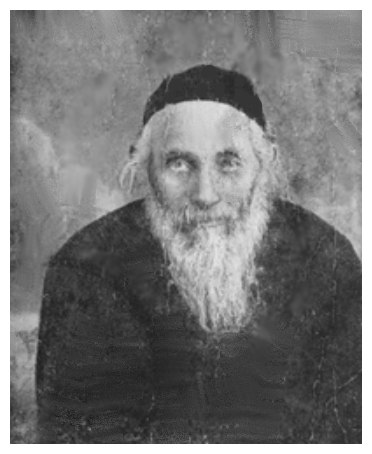
R' Yisrael Zelwer
R' Yisrael Zelwer, son of R' Shmuel aforementioned judge, was already a judge during his father's lifetime in 5654. R' Yisrael was a scholar and was certified to teach by HaGaon[1] R'Avraham Bornsztain of Częstochowa author of the book Iglei Tal, and HaGaon R' Yoav Yehoshua of Kinsk [Końskie] author of the book Chelkat Yoav.
R' Yisrael was a was a great scholar and always engaged in the service of God. He had a dignified appearance and studied Torah and knowledge in his synagogue with the congregation. R' Yisrael was one of the most important Sochatchover Hasidim and a cantor on the High Holidays for the Sochatchover Rebbe. I remember there was once an issue when the house, in which his synagogue was located, was sold to another man who wanted to abolish the synagogue that had been there for many years. Once, when they came to pray, they found the synagogue desecrated: the Torah scrolls, and all the objects were taken out, and the walls and floor were dirty. Then he said that all those who had a part in this would not wake up from their sleep. And indeed, his words came true. Within six months, two young men who had a hand in the matter died. The new homeowner lost his property, and his family was doomed to great destruction.
 |
|
The judge Reb Yisroel Zelwer |
R' Hanoch Henoch Zelwer the judge
R' Hanoch Henoch Zelwer z”l served as a judge in Radomsk after his father R' Yisrael Zelwer the judge. He was good natured, gentle, and excellent in his moral qualities. Until he was accepted as a rabbi, he had a grocery store at the home of R' Aba Schwarz but he hardly engaged in trade. Day and night he sat and studied Torah and Hasidut. He loved Israel and was beloved by all.
R' Yosef-Eliezer Buki the judge
R' Yosef-Eliezer was accepted into the rabbinate thanks to his great diligence. He was well-versed in all laws and knew them properly and from their source. He taught the wisdom of Chazal[2] in Aggadah[3] and Halacha[4] at Chevra Kadisha Synagogue and fulfilled his obligation to Jewish law. He was honest in his deeds and very humble. He was not involved
[Page 36]
in politics, did not interfere and received everyone with kindness. R' Yosef-Eliezer was loved by people and all the townspeople respected and loved him. Many came to him to ask questions, since he lived in the city center and was one of the most eminent in Jewish law. He passed away with good reputation and left behind his son, who served after him in the rabbinate in our city Radomsk.
The judge Tuvia Buki
In his adolescent, R' Tuvia was an educated young man, and it may not have occurred to him to ever serve in the rabbinate, as he sought to put into practice the saying: “love work, hate acting the superior” [Pirkei Avot 1:10]. He was not satisfied with the profound knowledge he acquired in the Torah, gave his heart to the realities of this world and was involved among the people. Only after the passing of his father HaRav R' Yosef Eliezer z”l, who left behind a widow and children without a source of income, his friends repeatedly urged him to accept the rabbinate crown that the townspeople wanted to crown him with. Neither the father nor the son used the rabbinate as a source of income. Both were beloved, pleasant and humble, and engaged in Torah and good deeds for its sake.
R' Tuviah surpassed his father in this, as his father was hiding in four cubits of law and was not involved in city affairs, while Tuvia was involved in all public affairs and was always first in everything. His words were heard, for he always delivered them with taste and intelligence, and captivated everyone with his face that expressed nobility and kindness. He was devoted to the city with every fiber of his being and preached for peace in Jerusalem. It is possible that the heavy burden that weighed on him prevented him from achieving his goal and did not have time to reach his aspiration - Jerusalem. Perhaps he did not want to leave the holy community in which he served as judge in place of his father. My knowledge may be insufficient as I was not in Radomsk at the end of the days. But I have been told only good things about him and his great deeds. R' Tuviah z”l perished in the Holocaust together with the entire holy community of our city. When I remember the martyrs of our city, thousands of young men and women, the elderly, men, women and children, whose blood was shed like water, my soul laments and cries without ceasing. How did the wild boar manage to knock down the fence, enter this beautiful orchard, destroy it, and gnaw at it. Residents of Radomsk, may the memory of our brothers be engraved on the tablet of our hearts and will not depart from us until the time comes when God will take vengeance on the Amalek of our time for all that he has done to us.
The ritual slaughterers house
Unfortunately, many of the inhabitants of Radomsk who know the history of the city's past did not survive, and it is appropriate to tell the events of the past. About a hundred years ago lived in S³ostowice, a village near Radomsk, a large family that barely made a living. Once, villagers passed by the family's house and noticed that the shutters were closed in the daylight. They knocked on the door and when they were not answered, they broke it down and found that everyone was murdered with great cruelty. After a search, they found a live baby hidden under the bed. They took this boy and brought him to the nearby city of Plawno where a tailor took him into his home. The boy grew up, and when he was eight years old, he started working and in return for his work, sewing buttons, he received one kopeck for a certain number of buttons. The boy added a kopeck to a kopeck until he could buy big houses.
As was well known, the house of Yakov Erlich (Piontek) on 9 Krakowsky Street was almost a community in itself, since all the ritual slaughterers gathered in this yard, as well as most of the city's teachers, the butchers, the rabbi, the doctor, the tailor, the shoemaker and the baker, all gathered in the courtyard of Yakov Erlich's house.
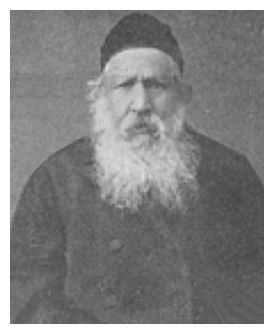
R' Noah Rubinsztajn the ritual slaughterer
He was one of the famous tzadikim of his time, a student of the Rabbi of Lubin. From his first wife he had an only son, R' Chanoch Hanoch who was a ritual slaughterer after him. His wife passed away while he was still young, and he married a second wife. He had four sons and a daughter. His
 |
|
Reb Noah Rubinsztajn, the ritual slaughterer |
two sons, Yuvia and Mendel, made aliyah [emigration] to Israel. Reb Noah was the gabbai [assistant to the rabbi] of the Gerer Hasidim house at the time that the hospital was still at the courtyard of Aharon Wolf on Częstochowa Street.
He was among the important ritual slaughterers in our city and passed away at a ripe old age and wih a good reputation. After him, his son Reb Chanoch Hanoch was accepted in his place. Reb Hanoch the ritual slaughterer had a good temperament, was kind to people, and upheld the Mishna: “and receive all men with a pleasant countenance” [Pirkei Avot 1:15]. The livelihood was good, but he had great sorrow of raising sons. He passed away at the prime of his life and there was great mourning at his death. His son, Hirsh Meir, was still young, unmarried, and yet he was accepted as ritual slaughterer.
R' Noah Rubinsztajn the ritual slaughterer
two sons, Yuvia and Mendel, made aliyah to Israel. R' Noah was the gabbai of the Gerer Hasidim house at the time that the hospital was still at the courtyard of Aharon Wolf on Czestochowa Street.
He was among the important ritual slaughterers in our city and passed away at a ripe old age and good reputation. After him, his son R' Chanoch Hanoch was accepted in his place. R' Hanoch the ritual slaughterer had a good temperament, was kind to people, and upheld the Mishna: “and receive all men with a pleasant countenance”[Pirkei Avot 1:15]. The livelihood was good, but he had great sorrow of raising sons. He passed away at the prime of his life and there was great mourning at his death. His son, Hirsh Meir, was still young, unmarried, and yet he was accepted as ritual slaughterer.
R' Hirsh Meir the ritual slaughterer
He was a nice young man who supported the entire family, the widow and orphans left behind by his father. The members of the community urged him to get married, and he married a woman from the city of Lodz.
R' Michael Poznanski the ritual slaughterer
He was a Vurke-Amshinov Hasid and an excellent ritual slaughterer. A righteous and respected man who wrote a book on ritual slaughtering which was received as an important book. He used to recite “sayings." He was loved by people, and his work was fearless. He was the driving force among the ritual slaughterers in Radomsk. He passed away with a good reputation at a ripe old age.
His son Yechezkel was accepted after him.
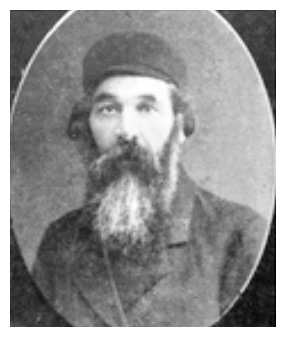
R' Yechezkel Poznanski the ritual slaughterer
His traits were like his father's z”l. He was involved with people and successful in his work. His two sons became ritual slaughterers during his life .his son Yitzchak was a ritual slaughterer
 |
|
R' Yechezkel Poznanski the ritual slaughterer |
R' Avraham-Yitzhak Botshan the ritual slaughterer
He was of considerable importance. Like all the ritual slaughterers, he and his wife were hospitable, and he had done charity and kindness with a generous hand. Before R' Avraham was accepted as ritual slaughterer there were many meetings in the city. They couldn't decide which of the ritual slaughterers to choose, until the Admor, author of Kenesset Yisrael, asked all those gathered at the meeting to give him the authority to appoint a ritual slaughterer. All the Hasidim couldn't refuse him, and they all agreed. Then, the Admor sent to call his father R' Yakov David zt”l, gave him travel expenses and told him the ritual slaughterer that you would bring will be the ritual slaughterer. R' Yakov David traveled to several places and then R' Avraham-Yitzhak was accepted. In this manner the honorable Admor, author of Kenesset Yisrael, ensured that there would be no dispute in the city.
R' Abele Tamar the ritual slaughterer
He was a native of Czestochowa, son of a scholar who studied at a yeshiva in the city of Czestochowa. His brother, a prominent Torah scholar, serves as a rabbi at the Tel Aviv Community Committee.
At the center of the large courtyard of Reb[5] Aba Schwarz's z”l house, separated from the rest of the houses, stood the Strykower Hasidim Synagogue. Below I will mention the important synagogue visitors.
The most important was the rabbi - Reb Yakov Dovid z”l. His Hassidim included all the worshippers of Bikur Cholim Synagogue, close to four hundred homeowners, honest and simple people, who liked their rabbi with great affection.
Reb Yisrael Tiberg z”l. Righteous and humble who aroused great interest in the stories of the tzadikim that he used to tell. He prayed with such emotion that he shed tears in his prayer. He did not waste a moment, studied the Torah and worked for a living.
Reb Mendel Lakhman z”l. Was of great importance in the synagogue. With holy enthusiasm, he performed great deeds of charity and kindness and was praised throughout the city.
Reb Mordechai Mendel Hershberg z”l. Was one of the prominent residents of Radomsk. I remember the excitement that gripped him when the cantor prayed Yom Kippur Katan[6] on the eve of Rosh Chodesh at the Great Beit Midrash in the traditional melody. If he was on the way and worried that he would be late for the Mincha prayer with the minyan, he used to hire a carriage to take him straight to the Beit Midrash so that, God forbid, he would be late.
Reb Leibky Donski. His work was sacred, and he was engaged day and night in Torah and Hasidut. Was a cantor at the Great Synagogue and prayed the Shacharit on the High Holidays. After that he came to the Hasidim's house to pray all the prayers there. He read the Torah, was a good shofar blower, and prayed Mussaf, Ne'ila and also Kol Nidre. The man was kind, gentle and precious, innocent in his actions, pious and humble.
Reb Yitzhak Shaya son-in-law of Reb Bril Shenkar z”l. It is impossible to forget this gentle-hearted man, who was beloved by all who knew him, and also his brother-in-law, Rabbi Meir Levnerich, who bravely and brilliantly endured everything he went through and, God forbid, did not resent it.
Reb Chaim Wargon z”l. A man of integrity, righteous and humble. He was among the singers who assisted Shlomo Hazan, may he rest in peace, and even knew how to write musical notes.
Reb Berishel Yurkowicz z”l. Of the elderly Hasidim, he used to distribute brandy to everyone on the day of study and always fulfilled his legal duty.
And more righteous and upright will be remembered: Reb Meir Naftali Yanowsk; Reb Yeshaya Greikhter son of R' David Greichter who, at his time, earned two tables and was gentle and righteous. Reb David Meir'l and Reb Gershon Kaminski righteous and humble; Reb Leibel Nordman a man honest and decent, son-in-law of R' Yisrael'k Tiberg, and his brother-in-law R' Leible Nordman a man honest and righteous, son-in-law of R' Yisrael'k who was devoted to the Torah; Reb Dudel Rapaport son-in-law of R' Henoch the ritual slaughterer, son of HaRav Moshe a scholar and an excellent, kind and nice man; R' Chaim Rapoport who engaged in charity and strengthened the hands of the poor in secret; Reb Hirschel son-in-law of Reb Zvi Wincentowski an excellent man loved by many; Reb Yisrael-Aharon Landau and Reb Yeshaya Zilbersatz and more.
It is impossible for me to list the names of all the worshipers of this synagogue, which excelled in its distinguished circle of worshipers, Hasidim, and outstanding men of action in the city.
Woe for those who are gone and cannot be replaced. The reaper ascended, cut down the tree by the roots and chopped the branches, them, their wives and children. We have no words to mourn the great loss to the Jewish people.
The teachers for beginners were an integral part of the city's way of life. Every boy, who had reached the age of three, was sent to R 'Yehoshua Pechter, R' Michael Melamed and to R' Yosef Ber. So that the boy would not look at anything impure, his parents wrapped him in a tallit and carried him to the cheder to learn the letters of the alphabet. In this manner they began to teach the Torah to Jewish boys.
Each of the teachers had their own teaching method, and each tried in a different way to solve the problem of how to get the information into the boy's head.
Often the cheder lacked basic amenities and the teacher's kitchen also served as a dining room and bedroom. The boys, the students, were usually involved in the rabbi's household management, because the boy lived most of the day in the cheder. The income from teaching was not sufficient to support the teacher and additional income was needed to support the family. Therefore, the wife of one teacher sold salted fish in the market, and the daughters of another worked as seamstresses until midnight. Even though all of these livelihoods did not provide enough for their needs, they nevertheless did not do their job dishonestly and worked hard to provide the boys with sufficient knowledge of the Torah. The teacher of young children took care of the boys and had no shortage of trouble. Even worse was the situation of those who taught older boys. They bullied the teachers, played cards under the table, performed various pranks and did not listen to the rabbi's words. The rabbi tried with all his might to get some Torah into their heads, many teachers deprived themselves of their health, groaned and spat blood, Heaven forbid! The teacher's livelihood was also difficult because he was not sure that those students in whom he had invested all his strength and energy would not, when the "time" came, move on to another country.
When the holidays arrived ,the intermediate days of Passover and Sukkot, the teachers went from house to house to beg before the homeowners to agree to hand over their sons to them and to ensure various promises regarding teaching methods. Every Sabbath, the teacher came to the student's home to examine him in the presence of his parents.
If the boy knew his studies and the weekly Torah portion, or the Gemara page, he received Shabbat fruits and a pinch on the cheeks, and if, God forbid, he did not know, it was the teacher's fault, even if the boy had an intellectual disability or was stupid.
R' Yehoshua Pachter
R' Yehoshua Pachter was a melamed for beginners. He lived in Yakov Erlich (Pyontek) courtyard. Many teachers lived in this courtyard, and he was the oldest among them. R' Yehoshua had a long white beard, by nature he was a pleasant man, was good to his little students and always treated them with great patience. His daughter Sarah helped him with his teaching, taking care of the girls and teaching them to read and write.
[Page 38]
R' Gershon Kaminski
R' Gershon taught a lesson in Gemara. He was a student of the Rabbi of Kamieńsk who was known as one of the famous rabbis, led a yeshiva and appeared as an arbitrator since he was a great scholar. R' Gershon was a great scholar, father-in-law of HaRav R' Yakov David zt”l, but he had a house full of his own children and was unable to fulfill their many demands. They, for example, wanted to eat bread to their fill, while Gershon often went to bed, after a hard and tiring day of work, without filling his stomach. The students were satisfied with him because after they filled their abdomen on Torah, he used to tell them beautiful and interesting stories and ,in doing so, won their hearts. He was a good man and a virtuous Hassid. His wife was called Feigale-Bublis because she was the granddaughter of R' Avraham Sofer. The author of Tiferet Shlomo [R' Shlomo HaCohen zt”l] ordered to call her “Bubale” until she grows up, and at the wedding ceremony to call her by the name Primit- and so it was.
R' Pinchas Wolf
R' Pinchas Wolf was a Kotzker Hasid, and old and esteemed man. He didn't have many students, and yet he had a good income because his wife ran a business, and whoever needed good fabric, found it at Malka'le. He had one daughter who married Mordechai Markowic and moved to Belgium.
R' Yosef Ber
R' Yosef, a teacher for beginners, lived at the home of R' Shabtai Pairman z”l. It was difficult for the little boys to get used to his frightening appearance, as he was dark-skinned and tall, but once they got used to him, they learned to love him because he was a good man by nature.
R' Mordechai-Yosef Jakubowicz
R' Mordechai was a Vurke and Alexander Hasid. Whoever did not study with R' Mordechai-Yosef will never know the taste of a cheder. He treated his students aggressively, and woe to the boy who did not listen to the lesson or was caught playing in the middle of studying. He used to give a fair beating. The parents were satisfied with him because he instilled in the boys a wealth of knowledge they would never forget, as is known, knowledge acquired in childhood is not forgotten. He was a great scholar and studied Gemara, interpretation and Tosafot with the students. One son, HaRav Yehezkel Jakubowicz, who was a rabbi in the town of Ryki, was fortunate to come to Israel. They had a big and extensive family and all of them perish in the hands of the bitter enemy.
R' Chaim-David Dudkewicz
R' Chaim-David's father was called “doctor” because he won the hearts of the students with his noble qualities. He was a righteous man with a good temper. He never bothered a boy, and everyone loved and respected him. He was God-fearing, studied Gemara, interpretation and Tosafot diligently with the older boys and instilled in the hearts of his students a beautiful dose of reverence for God. His daughters helped him and supported him by sewing undergarments. And if they sang, as was the workers' custom, he scolded them and said that because a woman's voice is being heard the livelihood would decrease. He had great power to instill faith, knowledge, and fear of God in a boy. His father was a tailor by profession, but he had a clear knowledge of medicine and engaged in it without expecting any reward or salary.
R' Reuven Wergon
R' Reuven was a Vurke and Alexander Hasid, had good qualities, was quick learner and an excellent cantor. He lived in the market at Ozer Goldkorn. He did not have sons only daughters. He too would not have been able to make a living if it weren't for his daughters who helped him. He was the son of R' Shmuel Wergon of Radomsk, son-in-law of R' Moshe Freiman and grandson of R' Fishly of Stryków.
R' Yitzchak Piner
R' Yitzchak, son-in-law of E' Mordechai Yosef Yakubovich taught the Chumash and Rashi. He knew a chapter in pedagogy, was a good husband and beneficial to people. He was Vurker Hasid, and his wife's name was Ester.
R' Fishel Ofman
R' Fishel taught Chumash, Rashi and a little Gemara. He was a good cantor and prayed at Beit HaMidrash of the Amshinover Rebbe. In his old age he became blind and prayed all the High Holidays prayers by heart.
R' Yankel Melamed
R' Yankel never served as a teacher for beginners because overtime he became a superintendent of the chadarim in Radomsk. But he also did not hold this position for long and turned to trade. He traveled to fairs in the small towns of Radomsk district with a meager stall of cloth goods. Even though this income was not enough to support him with dignity, he preferred this situation to teaching. He was a wise Jew and a scholar and, above all, a truthful and honest man.
R' Aharon-Tzvi Aronowicz
R' Aharon, of the Vurker Hasidim, managed a yeshiva in Radomsk at the Rabbi's Synagogue and studied Gemara, interpretation and Tosafot with the yeshiva students. He was a great scholar, proficient engineering and mathematics. He had three daughters and two sons. One of the daughters married the son of R' Tuvia Kalko, may he rest in peace. She passed away during a crisis and there was great mourning in the city for her.
R' Chaim Rapaport z”l told me that his father, R' Refael Rapaport z”l, had a tobacco shop and important people came to buy from him. Once, both R' Aharon-Tzvi z”l and the manager of the steel factory in the city, a Frenchman who was one of the greatest mathematicians, happened to be at his place together. R' Refael said to him: "You boast that you know mathematics, and I say that this Jew knows mathematics better than you, even though he didn't go to university." The above-mentioned person got angry and said: I will give him a math problem to solve, and if he knows it, I'll agree with you. I am giving him three days to do that. R' Aharon-Tzvi promised him to solve the problem in one day, and indeed so it was. The next day, when they met and the solution was in R' Aharon-Tzvi hand. The mathematician was startled and said that he had received a prize and honors for solving this calculation, and if he hadn't seen it with his own eyes, he wouldn't have believed that it was possible to do it without studying.
R' Yitzhak son of R' Gershon
R' Yitzchak the melamed was the son-in-law of R' Meir Ber, grandson of R' Yankale Widmer a student of the Rabbi of Lublin.
And we will also remember fondly: R' Avraham Melamed (“Boidim”) brother-in-law of Shmuelevitz, R' Yodel melamed [the teacher], R' Lipa melamed, R' Hirsh-Leib melamed (“Der Geler”), R' Henich-Fishel (“Lerer”), R' Yakov-Yosef melamed, R' Berish Chetzura melamed, and all the teachers for beginners. They were all intellectuals, did their work for the sake of heaven, and took great pains to instill faith, Torah, and morality in Jewish children, so that they would be pious and perfect.
Among city's institutions was a school for the sons of the poor. Hundreds of boys studied reading, writing there, and also Chumash and Rashi for free. There were times when “Talmud Torah”[7] in Radomsk stood at a high-level and students, who knew Gemara and Tosafot, graduated from it. But generally, the parents' tendency was to give their sons elementary knowledge of Torah and Judaism and then sent them to work. “Talmud Torah” was an important institution in the city, and for many years it was headed by the city's rabbi, R' Yisrael Pinchas HaCohen. Over time,
[Page 39]
he gave this work to others. Among the activists and principals of “Talmud Torah” were R' Moshe Mendel Rozenblat, Mr. Shlomo Gliksman, Mr. Yakov Rozenbaum, Eli Grondman, Aharon Wolf Schwarz, Berish Gensherowitz; Mrs. Dora Rozenbaum, Mrs. Manya Markowicz; and R' Yehuda Margolebsky. The latter was very devoted to the “Talmud Torah” an took great care of the students and also the teachers. The teachers of “Talmud Torah” were R' Henoch Borenstein, R' Yitzchak Mendel Yorkvitz, R' Yosef Shamai and his son Avraham, R' Shlomo Kos and Reb Yehoshua Frish.
“Talmud Torah” did not have a special location, and the studies were held in the synagogue's corridors. Occasionally, when one of the important homeowners passed away, the boys walked ahead of the funeral and called “Righteousness will go before him…”
Translator's footnotes
by Yitzhak Grosman
Translated by Sara Mages
Up to the First World War
Radomsk was an industrial city. When you arrived in the city by train, your eyes immediately met the furniture factories of “Thanet” and Yakov-Yosef Cohen, as well as the large French metal casting factory, in which worked hundreds of Christian laborers. The clerks at Cohen's factory were Jews. The metal casting factory also employed a number of Jewish clerks. The furniture factories provided employment to city's Jews, who worked in weaving straw chairs which constituted part of their livelihood. It can be said that the industry, and its workers, were the source of livelihood for the majority of the population.
During the Russian revolution of 1905/6, there were already organized laborers by the Polska Partia Socjalistyczna [“Polish Socialist Party”] in Radomsk. The Jewish laborers' parties that were active on Jewish street were, the Bund, Poalei Zion, and Zionist-Socialists. The leaders of the Bund were Yakov Rozenblat, Eli Barde, Zukan Szreiber; of Poalei Zion: Melech Grosman, Zisma Tiberg, Yakov Witenberg, Avraham Beser, Dovid Krauze, Mordecai-Zelig Rozenblat, and Leah'le Walinski; of the Zionist-Socialists: Hershel Krauze, Simcha Kalka, Hershel Epsztajn Shlomo Bugajski.
Organized trikes, in workplaces owned by Jews, were carried out by Jewish labor parties. But there were also cases, such as the strike of the stocking workers, that was only organized by Poalei Zion, because most of the workers belonged to Poalei Zion.
The strike of the Jewish cooks was one of a kind, it also encompassed the cooks in the rabbi's courtyard. The rabbi of that time, Rabbi Yehezkel z”l, gathered a meeting and demanded not to employ the cooks in Jewish homes, since they were under the influence of the young members of Ahdut haAvodah [“Unity of Labor”], they cannot be trusted in matters of kashrut. But the strike ended with the victory of the cooks, all the women returned to their work, even at the rabbi's courtyard.
In 1904/1905, the year of the Russo-Japanese War, Radomsk was a recruitment center for the western regions of Poland. The presence of the army in the city provided a livelihood for the Jewish population. On the other hand, the soldiers often tried to organize a “revelry,” to rob Jewish stops and attack passersby.
Then, the Jewish labors parties established self-defense. Wealthy Jews were required to contribute certain amounts of money for the purchase weapons, and those who refused to contribute were forced to double the quota. From time to time the policeman, Dlobiak, informed of the dates of the police searches, and that prevented the discovery of the weapons. Of course, this officer was paid for his service.
The self-defense in the city excelled in its good organization. When the Jews closed their shops and the gates of their homes, following the provocations of the recruits, the defense members immediately appeared and restored order, and the recruits no longer dared to harm the Jews.
There were also Jewish activists called machers[1] who handled the release of Jews from the army. They were led by: Chanania Lewkowicz, Yosef Beham and Leizer Rozeshanski.
The members of the labor parties met at teahouses. Large meetings were held on Saturday afternoon at Beit HaMidrash. When the police appeared – those gathered “engaged” in prayer and Gemara study.
Poalei Zion had a small synagogue, at Mendel Lipshitz house, and every Shabbat they gathered there for a prayer. The members of the Bund and Zionist-Socialists were also among the worshippers. After prayer they drank lechaim [to life] and debated about the Bund and Zionist-Socialists. There was also a library there. They also engaged there in the distribution of the shekels[2] for the Zionist congresses.
I remember a meeting in which a Bund member from Częstochowa spoke. With the interjections these words were directed at him:” tell us, why Zion does not please you, after all, today we prayed for Zion in the siddur - When You return to Zion in mercy. You have the right to be with the gentiles, but do not hinder others from ascending to Zion.”
Meetings were also held in Ginter's garden and behind the Christian cemetery, and female members also participated in them. However, when the anti-Jewish persecution increased, and several activists wandered to distant places, a workers' public library was founded by the members: Melech Grosman, Zisma Tiberg, Yakov Witenber and M. Z. Rozenblat.
In 1909, S. Winer opened a factory for wooden buttons and Jewish workers were employed there. Despite the rabbi's objection that Jews will be employed in work related to offense of Bal tashchit[3] since the buttons were made from trees cut down in the forest while they are still growing, the Jews continued their work. Over time additional workshops for buttons were added.
Since the Russian regime did not allow any political activity of parties or unions, as in other cities in Poland, HaZamir[4] circle was also founded in our city. The famous musician, H. Bansman and the conductor Gelbard, were invited to take over the artistic direction. The initiator of HaZamir was the lawyer Mr. Chaim Zukan. In the years 1910/12, when immigration to Galveston drew a large part of the youth, HaZamir ceased to exist. From each party only a few loyal members remained in the circle: from Poalei Zion: M. Z Rozenblat, Dovid Krauze, Reuven Okrent, and M. Numberg. From Zionist Socialists: Hershel Krauze (no one remained from the Bund). But also those who remained did not demonstrate any public activity, they wrapped themselves in a tallit and returned to the Old Beit Midrash. Among them were also zealous revolutionaries such as: Zukan, Szreiber and others. Several professional associations still existed in Częstochowa and the member Waldfogel from Poalei Zion occasionally visited Radomsk and lectured at illegal meetings.
In 1911, I traveled to Krakow, which belonged to Austria, for the goal
[Page 40]
of making aliyah to Eretz Yisrael. In Krakow The political regime was free, and I breathed a sigh of relief. I met there with the leaders of Poalei Zion: Shakhne Zagan, Yakov Kener and Dr. Warhaptik. I also met a group of Radomsk residents: Shlomo Rodelsazn, Reuven Neikran and others. Thanks to these friends I arrived in Vienna and from where I made aliyah to Israel and stayed there for three years.
In 1941, I returned to Radomsk where my grandmother, Hinda Grasman, lived. They received me as an honored guest. R' Shlomo Henech (he was later shot with his family by the Germans in Warsaw). invited me to his home to tell him about what was happening in the Holy Land in great detail. I was also invited by the members of Poalei Zion from Częstochowa, Będzin and Sosnowiec, and I lectured before them on the life in Israel.
At that time, there was a stagnation in social and political life on Jewish street in Radomsk. Only with the occupation of the city by the Austrians, during the First World War, the situation changes for the better and a renewed political and social awakening began among the Jewish public in the city.
During the first months of the war, the Jews of Radomsk suffered quite a bit from the changes in the occupying forces (Russia and Austria). At times the city was captured by the Russians, a few weeks later they abandoned it and it passed into the hands of the Austrians, and so on. There were days when Radomsk was devoid of any local government, and then a municipal police force was established in the city and for the first time Jews were included in it. But with the return of the Russians to Radomsk the police force was disbanded, and great suffering was the lot of the city's Jews.
On December 14, 1914, with the occupation of the city by the Austrians, the city was freed from the frequent changes of the occupying authorities. However, the economic situation of the Jews was so poor that most of them were forced to earn a living by selling tea and cakes to military personnel. Some smuggled food from the villages to the city, and from the Austrian-occupied territories to German-held territories, such as: Częstochowa, Będzin, Sosnowiec, etc. A shuffling of domains prevailed among the occupation authorities. The Radomsk railway, which was under Austrian control, was in German hands. In the Austrian army that was stationed in Radomsk, or in the units that passed through the city, there were many Jewish soldiers, including Zionist activists who helped the Jewish population.
The youth movement at the end of 1914
As I emphasized, I encountered upon my return from Eretz Yisrael the lack of any organized political activity. Even those who were interested in public work did not believe that it was possible to act under the Austrian occupation, but I could not find peace for myself. I saw it as my duty to fulfill the promise I had given to the members of Poalei Zion in Israel., and I began to work. I turned to the youth with the proposal to meet at my grandmother Hinda Grasman, who was known by the name “Hinde Yisrael-Yakle's.” Our house was surrounded by a small, narrow courtyard, and only my grandmother, her son-in-law Shlomo'le and her daughter Gerona lived there. The house resembled a fortress after the courtyard gate was locked.
Once on a Shabbat, after the prayer, I invited to me the young men: Yakov Aronowicz, Fishel Peldberg, Fishel Pariz and Matel Peldberg. I presented them with an action plan, and it was decided to meet once a week. Yakov Aronowicz suggested that the meetings would be held at his place, in his small room above the store at the home of “Crazy Salteshe” in the New Market. Each one was tasked with bringing another member. We had to prepare lectures on certain topics. I was assigned to tell memories from Israel. Later, new members joined us: Dovid Krauze, Avraham Lipshitz and others. We set our role: to conduct public work. Obviously, all our work was conducted in secret, for fear of the Austrian gendarmerie.
Over the days our circle expanded, and we rented Aharon-Wolf Sczwarc's attic on Minchelna Street, (below the soda factory). The Gerer Hasidim and the community department that distributed donations to the poor were located in this house. There was always noise and commotion in the courtyard because many people came to drink the healing spring water. All of this made our work easier because we didn't attract any special attention.
A group of young people turned to me with a request to train them in farming. We decided that the most suitable place to do this was the courtyard of the Great Synagogue, which could be converted into a stroll garden. The community activist, R' Leizer Tencer, set the conditions: a) the community would not allocate a budget for this purpose. b) young men and women would not be allowed to walk together. A letter of recommendation from R' Shlomo Henech expedited the agreement with the community, and the work began. The homeowners provided us with tools, some of whom also donated small sums of money. The number of people who volunteered to work was large, and we had to divide them into shifts. Of course, this activity surprised all the city's residents: Jews engage in agricultural work! Not only Jews and Poles came to watch our work, but also Austrians. Among the latter was a Jewish officer from Budapest named Schubert. When he heard that I was from Israel, he became very friendly with me. He helped us a lot by providing transport vehicles from the army - to remove the trash, to transport trees and logs from Daniel Rozenboim's forest, to bring planks for the fence from Moshe Reichtman's sawmill, for spreading sand in the garden, etc. The work was carried out in high spirits. After the work meetings were held in which the following appeared: the Zionist and musician Moshe Lewkowitz, the teacher Melaleuv, Zeinwel Goldman, Sztatler, Fainzilber, Nachman and David Gold, David and Hershel Krauze and me.
With the completion of the work in the garden a celebration was held at the synagogue. At the opening of the garden, the Jewish officer Schubert was presented with a gift - a Bible. The city's cantor sang cantorial music, Moshe Lewkowicz conducted the choir, David Krauze, and David Kruiz gave a speech, and I opened the meeting. Flower Day, for the benefit of Keren Kayemet LeYisrael, was held in the city on that day. The following members participated in this fundraiser: Esther Szternfeld, Sarah Feldman, Dobshe Gold, and Chava Engelhard.
The celebrations were a great success. People from all strata participated in it: orthodox Jews, rabbis and members from all political factions in the city. The garden was very beautiful. All the paths were covered with sand, there were benches to sit on, and the crowd was pleased with the youth who prepared and cultivated the garden. Sometime later, also a water well was dug on the site to irrigate the plants in the garden.
As a group of young people consisting of the members: Jacob Aranawicz, David and his eldest brother Hershel Krauze, Aba Weiner (and later also David Gold and others) - we rented a small apartment in the attic of the soda factory owned by Wolf Szwarc. There, we established a library with books donated by us, and the cultural activities were carried out by our own efforts. The number of our members grew to thirty, and we had to move to a larger hall at the Szpatlan house on Staschalkave Street. Our activities in this hall were made possible thanks to the license we received from the authorities for the establishment of a library and a reading room, which was granted to one of the veteran members of Poalei Zion movement, the member Z. Rozenblat (he participated at the World Conference of Poalei Zion, held in 1912 in Krakow). The name of our organization was the ”The Youth Organization.” We showed great activity, established a large library, and held lectures, meetings, etc. every week.
Thanks to the letter I received from the aforementioned officer Schubert (that he is employing me and thirty other Jews), I had the means to free Jews from Radomsk and the surrounding area who were kidnapped by the Austrian for forced labor. We were also admitted for an interview on this issue by representatives of the “The Committee for the Protection of Eastern Jews” - Dr. Bodenheimer and Prof. Majer Balaban who visited Radomsk. I prepared a report on the persecutions and discrimination against the Jews of Radomsk, and when I was in Vienna, I handed it over to the Zionist movement's officials: Dr. Adolf Stand, engineer Robert Stricker, and the movement's secretary Dr. Nathan Birnbaum.
[Page 41]
In Vienna – and back to Radomsk
The Jewish labor parties in Radomsk continued to exist thanks to veteran members: from Poalei-Zion - Reuven Okrent, Mordecai-Zelig Rozenblat, and the fans – Fischl Gliksman, Fischl Paris, the brothers Fischl and Matt Feldberg, Gittel Birnbaum, and more. From Zionist-Socialists group: Hershel Krause, Pinkhas Kalka and Luzer Bajgelman. From the Bund - Eliyahu Barda and Zakin Szrajber.
When I was in Vienna in later years, I met there with the residents of Radomsk: Shlomo Waksman, Dovid Buchman and his uncle Shlomo ben “Kaper.” They informed me about the extensive political and social activities in Radomsk after I left.
In those days the activities of Poalei-Zion movement in Vienna increased, and the movement's newspaper, Der Yiddisher Arbeter [“The Jewish Worker”] edited by Mendel Zinger appeared there, The members, Dr. Yitzhak Sziper, Dr. Yuris, Rodal and others were also active in Vienna at that time.
In Vienna I inquired about the situation of the members from Radomsk and the surrounding area, who came to Vienna on various matters, even on matters of doctors and hospitals. Everyone knew my address. The members Waksman helped me a lot, and so did: Michael Cohen, Evert, and other members of the movement.
Jews from Radom, Radomsk, Kielce and other cities were brought to a prisoner-of-war camp in Vienna. “The Committee for the Protection of Eastern Jews,” I managed to free many of them, after obtaining evidence of possible employment for them. Dr. Nathan Birnbaum's sister-in-law, who was the manager of a shoe factory, gave me a letter saying that the factory needed thirty workers. Among the released in this group was a resident of Radomsk named Aronowicz, the son of the teacher Aharon-Hirsh.
At that time, Majer Balaban visited Radomsk as an advisor on Jewish Affairs next to the main office of the Lublin Voivodeship. When he saw that there was a lively youth movement in Radomsk - he granted legal authorization to a youth association named “Kultura” [Culture] with the right to conduct cultural activities. He also granted permission for political activities for the parties Poalei Zion, and Zionist-Socialists. The party leaderships were tasked with developing a programmatic plan and submitting it for review to government institutions. The photographer, Ludwig Weinberg, was elected chairman of the “Kultura” association and his role will be representative. Everyone appreciated and respected him because it was thanks to him that we achieved many things. A special place in aiding the youth association was occupied by the honorable townsman Moshe Lewkowicz. He had done a lot for us at Mr. Temrel, the advisor next to his office of the Provincial Governor
When I returned from Vienna to Radomsk, they thanked me for the help I had provided in public and political work.
On the threshold of the 1920s
In those days the best speakers and activists visited Radomsk: from Poalei Zion - Yitzhak Lew, Shurek, Nir, Leizer Levin, Einrol Lewinski and others; from Zionist-Socialists - Kruk, Mendelson, Federman, S. Frank and others; from the Bund - Aronowic, Wladimir Medem and others.
With the rapid development of the branches of political movements in Radomsk, it became clear that the “Kultura” hall could no longer serve as a general hostel. In order to prevent friction and clashes, the members of Poalei Zion rented the wedding hall from Shlomo Hazan's widow and turned it into a laborers' house.
I continued with my connections with the members of the movement Vienna. The member Waksman provided us with the newspaper Der Yiddisher Arbeter and movement literature.
In one of the lectures of Yitzhak Lew of Warsaw, on the topic: “Eretz Yisrael - as a country of Jewish Settlement,” Temrel, the district political advisor, demanded that the speaker would only speak in German, but we overcame him, and the speech was given in Yiddish.
Usually, the Radomsk branch of Poalei Zion branch earned a good reputation at the movement's center in Warsaw, therefore the most respected leaders of the movement visited us.
In 1918 I traveled to Budapest. The days were turbulent (the Kun Béla revolution). In May 1919 I returned to Radomsk.
General Haller's army caused great suffering to the Jews of Poland in general, and to the Jews of Radomsk in particular. But these were the last manifestations of the Polish “reaction.” The Polska Partia Socjalistyczna and the Jewish laborers' movements grew stronger and prevailed in the first democratic elections for the municipality. The left-wing movements of Radomsk received the majority of the votes.
In 1920 I married my girlfriend Chaya-Rivka Paska, who was very active in the life of our movement in the cities of Będzin and Sosnowiec. I moved my residence to Sosnowiec, where we both engaged in helping members of the movement to steal the borders when they left Poland.
In 1923 we returned to Israel where we live to this day.
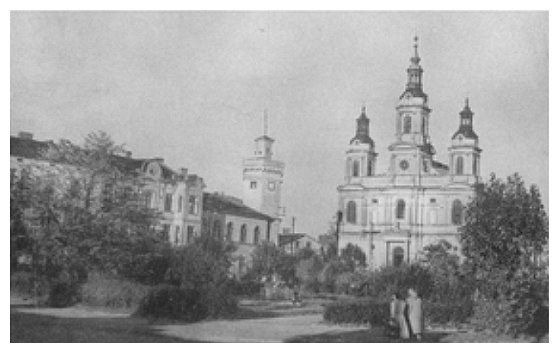 |
|
City Hall (on the left) and the Catholic Church (on the right) |
Translator's footnotes
Translated by Sara Mages
In the 20s of the previous century (1822-1826), a lengthy negotiation took
place between the government institutions and the community of Piotrków,
regarding debts imposed on the community from the period of the Polish Republic
before 1795. The authorities claimed that at the time the community received
loans from churches and monasteries in the vicinity and that the community did
not pay the debts. After lengthy inquiries – a total sum of about 2500 zloty
was set, the authorities demanded to pay it and the prosecutor's office
demanded, for its part, to hasten the end of the affair. It was proposed to
impose the payment of the above amount on all the communities and settlements,
which were affiliated to Piotrków during the period of the Polish
Republic, according to the distribution below:
| The Jewish Settlements | Number of families once belong to Piotrków | The equal ratio they must pay on account of the annual interest | Payment for 5 years from 1 January 1822 to the end of 1827 | ||
| Groszy | Zloty | Groszy | Zloty | ||
| 1. Belchatow | 98 | - | 38 | - | 100 |
| 2. Tuszyn | 97 | 18 | 37 | - | 188 |
| 3. Piotrków | 592 | 14 | 50 | - | 254 |
| 4. Rozprza | 131 | 24 | 27 | 15 | 139 |
| 5. Kamieńsk | 72 | 27 | 50 | - | 250 |
| 6. Wadow | 129 | - | 11 | 5 | 56 |
| 7. Radomsk | 29 | 7 | 442 | 30 | 56 |
| Total | 1148 | 90 | 129 | 10 | 1147 |
In order to finally settle the matter, a meeting to was held on August 7, 1826, at the office of the Commissar of the district of Piotrków. The participants in the discussion were: the community leaders of Piotrków - Feivel-Avraham Dessau, Yona-Avraham Platto and Shmuel Zerach; the community leaders of Rozprza – Asher Cwalinski and Moshe Kaminski; the community leaders of Kamieńsk – Lebak Joskowicz and Zalman; the community leaders of Tuszyn – Bezalel Hochberg and Lebak Fiszer; the community leaders of Radomsk – Meir Brandeis and Shlomo Fridman; the community leaders of Belchatow – Herzl Wajz and Feive Cwilich.
The community leaders of Rozprza announced that they have never paid a similar tax to the community of Piotrków, and therefore they are not obliged to pay the amount of 254 zlotys for 5 years without the consent of their community members. A similar statement was made by the community leaders of Kamieńsk on the grounds that they never benefited from these loans. The representatives of Tuszyn declared that they never belonged to Piotrków and even now they do not wish to belong to it (they were an independent community and paid for the poll tax in and in Wieluń and Wieruszów, as they had proved in the receipt they submitted at this meeting).
The community leaders of Radomsk announced that only part of Radomsk was affiliated to Piotrków. If Piotrków will be authorized to do so by the authorities – it will be entitled to collect part of the payment. The leaders of Belchatow announced that their community did not belong to Piotrków, and therefore asked to release them from these debts.
|
JewishGen, Inc. makes no representations regarding the accuracy of
the translation. The reader may wish to refer to the original material
for verification.
JewishGen is not responsible for inaccuracies or omissions in the original work and cannot rewrite or edit the text to correct inaccuracies and/or omissions.
Our mission is to produce a translation of the original work and we cannot verify the accuracy of statements or alter facts cited.
 Radomsko, Poland
 Yizkor Book Project
 JewishGen Home Page
Copyright © 1999-2026 by JewishGen, Inc.
Updated 19 Jan 2026 by LA