 |
|
|
[Column 445]
by Ch. A. Michaeli
Translated by Jerrold Landau
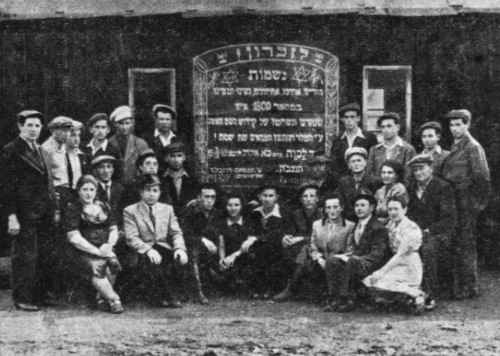
Lakhva is a small town in the Polesye Voivoideship [province]. It is seventy kilometers from Pinsk and fifteen kilometers from the Polish-Russian border.
It was a town that was all Jewish. It was a stronghold of well-known Misnagdic tradition, woven through with strict customs, the inheritance of generations, a thirst for enlightenment, and a drive for Zionist activity.
Before the war, approximately 1,800 Jews lived there. They earned their livelihoods from
[Column 446]
small-scale commerce and the trades. In general, it had not distinguished itself in the economic realm.
At the same time, it was widely known for its distinctive, inner way of life, with its organized, nationalistically conscious youth, who intertwined their day-to-day course of life with a yearning for spiritual fulfillment and Zionist activity.
In a brief time, the Hashomer Hatzair Zionist youth organization was set up in the town. Unlike in the majority of
[Column 447]
the Hasidic Polish towns, a “battle of fathers and sons” did not take place. It was the opposite: the children did not raise the flag of “rebellion against the fathers.”
The process of binding the youth to new, still-scattered but meaningful spiritual values eventually crystallized – without what could be called birth pangs.
Almost overnight, the prematurely aged and passive youth transformed itself and turned its face toward a new, content-rich moral and spiritual turning point. The fathers did not revolt over this. They too, deeply understood the necessary spiritual change of values that had already taken shape in the inner thought-world of their [i.e. the youths] young hearts; for subconsciously, they too were loyal and devoted Zionists, and many among them were old Chovevei Zion adherents who had been educated on the knee of HHaChavatzelet, HaMagid, HaZman, and Sokolov's HaTzefira.
The organized youth imprinted its stamp upon the general life of the town. Mothers made preparations for their children who had to go out to summer communes, conventions, party activities, etc. The fathers looked on, half-astonished at the sense of responsible discipline that prevailed among the youth. On long summer Sabbath afternoons, they [the fathers] – between a chapter of Chumash and a page of Mishnah – would cast a glance at the nearby Shomer clubhouse, where a battalion assembly, a group meeting, or an extraordinary chapter-gathering would be taking place.
The “silent rupture” between the young and the old did not last long. The General Zionist organization now emerged, organizing and activating the parents together with the youth. From this point on, all boundaries between children and parents became blurred. The town once again became, spiritually and ideologically, an unbreakable chain of shared hopes and dreams. On the Sabbath, fathers and children sat at one table learning a chapter of Bible, studying a chapter of Zionist history
[Column 448]
and discussing actual political problems from the week.
In Lakhva, as in all other Jewish settlements in the Polesye province, there was never an actual “language question”. Everyone read and thought in Hebrew or Yiddish. In all the youth organizations, the cultural-educational work was conducted exclusively in Hebrew.
A few years before the outbreak of the war, a large group of children from Hanoar Hatzioni formed a Chug Dovrei Ivrit [Club of Hebrew Speakers] named Bnei Yehuda. They strictly upheld the oath they made to not use any language other than Hebrew. Through this, the mothers and fathers were forced to learn the language and use it in their day-to-day lives. Many of them courageously kept the oath even during the Soviet period, and even during the entire time in the ghetto until the escape into the forests and marshes during the time of the liquidation, where some of them were killed in horrible fashion through the actions of the White Russian police with the help of the local gentile bandits.
The entire cadre of Jewish youth studied in the Yavneh local Hebrew folks' school, headed by veteran, seasoned pedagogues. There was also an active Tarbut branch – a library of nearly three thousand Yiddish and Hebrew books, including rare Judaica volumes as well as the full range of modern Hebrew literature from the Land of Israel. There were times when more than a third of the population were active subscribers to the Tarbut library.
After graduation from the local folks' school, a portion of the youth continued their studies at the Tarbut or Czeczyk gymnasiums [high schools] in Pinsk. Another portion went to hachshara and made aliya to the Land of Israel.
A large number of Lakhva youth (among them
[Column 449]
also many parents) made aliya to the Land of Israel until 1939 and became deeply rooted in the constructive economy of the Land.
Aside from standing on a high spiritual and Zionist level, Lakhva was a native jewel in the radiant splendor of our Jewish folk character. The interconnection between generations and traditions could be felt in its air: living traditions from the past, infused with an active Hebrew-Zionist spirit. There were hard-working Jews – blacksmiths, tailors, shoemakers, carpenters, and small shopkeepers – who would not miss the chance, now and then, to ‘study through’ the Heint and Moment from aleph to tof, even if it meant postponing Mincha. (The newspapers from Warsaw would arrive around Mincha time.)
There were many remarkable personalities from the older generation. Each of them took their honorable place in the richly coloured societal life.
What can a non-Jew understand of the richness of our distinctive folk character – of our chain of generations, and of the unique way each individual weaves himself into a vibrant community?
There was a Jew – they called him Avrahaml Shlomke's – who had gotten himself into arguments for being a kofer be'ikar [heretic]. He had never once missed davening, but, just to spite the Master of the Universe, he made a point of delaying the Shacharit service until 12:00 noon…
In the structure of the small-town way of life, everyone knew their place: the wagon drivers with their decorated horses, the fish traders who for the most part were divided into pairs in partnership the energetic butchers, the calm shopkeepers, the weary village peddlers, and the tens of unassuming tradespeople – each in their workshop and work.
When the Sabbath would come, the weekday spirit would disappear, and everyone would go around under the wings of the deep Sabbath
[Column 450]
sanctity and calm. People would study and read, or busy themselves with societal activities.
Thus it lived, and thus it contributed its modest share to the broader shaping of our people's character – the unknown one in the wider public, the small Jewish community of the Polesye district, Lakhva.
The town was taken by the Soviet army on September 17, 1939. The Jewish society deeply understood the new transition that overtook it and its way of life. Even stronger grew the sense of shared communal fate and the impulsive feeling of mutual responsibility in those days – the readiness to confront every challenge arising from external forces whose aim was to undermine or shake the age-old, massive foundations of our spiritual and moral unity. No boundary-breakers were found among its ranks, as there were in other small towns. Thanks to this, none of the communal activists were deported to deep Russia. A portion of the youth had gone off to the nearby Jewish settlements for various kinds of work, without leaving the region, while those who remained continued to spin the golden threads of shared aspirations and hopes. The Hebrew Yavne school was immediately closed, and in its place the Russian Semilietka [seven-year school] was established.
The Tarbut library remained thanks to the wonderful dedication of the Hanoar Hatzioni members Tzvi Moravchik (Shlomo Nachum's) and Chaim Shklar, may he live. Some of the books were moved to the cellars and attics of their residences. It continued to serve as a bubbling spring of Zionist spirit for devoted and self-sacrificing comrades, who carried out a systematic cultural-Zionist underground activity.
Some members succeeded in reaching
[Column 451]
the border with Vilna, from where they made aliya to the Land of Israel.
|
|
On July 8, 1941, at 9:00 a.m., the town was taken by the German army. The path of indescribable pain and afflictions, which led to the final annihilation of our community, began at that moment.
Already during the first month of the bloody German occupation, the surrounding Jewish localities were entirely or partially destroyed. Lakhva was one of the isolated islands in the surrounding seething sea of blood and hatred, struggling by every means and in every way to preserve its existence.
This was a result of the exemplary organization that pervaded in its ghetto life, which was led by the
[Column 452]
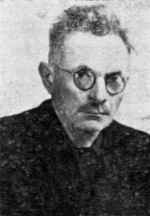
societal activist and president of the General Zionist organization Dov Lopatin of blessed memory.
On August 12, 1941, a month into the German occupation, three mass graves (dug by the Jews themselves) were already prepared for the Jewish population. Two days later, on the 14th at 4:00 a.m. all the men who were designated to be murdered were gathered together. Only thanks to the head of the community, Dov Lopatin (who succeeded in bribing the Gestapo chief), was the mass slaughter was temporarily postponed, and the life of the Jews of Lakhva was prolonged for another thirteen months.
The ghetto was set up, according to the well-known model, on April 1, 1942. The entire population was crammed into thirty houses, with terrible crowding. People lived
[Column 453]
in the attics and the animal sheds. However, despite all the inhuman conditions, they succeeded, the entire time, in protecting the ghetto residents from severe illness and epidemics.
During the first months, the ghetto was supplied with a certain stock of food products. Of course, the allocated hunger rations were not distributed based on the health situation of the ghetto residents.
In July 1942, the supplies were completely exhausted. This led to a permanent famine.
On dark nights, the “risk-takers” among the ghetto inhabitants would make their way across the river (the ghetto was located on the banks of the river) and set out for neighboring villages and farmsteads to obtain some amount of food products.
There were cases when they would be noticed by the guards at the posts, who would open merciless fire upon them. A group of six Jewish children were murdered in that manner.
Many “Biezientzes”[1] from the nearby and distant Jewish settlements, as well as from central Poland, could be found in the Lakhva ghetto. The local population regarded them like their own brothers and sisters, and shared with them as good as with anyone, with their last morsel of bread.
The hunger worsened as the ghetto's surveillance intensified, until it became impossible to slip out to the non-Jewish side. Tens of people, among them many children, became swollen from hunger.
The situation became more unbearable from day to day. The population felt that the dreadful day of the threatened mass slaughter was drawing near.
The youth began to think about an organized uprising. In the region, the first partisan
[Column 454]
Otriads were being organized, but despite all the efforts, they did not succeed in forging contact with them.
Therefore, the hoped-for uprising was, from the outset, based on our meager strength and primitive means.
The Hebrew-Zionist youth of Lakhva were far too Jewishly rooted and nationally conscious to decide to go like a completely resigned mass – like sheep to the slaughter.
A group of youth gathered daily in Mr. Rochtshin's house, and conducted organized preparations for the uprising. The later heroic martyr, the Beitar man Yitzchak Rochtshin of blessed memory, stood at the head of the local group.
All efforts to obtain weapons came to naught. It was decided to attack the murderers with axes, hammers, and iron rods. The circle of revenge-thirsty resisters drew in expanding circles of youths, and they all prepared for the uprising, which was to be conducted with full conspiratorial and strong military discipline.
It was decided to designate a group of resisters whose task would be to set the ghetto on fire, so that the last bit of property and the Jewish houses would not fall into the hands of the local, bloodthirsty gentiles.
A group of local gentiles were mobilized on September 1, 1942, to prepare a mass grave for the Lakhver martyrs. The grave was dug near the railway line, on a field where the Jewish youth would spend their free time playing football prior to the war.
A sacred anger seized the ghetto Jews, who already knew that their martyr-lives were on the brink of a cruel end.
The resisters made their final necessary preparations, and readied the comrades, to be prepared at any moment to attack the bloody enemy.
On September 2, the ghetto was
[Column 455]
surrounded with a reinforced cordon of local police and specially arrived S.S. groups.
At 8:00 a.m. on September 3, after perpetrating the mass slaughter in the neighboring Luninets and Kozhan Horodok ghettos, the ghetto was surrounded by salaried SD [Sicherheitsdienst] personnel and local police-executioners from the region, who sealed off with machine guns every possibility of exit.
A portion of the executioners appeared in the ghetto and ordered the entire population to arrange themselves in rows of four.
|
|
The situation was hopeless. The head of the community, Dov Lopatin, turned to the population and called out, “They are taking us to the slaughter. Everyone should save themselves however they can!”
He was the first to rush to the committee building – the house of Zalman Chefetz – which had been doused with kerosene and gasoline, and he ignited it. That was the signal for the beginning of the uprising.
The group of “igniters” set fire to a series of other ghetto houses.
Flames of fire engulfed the ghetto from
[Column 456]
edge to edge, throwing the ranks of the murderers into complete confusion.
The tongues of fire from the burning ghetto were the signal of the revenge-thirsting resisters, as the resigned masses undertook the final battle against the German murderers.
The command to arrange into rows of four was not carried out. This led to a savage agitation by the bloodthirsty beasts, as they raised their guns and sent the first bullets into the crowd. The first two victims, Yisrael Drebski and Avraham Slutski (Chasha Perl's son) fell.
Seeing the innocent blood that had been spilled, Yitzchak Rochtshin attacked the German SD executioner and killed him with an axe over the head. Yitzchak was shot with a hail of bullets. Seeking cover, he returned to the riverbank and jumped into the water. He was met by a murderous bullet and plunged into the depths.
At the same time, several other SD murderers fell at the hands of Chaim Chefetz (Yosel Shlomke's son), Asher the son of Zalman Chefetz, and Chaim Rimer.
[Column 457]
The crowd was swept along by the flaming anger of the resisters. They attacked the police and the SD murderers, overturned the ghetto fences, tore apart the tightly wound barbed wire in several places, and opened a path for escape.
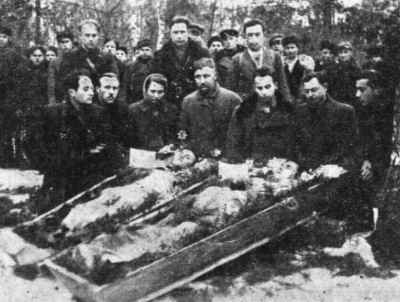
Dov Lopatin grappled with an SD murderer to wrench a submachine gun from his hands, and was wounded in the arms and chest during the struggle. The masses began to run. A hail of fire from all sorts of weapons flew over the head of the unfortunate people. The market and nearby streets were filled with tens and hundreds of bodies[2] of martyrs – the elderly, children, men and women.
The murderers managed to prod only a small group of elderly people and weak children to the prepared mass grave, where they stripped them naked and shot them.
The rabbis of Lakhva, Rabbi Eliezer-Aryeh Lichtstein, Rabbi Avraham-Chaim-Zalman Asherowitz, Rabbi David Mintzberg – one of the greats of the generation and one of the heads of the Yeshiva Chachmei Lublin (who ended up in the Lakhva ghetto as he was fleeing from the German murderers) – and all other captured and tormented elderly people,
[Column 458]
wrapped themselves in their tallises and tefillin, and fell in sanctification of the Divine Name with heaven-rending cries of Shema Yisrael.
About seven hundred Jews of Lakhva managed to break through the cordon of fire and fan out into the surrounding Pripyat marshes. Many of them were caught by the local White Russian murderers and killed.
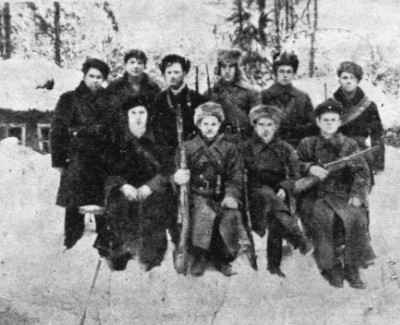
A significant number managed to find their way to the partisan groups, where they fought heroically, taking vengeance for our innocently spilled blood. Many of them inscribed unforgettable pages in Jewish valor – heroes such as Dov Lopatin, Moshe-Leib Chefetz, the gifted poet Yitzchak Slutski (Chasha-Perl's son), Yitzchak Fishman, and others, who will serve for us as an inexhaustible source of inspiring example.
Many fell in battle on the fronts with the regular Red Army.
Small in number is the surviving remnant of glorious Lakhva, which inscribed one of the most stirring pages of resistance and collective heroism in the history of our martyrology.
Translator's footnotes
by Yitzchak Lichtenberg
Translated by Jerrold Landau
In April 1942, the ghetto was created in Lakhva based on an order from the Pinsk district commissar. The ghetto was located in the eastern part of the town. It consisted of forty-five houses for 2,350 Jews.
Within twenty-four hours of its establishment, the ghetto was fenced in with barbed wire, two meters high. The Jews had no right to go around in the city. The groups of workers had to go to work in guarded rows. Dramatic scenes took place with the founding of the ghetto: The White Russian police, under the leadership of commandant Gretshka, with the help of the White Russian population, beat the Jews severely, and robbed them of the goods and living necessities along the way. Life was constricted in the ghetto, and was severely suffocated both from a moral and material standpoint until the last day of the slaughter, September 3, 1942.
The thought of self-defence took shape immediately after the horrific mass slaughters in the surrounding cities that was perpetrated by the Wiking S.S. division. It was impossible at that time to create a fighting group, because partisans were not yet seen in the forests, and the Jewish people did not yet believe that the complete annihilation of the Jewish people [was intended]. The first contact with a local partisan took place in January 1942 – a white Russian peasant from the village of Liuban.
[Column 460]
Roman Shevchok, 37 years old, was an underground activist of the partisan group under the leadership of “Vostochnik” Volodia Poliakov. A group of five partisans was created: Yitzchak Rechtshin, Yitzchak Slutski, Yitzchak Lichtenberg, Hershel Migdalovitsh, and Moshe-Leib Cheifetz. They decided to divide up the underground work, clandestinely, into a fifth-system [a cell of five people], so that each member would not know the others. A group of thirty members was created, consisting of the best of the town's youth. They arranged a special night guard who had to issue an alarm in the case the ghetto was surrounded and suddenly attacked.
The issue of weapons was difficult and very complicated. It was difficult to obtain weapons even for large sums of money, for the following reasons: The White Russian population, who were inimical to us, would not give us any weapons, and there was a fear to discuss that topic with them. It was completely impossible to steal weapons from the Germans. In fact, we were empty handed. We conducted heavy persuasion with the Jewish population, that we must put up a resistance with what we could in the event of an attack on the ghetto.
At 1:00 a.m. on September 3, 1942, the local militia surrounded the ghetto. I was immediately alerted to this, and I then informed the entire population. It was clear that this was the very last moment of our lives. We knew well enough the objective of
[Column 461]
the White Russian militia, and it was decided to break through their cordon and exit the ghetto. However, the Jewish population was hindered. Everything depended on a miracle, as had taken place with General Schmidt on August 17, 1942. The plan was abandoned.
|
|
At 9:00 a.m., 150 Germans (gendarmes and S.D.) and 200 White Russian police already surrounded the ghetto. The stark reality of the [impending] murder and mass slaughter became clear to us. Nevertheless, we did not give up. We prepared flammable material to set all the houses on fire. Some people were armed with axes and clubs. At 10:10, when the first shots were fired, and the first victim, Yisrael Drebski fell, all the houses began to burn. In the chaos of the fire, we attacked the gendarmes, and immediately killed six gendarmerie troops and eight of the policemen. The German enemy left, and, thanks to the commotion, over six hundred people escaped from the ghetto, taking a German gun with them. I myself was wounded while breaking through the cordon of the gendarmerie. As I saw, Asher Cheifetz split the head of a gendarme with an axe.
[Column 462]
His brother Moshe-Leib captured the gun of that same German and used it to shoot the police. As I was wounded, I went out with a group of scouts, tore down the fence, and made a route for the escaping Jews. The entire time, they were shooting at us with a hail of bullets from various weapons: rifles, automatics, machine guns, and grenades. The screaming and the shouting of Shema Yisrael were frightful. However, these were also intermixed with voices of Hatikvah. That is how 1,600 people fell victim. Some poisoned themselves. The ghetto was completely burnt down, but the buildings of the Wehrmacht, the post, the militia, the pharmacy, and warehouses -- especially the warehouse storing the stolen Jewish property and furniture – were also burnt down. In total, 144 buildings were burnt down.
About six hundred people – men, women, and children – gathered together at the Pripyat River. Knowing that the gendarmes would soon be searching and pursuing them, small groups of not more than twenty individuals were formed. They set out deeper in the forest at night, so that they would be able to hide for several days until they could connect with the partisans. A group of twenty-five men was organized; I was among them.
[Column 463]
We wandered in the marshes and forests for three days. On September 7, 1942, we met the first partisan group not far from the Gritshin marshes. They received us in a friendly manner, and gave us the necessities for living, available places where we could sit in calm. About 160 Jews had gathered there. The leaders of the partisan group, Petrovich, Ivanov, and Schvets, explained the situation of the partisan movement to us, and where we could obtain weapons. They showed us where the larger partisan units were located, who might be able to take in a larger number of Jews. I, along with twenty-five people, remained with that partisan group.
We organized ourselves and began to procure weapons. The Soviet partisans were unable to give us any weapons, because they themselves had few.
|
|
With all our means, connections, and money, we managed to purchase thirteen weapons, and we began to raid the guard stations of Lenin Senkevich, and other places. Under my leadership, we destroyed forty-eight wagons with ammunition. My group
[Column 464]
was combat-capable and excelled in all the battles.
On September 12, 1942, an order was issued that special Jewish groups must not exist. Like other national groups in all the villages, we had to join the ranks of the general Soviet partisans. Our group consisted of fifty-six individuals at that time.
In January 1943, I was joined to the general Soviet group that built itself up to a large partisan battalion called Kirov, consisting of two-hundred people. The Jews were distributed into various fighting units [druzhene]. I became the commander of the first platoon [otdelenie], and at the same time served as deputy to the company commander. With me, there were three Jewish men and two Jewish women, [the latter] occupied with the cooking, washing, laundry, etc.
After the unification, we immediately sensed that the partisan leadership now felt free to belittle us, make jokes at our expense, and chip away at our heroic standing. We knew that
[Column 465]
five Jews of Lakhva – Binyamin Zalmanovich, the two Wolochanski brothers, and the two Shulman brothers – were shot without a motive or cause by a partisan group that was under the leadership of the Chief of Staff Kubasov. Even before the unfortunate murder, they had shot a partisan from Lakhva, Hershel Moravnik, who had been expelled from our partisan battalion for a breach of discipline. He was shot by an order of Commander Ivanov (Lisavich) and the commander Rupeyev of the Red [detachment]. In June and July 1943, they shot the partisan from Lakhva Nachum Moravchik through an order from the aforementioned Commander Ivanov. The murder was conducted by Volodia Poliakov. The official pretext was disciplinary negligence and affiliation with the ghetto police. The actual reason was that he had given over to them several pieces of gold as he joined the partisans, and they shot him because they were afraid that they [the partisan leaders] would find out about this. The leaders of the Kirov brigade, the acting commissar Ivanov (Lisovich), the chief of the “Special Department” Schvets, the head of the brigade chief of staff Kubasov, the commissar of the partisan group Za Rodino [For the Motherland] Svirchov, and the chief of staff of the “Stalin” partisan division Rupeyev all revealed themselves as unabashed anti-Semites, against the Jewish partisans, and against Jews in general. Now, they had taken on positions of responsibility. Ivanov (Lisovich) was the secretary of the District Committee [Raikom] in Luninets. Schvets became the secretary of the Raikom in Zhobtice [Zhabchytsy] near Pinsk, and Kubasov became the secretary of the Oblast Executive Committee of Pinsk. Svirchov became the chairman of the City Soviet in Pinsk. Rupeyev became an Raikom instructor in Luninets.
The Jews were strongly suppressed, but this did not weaken their fighting spirit and thirst for revenge. The best partisans in the brigade
[Column 466]
were Jews, such as Shlomo of Sarny (Psevdonim), who was the best reconnaissance scout of the brigade, and was later killed in the district of the Red Army; Berl Furer from Wlodawa, Mishe the Reconnaissance Scout, Nechemia Kurland, Jalvitzki from Slonim (the best machine gunner); and, from Lakhva, Moshe Leib Cheifetz, Asher the son of Shmuel Cheifetz, Avraham Feinberg, and others. The Jewish partisan Yeshayahu Milman from Lakhva, currently in the Red Army, had 185 railway demolitions and two trains to his credit. The Jewish partisans displayed steadfastness in various sabotage operations, reconnaissance missions, and attacks on the enemy.
On April 28, 1943, the only group that conducted the pre-May Day action was the Jewish group of my division. They numbered six people, among them two Russians. We laid an ambush on a group of Germans. One German non-commissioned officer and two Russian Cossacks were killed. In collaboration with an entire partisan division, we conducted an entire series of attacks dedicated to the First of May. Not taking this into account, they thought that I was involved in sabotage among the partisans, and said that one must not eat any slaughtered meat. They wanted to shoot me. An anti-Semitic German woman from Lakhva, who was Ivanov's mistress, was involved in this affair. According to her, Dr. Mina Pidiszowa and the former chief of staff Captain Kapustin were murdered without cause. Thanks to Commander Petrovich, who was a very good man and exposed what they had done, I was not shot.
I recall a tragic incident: There was a detachment of Germans. We had to retreat, and there was an order from Ivanov that no unarmed Jewish partisans could be taken along, but unarmed Russian partisans would be taken along. In the vicinity of Wolia, according to the order of
[Column 467]
Major General Komarov, currently secretary of the Oblast Committee [Obkom] in Pinsk, seven Jews of the brigade, who were near the detachment, [moving along] with the settlement, were shot. I attest that in all the brigades of Komarov's federation, the aforementioned command existed, and an anti-Semitic agitation took place. The commissar of the federation, Major General Kleshtshov showed himself to be a terrible anti-Semite.
I could no longer remain in the brigade. I was afraid of a bullet from within [the brigade], and I was morally crushed.
I left them on January 17, 1944, and met
[Column 468]
a Red Army sabotage group. I remained with them until May 12, 1945, and took part in the battles of the Red Army, helping in the victory over the enemy. I had a desire to fight, and even more so, to beat the enemy. There, I excelled in various battles, and I was decorated with various awards: one order of “Red Flag”, one order of “War of the Fatherland First Class”, medals: “For the Liberation of Warsaw”, “For Victory in Berlin”, “For Victory Over Germany.” For the partisan battles, I was granted the order of “The Red Flag” and the medal: “Partisan – First Class.”
Original footnote
by Michael Shifman[i]
Translated by Jerrold Landau
|
There were sixty-four Jews in the two villages of Sinkevich and Mokrova, which are separated by the Lan River, ten kilometers from Lakhva. The Jewish houses were scattered through the villages, but we did lead a Jewish life. There was a synagogue with two Torah scrolls and a set of Talmuds, where a class was given in the evening. On Sabbaths and festivals
[Column 468]
all the Jews without exception, both men and women, would come to the synagogue to worship. We obtained spiritual sustenance from Lakhva. Whenever we needed a halachic ruling or anything connected with Yiddishkeit, we would go to Lakhva – sometimes by wagon, sometimes on foot – to the old tzaddik, Rabbi Itzele, of blessed memory, and later to the younger rabbis: Rabbi Leizerke and Rabbi Chaim-Zalman of blessed memory; or to the Lakhver shochet [ritual slaughterer] Reb Matisyahu. Later, we had our own shochet, with the permission of the rabbi of Lakhva. The shochet was a scholarly young man. He had rabbinical ordination. He was a dear young man.
I came to the village in 1910. I had married Feigel, the daughter of Reb Betzalel Slutski. Reb Betzalel was the son-in-law of Reb Asher, who was known as a great scholar and a dear Jew. Reb Avraham Tzvi Busel and Reb David Vinik, a scholarly man, were also among the important Jews. We would study Gemara and Mishna with the shochet and Yerachmiel the tailor.
Earlier in Sinkevich, there was Reb Yitzchak Portnoy,
[Column 469]
Reb Lipa, and Reb Noach Kerzner, dear pious and good Jews. In Mokrova there was Dov Slutski, an important and well-known householder. The table was always set at his house, and his hand was open to help the poor. His mother Chana, my mother-in-law, was known for her hospitality. She always helped poor people with a discreet gift. Almost all the Jews in both villages lived like brothers, forging marital bonds with each other, so that they were all related by marriage: sisters, brothers, and cousins.
Livelihood was not in abundance. There were no wealthy people. Most people were laborers, tailors, shoemakers, carpenters, and perhaps shopkeepers. People earned a living without fear. People could go about freely at night, and got along not badly with the village gentiles.
Only during the time of the First World War, from 1914-1917, was there a horrific murder of a man and wife, Reb Mordechai Abramowitz and his wife Peshia, on their way from Mokrova to Lakhva. They murdered both of those dear, honorable people. Nine young children were left behind.
After the First World War, the border with Russia became close to us. There were many Polish soldiers stationed in Sinkevich. Jews earned their livelihood from them and from the activity around the train station until 1939, when the Russians arrived. The Russians took over all the businesses, and we were very broken.
With the retreat of the Red Army in 1941, the Russian soldiers destroyed the bridge over the Lan River, and remained stationed on the other side of the river, from where they shot. We lay in the potato pits in the fields for the entire night until the Germans entered. A Jew came running, and called out with joy, “Come to work!” We went to the bridge and worked with our last strength. Early the next morning, we went to work again. Two German soldiers fell at that time. The Germans dug a grave near my house and buried both Germans.
A German set out to make a fence. I told him
[Column 470]
I was a carpenter, and he let me build the fence. Then I was already happy.
The Germans brought workers from Lakhva. I remember one of them, Leizer Chefetz, the carpenter. They worked at the bridge. My brother-in-law Dov Slutski and is son Aryeh, who survived from the ghetto, were among them. The Jews had to carry very heavy beams, and the Germans murderously beat them.
The Germans took over my house and drove me out. The oldest German knew me and told me, “You must go with your family into the forest, because soon there will be a large battle with the Russians here.” I took my family and went out to a peasant in a farmstead. While I was there, the German from my house came and told me that the peasants from the village had removed all of my belongings from the house. He asked me to tell the peasants that they must give him rope and stakes. I wanted to be on good terms with the peasants as well as with the German. I told them, they gave over a bit of rope with a few stakes, and the German left.
A few hours later, a young gentile came, along with eight Germans, to the house where I was staying and told them, “Here is a spy,” and that I was going over to the Russians on the other side of the Lan and giving them information. Two Germans immediately took me to the Lan, near the front where there was a detachment with two officers and a translator.
The gentile wanted that them to also take my wife and children, but the peasants asked the Germans to leave my wife and children.
The gentile pursued us. As we were going, I asked him, “What will come of it if they kill me?” He did not answer. When I went in to the officers, I asked for permission to speak. They allowed me. I told them that I have a son in Germany who works in a factory, and that during
[Column 471]
the years 1914-1918, I was with the Germans, and that I was happy that they had came. The translator went out and told the gentile, “It is good that you bring such people.” They took me to a house in the forest where there were Germans and a peasant, who was out looking for his animal. As I was sitting in the room, a young German came to me and gave me bread and coffee. The other German told him, “He is a Jew, after all.” The other one responded, “Is a Jew not a human being?” He told me that I should write a letter to my family. I wrote a letter. He went out, and returned, bringing a pot of cooked food from my wife.
A few hours later, they brought Yaakov Abramowitz (currently living in Israel), along with his wife, his father-in-law, and mother-in-law. All of us sat together the entire night pleading to G-d. The next day, they took us to Mokrova. On a bridge, the Germans and their officers who were passing by questioned us and asked who we were. The guard responded that we were spies and we should be shot, “Yes, this is the best means.”
From there, they took us to house of the Baptists, near the church. We noticed that they were digging pits near a barn, and they were making preparations to shoot us. Then they called over a peasant and asked whether we had gotten involved in politics during the time of the Russians. The peasant spoke well of us, and the village headman also said good things on our behalf. Then they Germans let us go free. To our joy, there were no restrictions.
Now an organized work routine began – carrying beams. There were weak men such as Zeev Abramowitz of blessed memory. He was unable to carry, and one was not allowed to help. The Germans beat the weak ones who did not have the energy for the work.
We especially suffered from the Lakhva police. They would come to us in the houses and
[Column 472]
beat us terribly. Among us, the main person responsible [for organizing the Jewish labor] was my brother-in-law, Dov Slutski.
The commandant from Sinkevich arrived in Lakhva. Zeev Abramowitz, the shochet, and I went to him due to his command. The robber was tall and frightening; he demanded that we Jews from both villages supply leather for fifty pairs of boots, one hundred couches, and two hundred down pillows. We said that we would see what we could do. However, it was a very large amount for us. Dov Slutski went to the commandant and said that we remove the boots from our feet and give over everything that we had, but we do not have the quantities that he demanded. The commandant beat Slutski to the point where he was black from his wounds. When he returned, he wept like a small child. The robber came to my house and found eggs and a pail of leeks. He threw the eggs into my wife's face, beat me over the head, and ordered me to clean his boots with my cap. He then asked the police whether I had cleaned well. He grabbed my tallis and tore it, and then ordered the police to make up bundles of whatever things they wanted. He then went from my place to my brother-in-law Dov Slutski. He completely ransacked the place. He beat him until he lost consciousness, and ordered that twenty-five more blows be given. Seeing that Dov could not hold out, the police postponed the blows until the net day. The village priest found out about this. He had known Slutski for man years. He went to the commandant and asked him to refrain from beating him further.
At night a few days later, I encountered a policeman and he said, “Michel, you must be in the Kommandantur [German command office] in five minutes.” There was weeping at home. What can one do, one had to go. I met Zeev Abrahmowitz and Aharon Moravnik, an invalid. A policeman said to us, “Do not be afraid. We are taking you for some formalities.” In the Kommandantur, a German
[Column 473]
in the police demanded that the Jews must give over all the pelts and fur linings. Anyone found with pelts or fur-goods would be shot – even for the tiniest scraps. Dov Slutski collected all the pelts and gave them to the police, and then they freed us.
Before Passover, we heard that the Jews of Lakhva were in a ghetto. We were still in our homes. They commanded that we must gather together. They permitted us to take wagons and take along whatever was possible. However, when one crossed the threshold of one's door, he was already no longer permitted to re-enter the house. One could open the windows and toss the belongings onto the street. We loaded the belongings on the wagons, and all the Jews went to the Kommandantur. All the peasants and musicians of the village were there. They played, and all the old men were forced to dance with young girls. Then, we had to pay the musicians. They ordered us to go to Lakhva. Along the way, they shot into the air over our heads.
In Lakhva, they had already prepared places for us in the houses. They allotted ¾ [of a square] meter per person. Our family met Chana Basha Moravchik, Shlomo Nachum's wife, who took us into the house. Reb Zalman Chefetz of blessed memory gave us warmth and sustenance.
We felt very good in the ghetto, because we were together with other Jews, and the Judenrat concerned themselves with everything for us.
Mordechai Zaretski, Yaakov Abramowitz, and I went to Sinkevich every day to work as carpenters for the Germans in the school building. At night, we had to go to the ghetto.
After the wiping out of the Jews of Mikoshevich, we noticed changes in the guarding of the ghetto.
As we returned from work to the ghetto in the evening, the gentiles in the village of Lyubon told us, “Where you are going, they have already prepared pits, and tomorrow they will kill you!!!” Even then, we did not believe this.
We spent that terrifying night together with all the residents of the ghetto. In the morning, Reb Yaakov Rabinowitz died from fear, and Rabbi Chaim-Zalman eulogized him saying, “Rabbi Yaakov, we are jealous of you.”
The murderers entered the ghetto around noon. I was standing near Shlomo Nachum on the bridge, and saw how Lopatin came back from the Kommandantur. He went to his son, kissed him, and said, “Jews, take axes, burn the houses, and save yourselves, anyone who had the possibility of doing so.”
The young lads, Zalman Chefetz's and Kolponiczke's sons and others, immediately felled several Germans, took their weapons, and shot them. I was standing with my wife and children near the rabbis: Rabbi Leizerke, Rabbi Chaim-Zalman, and Rabbi Dovid from the Yeshiva Chachmei Lublin, along with all the old people of the ghetto. They shouted out Shema Yisrael in its entirety until uvechol nafshecha [and with your entire soul]. Then the lads opened the gates of the ghetto, and everyone began to push and run. I gathered up my family and ran together with the stream of people fleeing the ghetto. I arrived in the forests of the partisans, where I spent the entire time until the arrival of the Red Army.
by Fishel Grodbein, Maków Mazowiecki
Translated by Jerrold Landau
It was 1940. I had wandered for a long time, going through many cities and towns, not finding any place to lay down my head. I arrived in the small town of Lakhva, twenty-one kilometers from the district capital of Luniniec, Polesye, eight days before Passover.
When I arrived in Lakhva, the local Jews received me and immediately concerned themselves with a place to live. I was able to rest from the long, bloody journey. A few days later, I went out to the marketplace in Lakhva. That was a square with a garden with benches in the middle. On the sides there were streets, and a few brick houses, with the rest being wooden houses with wooden sidewalks.
I gradually got to know the local Jews, who worked for a living: tradespeople and officials who lived calmly. In general, I was happy to be among a warm, Jewish settlement: fine, wonderful, young people, who had studied in Hebrew schools in the recent past before the Russians had taken over the city. In general, the entire Jewish population had a Zionist outlook, with a unique, brotherly spirit of heartiness and generosity. They gave us a warm, hospitable welcome.
Several hundred refugees made their way into Lakhva. They were Jewish families with children from the regions of western Poland that had been occupied by the Germans. They grouped themselves according to their
[Column 476]
hometowns, mostly from: Wlodawa, Ostrów Mazowiecka, Maków Mazowiecki, Ostroleka, etc. All were provided with dwellings. Most of them were set up in various jobs. A small number, who could not work, were supported by the local community welfare officers, headed by Rabbi Eliezerke Lichtsztejn, and Rabbi Chaim Zalman Oszerowicz, and by the local Jews.
We, the refugees, quickly integrated into the Jewish population of Lakhva. Many of us married Lakhva boys and girls, and all lived together as one family, as if we had been local residents for generations.
Our children learned the local languages and studied together in the Russian school. They also learned the Yiddish and Hebrew languages in the “underground”, and Chumash, Tanach, and Gemara in the cheders, shtibels, and Beis Midrashes.
The well-known Rabbi Zindel Brisk from Ostrów Mazowiecka, a pious Jew with a splendid countenance, conducted his cheder with dedication and devotion, studying Torah with Jewish children until the last day of the existence of Lakhva Jewry.
The Germans entered Lakhva after the beginning of the Russian-German war in June 1941. The Jewish population immediately felt that their fate was determined for destruction. However, Lakhva Jewry also knew how to remain on
[Column 477]
the appropriate level even on that tragic day, and all, like a single person, met the expectations of their city leaders, who were chosen for the Judenrat. The population regarded the outstanding communal functionaries as their emissaries. They [the functionaries] carried out their charge and roles with the greatest goodwill and highest level of self-sacrifice.
The committee, headed by Berl Lopatin, was also held in esteem by the families of the refugees from Poland, who often went beyond the local Lakhva population in giving over their belongings to avert a threatening decree.
On the fateful Monday that will not be forgotten by the Jews of Lakhva who survived, one of the refugees gave over a valuable pocket watch with other rings and diamonds to the chairman Berl Lopatin, who, thanks to that, was able to ransom the local population from the murderer, SS-Obersturmführer Maier Schmidt.
The brothers Michael and Yehuda Uzdaba from Ostrów Mazowiecka, as well as other former people of means from their hometowns, gave their great support and assistance so that the local poor Jewish population could maintain themselves and shoulder the burdens of daily contributions and other decrees.
The young refugee lads were the first to go to all the difficult jobs. They were often able to find a bit of “understanding” from the overseers, and were able to smuggle food and other products into the ghetto.
Life became increasingly difficult with the establishment of the ghetto. This was especially so for the families of the refugees who did not have any items to barter with the local Christians.
People would sneak out of the ghetto, and go to the villages to obtain
[Column 478]
bread and other products from the peasants. Prior to Shavuot 1942, the following people were shot dead while searching for food: Zindel Sztejfman, the daughter of Zindel Brisk from Ostrów Mazowiecka, several other children of refugees, and the girl Chaya Szulman from Lakhva.
It is noteworthy to emphasize the solidarity of the local Jewish population. Both during the time of Soviet rule as well as in the time of the German occupation, there were no cases of anyone in the Jewish population going outside the camp with slander or betrayal.
During the tragic moment when it became clear that they were going to exterminate the local Jews, I, along with others of my refugee friends, contacted Berl Lopatin, Yitzchak Ruchchin, Izha Lichtenberg, Moshe-Leib, Asher Cheifetz, and Moshe Kolpanicki, and we decided to mount a revolt. We began to organize the refugees who were for the most part young and capable of combat.
In the battle of the heroic martyrs against the murderous Germans and Police, our refugees fought hand in hand with the Lakhva youth.
Dr. Moshe Igelnik, a refugee from Wlodawa, was ordered to provide medical aid to a wounded murderer. He categorically refused, declaring that he would not give assistance to the murderers of Jewish people. He was shot on the spot.
The ghetto fence was ripped open, and there was a large percentage of refugees among the hundreds who escaped from the ghetto. We reached the partisans in the forests, and fought together in their ranks, taking revenge for the innocent Jewish blood of those who were smothered.
Translated by Jerrold Landau
|
|
Escaping from the Ghetto
The Germans arrived in the town of Lakhva in 1940. It was a nice day. The sun was shining as in deep summer. There, our suffering began. At first, they began to demand gold and silver from the Jews. In order to obtain that, they gathered the most important householders of the city and tortured them with all sorts of tribulations. That went on for a half a year. After the Germans had emptied out everything that we had, they closed off the Jews in an alleyway, with fifty people in a house. The street was surrounded by barbed wire.
[Column 480]
That was the ghetto. From there, they would drive out hundreds of people, indiscriminately, young and old, to hard labor with barely a morsel of bread each day. As we were working, we were guarded on all sides by murderers. That is how another half-year passed. One fine early morning when everything around was utterly still, the murderers stormed into the dark ghetto. That was the early morning of death. When they started to lead us to the pits, the youth resisted. We set the ghetto on fire, and we attacked the Germans with axes in our hands, and killed several of them. Thanks to this, many people had the opportunity to run into the forests.
The remaining several hundred people were led to the pits. The rabbi and the older people were the first. They called out Shema Yisrael with their hands [raised up] to G-d, but G-d did not hear them.
Along with my older sister and my father, we managed to remain among the living. It is impossible to write down everything that we endured.
From that point, we lived in the forests for three years, without food, without possessions, and without a home. We were in constant fear of our own shadows. We wandered around like the Gypsies. Now, coming here, it is like a part of my dream has been realized.
[Column 481]
|
In the grove, there at night Stands a lad, deep in thought He hides himself from death He suffers from hunger and want.
He has come here alone
His mother has already been long dead
Everyone is already no longer here (Translation of the poem from Yiddish)
In the depths of the grove, in the darkness of night
He came by himself, he is so alone
Where are you, Mother? She too is no more
They have all fallen, and are no more |
[Column 482]
|
|
From the Ghetto to the Forest
… Suddenly, during the day on one Wednesday, it was said that the next day, they would murder the Jews from the town. That is what a Jew who had come from a village had said. They caught him as he was leaving the village with a knapsack. There was something strange about the knapsack, but even so they immediately let him go home.
On Thursday at three in the morning, someone noticed that the entire ghetto was surrounded.
He woke the Jews and informed them of the news. Everyone got dressed and sat with clasped hands. In the morning, I suddenly found myself awake, and Mother said:
“Sleep, my son, sleep – here you will soon have your rest.”
[Column 483]
I got dressed and went out to the ghetto street. I figured out everything.
There, people were preparing for the resistance. They wanted to attack the German (White Russian) police and tear away their guns. But the rabbi and the older Jews did not allow this. “Perhaps G-d will help,” they said . Three times they went out to attack, but they were restrained.
|
|
At 10:00 a.m. I saw the gendarmes coming. The Jews began to run and on one
[Column 484]
side – the German policemen leveled their rifles, and in that instant, everyone ran against them. People ran on and on until they were standing in a small alleyway.
In such a little alley, two thousand Jews couldn't possibly squeeze in, and there was terrible pushing and shoving.
However, it was said that they would burn the ghetto. Then, Yisrael Drebski set the Judenrat [building] on fire. When he left the house, a gendarme immediately killed him. The young people's hearts were boiling greatly. When the gendarmerie killed two Jews, Yitzchak Roczyn grabbed an axe and did not obey what the older Jews had said. He split the head of a German and then threw himself into the river to drown. All the Jews then attacked the Germans.
I held Father's hand, while Mother was behind us with my little brother.
However, at the time when they began shoving, I was torn away from Father, and I was separated from him.
People pushed me, and I saw how people were running – I too ran.
The machine guns were firing – and Jews from the Lakhva ghetto were running – – –
|
|
JewishGen, Inc. makes no representations regarding the accuracy of
the translation. The reader may wish to refer to the original material
for verification.
JewishGen is not responsible for inaccuracies or omissions in the original work and cannot rewrite or edit the text to correct inaccuracies and/or omissions.
Our mission is to produce a translation of the original work and we cannot verify the accuracy of statements or alter facts cited.
 Lakhva, Belarus
 Yizkor Book Project
 JewishGen Home Page
Copyright © 1999-2026 by JewishGen, Inc.
Updated 19 Jul 2026 by LA