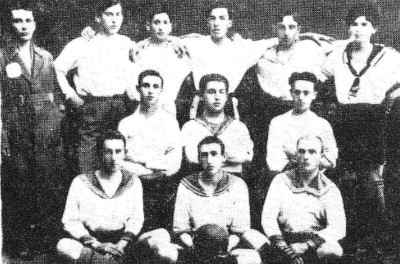
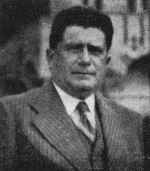
 |
|
|
[Page 63]
Translated from Monica Devens
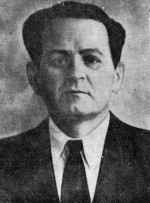
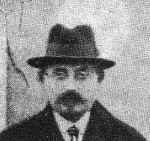
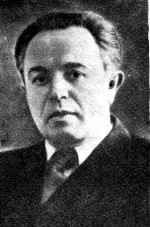
Yosef Appelboim
|
Yosef, son of Ephraim and Beila Appelboim, was born in Khotyn on December 15, 1889. He was educated in “Cheder” and later acquired a secondary school education. Due to the numerus clausus [=restricted admissions policy], he was unable to continue to study at a university. He had a thorough knowledge of Hebrew.
Along with other young people, he became involved in Zionist activities at the age of 18 and, during the time of the Tsar, he worked secretly for Zionism and to learn the Hebrew language.
At the first assembly after the Revolution of October 1917, when all Jewish matters were concentrated in Chane Reiss, Yosef Appelboim was among the first to demand independence for the Jewish community in order to wrest the interests of the many from people who saw them as their private matters.
After he returned from a meeting in Kishinev [=Chişinǎu] where representatives from the entire region participated, he set the community up on new, strong foundations, which would concern itself with the religious, social, and educational life of the Jewish population.
Despite the fact that he was no jurist, he composed the regulations himself with the help of Aizik Berg and Leibush Ludmer. He worked hard to get the public used to paying taxes to the community.
From the time that he returned from Kishinev, he would tell the Jewish public in Khotyn, which was cut off from information pipelines, what was happening in the world and, in particular, in the Jewish and Zionist world.
Between 1919 and 1922, a huge wave of refugees from the Soviet Union came to Khotyn, among whom were active Zionists. Khotyn Zionists, with Yosef Appelboim at their head, put together a committee and did much to facilitate their settlement in the area or their immigration to Israel.
After the First World War, with the entry of the Romanians into Bessarabia, the Zionist circle, with Yosef Appelboim at its head, was officially recognized. He broadened the activities of the Zionist movement outside of Khotyn: Britshan [=Briceni], Novoselitz [=Novoselytsya], Sekorn [=Sokyryany], Yedinets [=Edineț], Lipkan [=Lipcani], and the like. Yosef Appelboim dedicated himself to collecting money in all the cities of the region on behalf of the Zionist movement and its institutions. He invested much work on behalf of Jewish education and, in 1933, the “Tarbut” school got its own building.
He took care to install Zionist representatives in the municipal institutions in Khotyn and remained in close ties with non-Zionist Jewish organizations. When the Romanian Zionists decided in 1929/30 to establish a Jewish national block that would represent the Jewish minority in Parliament, a Jewish representative from the Khotyn region was elected to the Romanian Parliament, thanks to the work of Yosef Appelboim.
On June 20, 1940, Yosef Appelboim was arrested by the Soviets along with other Zionist leaders. He was subjected to extensive questioning about his Zionist activity for a full year. He was sentenced to 5 years' imprisonment and hard labor at a labor camp in Siberia, from which he did not return.
[Page 64]
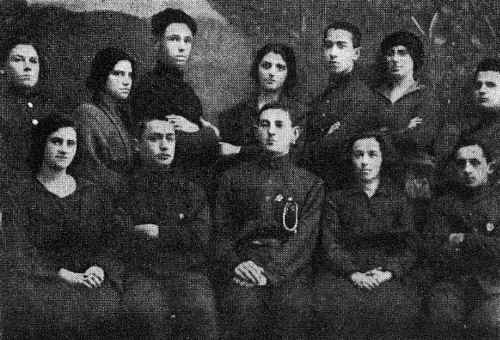
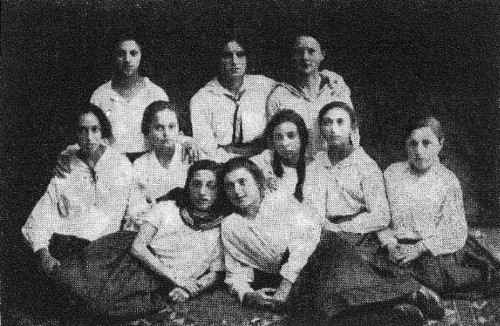
“Ha-Shomer Ha-Tza'ir” [=a Zionist youth movement] in Khotyn
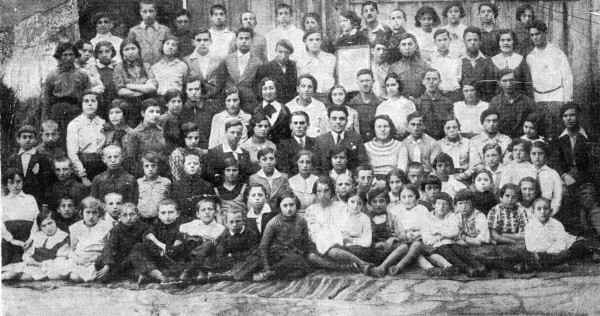
In 1917/18, following the example of the Romanian scouts, an organization of scouts was founded in Khotyn. Some of the members of this organization established “Ha-Shomer Ha-Tza'ir” in 1922 under the leadership of Abba Weissolder, the son of the well-known Zionist, R' Berl Weissolder, and Munya Roytshteyn was the secretary. There were 70-80 members in the movement. The branch belonged to the main administration in Czernowitz [=Chernivtsi], with which core groups of Ha-Shomer Ha-Tza'ir in Bessarabia and Bukovina were affiliated.
The first place of training in order to immigrate to Israel was in Kishinev [=Chişinǎu]. In summer, they worked in the vineyards and in the winter, in wood chopping and arranging piles for home heating. Later on, agricultural training places were established in Yasi [=Iaşi] in government farms. People from Khotyn were sent there, former members of Ha-Shomer Ha-Tza'ir, through “He-Halutz” [=a Zionist youth movement], to train in work and in communal living before their immigration to Israel.
Upon immigrating to Israel, they were sent to Kibbutz Gimel in Afula (Kibbutz Alef - Beit Alfa; Kibbutz Bet - Mishmar Ha-Emek; Kibbutz Gimel - Haifa). The kibbutz, Merhavia, and the Russian kibbutz that moved to Afikim were first in Haifa.
We participated in all kinds of work in the port, in construction in every part of the city, for the municipality, and when there was no work, we found vitality in work in the cemeteries until we moved to our permanent place, Ma'abarot, where we are to this very day.
“Ha-Shomer Ha-Tza'ir” was the most active from among the youth movements.
This movement did not excel in the number of its members, but in their quality. This was a movement with consolidated ideas, Zionist-revolutionary, which carefully vetted those who joined and accepted mostly the student and educated youth into its ranks.
The joint hikes, the enthusiastic dancing, the discussions in a team or a brigade or a core group, and the “activities” had within them great power to attract and trap.
Despite its being a Zionist movement, a familiar and legal movement in the country, the government did not look favorably upon it and worried about revolutionary spirit in it. Most of the gatherings were in secret or camouflaged as study meetings since most of the members were students in the government secondary school in the city. But it was precisely the mysterious quality of the meetings that captivated the members even more
|
|
|
|
and it was possible to rely on them since, should their activities be exposed by chance by the police, they would not “break” and wouldn't reveal anything. The words of the leader were holy to the participants and, if a spirit of friendship between young and old reigned, there was also an atmosphere of respect for the idea and for the leader as one.
One had to be careful so as not to be expelled from school over illegal activities. One day, my friends and I distributed invitations to a Zionist meeting. The police, who, of course, did not know how to read Yiddish or Hebrew, thought that this was leftist propaganda and, until the matter was clarified, we were taken to the police station. Since the chief of police wasn't there, we stayed there all night. I realized in the meantime that I had an article with me, in part revolutionary, of the type of articles of Ha-Shomer Ha-Tza'ir at that time. I gnawed on the paper all night and swallowed bits of paper so that there would be no grounds to accuse me.
The attitude of the parents to membership in the movement was not uniform. There were those who opposed, those who supported, and those who ignored it.
The first ones were concerned with the response of the authorities or with breaks in studies. Although the educators were interested in the youth completing their secondary school studies and taking the matriculation exam, they did not reprimand individuals who abandoned their studies out of a clear understanding that they had to prepare for kibbutz life where education was not the determining factor. There were, nevertheless, incidents of dropping out of school in order to dedicate oneself to movement matters, to the dismay of the parents.
In the movement, there were also “children of good families,” in the positive sense of the phrase. Children of the wealthy who sincerely sought wholeness in life or young people from traditional households who came to the movement out of conviction.
The feeling of belonging to a youth movement fighting for a better future enriched social life. The level of education of the young people allowed for serious discussions on various topics through the means of “public law,” which drew a large audience, both from the other youth movements and from the general public.
Although the members of “Ha-Shomer Ha-Tza'ir” did not generally associate with members of other movements, there were joint celebrations, of which
[Page 65]
the principal one was on “Simchat Torah.” On that day, the general Zionists and the adult members of the other streams of the Zionist movement had the habit of organizing a joint celebration, and the youth, including the members of “Ha-Shomer Ha-Tza'ir,” contributed quite a bit to the success of these parties.
Due to the relatively difficult transportation conditions, we did not have consistent contact with members of the movement from other places. But still, we were in contact with the members of the movement in the surrounding cities and, periodically, also with those in Czernowitz [=Chernivtsi], where the level of the movement was famous. Of course, we did come in contact with members of the movement in the other big cities in Romania. There was a significant difference in education among the various settlements and more than once we blushed at the sight of the relatively “free” behavior of the others, especially as regarded the relationships between male and female members.
Despite the fact that the relations in secondary school between us and the non-Jews were decent, still they did not hide their anti-Semitic feelings.
|
|
From time to time, there were rumors in the city that anti-Semitic groups were preparing to march on the city and the Jews, particularly the youth, considered how to defend if something might happen.
Little by little, a portion of the members immigrated to Israel, others went to Europe to continue their studies, and the bulk of the youth in the city, and in particular the students, felt that there was no future in the town.
Many members of “Ha-Shomer Ha-Tza'ir” in Khotyn immigrated to Israel, went to kibbutzes. Nevertheless not all continued to the end, sometimes due to a lack of flexibility of the movement at that time, which severely limited the possibilities of the young people's training according to their abilities.
There is no doubt that the education that the youth of “Ha-Shomer Ha-Tza'ir” received buried deep in their hearts and they remained faithful to the Zionist and Socialist idea together.
[Page 66]
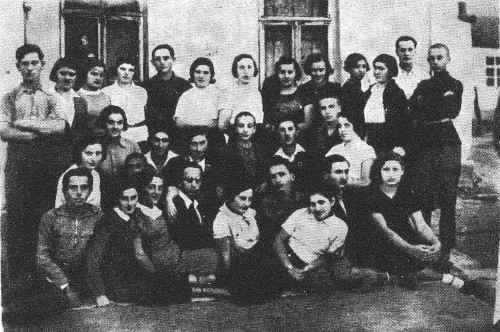
The Young People of “Poale-Tzion” [=a Zionist youth movement]
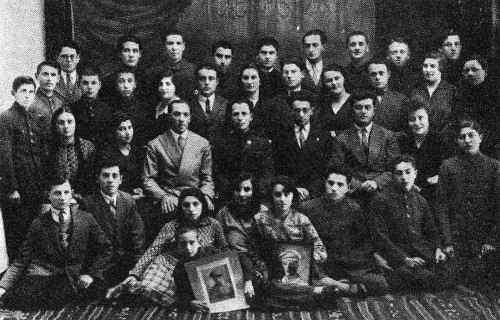
The lawyer, Moshe Feldman, Azriel Yanover, Hirschel Rokhverger, Chaim Shvayger, and others founded the “Poale-Tzion” organization (right) in Khotyn, whose center was in Kishinev [=Chişinǎu]. In order to assure the development of the movement, it was decided to also establish a youth movement that would draw from the poor classes of the population. The youth filled tasks with Keren Kayemet [=Jewish National Fund], He-Halutz [=a Zionist youth movement], training.
It was decided to recruit the youth to the ranks of Poale-Tzion in order to save them from the hands of the Communists, whose activities were highly emphasized. There was a need to educate the youth in both Zionism and Socialism. The choice of candidates for the movement was carried out with great care. Nightly lectures, literary discussions, and even singing and dancing took place in the clubhouse. Many went through pioneering training before they immigrated to Israel.
One of the most important acts was taking interest in the private lives of the youth in order to stand by them from both a material and social standpoint.
In our city, there were stormy arguments between Poale-Tzion and Tze'irei Tziyon, the youngest of the parties, which suspected it of not emphasizing the Zionist side of the activities enough.
|
|
|
|
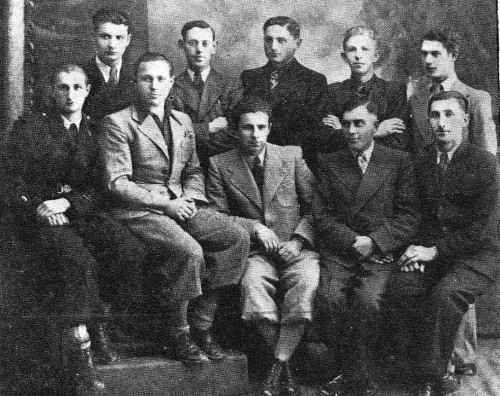
Present: E. Zaltzman, M. Shtern, M. Shekhter, Y. Barg, S. Feldman, C. Rekhter, H. Ayzenber [typo for Ayzenberg?], G. Shot, M. Roizman, S. Shtern, S. Sosenboim, Z. Entlis |
[Page 67]
Tze'irei Tziyon
The Tze'irei Tziyon organization was founded in Khotyn in 1915 in a hall rented by Tzeitel Gitsis, the mother of Yisrael Gitsis. The founders: Avraham Bronstein - chairman, and Moshe Shtern - secretary. The organization had 60 members. The purpose of the organization: to spread culture among its members. Lectures on Hebrew literature and Zionism took place twice a week. One of the active lecturers was Moshe Shtern, a young man, alert and energetic, who filled many roles in many areas. He was killed in Romania during the Holocaust.
David Gorenshtein and Elazar Zaltzman were also counted among the activists.
“Ha-Techiya,” “Gordonia”
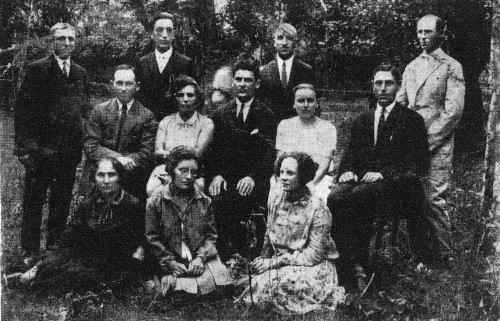
“Ha-Techiya” conducted extensive and fruitful activity in all areas of Zionist life. The activists were: Avraham Volkov, Avner Berg, Esther Gofman, Perla (Pnina) Peker, lawyer Roitman, Zvi Rozenberg, and Zalman Schneider.
In 1920/21, “Ha-Techiya” was founded in the home of Yitzhak Meir Tissenboim by Zalman Malamud, Avner Berg, Elazar Zaltzman, and Moshe Roitman. At the beginning, there were twenty or twenty-five members. This was a high quality core group, which was like a magnet for other movements (Gordonia, Ha-Shomer Ha-Tza'ir, Beitar, and the like).
The founders of “Gordonia” were: Volkov, Esther Gofman from among the activists of “Ha-Techiya.” Their activity was felt in all areas of Zionist life, particularly in the cultural realm. There was a difference between the level of the youth who came from the worker class and the youth in “Ha-Shomer Ha-Tza'ir,” who came from the educated class.
The work in “Gordonia” centered, in particular, around developing the habit of reading. Particular emphasis was placed on pioneering values and on group life. Many of their members immigrated to Israel.
From 1931, Zalman Schneider was at the head of Gordonia. The members of the committee were: Zvi Birenboim, Zvi Rozenberg, Chaim Zoninsheyn, and Sonia Horowitz.
The lawyer, Roitman, and Avraham Volkon z”l were outstanding in their action. The main topics of the conversations were: pioneering, Zionism, Socialism. Work on behalf of the Keren Kayemet and cultural education stood at the center of our activities.
|
|
Sitting in the middle: Z. Schneider, P. Peker, lawyer Roitman, A. Volkov |
[Page 68]
Beitar and Tzohar [=Revisionist Zionist party]
The development of the Zionist national movement and its activists in Khotyn constitute an impressive and comprehensive chapter. Adult and youth from all layers of the community joined Ha-Tzohar and Beitar, in their consciousness, belief, and comprehension, seeing Zionism as a source of inspiration, of action and constant readiness towards returning to the Land of the Fathers.
Because of this change, from the 20s on, relations with the accepted official Zionist frameworks in the city, in the organizational area as in the spiritual area, began to loosen until there was complete disconnection; on the other hand, core groups of Ha-Tzohar and Beitar grew and developed. Fulfilling the Zionist mandate led to gradual disengagement, in theory and in practice, from all connections to diaspora life. Beitar members, who worked especially in this direction, introduced dynamic content to the Zionist aspiration, stirring the spirit constantly by highlighting a strong and open stance in arguments with all the groups, beginning with the assimilation of both the right and the left together and ending with all kinds of compromisers, including the hesitant Zionists.
As a result of this singular identification with the Zionist order, the essence, appearance, and outlook of the members of the movement changed. Every one of them was deeply convinced that he was freeing himself and coming out of diaspora complexes and a split personality and that the accelerated impulse to action stemmed out of the definition of “Return to Zion.” There was in this a kind of standing tall and freedom from debilitating doubts in order to advance to the clearly defined and lucid goal.
The people of Khotyn, perhaps more than those of the settlements close to the great centers, were proud, rightly, of their achievements, which they had brought about by their own power. Indeed, expressions of respect and congratulations from the leadership and the central organizations of the movement did not delay in coming. Excitement and faithfulness characterized all the people of the movement. Alongside the shaping of ideological trends, formulating the plans for the advancement of the action and goals, the organizational frameworks of Ha-Tzohar and Beitar in Khotyn were established.
In the political section of Ha-Tzohar, these stood out for their actions: lawyer Barak, Shalom Goldenberg, Chanoch Shadovnik, Yaakov Verdiger, Yaakov Tutelman, Leibush Ludmer, Kilimakher, lawyer Fishler, Shlomo Fuhrman (called the Red); from among the supporters, one must remember Dr. Zeidman, Dr. Khoresh, Nuchyo Yakir, and many others.
The pioneering section of Beitar excelled in its endeavors, acting with great vigor. Among the first of Beitar are counted Efraim Roitman, Yehudi Yurist, Shimon Weissberg, Yitzhak Roitman, Yosef Zilberman, and the students of the Avraham Grenovitzer secondary school, Efraim Roitman and Avraham Kizhner. The founding group endured many organizational difficulties and numerous challenges in realization.
In 1931, headquarters leadership was appointed for the Beitar core group in Khotyn. The core group was permitted and recognized as an organizational body with authority in the nationalist-Zionist movement in Romania.
Through Dr. Zeidman, chair of the community committee, Ha-Tzohar and Beitar, after much moving about, were able, for a nominal payment, to get a classroom in the “Talmud Torah” school, including permission to use the broad courtyard of the school. This was the first place in which it was possible to organize and plan activities for a more extended period than a month or two. Regular club activities developed and the courtyard was utilized for sports activities and large gatherings. This strengthened the movement and its position from an organizational and representative perspective. The lawyer Fishler, commander of the core group in the area of propaganda and publicity, was helped in his welcome and energetic action by members of the headquarters leadership, full of energy and constant amplification, and they are: Shimon Weissberg, Yehudi Yurist, Avraham Krizner, Mendel Albert, David Sheinman, Avraham Grenovitzer, Efraim Roitman, Shlomo Shitnovitser, Syoma Bekel, Yehudit Shochet, Mordechai Guterman, Dvora Kirzhner, Sarah Wasserman, Charna Kirzhner, and Zvi Kirzhner.
The activity of the lawyer Barak, chair of the leadership of Ha-Tzohar in Khotyn, was extensive and highly efficient. He knew how to implant and deepen the political meaning of nationalist Zionism in the people of the movement. Veteran faithful of the movement, such as Shalom Goldberg, Leibush Ludmer, Chanoch Shadovnik Altman, and others, stood at his right hand.
The joining of a group of secondary school students had special meaning: Izia Kamintzki, Moshe Lerner, Yaakov Derzhi, Shlomo Eidler, Bushka Goldenberg, Moti Gorgon, Yitzhak Koifman, Avraham Frenk, Volodia Roizman and others.
With the actualization of the organizational framework, the improvement of the social foundation, and the growth in communal influence, the actual, political, and pioneering activity of the nationalist movement expanded. It is sufficient to recall several events that highlight the sweep and dimensions of the impact of the movement.
|
|
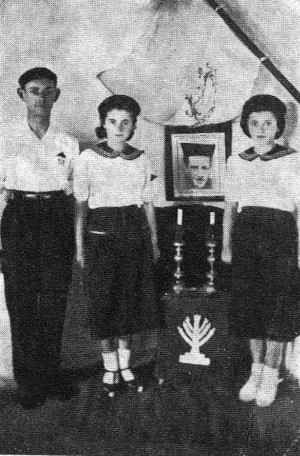
(Tsila Weingold-Nimri, Esther Beri, Nyutzia Rozenfeld) |
[Page 69]
The first event above all is: the immigration of Beitar people to Israel in 1931: Shoshana Pesach, Yenta Shtrikman, and Yosef Zilberman. Per the request of the leadership of the core group, Shoshana and Yenta each sent two citrus tree leaves, in a separate letter, which were sewn on the two parts of the national flag, which the core group decided to honor.
The Beitar members, Esther Beri, Tsila Weingold, Charna and Dvora Kirzhner, Yehudit Shochet put a lot of work into embroidery, sewing, drawing the symbols and mottos, under the direction of the leader of the core group, the lawyer Fishler and a special committee made up of Beitar members Yehuda Yurist, Shimon Weissberg, and David Sheinman. The ADMOR Tversky responded to the request of the leader of the core group to sanctify the flag in the courtyard of the synagogue, which was in his house. After much consideration, he arrived at a compromise between the stringency of Jewish law and his desire to help: the flag, which was a kind of embroidered map, would be draped over the synagogue table during the Torah reading. The consecration of the flag took place on one of the Shabbats in Nisan 1933, right before the 18th Zionist Congress, and the Beitar members took part in the services. Everyone present swore allegiance to the flag and to everything it represented.
In that same year, a campaign took place in the city towards the elections for the Zionist Congress. At the conclusion of the voting in August 1933 and the counting of the votes, it became clear that the national movement had won by a huge margin, 50% more than all of the votes of the other organizations combined, which spurred great enthusiasm among the members of the movement.
With the execution of Shlomo Ben Yosef, a memorial ceremony was held at the “Talmud Torah” synagogue, a ceremony that stood out in the awe and the sanctity of the occasion. Opposite the ark, a tripod was erected on which stood a picture of the hero, wrapped in black, with burning candles on both sides. An honor guard made up of two Beitar members rotated every half hour. The heads of the civil administration, the commander of the army battalion, who appeared in ceremonial attire, were invited and they listened respectfully to the prayer of the cantor.
It was further proof that what happened in Israel aroused a strong echo in the diaspora.
The activities of Ha-Tzohar and Beitar were conducted in Khotyn in 1938/39 in the spirit of political Zionism according to the slogan: “Strengthening the struggle for the freedom of the homeland.” The outstanding guides were lawyer Barak, who returned from the world conference of Ha-Tzohar and the Tzach [??] that took place in Vienna, and lawyer Fishler, who returned from the world conference of Beitar in Cracow. The activities were organized around two topics: 1. Immigration “Even Though” and 2. Etzel - the national military organization.
Carrying out the activities, in addition to the organizational responsibility, was a heavy material burden on the Khotyn core group, where feverish work began under both internal and external pressure. The lawyer Fishler dedicated himself completely to meeting the representatives of Beitar from Bucharest and the emissaries of the immigration organization and completely neglected his private affairs.
|
|
[Page 70]
In the Khotyn core group, registration began to form groups of candidates for immigration and for struggle. In order to raise money, dance events were arranged, which brought in very little money, despite the great amount of work by lawyer Barak.
In the winter of 1939, the first group immigrated: Avraham Kirzhner, Zvi Kirzhner, and Sonia Lerner. The lawyer Fishler gave Avraham two pistols to bring to Israel.
Even non-Beitar youth wanted to join the groups of the “Even Though” immigrants. In the next groups immigrated: Mordechai Guterman, Neta Royf, Nachum Roitman, Chana Telfus, Shlomo Eidler, Shlomo Kirzhner, Sarah Wasserman, Tsila Weingold. Lawyer Fishler accompanied the last group that immigrated to the port of Constanza [=Constanța] at the beginning of the spring of 1940. On his way back to Khotyn, he received instructions in the matter of the organization of much larger immigrant groups, instructions that were delivered to the leadership of the core group that was beginning to organize the evacuation, under the direction of Shimon Weissberg, David Sheinman, Syoma Bekel. Shimon Weissberg was appointed as the acting leader of the core group.
However, the schedule went awry. In June 1940, two hours before the Soviets entered Khotyn, lawyer Fishler decided to gather a number of people and to flee with them … However, the border guard and the police restricted movement in the city and, in particular, in the approach to the lower portion where most of the people lived. After he managed to meet with David Sheinman and give him contact details, lawyer Fishler left the city, taking with him the core group flag in order to bring it to Israel.
It is fitting to mention the names of the members of Beitar who were active in the Khotyn core group before the Soviets came and are no longer among the living: Avraham (Bushka) Goldenberg, Avraham Frenk, Mordechai (Motye) Gorgon. They belonged to the Etzel nucleus that arose in the Beitar core group in Khotyn. Beitar members, Avraham Kizhner (Shaham) and Zvi Kizhner (Ami Netzach), left the core group and joined Lehi [= “Lohamei Herut Yisrael”, Fighters for the Freedom of Israel]. Yaakov Derzhi-Yardeni was also a member of Etzel.
Among the members of the Khotyn core group was also Mr. Shlomo Shitnovitser, who was for a long time the leader of young Beitar in Romania, and later the last Beitar representative in Romania, and now the chair of the committee of the Organization of Khotyn Natives in Israel; he was a Prisoner of Zion who defended the honor of the people and the homeland with courage as one of those accused of anti-government activities in the well-known court case against the Zionist movement in Romania, accused of treason.
|
|
Standing from right to left: A. Frenk, Lawyer Z. Roizman, B. Goldenberg z”l, N. Rosenfeld z”l, S. Shitnovitser Sitting: A. Grenovitzer z”l, Lawyer B. Dagon-Fishler, Y. Yardeni-Derzhi, Y. Kamintzki, M. Gorgon z”l |
[Page 71]
“Dror” and Aryeh Fichman
Out of concern for the next generation, in 1934/35 “Poale-Tzion” [=a Zionist youth movement] established a youth movement called “Dror,” whose members in Khotyn numbered almost 200. At the head of the movement were the members: Munya Rappaport, Yudel Wasserman, and Avraham Wasserman (they were not brothers), the two killed by the Nazis.
Many of the members of “Dror” completed their training in Bukovina, in Gora-Humorului, and fulfilled their obligation of immigrating to Israel.
Aryeh Fichman filled the position of movement organizer. His grandfather on his mother's side was counted among the Boyan Hasidim and his father, Zvi Fichman, was a well-known Zionist.
In his youth, Aryeh, as the rest of the sons of the religious families, joined “Ha-No'ar Ha-Tziyoni,” but he quickly came to realize that his place was with the ranks of the workers and he joined “Dror.” He was zealous about the values of the movement, opposed “compromisers,” and demanded self-fulfillment of himself and of others.
With the change of regime in Romania, which caused the Bessarabian branch of the movement to cut itself off and go underground, Aryeh Fichman (whose underground nickname was “Leibo”) was the living spirit in the center of the movement and his visits to the branches aroused great excitement. At one of the fateful meetings of the “Dror” center, he denounced the suggestion to disband that was raised by one of his very best personal friends. Thanks to his strong stance and his power of persuasion, the movement was saved at that time from the tragedy of dissolving.
When several training sites in Romania belonging to “He-Halutz” [=a Zionist youth movement] were closed, the pioneering members of “Dror” were sent to the training farms of “Ha-Bonim” [=a Zionist youth movement] - in Transylvania, the only training place belonging to Ha-Kibbutz Ha-Me'uhad [= United Kibbutz]. There was a great difference between the members of the two movements, both in language and in social consciousness. The pioneers of “Ha-Bonim” spoke Hungarian among themselves, while the members of “Dror” spoke Romanian and Yiddish. Transylvanians saw themselves as belonging to central Europe, while those coming out of “Dror” thought of themselves as belonging to the “Balkans.” Aryeh Fichman pushed the division between these two groups aside and succeeded in bringing hearts closer together.
In order to get permission to immigrate, Aryeh Fichman appeared to enroll in the Hebrew University in Jerusalem, received a certificate from the Mandate government, and in 1939 immigrated to Israel, joined his group in Magdiel, moved to the forests of the Carmel to settle, and was among the founders of Beit Oren. He worked on the Atlit road and then in building.
Aryeh Fichman moved to Jerusalem as an emissary under the auspices of the kibbutz to lead “Ha-Bacharut Ha-Sozialistit” [=Socialist Youth], the sister to “Dror.” With the outbreak of the Second World War, Aryeh volunteered for the Jewish units of the British Army. As soon as the idea of parachuting into enemy territory arose, Aryeh volunteered, successfully completed a paratrooper course in September 1943, and in 1944 flew to Romania with Lyuba Gokovsky to encourage Jews in the Nazi conquered lands. He was among the first to parachute. Their bad luck, the pilots erred in the jump place and airdropped them in a city. Fichman and Gokovsky were arrested by a Romanian patrol. Since the Romanian authorities did not succeed in getting anything out of him, he was transferred to the German Aviation Corps camp near Frankfurt, on the river Main, to be interrogated in Germany. There he was interrogated for three weeks by German Air Corps officers and Gestapo men, an investigation accompanied by torture and starvation. He was interrogated for many hours, day and night, but he did not reveal a thing. After the intervention of the International Red Cross, he was returned to a prisoner of war camp in Romania. From there, he came into contact with Lyuba who was in the army hospital in the same city. He began an operation to smuggle out prisoners of war, but it failed. While trying to dig a tunnel, he was caught and sent to a punishment camp. When he returned, he found Lyuba in the camp. The two of them continued with preparations for smuggling out prisoners of war and stayed in touch with the pioneering movement. When Romania announced a cease fire, Aryeh was transferred to Bucharest. In accordance with an instruction from his army unit, he left Bucharest and came to Israel on August 18, 1944.
Aryeh returned to the agricultural branch of his farm, where he served as a coordinator for some time. He went to a seminar in Ein Harod for professional development in farm operations and moved from student to coordinator and person in charge of the seminar for approximately three years.
During the mass rally that took place on July 29, 1954 in Ma'agan to commemorate the paratrooper, Peretz Goldstein z”l, a plane burst into pieces above the crowd and the tragedy killed 17 people, among them Aryeh Fichman z”l.
May his memory be forever blessed.
WIZO [=Women's International Zionist Organization] and Keren Kayemet [=Jewish National Fund]
WIZO operated in many areas in Khotyn: “Tarbut” schools, hospitals, and social assistance, and especially on behalf of the Keren Kayemet.
Tova Appelboim stood at the head of WIZO with Mrs. Manya Feferman, Chava Weissman, Tzirel Roizman, and Klara Vartikovskiy at her side. They all fulfilled their tasks with dedication and ability, according to the special characteristics of each one of them.
Mrs. Golda Shot excelled in her dedicated work. Every activity in which she took part was a complete success. When Bessarabia was annexed to the Soviet Union, she and her family were exiled to Siberia because of her Zionist work. She was interrogated daily with severe tortures and her answer was always the same: I was and remain a Zionist for which I was exiled to Siberia. You don't have the possibility of sending me any further away. When she could no longer stand the hard tortures, she and her husband took poison, but they saved them. However, the two died after a short time from the serious suffering they had endured.
The women active in the leadership of WIZO were: Rivka Axelrod, Chava Zeidler, Fania Tissenboim, Itta Lerner, Dvora Strakovsky, Diya Glyuzgold, and Sarah Stolyar.
[Page 72]
Oneg Shabbat
Every week at the “Tarbut” school, an “Oneg Shabbat” celebration was held within the framework of Zionist activity in Khotyn. Many people enjoyed coming to have a good time for a few hours and to hear words of Torah and wisdom.
Yitzhak-Meir Tissenboim offered commentary, Yechiel Kretchmer spoke at length about the sayings of Hazal [=our sages of blessed memory], and the teacher, Mendel Weinstock, brought to the community information from modern Jewish life.
Zalman Malamud principally gave lessons from the books of the prophets and the other books of the Hebrew Bible. We can still remember today the flavor of his talks.
And last but not least - Zvi Shvayger. He used to give a lesson in Midrash [=a traditional body of Jewish Biblical interpretation] and the hall would be completely full. Such is the way of the world, as cited in the Gemara [=part of the Talmud] about Rabbi Abahu and Rabbi Chiyya. The community prefers Midrash over Halacha [=Jewish law].
The community also listened with great interest to information about Israel. Nothing political of course, just information. The Jews wanted to know what was happening in Israel.
The institution of “Oneg Shabbat,” which was organized in Khotyn for many years by Yisrael Avner Barak and Elazar Zaltzman, was a true spiritual pleasure for all the Jews of Khotyn.
Rotshtein House
Our ancestors did not leave us silver or gold nor did they leave us land, vineyards, or mansions. Most of them were satisfied with being able to work and live with dignity, to educate their children and raise them to Torah, marriage, and good deeds, in those restricted four cubits of living space that the surrounding gentiles permitted them.
Nevertheless along with the wretchedness of stress and pressure, they gave us the light of the Sabbath and of an extra soul [=a traditional concept of a greater spiritual dimension on Shabbat].
One should say openly: Not all of our days were a bitter and black diaspora for we enjoyed the pleasantness of youth, the fragrant days of summer, the poetic melancholy of autumn, and the pure white of winter, despite it all being wrapped in the shadow of gloom.
Within this atmosphere of gloom, the distinctive light of the houses of the humble Jews, without luxury and splendor, flickered, whose luster has not diminished in our memories until now.
One of these houses, which stood at the top of Maidan Street, was the home of the Rotshtein family, which gave off extra light and extra graciousness due to the father, Ben Tzion, and the mother, Bat Sheva. As against the degeneration of exile stood the nobility and majestic bearing of the “sons of kings,” even though they were exiled from their father's table.
The Rotshtein couple enjoyed the complete good will of the people who came in contact with them. They were involved with people and tried to come to their aid in times of need. Their simplicity and down to earth natures radiated a precious light from the very essence of their beings, from their innermost secret places. Their humble home was open to all, a center for the youth and a refuge for the downtrodden.
When their sons and daughters immigrated to Israel and the house seemed to wither from loneliness and the sorrow of longing, the nobility remained intact until the parents, too, immigrated to Israel in 1936 and brought the special splendor of Rotshtein House with them to the kibbutzes in which they relied on their sons for their livelihood.
The Holocaust did not skip over Rotshtein House. In 1945, with the lessening of the fighting, the horrible deaths of their daughter, Manya, along with her husband, Noah Gurvitz, and their daughter, Nelli, in the extermination camp at Auschwitz became known. R' Ben Tzion Rotshtein died that same year, though his wife, Bat Sheva, lived quite long after him and died in 1955.
|
|
A True Activist
There is a big difference between activists of our generation who follow a more or less paved pathway and the activists who worked forty or fifty years ago, meaning at the beginning of the struggle.
The Histadrut Zionit [=Zionist Federation] in Khotyn was built on strong foundations. Every party had leaders, activists, thinkers, and strong men - who contributed to the strength of the movement in the period between the two world wars.
From among the activists, one Jew stood out, despite the fact that technically he was not counted among the Zionist leaders, but in truth, he was the soul of Zionist life in our city, and that was Berl Weissolder.
Until this very day, I do not know clearly to which party he belonged. If I'm not wrong, he was counted among the general Zionists. However, then this was of no importance and today, all the more so.
Berl Weissolder was full of belief in the Zionist idea and was among the first activists. He loved young people and did not care about getting honors from them. He was a model and example for all.
Weissolder was not just an activist, but rather a kind of unique institution on behalf of Zionist life in Khotyn.
There were also those who opposed his approach to Zionism. But despite all this, we saw an honest Zionist, enthusiastic and dedicated, whom everyone respected and saw in him a true Zionist activist.
[Page 73]
Yosef Seltzer
Yosef Seltzer, a native of the village of Klishkovitz [=Klishkivtsi], grew up and was educated in Khotyn, where his personality in public life was formed.
In the home of his parents, Shalom and Tsirel Seltzer, he embibed the atmosphere of Zionism and Hebrew. From his grandfather, R' Reuven Boim, an outstanding scholar with broad vision, he took in original Jewish sources. In the city library, he enriched himself with “enlightenment” through the pages of the newspapers, “Ha-Zman,” “Ha-Tzfira,” “Ha-Shiloach,” and Hebrew literature. Growing up in a working family, Zionist socialism sank deep roots in his heart.
With the outbreak of the Russian Revolution in 1917, he dedicated all his enthusiasm to the tasks of the awakening Jewish public and was among the first of the founders of the Tze'irei Tziyon movement in Khotyn and the creators of its character. Also in the place of his studies abroad, he held high the miracle of socialist Zionism and when he encountered anti-semitism, he knew how to fight back fiercely as a proud and brave Jew.
He was proud of his brothers, Ezra and Eliyahu, and his sister, Rivka, who were among the first pioneers of Khotyn who immigrated to Israel. He, too, aspired to immigrate to Israel, but did not get that privilege. An ugly death put an end to his plans - a hard blow for the members of his family.
Yisrael Geller
Yisrael, son of R' Itzik Shochet, was a member of “Ha-Shomer Ha-Tza'ir” [=a Zionist youth movement] from 1924 to 1929. At this time, “Ha-Shomer Ha-Tza'ir” in Khotyn had between 120 to 150 members between the ages of 13 and 18/19. They had the obligations of training and immigration.
In 1926, the active society brought Yisrael Geller for training to Nipolokowitz [=Nepolokivtsi], near the Polish border, not far from Zhvanets. As in all training sites, the work was done with an estate owner and at the sawmill. From there, he moved to the leadership of “Ha-Shomer Ha-Tza'ir” in Kishinev [=Chişinǎu] and worked also with the center of “He-Halutz” [=another Zionist youth movement] there. In 1928, he was the national organizer for “Ha-Shomer Ha-Tza'ir” in Czernowitz [=Chernivtsi]. In 1929, he immigrated to Israel to Kibbutz A'.
Dr. Yaakov (Yasha) Lerner
Dr. Lerner was an honored figure in the public life of Khotyn and also in the Zionist movement, and he excelled in modesty, the simplicity of his ways, and his dedication to others, also in matters beyond the area of medicine. During his studies in Khotyn, Yaakov (Yasha) joined the Zionist circle in which he met the woman who would become his wife, Itta, daughter of Baruch Feldman. With the completion of their studies (she graduated from the Faculty of Agriculture), they rejected many offers of employment and preferred to return to Khotyn until they could immigrate to Israel. In the meantime, they had a son. In 1939, Itta Lerner arranged to visit Israel to check out the possibilities of settling there. But in 1940, Bessarabia was annexed to the Soviet Union and their plans were annulled.
During the Second World War, I came to Tyumen [?] and found, with difficulty, the address of Dr. Lerner in a house which seemed
|
|
to be abandoned: the wicket gate hanging by only one of its hinges and the windows in front shattered. I spent a week in the home of this wonderful family among Siberian exiles. Their home was open to everyone from Khotyn, Jews or non-Jews. His wife, Itte'le, a faithful companion to her husband, fulfilled the mitzvah of hospitality with great friendliness.
Dr. Lerner explained the reasons for his exile to Siberia: because of his right-wing views, because of his Zionism, but principally because of his refusal to be an agent of the N.K.V.D. [=a precursor of the KGB] and to spy on the doings of his friends at the hospital. In 1941, Dr. Lerner was ordered to appear before the appointed head of the hospital. The latter praised the exemplary order that existed in the hospital. In 1941, Dr. Lerner was asked to appear before the appointed head, that perhaps he would take on an additional task, that is, to investigate the doings of the medical staff and to report about it to the appropriate section. Regarding this matter, heightened awareness was required in the area of spiritual hygiene in order to uncover the bacteria that were infecting the soul of the country. During the conversation, it became clear that the regime knew that Dr. Lerner's wife was a Zionist and that she had visited Israel. They did not pressure Dr. Lerner to give an immediate answer.
A week or two after the conversation with the superior, Dr. Lerner was invited to come to him again and asked for a report about the actions of the medical staff at the hospital. In answer to Dr. Lerner's reply that he had no time for such an activity, it was explained to him that, in Siberia, he would have plenty of time and the Lerner couple were, in fact, exiled to Siberia in closed wagons and with terrible conditions. They traveled through many places until they finally arrived in Tyumen. In the parking spaces [?], they worked
[Page 74]
in the forests and Itta broke her hand and was treated at the hospital. Because he had not been able to bring his diploma with him, he was not permitted to work in his profession. The efforts that were made in Khotyn to get his diploma to him failed. Dr. Zeidman managed to find the diploma and transfer it to Tyumen. However, in the meantime, Dr. Lerner found an article that made its way to Tyumen, an article that contained an evaluation of the work in the hospital in Khotyn, an article written by one of the supervisors in the maternity hospital in Khotyn. Dr. Lerner turned to her and revealed his problems to her. Not many days passed before Dr. Lerner was invited to Tobolsk, settled in to work as a doctor, and given a new diploma.
Prisoners of Zion, Dr. Yaakov Lerner, member of the Zionist leadership in Khotyn, and his wife, Itta, active member of WIZO, suffered like many others due to the sin of their loyalty to Zionism, on the one hand, and their refusal to become a tool in the hands of the Soviets and to renounce their conscience, on the other. Their son, who studied medicine, was compelled to denounce his parents in order to not endanger the continuation of his studies. He met with his parents rarely and in secret.
After suffering many tribulations, Dr. Lerner passed away and his wife, Itta, returned to Tyumen in order to be with her son, who worked there as a doctor.
Dr. Shmuel Sheynberg
Dr. Shmuel Sheynberg is a native of Khotyn, the brother-in-law of Pinye Roizman (son of R' Roizman). In 1903/04, he worked extensively in the Zionist movement. He advanced his studies through the “Learn and Teach” system: for six months of the year, he was among the bench-warmers of the universities of Strasbourg and Vienna and for six months, he earned money by giving private lessons in Latin and all the rest of the secondary school subjects.
Because he had served in the Tsar's army, he was afraid of retribution on the part of the Bolsheviks and, for this reason, in 1918/19, he moved to Greece, where he lived most of the rest of his life and became well-known as a doctor in Saloniki.
In a letter in Hebrew that he sent to Zvi Bernstein, he demonstrated that he had not yet forgotten what he had learned in his youth and indicated that he still remembered the tractate, “Gittin,” which he had studied with the teacher, Fradkin. Despite his being abroad, he was connected to his origin with all his heart, to the tradition of his ancestors, to Jewish consciousness, and to the new Israel.
From time to time, he visited Israel to warm himself by its light and to visit his cousin, the pharmacist, Roizman, in Rehovot. He stayed in contact through letters with those exiled to the far reaches of Russia, such as Leibush Barg and others.
He had intended to write down his memories of his childhood in Khotyn, but due to the pressures of work and time, he did not manage to do so.
Yisrael Burdeynik, Lawyer
Yisrael Burdeynik was the first lawyer in Khotyn after the First World War. A brilliant jurist, he stood out in the office of the lawyers in the city and also excelled in the appellate court in Czernowitz [=Chernivtsi].
Despite the fact that, due to personal reasons, he did not belong to any Zionist party, Burdeynik was a nationalist Jew with a warm Jewish heart.
The defense speech which he made in the court in Khotyn concerning the question of whether the Jewish lawyers were permitted to appear before the legal tribunals is well remembered. This happened during the administration of Goga-Koza [=Octavian Goga?], 1928-1939. The Christian lawyers, anti-semites and hooligans, came from the old government in order to subject the files of the Jewish lawyers to criticism and many of them were removed from the office of the lawyers for procedural considerations. Lawyer Burdeynik was the only representative of the Jewish lawyers in Khotyn. With an unusual power to convince, he stood against the anti-semitic lawyers and, with great reasoning, succeeded in getting a positive ruling from the three judges.
Several Jewish women also participated in the communal and social life of Khotyn. Despite the fact that some of them worked within the party or faction framework to which they belonged, they were accustomed to also organizing activities for the good of the Jewish community outside of these frameworks: parties, charitable events, and the like. Standing out from among them: Manya Feferman, Henrietta Shor, Ida Rozentzveig, Tzimerman, Tova Appelboim, Sarah Appelboim, Itta Derzhi, Rulya Derzhi, Polya Shevelman, and Gittel Shekhter.
Yaakov Tutelman
A respected merchant, a member of the assessment committee [?] of the regional finance department, a man of great energy, an active Zionist, and vice-chair of the Jewish party.
Y. Mazor
Mazor was an extremely talented musician and conductor. He organized the choirs for nationalist celebrations and conducted them with great ability.
Landau Moshe and Furman Eliezer
The two of them worked always among the Jewish masses. Gifted orators, they were always the first in every action of a nationalist Jewish nature. They succeeded in gaining the heart of the Jewish population due to their ideas.
During the last period of the rule of the National Peasants' Party, 1934-37, the Jewish population of Khotyn was represented in the municipality by an impressive number of leaders with key positions. Lawyer Moshe Feldman was the deputy mayor, Leibush Ludmer was appointed over the population register, Marek Barak - chair of the audit committee; there were also several Jews holding the job of municipal advisors; Meron Derzhi was the municipal accountant.
In Khotyn, there were four Jewish estate owners: Shor, Reiss, Diker, and Barak.
[Page 75]
|
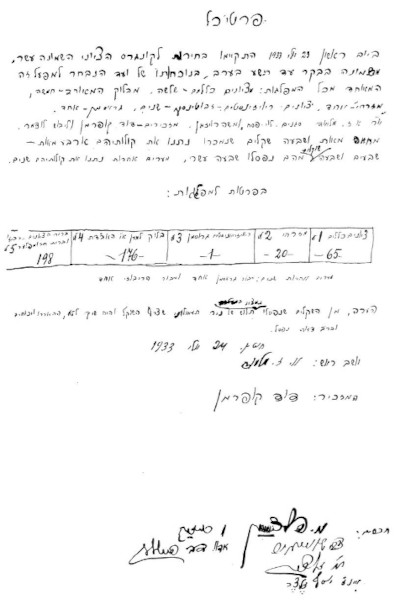
On Sunday, July 23, 1933, the elections for the 18th Zionist Congress were held, from 8 in the morning until 9 at night, in the presence of the committee chosen for this purpose, made up of all of the parties: from the General Zionists - 3, from the Mixed [unclear] Block - 5, Mizrachi - 1, Revisionist Zionists - [??] - 2, [?] - 1. Chair A. Z. Malamud, deputies Levi Pesach and Moshe Roizman, secretaries - David Kuperman and Leibush Ludmer. Of the 507 shekels that were sold, 477 voted, of which 17 were disqualified, other [?] voted twice. By party:
[too small to read] Note: Among the shekels that were disqualified, you will find a propaganda paper which the [?] attached and there was [?] for 15, arguments were aroused and with many opinions, it failed.
Khotyn. July 24, 1933 [signatures] |
[Page 76]
|
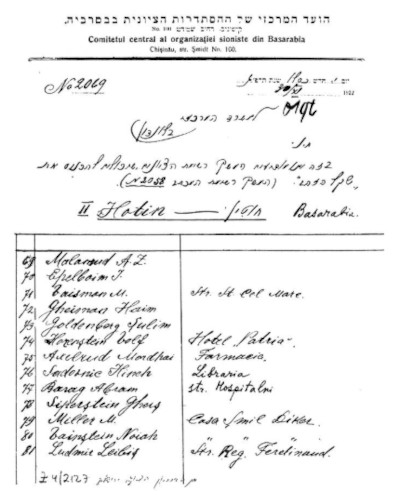
Kishinev [=Chişinǎu], Shmidt St. No. 1 No. 2069 Nov. 30, 1922 [handwritten list of names and addresses] |
The Jewish Party
There was a branch of the Jewish Party in Khotyn headed by the lawyer, Moshe Feldman. Vice-chairs were Yosef Appelboim and Yaakov Tutelman, and the general secretary - lawyer Marek Barak.
Leib Roizman, Leibush Ludmer, Dr. Aharon Stolyar, Yaakov Frenkel, and Eliezer Furman were also counted among the administration of the branch.
Zionists from all the factions belonged to this party and also Jews who did not belong to any movement. In a short time, most of the population of the city were registered in the Jewish party. The Khotyn region had the respect of the political parties because, in this region, one Jewish representative was always elected to the Romanian Parliament. The outstanding activists of the party were: Nachum Roitman, Moshe Landau, and Eliezer Furman.
|
|
Standing: Goichberg, Srul Feldman, M. Barak, Y. Podakmin, K. Mikviman Sitting: Dr. Aharon Stolyar, Shikhman Below: M. Varshavski, S. Freiberg, Moto |
|
|
JewishGen, Inc. makes no representations regarding the accuracy of
the translation. The reader may wish to refer to the original material
for verification.
JewishGen is not responsible for inaccuracies or omissions in the original work and cannot rewrite or edit the text to correct inaccuracies and/or omissions.
Our mission is to produce a translation of the original work and we cannot verify the accuracy of statements or alter facts cited.
 Khotyn, Ukraine
 Yizkor Book Project
 JewishGen Home Page
Copyright © 1999-2026 by JewishGen, Inc.
Updated 20 Oct 2026 by JH