 |
|
|
[Columns 245-246]
Editors:
Yiddish: A. M. Orzhitzer
Hebrew: Y. Khrost
Published by the Organization of Kamin Kashirsk natives in Israel,
and Kamin Kashirsk landsmanschaften in the United States and Argentina
[Columns 247-248]
[Columns 249-250]
[Column 251]
The history of the town of Kamin Kashirsk begins in the 14th century. A series of historical articles from Starożytny Polska [Ancient Poland] and Słowiańsk Geographiczny [Slavic Geography] describe the city in the Volhyn region in the following words:
Kamin Kashirsk
From the book, Ancient Poland:
“In bygone centuries this was almost certainly a fortress, or an important settlement for another reason, since Kazimir the Great retained for himself complete rights in it at the time that he signed a peace agreement with the Princes in the year 1366.”
The Lubartowicz family – Sanguszko had owned the estate [Sanguszko-Kashirsky line]. One of the family sons, Michal, who lived at the beginning of the 12th century, began to sign himself under the name of Prince Koshyrski; the last of that dynasty of princes, Adam Aleksander voivode Wołyński, died in 1656 [1653]. He was known for his religious orthodoxy and his generosity to houses of prayer and was responsible for erecting the Dominican monastery in Kamin. His sister (Anna Sanguszko), who was married to Jerzy Krashicki, brought to the marriage the Koszyr estate. Their son, who lived about 1776, was Antoni M. Krashicki, Choronzi.
“The village is small and poor, there are the remains of a fortress and a deep moat separates the wooden palace from the garden.”
[Column 252]
Kamin Kashirsk, once called the village of Kashir, is in the region of Kowel, district and police jurisdiction of Kamin Kashirsk, 54 verst from Kowel, on the Zyr River.
The police jurisdiction of Kamin Kashirsk includes the towns of: Kamin Kashirsk, Vielka Glusha, Baranovo, Sasitshna.
Jewish houses – 80. Peasant farms – 140. Ground of the landowners [poritzes] – approximately 2,000 desyatina [desyatina is a Russian measure of land equivalent to roughly 1.1 hectares or 2.7 acres], the same area that the peasants have. The soil is sand with lime on a bed of lime.
Kamin is an old settlement from the time of Kazimierz the Great. It was a border city with Lithuania. It was under private ownership of the Kashirsk Sanguszka, the last of the dynasty of Odom, of the Volhyn Wojewod. The Dominican monastery was founded in 1628. That monastery no longer exists. Through the marriage of the sister of the last Sanguszka of that lineage to Jerzy Kraszicki, that property transferred to the Kraszickis. Now, it is in possession of the monastery. The remnants of the former castle exist to this day.
The old castle was destroyed by the Haydamaks during the time of Jan Kazimierz.
In 1870, the population of Kamin was 493. 57% were Jews. There were 96 houses, 3 Orthodox churches, a [Catholic] church, a synagogue, a water mill, a pharmacy, 18 stores, and 4 markets.
A Catholic parish (from the year 1637) of the Kowel Diocese: 529 individuals, a division in Vorokmle, and a small church in Krymne.
[Column 253]
Kamin Kashirsk, a town in Poland, Polesye District. 862 Jews lived there in 1847. In 1897, 1,189 Jews (out of a population of 1,220) lived in Kamin Kashirsk. In 1921, there were 617 Jews (note from the editorial committee: According to our knowledge, 1,800 Jews lived in Kamin Kashirsk in 1921).
The gangs of Hetman Bulak Balachowitz perpetrated a pogrom in the year 1920, and burnt Torah scrolls that were there. (Note from the editor: In that pogrom, up to 120 Jews of Kamin were murdered, according to Encyclopedia Judaica).
Kamin Kashirsk is located in the Volhyn Gubernia on the Zyr River. It has a station on the Kowel railway. It has an elementary [folks] school and a middle school. It was known from the twelfth century. It has a sawmill and an oil press.
Jews in Kamin Kashirsk
According to what we know to this point, Jews settled in Kamin Kashirsk more than 300 years ago. During the time of Bogdan Chmielnicki (Tach ve Tat – [1648-1649]) up to 100 Jewish families were living in Kamin. They were all murdered. Later, Jews settled once again in the Volhyn region, and the town of Kamin Kashirsk was slowly settled by Jews, who were involved in shopkeeping, farming, and winemaking.
Around a hundred years ago, Kamin Kashirsk was settled with more Jews. They then formed 57% of the population, which consisted of Russians, Ukrainians, and Poles. There was a synagogue, and Jews were involved with business. Restrictions against Jews existed, but Jews were allowed to live. Jews were involved in the grain business, and in provisioning the farmers. The market in the town played a large role in maintaining and strengthening Jewish business. They were involved in haberdashery, iron, leather, the food business, manufacturing, toys, and shoes. The number of tradesmen in the city increased: tailors, shoemakers, tinsmiths, bakers, carpenters, wheelwrights, furriers, hat makers, and book binders. There were wagon drivers for passengers and transport. Small and large
[Column 254]
brick kilns, oil presses, distilleries, wineries, candle factories, etc. developed (according to data collected by Yaakov Plott).
There were also village goers [i.e., peddlers], house painters, smiths, barbers, butchers, and glassmakers. There were members of the intelligentsia professions, including teachers, doctors, and lawyers, as well as members of the clergy, including rabbis, shochtim, and shamashim [beadles].
When the misfortune brought on by the Germans hit the Jewish community of Kamin Kashirsk at the onset of the Second World War, there were over 2,000 Jewish souls there.
Many years ago, Kamin Kashirsk was subordinate to the large city of Kowel. The small towns around Kowel had to pay taxes to Kowel. The book of Kowel states on page 24 that in the year 1700, Kowel also received taxes from Kamin Kashirsk, but in the year 1764, the same Yizkor Book notes (page 26) many towns that used to pay taxes in Kowel, but Kamin Kashirsk was not included. This indicates that Kamin Kashirsk was no longer subordinate to Kowel – it had become independent.
Kamin Kashirsk was also connected to Kowel through rabbis. Rabbi Yaakov Aryeh, the rabbi of Kowel about 150 years ago, had two sons and two daughters. One son was a rabbi in Stobychwa, and the second, Rabbi Levi Yitzchak, was a rabbi in Kamin Kashirsk.
There were other great rabbis in Kamin Kashirsk. They will be written about separately in the book of Kamin Kashirsk.
Kamin Kashirsk was prominent in the entire area. Over forty small Jewish settlements in the area were affiliated with Kamin. Kamin became a very important city, with rabbis, rabbinical judges, shochtim, and their families, prominent people, institutions, and societies. It was typical that almost the entire town, the intelligentsia above all, had Zionist tendencies.
Pogroms, self-defense, and struggles:
In 1915, Cossacks with the help of the peasants perpetrated a pogrom in Kamin. In 1919-1920, a pogrom was perpetrated by Bulak Balachowitz and his gang, and Jews from Kamin mounted a resistance. In 1937, a pogrom in the fashion of Przytyk came to Kamin [See Note 3][1]. Poles and Ukrainians pillaged, robbed, and injured Jews.
[Column 255]
In 1939, Kamin Kashirsk fell to the Soviets. Hundreds of refugees arrived (among them the Modzitzer Rebbe), and the Kaminers took them in with open arms.
In 1941, the Germans entered Kamin Kashirsk. The first eight victims fell at the time of Tisha B'Av, and by Rosh Chodesh Elul 5701 there were up to eighty victims. The ghetto was created on June 1, 1942. Jews from the region were confined there along with the Kaminers. The large slaughter took place on 27 Av. Up to 2,000 Jews were murdered. The liquidation of the ghetto and the final slaughter in the town took place on 22 Cheshvan 5703 [2 November 1942].
Germans, Ukrainians, and other Jew-haters demonstrated what they could do. They slaughtered and murdered the Jews of Kamin Kashirsk.
[Column 256]
It was an epiphany of pain, suffering, and saving oneself, alone in the forests. However, the Jewish city of Kamin Kashirsk, which Jews built up and fortified brick by brick, is no more. It was destroyed and annihilated, as if it never existed. The city of Kamin Kashirsk remains in the hearts of the surviving Jews of Kamin, spread out throughout the entire world.
The Jewish history of Kamin Kashirsk of the last fifty years can be found in a book entitled The Jews of Kamin Kashirsk -- a description of the people.
Translator's footnote:
Collected by B. Melamed
Translated by Jerrold Landau
@Roberta Paula Books
The history of Kamin Kashirsk, its founding and development through the generation, is unfortunately unknown to us. We only know a little bit about the beginning of the Jewish settlement there. However, among the information about the history of the town of Ratno (Ratno Yizkor Book) collected from various sources, we find details from which we can infer that Kamin Kashirsk was already a town in 1366 which the kings at that time included in their peace treaties. The citation is as follows: “The peace treaty between the Lithuanian Duke Liubartas and the Polish King Kazimierz the Great from 1366: According to the treaty, King Kazimierz received Belz, Chelm and Ludmir (Wladymir) and received a row of settlements located on the east of the Turia (Tur) River: Horodlo, Lyubomil, Turisk, Ratno, Kamin Kashirsk, and Oblucyn.”
From this we learn that in 1366, Kamin Kashirsk already existed as a town. We also know that in the years 5408 and 5409, the bloody years of the Chmielnicki uprising (1648-1649), there were a hundred homeowners (families) in Kamin Kashirsk, and almost all were killed. There were 400 homeowners in Kowel, and all were killed. That is what is stated in the accounting of 744 destroyed
[Column 256]
communities, in which over 650,000 Jews were killed. They were perpetuated in the book Teet Hayaven by Reb Shmuel Feivish, the son of Reb Natan Feitel of the city of Vienna, brought down by Dr. Shimon Bernfeld in the book Sefer HaDemaot [Book of Tears], volume III, published by Eshkol, Berlin, 5664 [1904].
The great Russian-Soviet Encyclopedia writes about Kamin-Kashirsk. “Kamin Kashirsk is situated on the Zyr River at its confluence with the Pripyat River. The city was already known at the beginning of the twelfth century. It is located in Volhyn.”
The Great Jewish Encyclopedia published in Peterburg (volume XI) writes about Kamin-Kashirsk, “This is a town in the Kowel district, Volhyn Gubernia.”
According to the census of 1847, the Jewish community of Kamin numbered 862 individuals.
According to the census of 1897, the Jewish community numbered 1,189 individuals out of a general population of 1,220 residents. The census does not consider the surrounding gentile streets such as Zastawia, Wolia, Dolniki, and Zachrezia.
by Y. Plott
Translated by Jerrold Landau
@Roberta Paula Books
Like all other cities in our area, the Jewish settlement in Kamin Kashirsk did not know of an organized communal structure that would have supervisory authority over the Jewish religious institutions. Rabbis, rabbinical judges and shochtim earned their livelihoods independent of the community. Beis Midrashes, synagogues, and Hassidic shtibels were built and maintained by their worshippers. It was the same with the bathhouse and the mikva [ritual bath], which were maintained by their users. The cemetery was maintained by the Chevra Kadisha [burial society]. The Talmud Torah and Bikkur Cholim [Society for tending to the sick] were maintained by gabbaim [trustees], who collected a certain sum monthly to maintain these institutions. This went on until the Polish regime passed a law with various regulations to create a Jewish community structure with autonomous rights, which would supervise the religious institutions of the Jewish population. This structure would also create new institutions to take care of all the religious needs. It would collect taxes from the Jewish population to cover the expenses. Anyone who refused would be forced to pay by the Polish authorities.
Elections for the first communal council took place in Kamin Kashirsk in 1927. The towns of Lyubashov, Pnivne, Greater Lisha, Smaller Lisha, and all surrounded villages of the town also belonged to the communal council. An election committee to conduct the elections was formed. The following candidate lists were entered: 1) Religious, lead by the Trisker Hassidim; 2) Merchants; 3) Hand workers; 4) Kobriner Hassidim; 5) Lyubashov; 6) Pnivne, 7) Greater and Lesser Lisha. The following were elected from Kamin Kashirsk: 2 parnassim [communal administrators] from the religious Triskers: Shabtai Zafron and Aryeh Dekelbaum; 1 parnas from the merchants: Gedalyahu Grimtlich; Hand workers – Nachman Moreida; Kobriners – Fishel Linzen; Lyubashov – 2 mandates: Yaakov Poltshuk and Shimshel Shklov; Pnivne – Avraham Katzman; Glusha, one mandate – Chaim Goldshul.
At the first meeting
[Column 258]
Sh. Zafron was elected as chairman, A. Dekelbaum as cashier, Yisrael Burstein as secretary and officer, and as shamash, Feivel Tarme. A site for the communal council was rented from Reuven Linzen. It was decided that the community must immediately take over the shechita [ritual slaughter] in order to cover the communal expenditures that were already needed. The shochtim would become communal officers, and the butchers would have to pay fees to the community for shechita. The excess of the shechita money would be used to cover other expenses.
Of course, this would lead to disputes. The shochtim, Reb Yitzchak Plott and Reb Mordechai Kaminska, found it difficult to agree. They had been independent in their livelihoods throughout all the years, and now they were made dependent, in that strangers from the communal council would now be their bosses. The butchers did not want to agree at all, knowing that it was easy to agree with the shochtim regarding the shechita fees, sometimes more, sometimes less. However, now the communal council would set a specific price, and they would have to be paid immediately. Nevertheless, the communal council imposed this. They also had to pay a larger monthly salary to Rabbi Perlin, for he was now considered a communal officer. The communal council had to oversee the tax system, and every Jew had to pay the amount assessed by the council on an annual basis. (Then the fight grew even larger because everyone claimed that they had been assessed too high a sum…)
The elections for the second communal council took place in 1931. The same list of candidates was entered, and almost the same people were elected, with some exceptions: In place of Gedalyahu Grumatlich[1], Leibush Lew was elected. Instead of Fishel Linzen, Avraham Leib Katz was elected. Shabtai Zafron was named chairman, and Leibush Lew was elected as cashier.
During that term, the communal council was located in the house of Sh. Zafron, which was the Folks Bank until that time.
[Column 259]
However, the communal council was unable to work calmly. It was always full of internal schisms. This was regarding various civic matters as well as issues relating to the towns of Lyubashov and Glusha, where there were battles regarding rabbis and shochtim who were overseen by the communal council in Kamin. If something was not smooth for one side, the other side always tried to prove that it was correct, and that the communal council was one-sided.
Large disputes took place in the city at the end of the term. The communal council had to deal significantly with the old “disease” – the question of rabbis. One would have thought that this would have been cured already.
The Kobriner Rebbe, Rabbi Noach Rabinovitch, who lived in our city, took a son-in-law from the Rebbe's court of Radom, and gave him the “rabbinate of Kamin Kashirsk” as a dowry. In truth, he also had rabbinical ordination from the Polish authorities – which according to the new law required rabbis to have a certain degree of secular knowledge. However, our city sufficed itself with the authority of the rabbi and Gaon Rabbi Perlin of blessed memory, even without the certification of the Polish government. The Kobriner Hassidim demanded that the community take him as rabbi as well, and give over the registration books to him , for he had taken a Polish exam. However, the majority of the communal administrators [parnassim] were against this, and things became quarrelsome in the city. Almost the entire town was involved. Complains about the matter were presented to the highest authorities, asking that they adjudicate the matter of the rabbinate.
This continued until the elections for the third communal council in 1936. Each side was prepared to vote for its representatives. The left leaning Poalei Zion party[2] decided to enter the communal elections. A committee of its most active members was formed. Its program was to create a worldly community, not only for religions purposes, but also to maintain cultural institutions to the extent that it was possible to create new
[Column 260]
institutions, to support the Zionist Keren Kayemet LeYisrael and Keren Hayesod funds, as well as the pioneering Hachshara points for the Land of Israel.
In that spirit, strong electioneering agitation took place in the city and in the entire area, and that party won. The list of left leaning Poalei Zion[2], list number 5, called “For the Working Land of Israel” obtained five mandates. The religious and the merchants – two mandates; Great and lesser Glusha – one mandate; Pnivne – one mandate.
The following were elected: 1) Gershon Sokol; 2) Leibush Lew; 3) Yosef Bokolczuk; 4) Chaim Polczuk; 5) L. Zelcer; 6) Leibush Goldstein; 7) Aryeh Dekelbaum; 8) Chaim Goldshul; and 9) Yechiel Guber.
At the first meeting, Leibush Goldstein was elected as chairman and Leibush Lew as cashier.
The new committee as well, for which there were great hopes that they would be able to do more and create some new positivity in the city, remained in the previous situation. The old disputes and battles between the sides of the rabbis, the Beis Midrashes, and the internal affairs of the community [continued]. Furthermore, anti-Semitism strengthened in the city. Business was taken away from Jewish hands due to the official “Owszem” politics. In our town, it reached the point where the city market took place on the gentile streets. There was a pogrom in the summer of 1937. Many Jewish businesses were pillaged. This greatly disrupted the work of the communal council.
In praise of our communal council in all of its terms, it must be stressed that our Hatechiya School was always treated positively, with moral support, according to the possibilities that it had within its power, until the Second World War in 1939.
Translator's footnotes:
by Yaakov Plott
Translated by Jerrold Landau
@Roberta Paula Books
After the First World War, approximately sixty years ago, our town Kamen Kashirsky belonged to the Volyn Gubernia, Zhitomer, and Kovel District [oyezd]. It was a miestetshke, that is a shtetl to which various volosts [subdivisions] belonged administratively: 1) Kamen Kashirsky, 2) Vielka Glusha [Velyka Hlusha[a]], 3) Choteshov; 4) Borovne, and 5) Soshychne. Several villages belonged to each volost. The village of Stobychiwa belonged to Borovne. It had a large Jewish community with a rabbinical judge, a shochet, and Beis Midrashim. In earlier years, a rabbi lived there who had many Hassidim in the area. However, he moved the nearby town of Nieschizh. Nevertheless, he continued to be known as the Stobichwer Rebbe to his many Hassidim.
There was also a large Jewish settlement with a Beis Midrash in Vielka Glusha. There was also a shochet, Reb Abba Plott, a great, G-d fearing scholar. He also served as the mohel [circumciser] and prayer leader there, and he would respond to halachic questions. The Jewish community of Glusha and its area related to him with love and respect, like a rabbi. There were also smaller or larger number of Jewish families in the other villages. There was almost no village in our area without Jews. All the volosts with their villages belonged administratively to Kamen Kashirsky,
|
|
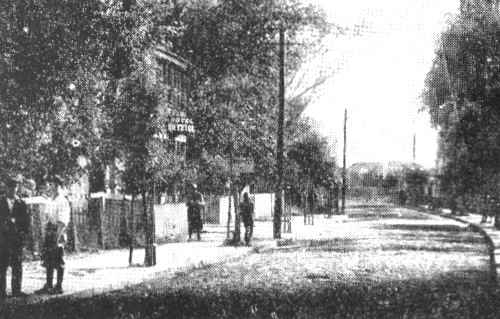
| Koveler Street |
[Column 262]
where the nachalstvo was located, that is the pristav, who was the chief of all the volosts, the leaders of whom were called Starshina.[b] He also ruled over all his villages, whose leaders were called Starosta. The Jewish population also elected a Jewish Starosta every three years. His secretary was a gentile, Konichki, who was also the organizer of the parish. In my time, Reb Zelig Kichtal was the Starosta, followed by Reb Baruch Verba.
Battles between the old Starosta and his competitor had begun in the Beis Midrashes a few months prior to the elections. Two sides were formed, each of which spoke in favour of its candidates. They hosted meals with drinks, liquor, and roasted geese. The elections took place in the Beis Midrash. The nachalstvo, the pristav, the starshina, oradnik, and others would come.[a] Only men over the age of 25 had the right to vote. The Jews felt good in the Beis Midrash, as they always did. When they called out the names of the candidates for the Starosta and deputy Starosta, one would hear shouting, and a commotion broke out: “Zhilayem, Nie Zhilayem.”[c] However, when they called out the names of the voters, they went up to the bima where the ballot box was located and cast their ballots.
Afterwards, those elected gave their oath to be faithful to the batyushka[d], Czar Nikolai, and everyone left the Beis Midrash. The new Starosta took the petshat[e] with the gentile secretary of the previous Starosta. The main work was in issuing passports, maintaining the record books, dealing with the svitshnisbar[f] and other fees, maintaining contact with the nachalstvo, sitting with the prisodstova as the Jewish representative when the ispravnik [district police chief] Voyski Natshalnik, came from Kovel along with the military physician to go to the prizov when they would
[Column 263]
take 21-year-old lads into the army. Sons who were an only child to their parents and handicapped individuals would not be mobilized into the army. Therefore, many lads in our town would identify themselves as handicapped, mainly with hernias, to free themselves from military service. There was a Jew who was expert at this, who would create the “hernia” for a fee. To accomplish this, they had to engage in hard labor for several months, run a great deal, and also give a bribe to the ispravnik with the doctor and the other nachalstvo to finally be free to go. The lads tortured themselves, ate little, and did not sleep at night. Then they received a Stratshka, that is a one-year deferment of service. Then they tortured themselves for a second year and a third year. In the end, they truly had hernias, and were freed from the military.
I recall that they used to vote for other known taxes[1] – that is, the right to slaughter kosher meat. The first tax lessee whom I recall in the town
[Column 264]
was Moshe Aharon Kowiebelski. He was also a corner-advocate, that is a petition writer. Later, Eliezer Zukerman leased the tax rights. He was a forestry merchant, and his wife Mirka was the permanent supervisor. One could always find her in the room of the shochtim, and she took the tax money for every fowl, goose, head of cattle or calf.
During the latter years, Reb Shalom Karsch leased the tax rights. At that time, they built a modern slaughterhouse (choine) far below the city. They had already issued a warning that one must not slaughter in the stalls. The tax level was raised. Harsh battles between the tax lessee and the butchers broke out. They did not want to pay the amount that the tax lessee demanded in the name of the law. The shochtim also suffered greatly from this, for they were not allowed to slaughter until the tax money was paid.
Translator's footnote:
Editor's footnotes:
by Yaakov Plott, Ramat Gan
Translated by Jerrold Landau
@Roberta Paula Books
|
Rabbis and Shochtim [Ritual Slaughterers] (Shubs[1])
My father always mentioned Reb Yisrael Zayn, who was his rabbi. In his senior years, he left for the Land of Israel. His rabbinical judge was Rabbi Gimple. In my time, however, the rabbinical judge in Kamin Kashirsky was Rabbi Moshe Goldschmid. He was the son-in-law of the Kobriner Rabbi, and a brother-in-law of Rabbi Schik of Kovel. However, according to various rumors about his personality that were spread in the town, the Trisker Hassidim brought in a second rabbinical judge, Rabbi Pesach Aharon Weisman, a Trisker Hassid. Then, a large dispute broke out, with blind hatred. A fire flared up. There was fighting
[Column 264]
and battles in every place where the two sides could be found. They were called, in short, “the old rabbinical judge” and the “new rabbinical judge.”
Rabbi Goldschmid was a zealot, quite high handed. He had a good command of the Russian and Polish languages. He also read Hebrew newspapers. That means, he was a Maskil [enlightened person]. He was a quarrelsome man; however, he knew how and with what to take on the world. There were always drinks and snacks on his table, and his people were always with him in his house. At first, he had the vast majority on his side, but later many abandoned him and went to the new rabbinical judge.
[Column 265]
Rabbi Weisman was a great scholar and had good relations with his fellow. He had a minyan in his house for upstanding, important youths. He was a good prayer leader. He also was fluent in languages. His children were educated in Torah as well as worldly knowledge.
The dispute sharpened. Since the shochtim were Trisker Hassidim, another shochet was brought in, but this was not successful, since everyone from the other side, and primarily the butchers, strongly supported and trusted the old shochtim. The new shochet had to leave the town.
The dispute lasted for a long time. Once, there was an issue with a lesion in an animal[2]. The new rabbinical judge stated that it was treif, and the old rabbinical judge stated that it was kosher. The question was turned over to great rabbis. When the Koveler Rabbi, Rabbi Schik died, his brother-in-law Rabbi Goldschmid left Kamin, and moved to Kovel, where he served as rabbi. When the Poles took over Kovel, he became a chief rabbi, meaning he was nominated as “Kozianer rabbi”[3]. Rabbi Ginzberg assumed his responsibilities in Kamin Kashirsky. He was a Lithuanian Jew and a great Torah personality. He was very pious and friendly – an exquisite Jew, a man of peace who hated discord. The town became calm, quiet, and peaceful. The Hazman and Hatzefira Hebrew newspapers came to his home. His children, who studied in Yeshiva, also received a worldly education, and opened a school in the town.
Our rabbinical judges earned their livelihood through the sale of yeast. Every Thursday, the housewives would go to the houses of the rabbinical judges, and their wives would sell yeast to them. The gentiles would also purchase yeast from “the rabbin” for their Easter. They [i.e., the Jewish housewives] would also purchase from them candles for the Sabbath and festivals. They also had an income from the sale of chometz on the eve of Passover, from rabbinical adjudications, and for performing marriage ceremonies. They would also benefit from large sums of money on Chanukah and Purim.
Rabbi Perlin came to our town as rabbi after the First World War. He was a fine personality, a scholar, and intelligent. He would therefore be summoned for the most difficult rabbinical adjudications in our town as well as adjudications in other cities.
[Column 266]
He was deeply pious, but his daughter studied in the Hebrew Gymnasia of Kovel. Even though he was not a Zionist himself, he had the blue Keren Kayemet [Jewish National Fund] charity box in his house. When people came to his house to collect funds for the Land of Israel, they would receive a fine sum.
He endured many tribulations during his final years because the Kobriner Rebbe brought his son-in-law of his to town [Rabbi Goldschmidt]. The Hassidim appointed this son-in-law as their rabbi and wanted the community to recognize him as well. A great dispute broke out once again. It reached the Polish authorities and the Starostowa, who had recognized him as a rabbi for various reasons. However, the vast majority in the townsfolk, as well as the communal representatives, recognized Rabbi Perlin as the rabbi.
Shochtim [Ritual Slaughterers, also known as Shubs]
There were two shochtim in the town. One of them was Rabbi Yitzchak Plott the Shub, about whom we know four generations. His son was Rabbi Yaakov, my grandfather, and his grandson was my father, Rabbi Moshe, who died in 1914. His [i.e., Rabbi Moshe's] second son, was my brother Yitzchak the Shub, who was shot by the Germans in 1942.
The second shochet was Rabbi Isser Stern the Shub, who was also my great-grandfather.
His son-in-law David Shub (Kaminski) was shot by the Balachowiczes in 1920 [followers of Stanislaw Bulak-Balachowicz[a]]. His son Mordechai was murdered by the Germans in 1942.
The shochtim in our town were scholars, prayer leaders, mohels [ritual circumcisers], and Torah readers. They also excelled at hosting guests and were generally involved with charity. Ever since the establishment of the Jewish community, they had earned their livelihoods from shechita, which thy divided up in the following manner: One shochet would slaughter in the town, and the second would travel around the area for a week. They reversed this in the second week. There was also a tax lessee, who would take for himself the largest portion of the cattle, calves, fowl, geese, etc.
When the community was founded, the Polish authorities made the butchers take notes[4], and they were paid by the community. The shochtim were official officers of the community and received a monthly salary. The excess money remained with the community
[Column 267]
to cover other needs of the town, primarily for the rabbis, who were also officers of the community and received monthly stipends. Over and above the stipends, they sold yeast and candles, and also had income from rabbinical judgments, marriage ceremonies, maintaining records, selling chometz, and Purim and Chanukah monetary gifts from the householders.
The Geographical Situation: Marshes
Geographically, Kamin Kashirsky was situated in the Polesye region, in what is called the Pinsk Marshes. It belonged to the Volyn Gubernia and bordered the Minsk Gubernia. The town was surrounded by forests, which continued deep into Ukraine.
There was no highway. One had to use various dirt roads or paths to travel to the neighboring cities, towns, or villages. The routes were not secure, and they were full of danger, especially when it rained. Attacks by bandits also occurred. I still recall how a certain peasant, Tureszko, killed a Jew in a forest near our town. This instilled fear in all the Jews of the town.
After the holidays, during the winter until after Passover, the entire town became full of mud when it rained. Then, they would lay down wooden footbridges in the market as well as in the surrounding streets so that one could go from one house to the next with dry shoes. I recall that all the men wore long boots made of cowhide, and the women wore high rubber galoshes. However, one could not prevent the boots from getting dirty, for the mud was so deep during that time…
The mud began to dry up as Passover approached. It finally became dry. The children began to go barefoot to play in the streets. Behind the town on all sides, the trees began to sprout leaves. Field flowers began to grow in the streams and in the fields, and the air became refreshing. It smelled like spring. However, the air in the town became saturated with dust, because
[Column 268]
the alleyways were crowded, and one house was right next to the other. There were no garbage bins, and there certainly were no sewage conduits. All the dirt from the houses was tossed onto the street, and the wastewater wet the streets.
The Jews lived on the market and on the side streets, which surrounded the gentile streets on all sides. Ukrainian peasants lived on the gentile streets. The peasants had their fields behind the town, whereas in the town, they had their small cottages, with large stables for horses and cattle and granaries for the grain. Everything was built of wood, and the roofs were covered with straw. That was the cause of the fires from which the Jews suffered every year. An eruv was constructed between the Jewish and the gentile streets so that the Jews would be permitted to carry on the Sabbath…
Wagon Drivers in the Town
There was no train in our town at that time. That is why the wagon drivers were so important for us. They were the only means of connection with the nearby cities, primarily with Kovel. There were wagon drivers who transported passengers, small-scale merchants, and shopkeepers who traveled to Kovel to purchase all sorts of merchandise.
They would leave the town during the day and arrive in the nearby town of Neschiz [Nesukhoyezhe] (30 kilometers away) in the evening. They would spend the night there and go to Kovel (18 kilometers from Neschiz) the next day. There, the merchants would purchase merchandise. They would travel back to Neschiz, spend the night there, and return to Kamin the following morning.
There were also wagon drivers who transported loads themselves. They would bring a letter from a shopkeeper in Kamin to a merchant in Kovel so that they could obtain the merchandise and bring it to Kamin.
There was also a transport wagon driver, Shimon Eisenberg, who used to travel with several wagons to Brisk, from where he would bring the merchandise that was purchased by the wholesaler Reb Moshe Bergil and several other manufacturing shopkeepers.
[Column 269]
Brisk is 100 kilometers from Kamin [62 miles], and the trip with a wagon was somewhat difficult. I made the trip as a child, when I went to study in the Brisk Yeshiva, and back again when the First World War broke out. The trip with a wagon took an entire week.
My Home
Our house stood on an alleyway that was called Mitzraim Gesl [Egypt Alleyway], seemingly because several Jews made bricks there[5]. From Kovel Road, this alleyway ran close to a large field in which lepechs [prickly comfreys][6] grew. All the children used to go there a few weeks prior to Shavuot to begin to harvest them.
Of course, there were ponds there. When we stuck our feet in them, it was difficult to move. In the field, detached from the houses, there was a dry area where the neighbors would toss their garbage, or they would take all their dirty unclean things there at night.
Our house was exactly like all the other houses that stood close to each other. Alleyways spread out from all the sides until the marketplace.
There were no trees, flowers, or grass in our alleyways. Our house had two sides. There was a long hallway with several rooms in the middle. However, a neighbor lived on the second side.
My memories move to the main part of my childhood, when my father, Reb Moshe, would hold my hands after observing chatzot[7], and tell me nice stories about the Land of Israel, especially about Jewish redemption and the Messiah. When the Messiah comes, all the Jews will go to the Land of Israel. Everything will grow on trees there, and one would immediately get what one wants. I heard such stories about the Messiah and the Land of Israel from him throughout all the years.
I remember when I was already studying in cheder, when I would wake up at night, and my father was sitting at the table studying, I would go to him, or he himself would take me to the table. Whatever he was studying at that time, be it Zohar, Talmud, or other books, he would always
[Column 270]
look for stories about the Land of Israel or those connected with the Messiah and the Land of Israel, and tell them to me.
Thus, my love for the Land of Israel, trees, flowers, and nature in general grew with me. However, this was all in my fantasies. Therefore, I was indeed full of happiness when I would travel with my mother in the summer to her parents, Reb Berish and Devora Klein, in her hometown of Ratno. There, I was able to breathe a full chest of fresh air and enjoy nature to the extent that I desired.
With my Grandfather's Family in Ratno
My grandfather, Reb Berish, was one of the wealthiest Jews in Ratno. He lived on the highway and occupied two separate large houses together with the family of my uncle, Reb Mottel Klein. There were trees and flowers around the houses. There was a large orchard with fruit trees, mainly sour cherries. There was also a garden with all sorts of vegetables.
Of course, I would climb the trees, pick fruit, inhale the aroma of the flowers, and enjoy the wonderful nature all around during the few weeks that I spent there. However, it passed quickly, and I had to return to my town with the crowded alleyways, devoid of air. I would dream of and think about the trees and flowers at my mother's parents' place in Ratno.
My dream was fulfilled somewhat a few years later. Our town had endured several fires. The streets and alleyways were wider. Nicer houses were built. When the Polish authorities took over the town, they paved the highways and the roads, and planted trees near the houses. Many householders planted gardens with trees near the windows and flowers. In this way, the air became cleaner and the streets tidier.
Every morning, a police officer made the rounds. If it was not clean around the houses, he would issue a “protocol” [ticket], and fine them several zlotys. Thus, a garbage bin stood near every house, and when it was full, it
[Column 271]
had to be removed immediately, for a sanitary committee headed by a doctor would often come by and issue a large penalty. Often, the cleanliness was not maintained. When the sanitary committee needed money, they went to the Jewish houses and issued “protocols” to create money… In truth, our Jews knew about this, but they also knew that they might revoke the decree if it would be clean around the houses – and this is often what happened. Therefore, our town indeed became known as a clean, tidy, beautiful town during the latter years.
My Father
My father, Reb Moshe the shub [shochet], was descended from the Kaminer shochtim. His grandfather Reb Yitzchak, his father Re Yaakov, as well as his maternal grandfather Reb Isser Stern were shochtim in Kamin Kashirsky.
My father had a splendid countenance, with a fine long beard. He was a scholar, a prayer leader, a Torah reader, a Trisker Hassid, a very modest and unassuming person, who excelled at hosting guests.
There were always guests in our house, a Rebbe, a preacher, an emissary from a Yeshiva, a descendent of a Tzadik, a bookseller, a cantor, or a regular fine Jew. One told the next about the hosting of guests in Kamin. Of course, he would help collect money from the guests for the rabbi.
He would always say that one must fulfill Eshel in its entirety – food, drink, and lodging[8]. Without lodging, it is fire[9].
Guests
I recall that every winter, Rabbi Yaakov Leibenyu would come to us in earlier times, and after him, his son Rabbi Shmuelikl. They lived in Neschiz but were called the Stobichower Rebbe. They were grandchildren of the Neschizer Tzadik Rabbi Yitzchak, and of the Koveler Rebbe. They had many Hassidim in all the towns, and a small number with us, but they would come to us and stay in our house. We had already prepared everything for the Sabbath. The Rebbe conducted his table celebration [tish], and my
[Column 272]
father had already ensured that all the Jews of means in Kamin, including Hassidim of other Rebbes, would come to give him donations.
The Stobichower Rebbes calculated the appropriate time and would come when my father would go around to slaughter animals in the area, where he was held in high esteem. The Rebbes would travel around with him, and all the village Jews would give him large donations.
From the regular, annual guests, I recall Reb Avrahamele from the Mirer Yeshiva. He was an old man, short, and very pious. He stayed with us for several days, because it was the custom that there was a charity box [pushka] for the Yeshiva in every home. He would go from house to house with a sack and would empty the charity boxes and take the small change that the wives would put in the box before candle lighting. Later, his son-in-law, a tall, stout man with a splendid countenance, would come and perform the same task.
Emissaries or preachers would come from the other Yeshivas. After their sermons in the Beis Midrashes, they would make the rounds to the houses and the businesses with a local householder, and collect a significant sum for the Yeshiva.
The emissaries that traveled about for the Yeshivas in the Land of Israel would not be satisfied with the same amounts that the others collected, and they expected large annual donations. They introduced the methodology of membership. A member would pay a large amount every year. In return, they would study Mishnah, recite Kaddish, and observe the yahrzeit after he passed away. Thus did the Yeshivas of Toras Chayim and Meah Shearim gain many members in our town and collect large sums of money annually. I recall that Jews came who claimed that they came from the Land of Israel, and they also collected money.
Letters from the Land of Israel also came to my father. Then he set out with other prominent Jews to the Jews of means and collected a significant sum of money to send to the Land of Israel. When I wanted to know for whom this was, they would tell me that several years back, a fine, scholarly, pious Jew came from the Land of Israel, and “created” an annual payment [pledge] for a large number of Jews. Since he does not come, he requests notes that they will send him
[Column 273]
the money to the Land of Israel. (I do not remember whether this was for an institution.) That is what they did. They sent a letter with the names of the donors, and he sent back receipts with blessings. In this way, both sides were happy. The Jew from the Land of Israel received his money and benefited in this world, whereas our Jews certainly obtained the World to Come…
Reizele the Rebbetzin
Reizele the Rebbetzin also used to come to our house. I did not know her husband, but I do know that they were scions of all the dynasties of Hassidic Rebbes from our region, such as Neschiz, Trisk, Kovel, Stobichowa, Lubashov, and Kashiovka. She had three sons. The oldest, Reb Abale, was the Rebbe in Stekotsin [Shchekychyn]. The second, Itzikl, was mentally ill during my time. His wife, Shprintzele the Rebbetzin, as she was called, used to function herself as a Rebbestova, and accepted donations that were given, and also used to travel to the villages….
The third son, Leibel Shapira, who came from the Yeshiva and became involved in the current world, played an active role in our town during the years 1904-1905 in the efforts to overthrow the Czarist regime. Of course, Reizele the Rebbetzin had many difficulties from all sides, but less regarding livelihood. From time to time, she would travel around the towns, where they would collect money for her. However, in our town, the entire payment fell upon my beloved mother, Feiga-Rosia.
She, the Rebbetzin, used to come to us to pour out her bitter heart, saying she had no desire to live. Once a week, usually on Thursday, my mother used to take her kerchief and go to the businesses and the householders to collect a few rubles for her. I recall that when I already knew how to write, and I became her letter writer to the Rebbe's son and other high individuals, she brought me a present, a large, silver pointer[10] from the great Tzadik of Neschiz, Reb Yitzchak, which had been given as an inheritance to the Kovel Rebbe, and then to her. She found it necessary that I should have it as a token of recognition and a gratitude to our family. I always had the
[Column 274]
intention that I would take it with me to the Land of Israel and give it to a museum. To my regret, it was stolen along with all my belongings by the German and Ukrainian murderers.
The Baal Mofes [Miracle Worker]
There are another few episodes that I remember when a Rebbe with his gabbai [assistant] came to us for the Sabbath. Of course, we hosted them. The Rebbe sat and learned as customary. He was a fine Jew with a yellow beard. However, a rumor spread in the city that he was a miracle worker: he helped barren women to have children, and even dispensed cures.
Many wives from the town came to the Rebbe for help, bringing along large donations. However, suddenly a letter was tossed to him through the window, stating that he must immediately cease taking donations and must depart. Of course, he acted as if he did not know about this. However, late at night on the second day, several youths in disguise came to us. They had masks on their faces and arrived with large sticks. They demanded that he return the money that he had taken deceitfully from the women. The Rebbe, his gabbai, and the people who were with him were very afraid. My father ran in. Of course, he did not recognize them, but they certainly recognized him. They stated that due to the honor of my father, whose guest the Rebbe was, they would not bother him. However, he must return the money and leave early in the morning. And that is what indeed happened!
The “Grandchild”
A second episode was when the “Grandchild”[11] came to us. He stated that he descended from the Trisker dynasty, from the Twerskys. He indeed knew the entire family of Rebbes. On Friday, he called a neighbor, a melamed [teacher of young children] into a room in our house and spent several hours with him.
On Friday night and Saturday morning, he went to worship at the Trisker Shtibel. There, he met with the wealthiest people of our city, and surprised them in that he knew everything about their families: where they are called, what they do, how many children they have, etc. A rumor spread through the town that he was a great man. He met
[Column 275]
with everyone, almost acting like a “prophet,” and the wealthy people gave him large donations.
Once he was sitting in the house, and several women came to us to slaughter fowl. My father was not there, so they sat and waited. In the meantime, he called me aside (at that time, I was learning in a cheder, and was eight or nine years old), and asked me the name of each woman, what their husbands did, how many children they have, etc. I told him everything wrong!
I recall that the first one was Baruch the hatmaker's wife, and her name was Chava. I told him that her name was Sara and that her husband was a shoemaker. I did the same regarding the others… He met them and mixed up everything. They began to laugh. A rumor immediately spread through the city that he was a false “grandchild,” and that he had tried to fool us. It then became known that he had received all his information from our neighbor, who was a very pious Jew, a fool, a naïve man who felt that everything that a Trisker grandchild asked must be answered. That same day the grandchild simply fled!
After that, it was said in the city that the melamed had turned him into a prophet, and his student had made him into an ex-prophet.
Institutions in the Town
Bikur Cholim [Society for tending to the sick] – that was one of the most useful and important institutions. The gabbaim [trustees] were Reb Mordechai Lerman and Reb Pinchas Malik. Every Jew paid a specific monthly payment, and every month a pair was sent out to collect the payments. When a poor Jew became sick, he received a to enable him to go to a doctor for free, as well as a for the prescription at the pharmacy, also for free.
If someone had to go to Warsaw to be treated, a pair of our householders was sent to the wealthy people to collect a larger sum of money to enable the person to travel to Warsaw or Kiev for medical purposes.
Linat Tzedek – if a Jew became sick and was laid up at home, even with a contagious disease, two people were sent to him every day to
[Column 276]
keep watch at night, so that the family could sleep.
Talmud Torah – The gabbaim were Reb Shalom Karsch and Reb Yitzchak Friedman. Every Jew also paid a monthly payment for the Talmud Torah. A pair was sent out to collect the money. They hired a melamed, who studied with the poor children, mainly children from the villages. The poorest of them partook of their meals in rotation at the householders. I recall a period prior to the First World War when they learned to write for free with Reb Yitzchak Plott the Shub.
Maos Chittim – After Purim, people already began to prepare for Passover. Already then, they began to collect money for Maos Chittim [wheat money, for Pesakh) in the Beis Midrashes and especially at the houses. During the last years before the First World War, Rabbi Pesach Aharon Weiman did this, along with one of the greatest scholars in the city, my rebbe, the great Gemara teacher Reb Yitzhak Wolf Lesnik. They would indeed collect a large sum of money and distribute it among those in need, so that they would lack nothing for Passover.
Chevra Kadisha – It was involved with organizing the funerals for the deceased. They would send a minyan of Jews to the cemetery. It also had a gabbai who would be elected annually at an election in the Beis Midrash with ballots.
I recall that on Simchas Torah night, everyone went to the gabbai of that time, Reb Alter Stern, for a large kiddush. On Simchas Torah eve, they would send candles and apples to all the members. I also remember that as a child, I saw a Chevra Kadisha ledger with Reb Yehoshua Kremener (Gortinstein) , who had been the gabbai at one time. The details of various communal events were inscribed in the ledger with printed letters and gold ink.
If a person of means, who had been stingy regarding the given of charity during his lifetime, died, they would take a larger sum of money and distribute it to the local institutions – the Talmud Torah, Bikur Cholim, and others.
There was also a Chevra Mishnayos, which distributed segments of Mishnah study to the learners in the city,
[Column 277]
when a prominent, well-placed householder of the city died[12].
There was also a Chevra Tehillim, whose members recited the entire book of Psalms in the Beis Midrashes during the early morning of Sabbaths and festivals. So that people would not be late, Reb Motke the tailor went around the streets with a lovely, melodic tune and a melancholy voice to awaken people for the recital of Psalms. On Shabbos Bereishis [the first Sabbath after Simchas Torah], they had the custom of hosting a large kiddush in the Beis Midrash.
I also recall how the elderly gabbai, either Reb Motke the tailor or Reb Mottel the Shamash would awaken people for Psalms during winter Sabbath mornings, singing the verse: Wake up, present yourselves, listen to the service of the Creator! My father used to get up immediately and go to the shtibel. However, I could not longer sleep. I would think various thoughts until it was day. Then my father would return, and I would calmly get dressed in my Sabbath clothes and go to the shtibel with him for services. I had derived great enjoyment from his serving as the prayer leader, as well as the Torah reader, with his pleasant, sweet, high voice.
Revolutionary Circles
In our town, there were no factories or enterprises that made use of employees. There were shops with merchants who served their clients with the help of their wives and children. Our tradespeople worked themselves with the help of some of their children during day and night to seek their livelihoods. Only a few tradespeople and tailors hired employees. Nevertheless, because in the large labor centers and big cities they organized Socialist parties with revolutionary slogans against the Russian Czarist regime, the youth in our city did the same. The so-called balebatish [middle class] children took part. As I remember, they were called “brothers and sisters” in the town.
The leaders of the organization were:
Leibel the Rebbetzin's (Shapiro) was a scion of the Volyn rabbinical dynasty. He had studied in a Yeshiva.
[Column 278]
He came home and worked in the organization. Later he left for Budapest (Hungary).
Leibel Shtsherbota, a son of Yosef, who owed the largest manufacturing enterprise in the town. After his marriage, he went to Kovel, where he had a large manufacturing business.
Yitzchak Plott, a grandson of the Kaminer shochtim, a son of Eliezer Plott the maskil and a Hebrew teacher in the large cities of Russia. Yitzchak, who studied in a Yeshiva, returned to Kamin and became a teacher. He became deeply involved in the Socialist movement. Later, he left for America.
All three of the aforementioned comrades created a strong organization in the town. They held lectures and discussions in the forests near the town, and also in various places in the town. These were illegal for our youth.
I remember that on one occasion, announcements were posted in the town that Yitzchak Plott will hold a lecture in the Beis Midrash on the Sabbath. He was a Yeshiva student, and quite knowledgeable. All the Jews came to hear him. Many comrades from the organization came. Of course, he spoke about verses from the Bible and illustrated Socialism through them. This continued until a large fight broke about between the parents, brothers, and relatives, upholders of the religion and fighters for Socialism.
Episode number 1: I remember that two youths arrived from the Kovel organization, Mr. Charon and, it seems, Entin, and conducted a trial regarding one of the wealthy residents of our town, Yehoshua Kremener (Gortenstein). As it was said, he fired a worker who had gone to bathe in a stream, the path to which was covered with grass, and belonged to him. Therefore, he had to pay a penalty of 50 or 100 rubles to the organization.
Episode number 2: I remember that my father of blessed memory said that he had traveled to Kovel, and when he went to the Kaminer inn, he encountered several youths with sticks. Suddenly, he heard a shout from the side, “Don't bother him. This is not whom we need.” As became clear, the Kaminer committee of the organization had a dispute with Nissel the hatmaker because he had
[Column 279]
beaten a worker. They found out when Nissel had to travel to Kovel to obtain merchandise. The Kovel committee had been informed of this and had given signs of Nissel's appearance. A large worker went out on the specific day to confront Nissel. A Kaminer lad, Pesach the son of Mottel the Shamash, went along with them. When they encountered my father, who looked a bit like Nissel, they approached him, but when Pesach saw this from afar, he realized this and began to shout. He ran quickly and defended my father.
In time, I noticed that during the years 1905-1906, the leaders started to conduct a fair amount of enlightenment and cultural work among the youth. The divisions among the children of the well-placed people and well-to-do Jews with the children of the tradesmen broke down. I remember that on Sabbaths and festivals, as well as during evenings, they went on strolls in the so-called “bourgeoisie” Kovel Road. The children, boys and girls together, were fighting
[Column 280]
for a common goal. A Jewish library was set up in the Kimmel family house. Several people contributed money for that cause, and the members obtained books to read.
A dance hall was also created in Mr. Zelig Kimmel's home, where a teacher from outside taught dance. This was due to the influence of the Socialist idea, to which he subscribed.
The leaders and activists of this movement left Kamin. Many went to America, and a few went to cities and towns in Russia. However, the ideal for the Kaminer youth was not going abroad: for a short time after the First World War, Zionism came to Socialism, and the Kaminer youth began to fight for and work for Socialist Zionism. They created the Zionist movement with its youth organizations. They actively worked for all the financial, political, and cultural activities that were associated with the Zionist World Headquarters for the Land of Israel.
Translator's footnotes:
Editor's footnote:
by Isaac Solomon Plot, Miami Beach, America
Translated by Jerrold Landau
@Roberta Paula Books
This was around the year 1904. In the larger cities and in all the manufacturing centers of Russia, the workers had already been organized for a long time. They formed Socialist parties that fought against the Czarist regime and wanted to create a democratic order to improve the economic and political situation of the worker and populist masses. It was still very calm on the Jewish street. The Jewish workers with self-consciousness and the intelligentsia belonged to the Russian Socialist parties: the Social Revolutionaries and Social Democrats.
[Column 280]
However, when the Czarist regime, desiring to distract the masses from revolutionary ideas, began to organize pogroms against Jews, the Jewish workers and intelligentsia began to form Jewish Socialist parties: 1) Bund – the program of which was to work and struggle for the rights of Jews in the countries in which they were living, and were against the land of Israel; 2) S.S. (Socialist Zionist Workers Party), the program of which was to struggle for the full rights of the Jews in the countries in which they live while simultaneously working for the Land of Israel; 3) Poalei
[Column 281]
Zion, the program of which was to dedicate its entire effort only toward the Land of Israel.
In the year 1904, Kamin Kashirsky burnt down. My father, Eliezer, was in Kishinev at that time to collect material for the publication of the Givat Shaul book. At that time, I had to leave the Kovel Yeshiva, where I had been studying, and come home to help rebuild our house for the family. My mother became sick, and I had to remain in the town and become a teacher.
At that time, workers were badly exploited by their employers. They worked until late at night for a meager salary. My sister Roza as well, who worked for Yankel the tailor, would even come home on sabbath eves when people were already worshipping in the synagogue. Considering everything, I decided that we must improve the situation of the workers in our town as well. Together with Leibel Shapira, who
[Column 282]
was descended from rabbis, and David Shtsherbota, who was descended from merchants, we organized approximately ninety workers and created an S.S. (Socialist Zionist) Workers Party, which developed well in all areas.
When Shapira left our town, David Engel, a very fine and energetic lad, joined the committee, as did Yudel Klorman. Our publicity work continued further among the all the Jewish youth of the town.
In 1907, when my mother died, I left for Odessa. There, I was also employed in giving lessons, while simultaneously being involved in societal work. I also belonged to a group that was preparing to travel to the Land of Israel, purchase land there, and settle and work there.
For various reasons, I had to leave for America in 1911.
Translator's footnote:
|
|
JewishGen, Inc. makes no representations regarding the accuracy of
the translation. The reader may wish to refer to the original material
for verification.
JewishGen is not responsible for inaccuracies or omissions in the original work and cannot rewrite or edit the text to correct inaccuracies and/or omissions.
Our mission is to produce a translation of the original work and we cannot verify the accuracy of statements or alter facts cited.
 Kamin'-Kashyrs'kyi, Ukraine
 Yizkor Book Project
 JewishGen Home Page
Copyright © 1999-2026 by JewishGen, Inc.
Updated 14 Oct 2026 by JH