 |
[Yiddish] In the Valiant Battle
|
|
[Page 363]
|
|
| [Hebrew] “In quiet and trust is your strength” (Isaiah 30:15) [Yiddish] In the Valiant Battle |
by The Editor Very few natives of Grabowiec were fortunate enough to take part in the sacred mission of taking revenge on the murderers of our people, but the descriptions provided by the partisans Erlich, Shisler, and Hustik are an important component of the Jewish struggle against the German Nazis that attacked the Jewish people in order to exterminate them. The partisans' struggle was bitter and resulted in many victims, especially Jews, including natives of Grabowiec. We know no details about them, besides the fact that, regardless of military rank, they all fought bravely on the fronts and in the forests. We would like to emphasize that many young Grabowiec natives sought out the partisans, though only few were successful. Many died enroute to the forest; unfortunately, we know little about them. But the articles by David Erlich and Itta Shisler make clear that the Jewish fighters played a major role in the partisan struggle as a whole. The daring young Jewish partisans, men and women, who were utterly devoted to the fight against the Nazi enemy – whether in actual warfare or in supportive roles – were an integral part of the fight in the forests. The tale is one of glory and great heroism, which added to the prestige of all Jews, not fighters alone, in the face of unique national extermination.
The fighters from Grabowiec – Erlich, Shisler, and Hustik – have contributed only some essential details about their actions in the forests and on the fronts. Much of their heroism has not been documented. Yet the little that we know make it clear that they were not passive victims. Their heroism was expressed not only in their superhuman strength, but also in the spiritual power they possessed that was essential to success in battle. They can teach us about the qualities and values of the Jews of Grabowiec, as well as the sources of their courage and valor in battle. |
by David Erlich
The last days before Hitler's Germany assaulted Poland, in September 1939, were nightmarish. The Jews of Grabowiec knew very well that in any war, the Jews would suffer the most. We were already aware of Hitler's plans for the Jews of Germany and what they promised for all Jews. It was enough to cast a pall of fear that grew more and more menacing with every passing day.
The day that we were so afraid of came. Early in the morning of September 1, 1939, Germany attacked Poland. German aircraft bombed cities and towns. In Grabowiec, the Jews trembled when they heard of Germany's victories. The Polish authorities mobilized only a few people from the town, but the war's outbreak was hardly felt. No German soldiers were seen in the first few days. No one thought that the Polish army would fold so quickly. But as soon as the eve of Yom Kippur, news came of battles near Zamość.[1] Many wounded Polish soldiers were brought to the primary school. There was a severe shortage of doctors. Many young Jews felt the need to join the Polish army, but there was no address to turn to. The Yom Kippur prayers were more melancholy than usual.
There was a general feeling of helplessness. No one knew what to do and where to run. Shortly after Yom Kippur, it became clear that Russian forces had crossed the border and entered Poland.[2] People said that they would advance as far as Lublin, and Grabowiec would be under Russian control. That lightened the mood a bit,
[Page 366]
but more experienced Jews noted that the outcome of a war was never certain; things might be one way today and different tomorrow. Young Jewish left-wingers were preparing to help the Russians establish authority in the town. Their elders warned them against such active engagement, as it might backfire.
Indeed, that was the case. An agreement with the Germans led the Russians to retreat to the Bug River, and to evacuate anyone who wanted to leave town with them. Some Jewish merchants loaded their stock onto wagons and went to Ludmir. About 500 Jews left Grabowiec, including my brother, sister, and me.
When we arrived in Ludmir, the town was already full of refugees, most of whom were seeking a way to make a living. That was impossible in Lublin. There were no factories. The only source of employment were the rail lines, and preparing banners in honor of the October revolution. The Jewish refugees from Grabowiec saw no future for themselves, and decided to move a bit farther into Ukraine and Russia. My sister Henekh (now in Toronto), my cousin David Glomb, and I were among the first groups to go to Radziłów, a friendly Jewish town with kind Jews, who helped the refugees with accommodations and assured them that matters would improve someday.
We found Baruch's wife, Sheyndl (Glomb, now in America) and her family in the town, as well as Berish Reichman and his family (his children now live in Israel). I now felt a bit better, but understood that the town did not offer me a future. I went to Dubno and thought I would find work there, but soon realized that my trip had been in vain. I returned to Radziłów.
As I was walking on the street, a man who looked familiar came by. I soon remembered that he was a former functionary of the Achdus Yisro'el religious sector of the Revisionist Organization of Poland.[3] I caught up with him and tried to have a conversation. At first, he was afraid to talk, but later invited me to visit him at his house that evening.
[Page 367]
As we talked, he told me in confidence that Vilna was now under Lithuanian control, and it was a gathering place for refugees who wanted to go to the Land of Israel. The Russian-Lithuanian border now had to be crossed enroute to Vilna. He suggested that I go to Lida, where I would find more information. I came to my cousin David Glomb with this suggestion, but he did not seem interested in going. He did not want to steal across the border, for fear of the Russians, and thought we would be able to stay where we were and survive until the end of the war. I began looking for a partner who would go to Lida with me. People recommended a guy from Radziłów whose father lived in America. We started to make preparations for the trip. I left my meager possessions with my sister. She did not want to part from me, and wept silently. My cousin David accompanied me to the train with a heavy heart.
We arrived in Lida on Friday afternoon. The study houses were packed with refugees, and we could not find a place to set down our rucksacks. I knew that we had a distant relative in Lida, Shmuel Blechman (Netaleh's cousin) who was nicknamed “the Warsaw tinsmith.”[4] I managed to ask about him. He lived at 10 Szkolna St. When we arrived there, he wasn't home. His landlady didn't let us in, or allow us to lay down our rucksacks. We went to the large study house once again, and were able to connect with a group that was leaving that very evening for Eišiškės, on the Lithuania side of the border.
Walking on the streets of Eišiškės, we felt the approach of Shabbat in this Jewish town. Shabbat candles flickered in the windows. The men who were coming from the synagogues dressed in their Shabbat finery looked compassionately at our group of about 60 men. When we had talked with people in Lida they were worried that we were setting out on a senseless quest. Women tried to stop us: “Have pity on yourselves! Where are you headed? People are killed on the roads, shot at, captured by the NKVD…”[5]
[Page 368]
Our minds had been made up. We continued on our way. We entered a wood, but had gone no more than ten km when a young man in a leather jacket caught up with us and told us to go back to the town. An earlier group had been stopped, and we, too, were in danger of falling into the clutches of the NKVD. It was past ten p.m. by the time we returned to town. Having nowhere to go, we went into a Hasidic synagogue and lay down on the benches. The synagogue manager came in and yelled at us to leave. But he had no choice, and resigned himself to our presence.
We lay there, exhausted, but couldn't fall asleep. I told my friend that I would try to go to Blechman's, at 10 Szkolna St. He could come with me if he liked. He was afraid, and tried to dissuade me. But I felt that I had nothing to lose. This time I was lucky enough to meet Shmuel. It was late, but he was still awake. He was sitting with his two cousins from Grabowiec – the brothers Avraham and Zecharia Zack. They were speechless when they saw me and couldn't understand where I had come from and how. I told them everything, and they listened with great interest. Avraham Zack (the son of Tcharna, Netaleh's daughter) suggested that I stay with them, but my mind was made up. I decided to keep going. Zecharia said. “If you're going to cross the border, you'd better come with me. I have friends in Święcany, and I'm a woodsman in the Lyntupy forests, near the border.” I agreed. We left on the train for Święcany at 5:00 a.m. We went to Zecharia's friends, the Katz family, who lived not far from the synagogue courtyard.
Two weeks later, I rode on a sled with the rabbi of Łokacz and two other Jews, to Nowe Święcany, which was already controlled by Lithuania. We were taken to the local rabbi. With the aid of the rabbi's son, we were in Vilna two days later. I met friends from Wojsławice (Shmuel Kornfeld and Nachman Shtein) as well as two women from Grabowiec: Chana Zilberzweig and Leah Shroyt, from the Shachriya kibbutz group. My mood improved a bit.
At Pesach, I left Vilna for Šiauliai,
[Page 369]
where I became employed and conditions were quite good. I was even able to send food packages to Grabowiec.
During that period, I often received letters from Grabowiec, but they weren't very informative. That was also the case with the letters I received from my brother and sister. I could gather only that they had woken from their dream, and were happy that we, at least, were living well. However, this idyll was not long-lived. In June the Russians occupied Lithuania, Latvia, and Estonia. The rest of Europe was held by the Germans. Many Jews left Vilna for Japan, the Land of Israel, and India, but not all were able to do that. I was unsuccessful, and went to Kaunas, where I still had hope of going to the Land of Israel.
When the Germans attacked the USSR and were making progress on all fronts, I left for Kaunas, with four friends.[6] Three of them were from Łódź. The fourth, Lipeh, was from Husiatyn-Hrubieszow; I knew him from his visits to Grabowiec. We traveled a bit on Soviet military vehicles, but mostly on foot. The Germans blocked our way. We could not go ahead, and returned to Vilna, each to his former address. Lipeh Eisen knew no one in Vilna, so I took him with me to the Davidovitch family. They allowed us to stay with them, until the order came that housing unregistered guests was prohibited and punishable by death.
At that time, there was still no ghetto, but we did not want our hosts to risk their lives. We went to the small study house on 2 Spitalna St. The congregation was chanting the evening service when we arrived, but the manager threw us out immediately afterwards. We had nowhere to go, and sat down behind the stairs, intending to spend the night there. A girl who lived in the ground floor apartment recognized me as she passed, and immediately took me inside. The news spread quickly. A commotion began: how could Jews be forbidden to spend the night inside? We were invited into the house of the very kind Mrs. Shula Shapiro. She prepared an evening meal for us,
[Page 370]
and we stayed there for several days, until we registered and returned to our previous lodging.
A few months passed, until the cursed day of the creation of a ghetto.
The Way to the Partisans
It was the start of nightmarish days. I was friends with the young people who were preparing to escape from the ghetto and flee to the partisans in the forest. Most members of the United Partisans Organization (FPO) went to the Narocz forests, with the help of young men from Święciany.[7] Their task was to take as many Jews as possible out of the ghettos and bring them into the forest. But the remainder of the FPO members, together with their command, planned to go into the Rudnicki forest, following the orders of the central partisan command. However, it was impossible to leave the ghetto. The Germans kept a tight watch on all the town's bridges. Preparations for leaving were made every evening, only to receive last-minute word that the operation had to be postponed. People felt defeated.
One of the most difficult moments of my life was when I parted from my wife's parents. Their tears and mournful faces accompanied me along all my travels.
Events in the ghetto came in quick succession, like heavy blows. The day soon came when the ghetto was encircled, and its liquidation begun. We then left through a previously prepared exit, made under emergency conditions by members of the FPO. It ran through sewer pipes that had to be crawled through and led to a bombed-out house on Tatarska Street. We then went out to the street, where two Lithuanian policemen, who worked with the underground movement, waited for us. They pointed us in the right direction and told us which streets were open. Our goal was the town's stables, where we were to wait until the Germans canceled the state of emergency they had imposed because of the ghetto's liquidation.
About eighty of us started out. Only sixty-odd arrived. The others had been caught on the streets, betrayed by
[Page 371]
the stench of the sewers in which they had been creeping all day. We spent three days and nights in the city stables, until word came that the bridges were free. We prepared for our trek.
Through Bloody Battles
It was the month of Elul.[8] The rain was pouring. We walked in groups of five, spaced several meters apart, and tramped through the mud all night. By morning we had arrived at the Rudnicki forest, and met Jewish partisans. Among them were Shlomo Brand, Leo Bernshtein, and their group, numbering about 60 in all. We were joined that evening by Chayim Lazar, who was in a different unit. We cooked some food, and began to cheer up. There was a sense of freedom.
We began to set up huts, using branches, and started to prepare for partisan action. I was in the intelligence group. I was familiar with all the paths and trails, and
|
|
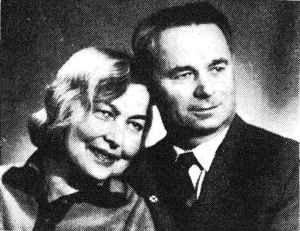
| David Erlich and his wife, Esther, on the eve of liberation |
|
|
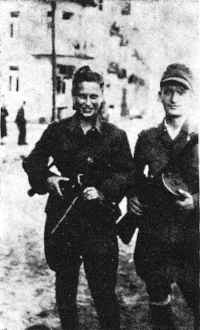
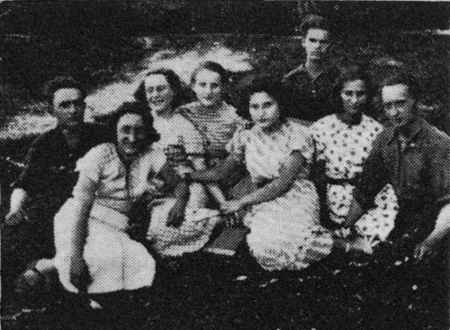
| Mordechai Aharon David's grandchildren: David and Chana Shisler and Malka Zisman. Between them: Henya, Yosl, and David Erlich |
[Page 372]
I already had a trusted peasant contact in every village, who would pass on important information. I joined several reconnaissance missions, spying on German army positions. We succeeded in killing twelve Germans on one of these missions, and took two machine guns along with many rifles.
We numbered more than 350 Jews, and were divided into four units. Our unit's name was “Revenge” It consisted of bold guys who were well armed and very disciplined. There was no shortage of food – we even had our own bakery.
Once, two partisans who went to a peasant's house to ask for food were invited to have a meal. As they were eating, they were shot to death through the windows. This incident strongly affected the others. News also came that the peasants were arming themselves with the assistance of the Germans. New orders came: liquidate the village. An unarmed Christian partisan was sent, pretending to seek work.. He lived in the village for several weeks, found out when the guard changed, how they were armed, and all their habits.
|
|
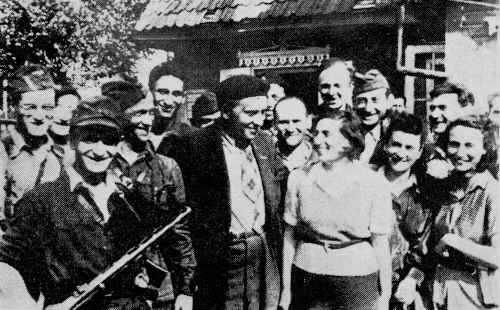
| David Erlich with a group of partisans welcoming the Russian Jewish writer Ilya Ehrenburg, who had come to visit their unit[9] |
[Page 373]
He passed all this information to us. It was decided that on a Sunday when a wedding was to take place in the village and all the peasants would be drunk, we would carry out the liquidation. Groups from each unit were designated, 140 men in all. Each group was at its position at dawn, encircling the village on all sides. The telephone line was cut, and all the incoming roads were blocked, to prevent incoming help.
All this was done with incredible speed. A red rocket went up, signaling the groups that were in charge of setting fire to the village. Very few peasants were able to escape the fire, and they, too, were shot. The operation was finished in two hours. The village had been erased from the face of the earth, and all the partisans returned safely to the forest.
News of the successful operation against the treacherous village spread throughout the region. The partisans' Central Command warned all the surrounding villages to give the partisans within a week all the weapons they had received from the Germans, or they would face the same fate as the village of Konyukhi. This announcement frightened all the other treacherous villages, which sent delegations to the forest, promising to hand over all their weapons, and to supply the partisans with food. They left ten peasants with the partisans as hostages, assuring the partisans they would not be harmed when they came to collect the weapons in the villages. The mood in the forests was much improved. The partisans were able to move about the villages
freely, the peasants were friendly, and gave them as much food as they wanted.
The news from the fronts were also cheering. The German armies suffered a series of defeats. After Stalingrad, the Red Army began to march back into Lithuania, liberating one city after another.[10] Finally, the news came that the Red Army was marching toward Vilna.
We emerged from the forest on July 10, 1944, near Vilna, and met up with the Red Army with its Jewish
[Page 374]
Vilna had already been surrounded, but the Germans continued to resist. The Red Army officers held us back, and we entered the city only on July 12, 1944. Shots were still coming from the rooftops, where a few German soldiers held out. Four of our partisans were wounded. But our fighting spirit was strong, and we burst into the city, liquidating the few German soldiers who were still fighting. Dozens of Germans fell to partisan bullets. We controlled the city, occupied the city offices, and began gathering the few Jews who had hidden in various places. They practically wept for happiness when they saw us. We greeted them with open hearts, fed them together with us, and made efforts to help them in any way we could.
For us, the young Zionists in the partisan movement, liberation also meant revival of the ideal of emigration to the Land of Israel.[11] By March 1945, I was in Lublin, the seat of the new Polish government. Two months later, at the end of May, I was already in Romania, from which I continued through Hungary and Austria. Finally, thanks to the help from the Jewish Brigade, I arrived in Italy, where we boarded a ship for the Land of Israel.
Our ship was captured by the British, who sent us to Cyprus.[12] It was only in 1947 that we arrived in the Land of Israel. I immediately joined the ranks of Etzel, and went on to serve in the Israel Defense Forces (IDF).[13] Together with many of my comrades from the forest, I participated in many battles of Israel's War of Independence.
Translator's footnotes:
by Sara Fishman-Shisler
There is much to tell about the bloody days from the time the Germans entered Grabowiec and their liquidation of the last Jews in our town. It is a story that should be told by each of those who survived, and engraved on the hearts of our children and grandchildren, for all future generations. My sister Itta and I are two of the few Grabowiec women who survived that horrible period of murder. Anything I could write would pale in comparison with what I endured. Therefore, I will present only brief fragments of my part in the Jewish resistance and the heroic battle of the Jewish partisans against the enemies of our Jewish people.
The events of the war followed upon each other in rapid succession. Jewish blood was shed in the town. Those who were able to tried to rescue themselves in the villages, but it was open season on Jewish life everywhere. Every day posed danger. The young people, however, refused to surrender so easily, and tried to link up with the partisans in the forest. Only few, though, succeeded. When I was able to penetrate the Harshev forest, I met Yirmiyah, from Grabowiec, with his son and two daughters, who were all later killed in that forest.[1]
The days in the forest seemed an eternity. We could not have imagined how much we would change in such a short time. I couldn't recognize myself. In my wildest fantasies I couldn't have concocted events such as those we endured in forests and in bunkers, tussling with
[Page 376]
bands of wild Poles as well as with Germans. Days and nights went by in terror, and fear gnawed at us – would we be able to survive? The only moments of cheer were when we carried out operations against the Germany army. But my sister and I often looked death in the eye, when we were saved from certain death only by a miracle. We saw the forest becoming soaked in Jewish blood, but also witnessed young Jewish men taking revenge on the German murderers.
It is important to remember that we constantly faced two enemies: the Germans and the Poles. They had both undertaken the mission of killing every Jew they encountered. Very few Poles were willing to help us. Roving bands lay in wait for us everywhere, like jackals around the flesh of wounded prey.
Life in the forest sharpened our senses, and taught us skills that we could only have acquired through danger. We learned all the vital signs and signals. As the saying goes, need is stronger than iron. The impulse to live vanquished terror and fear, and replaced them with faith that we would survive to witness victory over the Germans.
Life in the forest was intense, sometimes as excruciating as death itself. At times, we felt like stray sheep, with no shepherd, guide, or savior, but at the mercy of Fate, which could cut us off and annihilate us any minute. We were often barefoot in the harshest cold, wearing tattered rags, searching for a safe hideout in the forest snow and viscous mud. Winds pierced our skin, and our feet became swollen and bloody. At times, despair overtook us, and we felt that we were sentenced to a death that was sure to come sooner or later. That was when we were sometimes saved by a surprising turn of events that encouraged us to withstand the trouble and misery.
I can see the faces of my beloved comrades Moshe, Dovidtshe, Henech,
[Page 377]
Shmulik Smoliar, and Yurek. I cannot forget how eager they were to do battle with
the German murderers. They switched from defensiveness to acts of revenge. Both Russian and Polish partisans saw that Jews could fight with weapons, as well as the strength of our impetus to act, even when there was little chance of success. As if in compensation, our hearts were aflame, and we could not sit by, arms folded. I took a nursing course, in order to be useful in partisan operations; I could help our wounded fighters. I also learned how to operate weapons. Incidents and confrontations happened daily. Fate was certainly not compassionate. We were toughened by the changing circumstances. Many heroic young lives were cut short in clashes and battles with German soldiers. Each death of a valiant fighter was a terrible blow, and the dangers multiplied. The forest was constantly stirring with menace, and we had to be on watch ceaselessly, always remembering that German forces, which ruled half of Europe, lay in wait just outside. We were always aware that we were only the few who had escaped to the forest, which shielded us from the lurking enemy, whose murder machine operated ceaselessly. Protected by the forest, the partisans prepared their operations. We would leave at night. Over time, our resolve grew stronger and more resolute, and our battle plans became ever more daring.
Our everyday partisan activity included fighting against Ukrainian and Polish traitors, who worked with the Germans. Our unit liquidated quite a few such agents, who hampered our work and were active partners of the Germans. On one occasion we decided to settle accounts with peasants who had informed on a Jewish hideout. In a different village, peasants dashed into a forest where Jews and been hiding, and murdered them with axes and knives. We couldn't go near that village for a long time, because our numbers were too small
[Page 378]
to fight the many Germans who were there. Later, when our squad became stronger and we were encircled by fewer Germans, we took our revenge for all the Jewish blood that had been shed. We were not the only targets of the hooligans. They also attacked Russian and Polish partisans, spied for the Germans and gave them the locations of the partisans. However, there were also villages whose residents had a good relationship with us and were constantly in touch with our commanders.
I do not plan to describe all the battles our partisan unit took part in. Things were not always good. But our spirits did not flag. We were constantly on the move, and weren't deterred by the casualties we suffered. On the contrary, they only reinforced our desire for revenge.
This situation continued until the Russian army arrived and liberated the area. Many of our partisans joined the Soviet army. However, I continued to travel through Russian cities and towns, and witnessed the ruins of a destroyed Jewish world, though I always bore the memory of the Jewish heroes and their valor and dedication in the fight against Hitler's murderers.
All this describes only a small portion of my life in the forest. There is so much more I would like to say, but not everything can be told. There were so many events and experiences that cannot be put into words and set down on paper. Let my short sketches be a memorial to the Jewish heroes who took revenge for the innocent blood shed by the members of their destroyed families and fell in the heroic fight.
Translator's footnote:
by Yisrael Hustik
My cousin Simcha Hustik was one of the Jewish heroes who fought both in the partisans and in the Red Army's combat units on the war fronts. He came from a Hasidic family, and as a child absorbed the Hasidic enthusiasm for elevated ideals. He always strove for a better world.
|
|
| Simcha Hustik and his wife Rachele |
When the war broke out, he was one of those who rushed to the forest in order to wage an armed struggle against the Nazi enemy. He was able to join General Kovpak's First Partisan Division.[1] His friends gave enthusiastic descriptions of his daring exploits and battle expertise doing war with the Germans. He helped destroy German units and bridges, laid mines on roads, and disrupted telephone communications. Official documents confirm that Simcha Hustik was a shining example of heroism. Simcha exhibited the same traits after he joined the Soviet army, such as outstanding bravery at the risk of his own life. He was awarded high Soviet military medals by his commanding officers.
[Page 380]
His wife Rachele, the daughter of Kalmen David Licht, survived the war by posing as a Christian. She was assisted by the priest, a truly righteous Christian, in her struggles to stay alive in the face of the danger that lurked day and night, from the Brownshirt annihilators as well as from the Poles and Ukrainians.[2] Through all her trials she preserved her humanity as well as the innate nobility of a woman born and bred in Grabowiec.
We can only marvel at the survival power of these two Grabowiec natives, the genteel Simcha who became so adept at warfare and refined the iron will to fight to the last drop of blood, and sweet Rachele, who so cleverly withstood the terrible circumstances and became as tough as steel in order to escape the Nazi jaws of death.
They were among the few Grabowiec Jews who still live in Poland. However, like all of us, they carry memories of our town in their hearts, the place that formed their unyielding characters.
Faithful Translation from Russian
The People's Commissariat for Internal Affairs of the First Ukrainian Partisan Division, named for the twice-awarded Hero of the Soviet Union, Major-General Kovpak, November 11, 1944.[3]
Characteristics of the fighter, member of the First Ukrainian Partisan Division S. Hustik, Z. Shlomo (born in 1905), Jewish nationality, education to Class 5, not affiliated with a political party, member of the First Partisan Division since June 5 (some words are illegible due to rip in document).[4]
During his service in the Division, Comrade Hustik distinguished himself by his boldness. He was a daring fighter, devoted to the idea of the Leninist-Stalinist party and the Socialist fatherland. Comrade Hustik took part in the Stalinist march into the Carpathians, in a region of German national interests.[5] He also participated in the attack on the border of East Prussia.
[Page 381]
Comrade Hustik was wounded in battles against the Ukrainian nationalists. He was awarded the Medal for Valor as well as the medal for Partisan in the Great Patriotic War (Second Category).[6] He had rendered 25 Germans harmless. Comrade Hustik was a disciplined fighter, behaved honestly and conscientiously, and obeyed all the commands of higher-ranking officers.
[Signed] Commandant K.P., Hero of the Soviet Union (signature illegible), sealed with a round stamp bearing a five-pointed star centered on the text “Death to the German Occupier…”
Reference no. 761/1
The undersigned Eliasz Pileczki, Official Translator from Russian and Lithuanian, office in Wrzeszcz-Gdansk, at 9 Brzozowa St., affirms the accuracy of this translation based on the original Russian document.
Translator's footnotes:
by Yisrael Hustik
In the catastrophe that overcame us, no one knew what would happen the next day, and what even more devilish commands would be issued. “The living envied the dead,” as stated in prophecies about the end of the world.[1] I had received word that my parents and entire family were gone; I was secretly consoled by the knowledge that it was all behind them and they would not witness my suffering, nor had I witnessed their annihilation. I did not know what they had gone through, because even the wildest imagination could not envision the extreme acts of the Nazi monster…
I did not witness the events in our town, which began in September 1939. I was far from Grabowiec, in the “Shachriya” kibbutz training center in Baranowicze when World War II began. We, a group of teenagers far from home, heard the grim news on the radio. Cut off from our movement's central office in Warsaw, we were filled with anxiety for the future, but could not imagine what awaited us.
It was noon on the very first day of the war, when we were hit by the first German bombs, meant for the Polish radio station near our camp. Our camp was badly damaged: the doors and windows had been torn out, the cowshed was destroyed, the well caved in, and the courtyard was full of debris. The cows ran amok in the yard.
We were shocked by the speed of the events and the scope of the destruction. Everything I had read in literature about the horrors of war paled in comparison with what was happening to us. There had certainly never been anything like this in world history. The scariest part was that there was no escaping the terror, and the enemy could reach us wherever we were.
The war between Germany and Poland did not last long. In fact, only Warsaw kept fighting for about a month. Once the capital city surrendered, the war was over, for all intents and purposes.[2] The area of Poland was divided between Russia and Germany. Baranowice, near the Soviet border, was “liberated” by the Red Army. Moscow Radio announced that the Soviet occupation of eastern Poland was intended to liberate us from “the burden of the Polish nobility, which enslave the people.” In fact, we could have been be happy that the war was over, but
[Page 383]
we did not feel that way. The fate of our parents and family members who remained in the area occupied by Germany gnawed at us. Besides, the Soviet occupation authorities forbade us to leave the area we were in without special permits, especially for the German-occupied area. We couldn't stay in the kibbutz training camp, either, because work by all organizations had been prohibited. We decided to go to Pinsk, where we could at least be with our members who had stayed there. However, we couldn't stay in Pinsk for long, because the NKVD paid us regular visits and issued threats. We moved to the kibbutz training center in Vilna, where all the remaining members of the leftist Zionist youth organizations had gathered, and spent the winter there. When the Soviets came there, in the winter of 1940, we moved to Shavli in Lithuania.[3]
We had fled the war, with no possessions and penniless; we were far from home and cut off from information about our families. Shavli had been quiet until we arrived; we were the harbingers of disaster.
We re-organized, re-established our kibbutz groups, and deluded ourselves that the quiet would last and we would live out the war in Shavli. We hoped to make our way to the Land of Israel someday. But the Soviets soon conquered the Baltic countries, including Lithuania, and our illusions were shattered. Once again, we had to disappear from the prying eyes of the authorities and their minions, the Jewish Communists who were – like all collaborators and sycophants – extremely dangerous. Our kibbutz framework collapsed, and we had to go underground. “New” life stirred all around us, in which we did not share.
The presence of the Red Army gave us some confidence that we would be protected. Some believed that the Nazi army would avoid confrontation, and that the fate of Lithuanian Jews would be better than that of the Jews of Poland. This belief was based on the Molotov-Ribbentrop pact.[4] They mistakenly thought that Hitler would observe treaties. Their faith was quickly shattered.
The Soviet Union was attacked by German armies on June 22, 1942. By early the next morning, crowds of Jewish refugees had already streamed in from the towns bordering the German area. Their hair-raising accounts of German anti-Jewish acts sowed fear and terror in the hearts of the local Jews.
At noon that day, Molotov officially announced Germany's invasion of Russia and the occupation of Kiev, Kharkov, Zhitomir, and other cities. The Red Army had been surrounded, and began to retreat while doing heavy battle with the Germans. The Soviet forces had just barely cleared the Lithuanian borders when Lithuanian citizens began dancing in the streets and enthusiastically welcoming the army of new “liberators.” The Jews were now at the mercy of Lithuanian reprisals as well as German edicts. Once again, Jews began travelling desperately, this time towards the Russian border, in search of shelter and safety.
Groups of Jews flooded the roads, a sight that expressed the extent of our catastrophe. We were a people without a homeland. There was no escape – all roads were blocked by the German army, which was coming from all directions. After two weeks of desperate trekking, we returned to Shavli, which was in a state of confusion, with disasters following in quick succession. Most of the men had been arrested and executed at the outset.
[Page 384]
We were ordered to wear the yellow patch, that medieval mark of shame. Jewish property was confiscated and impounded. Jews were forbidden to use the sidewalks. We were interned in a ghetto. We could only bring as much as we could carry. The ghetto was too small for the Jewish population, and five or six families were crammed into a house that had previously housed a single family. We were marched out for hard labor before dawn every day; we returned at nightfall, exhausted and frightened by the events of that day. Hunger, disease, and uncertainty spread through the ghetto. The “Aktions” began. Every so often, people were taken out of the ghetto and never seen again. We began to hear about the liquidation of Lithuanian Jews who lived in small towns. They were taken out to the forests of Telsiai and Zagare, shot and dumped into pits. Survivors of the pits, considered dead by their murderers, made their way back to the ghetto. One of the few survivors who eventually returned had survived in the forests, chilled, hungry, and terrorized by the sights he had seen. One of these was a child named Yosseleh whose parents had been murdered in his presence. He had fallen into the pit with them, but remained alive. He made his way through the dead bodies, and was discovered, lost and crying in the forest, by a Lithuanian woman who brought him to the ghetto. The children's “Aktion” was the most atrocious the ghetto underwent. It took place on “black Friday.” All the children were taken, and the ghetto fell silent.
We knew that, we, too, wouldn't stay in the ghetto for long. We also knew that the vital work we carried out for the Germans was no guarantee of survival. Sooner or later we, too, would be liquidated. We had no choice but to live with this terrible knowledge. Escape was impossible, because there was no place of refuge. The Lithuanians happily joined the effort to round up every Jew found in hiding, dead or alive. We also knew about the following threat: “Every Jew who escaped would cause fifty Jews to be hanged!” Who was willing to protect his poor existence at such horrific cost?
We knew nothing about the death camps, as all the Jews taken from the ghetto were never seen again. Our connections with the outer world had been severed.
The order was not late in coming. The liquidation of the ghetto and removal of all Jews to death camps was proclaimed in 1943. From then on, our experiences defied human description. Would the rest of the world believe that it had all really happened?
Concentration Camps and Death Camps
The Stutthof concentration camp was on the shore of the Baltic, far from any observers, and was the first stop in the journey of horror, the likes of which we had never experienced.
The order “Out!” was given before the train cars came to a full stop. In the chaos, we all
[Page 385]
crowded toward the door, tripping and falling under the hail of blows that was raining down on us. A company of SS soldiers was marching towards us, their jackboots stomping in unison. The sight of their stony faces and the skull insignia on their uniforms froze the blood in our veins. We were handed over to them and marched to the camp. Our first sight of the camp beyond the gate was enough to make us doubt our sanity.
It was an enormous camp, enclosed by tall double barbed wire fencing and numerous lookout posts all around. Exhausted wraiths with shaven heads and wearing striped clothes moved around the yard. They were ordered by the SS men to run and drop, then get up and start running. When their strength was gone, they crawled on all fours, as the SS men swung their whips and laughed. Those who did not get up were left lying on the ground like filthy rags. They were Jews! Who knows how long they had been here? Where were they from? The horrible thought passed through our heads: one of our relatives might be among these ghostly figures, but beyond recognition.
I thought that if we had the strength to inform the world about its shame, our death would be easier. In any case, life had become worthless; after our arrival in this cursed place, our last spark of hope had flickered out. And who was there to hear us? It was the tail end of the world, and the tail end of life. I had no idea then that the world knew about us, and had remained silent.
We were taken to the disinfection building, as though we were following the Jewish ritual purification after death, and ordered to remove our clothes in view of the SS men. Naked, we were herded to a door marked “Medical Examinations.” I walked in, dazed. When my turn came, I was ordered by a white-coated man to climb up on a table, the likes of which I had never seen. When the man saw that I didn't understand him, he explained that there was going to be a gynecological examination; he was tasked with finding the gold that Jewish women were hiding in their private parts. In a state of shock, I burst out of the room screaming hysterically. Someone shoved me into the shower, where I was given a piece of soap and ordered to wash. The soap was stamped “RJF” for Reine Juden Fett – pure Jewish fat. I remember that after soaping myself with the horrible soap, I was pushed into a room and given clothing that was too small. Then I was finally outside. I think it was warm that day – it was the height of summer. But I was shivering. My mind was blank, and my eyes moved unseeingly.
That day lasted an eternity. Once, eons ago, it was called Shabbat. But after the destruction of the Jewish world, the sanctity of Shabbat was destroyed as well. The heavens were locked, and a dark terror came over the world. All the days melded together into a single Day of Judgment. No one was praying to the God of Vengeance. Humans had been trampled, and without humans there was no God.
[Page 386]
We were taken from Stutthof, once again in hermetically sealed train cars, wearing only one article of clothing clearly marked K.L.[5] Everything had been taken from us, including toothbrushes, combs, family photographs, watches and pens. We had nothing to connect us to everyday life in which time was kept, days were marked, and memories cherished. Not all those who had been taken from the ghetto and arrived at Stutthoff were in the cars. We had already learned that the left-hand row was always fatal. In the ghetto, as well, the Jews taken from the left-hand row had never been seen again.
I don't know how many days and nights we spent inside the sealed cars. We had no idea where we were bound this time. We all seemed to be lifeless, though our eyes were open. The rapidly turning wheels seemed to be carrying our lives off to their end. What awaited us at the end of this journey? We were told nothing, because we were nothing. My mind was empty of all thought, except the horrifying realization that the Germans had quickly been able to turn us into a frightened herd of cattle. We were no longer human, because we had no power over our own lives.[6] “They” were the deciders of our fate. We had no right to speak and protest. I felt helpless rage, useless because it was silent. There was only curiosity to see how it would all end…
The long journey was finally over. We were still alive. We had arrived at a remote destination, far from any sign of civilization: Camp No. 1 at Landsberg.[7] The same scene unfolded: the camp was surrounded by a high barbed-wire, electrified fence, punctuated by tall lookout points for the armed guards. Beyond the barbed wire lay empty pastures, and forest. We entered this “new world” as the gate closed behind us, seemingly forever. Here too, men with cropped hair, dressed in striped gray clothing, scurried frightened and beaten, their eyes extinguished. Jews from all over Europe! Even some of the vicious overseers (titled Kapo) were Jews as well.
They gave us men's striped clothing and our heads were shaved “because the curly hair of Jewish women was needed for mattresses used by the families of SS men.” We got fragments of ripped tallises to wrap our heads in. Jews met the same tragic end as their tallises. The rags of tallises on my head invested the prayer shawl with new significance.
Life in the camp was truly hellish. Our overlords, the SS men (themselves former prisoners) included various types of criminals and perverts who had been released for this special purpose. They had their own insane, cruel interpretation of the Nuremberg laws, and invented new forms of torture daily.[8] We would be forced to run aimlessly, or punished for no reason. Sunday, we were all punished. Thousands of us
[Page 387]
carried heavy rocks from one spot to another. When the rocks had all been piled up, we were ordered to return them all to their original location. The harsh work sapped the last of our strength. We were ordered to shovel snow while it was still snowing. These pointless tasks made life unbearable. The constant running to and fro, hunger, and cold cost the lives of thousands of Jews. New shipments of Jews arrived constantly, and the scenes recurred. All this, without a crematorium! If there had been a spark of hope that the suffering would end, many of those who collapsed would have held out. We served as guinea pigs for new drugs that we were injected with, or that were expected to lead to organic damage. In any case, the results appeared quickly: deformities, swellings, pus-filled wounds, and forgetfulness.
As noted, the prisoners constantly declined in number, and they were replaced by new shipments of prisoners. A shipment of men and women from Hungary arrived in 1944. Some of the women were pregnant, and we were apprehensive: what would happen to them? According to Nazi law, Jews were supposed to die, not be born. These women were the object of “special care” on the part of the Germans. They did not work, and enjoyed better food and housing. Their barracks furnishings included cribs and other necessities for babies. The care and preparation for the birth of Jewish babies was frightening. We were sure that a diabolical plan lay behind all this. And indeed, the skin of the newborns was needed for surgery on the faces of German officers wounded in battle.
The worst spectacle was that of the orchestra against the camp backdrop. It comprised musicians from famous European orchestras. The stage was the camp with all its horrors. Underground burrows and other-worldly figures supplied the scenery. The background was the barbed wire fencing and the locked gate. The music accompanied the collapse and death of the Jews who expired of starvation, illness, and terror, as well as the wagons full of corpses…
We were cut off from the world and knew nothing about events on the war fronts. Nevertheless, news occasionally came of German defeats on the Russian front. This news raised our spirits a bit. However, it was absurd to hope that we would survive and live to see Hitler's downfall. The daily addresses by the camp commandant promised that if Germany lost the war, the Jews would not live to witness it – they would all be dead by then.
The second half of April 1944 was a time of increasing nervousness among the Germans, who eased their tension by increasing our suffering. We realized that decisive days were coming fast. What would become of us?
We weren't taken out to work in the last week of April. Our tension and fear increased. Thunder from the Allied cannons was audible. We expected their forces to enter Landsberg that evening. However, in the afternoon we were ordered to move out.
[Page 388]
We were moved out of the camp, enroute to the “final solution.” Rescue was so close, but we had been taken away, to Dachau, where the crematorium was still operating.
During the 24 hours we spent in Dachau, we starting going into the gas “showers.” However, before the SS guards were able to cram us all inside, strong bombardment of the city of Dachau began. It was our salvation. The guards fled and hid from the bombs, and we burst out. We hoped for death by the liberating bombs, but none fell on the camp…
The few lines above encompass the entire tragedy of hundreds of thousands of Jews from all over Europe, and of my own Via Dolorosa. The years between 1939 and 1945 were a blend of endless nightmares. I did not see the color of the sky or sunlight; but of course the sun rose and set, and there were seasons of spring and summer. During those years of fury and deathly terror, I consoled myself with the thought that my dear ones, at least, were not undergoing my suffering because they were no longer among the living. I believed that my sister, aunt and her family in Russia would not undergo such horrors.
Neither did I think of Grabowiec, because in the absence of my parents and relatives, and all Jews, that town meant nothing more to me than any other place on earth. Now, when my thoughts carry me there, I think of the period before the catastrophe, when the distant town was peaceful. That is where I was born and lived as a child and young girl, and forged the connection with the Zionist movement that led me to emigrate to the Land of Israel. This connection determined the later course of my life and of all the survivors. The memories evoke longings for the lost world from which I was uprooted and cut off. Everything now seems enveloped in light, although in reality there were shadows as well. It is only natural that in our memory the past shines brightly, and disappointments and pain are shoved to the background and forgotten.
An entire branch of Jews has been annihilated, and is replaced by memorial books. Jewish cities, towns – worlds of desires, joys, and concerns, dreams and hopes were all lost in an instant. The nation was exterminated, with no Kaddish or headstones; they did not join their forefathers in Jewish cemeteries…
I pray only that these pages and words will convey the power of the martyrs' last screams, lost in a world bereft of compassion, where hatred and cruelty reigned, striving to kill and wipe out the very last Jew.
[Page 389]
Let these pages and words serve as a Kaddish¸ a prayer for the dead: “Exalted and hallowed be the names of our martyred parents, brothers, and sisters, who were murdered gleefully in cold blood, through no fault of their own”:
Our father, whose life was not easy – Efrayim Zilberzweig, of blessed memory.
Our mother, who was wise and intelligent – Zvia Zilberzweig, of blessed memory.
Our brother, the child who was cut down before he had fully lived – Shmuel Zilberzweig, of blessed memory.
Our grandmother, the peerless housewife – Hessia Klinger, of blessed memory.
Our aunts, Mother's sisters, and uncles, and their children,
Frida and Avraham Eynes and their only son Mordcheleh, of blessed memory.
Chaya and Yosheh Eynes, their lovely daughter Leya and their sweet son Mordechai, of blessed memory.
My aunts and uncles, Father's brothers and their families, our relatives close and distant, from Wojslawice, Chelm, and Warsaw, who died in crematoriums and killing pits, among the six million members of our people who were exterminated in the annihilation.
Cursed be the soil of Poland, which concealed the blood and ashes of the murdered Jewish nation and did not heave inside out.
Cursed be it for producing flowers and wheat instead of being destroyed like Sodom and Gomorrah.
Translator's footnotes:
|
|
JewishGen, Inc. makes no representations regarding the accuracy of
the translation. The reader may wish to refer to the original material
for verification.
JewishGen is not responsible for inaccuracies or omissions in the original work and cannot rewrite or edit the text to correct inaccuracies and/or omissions.
Our mission is to produce a translation of the original work and we cannot verify the accuracy of statements or alter facts cited.
 Grabowiec, Poland
 Yizkor Book Project
 JewishGen Home Page
Copyright © 1999-2026 by JewishGen, Inc.
Updated 07 Sep 2026 by JH