 |
|
[Page 259]
by Lola Bader
Translated by Mira Eckhaus
|
Is it true that the destruction has come
on my father, my mother? Where are you?
Where shall I seek you in my thoughts?
Will it ever be possible again?
My dear and only father …
Silence all around – only the ticking of a clock on the wall is heard.
And only our fervent hearts – that love you so much
|
|
| Budzov 8, 1942/43 | (Translated from Polish) |
Translated by Mira Eckhaus
The Synagogue
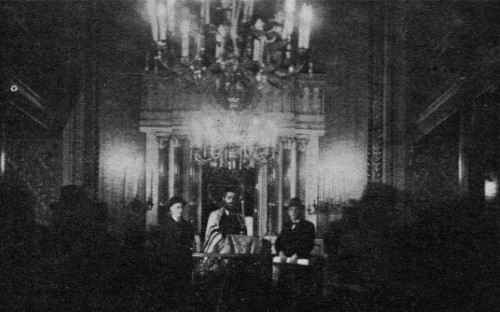
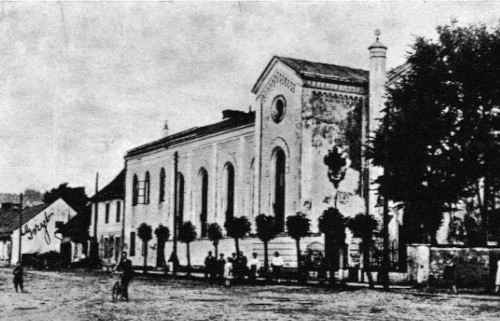
The synagogue in Andrychów was established in 1885. The settlement was at the peak of its economic prosperity at the time, and the congregation ensured that the synagogue will be built in a magnificent manner, in the style of the modern synagogues in Germany, and that it will glorify the entire settlement.
[Page 260]
Most of the money needed for the construction of the synagogue was donated by the head of the congregation, Moritz Unger, from his own money. A plaque was erected at the entrance to the synagogue commemorating his generous act.
The synagogue had six hundred seats. A special gallery was built for women. The synagogue had wonderful acoustics. The painting work was done by Avraham Tiberger of Zator, the grandfather of the writer of these articles. Shortly before the war, the walls were repainted.
On Shavuot, the doors, pillars, and the Ark were decorated with fresh tree branches. On Yom Kippur, even the most extreme “progressives” visited the synagogue, and the rabbis would speak with emotion and enthusiasm. Even on the day of Herzl's death, a festive rally was held here with the participation of large crowds. Even on government holidays, a grand celebration was held in the synagogue in the presence of representatives of the municipality, the police, and other public institutions. We also remember the magnificent wedding ceremonies that were held in the synagogue.
|
|
| The synagogue in Andrychów |
The synagogue was the center of life for Andrychów Judaism.
In recent times, Hanina Goldfinger served as the chazan of the synagogue. He had a wonderful voice and his prayers attracted crowds of people. The Poles were fascinated by his performances during government celebrations. He also served as a Shochet and Bodek. He was killed a few months before the outbreak of the war, in 1939, in the city slaughterhouse, by a gun that the Poles used to stun the animal before its slaughter. At that time, there was an acrid polemic in Poland against
[Page 261]
kosher slaughter, and as a result, the slaughter law of the well-known anti-Semite Peristor was enacted.
In a dying state, Goldfinger was taken to the Wadowice Hospital, but died on the way without regaining consciousness. The police found no trace of the murderer and determined that it was a case of suicide, which of course was contrary to his religious views and tradition. He was observant and a passionate Hasid. He left behind a widow and two children.
The method of the murder and the police investigation were the first signs of a tragedy that hovered above the Jews of Andrychów and all of Poland.
On November 25, 1939, the synagogue was burned by the Nazis. Jews were busy clearing the rubble and they tried to destroy all the bricks, because the Nazis' plan was to sell them to the Poles.
|
|
|
A festive ceremony in 1937 to mark completion of comprehensive renovations
carried out in the synagogue From the left: Dr. Joachim Lowicz, Rabbi David Avigdor, Bernard Stamberger |
Community Buildings
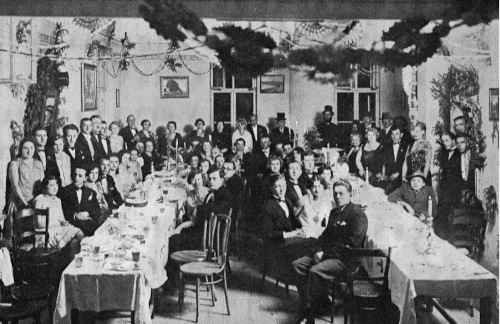
In the years 1922-24, the community building was built, which had two floors. This house housed the community offices, public institutions and the Zionist Organization. It had a large hall for weddings and banquets. It was also used for gymnastics, dramatic performances and lectures.
The community office had a library containing thousands of books. After the outbreak of the war, the Nazis transferred the books to the Czestowiczka factory, where they were burned in ovens.
The community building remained intact and was converted into a carpentry shop during the war.
[Page 262]
|
|
|
The hall of the Jewish Community Building
Photograph depicting a wedding meal |
[Page 263]
The Religious Life
The community was composed of 80% “progressive” and 20% Orthodox. For the Haredim, a Beit Midrash was built by the synagogue. Above the Beit Midrash was the rabbi's apartment. On Sukkot, Rabbi Avigdor would invite the entire congregation to “Kiddush” in his Sukkah. The Sukkah was large and magnificently decorated. The rabbi received all the guests with great hospitality and hosted them with great kindness.
On Shemini Atzeret, the Chevra Kadisha held a large “Kiddush” in the community offices.
On Simchat Torah, there was great joy among the Jews. Traditional Hakafot were held, which were organized by Hasidic groups, and the entire community took part in this joy, accompanied by about hundred Torah scrolls that were in our community. Hasidic dances were also held.
Before Passover, kosher matzahs were baked in a special oven under the supervision of the rabbi.
The Haredim were not zealous. They were content with keeping the 613 commandments and were innocent in their entire way of life. They were an example to the entire city in their loyalty and honesty. They also excelled in mutual aid and support for the poor. Despite the dire economic situation, they had time to come to the Beit Midrash and continue studying Torah and serving the Creator.
It is especially worth mentioning the memory of the Baal Kore Pinchas Zweig, a wise scholar, infused with religiosity, whose lifestyle served as an example to others; Chaim Goldberg and Shmuel Spanglet, who were good-natured and concerned with the needs of the community; and chazan Moshe Rosbach, a scholar of Torah and beloved by all.
The Cemetery
The plot of land for the cemetery, on a hill called Gornitsa, was purchased by the community in a purchase contract dated May 5, 1884. It is listed in the Andrychów estate book as plot no. 58. The cemetery was founded about ten years before the Wadowice cemetery. It and the old cemetery in Zator were the only burial sites in the entire district until 1894. Until 1884, the deceased were buried in Zator.
The members of the Chevra Kadisha fulfilled their duties with loyalty and dedication.
After World War I, Henrich Abel served as head of the Chevra Kadisha, and more recently, Yosef Silberman.
The cemetery remained intact, and to this day one can marvel at the respect that the residents paid to the dead by erecting magnificent tombstones made of precious stone, mostly Swedish granite. This is also evidence of the wealth of the Jews of Andrychów. All the tombstones, including those made of precious stone, have remained intact to this day and in their places, a phenomenon that also testifies to the cultural nature of the population in Andrychów. There were towns in Poland, including Myślenice (see below: Myślenice Holocaust), whose tombstones were removed from their cemeteries during the war and used to pave the sidewalks.
Over time, some of the tombstones sank into the ground and needed repair. In 1961, the walls and the house next to the cemetery were repaired by the Krakow community, and for these repairs, materials were taken from the purification room which was about to collapse.
[Page 264]
|
|
|
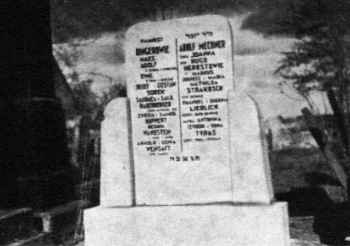
Monument erected in 1946 at the Andrychów cemetery
in memory of the families perished in the Holocaust |
Participation in the City Council
The City Council consisted of:
In 1867 – ten members, two of whom were Jews
In 1894 – twenty-four members, three of whom were Jews
In 1927 – forty members, eight of whom were Jews
In 1939 – sixteen members, one of whom were Jews
These numbers indicate that at certain periods some Jews were elected by the votes of the Poles, because the Jews were known as honest, energetic public figures and activists for the benefit of the entire city. For example, the management of the construction of the famous swimming pool was entrusted to council member Bernard Stemberger. Many rights in working for the city were attributed to council members Julius Israeli, Mauritzi Unger and Joachim Grynszpan in the second half of the 19th century.
There was cooperation between Jews and Poles in the council. The Jews voted in favor of proposals to provide aid to Poles whose homes had been burned, or for the establishment of a Polish poorhouse and for the repair of the local church, and the Polish members voted (1897) in favor of a proposal to approve a budget of 17.50 guilders through the community for poor Jews.
It is worth citing proposals preserved in the minutes of council meetings, which are typical for this period:
At the meeting dated February 8, 1884, Mauritzi Unger volunteered to establish a fund of hundred guilders in his name, to provide assistance to poor students at the elementary school in Andrychów, on the condition that on the first-year Polish children will benefit from it and the second-year Jewish children will benefit from it.
[Page 265]
At a meeting dated November 24, 1893, a debate took place on whether to approve support for the Ruthenian National Theater in Lviv. A member of the city's executive committee, Julius Israeli, opposed it, saying that when the Polish Theater was built in Krakow, we had not heard that the Ruthenians helped in any way with the construction. The proposal was rejected.
Economic Life
In the second half of the 19th century, the domestic textile industry, which had existed in Andrychów for centuries at the initiative of the Jews, became a modern industry that gained a reputation throughout Europe. Its products: cloth (Drelichen), percale (Blaudrucke) and gobelin conquered markets in Austria and over time also in Hungary, Bosnia, Herzegovina, Romania and Bulgaria.
Over time, the textile industry ceased and in its place the percale and aperture (printed fabrics) industry developed. According to the 1913 Industrial Directory (Andrychów Municipality Archives), before the First World War the following were employed in the factories:
Factory of Theodore Felix – forty workers
Factory of Yitzhak and Adolf Michner – forty-two workers
Factory of Ferdinand and Bernard Stemberger – thirty workers.
This industry later developed even further, and these factories, together with the factories of David Krumholz and Leopold Stemberger, employed over hundred workers each.
As described above, with the establishment of Poland, Andrychów could not compete with the cheap goods flowing from Lodz and its industry was forced to close. In the last years before World War II, only Bernard Stemberger's factory remained. The rest closed their factories themselves. Thus, this industry, which was founded on sound foundations and which had developed successfully for several generations, disappeared.
Joachim Grynszpan, who excelled in the gobelin industry, came to our city from Krosno in 1864 and established the first goblin factory in our city, in which forty workers were employed. His goblins were so excellent that Emperor Franz Joseph I appointed him as a supplier to the royal court. After his death, his son Nathan continued the business until shortly before the outbreak of the war.
Joachim Grynszpan also initiated the establishment of a large textile factory in our city. After obtaining the consent of the municipality and the promise of its help, he turned to the National Committee of the Commissioner in Lviv, and it approved a loan of 400,000 crowns for ten years, subject to provision of financial guarantees. But he was unable to obtain the guarantees. The Czestowiczka brothers, Jews from the Czech Republic, took advantage of this offer on his behalf and provided the financial guarantees, and thus this enormous factory was built in 1906-7. It grew every year and in the last years before the war it employed about 4,000 workers and hundreds of clerks, and its products were supplied throughout Europe and even overseas. Thanks to the energy and Jewish capital invested in this factory, the entire city became rich and acquired a reputation throughout Poland.
Among the Jews who were employed at the factory, mention should be made of the chief accountant Ignacy Weisberg and the foremen Friedrich Weissik, a native of Wadowice, Henryk Silbermann and Josef Rosenberg, who graduated from the famous textile school in Żukowo.
[Page 266]
After the war, the factory was nationalized by the Polish government and it was expanded by building a branch in the former chemical fertilizer factory (owned by Matityahu Jakubowicz) in Mucharz.
We mentioned above several Jewish employers who helped the economy of the city of Andrychów. In order to give a more accurate picture, we think it's essential to provide the following list. Unfortunately, the list is not complete:
Mauritzi Mittler – Leather processing factory.
Nathan Aharon Klapholtz, Shimon Koren – Lime factory.
Shlomo Farber – Cement products factory.
Shimon Bader, Ludwig Enoch – Factory for soda and juices.
Professionals:
Lawyers: Dr. Joachim Lubitz, Dr. Landau.
Doctors: Dr. Obzhansky, Dr. Shimon Messinger, Dr. Adolf Zeilender.
Pharmacists: Dr. Henrik Hess.
Dentists: Adolf Goldberger, Shmuel Monderer.
Merchants:
Leather trading house – Israel Tyras, Schnetzer.
Iron trading house – Shlomo and Max Hamer, Shmuel Neiman, Isidor and Wilhelm Kornhauser,
Leopold Stemberger.
Beer bars – Adela and Herman Enoch, Max Batstadt, Zygmunt Lieblich.
Manufacturing – Eliyahu Gutter, Gusta Goldberg, Adolf Weinsapt, Felix, Wilhelm Pilzer, Jacob Friedhaber, Shlomo Kinstlinger, Jacob Rothbart, Shmuel Spanglet.
Knitting products – Pinchas Zweig, Liba Shpanglet.
Food wholesaler – Yaakov Gazhiv.
Groceries – Goldfinger, Tyras, Shimon Mel, Marcus Moses, Jacob Ringer.
Butcher Shop – Hankam, Shaul Siegel.
Dairy – Goldberg.
Kiosks – Ignatzi Silbermann, Krieger.
Restaurants and schnapps bars – Ferdinand Better, Joseph Silberman, Mauritzi Langer, Shlomo Farber, Shlomo Rauchberger.
Heating materials warehouse – Shmuel Ringer.
Transport – Chaim Lermer, Yezhy Mittler.
Craftsmen:
Shoemaking workshop – Panzer
Watchmakers – Chaim Goldberg, David Zilbershitz.
Tailors – Zilberman, Stefania Koren, Eliezer Kichler.
Glazier and upholsterer – Shmuel Hirsch.
Hatter – Yaakov Haftel.
Tinsmiths – Bernard Marmore, Reich.
There were also salaried officials, most of whom were busy at the Czestowiczka Brothers' factory.
[Page 267]
Most of the above people perished in the Holocaust by the Nazis. They were all honest and productive people, whose tireless labor benefited the entire population.
The Jews of Andrychów had been rooted in the city for generations and until World War I did not think about leaving the city and would invest their savings in building houses and establishing factories. Most of the houses in the city center were built by Jews. The decent relations that prevailed between Jews and Poles also had an encouraging effect on the economy. Indeed, until almost World War I, no anti-Semitism was felt even from an economic perspective, because there were enough livelihoods for both Poles and Jews.
Only from 1919 did major changes occur. Anti-Semitic movements arose, which began to push Jews out of commerce and the economy, and every year the economic situation of the Jews worsened. Jewish youth, who saw that they had no future in commerce, began to seek new paths by learning various trades, so that they could join the pioneer movement and immigrate to Israel.
The Zionist Movement
Herman Gazhiv was one of the first active Zionists in Andrychów, and in 1912 he founded a scout organization with a general Zionist program. Beginning in 1916, Prof. Michal Berkowitz of Bilitz, who at the time was Herzl's secretary, would visit our city and appear at Hanukkah rallies. He would lecturer on current affairs.
After World War I, Herman Hamer reorganized the movement and was very active in it. He would also lecture on Zionist topics in the nearby towns of Wadowice, Kalwaria and Kanty. When a training point was established in Nidek and Glambowice next to Andrychów (most of the Nidek group were residents of Wadowice), it was the Jews of our city, headed by Herman Hamer, who provided them their daily needs.
Another association that was active at that time was the Zionist Women's Association (WIZO), founded by “Union” (Andrychów Women's Association: Froyeon Paren), which will be discussed below. Among the members of WIZO, the following women were outstanding: Regina Weinsapt, Berta Wolf, Ella Landau, Mania Lubitz, Penny and Betty Krumholz, and Berta Kuperman.
WIZO's extensive program of activities included holding lectures, performances, and fundraising for the Jewish National Fund and for philanthropic purposes.
At the initiative of engineer Max Felix, Rabbi Dr. Yehoshua Ton, one of the great leaders of the Krakow Zionist movement, once appeared in our city as a lecturer.
In the years 1925-30, there was a Hashomer Hatzair nest in the community building. The famous Felix family provided the nest with a house and land to train the youth in agricultural work. Several Haredi members also secretly participated in this nest. Two of its members, Artur Neiman and Arnold Reich, immigrated to Israel. However, due to supposedly revolutionary activities, they were returned to Poland by the Mandatory government in 1936 and were killed by the Nazis during the Holocaust.
From 1930 until the outbreak of the war, all Zionist activity was transferred to the Zionist youth movement “Akiva”, founded by Paula Biter of Dziedzice. This movement
[Page 268]
gained the support of the entire community, headed by Rabbi Avigdor. There was great participation in the Hebrew language courses and the history of our people, and it was necessary to organize three classes according to age. The management was alternately handled by Stella Weinsapt and Nathan Goldberg, and finally by a committee which was composed of the members Itke Lerner, Greta Kichler, the writer of these articles, headed by Bernard Marmor.
Every month, donations were collected by these organizations for the national funds. Initially, the collection was carried out under the supervision of Arnold Weinsapt and the engineer Max Felix, headed by Isidor Krumholz at the head. When Isidor Krumholz left the city in 1937, the “Akiva” movement was engaged in this operation and the treasurer was Mr. Seidenfeld. The main source of income was from boxes found in every house, donations at weddings and family celebrations, registration in the golden book of the Jewish National Fund, etc. The “Akiva” youth also engaged in the sale of “shekels”. Thanks to this vigorous operation, tens of thousands of zlotys were collected in our city during the interwar period and transferred to the center in Krakow.
In 1935, “Akiva” members Stella Weinsapt (Doron) and Victor Silberman, who are nowadays living in Israel, immigrated to Israel. Also, in 1934, the following immigrated to Israel: engineer Max Felix and his wife, Motz Horowitz, and one of the Czestowiczka brothers.
One of the active members in “Akiva” movement was Maya Veksburg, an outstanding teacher and educator, who, after graduating from high school in Kanty and training as a teacher, ran courses in Andrychów for youth in a distinctly national and Zionist spirit. She had many privileges, as during the war the doors of schools for Jewish youth were closed, and she continued her educational work under difficult conditions, also running a kindergarten in Andrychów and later in the ghetto and in Dobice. Her character is described in various places in this book.
Recently, attempts have been made by Adolf Hess to organize a “Gordonia” movement, but without results. More successful was the Trumpeldor Alliance movement “Beitar”, which operated mainly among youth from the ages of 10-15 and established a camp on Mount Kotziz. The commander was an emissary from Israel named On. He ran the camp on clear national and disciplinary principles. At the outbreak of the war, this camp was in full swing, with at least two hundred participants from Bilitz and nearby towns.
The youth in Andrychów, who was educated in a national and traditional spirit, carried the Zionist flag with pride. The youth had only one goal – to immigrate to Israel! Only because of a lack of certificates did it not make Aliyah. The idea of ??Aliyah accompanied the youth to labor camps during the Holocaust or to the Russian steppes. Even then, he continued with this dream and with this desire passed away. Only a few were privileged to survive the horrors of war and the Holocaust and immigrate to Israel.
Education
In the description of the establishment of the community, we wrote about the reasons why until 1879 there was a separate elementary school for Jewish children. From 1879, Jewish children began to study together with Christians in a state school. In the state school, the curriculum also included the Jewish religion and the history of our people. The special lessons for Jewish students were given by the local rabbi, Rabbi Abba Metzner, and after his death by Rabbi David Avigdor. The rabbis were qualified to teach in a state school.
[Page 269]
Most of the youth continued their studies at a secondary school in Wadowice or Bilitz. Students who could not afford to rent a room were forced to get up early in the morning and travel by train to school, preparing for their lessons after returning home late in the afternoon. The youth did a great effort to fulfill their desire to acquire an education and obtain a matriculation certificate.
From about 1930, a kindergarten was established in Andrychów, run by the certified kindergarten teacher Malka Bergman (Waxberg) from Kuty. She was also proficient in Hebrew and devoted herself wholeheartedly to providing the children with the basics for acquiring the Hebrew language. She also taught Hebrew songs.
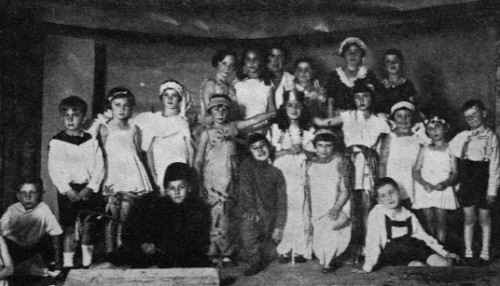
The establishment of the kindergarten was initiated by Rabbi Avigdor, Aharon (Arnold) Weinsapt and Chaya Felix. They also took care of its budget. During Hanukkah, plays were held for children in the community hall, and in blue and white bags, sweets and fruit from the Land of Israel were distributed to everyone.
The youth had a great desire to study, and wealthy parents would bring special teachers from the big cities, who gave lessons in general education, foreign languages ?? (English and French), and music, especially piano playing.
There was a “cheder” where the children, in their free time from their studies at the elementary school, studied the Bible with Rashi's commentary and writing in Yiddish and Hebrew. Teacher Elisha Szpilman and his predecessors made vigorous efforts to instill in the hearts of the students the spirit of Judaism and tradition that would bind them in close ties with the Jewish people and the Land of Israel.
Charitable Institutions
For many years, there was a Jewish women's association in our city called “Union” (Froyeon Paren), which cared for poor pregnant women, the poor and the sick, and also trained poor girls in various professions. The founder was Regina Felix, the wife of Theodore Felix.
For many years, the operation was headed by Adela Enoch, who is described below in the characters section. The committee included:
Cornelia Ebel, Antonina Hamer, Berta Krumholz, Berta Better, Regina Weinsapt, Berta Ringer, Sela Goldberger, Mechner, Melania Stemberger.
In particular, the dedication of Antonina Hamer (now lives in Netanya) to the association should be emphasized. She invested a great deal of effort and money while treating patients.
Adela Enoch and Regina Weinsapt were deported to an extermination camp; Cornelia Ebel traveled from Russia to Persia, hoping to immigrate to Israel, but died in Tehran from an infectious disease on the way. Berta Better, who was exhausted, was shot in her bed in Andrychów during an Aktsia conducted by the Nazis.
There was a Bikur Holim society, headed by Israel Tiers. The society treated poor patients who needed medical help.
The poor who came from outside the city were treated by Chaim Goldberg and Bernard Goldberger. They would collect money from the public and provide one-time support to the poor so that they would not have to go door to door. In preparation for the holidays, the community distributed food and clothing to the poor, and during the Passover holiday, a “Kamcha de Pascha” event was organized, and matzah and wine were distributed among all the poor families.
[Page 270]
It is worth noting the participation of all residents in providing assistance to the city's poor in any case. This willingness was one of the closest ties in the unity of the Jews of Andrychów. Everyone, regardless of class or party, became one family when the need arose to save a Jew from distress.
Culture and Sports
The youth who aspired to a cultural life in a healthy body found satisfaction in the “Maccabi” sports association, which existed in our city for many years. Almost the entire Jewish population of all political stripes and party views participated in “Maccabi”, and thus this association became a cultural center for the entire city.
The chairman of the association was Bernard Stemberger, followed by Dr. Shimon Messinger and Siskind.
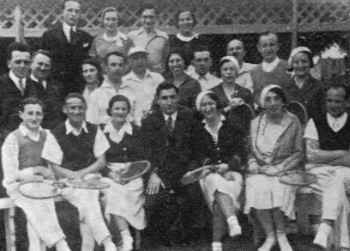
The living spirit in it was Avraham (Adolf) Stemberger, a man full of energy and in close relations with the youth. He organized all kinds of sections and meetings. Joseph Rosenberg helped him with administrative matters. There were sections for gymnastics, ping pong, winter skiing, tennis, swimming, soccer and basketball.
The community made its hall available to the association for gymnastics exercises. The association had tennis, athletics, and basketball courts.
“Maccabi Andrychów” had great achievements in competitive games. The ping-pong team took first place in the Wadowice district; the basketball team moved to the “A” league of the Krakow region. The swimming section also had great success. For several years, members of the sports association in Bilitz were guests of the Andrychów section during the summer and trained together in the famous swimming pool of the Andrychów municipality. In the race competition held in Zakopane in 1935, Zygmunt Forszyram from the youth team and Lula Bader from the women's team came first.
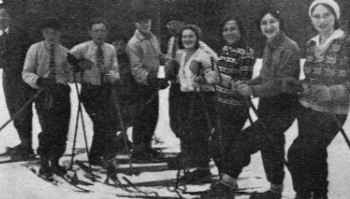
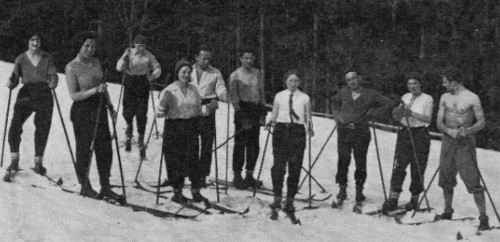
The “Maccabi Andrychów” association built a hostel on Mount Kotziz, 10 kilometers from the city. The settlement benefited from this enterprise thanks to the intensive work of Max Hamer, head of the winter skiing section, and his assistant Yitzhak Koren. In the winter, carts with ski enthusiasts went to Kotsiz almost every week and it was possible to spend the whole day on slides on a track that stretched for several kilometers. In the summer, trips were organized in the wonderful surroundings of the Beskid ridge.
The instructors were Adolf Stemberger, Daniel Gross, Haskel Goldberg, Itke Silberman and Lola Bader. Their dedication to the work was great and the results were wonderful.
Among the first to cultivate the sport in Andrychów was Shmuel Ringer, who was one of the best winter skiers in this sport. He did a lot for the public, especially in the field of sports, and to mark his efforts and achievements, a festive party was held in his honor on his 50th birthday.
After the war, in 1946, Shmuel Ringer erected a memorial stone in the Andrychów cemetery in memory of several families who perished in the Holocaust (a picture of the stone is given in the cemetery chapter). He and his wife Berta immigrated to Israel and died a few years ago. Their daughter Rania (Ferber) lives in Haifa.
[Page 271]
|
|
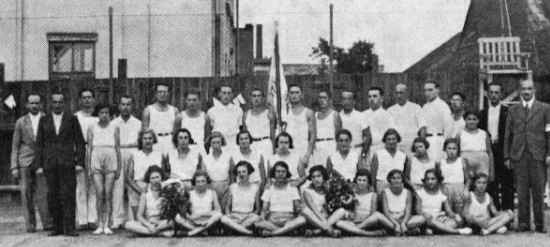
| Sports festival held on the 15th of August 1935 | |
|
From the right first row: Ringer, M. Weksberg, L. Kornhauser,
M. Betstadt, A. Stamberger, R. Korn, M. Rauchberger, M. Langer, T. Tyras Second row: R. Ringer, I. Weinsaft, H. Goldberg, L. Bader, G. Kichler, G. Goldberg, B. Langer, J. Silberman, J. Ebel Third row: Tyras, M. Bader, Szancer, D. Has, E. Vorschirm, Rozenberg, Süsskind, A. and St. Stamberger, Ch. Silberman, Z. Langer, Z. Vorschirm, W. Sibert, A. Betstadt, H. Silberman, /–/, N. Spanglet, Rauchman, A. Goldberger |
“Maccabi Andrychów”, for its extensive activities and the pleasant social atmosphere that prevailed between its lines, constitutes one of the great chapters in the history of the Jews of Andrychów.
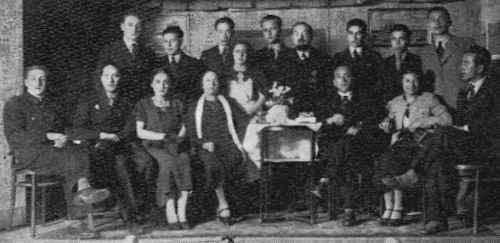
There were many theater enthusiasts in our city, and they founded a dramatic group that organized various artistic performances under the direction of Adela Enoch, Regina Weinsapt, and Adolf Stemberger. The sisters Irena and Stella Weinsapt, and Lonia Krumholz (Rambyszowska), were considered talented actresses. The group that performed plays with a backdrop of Hasidism and biblical themes particularly excelled. The plays were staged at every opportunity, with the aim of satisfying the fans and at the same time serving as a motive for donating funds for public needs. On Purim, in particular, there were plays and entertainments such as the sale of Joseph, the redemption of the son, etc. Adolf Stemberger and Moritz Bader with their groups would go from house to house, creating an atmosphere of general joy, and on this occasion, they collected funds for the Jewish National Fund.
There was also a dance class led by Miriam Stemberger.
[Page 272]
|
|
| A group of actors in Andrychów, after a play | |
|
First row, seated, from the right: Moritz Bader, Hella Goldberg,
Adolf Stemberger, Regina Weinsapt, Lola Rauchberger, Jacob Weinsapt, Zygmunt
Forschiram Second row, standing, from the right: Chaim Zilberman, Yitzhak Koren, Zygmunt Langer, Mozes, Naftali Spanglet, Adolf Ringer, Walter Sievert, Emil Vorschirm |
|
|
| The tennis section |
|
|
| Winter Ski Group on Mount Kotziz in 1931 | |
|
From the right: Weinsapt, Hilda Better, Margot Greenspan, Goldberg, Emil Vorschirm,
Zygmunt Vorschirm, Leon Ferris, Walter Sibert, Ernst Ebel |
|
[Page 273]
|
|
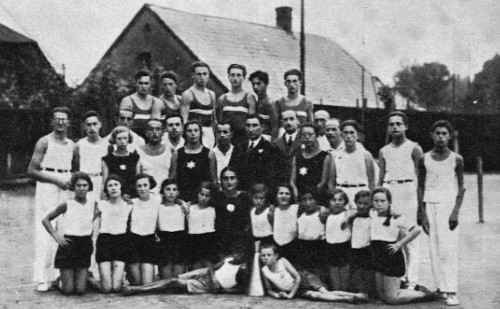
| Sports Day from around 1933 | |
|
Kneeling: Irena Silbiger, Mia Batstadt, Mala Kornhauser, Irena Messinger,
Gina Zweig, Rosie Ringer, Lola Rauchberger, Irena Weinsapt, Süsskind, Mathilde Rauchberger,
Malka Zweig, Rosia Koren Standing, third row: Wilhelm Schneider, Nathan Spanglet, Stefan Stemberger, Naftali Spanglet, Rosenberg, Zinke Silbermann, Tyras, Dr. Messinger, Henrik Silbermann, Itke Silbermann, Süsskind, Adolf Stemberger, Berta Langer, Fromowitz, Adolf Ringer, Adolf Betstadt Fourth row: Zygmunt Langer, Loshik Schneider, brothers Zygmunt and Emil Vorschirm, Walter Sibert, Daniel Gross |
|
|
| Winter ski team, in 1933 | |
|
From the right: /–/, Malka Bergman, Adolf Stemberger, Lola Rauchberger,
Cuba Reich, Kobi Krumholz, Goldberger, Walter Sibert, Margot Grynszpan, Hilda Better |
[Page 274]
|
|
|
At a party held by the “Maccabi” association in 1935
in honor of Shmuel Ringer on his 50th birthday |
|
|
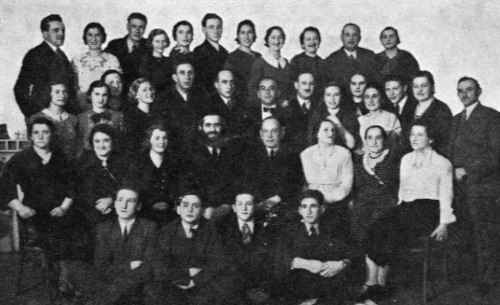
First row, seated, from the right: Zygmunt Langer, /–/, Nathan Spanglet, Zygmunt Vorschirm Second row: Sibert, Mela Stemberger, Berta Ringer, Shmuel Ringer, Rabbi David Avigdor, his wife, Meshia Ebel, Zinka Lieblich Third row, standing, from the right: Wilhelm Gross and his wife, Walter Sibert, Lola Rauchberger, Stella Weinsapt, Tyras, Adolf Stemberger, Rosenberger, Max Hamer, Mania Goldberg, Frieda Kornhauser, Golda and Hela Goldberg Fourth row: Wasserberger, Hugo Silbiger and his wife, Hilda Better, Yadzia Messinger, Emil Vorschirm, Itke Silbermann, Berta Langer, Leopold Ringer, Malka Bergmann, Dori Bader |
|
|
| A group of child actors in Andrychów, after a performance |
|
JewishGen, Inc. makes no representations regarding the accuracy of
the translation. The reader may wish to refer to the original material
for verification.
JewishGen is not responsible for inaccuracies or omissions in the original work and cannot rewrite or edit the text to correct inaccuracies and/or omissions.
Our mission is to produce a translation of the original work and we cannot verify the accuracy of statements or alter facts cited.
 Andrychów, Poland
 Yizkor Book Project
 JewishGen Home Page
Copyright © 1999-2026 by JewishGen, Inc.
Updated 28 Feb 2026 by OR