 |
|
|
by Tzvi Brik[1]
Translated by Jerrold Landau
|
I stand at the crest of my life, Full of trembling, full of pain, Whether there will be a tomorrow, who is left to ask, Then I will no longer be here.
The Master over our world,
Your people, gathered together, set apart,
Why does every storm carry them off like a leaf,
When I, as a child, through the cracks of the store,
From then, dear G-d, it accompanies me like a shadow, |
Translator's and Editor's Footnotes:
by Tzvi Brik
Translated by Jerrold Landau
|
Remember the sisters and the brothers, The fathers and the mothers, The lime-covered pits, The home and the flames…
The children like flowers,
The murderers in the dark –
Around the stream,
The howling of the wind |
Editor's Footnote:
by Sara Shavel
Translated by Jerrold Landau
I was born in a small town in Lithuania, Plotl [Plateliai], but I spent my childhood and youth in Telshe. There in Telshe, I absorbed the pleasant aroma of our home.
My mother, Feiga-Mere Fidelman, remained a young widow with seven young children: three boys and four girls. It was very difficult for my mother to feed such a large family. The end of the 1920s was a very difficult time in Lithuania, and it was especially difficult for a family that was missing the main provider, the father. It was very difficult for a widow to find some source of livelihood, and things were very difficult for us. At that time, my mother's brother from America came and helped us settle into the larger city of Telshe. However, life was very difficult in Telshe as well.
After a few years, the older children grew up and began to work. My oldest sister Menucha got married to a photographer, Shlomo Glikman. My two older brothers worked. My sister Doba also worked, and our material situation improved. All the children made sure that our mother would not have to work, because she was a weak and unhealthy woman. I was one of the younger children, and I studied. I graduated from the Folks School and continued studying in the Yavne Gymnasium [high school]. Only girls learned in our gymnasium. I received a religious education. The level of learning was very high. I learned very well and mastered the subjects well, especially the religious subjects. During the High Holy Days
[Page 394]
I would go to the synagogue together with my mother. There, women who did not know how to read would gather around us, and I would recite the prayers from the machzor [High Holy day prayer book], as they would follow after me.
That is how things went until 1940, when the Russians took control of Lithuania. This was a dark period for many religious Jews of Telshe. The Russians immediately closed the Yeshiva. Our Yavne Gymnasium was also locked. However, the youth wanted to study, and we were forced to go to learn in Soviet institutions of learning, where one had to write on the Sabbath.[1] For us, this was a very difficult decree, and we imagined that no greater misfortune could befall us. However, nobody could foresee the misfortunes that would unfold later.
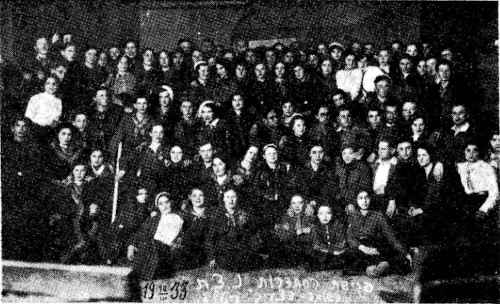
{Photo page 394 A Hapoel group in Telshe in 1943. Paul Klotz is standing seventh from the right, ninth is Sandler, and Moshe Veries is in the middle. (Note: date on the photo is July 27, 1938. LGSF is: Lietuvos Gimnastikos ir Sporto Federacija – the Lithuanian Gymnastics and Sports Federation.)}
The war with the Germans began on June 22, 1941. Our greatest troubles first started then. We were the first family in Telshe who lost a son, who was twenty-one years old.
It happened like this:
On the first day after the Germans occupied Telshe, we were all transported to the village of Reiniai. There, we found the most terrible conditions. We endured various humiliations. We were housed in filthy barracks, and suffered from hunger. Everything that we owned was taken from us.
One day, they took a certain number of young lads to work. My brother Feivel was among them. As became clear later, they worked at exhuming from pits the corpses of Lithuanians who had been shot by the N.K.V.D. as political criminals before the Russians escaped from Lithuania.
After our lads had completed the work, they were all ordered to line up in rows. One of the Lithuanian murderers, Petras Vačiulis, a bloodthirsty murderer, took out his pistol and went by everyone, pointing his pistol at the heart of each person, threatening to shoot. Nobody knew who his victim would be. When he
[Page 395]
reached my brother Feivel, he remained standing, and looked into the face of my brother with his murderous eyes. He did not think for long, and he shot my brother in the heart. He fell dead on the spot. He was the first victim from Telshe.
The murderer was the son of a poor Lithuanian family. His mother would come to us on the Sabbath to bring water, heat the oven, and perform other tasks. She would often meet my brother Feivel as she was doing various jobs. The death of my brother shattered us completely, but how could one hide this from our mother, so she would not know of the misfortune? We knew that she would not be able to bear this. We had to hide the tragic secret from her, but for how long can one hide such a secret? Our mother was barely surviving. She was sick and weak after all the troubles that we had endured, and with so much suffering. We worried greatly about her health.
Later, people said that Yitzchak and a few other lads ran away, but as they were escaping from the shooting, he was hit by a bullet and fell dead. Then, our brother-in-law Shlomo Glikman was murdered. We heard nothing more of our sister Chaya, who had recently married Zelig Bunis in Salant [Salantai],
That is how we, three sisters, were left with our sick mother. All of us women were taken to a second camp, Gerol [Geruliai], where we suffered many tribulations. We were prodded to difficult labor. We were hungry, and embittered.
Six weeks later, my sister Doba and I were separated from our mother and our sister Menucha. We were sent to the Telshe Ghetto.
That is how we two sisters, from the entire family, remained in the Telshe Ghetto. The ghetto was surrounded by barbed wire, and we found ourselves in a closed-off path. However, they did not let us remain in the ghetto for long. We remained there until the murderers decided to kill the few surviving Jews of Telshe, as well as the remaining Jews from the region.
Yom Kippur arrived for us in the ghetto. The Schneidershe [Tailor's] Synagogue was also in the territory of the ghetto. We, all the women, gathered in the synagogue to pray. Unfortunately, at this point there was nobody to whom I could read from the Machzor and there were no elderly women. I will never forget the heartfelt weeping of all the women during the prayer. Everyone cried themselves out, and every woman felt that this would be the last time worshipping in the synagogue. We had no illusions that the murderers would let us live. Therefore, we reached the decision that we would not go like sheep to the slaughter. We had nothing to lose. Death awaited all of us as one. We would run when we saw that they were taking us to be shot.
We stayed in the Telshe Ghetto until the end of December. Then we found out that
[Page 396]
the Germans with the Lithuanian murderers were going to liquidate the last bit of Jews in the Telshe Ghetto. When the time came, my sister Doba and I tore through the fence without being noticed, and we escaped from the ghetto.
But where should one go? We were in a hostile environment. There were Lithuanians all around, and we knew who they were: they were only waiting for our deaths. However, we had no other choice. The will to live was great, and we went to a Lithuanian acquaintance, to seek a hiding place with him. We had in mind, we hoped, that perhaps he might not refuse us. However, as soon as we appeared to him, he immediately ordered us to go back. What could we do? We went to a priest. We hoped to obtain help from him, and perhaps a place to hide. We thought: He is a spiritual person, he has G-d in his heart, perhaps he will not refuse us. Unfortunately, however, with the priest as well we could not remain for a long time. We only spent the night with him, and then he ordered us to go.
We saw that we had no way to find a place to hide, so we had no choice other than to return to the ghetto. Things were still calm in the ghetto in the meantime, but we felt that they would not let us live long there. Danger threatened us at every hour.
We again went out through the fence, and went to search for an elderly gentile acquaintance who worked in Viskupiai. The old man was sick, but nevertheless, he did not refuse us. He asked his wife to hide us in the meantime, and then we would see.
After a few weeks of lying in a hiding place, the wife, who used to bring us food in our hiding place (the hiding place was the pigsty), came and told us that they were afraid to keep us, because one of the hired hands, who was not a fully normal person, started to say that there were Jews in Viskupiai. There was a danger that they would find us in the hiding place, shoot us, and our saviour would also suffer. There was no other choice than to leave the gentile before it was too late.
We set out on our way, one winter day, when there was a strong wind outside. It was very cold and the frost was severe. We set out to where our eyes would take us. As we walked, we headed in the direction of Alsiad [Alsėdžiai]. We decided to go to a Christian with whom we had worked at digging potatoes. However, with him as well we could not remain. He took us to the Alsiad priest, and we remained with the priest until he found peasants in his area who agreed to take us in.
The priest was a very fine man. He was very upstanding, and he very carefully avoided the peasants who might turn us in. We were not the only ones for whom the noble priest found a place and whose lives he saved.
I was taken in by a young couple who lived not far from the town of Alsiad. It was very difficult for me to part with my sister, the only one from the entire family who had survived. I did not know where she would be, and what would be her fate. Fortunately, the priest also found a place for my sister, together with Mire Gapanovich, with peasants in a village where they had to work very hard, but were able to survive the terrible war. She
[Page 397]
came to Telshe after the war, where we reunited.
The peasants with whom I hid were called:
Antanas and Stasė Mikolauskas. With them, I did not hide in a confined place. Rather, I was in the house with them. They did not give me any difficult work. I worked in the field alongside them. They knew that there was no type of field work that I did not know. They related to me very finely and humanely. But even though the conditions were very good, it still took me a long time to get used to the village conditions. It was a gentile house. I did not see any Jews; there was no Sabbath or Yomtov [religious festivals]. Even worse, I did not know what tomorrow would bring. I was in danger the entire time [so] that, in the end, might become known that a Jewish daughter could be found with that gentile.
One Sunday, I decided to go to the priest and speak with him from the heart. He was a spiritual man. He had a sensitive heart, and he would understand me. When I went to the priest, to my great misfortune, I met along the way a Lithuanian lad with whom I had studied in the Telsher Gymnasium.
Not considering my appearance (I was dressed in village clothing and presented myself as a village girl), he recognized me. I went, and he accompanied me along the way. He told me about his “heroism” – how he shot Jews in Vilna. He took part in the aktion in Ponar, where thousands of Jews of Vilna had been shot. He was in a very good mood, and he could not conceive at all that his words brought me great sorrow and pain. My heart was weeping, and he certainly could have noticed what was going on with me.
He saw my distress and understood my suspicion that he might shoot me or betray me to the Germans. He called out, “Have no fear. I will not harm you. I will not turn you in to the Germans.”
I kept walking, and he walked the entire way with me. My good fortune was that he did not have a lot of time, and he hurried. As we were going, we passed my hiding place, and I pretended that I did not know the house at all. He also understood that I did not want him to know where I had been living. I sat down and I told him that the following Sunday, I would come to the same place where we met, and we could go for a walk.
Of course, I did not go to meet him the following Sunday. I looked at the meeting place through the window, but he also did not appear.
I hid with Lithuanians throughout the entire time of the war. I remain in correspondence with them to this day. How can it be otherwise? They indeed saved my life. They themselves put their lives in danger, and it is only thanks to them that I survived. They are true righteous gentiles, thanks to whom I live today with my family in Israel.
by Tzvi Brik
Translated by Jerrold Landau
|
The echo brings to me, From over the seas, distant horizons, My footprints from every path and doorway Left there at the beginning of life.
My steps to go to cheder[1],
Like small children – elderly Jews,
The echo's resonance, like the banging of a hammer, |
|
|
| A meeting of the N.Tz.Ch. organization, Hashomer Hatzair, in Telshe, 1933 |
Editor's Footnotes:
by Sara Elitzur-Ritov
Translated by Jerrold Landau
|
Forest Memories
It is good for me,
Nobody disturbs
Green trees,
My blood bubbles and boils within me –
Enveloped in deep sorrow
The forest rustles with a wild noise Spring
Again spring has come
The dawn-red greets me
My eye cannot accept |
|
|
JewishGen, Inc. makes no representations regarding the accuracy of
the translation. The reader may wish to refer to the original material
for verification.
JewishGen is not responsible for inaccuracies or omissions in the original work and cannot rewrite or edit the text to correct inaccuracies and/or omissions.
Our mission is to produce a translation of the original work and we cannot verify the accuracy of statements or alter facts cited.
 Telšiai, Lithuania
 Yizkor Book Project
 JewishGen Home Page
Copyright © 1999-2026 by JewishGen, Inc.
Updated 14 Sep 2026 by JH