 |
|
|
[Page 291]
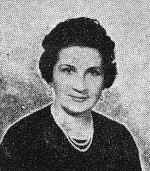
by Sara Feier-Shlomovitz (Mexico)
Translated by Jerrold Landau
I was still a young, fifteen-year-old girl when I left Telshe. The town with its streets and alleyways, the dear Jews and the dear Telshe youth who filled the buildings of the wide-branched networked of learning institutions in the town stand before my eyes to this day. Now, when I think about the former Jewish life in Telshe, happy, bright episodes from my family, my environs, and about people come before my eyes. I feel a gnawing, nostalgic awakening for that life that once was and is no more - a life that was so brutally cut off by the Nazi and Lithuanian murderers. I will always remember everything that took place in the town.
|
|
| Sara Feier-Shlomovitz |
Telshe was a town of various contrasts: a town of religious and worldly institutions. There was a large Yeshiva that was famous throughout the entire world, in which over four hundred Yeshiva students from various towns and villages in the province and also from abroad studied. In my time, Yeshiva students from Yeshivas of Germany, Africa, America, and even the Land of Israel studied in the Telshe Yeshiva. When one passed by the Yeshiva building, it was bustling like a beehive.
Great Torah personalities would come to admire the methodology of Torah study that was conducted in the Yeshiva. A very large number of future scholars and rabbis were students of the Telshe Yeshiva.
Telshe excelled with religious piety. The voice of Torah was heard all day, both in the Yeshiva and in the Beis Midreshes (“Houses” of Religious Study). The directorship of the Yeshiva also had the supervisory role over the Yavneh Gymnasium [High School], which was a religious, girls' gymnasium in which over three hundred girls from the town and other towns and settlements studied. The Yavneh Gymnasium had eight classes, and the leadership ensured that the finest pedagogues would work in that important institute of learning. The curriculum included religious and secular subjects. The students of the Yavneh Gymnasium would pray the shacharit[1] service early every morning.
[Page 292]
One student would lead the prayers from the podium, and everyone would follow after her in reciting the prayers. The students would recite the Mincha or Ma'ariv service after the conclusion of the school day.
It was natural that, following the high-level religious education, a magnificent generation of female Jewish teachers arose, who imparted to their students genuine Jewishness and proper behavior toward their parents and others. It was not only a single family who was [i.e. all families were] proud of the education of their children, thanks to the pedagogic work of the Yavneh teachers.
Telshe Jews loved to study Torah for the sake of Heaven. Their greatest aspiration in life was to perfect themselves in Torah and Jewish knowledge, for learning was considered above everything in Judaism. Unfortunately, the German devil annihilated the Jews as well as Jewish life. Only a small group of Telshe Jews were saved from the destruction. The rest were killed in sanctification of the Divine Name. A small group of survivors of the Telshe Jews are currently found in Israel, the United States, Mexico, and other countries. They are scattered throughout the entire world. Wherever they are found, they spin the golden thread of Telshe. They brought with them the spirit and cultural legacy that they received in Telshe. The survivors of the destruction of Telshe Jewry continue with the Telshe style throughout their lives. They continue with their former lives, even though the conditions and possibilities are different. They send their children to continue studying in Hebrew schools to receive a Jewish national education.
G-d has gifted me with one son, and I have done everything to give him a Jewish education. He speaks a fine Yiddish and knows how to daven[2]. He is also giving his children a Jewish education. His children studied in a Tarbut School, and then he sent them to kibbutzim in Israel. Now, they are completing their studies in the universities. This is thanks to the genuine Jewish education from Telshe that was transmitted from generation to generation.
|
|
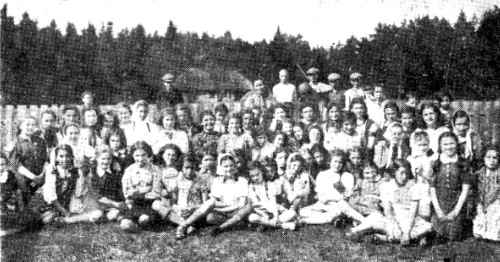
| A'zeh אזע summer camp in Bladmishka [probably Baldoniškis] |
Footnotes
Translated by Ellen Rifkin
Edited by Yocheved Klausner
Until a few weeks ago, a journey from Memel to Telshe was a difficult undertaking–about ten hours on the train–but now that the new Telshe–Kretinge line is complete, it's a short jump of just a few hours.
All the Jewish cultural organizations and institutions can be found in Telshe, as in all Lithuania. These include two Hebrew kindergartens, a public school and a high school of the Yavneh group where the entire Jewish youth receive their education. The high–school is only for girls, but it provides an ample amount of the knowledge and subject matter that boys study, the majority of whom are preparing for the large world – famous Yeshiva. If the Hebrew poet Yehuda Leyb Gordon could see his Telshe now, where he had been a teacher of Russian, he would be amazed at the great advance and enlightenment that just a couple of generations have achieved. He would also surely have celebrated the Jewish daughter, who is now entitled to receive an education and has equal rights to study Torah and related subjects. There is now a Benot Ya'akov (Daughters of Jacob) society where women recite Chumash (The Five Books of Moses) with Rashi (medieval rabbinic commentary) –– and I'd venture to suggest that they are doing no worse than the male “reciters” (students) in their own societies.
The town also has active institutions, such as the OZE humanitarian organization, the Bikur Cholim (visiting the sick) Society, a Free–of–Interest Loan Fund (Gemach), a people's bank, the associations: Maccabi, (sports organization), Brit–Trumpeldor, HaShomer HaTza'ir, and Zionist parties of all persuasions. It is interesting to note that in contrast to other cities where the expression “He is a Zionist” indicates a community activist engaged in Zionist affairs, there it indicates, “He sympathizes with Zionist thought”– just like in the old times when Zionism was first arising.
The influence of the Yeshiva on the city is strongly felt. The Sabbath is observed – people don't go to the movies on Shabbos. The public is more observant than anywhere else. There is also an overall orientation toward learning. When Zionists of different philosophies have arguments or disputes, they do so as scholars, precisely and not superficially. They show that they are conversant in their own as well as in their opponent's ideology.
And what about earning a living? Jews are groaning; it's hard times, like everywhere.
Footnote
[Tr.] - Translator's footnote
[Page 294]
by Pera Levinson-Sofer
Translated by Jerrold Landau
To this day before my eyes stands my town of Telshe, where I was born and raised, there where I spent my best years. Unfortunately, no trace of Jewish life remains, and everything has been forgotten with time.
I still remember like today when I was taken to study in the school as a child. The school was opposite the Yovnisher Shul. At that time, the streets had not yet been paved, and in the spring and fall there were puddles of water which we waded through in going to school.
Our teacher at that time was Ratzer, a magnificent pedagogue, a great pedantic, who was very careful with cleanliness. I recall that we had to polish our shoes before we went to school…
The Beis Midrash was called Yovnisher because that is where the Jewish soldiers swore their allegiance to the Tzar when they presented themselves for military duty. In those days, a soldier was called a Yovn. There was a Prisotstva near the Beis Midrash where the soldiers underwent medical examinations.
The girls studied from noon until 3:00 p.m., because the boys learnt in the mornings. We felt the difficulties of being a Jew already at that time. We saw the suffering of the parents who were parting from their sons who were going to serve the Tzar…
The prominent families of the town who led Jewish lives were, as far as I recall, the Neimark, Walfer, Naftolin, the feldscher [medic] Sher, and Rastovski families. Unfortunately, almost nobody remained from those families. They will not be forgotten.
I still recall, as a child, the day when the Telsher rabbi, Rabbi Eliezer Gordon, died. A great sorrow surrounded the entire town. All of Telshe was in great sorrow, and everyone went to the funeral to accompany their great, beloved rabbi to his final rest.
I recall that many neighbors and good friends gathered in our house, and each one talked about the great loss that had afflicted Telsher Jewry, just as if the sun in the heavens had been extinguished.
My father was a butcher, as were my uncles and good friends. That was a difficult source of livelihood during that time. The butcher himself had to go out to a village to purchase cattle. My father often spent many days in the villages, far from
[Page 295]
home, because he had not succeeded in purchasing what he was looking for. More than once, he had to trudge by foot over various routes from one village to the next, wading through marshes, and facing life-threatening dangers. The family barely managed until Father returned from his journey. We were aware of cases where gangs would attack lone Jews on the routes. They would rob them and then murder them.
If Father was lucky and succeeded in coming home, we had to pray that the shechita [ritual slaughter] would be kosher[1]. The livelihood of a butcher was difficult. When the Sabbath came, however, Father, like all the Jews in the town, would cast off the yoke of livelihood. One would forget the day-to-day concerns. The Sabbath was the day of rest, just as the Divine Presence granted rest to His toiling people.
In 1906, a large fire suddenly broke out in town, and almost all the houses burnt down. Jews remained without a roof over their heads. At that time, a committee was formed to help the Jews rebuild their houses. Geltner the pharmacist helped a great deal. He planned the rebuilding of the city. He was a good friend of the Jews and a noble Christian. Nevertheless, his children helped murder Jews during the Nazi period.
In the later years, after I concluded my studies, I left the town and worked in the province [countryside]. However, the larger portion of my family remained in Telshe, and were murdered along with all the Jews of Telshe. Sixty-eight people of my wide-branched families were murdered. My two children Ruth (aged six), and Sima (aged nine) were also ripped away from me and were murdered in the Siauliai ghetto during the aktion of November 5, 1943.
Honor to their holy memory.
|
|
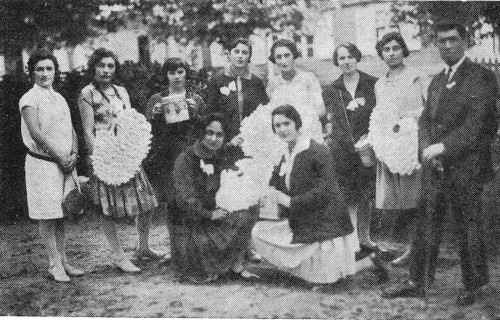
| Donation Day for the Keren Kayemet [Jewish National Fund] in Telshe Participants: Koka Elyashiv, Bluma Teitz, Chana Sasson |
Footnote
[Page 296]
by Grisha Volpert, z”l[1]
Translated by Jerrold Landau
The N.K.V.D. came on June 14, 1941, and arrested my entire family: my wife Chaya, my two young daughters, and me. My older daughter Genia was eleven years old, and Miri was just seven. They loaded us on freight wagons and sent us to Siberia.
I was accused by the authorities of a terrible “crime”: During my youth, I had belonged to the Zionist organization. That means, I was a Zionist activist and therefore an opponent of Communism, an opponent of the Soviet Union, and “an enemy of the people.”
They did not allow anyone to talk to us at the railway station. They separated us. The females were in another wagon, while I was in a different wagon with the men.
I labored as a forestry worker during the first period in Siberia. According to the local law, one had to go to work in the forest even in the minus 40 degree cold. I remained in the barracks after work. The food consisted of four hundred grams of bread and boiled water. Many people believed that one would be more satiated the more one drank. Therefore, many became ill with blisters.
During the first period, I was in a camp with two other Jews who had been deported from Telshe – Yosel and Gavriel Zaks. In comparison to them, I was a weak man, and only the strong ones could go out for two months.
That is how three and a half years passed. I felt that I would perish there because of the arduous work. Once, when I came from the forest with my last strength, I did not have the energy to move my legs. A Jew from Vilkomir [Ukmergė], Orchik Koltus, came up to me and told me that the chief doctor had ordered me to come to him at 8:00 p.m. When I went to the doctor, he asked me: “How is the weather today?” I responded to him with the words of famous poem:
Burya mgloyu mebo kroyet.[2]
A terrible snowstorm was raging outside.
It seemed that a wild beast was rampaging outside. At the same time, we realized that a child was crying.
With those words, I found great favor with the doctor, and he told me, “You will remain in the hospital until you regain your strength.” Later he appointed me to serve as the chief medic of the infirmary of the entire Krasnoyarski Krai, Pasiolok number 7.
I had no idea where they had sent my wife and children. In vast
[Page 297]
Russia, and given the situation of our deportation, one could not even think about that. However, miracles do happen in the world. It turned out that my family was located in the same Komi as I was, that means in the same deportation region.
Once, a Lithuanian named Androyaskas, a hairdresser from Plungyan [Plungė], came to me and showed me a postcard from my older daughter Genia. You can imagine my joy! I could not read the card because my eyes were wet with tears of joy.
A second Jew from Kėdainiai, also with the name Volpert [Volpertas], read the card for me. From that point, my suffering was much lighter, and life was more joyous, for I was not far from my family. The only hope was to meet them as soon as possible.
During the first period, many deportees – Lithuanians, Latvians, Estonians, and Jews – perished from hunger and died of dysentery. Once, when I went to bring water for the sick (as the medic, I went about dressed in a white smock), I passed a large pit, and suddenly I heard some sort of melody that reminded me of the chant of Gemara. I could not figure out whether it was perhaps a dream? From where can such a melody come in this desolate corner [of the world]?
I stopped so that I could better hear the sound – it was a Gemara melody. Was this a hallucination? I took several steps forward to the pit, and what did I see? Two elderly Jews sitting there with a Gemara in their hands. They became very frightened when they saw me: a man with a white frock, perhaps [thinking that I was] one of the officers, and they trembled from fear. However, I calmed them: I shouted, “The voice is the voice of Jacob”[3]. The two frightened Jews remained puzzled, with open mouths and crying from joy. At the end I sat with them, and we all wept for a long time.
One day, the doctor called me in and offered me the position of medic in a new camp for women. I did not accept his offer. I did not want to show that I was striving for that job. I did indeed accept a second offer, to serve as a medic in a camp for criminal offenders. However, that was already my last mission, due to an exceptional thing, which, in and of itself, was a bit of a miracle.
The following was what happened:
The sledovatel (investigator) in the criminal camp suddenly posed the following question to me:
“Why are you in Siberia? Are you a bourgeoisie or a Zionist?”
“Yes,” I responded, “My parents were indeed wealthy folk, but why cannot we Jews have our own country, the country from where were driven out some two thousand years ago? Do you not love your Matushka Russia [Mother Russia]?”
The sledovatel looked at me puzzled, “I see for the first time that Jews tell me the truth.”
The end was surprising and unexpected. A day later, the sledovatel came and asked me:
“What is your name?”
“Volpertas,” I answered.
“If that is the case,” said the sledovatel, “you are here unjustly, because according to the papers, they had to arrest Volpertienė… I can free you immediately, but it is wartime now
[Page 298]
and when you leave the camp, they will immediately mobilize you into the army, and you will be sent to the front. I advise you to remain here until the end of the war.”
Of course I obeyed him. In my spare time I recited Psalms to the extent that I remembered them. I cried before the Master of the World with my heavy heart. I had faith that G-d would help me to survive until the liberation, and that is what happened.
My brother-in-law Blott and his wife Dr. Blott were very well acquainted with Paleckis, the president of Bolshevik Lithuania[4]. Thanks to this, I was freed at the end of 1946 and returned to Telshe.
In Telshe, I met several young Jewish girls and a few ill women. Rafael Hotz, the son of Rabbi Moshe Hotz, [had] returned from Russia. Throughout his life, he taught a page of Gemara in the Zionist Kloiz.
I could not live in the ruins of Telshe. I attempted to free myself from the Communist predicament, and succeeded in 1956 when my family and I were freed to go to the State of Israel.
Footnotes
[Ed.] - Translator editor's footnote [Tr.] - Translator's footnote
by Zalman Levi, Johannesburg
Translated by Jerrold Landau
I am not a Telsher. I come from the town of Plungyan [Plungė], twenty-eight kilometers from Telshe, closer to the border with East Prussia [today, the border with the Russia's Kaliningrad exclave]. Plungyan is a larger town than Telshe. It had about five hundred Jewish families. It had many more youths than Telshe, however they could not compare with Telshe, which was famous with its large Yeshiva, its institutes of education, a Hebrew gymnasium for girls, and various teachers' seminaries for males and females.
Telshe was a symbol, a high point in the Jewish world, and it is no wonder that there is today a Telshe Yeshiva in America as well as in Israel. I personally will never forget Telshe, where I spent the years of my youth. I studied at the Yeshiva Ketana [Yeshiva for younger people] in Plungyan from after my Bar Mitzvah [at the age of thirteen] until age sixteen. The Yeshiva head was the famous teacher Rabbi Yosef Shachnowitz. Immediately after that, together with several young lads, I went to the Telshe Yeshiva, where I entered the fourth preparatory [mechina] class, and a year later the mevaker. At that time, I did not yet understand what Telshe meant for me, what type of an influence the town would have upon me.
In 1923, I went to the Ponevezh Yeshiva. I remained there for two terms, and I first felt what Telshe meant. In 1924, I returned to Telshe and entered the second class. However, fresh winds were blowing in Lithuania at that time.
[Page 299]
A striving for worldliness began. The Zionist movement grew from day to day. A broad network of educational institutions, Hebrew and Yiddish folk schools, pro-gymnasiums [preparatory school for a gymnasium high school], teachers' seminaries, and libraries sprung up in many cities and towns in Lithuania. All of this had a strong effect on a portion of the Yeshiva students.
When I talk about libraries, I recall the following interesting episode:
I and a fellow student from Plungyan in the fourth class set out with the idea of founding a library in Telshe where Yeshiva students could have the opportunity to read a book that would be in the spirit of the Yeshiva – a library that would be entirely different from the libraries of the Zionist and leftist camps. The outside called and teased. The day came and we were summoned to the home of the Telshe rabbi, Rabbi Yosef-Leib Bloch, zt”l[1], who was also the principal of the Yeshiva and gave a class one day a week. He said:
“Word came to me that you have the idea of founding a library in Telshe. Does it make sense? Is this possible? Satiating our young men from the Yeshiva and other religious people with heresy, with apostacy!…”
“No,” we responded with a contradiction, “It is the opposite. We want to bring into the library those books and journals that have a strong religious character. For example, the words of Professor Nathan Birnbaum and Rabbi Hillel Zeitlin,” who in those days earned renown with their steps into the Polish-Jewish press with an encouragement of the religious consciousness in the struggle against the outlook of the Zionist and leftist camps.
“No,” responded Rabbi Yosef-Leib, “We must not let even people such as Birnbaum and Zeitlin enter our camp.” He did note that Birnbaum and Zeitlin are today very fine Jews. “They write about the importance of strengthening Torah and religion. They do this and are believers today only because their intellect obligates them. What would be, however, if tomorrow their intellect dictates otherwise? We must be believers without any ulterior motives, without ruminations… I will certainly not permit this…”
Of course, nothing came of our plan. However, they already were casting an eye upon me. They followed my every step.
A second episode:
A regional conference of the Keren Kayemet LeYisrael [Jewish National Fund] took place in Telshe, and my father of blessed memory was in the delegation from Plungyan. In the evening, I went to visit my father at Elyashiv's hotel, where the conference was taking place. The chief spokesperson of the conference was Shmuel Gatz (who lives today in Bolivia).
In the morning after the conference, I was again called in and told that I was an undesirable element in the Telshe Yeshiva, or not only in the Yeshiva but in all of Lithuania as well. As a result, I became involved with a bad crowd. I began to read Haskalah literature, which was very popular and widespread in Russia at that time – especially [the writings of] Abraham Mapu [and] Peretz Smolenskin, [Mordechai Zeev] Feuerberg's Le'an [Whither], and the like. Nevertheless, I will never forget Telshe with its Yeshiva. Passing before my mind are the Gaon Rabbi Yosef-Leib Bloch; his son Rabbi Yitzchak, who was the Yeshiva head of the younger classes, and a great, deep learner; his second son Rabbi Eliyahu-Meir; and Rabbi Zalman of blessed memory (Rabbi Eliyahu-Meir died in America where he settled to lead the Telshe Yeshiva [in Cleveland]). His two sons-in-law, Rabbi Avner Oklanski and Rabbi Mordechai Wesler, delivered the class in the Kollel.
The second Yeshiva head in those years, Rabbi Chaim
[Page 300]
Rabinowitz, a world-class Gaon, was an interesting personality. His son was the Illuy [genius] Rabbl Azriel.
Reb Mottel Pogrimanski from Tavrik [Tauragė] passes before my eyes. He had an open mind, and he was an uprooter of mountains[2]. Also [passing before my eyes are] his older brother Yosel, Mezgal with his sharp mind from the tiny town of Naveron [Neveronys], and very many others.
Were it not for the terrible cataclysm, those sharp minds would be among the great scholars of the Talmudic world. Telshe was one of the greatest Yeshivas. Its first leaders were the Gaonim Rabbi Shimon Breinisker and Rabbl Leizer Gordon, the brother-in-law of Rabbi Yosef-Leib Bloch.
There were students from all corners of the world in Telshe during the 1920s. The famous editor of Maariv [Israeli newspaper] Dr. Azriel Carlebach, a world-famous Yiddish and Hebrew journalist, also studied in the Telshe Yeshiva.
Telshe! The town of Telshe will go down in Jewish history as [home of] one of the greatest Jewish learning institutions. The great Hebrew poet Ch. N. Bialik rightly termed it: “A factory for the souls of the nation.” That was said regarding all the Yeshivas in the small towns of Lithuania, White Russia, and Poland, such as Volozhin, Mir, Kletzk, Novhorodok, Lomza, Slobodka, and Ponevezh.
May their memories be a blessing!
|
|
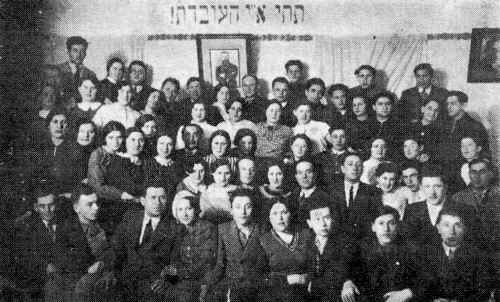
| Purim celebration of members of Young Zion in Telshe in 1930 Seated (third) from left to right is Jakob |
Footnotes
[Page 301]
by Ya'akov Zlotnik (Johannesburg)
Translated by Fruma Mohrer
In its appearance and size, Telshe was perhaps not different from other Lithuanian shtetlach.[1] But in quality, Telshe occupied a very important role in Jewish life, not only in Lithuania, but also beyond its borders. Telshe was the site of the renowned [Telshe] Yeshiva, which was a spiritual center of European Jewry. The Yeshiva attracted many young people who came there to study all the way from the depths of Russia, from Germany, [and] even from America.
One of the leaders and founders of the Yeshiva was the well-known Telsher Rav and Gaon, Rabbi Eliezer Gordon. He was beloved and esteemed by the entire Jewish population. After his death in London, in 1910, there was a photograph of him on the wall of almost every home.
Before my time, about 300 young men studied at the Yeshiva. A large proportion of them came from poor homes. For this reason, they participated in the custom of essen teg (“eating for a day”), meaning that each day they ate in a different local home.[2] But the poverty did not prevent them from learning, and of them it could be said, “Bread and salt shall you eat; measured water shall you drink; and on the ground you shall sleep …. – that is the path of the Torah.”[3]
The Yeshiva's doors were open 24 hours a day and young men were constantly sitting and studying with great diligence and dedication. The accomplished prodigies and dedicated full-time learners would study through the long winter nights. These were the character types who were celebrated by Chaim Nachman Bialik in his poem “Ha-Matmid – The Dedicated Talmudic Student.”[4]
With time, after the First World War, the Yeshiva established a series of educational institutions for the religious and traditional youth. In those institutions, they studied general subjects in addition to religious studies and the Talmud. The Yeshiva also founded the Yavne Teachers' Seminary, with one division for male teachers and a second for women teachers. A full 8-grade Yavne gymnasium [an advanced high school] was established for girls as well as a Yavne elementary school.
After the First World War, the non-religious circles also became more active: The Zionists [and] the Bundists began to carry out more activities, organized various courses, [and] established lectures about literary and political topics, and similar subjects.
And when it was all developed and flourishing at its peak – the terrible Holocaust came.
Telshe will be engraved in my heart as long as I live.
Footnotes
[Ed.] - Translator editor's footnote [Tr.] - Translator's footnote
[Page 302]
by Tzvi Brik
Translated by Aldona Shapiro
|
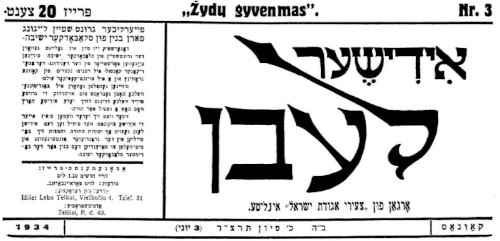
Around the cliff, next to a grove of fir trees, There flows a creek Where a bridge was built with stones. There is my little town of Telz.
Around the market with butchers' shops
The Great Synagogue and the tailors' house of prayer
In the old, deep well
Wind, take into your embrace my prayer |
Footnotes
[Page 303]
by Tzvi Brik[1]
Translated by Jerrold Landau
| The night with its stars Lulled the hills and valleys to sleep, The night with my tears Struck every footprint from the past.
My world is wrapped in gloom,
Then a dream comes to me,
There when one lived a life
Do you see if the old synagogue still stands bent over?
The dream takes me around |
Footnote
[Ed.] - Translator editor's footnote
by Nechemia Endlin, z”l[1]
Translated by Jerrold Landau
From the book “On the Path of the Partisan Battle” published by the committee of partisans and underground fighters of the Kovno Ghetto, Tel Aviv, 5780 – 1980.
… After two months of rest from the long and difficult path, finding myself located in Khveidan [Kvėdarna] with my grandmother, they sent me to study in Telshe. I was eleven years old at the time, and they placed me in the second grade of the Beit Hachinuch. The Beit Hachinuch of Telshe was a religious institution of learning with five grades, where secular subjects were taught along with Torah. This was a preparatory school for the Mechina, where they only taught Torah. The Mechina consisted of four grades and a Mevaker[2]. From the Mevaker, one was accepted to the first class of the Yeshiva.
The first time for me was exceedingly difficult, because
[Page 304]
my knowledge of Yiddish was very weak. I had studied it for two months in Khveidan. All the students laughed at my Yiddish. Later, I mastered the language and, at the end of the year of study, I even received a certificate of excellence, and I skipped from the second grade to the fourth grade. I also received a certificate of excellence at the end of the fourth grade, was designated as a first-class student of the Beit Hachinuch, and moved to the second grade of the Mechina.
The principal of the Beit Hachinuch was a student from the fourth class of the Yeshiva, named Leibe Polivnik. His brother Moshe Polivnik was the Gemara rebbe. The secretary was Yitzchak Yafa – a student from the fourth class of the Yeshiva. The Chumash rebbe was Rabbi Shimon-Moshe. The Bible rebbe was Rabbi Moshe Friedman. The teacher Bluma Schwartz (the daughter of Rabbi Artzik Schwartz) taught us arithmetic. The Hebrew teacher was Yosef Rabinovitch (the son of Rabbi Chaim Rabinovich). He was also a student in the fourth class of the Yeshiva. The teacher Shocha Talpiot taught geography, natural sciences, and history. Burba was the teacher of the Lithuanian language.
That was the teaching staff and leadership of the Beit Hachinuch of Telshe. All of the teachers were strictly religious except for the teacher Burba. The children of the Beit Hachinuch were, of course, educated in the religious spirit. I, like all the students, was greatly influenced by the general spirit that pervaded there. I was fanatically religious and even had payos[3]. I must stress here that I obtained the foundation of my entire knowledge in the Beit Hachinuch of Telshe.
Telshe was a town in which the rabbi's dynasty ruled. The rabbi, Rabbi Yosef-Leib Bloch, was the principal of the Yeshiva and also one of the Yeshiva heads [Rosh Yeshivas]. His middle son, Rabbi Yitzchak Bloch, was a Yeshiva head. His oldest son was the treasurer and secretary of the Yeshiva. His son-in-law, Rabbi Avner Oklanski was the principal of the Mechina. Another son-in-law, Wesler, was the principal of the Kollel. His son-in-law, Rabbi Mottel Katz, used to travel to America to collect money for the Yeshiva and for other religious institutions of Telshe.
The second Yeshiva Head was Rabbi Chaim Rabinovitch, followed by his son Rabbi Azriel Rabinovitch. Both were great scholars. They excelled in sharpness and breadth of knowledge of Talmud. They had their special methodologies of learning, and knew how to shape and mold the young souls of the Yeshiva students. They greatly valued their students, and others as well. They extended honor to everyone, and treated everyone with great politeness.
Telshe excelled with its great educational network. There was also a Yavneh high school for girls and a teachers' seminary for males and females, which were also under the supervision of the rabbi's dynasty. The principal of the Yavneh high school was an honorable Jew, Holtzberg. Both of his sons, the twins Yosef and Beno Holtzberg, studied together with me in the Mechina. The youngest son of the Telshe rabbi, Rabbi Eliyahu-Meir Bloch, was a son-in-law of a rich family from Memel[4] – Kaplan.
The students of the Beit Hachinuch, the Yavneh high school, and the teachers' seminary came from various cities and towns in Lithuania, who streamed into Telshe to study Torah and receive a general education. There, one could see hundreds of youths in their blossoming years streaming to the institutions of learning,
[Page 305]
and the city was full of them. A lust for Torah pervaded amongst the students, and they all studied with great diligence. It is no wonder that the influence of the Telshe dynasty spread throughout all of Lithuania. The spirit of Telsher education was strongly and zealously Orthodox. Such were both brothers, Mottel and Yosef Pogremanski from Tauragė; the brothers Yitzchak and Moshe Yaffa from Khveidan; Chaim Rozin from Khveidan; both brothers Pinchas and Efraim Helfant from Telshe; both of the Ardman brothers from Shavel [Šiauliai]; Bamberger from Kissingen; Chaim Wigder and Chaim Bakshpon from Cologne on the Rhine; Nachman Hirshovich from Virbalis; and many others…
The house and shop of Rivka Javshitz was directly opposite the Beit Hachinuch. I would run in there to purchase sweets. I did not only go there to purchase sweets. I wanted very much for the sweets to purchase for me her middle daughter, Masha Javshitz, who later became my life partner. Masha was a graduate of the Yavneh high school of Telshe.
In Telshe, I encountered the educational methodology of Rabbi Avner Oklanski. He immediately noticed that a change was overcoming me. First, my payos were already “missing.” Aside from that, my comportment was audacious and brazen… I had completely become “not that which I had been.” The rabbi decided to systematically restrain me. He imposed a control upon me, and followed my every step. He gave, specifically to me, the most difficult passages of Talmud and the hardest Talmudic topics. It was the same with halacha [Jewish law].
It is self understood that I did not sit and study the entire time. Friends came to me, and we had fun and smoked cigarettes. The rabbi caught me once again, and again reproved me for being the organizer and the guilty one… He threatened me that he would throw me out and not permit me to graduate to the first class of the Yeshiva after the upcoming exams.
I took his threat with full seriousness, because I was certain that he would carry it out. I prepared very well one day and night prior to the exams, in order to avert the “harshness of the decree.”[5] Then the rabbi came to the exams with his retinue. These were the matriculation exams to be accepted to the Yeshiva. The rabbi asked various questions and said that anyone who gives the correct answers would be freed from the latter questions and would be accepted into the Yeshiva.
I immediately raised my hand and answered all of his questions, also showing the sources, including the page of the Gemara where the source is found. The rabbi liked my answers and said, “Excellent.” He told me that I could leave the exams. Then his son-in-law Avner Oklanski bent over to him and whispered something in his ear, pointing at me. However, the rabbi paid no attention to this and upheld his previous decision.
In the morning, I was invited to the rabbi. He had a lengthy conversation with me, with the aim of encouraging me to repent and cease my “free” conduct… Considering that all this would be reported to my father, I promised to be “good and pious”… I did not imagine that they would spy on me even in the Yeshiva. The result was that I was excluded from the Yeshiva…
During the time that I was in Telshe, my two brothers Boris and Natan immigrated
[Page 306]
to South Africa. They kept this secret from me. I first found out about this from the postcards that they sent me along the way, in which they informed me that our parents had forbidden them from bidding me farewell, so they are doing it by postcard…
When I came home after being expelled from the Telsher Yeshiva, my father's patience was endless. He tried all means so that I could learn in a Yeshiva. He took me to Slobodka, which was famous for its large Yeshiva. We went to see the Yeshiva head, Rabbi Eizik Sher, in his house. He was an old friend of my father from Yeshiva, from way back.
|
|
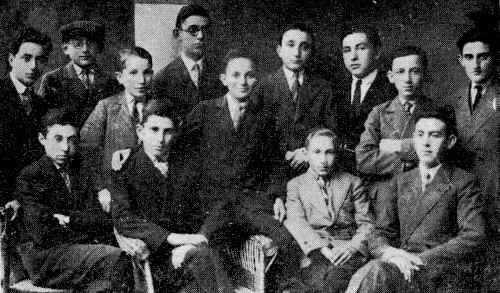
| A class from the teachers' seminary in Telshe in 1931 Yaffa is third from left |
Footnotes
by Tzvi Brik
Translated by Jerrold Landau
Poor are the expressions and weak is the pen to portray the feelings and memories, which shrink to their essence, so that they can be written down in our Yizkor Book of Telshe.
Nostalgic memories of my native city of Telshe pain me. The Jews of the city come before my eyes: fathers and mothers whose lives were plunged into darkness. However, with modest faith and stamina they accepted everything with love, and found the strength and bravery to bear all the difficulties. They hoped that perhaps the lot of their children would be better…
Precious images from yesterday, from all that took place in Telshe, are etched in my memory. Images float by of personages who were so integrated into Jewish life in Telshe. Streets and alleyways which were so deeply embedded in my world live in my memory. There, in Telshe, my childhood was spent. There, in a house, stood my cradle. From there, from Telshe, my difficult path of suffering during the time of the Holocaust began. I see our fathers and mothers who became grey before their time when the tribulations of the period of the German occupation began. They became old before their time, and were bent under the difficult burden of worries about how to save their children from being killed. I find it difficult to think about, and the thought torments me even more about how to feel united with the holy souls, and at least for one moment to live within their agony and tribulation at the time that they went on their final way to death in sanctification of the Divine Name.
In that elevated mood, I wish to note that everything was so brutally
[Page 315]
destroyed, uprooted completely – everything that had represented Telshe. A full blooded, richly textured Jewish life flowed through Telshe, a life filled with substance. It was a town with well-rooted Jewish institutions: clubs, libraries, sports organizations, Beis Midrashes, institutions of learning, parties, and youth organizations; a city that was famous in the scholarly world with its large Yeshiva. It was a modest, yet pure life in Telshe. A Jew felt soulful and spiritual in Telshe, as in his natural living space. The way of life, the rhythm of life, in the home and on the street, intermixed holy and secular. In Telshe, one did not only study in one's youth, but also in middle age and in deep old age. Jews studied a page of Gemara in the synagogue, and the youth made sure to enrich their knowledge with self-education. They studied alone as well as communally. Simple folk who did not know any Torah absorbed the aroma of the Torah.
The Jewish institutions are no more. The worshippers are no more. The splendid Jewish youth are no more. Shattered and scattered is Jewish Telshe. In the hours of longing and distress, I feel the need to probe into my thoughts, and images and episodes from the cut-off past, from life that once was in the old home as I remember it. My soul weeps and my heart throbs from pain, sorrow, and bitterness in that everything that was embodied in Telshe is destroyed and ruined, and from all sides and all people only memories of former life remain.
I remember the oncoming storm as if it were yesterday. I still feel the shudder and tremor of the Jews of the Telshe community when the bloodthirsty Hitlerists, joined by the brutal Lithuanian murderers, filled the streets with their hovering terror. In my dreams, I see the last phase of the vibrant Telshe community. The hand trembles and the heart chokes up when I recall those sorrowful days.
With a feeling of holy awe, with holy trembling, I wish to perpetuate the final period of Telshe in our book. I must do so as one of the few Telsher Jews who went through the path of tribulation from the final destruction until the liberation. I feel a holy duty to preserve for eternal memory everything that was destroyed. It is very difficult for me to write measured words of eulogy for Telshe. I do so as a witness who must record the sorrowful account of our city of Telshe.
Upon us – upon the survivors of Telshe – has fallen the fate to perpetuate our city of Telshe and erect a spiritual monument of words for it, to erect a monument for the murdered martyrs of Telshe, the Telshe residents whose cut-off lives disappeared like a shadow at the last gasp.
For all the people, for all the refinement, for all the gentle, well-rooted Jews, for all the Jewish values that were woven together in Telshe for generations: our Yizkor book will be our scroll.
Telshe, we will never forget you!
|
|
JewishGen, Inc. makes no representations regarding the accuracy of
the translation. The reader may wish to refer to the original material
for verification.
JewishGen is not responsible for inaccuracies or omissions in the original work and cannot rewrite or edit the text to correct inaccuracies and/or omissions.
Our mission is to produce a translation of the original work and we cannot verify the accuracy of statements or alter facts cited.
 Telšiai, Lithuania
 Yizkor Book Project
 JewishGen Home Page
Copyright © 1999-2026 by JewishGen, Inc.
Updated 14 Sep 2026 by JH