 |
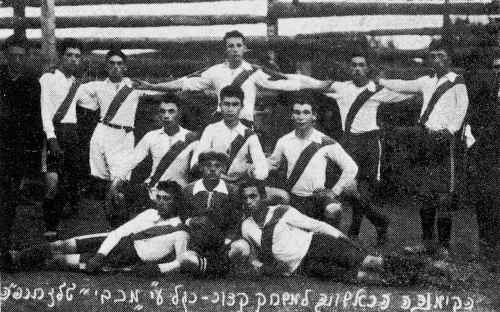
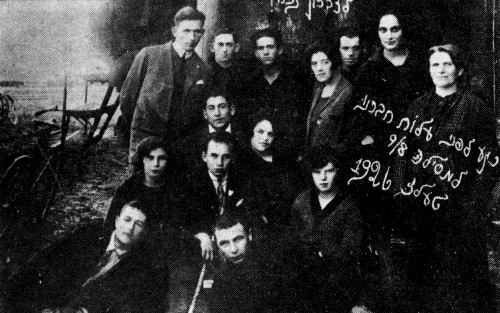
of a friend from Telshe to Israel (9 August 1926)
Standing second from the right: Sara Haytin, fourth Kopel, Shishi Yakob
Lying down: Leibovitch and Kopel
In the middle: Moshe Varias
|
|
[Page 228]
by Tzila (Varias) Weinstein
Translated by Sara Mages
I was born in Telshe to a religious family. We were seven children in the family - five brothers and two sisters. My sister Malka was the eldest, I was the sixth and my youngest brother Moshe was born after me. Today he lives in Los Angeles, in the United States. The rest that already had families with children perished in the Holocaust. My father Eliyahu Varias died at the prime of his life at the age of fifty-three as a result of an unsuccessful hernia surgery. I remember that at that time, before his death we had guests from abroad - my mother's sister Chana Rachel Singer and her husband Lipa from America and my father's niece, Dora-Malka Sasson and her three children from South Africa. At that time, my sister Malka got engaged to Zeidel Levin and a beautiful party was held for them. Everyone advised father to go through the surgery, that it was an easy surgery and there was no reason to suffer. And indeed, he listened to them and traveled to Memel where he was operated on. To our sorrow, the surgery wasn't successful and father died. I was a young girl then and the death of our father who was the main breadwinner was a hard blow for all of us. My two brothers, Yehoshua (Heshel) and Yitzchak (Eyzik) continued in father's trade. My sister Malka got married and left home. My brother Shimon worked as a sewing machine agent for “Singer.” My brother Aharon managed a bicycle repair shop and employed Jews and Lithuanians.
In order to facilitate the family's income, I was forced to stop my studies in the Yavne gymnasium and learn the trade of sewing. At the same time a Ger-Tzedek (convert to Judaism) arrived in Telshe and opened a shop for undergarments. I and Bluma Taitz (Berman), who now lives in Haifa, learned the sewing trade from him. A short time later we opened a workshop for sewing undergarments in my house in a nice room which faced a quiet street. We parted after two years. Bluma worked alone and I traveled to Kovna to study the sewing of bras and belts at “ORT”[1]. The principal, Oleiski, arrived in Israel after the war and also dealt there with matters of “ORT” (I met him in Tel-Aviv and gave him a picture in which he was photographed with the girls who finished their studies with him). I returned home after I finished my studies and opened a workshop for undergarments, bras and belts. I also employed three girls. In this way each of us contributed to the livelihood of the family.
One clear day I traveled to the resort town of Tirkshli to visit my cousins Chaya and Masha Yipschitz (both are now in Israel). After I spent a few days with them at the summer camp I returned home and found that my workroom, with its furniture and sewing machine, was moved to a small side room.
My mother Pasha, who was very sensitive to the sufferings of others and always helped everyone who was in mental and material distress, above and beyond her ability, housed Aharon Kopel in the large front room. He had tuberculosis and his house was flooded because of the heavy rains that fell at that time. She nursed him with great devotion and took care of all his needs. To my question of why she does it, she told me that it was very important for her to help others. I burst into tears and ran to my aunt, Rivka Yipschitz. I told her that my mother is exceeding all bounds with her mitzvot and charitable acts… Aharon Kopel stayed with us for several weeks until his situation improved. Such was my mother, may she rest in peace.
When my brother Moshe reached the age of military conscription he made every effort not to serve in the Lithuanian Army.
[Page 229]
He traveled to Kovna, managed to get an emmigration certificate and immigrated to Israel in 1933. I read his letters with happiness and waited for them impatiently; I envied him. Apparently I also longed to immigrate to Israel.
At the beginning of 1935 I had the opportunity to travel as a tourist to the second “Maccabiah Games”. I registered for this trip and turned to my aunt Rachel Singer in the United States with a request to help me with travel expenses.
|
|
of a friend from Telshe to Israel (9 August 1926) Standing second from the right: Sara Haytin, fourth Kopel, Shishi Yakob Lying down: Leibovitch and Kopel In the middle: Moshe Varias |
In addition, it was also necessary to deposit sixty Pounds Sterling (a lot of of money in those days) - a guarantee that I'll return to Lita after the “Maccabiah”. Otherwise, the money would be confiscated. I received the requested help and arrived in Israel in 1935. My family opposed the trip and I promised to return within three months. Fortunately, I didn't keep my promise and in this way I remained alive.
When I signed up for the trip to the “Maccabiah” I was very happy and waited impatiently for my departure. Meanwhile, I continued with my work. I remember that a short time before my immigration a Lithuanian came and brought me fabric for the sewing of undergarments. On the wall at the entrance, he saw a newspaper holder, the wonderful handiwork of my sister Malka and on it was embroidered a caption in German Zeitung Halter. The Lithuanian said: “You Jews always love to use foreign languages. Don't you have a culture and a language of your own?” To that I answered, “when your ancestors were still savages and lived in caves my ancestors already gave the Bible to the world. Very soon I'll be traveling to our homeland and speak in our language.” He laughed and said: “don't be so proud of your country, one day the Arabs might destroy you all.” When my mother z”l heard his words, she came out of the kitchen and said to him: “ How dare you talk like that in a Jew's home! When we enter your house it's necessary to bend over to avoid being hit in the head because you use your entire salary for bingeing and indulgence, and later you roll drunk in the ditches instead of using the money for education and for improving the quality of your life.” He didn't answer and left as he came. This man was a teacher at the Lithuanian gymnasium. I refused to take the work from him.
Life in Israel at that time was difficult and the daily struggle for survival wasn't easy. The absorption tools that we have today didn't exist then. There was a shortage of work in the country, but I didn't give up and accepted all the difficulties with understanding and love.
In the letters that I received from home I was asked to return and Reizele Yafeh (today Shoshana Holtzberg) brought me money that they sent with her. One day my brother, who lived in Tel-Aviv,
[Page 230]
came to Jerusalem where I lived at that time and brought a letter to me from America. He asked me if I was willing to travel to our relatives the Singer family, because they sent me an affidavit and urged me to come to them. I answered my brother that I didn't come to Israel in order to immigrate to America and that I hope the situation in the country would change for the better so I'll be able to settle here. I added: “if you want, take advantage of this affidavit and travel in my place.” And indeed, as you can see - my hope came true. I settled, as stated above and raised a family here that I'm happy and proud of.
My brother traveled in my place to the United States and today he lives in Los Angeles.
Footnote to the English translation:
|
|
by Malka Klein Sirot
Translated by Sara Mages
“The slayer slew, the blossom burst, and it was sunny weather”…Among the holy communities which were obliterated from the face of the earth when the Nazi soldiers, may their names be blotted out, invaded my homeland Lita, was also my hometown Telshe. “The slayer slew, and it was sunny weather…” The German oppressor, together with Lithuanian collaborators, attacked and shed the blood of the members of my holy community. The supreme angels didn't fear and the foundations of the world weren't shaken - the city was obliterated with its people, children and infants. In great terror and anguish, in seven different deaths it was destroyed and no longer exists.
(“The City of Slaughter” - H.N. Bialik)
My Telshe was a city immersed in mitzvot and religious education. A Jewish city, steeped in modest attributes and ancient Jewish ethics, no longer exists. Woe to the eyes that saw its loss. In Telshe, where we grew up, matured and were educated in such a pastoral atmosphere, we understood and absorbed the essence of Judaism which was imbued with mitzvot and good deeds. A city that won the right to establish generations of Torah scholars: On one side the scholars and on the other the workers, who were busy with the burden of making a living but always found the time to read the Gemara and the Mishnayot. God's work and manual labor lived together. Where can you find it, this beautiful integration of rooted laborers who have found refuge and satisfaction in matters of Heaven after a tiring day of hard labor?!
Telshe, its name is known far and wide. Telshe, it's a rich concept and a wonderful way of life. A city that bustled with energetic Jewish life, a city where the Sabbath had greater value than a weekday. They came to her from afar to hear the sound of the Torah and sit before the righteous and the devotees and learn from them.
In the summer of 1941 the oppressor came and cut off the heads of my holy townspeople. Among them my modest mother Henya Klein, my father Yehudah Leib, my unforgettable brothers Efraim, Tzvi and Yehosua z”l, who stood next to my mother on her last journey.
My mother, you were the symbol of a devoted Jewish mother. From sunrise to sunset you helped to carry the burden of livelihood and invested your best efforts so that nothing would be lacking in your home. A true Ashet Chayil (Woman of Valor)… My good father, a scholar and a man of good morals, was full of faith and basic Jewish consciousness, always willing to help others with a smile and abundant of kindness.
We will bear their memory forever.
May the legend of Telshe continue from generation to generation!
[Page 232]
by Walpert Gershon
Translated by Sara Mages
My hometown Telshe… the Žemaičių (ancestral) home is about ninety kilometers from the German border and one hundred kilometers from the city of Memel. The city sits on the shore of Lake Mastis and in the lake is a small island. A small part of the lake is surrounded by a forest and at the edge of the forest, in a few houses, lived the Jews. This place was called Dirksteliai.
About five thousand Jews lived in the city of Telshe. There was a Yeshiva in the city and its founder was Eliezer Gordon. This Yeshiva was famous throughout the Diaspora.
How great was the sanctity of the city. The shops were closed on the Sabbath and sacred silence reigned in the city. From early morning everyone rushed to the prayers in the synagogues. Nobody harmed the holiness of the Sabbath. At noon all the sidewalks were filled with people. Nobody smoked on the Sabbath and sacred tranquility prevailed in the city. Everyone kept the sanctity of the holidays. How great was the morality of the Jewish population in Telshe, and how great was the sanctity of family life. Husbands treated their wives with respect, love prevailed in each Jewish family and children treated their parents with great respect.
The city had a Jewish hospital and a Jewish National Bank. People worked with great dedication in the public institutions for the benefit of all!
How awful and bitter to think that all this has already passed and no longer exists…
We no longer have the city of Telshe which was emptied of Jews. All the Jews of Telshe were murdered, with a prayer on their lips, by the Nazi murderers. May the memory of our holy brothers and sisters who perished be for a blessing. How great is the sorrow and the feeling that none of them remained in our city Telshe. Their holy souls will be in the Garden of Eden.
|
|
by Eliyahu Rudnitski[1]
Translated by Sara Mages
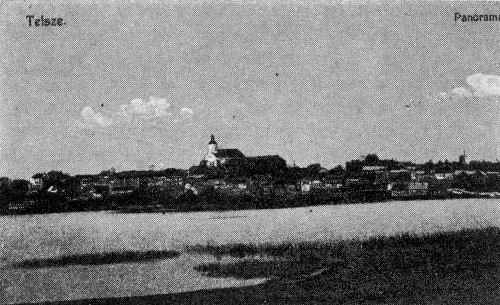
It seems it was only yesterday, to such an extent it was engraved in my memory: Telshe on the Sabbath at dusk. A light breeze is blowing from the big lake in the valley. The sun dips in the lake, wrinkled waves pass through the calm water and above – flocks and flocks of birds. The houses, the tall church on top of the high hill – everything reflects upside–down in the water. From afar, the singing of Soviet companies, [in Russian] Ach, Vintkovka, sounds in the silence of the evening. They sing on this side and a new song of another company is already rising from the other side – “The Marshal is with us, he'll lead us to battle.” The sound of the two melodies echo in the calm evening and ease into the heart.
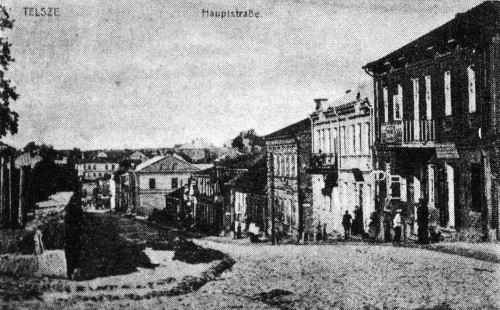
Somewhere in the big world blood is being shed, but here in Telshe, everything is still quiet. There's movement in the streets. Jews and Lithuanians are strolling on the wide sidewalks. Today is the Sabbath, the time is sunset and the holiday spirit is in everything. Lita is under Soviet rule for a year. During that time there have been enormous changes in the residents' way of life, but they stand in force on – Saturday and Sunday – on the Sabbath.
Soldiers of the Red Army are now camping in the building of the famous Telshe Yeshiva, and also in the seminary for priests. However, the Beit HaMidrash and the church are still open – both are filled with worshipers on the Sabbath and on [religious] holidays.
Young men and women are marching in the streets with arrogance as if they're saying: “Now is our hour!” Everyone – members of the Komsosmol in their ties, workers from the factories, officers and soldiers – are talking, laughing, pushing, whistling and singing. Now, the electric lamps are lit in the streets and myriads of stars appear in the sky. There's great congestion at the entrance to the only movie theatre in the city. Not everyone will be allowed to enter. A Soviet film plays here, but it's only shown to the soldiers of the Red Army, to the officers, members of the Communist party, and the Komsosmol. Two tanks pass the street with noise, and immediately it's quiet again.
There's no desire to return to the room. I pass by the Yeshiva. An electric lamp is lit at the entrance. The inscription, in the holy language, is still fixed at the entrance: “This house will be a house of prayer for you.” A Red soldier stands on guard and a rifle in his hand. Military personnel strumming on balalaikas appear through the open windows. For years “prodigies” found shelter in the shadows of these walls. At night through these windows came the bleak and enthusiastic melody of Yeshiva students swaying on the Gemara to the light of a candle… New times, new songs!
Russians, Kalmyks, Tatars, Uzbeks and Tajikim, blond and also black, tall and short, are sitting in the Yeshiva's rooms. The beds are covered with blankets and arranged in two rows. Juicy Russian language echoes in the quiet narrow alley. The Yeshiva is surrounded by a red brick wall, but neither did it stand against the tide of time. Telshe, which lies on the German border, was until the revolution, a fortress for Lithuanian Clericalism. Old Russian masterpieces, worn journals, a joy for a collector, are still available at the public library, but nobody in Telshe has read them for the past twenty five years.
[Page 234]
The government of [Antans] Smetona and the Lithuanian clergy gradually pushed everything that was related to Russia, especially the Russian language. It was difficult for the cheerful soldiers of the Red Army, who never stopped smiling, to talk to the local people. Both sides suffered a lot, especially the youth. The Russian song in its heartiness, pleasant melody and sweetness, formed the first bridge. Young Lithuanian cadets, Jewish boys and girls, were the first to sing popular Soviet songs in broken Russian.
Close to the Yeshiva are Jewish houses. Teenagers sit on the steps and listen to the music of the balalaikas. Now, the music stops and the soft tenor of a Red soldier bursts into a song: “If tomorrow the war, if tomorrow to fight, today you must be ready.” Immediately the voices of his friends joined him, the song overflowed and was carried softly to the Heavens.
|
|
I returned to my room late at night. My neighbors, two Russian officers and their wives, were getting ready to go to a party at the Lithuanian High School. The sound of the military band that played there reached us. The neighbors invited me to go with them, but I had no desire to go. I was still affected by the summer evening and the songs that I'd just heard. I was overcome by longings near and far for those who remained in Vilna. They attacked and didn't let go.
I lay down. Who would've thought then that the words of the song “If tomorrow the war, if tomorrow to fight” would become a reality immediately on the following day at the dawn of 22 June, 1941.
Footnote to the English translation:
[Page 235]
by Helen Kaplan–Hiller, the United States
Translated by Sara Mages
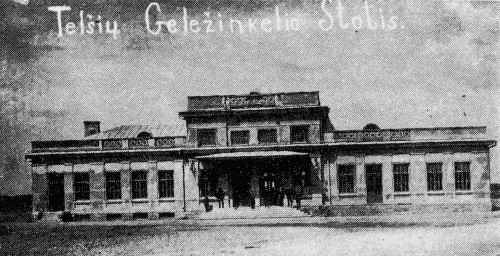
In 1927 when I was ten years old, my mother decided to return to her birthplace in Telshe after 14 years in the United States. She longed to see her parents one more time. We arrived at Telshe on Friday evening. The entire Jewish community came to the train to welcome the American guests. It was a very long road (for my small feet) to the home of my mother's elderly parents. I was amazed to see the huge crowed of strangers who surrounded us. After this long walk the people and the rest of the friends left the house. My first glance fell on the natural wooden floors without carpets. A simple electric wire with a single light bulb hung in the dining room in the middle of the ceiling, above a fairly simple table and chairs. This whole scene, with the rest of the simple furniture, reminded me of the stories that I once read in geography books about the first pioneers in the United States. The only art object in the house was the picture of Theodor Herzl. What interested me most was the stove in the kitchen,
|
|
which also warmed the rest of the bedrooms and was the only source for heating the entire house.
My uncle, Yitzchak, explained to me that he really enjoyed sleeping on top of this stove on cold winter nights. When mother asked grandmother for milk for us, she brought a pitcher of milk that was
[Page 236]
still warm from the last milking. Mother looked at the pitcher and decided to transfer the milk through a clean towel for “fear” of unwanted things on the surface of the pitcher, and also for lack of sterilization that we were used to. Despite all of that, the taste of the milk was very strange. None of us was willing to drink it on the first night. However, over time we got used to the strange taste. A greater surprise was waiting for my sister and me when mother took us for a walk outside to see the structures of the entire farm before we went to sleep. Nobody had prepared us for such a sight.
Despite all the surprises, I returned happily to the soft bed which had a strange mattress. Later, I found out that it was stuffed with simple straw.
All discomfort didn't prevent us from enjoying the long trip by train, and also the rest of the surprises and lovely reception that we got on our first night in Telshe.
|
|
by Yerachmi'el Ravad z”l
Translated by Paul Bessemer
A song of those who ascend [to Zion][3] to the beit midrash and yeshiva (Megillah)
|
1
How friendly are thy tabernacles
I disparage the rain 2
This is the minor temple for which I yearn
My gaze is not to the horizon, my thoughts not on the mountains, 3
If the evil Balaam[4] works his magic and curses 4
Those are all the blessings that Balaam spoke, they are done, complete, and he is gone without a trace. 5
This is the beit midrash, the treasure that is the awe of the heavens 6
And you, Yeshiva of Telshe! The place where the wise gather 7
And once per week I secretly peer into the building 8
Here I am, in paradise, among the greatest of the holy men, 9
But now I comfort myself and my heart is against strengthened! 10
Old beit midrash, You are a City of Refuge for me, 11
Twenty years ago, my father–may his memory be blessed–commanded: “Forever shall my son study at the beit midrash” 12
I too support and help my children |
Footnotes to the English translation:
|
|
JewishGen, Inc. makes no representations regarding the accuracy of
the translation. The reader may wish to refer to the original material
for verification.
JewishGen is not responsible for inaccuracies or omissions in the original work and cannot rewrite or edit the text to correct inaccuracies and/or omissions.
Our mission is to produce a translation of the original work and we cannot verify the accuracy of statements or alter facts cited.
 Telšiai, Lithuania
 Yizkor Book Project
 JewishGen Home Page
Copyright © 1999-2026 by JewishGen, Inc.
Updated 06 Sep 2026 by JH