 |
|
|
[Page 27]
Under Austrian Rule
Chapter 7
During the first partition of Poland (in 1772), the situation of the [Jewish] communities was a sad one. On July 31, 1772, the Austrian army entered Tarnów. On the 11th of September of the same year, the universal partition by Queen Maria Theresa was published at the Trumpet Hall in Tarnów, in which the Tarnów population was informed that they had become Austrian citizens. The Polish official ministries were reorganized in the Austrian manner.
In 1774, Barbara Sanguszko renounced her lifetime right to rule Tarnów County. Her sons divided their father's estate among themselves. Tarnów and the surrounding area now became the property of Prince Hieronymus Sanguszko, his elected province. After the first partition of Poland, under the influence of the changes in authority, different relationships were formed between the city and the lordly landowners.
With the partition of Poland, the landowner, as the owner of this city, decided about the city's facilities and about the issues of the city's self-government. The Austrian administration changed this position and intervened in the authority of the various princes and counts. Over time, their influence on city affairs decreased and finally disappeared completely. Tarnów's rulers also gradually lost their influence over the city's affairs. From the earliest times, Tarnów's city administration was run according to Magdeburg Law and therefore had far-reaching self-administration. However, in most cases, it was the will of the landowners that made the decisions.
The landlord's rule in the cities completely ceased only after the decrees of the Austrian administration in 1772. In 1787, Tarnów was finally included in the Austrian
[Page 28]
administration and on April 11, 1787, elections were ordered for the Tarnów city council.
Parallel with these regime changes, Jewish life also took on other forms. In the parts of Poland occupied by Austria; that is, in Galicia, the Jews became an object of merciless pressure from the bureaucratic apparatus of Queen Maria Theresa and her successor Joseph II. Their reforms had a significant influence on the transformation of Jewish life in Galicia. Maria Theresa, who wanted to extract as much income as possible from Galician Jewry, issued her “Theresian Edict” in 1776, based on which complete autonomy was left for the Jewish communities and a central autonomous body was formed for them; the so-called, “Jewish Directorate” whose task was to distribute the taxes between the individual Jewish communities. In addition, they had to compute the taxes for each individual Jew. The directorate comprised 12 Parnassim {ed. lay leaders of the Jewish community}, under the chairmanship of the Chief Rabbi. At that time, the only county rabbi was a rich Jew from Brody, Aryeh Leib Bernstein.
Maria Theresa's decrees were aimed directly at the Jews. The tax assessment for the Jewish population was twice as much as the head tax that Jews paid in the previous Poland [before the Austrian takeover]. At the same time, excessive fees were introduced for weddings, which was supposed to hinder the increase of the Jews in the country. A campaign was declared against Jewish poverty resulting in the removal of the so-called “impoverished Jews from the country” i.e. those who could not pay the “Tolerance Tax.” They were brought in the thousands to the borders in carriages and driven out of Galicia. And what these drastic anti-Jewish ordinances did not show was an end to the tax extortion that drove Jews to desperation. The tax debts had increased continuously.
Joseph II did not relate better to Jews, although he tried to add a touch of humanitarianism to his decrees, which was in fashion among the rulers of that era during the eighteenth century. First, he stripped the Galician Jews of the last remaining autonomy they had retained since before the partition of Poland. He brought the Jews under the royal jurisdiction, although at the same time he abolished the restrictions on commerce, and allowed them to freely engage in crafts in the cities. According to his decree, the Jewish administration that Maria Theresa had set up was liquidated, the autonomy of the Galician communities was abolished, the rabbinical
[Page 29]
courts were dissolved, and all the Parnassim were removed. Thus, the Jewish communities and the entire Jewish population were placed under the imperial jurisdiction. For religious matters only, a representative body of 3-7 delegates from each community was formed. At the same time, Jews were forbidden to market in the villages any alcoholic beverages, manage rents, estates, baths, mills; all of which were the primary source of income of the Jewish population. During the first Partition of Poland, about 40% of the Jewish population lived in villages and, thanks to the above “humanitarian” orders, they were left without a livelihood. The pauperization of Galician Jewry proceeded rapidly.
For this reason, Joseph II, in an imperial charter on January 1, 1788, gifted the Jews with German surnames, military service, and access to assimilated schools , which were under the leadership of Czech Enlightened Hertz Hamburg, the tutor of Mendelssohn's children. Hamburg was appointed inspector of the Jewish schools in Galicia, whose number reached 48. They were called the “German-Jewish Schools.” One such school was also established in Tarnów. The schools, which were initially designated only for boys, were divided into Trivial and Normal.
At the head of these schools was a headteacher or a mentor. The main obstacle to learning was the German language, which was to meant to lead to the Germanization of the Jews. These German-Austrian schools, which restricted exposure to Jewish religious traditions, were received by the Jewish population with hatred, which became even stronger when the director of the schools, Hertz Hamburg, took part in recommending the cheders {ed: traditional Jewish school for elementary-age pupils} and yeshivas to be closed. Galician Jewry began a campaign against the schools. Memoranda were sent to Vienna; efforts were made where needed; the opponents of the schools won a victory: in 1797, Hamburg left Galicia. The hated schools existed until 1806, when Kaiser Franz I abolished them and allowed Jewish communities to open their own schools.
On May 7, 1789, Kaiser Joseph II issued a “Tolerance Charter” for Galician Jews, which for a long time, until 1848, regulated the legal status of the Jews. This new order, among others, sanctioned the abolition of communities, leaving a type of religious supervision which was called “cultural community understanding.” This institution comprised 3-7 representatives (Parnassim), elected for a term of 3 years. The election ordinance expected
[Page 30]
the homeowners to choose between 6 and 14 candidates from among themselves, and the mayor had to confirm half of them. Only district cities could keep district rabbis.
So instead of the old community-based oligarchy, a representation of rich families was formed, which, with no legal basis, became the decisive factor in the life of Galician Jewry. The Jewish population continued to stoop under the tax burden and taxes, especially because of the taxes on kosher meat and Shabbat candles.
It goes without saying that Tarnów Jews also enjoyed these favors. Just as with all the Jews of Galician cities, here too they underwent impoverishment. Added to this, the plague of fires did not end. On April 14, 1792, at 1 a.m., Zydowska Street was engulfed by a terrible fire. Unfortunately, an east wind blew the fire onwards, and within three hours the entire Jewish Quarter, including the Rynek (market), was destroyed. The destitution of Tarnów Jews was then so great that Jews from Brzezinski (Briegel) and Dombrowa brought several sacks of bread and 600 Guilders to support the burned-out victims of Tarnów.
After this fire, Jews began to rebuild the destroyed homes. According to the aforementioned “Tolerance Charter,” Jews in Tarnów were politically, administratively, and juridically subject to the same authority as all the Jews in Galicia. The Rabbinic courts were limited only to the amicable settlement of disputes. The walls that surrounded the city disappeared, and Jews were allowed to live in all parts of Tarnów. This happened during the year 1792, when all the privileges of the city were abolished and it received the new imperial privilege, according to which it was left with: the court of first instance [Magistrate's Court], a certain autonomy in electing a magistrate headed by a mayor, and a city council of 24 members. Tarnów Jews received the same rights as all city citizens.
During this period, Tarnów developed robustly. In the years 1784-1785, the new, also called, “Caesar Road,” was built (through the current Krakówska, Walowa and Lwowska Streets). This highway facilitated communication with other Galician settlements, which lay along the imperial road. The fact that in 1786, the first printing house was established there also testifies to the economic development of Tarnów.
[Page 31]
In 1820, Tarnów already had 7,640 inhabitants. The Tarnów community also found itself in a state of development. On May 20, 1840, the community agreed to build its own Jewish hospital. For this purpose, a site was bought by the city's community. The purchase deed was signed by the community's representative, Shmuel Daniel.
From the foundation act of the Jewish hospital in Tarnów, solemnly drawn up on January 26, 1842, we learn that two years earlier, in 1840, the community representatives Jacob Goldlust, Pinchas Polester, and Shlomo Finkelstein had begun collecting for the Hospital Fund. This document shows that in the first half of the nineteenth century, the Jewish community in Tarnów was so developed that it could buy a plot [of land] and build a new Jewish hospital in place of the old one, which was located in the center of the city.
The foundation act, written in German, has the following content:
“In the year 1842, under the prosperous government of His Majesty Kaiser Ferdinand I, the Jewish community established a Jewish hospital. The Jewish community was requested to undertake this activity by the Imperial-Royal Governor's Council, Mr. Josef Breinel von Wallerstern; at the same time strongly supported by the highly esteemed Mr. Chris Hauptmann, through his official influence and personal involvement.
“During the past two years, the mayor, Mr. Ignatz Hingler and the community representatives, Jacob Goldlust, Pinchas Polester, and Soloman Finkelstein were involved in collecting for the already owned hospital assets in the farms [suburbs]. The previous hospital building, which was located inappropriately in the middle of the city, was sold. In this way, the funds for building the new hospital were amassed. The Jewish community voluntarily contributed the levy toward the facility, and to cover the initial expenses. The administration was entrusted to the following four distinguished community members: Michael Poletter, Aaron Kaminer, Haim Leib Feigenbaum, and Lippe Weingarten, under the leadership of the mayor. The ongoing maintenance of the hospital was supported through the following voluntary payments and collections made on various occasions:
“The income from ritual baths {mikve }, payment of [prayer] quorums and prayer houses, money collections at births, weddings, hair cutting, deaths, when erecting tombstones, when calling up to the Torah in the synagogue, and finally, charity that was collected by charity boxes that were placed in public places.
[Page 32]
“In this manner, the hospital was donated for the welfare and blessing of the suffering believers, and opened this very day.
“May God's blessing come upon this house in which we have gathered for this solemn and noble purpose.”
“Held in Tarnów on January 26, 1842.
“Joseph Breinel von Wallenstern, Holy Community, Governor's Council and Tarnów District Head; Ignatz Hingler, Mayor; Rappaport, District Rabbiner; Community Representative, Pinkas Polester, S. Finkelstein; Hospital Managers: Michael Forester, S. A. Kaminer, Haim Leib Feigenbaum, Lippe Weingarten, Hirsch Keller, David Rappaport, Menke Wechsler, J. Luxenburg. Witnesses: Humansky, District Commissioner, Yarasch, District Engineer and Construction Director, Edward Kellermann, Doctor of Medicine; HC District Physician, corresponding member of the HC Society of Practicing Doctors in Vienna; Isaac Keller, Hersch Bernstein, Shaul Finkelstein, Leibel Mintz, Israel Bernstein, and Mendel Keller.”
At that time, the noble Jewish philanthropist Deborah Wechsler did a great deal for the Jewish community. She donated an entire complex of houses on Nova Street to the Tarnów community, which was confirmed in her will, dated November 20, 1875. Until the outbreak of the Second World War, the following were located in these houses: the school named after Deborah Wechsler, and community offices. All these buildings were destroyed by the Hitlerite bandits toward the end of 1939.
Tarnów had reached great prosperity, since in the year 1845, during January, a contract was concluded between Prince Władysław Sanguszko , the heir-apparent of Tarnów, and the magistrate, according to which Prince Sanguszko allowed the villages of Grabowka, Strushibe, Zablotche, and Terlikow, to be annexed to the city. The prince renounced his authority and jurisdiction over the inhabitants of Tarnów city in favor of the magistrate. Around this time, Tarnów became one of the few larger cities in Galicia and increased its area more than sevenfold. The number of inhabitants increased, and the Jewish community also grew along with it.
During the period of the March Revolution in 1848, Jewish life in Tarnów was not easy. The eminent historian and martyr, S. Dubnow, writes in the second chapter of his World History of the Jewish People (p. 129) that during the years 1829 and 1844, Jews in the Tarnów District were accused of ritual murder. The investigation that was carried out at the time proved that estranged mothers killed their illegitimate children. According to Dubnow, the Austrian government at the time, although a thoroughly reactionary one, did not want to allow
[Page 33]
anti-Jewish demonstrations on just the mere suspicion that Jews had committed a ritual murder.
In March 1848, the “Spring of Nations” passed over Europe. A revolutionary wave swept over the German, Austrian and Italian countries, which brought the first rays of freedom to the nations oppressed by absolutism. The Jews, who suffered the most from absolutism, took a dynamic part in the March Revolution, which became the beginning of a broad emancipation movement.
In Austria, after the second uprising in May 1848, in which Jews took an active part, the Constituent Assembly was called. Even before that, in April 1848, active and passive voting rights to the Austrian Parliament were recognized for Jews. When the Constituent Assembly convened in Vienna in July of the same year, there were also Jewish representatives on the deputies' benches, the most prominent of whom was the Viennese Rabbi Mannheimer.
For the Austrian Jews, especially for the Galician ones, the hope of at least partial equality had emerged. It was about fighting for tax relief and canceling the prohibition for Jews to buy land, as well as introducing religious tolerance. Jews suffered the most from the “Tolerance Tax” and the “Jew Tax.” The former was a tax on consuming or slaughtering kosher meat, and the latter a tax on lighting Shabbat candles. These taxes brought in a large revenue into the royal treasury. The tax on candles also held political significance for Jews, because only the Jews who paid an annual tax on 7 candles, and in the smaller communities, from 3 to 6 candles, had active voting rights to the communities. Jews had passive voting rights. If living in the larger communities, they paid a tax on 10 candles, while in the smaller ones, a tax from 5 to 8 candles.
Jewish society, mostly in Galicia, did not rest. A lively emancipation movement embraced all the larger Jewish communities. In 1848, the Stanisławów “Society for the Promotion
[Page 34]
of Political and Literary Progress among Jews” took over the initiative in its chapters.
Among the files of the Tarnów community archive is an original letter (File № 267), dated February 30, 1848. In the letter, addressed to the Tarnów community, he shares with the administration of the aforementioned society that according to the relations of Abraham Halpern from Stanisławów, the Austrian deputy to the Parliament in Vienna, there is a positive mood in favor of the Jewish emancipation movement. The administration of the society requests the Tarnów community to provide the Jewish deputies with statistical data about the number of Jews in Tarnów and the surrounding area, about the amount of the “Jew Tax” paid, and what special taxes Jews pay to the local authority. In addition, the letter recommended that the local community should hand over a petition to one of the Jewish deputies, along with statistical data.
The Jewish community in Tarnów did not wait long; on August 31, 1848, it sent a letter to the administration of Stanisławów's “Society for the Promotion of Political and Literary Progress Among Jews.” From the copy of the letter, which was found in the community archive (File № 267), we learn that on August 29, 1848, the Tarnów community sent out a petition to Deputy Rabbi Mannheimer in Vienna, who was elected by [the city of] Brody as a deputy to the Austrian Parliament in 1846. There was also a remark in the letter that the petition was delivered to Mannheim, because the Jewish deputy Halpern, who had contact with the Galician communities, had gone on vacation.
In the letter from the Tarnów community, there is an answer from the Stanisławów Society regarding the question of statistics on the Jewish population and about the tax level. From the answer, we learn that according to the population list of 1846, there were 18,479 Jews in Tarnów County. From the appended list that was kept in the community archive, we learn the numbers mentioned are around:
Tarnów 7,914 people Żabno 481 " Dombrowa 1,736 " Radomysl 1,241 " Mielec 1,980 " Baranów 1,021 " Kolbuszowa 867 " Dębica [Dembitz] 1,469 " Ropshitz [Ropczyce] 1,770 " Total of 18,479 people
[Page 35]
Besides the statistics, there is an observation by the Tarnów community administration that numerous Jewish families were not included in the list and therefore the community believes that the number of Jews in Tarnów county is 30 thousand souls.
The amount of taxes paid annually by Tarnów Jews is stated in the reply to be 25 thousand Florins. From kosher meat and candles: 16,800 Florins. Altogether, the “Tolerance Tax” amounted to 41,800 Florins annually.
The Tarnów community was not the only one that sent a petition to the Jewish deputies in Vienna. Such petitions with statistical material about the situation of the Jews were provided from almost all the Jewish communities in Austria. On September 5, 1848, the Jewish deputy Mannheimer appeared in the Parliament with a strong speech, in which he demanded the abolition of the heavy and humiliating “Jew Tax,” which was ruining the Jewish communities (Dubnow also mentions this speech in his World History of the Jewish People). Mannerheimer's stirring speech influenced the overwhelming majority of the Austrian Parliament, and on October 5, 1848, with a majority of 243 votes against 20, it was decided to cancel the taxes on kosher meat and candles. However, there were other legal restrictions on Jews that remained in force.
Galician Jews did not stop leading the struggle for full emancipation. At the head of this movement were once again the communities, and the Tarnów community did not stand back. In March 1866, the Galician Sejm adopted a law on self-government. This law included a whole series of restrictions for Jews, especially for the Lemberg city administration. The two largest communities, Brody and Lemberg, organized a joint action in order not to allow the restrictions to be sanctioned by the central authority in Vienna. This action was also joined by the Tarnów community, which led a lively correspondence with the communities of Brody and Lemberg regarding Tarnów's participation in the delegation that several Galician communities were preparing to send to Vienna.
The letter from the Tarnów community administration to the Brody community administration dated April 10, 1866, is very characteristic. This letter shows the high level and deep nationalist feeling possessed by the then leaders of the Tarnów community. We quote the letter [written] in German, according to the copy that was kept in the community archive (File № 135):
“As soon as we learned of the anti-Jewish decision of the Land-
[Page 36]
Day (Galician Sejm), even under the painful impression that this announcement, a result of narrow-mindedness and intolerance, made on us, we recognized that preventing the sanctioning of the above-mentioned decision is the only suitable means to remove the evil and the enslavement that worries our brothers. We received your letter of the 5th with particular satisfaction. From which you can see that our idea is a correct one, because the Lemberg community administration is also of the same opinion. Related to this, we immediately received a call to action and did the necessary things, and conducted elections for a representative of our community. Our district Rabbiner, [Rabbi] Yisrael Rappaport, was elected. When your delegation arrives at the train station, our representative will join it. Regarding the same issue, we are also apprised telegraphically with the Lemberg community. May the delegation succeed in carrying out its mission with the desired success so that Galician Jewry, which is unfortunately not recognized and excluded from civil society, may regain its human rights. Governed by this wish, we are waiting for further news. The Community Administration. Tarnów, April 10, 1866.”
The delegation arrived in Vienna on April 22, 1866. From the telegrams that Rabbi Rappaport sent from Vienna to the Tarnów community administration, we learn that the representatives of the Galician communities were received at an extraordinary ministerial audience.
The reversal of the rights gained by the Jewish population began in 1851, when the December 31 charter nullifying the March Constitution effectively removed the Jewish Question from the agenda. This lack of clarity was used by the authorities to the detriment of the Jews. According to the decree of October 1, 1853, Jews were deprived of the right to own immovable property {real-estate}. The local authorities had re-introduced all the restrictions from before the revolution. This happened when the clerical reaction was forming in Austria. The then Minister of Education and Religion, Count [von] Thun, supported the Jewish Orthodoxy, considering them to be loyal monarchist elements; therefore, he came out against the Jewish progressive circles. The abandonment of Galicia by the above-mentioned enlightened Hamburg and the decline of the Yiddish-German schools greatly pleased the Hassidic circles. Hamburg's education
[Page 37]
in his schools failed in Galicia because of the wrong manner in which Hamburg wanted to introduce Western European culture among the Jews. For the same reason, the Ḥassidim in Western Galicia had outstanding success. The only opponents of the Ḥassidim were the Opponents [mithnagdim], headed by Rabbi Jacob Ornstein. But when it came to fighting the maskilim [Scholars, Enlightened Ones], the mithnagdim went along with the Ḥassidim.
The only supporters of education, and properly understood progress were the scholars, who did not want to destroy Jewish traditions as radically as did Hertz Hamberg [Hamburg], nor did they want to come out against the cheder [traditional school-room]. The scholars of this fashion, on the contrary, tried to create a contact point between Jewish tradition and the Enlightenment [Haskalah] and thus bring progress to the Jewish masses. The Maskilim formed a new direction in the Haskalah movement. For them, the language with which the Jews needed to be enlightened was not German, but Hebrew. This Haskalah movement also appeared in Tarnów, where the struggle between the Ḥassidim and the Maskilim also sprung up. At its head was Mordechai David Brandstetter, one of the authors of the Haskalah movement in Galicia. He began his enlightenment and literary activity in Tarnów.
During the period of this activity by the Maskilim, Austrian reactionism intensified. The Galician governor, Count Agenor Gołuchowski, seconded Count Thun, and in 1857 renewed the previous restrictions. The Jews were only left with the right to have their representatives
|
|
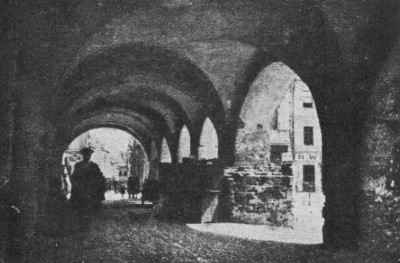
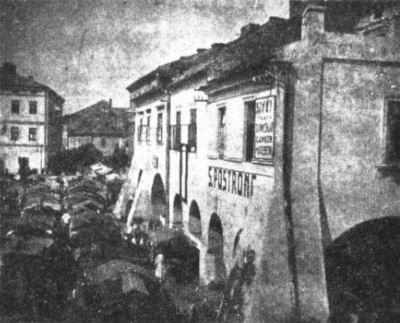
| The Jewish store over the Tarnów market near the Pachene |
[Page 38]
in the chambers of commerce and industry in Lemberg, Kraków and Brody, as well as take part in the self-government of some cities, including Tarnów.
Until the year 1848, the Jewish communities were hardly involved in economic matters. Broken by Kaiser Joseph the Second, degraded to the role of religious bureaus, decentralized with the abolition of the Jewish directorate, Jewish communities in the first half of the nineteenth century underwent a decline. The communities also went through a severe crisis after 1848. The freedom of changing residences that was given to the Jewish population caused a lively internal migration, which greatly weakened or partially emptied the smaller communities, from which people migrated to larger ones, where economic life was dynamic.
The number of Jews also increased in Tarnów, but they still had to live in ghettos, in terrible living conditions. Back in 1833, the Tarnów community submitted a petition to the Galician governor about expanding the Jewish residential area of Jews Street and giving Jews the opportunity to live over the market. The Tarnów magistrate emerged with a protest and proposed to create a kind of “Jewish city” behind the garden and settle all the Jews there. On the part of the gubernatorial authority, no step was taken in this direction and no answer was given to the petition. Actually, however, Jews already began
|
|
| The “Pashtene” on the Sabbath day |
[Page 39]
settling outside the ghetto walls.[c]
In 1856, there were already 11,153 Jews living in Tarnów.[d]
On the basis of Minister Schmerling's decree of March 1, 1861, Austrian Jews received active and passive voting rights to legislative bodies and also to the Viennese Parliament, the Galician Sejm, and the city councils. Some cities, including Tarnów, have proposed a whole series of restrictions for Jews, especially regarding the number of Jewish councilors, and not allowing Jews to hold the office of mayor. Certain laws that limited the rights of Jews were decided by the Sejm and confirmed by the government.
In the year 1861, during the first elections to the royal council, Galicia chose four Jewish deputies to the Sejm: Dr. L. S. Samelsohn from Kraków, Mark Dobbs from Lemberg, Meyer Kalir from Brody, and Dr. Lazar Dobbs from Kolomea. Not even a single Jew was elected to the Austrian Parliament. In the Sejm, the Jewish deputies began a struggle for full equality. In the year 1866, the country Sejm decided to reduce the number of Jews in the municipalities, abolish, and eventually limit,
|
|
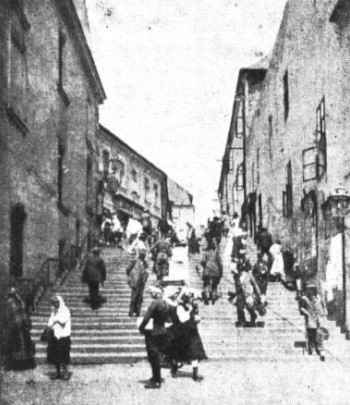
| The Broad Stepped Street (Photographed before the war by Dr. Isaiah Feig) |
[Page 40]
the Jewish communities, and contain them in the ghetto.
A gathering of representatives of Jewish communities, which took place in Lemberg, appealed to the government in Vienna, which canceled the reactionary decisions by the Galician Sejm.
However, the community statute of 1866 threatened the existence of the Jewish communities and limited their activity. From different sides; from governmental circles, as well as from Jewish and assimilationist circles, various proposals were devised to reform the declining communities. In January 1878, the “Shomer Israel” Association called a gathering of the Jewish communities to Lemberg with the aim of reforming the already outdated community regime. The assembly, in which representatives of 26 communities took part, adopted a model statute for the communities, and also decided to establish a rabbinical seminary.
At this gathering, a battle took place between the progressive elements and the orthodox. The Belzer tzaddik Rabbi Yehoshua Rokeach and Rabbi Shimon Sofer (scribe) of Kraków, called for a boycott of the Lemberg assembly. In the eyes of the two rabbis, the proposals to reform the communities seemed too progressive. In Belz, a special religious organization was formed, Maḥzickei Hadath, which set itself the task of leading the struggle against the progressives. In 1882, the Orthodox organized a conference in Lemberg, in which 220 rabbis and 800 representatives of Jewish communities in Galicia and Bukovina took part. At the conference, a statute was adopted for the communities in accordance with the Orthodox spirit. The statute envisaged that active and passive electoral rights to the communities should only be given to those who observed all the prescriptions of Shulcḥan Aruch. Against these decisions by the Orthodox assembly, 58 Galician communities submitted their protests to the then-Austrian government. In the end, the government prepared a general proposal of a statute for the Jewish communities in a more liberal spirit for the whole of Austria. In 1890, Parliament confirmed the statute. Although it did not take into account all the Jewish national claims, to a certain extent it normalized the relationships in the Jewish communities, establishing the legal status of the “Israelite Religious Communities.” In every territorially designated Jewish community, to which every Jew had to belong according to his place of residence, a community administration was established, which had the right to impose taxes and collect them in a coercive manner; to have supervision of all religious institutions, houses of prayer, and generally, over the entire Jewish religious life in a given place; the rabbis were given the right to keep the record books. The entire statute in its general
[Page 41]
framework, provided for regulating community relations based upon more precise statutes, which would be confirmed by the government. According to the adopted statute, the authorities had the right to remove members of the community administration, if their activity would threaten public order.
This statute also left the leadership of the community administrations in the hands of rich Jewish families. Suffrage was gained by a small number of well-to-do landlords, who did not allow the electorate to expand. Prolonged struggles took place in the community between various orthodox groups, as well as between rabbis. Wealthy families and power-hungry individuals fought among themselves, but (with certain exceptions) did not at all consider the interests and needs of the Jewish population. The broad masses did not have any influence on the composition of the community administrations.
At the head of Galician Orthodoxy at that time (1849-1859) were: the tzaddik of Belz, Rabbi Shlomo [Rokeach], and the tzaddik of Sandz, Rabbi Haim Halberstam. At that time, the Sandzer Rabbi had great influence over the entire Galician Jewry. The split in the Orthodox camp during the years 1867-1869, led to sharp battles between the Rabbinic dynasties. In the battle, they did not hesitate to use any means and did not even stop at a boycott, which the Sandzer tzaddik called against the Sadigura dynasty, with the refusal of the Lvover Rebbe {Rebbe of Lwów}, a grandson of the Ruzhyner [Rebbe], to continue being a Ḥassidic rabbi.
For a clarification of that struggle that took place between the various Orthodox groups in Tarnów, we bring further excerpts from the work by the writer of these lines among others, “Orthodoxy Among Itself in 1869,” published in the Zionist weekly, Tigodnik Żydowskie, in Tarnów, on November 28, 1928:
“We found a document in the archives of the Tarnów community that sheds light in an interesting manner on the relations between the Tarnów Orthodoxy [sectors] in 1869.
The document presents an anonymous letter, which was sent to the Tarnów mayor in 1869. The letter was directed against the famous Sandzer Rabbi Ḥaim Halberstam z”l, to whose gravesite thousands of Jews used to come every year.
The anonymous [letter], written in German, had the following content:
“[To the] Great Imperial-Royal Mayor!”
“The highly esteemed Mayor is certainly aware that there are two sects among the Jews, namely: the Sadagur and the New-Sandzer. The New-Sandzer sect
[Page 42]
which prevailed, oppressed the Sadagur bit by bit. This is done in such a way that, for Jews who belong to the Sadagur sect, it became impossible to trade and to exist. These people are oppressed and persecuted. They even have a boycott imposed on them. With one word, the members of the Sadagur sect found themselves in danger. All this happened because the Sadagur do not want to pay respect to Rabbi Ḥaim Halberstam of New-Sandzer. [As for] The rabbi of New-Sandzer, not enough that he oppresses the Sadagur sect, he decided immediately after returning from the Beder, on Shabbat, on August 21, 1869, and on the following days, to come to Tarnów, using the opportunity to give a sermon to the Jews whom he called to gather there from the whole area, including those who do not belong to the Sadagur sect, not only to the New-Sandzer [sect]. In this sermon to such an audience, Rabbi Ḥaim Halberstam blackened the Sadagur sect in such a way that not only did it become impossible for the people of the sect to trade, but even more so, their lives were put in danger. One can imagine how the unrestrained populace of the Sadagur sect, or all others, except for the educated people, who do not belong to any sect, could use any means possible on the recommendations of the New-Sandzer Rabbi, and thus cause a revolution. That is why I think it is appropriate to politely ask the highly esteemed Imperial-Royal Mayor to order Mr. Ḥ. Halberstam, Chief Rabbi of New-Sandzer, to be banned from entering Tarnów.”
|
|
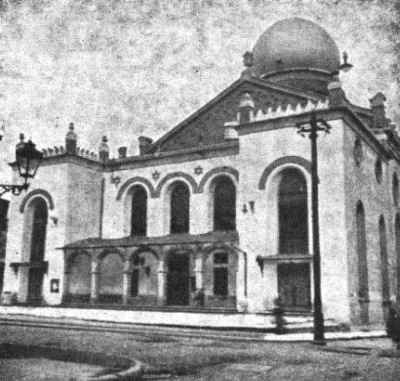
| The New Synagogue |
[Page 43]
Apparently, at that time (1869), when both sects were fighting for influence among the Jews, there was an influential Orthodox [person], who sent the above-mentioned letter to the mayor, because the city council head and district governor took seriously the imaginary fear about the revolution that could be provoked by the visit of Rabbi Ḥaim Halberstam. The Tarnów religious community was issued a directive (we quote directly), “in agreement with the city rabbi to counteract the stated beliefs of Ḥaim Halberstam and prevent disputes in the community.”
By the second half of the nineteenth century, Tarnów already had a sizable Jewish community, which in 1863 agreed to build a large synagogue on New Street. Also, during the construction of the synagogue, a fierce battle developed between the Orthodox and the progressive Jews in Tarnów. The pious Jews were greatly upset by the fact that a Catholic general, the military commander of Tarnów, was honored with laying the synagogue's cornerstone. The opposition of the Orthodox was so strong that they effectively boycotted the synagogue. For 50 years, there were just the empty walls of the unfinished
|
|
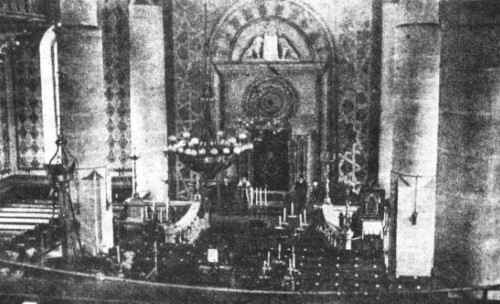
| Inside view of the New Synagogue in Tarnów |
[Page 44]
synagogue, because there was a lack of funds to complete it. It was only in 1911 that the community administration decided to finish building the synagogue, which later became one of the most magnificent prayer houses in Galicia.
The city had developed rapidly. In 1866, a decision was made to build a city park. That same year, a cholera epidemic broke out in the city, killing 1,700 residents, including many Jews. The main statute of August 12, 1866, which regulated municipal relations on the basis of autonomy, greatly boosted the development of the city. The beginning of constructing a railway line (1875) which passed through the city contributed greatly to the economic development of Tarnów. In addition, Tarnów was the capital of an entire district. In the eighteenth century, Tarnów still belonged to the Pilsen district, and now the city had become the center for the entire area. It now had a gymnasium {md: high school} and other school facilities, which the progressive elements of the Jewish population also enjoyed.
How did this initial development affect the Jewish street?
Already at the end of the eighteenth century, the influence of the Enlightenment [haskalah] was felt in Galicia, which broke through the ghetto walls and brought the spiritual movement of Moshe Mendelssohn to the Jewish population of Galicia. The first explosion of the Enlightenment movement was a reaction against the forced education of Jews, which Emperor Franz Joseph II wanted to carry out with the help of the “German-Jewish schools” with German teachers. The Kaiser's forced education ultimately led to conversions. The Enlightenment, strongly rooted in Eastern Galicia (Brody, Tarnopol), freed itself from the German assimilationist tendencies and led to the beginning of the new Hebrew literature.
At the start, the participation of Western Galicia in the Enlightenment movement was negligible. In this part of Galicia there were no Krochmals, Rappaports, and Pearls. If the Tarnów community in the second half of the nineteenth century found itself, exceptionally, at the proper level; showed a significant political awareness and took part in the struggle of Austrian Jewry for equality, it was mainly thanks to the unusually high spiritual level and noble character of then Tarnów [Rabbiner] Rabbi Israel Rappaport z”l. Also concerning the Enlightenment movement, Tarnów was ahead of all the other Jewish towns of Western Galicia. Here in Tarnów, there was Mordechai-David Brandstetter, one of the most capable enlightened individuals [maskil] in the nineteenth century.
[Page 45]
M. D. Brandstetter was born in Brzesko near Tarnów, to very pious Jewish parents. At 16, he married the daughter of a Tarnów merchant, and lived with his in-laws. By chance, he met a scholar from Prościejów, an ardent supporter of Hebrew [literature]. The maskil influenced Brandstetter to adopt Enlightenment thinking. The young Talmudist became acquainted with the treasures of Hebrew literature and began to write and translate German into Hebrew. In the year 1869, Brandstetter was in Vienna on business matters. There he met Peretz Smolenskin, who at that time published the Hebrew periodical Hashaḥar. Smolenskin saw a talent in Brandstetter, and persuaded him to write fiction in the Hebrew language. Brandstetter accepted the advice of his teacher and quickly occupied a prominent place in Hebrew-maskil literature.
In the second half of the nineteenth century, Tarnów Jews made up 40% of the city's population and contributed significantly to the economic development of the city. Commerce was almost entirely in Jewish hands. Tailoring and garment production were exclusively Jewish trades. Zydowska Street had changed its appearance. Jews already lived on streets outside the ghetto and, thanks to their economic position, they represented a significant power in the city, with which the Austrian authorities had to reckon. The royal authorities often protected the Jews against the attempts of Christian townspeople to push the Jews back into the ghetto.
The constitution of December 31, 1867, gave equality to all Austrian citizens regardless of religion and nationality. Article 6 of the constitution also abolished the ghetto walls. In the same year, Jews were allowed to study with no restrictions in the elementary schools, middle schools and universities. Thanks to the activity of Franciszek Smolka, the Galician Sejm also abolished all anti-Jewish restrictions. Jewish participation in educational institutions continued to grow.
During that period, Tarnów Jewry already had its intelligentsia. There were active Jewish doctors and lawyers in the city, but they had an assimilationist outlook. From time to time, capable and socially active individuals emerged from this circle of intelligentsia
[Page 46]
who later occupied leading positions among Tarnów Jewry. Regardless of the chasm that existed between the intelligentsia and the wider Jewish People, they were united by their common Jewish fate and the need to jointly defend the interests of their people, which at that time meant primarily the struggle for the most elementary rights of life, the right to work, and housing.
In March 1867, the first elections to the city council were held in Tarnów, based on the new election ordinance of August 12, 1866, which provided for 3 ballots for voters according to the amount of taxes paid. Tarnów Jews came out with their own list of candidates and elected the following councilors: In the first ballot: Dr. Herman Rosenberg, David Rosner, and the medical doctors Jacob Kreutzer and Leopold Glazer, as representatives. In the second ballot: Alexander Goldman, Jacob Frenkel and Adolf Ringelheim, and Hersch Mayerhoff as their representatives. The third ballot, which included a larger circle of voters, Joshua Maschler, Shlomo Schleiterer, Simcha Rappaport, Meir-Isaac Kelmann, and Fischel Ratts as representatives. Following this election, Dr. Hermann Rosenberg joined the Magistrate as an assessor, for the first time as a representative of the Jewish population.
The tasks of the Jewish councilors and the Jewish assessor were difficult. All their activity was limited to constant interventions in favor of Jews, which were always approved by the lower-ranking city bureaus. In such a situation, there could be no talk of a conscious independent Jewish policy or any organized action to fight for Jewish equality. This was a lobbying activity that each councilor led on his own, and its success depended on his influence in the appropriate offices.
Two very important events took place in Tarnów, in the years 1869-1870, which shed light on the unique relations that prevailed between the Polish and Jewish populations at that time. These two events were described by the writer of these lines (on the basis of documents from the congregation's archive) in Tigodnik Żydowskie of 10.8.28, a.k.a., “The participation of Jews in extinguishing the fire in the Tarnów Cathedral.” We read there, among others:
“At the end of September 1869, a terrible fire engulfed the Tarnów Cathedral. The entire population ran to save the prayer house. Jews especially took part en masse in putting out the fire. Almost all the Jews, young and old, were busy extinguishing the fire. Their voluntarily fetching water
[Page 47]
was especially helpful. From the entire series of wells round about the cathedral, Jews formed a chain of people to the site of the fire. One handed the bucket of water to the other; passing it along from hand to hand. Thanks to this dedicated effort by the Jews, they made it possible to put out the fire.
In honor of this dedicated help from the Jews, the archbishop of Tarnów sent a note of thanks to the chief rabbi, dated October 4, 1869. The note of thanks was signed by the bishop's representative, head vicar Father Francysk Schlusarchik. It expressed deep gratitude to the Jews for their help in putting out the fire. The bishop expressed his wish that the rabbi should read the letter to the Jews in the synagogue on a suitable day. In the note we read, among others:
“The Israelites especially distinguished themselves during the rescue and when putting out the terrible and dangerous fire that threatened the [Polish Catholic] church and the city. Small and large, young and old, everyone, one by one, came to help. It was to be admired. The briskness of the Jews in providing the necessary water to the people deserves the widest recognition,” (cited according to the German original of the church files). The note ends with a blessing that “the God of Abraham, Isaac and Jacob, with his full grace, embrace all those who took part in extinguishing the fire.”
But just one year later, Tarnów Jews experienced a bloody day, which was described in Tigodnik Żydowskie of 3.8.28, a.k.a., “The Bloody Day of August 15, 1870”:
“The day of August 15, 1870, was written in blood in the history of Tarnów's Jews. It was on the Catholic holiday ‘Saint Mary's Ascension.’ There was a lively movement [of people] on the streets, especially around the market and cathedral, where masses of people gathered. Between 10 and 11 o'clock in the morning, a fight broke out near the cathedral between a Jew and a Catholic. Soon a group formed, ostensibly curious, who, according to a pre-arranged sign, began their attack, beating up every passing Jew.
“The crowd, among whom there were also many farmers from the neighboring villages, continued to grow, and became more and more aggressive. The enraged masses marched from the cathedral to the market, instantly filling the sizeable area, thirsting for Jewish blood. Each of the attackers was armed; some with stones, some with sticks, some with iron rods, which proves that someone previously prepared the wild mob for the action. A full-blown pogrom began. The pogrom activists took it upon themselves to attack and rob Jewish homes and businesses. The shopkeepers suffered especially from the
[Page 48]
brutal raids, as well as the stores, which were entirely stripped.
“Every Jew that passed by was clobbered and thrashed mercilessly. According to the materials that the community collected at the time, the number of victims that day reached 90: 32 severely beaten and bloodied Jews; 11 robbed and lightly wounded; 47 completely robbed. Among the wounded were many women and children, as well as an 85-year-old man. A street vendor, Moshe Mintz, a father of three small children, died from his wounds. Besides these robberies and bloody attacks, a part of the wild mob engaged in smashing the window glass of all the Jewish houses. Woe to any Jew who sought to come out of his hiding place!
“In the requests and petitions that the Tarnów community administration sent to the central authority after the pogrom, there were also accusations against the then presiding magistrate of Tarnów. In a petition to the ministry in Vienna, it stated, among others:
“It would have been very easy for the magistrate, who had a 40-person city Watch at his disposal right, at the beginning, to send out the Watch and stop the riot that had broken out, basically overpower the law-breaking by the pillaging elements. The magistrate, however, remained indifferent during the events. Despite the fact that many councilors were approached from various sides with the request to intervene and stop the anti-Jewish riots, they were refused under the meaningless excuse, ‘What can we do?’”
Regarding the opinion concerning the magistrate's [inactions] during the pogrom, there is the fact mentioned in the above petition, “Many persons, who were caught during the pogrom, were placed in detention centers by the military authority; however, they were soon released by the magistrate.”
“Only in the afternoon did the community administration apply to receive help from the so-called commander of the military garrison. All the infantry and cavalry that were stationed in Tarnów went out across the city and managed to drive away the pillaging crowd and prevent further murders among the Jews. During the afternoon, the mob, who were thrown out of the market, gathered at the burek . Here, the hooligans began smashing all the glass windows of the Jewish residences. Only in the evening did the army come in to clean up the places and the streets, and restore peace and order. The next morning, on August 16, there first appeared an appeal signed by Dr. Yarotsky, representative of the mayor, and Kotlarsky, secretary of the magistrate, requesting the population:
[Page 49]
“Citizens! The sad events of the last day, caused by the enemies of our country and city, affected the inviolability of persons and property. The senseless agitation reached such a level that people did not want to listen to the expected advice from the city's distinguished citizens. The honor and well-being of the city demand that the affected social order be restored immediately, because similar actions are subject to severe punishment. For generations, we have all lived in inviolable peace and unity, and whoever in our city violates these relations will be recognized as a public enemy.
“The Magistrate calls on all residents to strictly maintain order, with the warning that anyone who disrupts order will be immediately detained and handed over to the Criminal Bureau.
“Adopted by the Tarnów City Council on August 16, 1870.
“Dr. Yarotsky, Representative of the Mayor,
“Kotlarsky, Secretary of the City Council.”
The resulting riots were suppressed thanks to the energetic stance by the military power. In a petition by the Tarnów community, the damage is estimated at the amount of 10 thousand Florins. For some time afterward, an unsafe situation continued to exist in the city. In their appeals to the authorities, the Jewish community especially complained about the unscrupulous agitators, who incited the benighted crowd to anti-Jewish excesses. In the city, people began to point out those individuals who took part in the excesses. Many Christians applied to the church leadership and tried to wash themselves clean of their criminality, of having taken part in the riots. We continue to present the contents of the appeal by Tarnów citizen and homeowner Michael Schwiderski, in which he asks the Israelite community to also hand over this appeal to the rabbinate. The appeal stated:
“An important message! Because of the unjust and malicious suspicion and slander that I may have participated in the riots against the Israelites, I was placed under boycott on their part without basis, and although I am sure in my deepest conviction that in the end my innocence will be proven, but every delay in the investigation about this matter by the leading authority, brings me great damage and creates the impression of the probability of these baseless suspicions which, are to my detriment. So far, my request to speed up the matter, which I submitted three months ago, has not yielded any result. As a citizen with an unblemished character and reputation, not deemed guilty, I therefore suffer even more strongly from the burden of unfair and baseless
[Page 50]
rejection, which causes me significant and inestimable damage to my earnings. All of this will be assessed by the important leadership and therefore I again turn to you with a request to the leading authority, to quickly transfer my matter to the local rabbinate, which I expect it will be treated and assessed appropriately and fairly, and as an innocent person, I will be freed from the consequences.
Michael Schwiderski”
With the restoration of order, the central authority also occupied itself with the matter. On August 29, 1870, the superintendent sent a circular to all the communities:
“To the leadership of the Israelite populace of Tarnów. The events of violent excesses against Jews by the Christian population that have occurred recently, and the reports that I received from various sources about an increased anger of the village population and the urban crowd against Jews, moves me to pay special attention to the instructions to the municipal leadership regarding their obligation to timely cease those events that can be brought on because of the above reason, making the municipalities responsible for any damage that can be caused by police negligence. On the other hand, I must call upon the leadership of the Israelite community, which should, in a suitable manner make the Israelite population aware of the need to avoid on its part from doing anything that can be a reason for the simple people, who are prone to excesses, to provoke attacks, and recommending that the Israelites to measurably restrain themselves.
Tarnów, August 29, 1870. K.K. City-Councilor Kawovski M.P.”
At the end of the nineteenth century, Tarnów Jews represented a significant economic force. At that time, the Jewish population also increased. By 1880, Tarnów's Jewish community numbered 11,349 people–46.1% of the city's population. Commerce and industry, which were continuously developed, were almost entirely in Jewish hands. Already at that time, the following large Jewish enterprises were situated in the city: Szancer's Mill, Goldman's Brick Factory; Faustum's Chicory Factory; Hahn's Glass Houses; Lichtblau's Candle and Soap Factory; Artz's Looms; the banking houses of Maschler, Wechsler, Aberdam and Kranzler; Farshirm's large wholesale iron and steel stores, Cinz and Klein, Whitmayer and Kleinmann's wholesale business of colonial goods; the hat industry; the first
[Page 51]
large clothing companies; tanneries, manufacturers' wholesale outlets; trade agents and construction companies. All this was just a small part of the Jewish community's effort and achievement.
During the elections to the second Tarnów city council (second term of office in March 1870), Jews gained a larger number of mandates. At the first electoral commission, they elected David Rozner and Henryk Szancer as Jewish councelos {md: typo in source}; as representatives: Wilhelm Greenfeld and Dr. Sigmund Schitzer. At the second ballot: Alexander Goldman, Hersch Mayerhoff, Herman Merz, Simcha Rappaport, Dr. Hermann Rosenberg, and Alter Rubin. Representatives: Dr. Leopold Glazer, Abraham Westreich, Meir Wasserman and Dr. Jacob Kreutzer. At the third [voting] ballot: Asher Eibenshitz, Joseph Fast, M. E. Kelmann, Joshua Maschler, Henoch Kleinmann. Representatives: Moshe Kahana and Dr. Adolf Ringelheim. Two Jewish assessors got into the magistrate['s office]: Alexander Goldman and Hermann Rosenberg. During the following years, during the elections, which took place annually, the same Jewish councilors were elected (with minor changes), came mainly from rich Jewish families and assimilated intelligentsia.
During the elections in October 1873 (third term), the following were elected from the first ballot: David Rosner, Henryk Szancer, Dr. Hermann Rosenberg. From the second ballot: Yehoshua Maschler, Simcha Rappaport, Shlomo Schleiterer, Henoch Kleinmann, Jacob Solomon, Alter Rubin, and Abraham Westreich. As representatives: Mendel Hertz, Adolf Schtiglitz, Wilhelm Mildner, and Meir Wasserman. From the third ballot, with minor exceptions, the same councilors from the previous term were elected, also as assessors: David Rozner and Simcha Rappaport.
The struggle over the city council elections occurred mainly between the wealthy families, whose relatives ran for councilors. The broad Jewish masses had very little influence on the outcome of the elections. The activity of the Jewish councilors was also nothing to brag about: there were no big achievements. Their activity had a purely individual character and depended on the personal ambitions and capabilities of each councilor. Although there were Jewish councilors, there was no Jewish politics since there were no Jewish parties yet. Nevertheless, there was no purposeful representation of Jewish interests on the Tarnów city council.
A certain change in this area was first introduced during the fourth term of the city council (1877), when municipal officials with social agendas were chosen. At that time, the following were elected as councilors: Bloch, Dr. Leopold Glazer, Dr. Elias Goldhammer, Alexander Goldman, Mendel Hertz, Nathan Kastel, Joshua Maschler, Herman
[Page 52]
Merz, Simcha Rappaport, Dr. Adolf Ringelheim, David Rozner, Dr. Sigmund Schitzer, Henryk Szancer, and Abraham Westreich.
Most often, the Jewish councilors were also the Parnassim of the community, over which the masses did not have the slightest influence. At the end of the nineteenth century, the conscientious and amenable Herman Merz led the Tarnów community. He managed the community property with no personal requests, and although he did not tolerate any criticism, he still tried to serve Jewish society to the best of his ability and resolve. He continued with the tactics used by former community lobbyists, which over the years were rooted in the activities of Jewish businessmen. With his independent and dignified attitude, Hermann Merz raised the prestige of the Jewish community as a representative of the Jewish population.
Characteristic is the address that was sent in 1877 by the community administration through Herman Merz at its head, to the bishop of the diocese of Tarnów, Father Fukalski, on his 25th jubilee as bishop. The address as well as the reply of the bishop, which were preserved in the community archive, were printed in the Tigodnik Żydowskie [issue] of August 1928:
“On July 17, 1877, Tarnów celebrated the 25-year Episcopal anniversary of Father Joseph Aloysius Baron Fukalski. Because of his religious tolerance, the bishop won the sympathy of the Jews of Tarnów and the surrounding area. In connection with this jubilee celebration, in which the Tarnów community also took part, on behalf of its administration, headed by Herman Merz, a memorial was presented to the jubilee celebrant, in which thanks are expressed on behalf of the Jewish population for the tolerance shown to them during the entire period of his 25-year Episcopal activity.
“In the address it is said:
“Your Excellency, the very honorable Bishop! Inspired by the most joyful feelings, the Tarnów Jewish religious community allows itself to send via its representatives its most sincere good wishes for the 25th anniversary of your occupying the Tarnów bishop's chair. In gratitude, we remember the past twenty-five years, during which your excellency, as a true spiritual person, displayed examples of noble love for the neighbor and was exalted in maintaining in our city the valuable peace between the believers of all religions. May the Almighty God grant your Excellency, that he may continue to work among us for many, many more years as he has done so far, in the spirit of justice, humanity and tolerance, which are the most beautiful adornments of your Excellency. We have the honor of
[Page 53]
conveying our expressions of true admiration for your Excellency. The representatives: MP Herman Merz, MP Joseph Fast, MP Dr. Ringelheim, MP Hirsch Massendorf, MP Jacob Frenkel, and MP Abush Westreich.
Tarnów, July, 8, 1877.”
On July 11, 1877, the bishop, Father Fukalski, sent a letter of thanks to the Tarnów community for their anniversary wishes. We quote here the full text of his answer, according to the German original:
“To the honorable religious community in Tarnów!
“On Sunday, the 8th of July, when we celebrated the 25th anniversary of our bishopric, it was a great comfort for us to hear from the mouths of the very honorable representatives of the honored Tarnów Jewish religious community, the expressions of admiration and gratitude, as well as to read the dedicated album. While expressing our joy, satisfaction and thanks for the attention given to us, we simultaneously ask the Almighty to also spread His divine grace over your honorable Jewish religious community in Tarnów.
From Bishop's Ordinate, Tarnów, on July 11, 1877, Joseph Aloysius, Baron von Fukalski, presiding Bishop, K. K. {Holy Community} of the Privy Council.”
A large group of well-to-do Tarnów Jews gathered around Herman Merz, who put together a type of celebration, but with no [Jewish] ideological basis. This was a “party” for community leaders and city councilors, who waged a bitter struggle with Dr. Elias Goldhammer and his group.
We find a description characteristic of the Hermann Merz's personality, and an evaluation of his community activity in the Tigodnik Żydowskie (number 11, 22.6.[19]28), written by one of the leaders of Tarnów's Zionists, Dr. Shlomo Goldberg (killed by the Germans). We read in the article:
“As for the affairs of the Jewish community, he (Herman Merz) led like a dictator; did not pay attention to the community council, did not tolerate any criticism, and did not allow anyone to collaborate with him. Regarding Jewish communal property, he behaved honestly and conscientiously. A merciless struggle was waged against Herman Merz by a group headed by the large and wealthy Maschler family, which rose to power in the community. When Dr. Goldhammer, a man of extraordinary abilities, became the head of the opposition, they succeeded in taking over the community, and this with extraordinary support from the administrative power.
“Rulership by the A. G. Maschler dynasty did not bring with it any improvements in the community's activities. It was then that the famous community magistrate and profiteering clique was formed, which with the help
[Page 54]
of terror and corruption fought the new trends and political ideas among Jews, also spreading demoralization among the members of the community, disastrously managing the property of the community. Dr. Goldhammer, a personably sympathetic and honest person, distinguished himself as a politician but had a large dose of naivety, and although he knew that under his name and in his ‘party’ there were abuses, he did not have a strong enough will to free himself from his followers who morally and materially exploited him at every opportunity. Moreover, he did not deal with the affairs of the community, although he invested all his energy and significant capital in elections to the royal council and the community council. The community was governed by his followers, whom he protected with his authority and pronounced individuality.”
However, Merz's group was very sympathetic to the Zionists, who at that time promoted activities in Tarnów and widely campaigned for the democratization of the community. When Dr. Theodore Herzl died in 1904, Merz's synagogue was the only one in Tarnów that allowed a memorial to be arranged in memory of the Zionist leader.
Hermann Merz led the Tarnów community together with Moshe Wechsler and Julius Silbiger, they were especially fiercely fought against in the city council by Dr. Goldhammer, a skilled lawyer and ambitious politician from assimilationist circles, who very quickly gained a significant influence in municipal politics and bitterly fought Dr. Tadeusz Tertil, the creator of the Democratic Club in the city council's area. Jewish councilors also belonged to that club, among them Dr. Herman Merz.
When Dr. Tertil was elected mayor, Dr. Goldhammer was initially appointed as his representative, but in the struggle with Dr. Tertil, he lost his position as deputy mayor and his place was occupied for a certain time by Julius Silbiger. After Silbiger, Dr. Hermann Merz was elected as deputy mayor.
The wider circles of the Jewish population did not take part in this struggle between a few rich Jewish families, or some ambitious municipal politicians. At that time, 11,349 Jews (46% of the total number of inhabitants) lived in Tarnów. They did not have the right to vote for the community and the city council because of the reactionary election ordinance. At that time, the Jewish street was dominated by black-yellow (Austrian) and white-red (Polish) assimilation. The cultural life on the Jewish street was poorly developed. It was not until 1880 that Fenichel set up the first Jewish bookstore.
[Page 55]
The only Jewish youth organization that existed in the eighties of the nineteenth century was also assimilationist: “The Society of Old Believers (Starozakanni {md: Polish = Old Testament}) Trade-Youth,” whose president was Councilor Dr. Ringelheim.
The Tarnów City Council's fifth term of office began without major changes. During the elections in 1881, they were elected for a further three years: in the first ballot: Henryk Szancer; as his representative: Dr. Glazer. [In the] second ballot: Dr. Phoebus Solomon, Dr. Elias Goldhammer, Joshua Maschler, Moshe Orange, Joel Margulies and Solomon Zunz. Representatives: Mendel Hertz, M.D. Brandstetter, and Nathan Castel. In the third ballot: Abraham Westreich, Herman Merz, Dr. Sigmund Schitzer, Moshe Kahana, and Moshe Rubin. As representatives: Samuel Schutzmann, Lippe Stegmann, and Isaiah Hirsch. Dr. Sigmund Schitzer, and Dr. Phoebus Solomon were elected as assessors.
In 1883, when a wave of pogroms in Czarist Russia drove many Jews from Russia into Galicia, it awakened Jewish conscience. Town committees were set up in the city, which extended help to the pogrom victims. From these expressions of sympathy for the suffering brethren, there slowly arose a national consciousness, especially under the influence Leo Pinsker's Auto-emancipation , which appeared in 1882. When the Bilu youth went on Aliyah to the Land of Israel, and began the first struggle with the swamps in the fatherland, so also in Tarnów, for the first time permission was given to [help] build the Jewish country. In 1887, the “Society of Old Believer Youth,” severed itself from the assimilationists and changed its name to “The Trade Youth Reading Room.” On December 18, 1887, they organized the first Maccabee event.
These first signs of the Zionist Spring and devotion had no effect on the municipal and community politicians. The struggle between the two groups, which were led at the time by the two personalities in Tarnów, Dr. Elias Goldhammer and Dr. Hermann Merz, continued onward. They fought over a seat, over a mandate, while Jewish concerns were set back to the last place.
In February 1884, began the sixth term of office for the city council. Elected from the Jewish population were the following councilors: Mandel Aberdam, Dr. Elias Goldhammer, Hersch Meirhoff, Joel Margolis, Joshua Maschler, Hermann Mertz, Dr. Adolf Ringelheim,
[Page 56]
Moshe Rubin, Dr. Phoebus Solomon, Dr. Sigmund Schitzer (died in the same year), Henryk Szancer (died in 1885), Lippe Stegmann, Abraham Westreich, and Hersch Wittmayer. As Assessors: Dr. Sigmund Schitzer and Adolf Ringelheim.
On March 13, 1889, the new Self-Governing Law came into effect for 30 large Galician cities. According to the law, each city council had to appoint 36 councilors, 18 representatives, and had a 6-year term of office. In March 1890, when the elections for the city council took place based upon the Self-Governing Law, the Jewish population in Tarnów numbered 11,627 (42.4 percent of the city's population). The Jewish councilors that were then elected were: Moshe Orange, Dr. Phoebus Solomon, Joel Margolis, David Zunz, Hermann Merz, Dr. Adolf Ringelheim, Hermann Ringelheim, Joshua Maschler, and Hersch Mayerhoff. As representatives: Hermann Saldinger, Alter Spiegel, and David Kleinmann. From the third ballot: Abraham Westreich, Arthur Szancer, Leon Schwanenfeld, Elias Goldhammer and Leopold Gertler. As representatives: Moshe Haber and Baruch Kornmehl. Vitald Rogowsky was chosen as city mayor. Jewish assessors: Dr. Elias Goldhammer and Abraham Westreich.
This city council decided to provide a subsidy to the sum of 4,000 Guilder toward completing the building of the New Synagogue. Construction of the synagogue began in 1863. This subsidy was provided to commemorate the 50th jubilee of Franz Joseph I's accession to the Austrian throne. In 1899, the community was led by: Joseph Maschler (trustee of Dr. Goldhammer), Mordechai David Brandstetter, and Hirsch Wittmayer. In 1897, there were 12,484 Jews in Tarnów.”[e]
The fact that most of the Jews were involved in commerce, industry, and free professions (government bureaus did not employ any Jews), provoked antisemitism in Galicia. At first, they were accused of promoting Germanization, and only later were economic measures issued against them. This rise in antisemitism in Galicia stemmed from the broader climate of Jew-hatred in Austria. In 1895 {md: should be 1897}, in the elections to the Vienna city council the winner was the antisemitic Christian Social Party. It was headed by Jew-hater, Dr. [Karl] Lueger. Under the influence of this party and its antisemitic economic laws, antisemitism grew stronger in Galicia along with the economic struggle against the Jews.
The lead speaker for Galician antisemitism was Teufil Maronovich.
[Page 57]
He pushed for a law establishing economic trade sites and organizing the peasants (Kulka Rolnitshe) to curb Jewish trade. The anti-Jewish struggle came to fruition in one of the chief laws instituted by the National Catholic Party (Stranintztva Nardowa Catolitzkia) who represented the well-to-do [land] owners and the upper clergy. At this party's assembly, held in Kraków in 1893, an economic boycott was proclaimed against the Jews in order to economically destroy them without bloodshed. Also, the influence of the Nordowa Demokratishe Party (Endecja), contributed to the proposal of extremely repressive laws against Jews.
This economic battle and the antisemitic laws had to have some outcome. The demagogue-priest Stoyalowski developed a vicious anti-Jewish campaign, which produced a bloody outcome. At 33 different sites in Tarnów, anti-Jewish actions occurred. The city market in Tarnów was again transformed into an arena of anti-Jewish outbursts. The Austrian military was ordered in to restore order in the city. The unrest had a strong echo in the Viennese Parliament, where the socialist deputy Ignacy Daszyński declared: “Poor farmers were incited against the poor Jews. Although the Galician Jews form 12% of the population, they constitute 90% of the poor. The pogroms have destroyed their remaining livelihood.”
Meanwhile, Zionism had struck deep roots in the Jewish street. At the Second Zionist Congress, a resolution was proposed to take over the communities! The Zionist organization at the time had already published a report on the large burdens that were placed upon the Jewish community. Therefore, one of the main points in their program, the so-called “Country Politics,” was to gain as many more Zionist representatives as possible from the communities. Their resolution was to democratize the communities!
The struggle to take over the Tarnów community began quite soon. The first Zionist supporters who were active in the Tarnów area; Dr. Fischel Waschitz and Dr. Bienenstock, appeared at public meetings at the beginning of the twentieth century, and made the following demands: 1) General suffrage for the community; 2) Abolish the indirect taxes; 3) Reorganization of the welfare institutions, and development of the economic situations and cultural institutions. The community leaders at that time strongly defended the old community stronghold, to which the broad masses of the Jewish population, which in 1900 formed 40% of the total number of Tarnów residents, did not have easy access.
[Page 58]
In 1901, a census was conducted in Tarnów. According to the compiled lists of December 31, 1900, there were 1479 households and 31,691 inhabitants in Tarnów. The population was divided according to religion in the following manner:
Roman Catholics 18,960 people Greek Catholics 110 " Eastern Greeks 2 " Evangelicals 33 " Jews 12,586 " *(i.e., 39.7% of the entire population).
During the first years of the twentieth century, construction began on the Tarnów-Dambrova railroad line, which significantly contributed to the city's development. The speed of construction [in Tarnow] also expanded. New houses and streets were being built. Jewish influence in the city continued to grow. All sectors of trade and industry were under Jewish control. The Jewish intelligentsia also increased. At that time, Jews in Tarnów had 6 synagogues, a Jewish hospital, and a school named after Baron Hirsch.
In the year 1905, elections were again held for the Tarnów City Council, and the following councilors were elected on behalf of the Jewish population: From the first ballot: Dr. Josef Opfner; from the second ballot: Julius Silbiger, Joachim Maschler, Leon Schwanenfeld, Dr. Adolf Ringelheim, and Israel Wechsler; representatives: Ignatz Holzapfel, Brod Hirsch, and Ignatz Hollander. From the third ballot: Baruch Jacobowitz, Ignatz Maschler, and Dr. Shlomo Merz. As representative: Moshe Kupferberg.
At that time there could not be any discussion about Jewish politics. Jewish councilors often fought each other, using their own people or influential non-Jewish personalities. In most cases, their activity was limited to interventions by the municipal authorities. The Jewish councilors' stance was far from revitalization of Jewish social life. They were especially hostile towards the Zionist movement, which had captivated ever-wider circles of Jewish youth. At that time, there were already a number of Zionist organizations such as Techiyah (Revival), the academic association Bar-Kochva , the Labor party Poalei-Zion (Workers of Zion), and the Jewish National Women's organization, “Miryam.”
In the article “The Quixotic Period,” printed in the anniversary book of the Zionist Organization in Tarnów (1934), Dr. Simcha Scheinfeld describes that period in this manner:
“In order to understand this epoch well, especially for the younger generation, we need to paint the canvas on which adolescent youths from
[Page 59]
the upper classes of the gymnasium, and some unexceptional academics, stepped up as officers, generals, as well as [simple] soldiers. There was something that was taking over the entire Jewish population. In depth, there were black and yellow government colors, which people had to respect, willingly or not. However, with a closer look, it was the intensely colored white-red Polish society of the domestic environment, which enlightened us from the cradle with its language and culture. They tied and bound us with thousands of threads! Even closer; an orthodox mass on the one hand, which was uncompromisingly intolerant. And on the other hand, an often unethical-cultural and partly pointless-snobbish, small but influential assimilationist environment in a hopeless wasteland. On such a canvas, Jewish life in Tarnów developed, and at that time Jewish idealists started to take over the Jewish street.
Dr. S. Scheinfeld describes in his memoirs such an event, which best characterizes Jewish social life in Tarnów at that time.
“The times of anti-Jewish persecutions in Romania have begun. Very often, groups of refugees from Romania passed through what was then Galicia on their way to America. Tattered and starving, they came to Tarnów in whole groups. With our various efforts, we helped these poor people with the Groschen [pennies] we received from house-by-house collections. We gathered them up and sent them on to Kraków. For the young men, without influence and without any standing, this was no small effort. In the entire city, there were not even three adults who wanted to participate in aid activities for their suffering brothers and sisters. Such selfishness prevailed at that time; so much was lacking in understanding of general Jewish suffering. With the slogan, “Today, him; tomorrow, you,” we knocked on their stony hearts and tight pockets. At the same time, the city rabbi had to give a loyalist speech in connection with an Austrian royal holiday. Bitter and upset at the rabbi, at the community and at the whole Jewish society, which was so selfishly presented itself to the Romanian victims, we gathered in the synagogue where the sermon was to be held and with our youthful strength ventured forth. We demanded that the rabbi should better speak about aid for refugees as a more topical issue for the Jews. We interrupted the rabbi's speech. This was reported to the [municipal?] authorities, but fortunately, not to the school authorities.”
This was carried out by a small group of idealists, and regardless of all the obstacles and difficulties, in the course of the number of years
[Page 60]
a large Zionist party grew from this small group of enthusiasts, which continued to embrace larger masses of Tarnów's young Jews, cultivating them in the national spirit, and awakening in them the awareness of the need to build their own home in the Land of Israel.
In the year 1906, the struggle for general elections to the [national] parliament began in all of Austria. The existing Jewish parties in Galicia then organized mass meetings and demanded the fourfold suffrage to the Austrian parliament.
As reported by The Jewish Worker , an organ of Poale-Zion in Austria, in a correspondence from Tarnów (from March 1, 1906): A large public meeting was held there on February 7, 1906, organized by the Zionist associations (General Zionists and Poale-Zion). There was only one item on the agenda: "The Electoral Reform and The Jews.” The big Merz Synagogue was overflowing. Dr. Saltz, as chairman, presided over the meeting. A long speech was given by the then Poale-Zion activist in Tarnów, Dr. Feldblum (now lives in Israel). Until World War II, he was one of the leading General Zionists in Western Galicia). The speech, as well as the resolution, which expressed the necessity for Jewish parliamentary representation, was accepted with great applause. “The Separatists (JSP), we read in this correspondence, who were united with their Polish colleagues at the time, did not succeed in breaking up the assembly.”
It is worth mentioning that the leaders of FFS, and in particular, the Jewish members of the Polish Socialist Party, spoke out against a special poll for Jews.
Dr. Avraham Saltz and Edward Schwager represented Tarnów at the National Conference of Galician Zionists, held in Kraków in July 1906. For the Zionists in Galicia, the National Political Program was accepted, and during the next parliamentary elections it was decided to put up a list of Zionist candidates. The following were elected to the National Election Committee: Dr. M. Braude, Adolf Stand, Dr. Gershon Zippor. The main issue was the struggle against assimilation, against the exclusion of Jews from economic life, the struggle for recognizing the Jewish religion and its national language, national autonomy and abolishing the law on forced Sunday rest-day {md: Sunday Blue Law}.
In twenty constituencies, national Jews and Zionists presented their own candidates and received 30,000 votes. In 1907, Dr. David Maltz ran on the Zionist list in Tarnów. His speeches at the election meetings evoked extraordinary enthusiasm among the
[Page 61]
voters. The then leader of Tarnów's Zionists, Dr. Abraham Saltz, ran in the electoral district of Stry-Kalush. His counter-candidate was the assimilationist Ashkenazi, running with the Socialists; [Jędrzej Edward] Moraczewski. The greater number of votes, 2,900, was received by Dr. Saltz. As it is reported by Dr. A. Saltz in his memoirs, published in the aforementioned jubilee book of the Tarnów Zionist Organization, “50 Years of Zionism,” Ashkenazi garnered barely 600 votes at that time; Moraczewski, 2,500 votes. In a runoff election between Dr. Saltz and Moraczewski, the assimilationists supported Moraczewski, who was indeed elected to parliament.
In Tarnów, apart from Dr. Maltz, another Jew ran for office, Dr. Josef Drabner from Kraków, whose candidacy was put forward by the FFS, and supported by the Jewish Socialist [Party] (JSP). A third candidate, who wanted to get Jewish votes, was the government's candidate, Baron Battaglia.
One of the founders of the JSP (Jewish Socialist Party in Galicia), Joshua Landau, related in his memoirs that during the elections in 1907, a “truce” was reached in Tarnów between JPS and Zionists, according to which both parties did not need to contend against the opponent's candidate. In the runoff election, the Jewish socialists had to give their votes to Dr. Maltz, if he had to stand again in competition with a second candidate.
From another source, in Lemberger's Yiddischen Tagblat , we learn that after the elections that took place on May 23, 1907, an appeal appeared to the Tarnów Zionists to enter into a compromise with Dr. Drabner, on the condition that the FFS in Brody and its followers should be called upon to give their votes to the local Zionist candidate Adolf Stand, who ran against Valerier, the assimilationist, in a runoff election.
A fierce election campaign took place on the Jewish street. The Jewish clerics and those circles that were grouped around the community-magisterial clique, tried to win Jewish votes in favor of Baron Battaglia. Regardless of the fact that Dr. Malts received a significant number of votes, he did not make it to any runoff elections. The final election campaign took place between Dr. Drabner and Dr. Battaglia. The Rabbinate, community leaders, Jewish councilors and the Orthodox circles, formed a front against the socialist candidate, and he lost in the runoff election.
In the Austrian Parliament, the Zionists elected during the elections in 1907 were: Adolf Stand, Dr. H. Gabel, Dr. A. Mahler, and Dr. Straucher (the last one was from Bukovina). Three Jews who belonged to the Polish Koło, Dr. Gold, Dr. H. Kalischer, and Dr. Nathan Levenstein; of the PPS
[Page 62]
Dr. Diamond, and Dr. Lieberman. The Jewish deputy from Kraków, Dr. Adolf Gross, declared himself an independent.
The three aforementioned Zionist deputies, together with Dr. Straucher from Bukovina, formed a Jewish club in the Austrian parliament, which distinguished itself by its vigorous activity and initiative.
Shortly after the elections to the parliament, based on the old election ordinance, elections were held for the Tarnów city council. At that time, a group of Jewish communal activists was operating in Tarnów. They came out in open battle against corruption phenomena in social life and demanded the democratization of the city council and the community. These communal activists, although they gravitated towards the socialist circles, did not belong to any political party, and by their activities, were united with the attitudes of the then young Zionist activists in Tarnów concerning the city and communal activity of the assimilationist politicians and long-lived community dynasties. Together with this group of community activists, headed by advocate Dr. Borgenicht, they formed a common front.
When the election campaign for the city council began in 1907, a joint list of candidates was published, which was also supported by the Jewish Socialists (JSP). Running on the joint electoral list were I. Schiffer, Dr. Borgenicht, Haim Neiger, Dr. Silbiger (at that time an active Zionist in Tarnów) and PSP leader Joshua Landau (now in Israel for many years). A weekly newspaper was published in the Polish language, edited by Dr. Borgenicht. Both Zionists and socialists worked there. This democratic list received a large number of votes thanks to the extensive information effort during the election campaign. The joint Democratic-Zionist-Socialist Front held in place during the community elections, which took place sometime later. Despite the fact that the extensive Jewish masses did not yet have the right to vote, this bloc achieved a great victory in the community elections.
Dr. Tadeusz Tertil, later deputy to the Austrian Parliament and president of the “Polish Koło” (the group of Polish civic deputies in the Austrian Parliament who called it the Koło Polskie ) was elected as mayor. During the time that Tertil was mayor of the city, Tarnów underwent major development. At that time, they started building the water conduit, electric station, tramways, and the new railway station. The gas line was also purchased then.
A change also took place in the political-social life.
[Page 63]
As we have already mentioned, the democratic group set itself the task of elevating Jewish social life, and removing the influence of the magisterial communal gang. This group also included the son of Hermann Merz, Dr. Shlomo Merz, who held a prominent position as a judge in the Tarnów Circuit Court. Dr. Shlomo Merz, a proud Jew of firm character, kept to the tradition of his father, who honestly served the Tarnów Jewish society, regardless of the fact that, as a high government official, he was definitely in danger because of his occupying himself with Jewish affairs. Yet with self-sacrifice, he devoted himself to Jewish interests.
Grouped around Dr. Shlomo Merz, were several other political and social activists, such as Dr. Borgenicht, Dr. Schitzer, Haim Maschler (the son of Hirsch Maschler) and others. As we have already mentioned, the Zionist Organization cooperated with this group, and when elections were held in 1911 for the Austrian Parliament, the candidacy of Dr. Shlomo Merz was presented as the candidate for the Zionists and Jewish democratic circles. Dr. Merz, who had the courage to take up the Zionist-national slogans, received a large number of votes, did not regard what the socialist candidate Dr. Drabner and Dr. Tertil, who were both fighting for Jewish votes in the runoff election between Dr. Drabner and Dr. Tertil, so had come in last.
These elections also greatly helped in developing the national consciousness of the Jewish street in Tarnów. In 1911, in addition to the Zionist organization, there was also the Tarnów JSP (Jewish Socialists) and Poalei-Zion. The Jewish economic life also strengthened, and in the years 1911-14 Tarnów was considered a solid industrial and commercial center. In the year 1914, on the eve of the outbreak of World War I, Tarnów numbered some 40 thousand inhabitants, including over 13 thousand Jews.
The confection [clothing] and hat industries developed particularly strongly in the city. Until the outbreak of World War I, the Tarnów textile industry was in Jewish hands. The beginning of this industry reaches back to the far past, when only taleithim {prayer shawls} were produced. In 1906, the F.F.S. began to organize a professional association of Tarnów's weavers, to which 50 workers belonged; pious Jews with beards, all married, with children. They worked
[Page 64]
on old-fashioned looms, which were found on three premises belonging to H. Arzt. In 1912, his heirs built a textile shop on Saint Martin's Street. The factory was equipped with the latest machines, and as a result, some older workers who could not adapt to them were at risk of dismissal. At that time, the weavers put forth a demand to finalize a collective agreement with all employed workers, including a provision not to admit women to the shop, because they would receive lower wages than men. The manufacturer did not want to comply with these demands, and a strike broke out. It lasted for 14 months and ended in a partial victory. The [number of] older workers who were unable to work with the new machines was reduced. After the strike, the factory developed well, but this ended with the outbreak of World War I. During the war, the owner moved the factory to Bielsko (Upper Silesia) and started producing textile goods instead of prayer shawls. In Tarnów, there remained only a hint of the former textile mill: the empty factory building with its tall chimney. The textile industry of Tarnów had completely disappeared…
The second industrial branch, the hat industry, began to develop in Tarnów during the middle of the last century, and employed many Jews. In the last years before World War I, this branch of industry reached the highest level of development and employed 300 men and women workers. Eighty percent of the employees were married, so over 1,000 people earned their livelihood from this profession. At that time, Tarnów was the largest center of the hat manufacturing branch in the Austrian Empire. On average, 700 to 800 dozen peasant hats were produced weekly. They were sold in the farthest corners of the great Austro-Hungarian monarchy, as well as abroad: Romania, Serbia and Turkey. The earnings of a worker ranged from 30 to 60 Austrian Crowns per week, which at that time was a good income.
In the first years of independent Poland (1923-1920), the hat industry in Tarnów developed even more strongly. Along with assistants, it employed over 600 people at the time. The economic crisis and the Polish government's tax policy, which was especially directed against Jewish industry and crafts, as well as the impossibility of importing the latest machines for this industry, had brought the entire industry by the thirties to such a state that only 80 workers were employed at that time. Their income was
[Page 65]
no more than 25 to 28 złotys a week. Moreover, it turned out that they only worked 4 months of the year.
The development of garment production in Tarnów dates back to 1905, after the suppression of the first revolution in Russia. Many Jewish workers in this profession emigrated from there, and as the refugees settled in Tarnów, garment making by mass production spread. On Bernardinska Street in Tarnów, where the quilting workshops were located, there was always activity and liveliness. In this profession, the local labor force soon received employment. In 1920, the professional association of quilt workers counted 120 members, but by 1930, it reached the same status as the hat trade. At the end of the thirties, Tarnów had only 10 part-time quilt workers, and they too were employed only a limited number of days a week.
Until World War I, Jewish economic life in Tarnów did not develop badly. A serious breakdown occurred in the Days of August, in 1914, when World War I broke out. The [military mobilization] into the army also included large masses of Jews.
The local committee of the Zionist organization in Tarnów, as well as all the local committees in Galicia, issued an appeal to the Jewish population in August 1914, in which it is said, among others:
“The opportunity has finally come when the Jewish People can show their great sympathy and sincere enthusiasm for the Polish People who are going into battle under the auspices of a free and independent Poland. Our people, who have been persecuted and oppressed for hundreds of years, have the greatest respect for its ideals. With bated breath, we follow the course of events and we look with admiration upon the victory march by Polish soldiers, who are renewing the heroic tradition of Polish arms. We wish success and happiness to the heroic campaign with all our hearts.”
The appeal is especially addressed to the Jewish population:
“Jews! In this war, no one should be unaccounted for. Whoever is able to bear arms should go into battle and shed his blood in the name of the honorable slogans: “For the freedom of the Jews! For a free Poland!” (Quoted from Tigodnik Żydowskie, No. 10, 1933).
The Jewish youth went to the front, spilling their blood on all
[Page 66]
the battlefields. At that time, they believed in a new era of freedom and rights for all, which would be born as a result of the war. Not much time passed before Galician Jewry became convinced that not only had the time of freedom not arrived, but they first needed to begin a struggle for the right to work; the right to life.
In November 1914, the Russian army occupied Tarnów. A large part of the Jewish population evacuated from the city, going deep into Austria. The youth who were able to bear arms filled the ranks of the Austro-Hungarian army. Tarnów Jews made their contribution to the number of fallen in World War I.
The moment the Russian army broke into Tarnów, the economic and political-social life among the Jewish population was disrupted. After driving out the Russians, the magistrate installed commissars in the Jewish shops, which were abandoned by their owners. When the Jewish shopkeepers returned, they found their shops empty, and were paid Groschen [pennies] for the sold goods.
In his book, Tarnów Under the Russian Invasion, Franciszek Szewczyk (a Pole from Tarnów) writes about the situation of the Jews at that time:
“The relationship of the Russians to the Jews, especially on the part of the commandants, was generally not favorable. There were some exceptions, commandants who were favorable to Jews, but they [the Jews] were always in last place. They were treated adversely, always found at fault. Beating them with whips was the order of the day. That is why Jews could not be optimistic, because the Russians themselves gave them sufficient reason to be so. Jews suffered the worst injustices from Colonel Kozlov. On his orders, whiskey from Jewish distilleries was poured into the gutters. Old wine and brandy washed away in a stream. This is how the best drinks were poured out from Kerber's wine shop. The same thing happened with goods from Schwanenfeld's distillery, and from other liquor stores. Wine and brandy ran into all the gutters, where the inhabitants of Tarnów scooped it up into pots, and later poured it into bottles, and then sold a bottle to Russian soldiers for 8 rubles…
“Colonel Kozlov, who had unlimited power during the entire period of his rule in Tarnów. He invented newer and more refined means to oppress Jews. So, he ordered Jews to be brought into the command post, ridiculed them, and then presented them with brooms, with which they had to sweep the streets, under the supervision of Russian soldiers. Meanwhile, Christian passers-by used to stop and laugh at the
[Page 67]
humiliated Jews. They did not spare the Jewish women, but forced them to do special work. The Jews were still forced to repair the highway, build a temporary bridge over the Biale River, and dig ditches.
“Russian soldiers often brought grief to the Jews, especially in the marketplace and on Lemberg Street. In the least case, they would order chasing the Jews on the Sabbath, when they went to pray. During the rule of Colonel Kozlov, who was deaf to the Jewish accusations, the soldiers, together with the city's underworld, used to rob Jewish businesses. If a Jew went to the colonel to complain about the looting, Kozlov still ordered him to be punished with 25 lashes ‘for slinging mud upon the Russian army.’ The following two facts (out of thousands) will best illustrate the attitude of the Russian authorities toward the Jewish population:
“A poor, weeping Jew once came to Colonel Kozlov and told him that Russian soldiers ransacked his home and took all his things, and on top of that, beat him up. This time, the commandant listened to the complaining Jew, showed sympathy and wrote some words on his visiting card, handed it to the Jew, that he should submit it to the cashier by the superintendent, where he would receive compensation for the damage. Having calmed down, the Jew left for the superintendent and handed the Colonel's visiting card to the duty officer, who sent the Jew to the cashier. There, instead of rubles, he received the same number of lashes that Kozlov wrote out as compensation for the Jew. A second Jew, who also received a visiting card, sent a boy to the superintendent to collect the ‘reward.’ The boy also received lashes instead of money.
“A second fact: With great effort, a Jew successfully obtained a ticket from Colonel Kozlov for a train trip to Lemberg to visit his sick wife. With the note from Kozlov, the Jew went to the station commandant in Tarnów, Prof. Sobalewski, who had to finally confirm the ticket. At the train station, they explained to the Jew that Sobalewski was not present now; he had gone to a restaurant for breakfast. The Jew left there and saw Sobalewski sitting in the company of officers, at a set dining table. The Jew gathered up courage, went to the table and began to explain to Sobalewski, what he had come for. The Czarist officer did not even let the Jew finish his request, took out the whip from its strap and began to beat the Jew mercilessly, insulting him with the worst words. Understandably, the Jews did not travel to Lemberg.
“Russian soldiers and bureaucrats used to display special murderousness
[Page 68]
toward Jews with beards. Beating such Jews with whips became a daily occurrence. At this opportunity, it is worth mentioning the following interesting case: The Russians often took many Catholics as hostages. Among them there was also to be found Christian Sokalski, who had a long beard. The mayor at the time, Dr. Tertil, took steps to free the hostages. Staff Officer Postnikov complied with Dr. Tertil's request and freed the Jewish as well as the Christian hostages. But the Pole Sokalski was kept in custody for the longest time. The motive for such behavior by the Russians was that Sokalski was surely a Jew, because, firstly, he had a beard; secondly, his surname was adapted from the Jewish name Sokal, a town in Galicia… However, it was still possible to convince the Russians about Sokolski being a Pole, and he was finally released.
“In the abandoned residences of wealthy Jews, the Russians put together stables and placed horses there. The small nimble Cossack horses used to be dragged up the stairs and given a place in Jewish apartments on the upper floors. The ‘Helios’ movie house (owner: the Pole Lisovsky) was active during the war, and films were shown there, while the ‘Apollo’ movie house (the owner, Wilhelm Lichtblau, fled to Austria) was completely destroyed. The Russians arranged a large stable for their horses there, although the cinema was located in the center of the city.
“The restaurants and liquor stores, whose owners evacuated, were taken over by people who did not have the slightest clue how to run such a business. Rostal's restaurant in the middle of the market was handed over to a certain Kazhimierchik and his partner Karol. The restaurant prospered well, and spirits from illegal sources were secretly sold there.
“After Markevich took over the city as commandant, the situation improved a little, because Markevich showed more friendliness towards Jews. When the Jews complained to him that their homes were being looted, Markevich sent one of his soldiers to protect the Jewish home. But the soldier had to be supported by the Jew with food and “vodka” (brandy) as long as he protected the residence. Understandably, they tried to get rid of such costly supervisors as soon as possible…
“Mid-February 1915, brought difficult days upon the Jews. Turns out, the Russian authorities felt they had to soon withdraw from Tarnów, and that was why they had it in for the Jews. They used to constantly attack them in the street and beat them, threatening to send them
[Page 69]
deep into Russia. Many Jews were held hostage so that the remaining Jews in the city would not betray the movements of the Russian army to the enemy. The Russian “Okhrana” (political police) compiled a list of prominent Tarnów Jews, who were sent to Nizhny Novgorod after their arrest. The list was confirmed later by Commandant Markevich. The following Jews were then sent deep into Russia:
Jacob Klein, Meir Saroka, Isaac Lemberger, Berl Berkelhammer, Jacob Tennenbaum, Yechiel Birnbaum, Shimon Blumenkranz, Hersch-Mendel Blumer, David Berisch, Haim-Leib Feigenbaum, Yehezkel Flor, Ziskind Flor, David Fries, Markus Gorlitzer, Gross Abraham, Isaac-Mechel Hertz, Maurycy Hirschhorn, Maurycy Kirschenbaum, Yechiel Kornhauzer, Hersch-Melech Kornreich, Marcus Kurtz, Jacob Landman, Maurycy Leon, Henrik Neumann, Eliezer Zilberman, Ephraim Singer, David Spanier, Israel Shapiro, Henrik Weinfeld, Moshe Shapiro, and Isaac Eder (altogether, 31 Jews).
Upon receiving news about the arrest of Tarnów Jews with the aim of sending them off to Russia, the mayor appealed to the commandant with the request to leave the innocent Jews in Tarnów. The commandant refused this request, just as he remained deaf to the appeal by a delegation of women, who asked him to leave behind their [elderly] fathers, and feeble-minded {?} men. Nothing helped, and the 31 Jews were sent away.
As we have previously written, many Jews left the city before the Russian army entered Tarnów. They left trustworthy people or relatives in their shops and apartments. But not everyone of them carried out the task entrusted to him, especially those who did not believe in the return of Austrian authority. They sold or appropriated the businesses that were handed over to their supervision.”
Sh. Ansky, in his memoirs published in the book, The Destruction of Galicia, also relates about the situation of Tarnów's Jews during the Russian invasion. Ansky was then sent to Galicia by the Jewish Rescue Committee and held the rank of an officer, a member of the official Russian aid delegation, named after a Czarist princess. He was present in Tarnów in 1915, and describes the situation at that time as follows:
“Dr. Ader related to me details of the tragic experience of the Jews in Tarnów. After the Russians took over the city, a pogrom was organized against the Jews, and some of them were killed. Even before that, the rich Jews left Tarnów, and those who remained were completely ruined. There was no income, and [many of] the Jewish
[Page 70]
population died of hunger. With the arrival of the Russian army, the Jewish Community [Organization] was dissolved” (it was still illegal). In another place, Ansky writes that “the Tarnów Jews had to deal with a teacher, an informer, who blackmailed the rich Jews, threatening that he would inform on them to the city commandant.” This informer (his name was Nette Eisenberg; “Notal Polisher,” and came from Piotrków in Poland), met his well-deserved end. As the Kraków Nowy Dziennik (№ 65, 1918) related, in August 1918, about the trial against Tarnów resident Nathan Eisenberg, known as “Notte Melamed,” took place before the Kraków military court. He was accused that as a Russian citizen, he served in the Czarist Okhrana [security], spied on Austrian soldiers who escaped from captivity, and handed them over to the Russian authorities. For this, he was sentenced to 4 years in prison. In May 1915, the Russian army left Tarnów. What did Jewish life look like after the Russian occupation? Dr. Shmuel Szpan, relates about this in his treatise “Zionist Work in Tarnów During the Years 1914-1934,” which was printed in the Jubilee Book of the Tarnów
|
|
| The administration and employees of the Jewish People's Kitchen in Tarnów in 1916 |
[Page 71]
Zionist Organization.
Dr. Szpan, then president of the Tarnów Zionist Organization, writes among others:
“Soon after the Russian army left Tarnów in the spring of 1915, and when only a few of our colleagues, along with the writer of the lines, returned home, we started again to continue Zionist activity in Tarnów. Because of the prevailing war conditions, this work was limited only to collecting money for the Land of Israel Fund and organizing demonstrations during occasional national celebrations. Because of the fact that during the above mentioned 3-4 years of war, it was not possible to work for the Land of Israel with genuine Tarnów Zionist intensity, our colleagues, Getzler, Shinagel, Schwager and others, who were then in Tarnów, devoted themselves with all their energy in volunteer social welfare work. Thanks to this activity and boundless willingness to our colleagues who made sacrifices during the most difficult war conditions, we succeeded in creating and managing a Jewish people's kitchen, which served some 2,000 meals daily to the poor Jewish population, civilians, and military people of our city. The lunches were issued with no payment, except for some of them, but then for only a minimal sum.
“Besides this activity, our colleagues worked very diligently in various committees, whose task it was to help the large number of widows and orphans of the Jewish war dead, who were found in Tarnów in large numbers.”
Original Footnotes
|
|
JewishGen, Inc. makes no representations regarding the accuracy of
the translation. The reader may wish to refer to the original material
for verification.
JewishGen is not responsible for inaccuracies or omissions in the original work and cannot rewrite or edit the text to correct inaccuracies and/or omissions.
Our mission is to produce a translation of the original work and we cannot verify the accuracy of statements or alter facts cited.
 Tarnów, Poland
 Yizkor Book Project
 JewishGen Home Page
Copyright © 1999-2026 by JewishGen, Inc.
Updated 1 Apr 2026 by LA