 |
|
|
[Page 369]
by Sarah Altman Batist
Translated by Mira Eckhaus
|
|
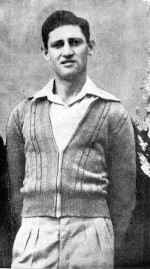
| Abraham Altman |
My brother Abraham was born in Rzeszów in 1918 in a devout Jewish home. His childhood was like that of many Israeli children. At the age of three, he began to study in the “cheder” the Hebrew alphabet and the Pentateuch.
On Shabbats, my father used to test his knowledge of the weekly parasha and would hint to my mother with a smile that gave her a sense of satisfaction that their eldest son indeed had a “good head”. When he reached school age, he studied in the mornings at the state school, and in the afternoons and evenings he engaged in his studies in the cheder and in the yeshiva.
I knew only a little about my brother in those days. There was a chasm between us - the girls, who were educated according to the Polish culture and were members in the “HaShomer Hatzair” movement - and between the boy with the big wigs, who lived in the shadow of our father. An “unspoken agreement” was made between us and our pious parents, that we would not “spoil” the boys and would not deviate them away from the ways of our ancestors.
My brother Abraham did not continue the tradition of his ancestors who had been merchants for generations. He wanted to learn a profession. He started by carving tombstones, a craft that was relatively common among the Jews, and then worked in bridge building and various stone works. Abraham was the only Jewish boy who worked on the construction of the new bridge over the Wisłok River in Rzeszów.
When the war broke out, my brother was on the Russian side. However, worried about his parents, he returned to Rzeszów. Later, in his first letter from Italy, my brother wrote: “I managed to hide our parents. They did not perish in the “Aktziya”, they died a natural death, if one can call it a natural death, a death from endless hardship, poor food, and damp, dark shelter. Two days after our father's death, our mother died. I buried them both with my own hands, saying “Kaddish” next to their graves”.
From his friend we learned how devotedly my brother cared for our parents, how he clothed, fed, and bathed them in the last months of their lives, when they were no longer able to get out of their beds. He risked his life every day by sneaking food into the ghetto.
“It was an act of heroism and sacrifice that very few could withstand”, the man said.
After the death of our parents, my brother fled the city, hiding in the surrounding forests. As soon as the Russians entered, he left Rzeszów and headed to the Land of Israel.
His journey to Israel lasted two years, along “smuggling” routes and through various borders to the camps in Cyprus. Sometimes we would receive greetings from him from people who had met him during his journey and who had arrived in Israel before him, and they were always full of praises about him.
“I don't understand how your brother remained such an honest and kind-hearted person after everything he went through during these terrible times. It was only thanks to his help that I stayed alive”, an elderly man, who lived in the same tent as my brother in the Atlit camp, told me. “You can be proud of such a brother”.
Abraham himself didn't say much. “I don't want to relive what I went through, now it's all over and I'm already with you,” he would say.
[Page 370]
My brother lived for several weeks in my kibbutz, Nir David. Then he decided to travel the country. He worked in Haifa and Tel Aviv, with the intention of returning to the kibbutz.
He volunteered for the War of Independence even before the draft order arrived. In February 1948, he trained at the training camp in Naan, and together with the “Beit Horon” Battalion, he went to the Jerusalem front.
For six long weeks we had not heard from him, and then my brother appeared on a hot summer day in May for a vacation. This time he was silent too. “When I clung to the first tap that came my way and I quenched my thirst, I forgot all my suffering. And after all, I'm not the only soldier”.
We spent his last day of vacation at my sister Yanta Waxpres' house in Ramat Gan. And in the afternoon, when he escorted me to the bus station, I was glad that the line was long. I looked at his face, his narrow, fierce, smiling eyes, his prominent cheekbones, his straight, slightly sad mouth. I remembered him when he arrived in Israel. Then his stature was slightly bent, now he has straightened up. I left him in Rzeszów when he was still a teenager, and now my brother is a man.
Translated by Mira Eckhaus
He was the son of Moshe and Yaffa. He was born on March 9, 1925 in Rzeszów, in Galicia. He received a traditional Jewish education in a “cheder” and even studied secular studies with a private teacher. In May 1935, he immigrated to Israel with his family. The unemployment situation in Israel made it difficult for the family to manage financially. In addition to Abraham, there were 4 more daughters, and therefore his uncle took him to his farm in Tel Adashim. Abraham studied there for 5 years. He worked on the farm, integrated in the life in Israel and became a farmer, a gardener, a lover of flowers and trees. He was a honest man, who took care of his family with all his heart and was willing to help everyone. After his return from Tel Adashim, he worked in building and he gave to his family every penny he earned in order to support it. He was a member of the “Haganah” since his youth.
At the outbreak of the War of Independence, he enlisted in the army, although military life did not appeal to him, and in the first battles he went through a severe mental crisis. “I was not born to be a soldier; I am a farmer” - he used to tell his relatives. Despite this view, he was among the first to volunteer and fulfilled his duty with recognition and dedication. He participated in the battles of Mishmar HaEmek, in the campaign against Kaukji's army, and fell on the 27th of Nisan, 5708 (May 6, 1948), on the slopes of Mount Tabor, along with his fellows, the defenders of Sejera. He was buried in the cemetery in Beit Keshet.
|
|
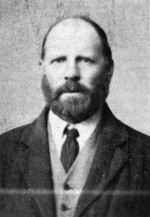
| Abraham Teitelbaum |
Translated by Mira Eckhaus
Mordechai ben Elchanan Lipshitz was born in 1886 in Gologori, next to Zlochov. In 1914 he settled with his family in Rzeszów. In World War I, he enlisted in the Austro-Hungarian army and participated in battles on the Italian front. On December 17, 1934 he immigrated to Israel and settled in Haifa. He was an active and loyal member of the General Zionist Organization. He worked as a laborer in the large flour mills in Haifa.
In 1940, he joined the “Achim Ve'reim” (brothers and sisters) society in Haifa, whose goal was to strengthen Jewish consciousness in the country.
On the 7th of Adar, 5708, he was a victim to Arab sniper bullets, he was buried in the cemetery in Haifa.
Mordechai was a quiet, humble, and honest man.
|
|
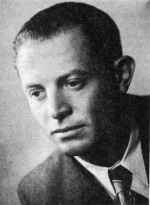
| Mordechai Ben Elhanan Lipschitz |
He was born in Rzeszów in 1912. After finishing elementary school, he studied in several frameworks, worked for two years in training, and immigrated to Israel in 1933. He worked for about four years at the Electric Company. During the Spanish Civil War, he volunteered for the Republican Engineering Corps, and upon his return to Israel, he was accepted into the refineries, when construction of the plant began.
After three and a half years of work as a responsible mechanic in difficult conditions, he moved to work (during the war) in the Royal Navy workshops. He sailed far and wide as a ship mechanic. He acquired extensive experience and technical knowledge, and upon his return to the refineries for “the new construction” in 1947, he was accepted as a foreman. He had good relations with all the workers and also with the Arab foremen, in whom he placed great trust. He was a good-hearted and brave young man. He never hesitated to go to dangerous places.
A few days before his murder, when he returned from work in a car that had been attacked, he showed me a bullet that he had removed from the leg of a wounded friend and kept as a souvenir. After a few days, fate struck him so cruelly, being the only one in the field. He was a devoted son to his family and took care of the immigration of his relatives to Israel. He left behind a wife and a three-year-old daughter. He was murdered on the 17th of Tevet, 5708.
|
|
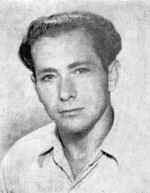
| Simcha Ben Mordechai |
Original footnote:
|
|
JewishGen, Inc. makes no representations regarding the accuracy of
the translation. The reader may wish to refer to the original material
for verification.
JewishGen is not responsible for inaccuracies or omissions in the original work and cannot rewrite or edit the text to correct inaccuracies and/or omissions.
Our mission is to produce a translation of the original work and we cannot verify the accuracy of statements or alter facts cited.
 Rzeszów, Poland
 Yizkor Book Project
 JewishGen Home Page
Copyright © 1999-2026 by JewishGen, Inc.
Updated 1 Mar 2026 by LA