 |
|
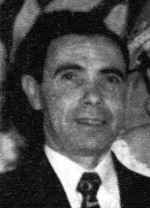
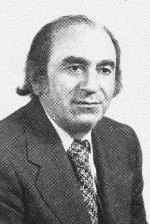
by Nosn Vigode, Petakh-Tikva
Translated by Tina Lunson
May my tongue cleave to my palate if I would forget you! And how could one forget all our most sacred and dearest? How could one forget the place and the environs, the home and the friends, where and with whom we felt like contemporary people and worthy Jews.
It appears before my eyes, the shtetl Rozhan and its surroundings, the marvelous nature, the hills, the Narew River, the forest, the demon bridge and all the gruesome tales about it. And in it and around it all the masses of Jews, Jews with sadness in their eyes, with fear for the morrow and with hearts full of hope that for us too, for the Jewish people, there would someday be joy, that better times would yet come.
How much strength, how much bravery, lay inside each one of them – and in all of us – to live through the hostility and hatred from the surrounding environs and from their authority. Who can say that our brothers went submissively to the slaughter, as they try to tell the story. How much strength, how much heroism was displayed by our Rozhaner Jews who more than once fended off antisemitic attacks and pogroms.
Rozhan was a shtetl with teachers, merchants and proprietors, of workers, unions, libraries, evening courses, lectures, sports clubs, drama circles and many others.
A Shabes in the shtetl – Jews in their silk kapotes, Jews in their Shabes'dik clothing going to the bes-medresh; youths and children going to their societies; and it all had one aspiration, one hope, one will – to live as Jews. Those innocent martyrs, those who were murdered in so many horrifying deaths – for what? For what? Only because they were Jews!
The Hitlerists and their helpers wanted to erase from the world and from History one of the oldest peoples. And the leaders of the whole world looked on and were silent. How indeed can we forget them? How could we forget? When we, on the other hand, protest and demand that the Nazi murderers not be pardoned, those who go around happy and free in both sides of Germany and in Austria. We will shout and call out to the last bit
[Page 127]
of conscience in the world: Do not allow the court to pardon the Nazis and to forget their hideous crimes!
Medinat Yisroel that arose after the murder of the Six Million martyrs, must and will absorb their holy memory into itself. Many of them could have been with us today and enlarge the settlement, increase our strength and make our land fruitful.
Let us remember them, and in thinking swear not to forget the immense crimes of the Nazi bands and their helpers! Do everything so that our Land will become stronger, because a Jewish State is the only guarantee that such misfortune can never be repeated!
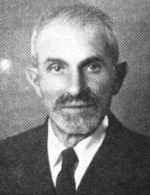
by Meyshe Beylis, New York
Translated by Tina Lunson
|
Why a book?
Rozhan – a small shtetl in Poland, where we were born and set our first steps on God's earth. Nothing extraordinary ever happened in Rozhan, not among the Jews and not among the Polacks. No famous figures were produced in Rozhan. Not even any military battles of historical significance took place in Rozhan, as in, for example, nearby Ostrolenke or Pultusk. The shtetl was sleepy, as forgotten, although it lay on the country road between Bialystok and Warsaw. So then why write about Rozhan? Only in order to give honor to the innocent murdered Jews, our relatives and friends of our youth, those with whom we sat on the same bench in kheyder or the same bench in shul. And one must begin with the childhood years.
Learning, Culture and Spiritual Life
They kheyder years. In memory remains etched a feeling of fear: fear of the goyish dog that runs after you and wants to bite you; fear of the Polish young hooligan who necessarily needs to demonstrate his “bravery”
[Page 128]
upon the body of a five- or six-year-old Jewish boy; also fear of the melamed teacher is baked into the memory.
One goes to school in the morning; in kheyder one goes until late afternoon or even into night. The melamedim – old Jews with long or short beards, without a spark of understanding of pedagogies or child psychology, with medieval methods for “very young males” as Max Nordeau called the youths of the Jewish Exile. But they had to teach, because they instinctly understood that only with that can one excel. Learn, learn, learn! Not wasting any time for play, for swimming in the Narew in summer or skating in winter. The skis we made from a piece of wood with an iron wire stretched along the length of the wood. Primitive – but in those years they served the purpose. Physical exercises to grow up healthy, that was strange thinking. Learning in order to become a rabbi or a doctor – that was the dream of the Jewish mother.
Unfortunately, there was no yeshive or gimnazie in Rozhan. The bar-mitsve boys traveled to yeshives in other towns, and there they “ate days” and tutored others. It was very rare to study in a gimnazie or a seminar. The overwhelming majority of Rozhan youths learned trades, craftsmanship. But I can give witness that the thirst for learning was very strong. They always wanted to know what was going on in the wider world. One read books and dreamed dreams. When I came home for vacations, some of them wanted to talk about literature, and literally manifested information in the work of the current popular writers such as Romen Rolan, Andrei Zshhid, Sholokhov and, of course, the Russian classics.
The youths of my generation found an ersatz school in the Zionist and non-Zionist movements. There they learned the history of our folk, learned to understand the abnormal Jewish-Polish life. They marched and sang songs of awakening, songs of love and longing for Zion. They read about a struggle for Jewishness and about a Jewish settlement in the Land of Yisroel based on just socialist sources. Others were captivated by the Bundist or Communist thought. Rozhan was a miniature reflection of the huge ebullience all over Jewish Poland.
The older generation also showed interest in the events of the times. There were hardly any Polish newspapers to read. But every weekday in the morning people would walk to Frizant's and wait impatiently for the “Haynt”, “Moment” or “Folks-tsaytung”, and analyze them on the spot to decide whether the news was good for Jews or bad for Jews.
Mostly the reports were unfavorable. Those were bad times for the Polish Jew. The antisemitism was rampant. The boycott against the Jewish shopkeepers or craftsmen was grim. The economic situation was
[Page 129]
a bitter one. Among other nations of the world such a situation would likely lead to a revolt. The Jews however were in Exile and had no unity among them. Rebellious thoughts multiplied, but the reality of the times took over and conquered the feel for freedom. The urge to emigrate was strong. But Jews did not have enough money, and, perhaps, not enough knowledge about what was going on in the wider world. Of course, the emigration politics of the pre-war government was also a great interference, and the position of the English administration in Erets Yisroel on immigration is very well known.
In today's times when every home has a radio, and almost every house has a television set, it is worth mentioning that in Rozhan in the Jewish houses up to the outbreak of the war, there were few radios. I remember precisely that only in 1932 was the first time I heard the voice of a radio. That was at Frenkl the “bicycle-maker's” house. He allowed me to put on the headphones and in a “mystical” manner I heard Yehude Meniuin play. Meanwhile others waited impatiently for their turn to put on the headphones.
Holidays
To write about those days and not to mention the yon-teyvim would literally be a crime. But the two days that have left the strongest impressions are Yon-kiper and Simkhes Teyre. What a contrast! Yon-kiper – serious, somber, the day the world is judged. Simkhes-teyre – happy, smiling, almost carefree.
Yon-kiper at night is the image of the burning light in the study-house, the image of Jews wrapped in [long white] kitln and taleysim, reciting the prayers with intention. Yon-kiper is hearing weeping that carries from the women's shul, especially during the u'natana-tokef. And who could express the mood of Yon-kiper evening, when Jews are going back home with the not-burned-out candle in the study-house or in the hasidic prayer-rooms – burning candles in the surrounding darkness!
Simkhes Teyre was the opposite. Simkhes Teyre was the hasid with a soldier's cap on his head, dancing and singing. It was the day when the Jew also took a drink of whisky and was often a bit tipsy. That was the day when he threw off the yoke of livelihood, forgot the whip of obligation, and was happy that he was a Jew.
Outbreak of the War and the Last Breath of Rozhan
All this came to an end on 1 September 1939. The war broke out. The German airplanes appeared all over the skies. We were able to carry wet handkerchiefs to protect against the poison gases. A well-known major helped my mother to flee to the other side of the Narew River, because on
[Page 130]
that side of the river the Polish Army was putting up a strong resistance. The concept that the Polish officers had about conducting a war! What a joke!
In all my years growing up in Poland and going to Polish schools I rarely had a positive approach to the Polish people. If I had learned something and appreciated from Polish literature, it was the idea of Wollenrodism.[1] I saw around me a raging antisemitism and also felt it on my own shoulders. More than once I was attacked. Each time I responded and sometimes lost the battle.
Because I did not take to heart Mickievicius' description of an Exile-type Yenkl, because I defended the Jewish right and had the nerve to doubt the truth of my history professors' interpretations regarding the role of the Jews in Polish history, I bought the “slate” of the Communist. What an irony! I, a student of Jabotinski, a communist of all things! Even Professor Rovkovski, the deputy to the Polish Parliament, the non-provincial, could not understand the new type of Jewish youth in Poland. Just a few weeks after the outbreak of the war the position regarding Poland had changed: in the end, the German Nazi was a greater enemy than the Polish hooligan. But even that romance came quickly to an end.
When we fled to Brisk and saw how the remnants of the Polish Army treated the Jews brutally, blaming them for helping the Red Army, I was outraged that the enmity of the Polack for the Jews was not reduced. The land of the Liach, as some Polish writers used to call their people, was for Jews a bitter place of refuge.
The end of Rozhan began on Shabes in the morning, the 2nd of September 1939. Some with baby carriages, some with wagons and horses, some with not more than a pack on their backs, Rozhan Jews set out toward Goworowo. This was the beginning of a long path of wandering, the beginning of the life of a refugee. Over fields and through forests they ran, on unfamiliar roads they dragged themselves, in order to flee further from the Nazi beasts. And those who were not running, were sadly murdered in the ghettos or crematoria.
I am often asked if only the brave survived. My answer was usually a categorical “No!” Each of the survivors looked death in the eyes more than once. He remained alive only by chance, simply a miracle.
The martyrs were so brave, intelligent and clever to me – but they unfortunately did not have any luck. The German persecutor succeeded in laying his paws on them.
May this yisker-bukh be a monument for all the martyrs of our shtetl.
Translator's footnote:
[Pages 131-133]
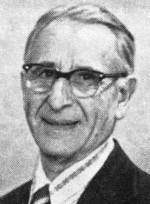
by Zakharye Khonin, New York
Translated by Tina Lunson
|
Among the thousands of Jewish settlements in Poland that were so tragically destroyed by the German murderers and their sinister Polish and Ukrainian assistants, our shtetl Rozhan may also be found. It is our obligation to relate to the world and to our grandchildren what Jewish Rozhan was, what kind of intellectual and human riches were snuffed out.
A Little History
The Jews in Rozhan – numbering about three-thousand souls before their destruction – had, like all the Jews in the Polish shtetlekh, traded and worked in order to make a living. But it was destined that Rozhan would be ruined two times, in both world wars. This brought about the development of a stronger Jewish brotherly-ness and gave Rozhan a special character.
When Rozhan went up in flames in 1914 – we remember it still – the Jews built it back when they returned. The first ones to return promptly organized a general coexistence and a temporary aid institution. Years later people still talked about all that, how Jews helped one another, raising the fallen and nourishing the hungry, and the shtetl was rebuilt again from the ruins.
In 1920 we lost victims in the fight between the Bolsheviks and the Poles. The Russian bombs that were meant to fall on the military barracks and war objects fell on the Jewish population and Rozhan paid dearly for it after the war. Later the Poles took revenge on a several Jews, just to sate their thirst for revenge. All that laid obligations on the survivors, and Rozhan stood the test.
Rozhan's Jews
There were merchants in the shtetl, a few rich ones, and a lot of poor who constantly worried where they would get a couple of zlotych to pay a bill, to buy things, and also where to borrow a few groshen for Shabes. There were craftsmen, grain dealers and regular traders, and official beggars whom Jews in Rozhan took care of and exemplified as the fallen needy that must be cared for.
[Page 135]
|
|
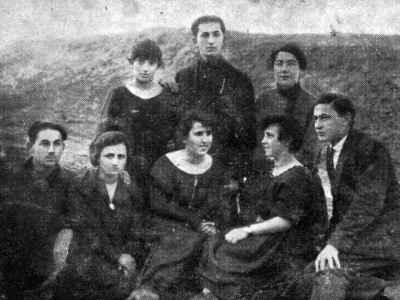
| A group of young people after the First World War |
Khayim Gerver and his wife Lotke, Feyge Vigoda, Bashke Bukhner, Herman Gorni (the teacher) and his sister, Yitskhak Shtshetshin, Khaye Beyle Pshishusker-Rozenblum
We had a fine, large shul and other houses of prayer and hasidic prayer-rooms. Even in the dark one could see Jews walking or running through our streets with taleysim tucked under their arms, to the first minyen to pray. Yeshive students sat in the shul and studied, and their earnest melodies carried out into Shul Street. Day and night, years long, Jews served God and so deepened the sense of Jewish fate.
The shul was burned in the First World War. The Rozhan generation after the war built back themselves what generations before them had built and furnished over many years. Rozhan Jews in America subsidized it, in order to rebuild the holy center of Rozhan Jewry. Also, the repair of our shul with our own strength and with brotherliness warmed all of our hearts for years.
Rozhan was an active unit in the cultural and political-organizational sense. There were movements, societies, parties – Zionist, Mizrakhi, Agudas Yisroel, Poeley-Tsion, Ha'shomer-ha'tsair, He'haluts, BeTaR and others. Community activity was led with understanding and culture. There were khedarim, libraries, evening course, hasidic prayer houses, minyonim, drama circles, sport clubs, loan agencies, a free inn, the fund for poor brides and others. When I begin to remember all that was done in our shtetl, I stand and declare: Goodness! All that was in a little Rozhan?!
I have mixed everything up. I cannot differentiate among the various
[Page 136]
characters of each organization. I won't let that bother me. I will simply provide a true general picture of the enormous activity of our shtetl. Where did people get so much time to devote to the community? Where did they get so many activists, leaders who so occupy themselves with the needs of the community that they spend their spare time and energy their whole lives on so many community matters?
Here I come to the end of our particularity. Rozhan had warm Jews, dear lovers of Yisroel, extraordinary figures – Jews who bore the Jewish pain and invested their entire life's interest in the life of the community and its existential needs and problems. Rozhan also had a warm and active young generation, who filled the local political-party venues, cultural societies and youth clubs every evening, day in, day out, and still found time to devote to libraries, theater clubs, and carry out fund raisers and Friday-night lectures, dances, singing, youth hikes. Hard to comprehend how the youth could participate in so many undertakings, like selling shekels, agitating, conducting election activities, reading books, presenting theater plays and so on.
And we should not forget that Rozhan was a shtetl of workers and craftsmen, good tradesmen, regular Jews who were full of the joy of creation and love for their trades. If I woke up in the middle of the night and asked myself, in what did Rozhan excel more than any other, I would say without thinking much about it: Rozhan's artisans! The non-Jews in the area talked about Rozhan, that they could do everything, that had all the craftsmen there were reliable.
And our artisans excelled not only from the standpoint of trade. In the social sphere they served as models. We spoke about the earnestness, their loyalty to one another, their activity in all areas. And after a difficult day of hard labor, they would go to the study-house to enjoy some reciting of psalms, or to hear a lesson in Mishnayos and be inspired by a little Ayn-Yankev.
And then, Rozhan weddings! Who could forget our weddings, with all the invited guests as well as not-invited guests! For a wedding in Rozhan was everyone's wedding. The shtetl joined the event. Musicians played, in-laws were merry, young folk danced, children ran around from groom to bride and back again. The streets rang with the sounds of music and noise. The groom and bride were escorted through the streets so all could see, so all would know, that it was a joyous occasion for Jews – that a new couple was approaching, that the Jews would multiply and not go under! Jews placed lit candles or oil lamps in all the windows. Little flames of joy illuminated the darkness. They rejoiced because they wanted to forget, and there was much to forget. But they also consciously rejoiced for it, that a Jewish daughter was now established, that the parents were relieved of a responsibility, that the whole town was happy.
[Page 137]
At the end of the Second World War, when I went back from that hell with other surviving Jews and arrived to see how our Rozhan looked, I saw only blackness. The living shtetl Rozhan looked like a cemetery. Everything burnt down, dark all around, deafly-still and dead.
The Polish neighbors, our enemies, rejoiced in our ruin and tried to beat up the few surviving Jews. (Then there was the pogrom in Kielce.) They looked at us as at a defect in the world, that Hitler had made a mistake in that he had not succeeded in putting us in the ground.
I left Rozhan forever.
May the hands be blessed that undertook the great and difficult task of publishing a book in remembrance of Rozhan.
by Nute Rogoze, Petakh-Tikva
Translated by Tina Lunson
|
Written in Kibuts Dafna
The Epic Poem of Rozhan
Rozhan after sunset was the authentic Rozhan. In that slice of time there was a quality that drew you to her and you cannot forget it. Between minkhe and mayriv was her “epic”, in which she was different from her surroundings, vivid, and endlessly deep.
Rozhan was everywhere full of Jews, especially in the study-house. Jews were together in order to forget what united them. In those hours they studied in the old holy books and joined with their great intellectual past. They studied khumesh, mishnayos, Talmud, Khay Adom, Ayn Yankev. And they studied alone or with the help of the learned men of their “group”, from a rebi, a teacher, a commentator. The point – not to stop learning, learning, learning!
In these hours there came together orators, fund collectors, sermonizers, emissaries from the yeshives in
[Page 138]
Lomzhe, in Telz and others. Here one could see the everyday Jews become suddenly others, become changed. Here they forgot their penny-livelihoods and occupied themselves with heaven and visions. And now and then they spared a little time for human issues and problems of the mundane world.
There was a lovely hospitality house in town. A woman, an ordinary seamstress, had donated a house on a nice site in the center of the town. Kind Jews organized themselves as the “society for the guest house” and dedicated their time to the “guests”, meaning the paupers and those who wandered from shtetl to shtetl, the lost of the eternal people. There they were cared for, had a clean bed, a warm house, a light ceiling over their heads. The city itself had added that it should be a special house for cooking warm meals for Jews and the impoverished, for a householder who had lost his way of making a living. They also organized a house for washing, with an attendant to help the poor folk orient themselves in the customs of the shtetl. The poor used to say that here in little Rozhan they could ease their bones more than in the big cities.
And Rozhan had an interest-free loan society by the group “support the fallen”, a group that gathered money to help small merchants and poor artisans stay on their feet and not go under, and allow them to remain Jews among Jews. They received the loans with no interest and at small, easy pay-back rates, and with respect, all according to the Jewish standard: mercy, humility, loving kindness.
There was no lack of problems. Rozhan had military barracks around it and Jewish soldiers would linger in the town. Rozhan concerned itself that they be among Jews, rest from the antisemitism of their brothers-at-arms, or even a warm Jewish meal after weeks of avoiding [treyf] and being hungry. I recall that on Jewish holidays there were more than a hundred Jewish soldiers in Rozhan, as well as our own poor folk. And they were all given the four cups of wine, matzo and a holiday lunch.
That was the collective content , and also the content of each Jew in Rozhan. They sent their children to other towns to learn the proper Jewishness. In the yeshives all around one could find Rozhan boys, who lived far from home and family and studied. Because Jews wanted to eternalize Jewishness in the coming generations.
A new, fresh energy arose gradually in the town – the enlightened youth. They created political parties, clubs, libraries, theater circles. The drive for a new direction pressed upon several areas and included various circles of the youth in Rozhan.
The Mizrakhi movement founded a kheyder in which Torah and Zion went together. Here boys and girls studied together, and many Jews looked askance at that. Old-fashioned elementary teachers helped to heat up the opposition of their sincere competition. But Rozhan's parents accepted it. Yekhezkel Gishem, a maskil [“enlightener”]
[Page 139]
and a Talmudist, and his son were quite devoted to the new institution and the kheyder stayed, literally the school with classes and a system, with consideration for the child, for his parent and tendencies.
The Polish regime created a Jewish government school with seven classes, with Jewish teachers and sabbath rest. Rozhan had begun to raise her own intelligentsia.
A Story with an Eyruv
Rozhan was divided into two forces, the observant and the modern, and as the saying goes “God joins a good thought to an action”. Thus, Rozhan remained Jewish outwardly. Friday afternoon became Shabes in the shtetl. Then, a difficult problem arose: the youth did not understand that Shabes demanded the whole person. They would carry things in public, for anyone to see, and did not feel that doing so would render the pact of the Shabes. The town did not bicker with their children and put up an “intensive” eyruv border with a kind of boxes and wire the length of the streets, and on Shabes the wire was drawn out along it – that was that! The children would not blunder into desecrating the Shabes. True, the older ones did not rely on the eyruv. Does it bother me, then, that I'm not even carrying anything in the confines of Shabes? They would put on a talis under a coat, the red kerchief tied around their necks with the knot in the front, or stick it into their tightened belt, and were certain that they were not trampling the sabbath.
But it happened that, in the First World War, while the tsar's Cossacks were in Rozhan inspecting all the streets and lanes of the town, they saw the little boxes with the wires that made up the eyruv and it occurred to them that the Jews had a secret telegraph connection with the enemy, with Germany.
The Narew River was one of the first lines of the front for the Russians, and their defeats along the way from Warsaw had made them nervous. They wanted to throw off their own defeats and lay them on Jewish shoulders – the Jews were guilty: They had transmitted reports to the Germans.
The Jews did not have any permits for the eyruv and could not demonstrate their innocence. And especially since one of the boxes was nailed to the residence of the organist, the organ player for the church, and the goy poor thing did not know what to say about it. That cost enough fear, exploitation and money before the issue was resolved and the laws of the sabbath had been explained to the Cossack general once and for all.
The intervention of the Jewish social activists who came from Petersburg was also a big help in defending Jewish issues.
But that did not hold for long. Jews had to leave Rozhan. And not only because of the eyruv. The Russians had, before their retreat, burned the town.
[Page 140]
Merciful Jews in the surrounding towns helped their Rozhan Jewish brothers to salvage whatever was left and they took them in like caring brothers. But how much can one, as a refugee, drag with them to a stranger's place?
Rozhan's Rebuilding
When the Jews turned back to Rozhan, they encountered Wilhelm's German regime, but they had nothing over their heads and not a piece of bread. Homeless, they stayed in pits in the ground or in cellars, freezing in the winter, until they revived the rebuilding of the shtetl.
The Germans introduced a coupon system and began to distribute bread and potatoes for coupons. The German government helped with cheap lumber for construction from the government's forests and Rozhan could begin to build itself back. Jews toiled for years before they could see their families in the houses. It took years. Indeed, at the same time, Jews were occupied building a holy space for prayer and Torah. Everyone gave money to support the study-house. Craftsmen lent their work. Shaul from Lodz did the artwork for the cupola. Zalman the carpenter made the round windows. I myself made the entrance doors. Others did the carpentry and fine art for the interior. The holy ark was made later, in the time of the Polish regime. It was completely beautiful, but for years we Rozhan Jews remembered with longing the old ark with the throne of Eliahu, which my father Yisroel Yehude and his brother Khayim Leyzer had made. In time, a Rozhan Jew came back from America, donated a sum of money and Leyzer Leybl Zshelazni's son carved a holy ark that was even more beautiful that my father's.
Our Professionals, Singers and Others
Rozhan was known for its good artisans and other workers in general, and specialists in all branches of work. Rozhan Jews clothed and shoed the town and the area around it. The goyim did not have their own specialists who could help out. Jews properly made the agrarian machines and tools for them, built their houses and covered their rooves. Without Jewish blacksmiths, carpenters and wheelwrights they were helpless. Rozhan's work had a good name in Warsaw, Lodz and other big cities. No work was too hard for our Jews.
There was no industry there. The only “factory” was Beker's brickyard and sawmill. There were also Jews among the mechanics and porters, grown-up Rozhan children.
The new leaders of all the new regimes found all their needed workers in the Rozhan Jewish community. I myself worked as a carpenter for the Germans (Wilhelm's Germans), and the Bolsheviks and the Polacks.
[Page 141]
Under the Germans the police inspector was Nakhum Rivke's son-in-law, and vice governor and chief administrator was Henikh Bukhner. He made everyone happy and relaxed with his good-natured smile, which was a family trademark among the Bukhners. I still remember his father, Meyshe Bukhner, and “grandma” Velke. When Meyshe prayed for Rosh-ha'shone and yon-kiper and his sons were his choir assisting him, people believed that it would be a good year for certain. Jews took much pleasure in his sweet praying.
In the women's shul there was a female singer, Rivke Avrom Leml's or Sore the Rebitsn. Both had sweet voices and knew the style and the prayers as well as the men. And when they would belt out the high “C” in their own women's choir it confused not only Satan but also all the fine Jews. But the oldest folks did not want to accept Reb Meyshe Bukhner's tune. They would clap on their prayerbooks and shout “Quiet!” until the women were silenced.
And when we're talking about prayer leaders and singers – they were in all the prayer rooms and minyonim. When Jews met for a happy occasion, there was no lack for someone to rejoice with a song, and a prayer, a wordless tune and a joke. Simkhe Hirsh the leather-cutter, our own “Hershele Ostropoler”, made even the sternest Jews laugh with his own jokes and witticisms.
There was no lack here either for bands for weddings. Yekusiel the wheelwright with his fiddle touched everyone's heartstrings with their pain and comfort, worry and courage. And his helper Vashileski the musician knew all the Jewish tunes and played with him. He even learned Yiddish well and spoke like a Jew. He spoke to his child in Yiddish and also could recite a blessing.
Interesting that Rozhan was also burned down by the Wilhelm's Germans, Jews again had no roof over their heads, and still they played theater in Rozhan. It is difficult to understand. From one side one could see that here Jews wandered around and searched for a corner to lay their heads, and there, the youth ran around in search of a venue for the rehearsals and performances. In the barracks near the bridge the Germans had made a bathhouse and quarantine area, and there they presented “Bar Kokhba” and other plays.
Memoriam
I left Rozhan in 1929. The last chapter of Rozhan is the same as the last chapter of all of Polish Jewry, but I cannot tell about that. My three sons fell as partisans.
Rozhan was mowed down. We remember her with pride. Our shtetl was a proletarian, industrious and politically intense town. What their death was like is hard to bring into thought. The heart could burst. They suffered, suffered terribly, for their Jewishness, and they have been given the name of martyrs, holy
[Page 142]
sacrifices. May my few memories, along with this whole yisker-bukh, be a matseyve, a gravestone for them, for our dear lost ones. May their souls be bound up in the bundle of life!
by Leyzer Beylis, Hertseliye
Translated by Tina Lunson
Our social and cultural life in Rozhan began with the rise of the “Haskole” [“Enlightenment” movement], which was a society to deepen the world view and broaden the general knowledge of the Rozhan youth. The “Haskole” was led by Motl Zamek, Heynt Armuni, Khayim Bukhner of blessed memory, Khane-Rokhl Holtsman-Bukhner, Meyshe Rogoze and the unforgettable leader Moniek Holtsman of blessed memory. The latter headed up the fruitful evening courses for adults. The evening courses were, for us, an immense achievement because in those times we had no opportunity to receive any education in any kind of school.
Holtsman as a teacher remains unforgettable. His lectures were deep and learned, but even more they were extraordinarily interesting. His devotion to the enlightening work drew everyone to study and to value the learning. The evening courses ended with Holtsman's leaving Rozhan, and everyone regretted it.
At the same time in the shtetl a large library was developed, and an imposing drama circle. Literature became the chief interest for everyone who sought to improve and enrich his life. Especially felt was the dramatic-literary activity, which demanded a lot of enthusiasm and stamina. The youth were sustaining terrible difficulties both in the rehearsals and in directing the performances, always in inappropriate venues. For the library we rented a site from Levande and also created a choir there and organized several literary discussions.
The youth were in ferment. The literary baggage created social drive, and political parties arose with general human content and programs. The largest part sympathized with the Poaley-Tsion because of the Zionist-Jewish thesis. A smaller part belonged to the labor “Bund”.
The Poaley-Tsion venue at Rushiniak's teemed with activity. Shaye Bezshaze and Motl Zamek led the cultural activities. One felt a deep revival and intellectual elevation.
This entire project was not legal. The legalization
[Page 143]
came only later, under the long-long name of “The Society for Evening Courses for Workers in Warsaw, Department in Rozhan”. We soon opened courses for Yiddish and literature, with the help of TsYShO [Central Yiddish School Organization]. A teacher would come from Zambov and from other central places to lecture, and the self-education and enlightenment went on intensively. The drama circle worked further and bloomed under the leadership of our unforgettable member Alter Loyfer may he rest in peace.
I should mention that when Mrs. Levande sold the house to the medic Miler, we were forced to close the venue down. The reason was that the floor was near to collapsing. And we wandered from venue to venue and sustained many difficulties. Then the idea of building our own building came into our purview.
We leased a site from the Stshaski brothers, and Baker built the house for us. there we doubled our cultural and enlightening work with fervor and dedication and thought that we could have peace. But the Polish government closed our venue. In 1935, two years after the rise of Hitler, Poland learned his Nazism and instituted it for itself.
We were again down to conspiracy situations, and it was that way until the end in 1939.
From my perspective years later, it appears that our small cultural activity in Rozhan was the death struggle of the Jews, who believe in the book and the word and hold to that belief in any circumstances.
by Eliahu Vilgovitsh, New York
Translated by Tina Lunson
|
After the First World War
In 1915, a few Jews came back when the German military had taken Poland and the front had moved away from Rozhan. Almost one hundred percent of the Jewish houses in the shtetl had been burned down, because after the Russian military had left Rozhan, an order was issued to burn the Jewish houses. Those few returning Jews did not have any apartments to live in; there was also no shul to pray in, and no yeshive either – in a word, it looked like an empty place. Only the firewalls remained (that is, the walls that separated the neighbors, that were made of bricks, as most of the houses were wooden) and the cellars that were also brick. And as there was no place to live, people began living in those cellars.
Gisha Lasko lived in such a cellar, and also Eliahu-Ayzik Tsinamon. One time, on a Friday night, there was a strong wind with rain. The rain weakened the bricks in the chimney and Gisha Lazko's chimney fell down on the cellar, killing Gisha and his wife and children. Then the fire-fighters demolished all the chimneys and firewalls.
[Page 148]
Eliahu Tsinamon continued to live in his cellar. He built a sort of cabin out of boards, like a room, and made it a shul or praying. Plus a separate place for women to pray. And until more Jews came back and rebuilt a shul, people prayed there. May the coming generation know what dear Jews were in our shtetl Rozhan. Such a Jew – who lived in a potato cellar with no windows and no air, but he constructed four walls with a roof for a holy space. He gifted it to the Otwotsk hasidic shtibl and they prayed there for many years.
Later people began construction. Eliahu-Ayzik also built out. At the time the Germans were not in their murderous personas, and gave bricks, mortar and some money as a loan; and people started building a new shul, larger and finer and taller than the earlier one, with two galleries for women. And nearby, a smaller shul. Every resident had to go one time a month and work a day for the shul. That went on for a long time until they finished. First they finished the small shul, then gradually finished to large shul as well.
And here the quarrelling began. People who had had a special seat in the previous `shul now demanded such a seat for free. But the shul council said that they needed a lot of money and everyone had to pay for the seats. They had to come to a reconciliation. The previous seat-owners paid in a little money, not a lot, and received a kinyen [nest] (that's what they called it).
The shul was built by a good craftsman, Shaul Feldmark (I recall that he left for Israel). People prayed in the smaller shul only in the winter.
Here I must mention a dear Jew, Kalman Shpitser, who went to America before the First World War, and when he returned later and saw that the Torah scrolls were laying in boxes in the small shul, he made a holy ark for the big shul. It cost him a lot of money. Could the Jew Kalman Shpitser foresee that he would be killed in Goworowo by a murderous German bullet?!
I will mention other Jews. There was a Jew Beker, was his name, and everyone knew who he was. He had a sawmill, a flour mill and a brickyard – a rich Jew. He had an open hand for everyone – for poor people in winter and for Peysakh, and he also helped in building the shul. When he had a yortsayt he would come to shul to say kadish and always gave a nice sum for the shul and also treated the shames very well. He was later seen in Lida, standing in the street selling cigarettes.
Let us take two such Jews as Arye Botshan and Itshe-Mayer Lasko. They never even bothered a fly on the wall. They regularly sat in the shul and studied, and their wives worked hard for their livelihood. In winter, when people came to the small shul midday, they always
[Page 149]
found the two Jews studying there. What sin did they commit, that they should be killed by the [Nazi] murderers?
The Craftsmen's Union
The small shul was also called the craftsmen's shul, and all the meetings concerning purely town issues, economic and political issues, were held there.
The craftsmen's union in Rozhan was joined to the central office in Warsaw. The Central sent out all the rules about the rights of the craftsmen. For example, a shoemaker made boots, and for that he was required to have a Category 8 permit. But, he had to sell the boots. But the Polish Tax Office said, “No, you must have a Category 4 permit!” That is, be a merchant, and merchants had heavy taxes imposed on them. So the Central for Craftsmen, along with the Izba Rzemieslnicza and the guild in Rozhan brought the rules to the chief of the Polish Tax Office, saying that craftsmen needed only the Category 8 permit – he could not eat what he made, he had to sell them – and the chief had to apply the rule.
There was also a Central for Craftsmen under the purview of the “Bund”, and they were called khalapnikes [cottage workers].
In Rozhan the craftsmen were not to concerned with permits. One had to travel to Makow to the tax office. The craftsmen dealt with the guild – which was called the “guild of all trades” – and the permits for all the trades were brought to Rozhan from Makow. It cost little and there was still money left for the organization.
The secretary of the guild was Peysakh Burshtin. The Guild was comprised of the following trades: Alter Prats, tailors; Yisroel Shultser, shoemakers; Eliahu Vilgavitsh, harness makers; Note' Ayzenberg, tinsmiths; Nosn Zshepke, mechanics; Kopl Grinvald, locksmiths; Yitskhak Shlezinger, carpenters.
We had to be constantly united and to stand watch against general antisemitism as well as against state-sponsored antisemitism. When it came to elections for the town council, we craftsmen could always bring more handworkers to the council. But because of the Polish antisemitism, we united with the Jewish population.
The craftsmen also usually had the majority in religious life. The craftsmen were active participants in the Jewish council. The mayor and the Jewish leaders impeded the craftsmen, but we still won in the town council elections. Even the president Yankev Leyb Agrodnik was a craftsman.
We accomplished all this work in the Craftsmen's shul until the free loan society was established on a firm base. Then they rented a venue from Yankev-Magen Oshever. In the meantime, people came to borrow money from the “Joint” [Joint Distribution Committee].
[Page 150]
We drew new people into the work: Shleyme Dobzshelovski, Barukh Zshepke, Yisroel Shultser, Fishel Gogol, Mayer Beylis, Kopl Grinvald.
The Free Loan Society fund was a very important and useful institution in the life of our shtetl. A craftsman, for example, borrowed a little money and bought some materials. Let's say, a shoemaker had to wait until someone brought him a pair of boots for repair. He did not even have any bread, because he had to buy a piece of leather, and in Rozhan it was very expensive. But if he was able to borrow 200 zlotych he could travel to Warsaw and buy leather much cheaper. He could create ready-made boots or summer galoshes and travel to Mishnitz. He could travel out on Tuesday with a pair and come back on Thursday after he had sold his products. And if someone brought him shoes to repair, he could now do it cheaper because the leather had cost him less.
And that was so for the small shops, who bought a 10-kilo sack of sugar from Yankev-Dovid Burshtin. What could the small-shop owner earn? He already had nothing to eat. And such was also with the Jews who peddled in the villages. If he bought an item he had to sell it right away, because he did not have any money to go to another village to buy anything else.
But the hand-workers made a turnover with the Free Loan Society fund. The small shop could now buy a sack of sugar from Iser Naymark; the village-peddler did not have to sell the item right away, he could now wait and next week it would be more expensive. Thus the economic situation was improved thanks to that energetic organization.
The Khevre-kadishe
When I was a little boy, my father used to take me to the Burial Society's kidush. The members of the Burial Society gathered three times a year to make a kidush: the eve of Shabes Rosh-khodesh they fasted as if it were a fast day, and after they prayed in the shul they read Torah and made a kidush; on the seventh day of the month of Oder they held a feast; and on Shmini-atseres they had another feast. The biggest kidush was on Shmini-atseres because they went there right from shul.
In the morning, Simkhes Torah, they made an election – that is they gathered the trustees, One, Two and Three. I recall the gabayim Borekh Burshtin, Yankev Pakshivko and Khayim Reytshik. The sexton gave a loud clap on the cantor's desk, and all the Burial Society was invited to the kidush.
To be a Burial Society member one had to be an honest, respectable person and also pay a certain sum of money. For the first three years one was a junior member, like an apprentice, going to call everyone to a funeral and also performing the tahore [cleansing and preparing a corpse]. And if there was a meeting in the middle of the year, all of the junior members were all called together.
[Page 151]
The Burial Society came from all levels of the community, except the Ger Hasidim. Later I understood why this was: The majority of the town were Aleksander Hasidim, and they were the ongoing trustees.
People were afraid of the Burial Society, because they could make a reckoning when the person had left this world. There were people who did not want to give to charity, they bided their time. They would say of them, “He will yet come into our hands, he will still pay whatever we ask. And if he does not give, his body will lie three days.”
Of course, there were also women in the Burial Society, to take care of a dead woman. Avreml Plotko generally made the casket. When he came into the shul with his saw, people knew that someone had died, because he made the caskets in the shul.
For years a fire flickered between the Ger and Aleksander Hasidim before it flamed up unexpectedly. It was Simkhes-Torah. Rov Naftali-Yosef Froynd – who was a Ger hasid – put on his talis and stood at the cantor's desk praying. Mordkhe Feldmark approached him and took his talis off of him and said, “You will not pray! The cantor is coming!”
The rov would not stand for such things, but there was nothing he could do. The rov left and handed it over to the Burial Society to punish him. Some of the Society said that the person should be punished, but most did not want to punish Mordkhe Feldmark. The rov and some of the Burial Society and of course the Ger Hasidim, and created a new Burial Society. They chose new trustees: Shimon Margolis, Yankev Burshtin and Berl-Velvl Barvuko.
They made a new tahare-bret [washing platform], which was located at Berl-Velvl Barvuko's, because he lived in an enclosed courtyard. (They called it “Bel Veder”, like a fortification.) They were afraid that the others would take the tahare-bret. The old Burial Society constantly waited for an opportunity, and one time they chopped up their competitor's tahare-bret with an axe. And don't even ask about the money, just to get the body. Most times the two competing Societies' representatives stood under the window and waited and also argued about the dying person.
The contention between the two Societies went on for many years. Many people were embarrassed and many were caused great anguish. It seems as if people who constantly deal with the dead, lose the feel for the living… Despite that one must hope that the Burial Society did their important work; and one must also not forget, not completely pleasant work.
All of them, equally, were murdered in the Holocaust. Honor their memory!
|
JewishGen, Inc. makes no representations regarding the accuracy of
the translation. The reader may wish to refer to the original material
for verification.
JewishGen is not responsible for inaccuracies or omissions in the original work and cannot rewrite or edit the text to correct inaccuracies and/or omissions.
Our mission is to produce a translation of the original work and we cannot verify the accuracy of statements or alter facts cited.
 Różan, Poland
 Yizkor Book Project
 JewishGen Home Page
Copyright © 1999-2026 by JewishGen, Inc.
Updated 27 Sep 2026 by OR