[Pages 487-488]
In Our Town
by Yosef Rolnik
Translated by Chanan Zakheim and Eileen Zakheim Fridman
Maintenance and Support
In our area there was a tradition of maintenance and support.
If a Jew possessed a mill, workshop or a tavern, and the landlord removed him
from his business because the Jew could not pay the rent, or if the landlord
became envious of the Jew, he was evicted from his business. No other Jews
would take over the business from another Jew, only when a gentile took over
– usually the gentiles did not do this kind of work.
Not far from us, approximately eight or nine kilometers away, in the village
known as Prostsi, a Jew named Yona Aharon possessed a mill. This Jew lived
there for many years, had a large family which consisted of adult sons and
daughters, daughters-in-law, sons-in-law and younger children who he supported.
Then it occurred that the landlord removed the Jew and his family.
The Jew moved to town. The adult children rented stores and the younger
children were dispersed all over the world. One of the boys, a little older
than me, came to us as a teacher for the younger boys and girls of the village.
We became friendly, and in the early summer evenings we would stroll along and
would discuss what we would become when we reached adulthood. We only wanted to
become professors dressed in long capes and wearing small gray hats with a
peacock feather.
We did not know that these “professors” with the gray hats were
simple “land surveyors”.
* * *
On another road approximately one or two kilometers away was the village
Barshevitz, and another Jew lived there, named Berke. He had a small tavern and
three talented sons. The oldest, Itzche, was a very tall, thin, dark haired and
good looking youth with a very smooth tongue.
Although he did not conduct any major dealings with the local gentry, and only
occasionally purchased a small amount of grain which he sold to the local
millers, nevertheless, the local gentry knew him well and he was one of the
“crowd” because of his well spoken Polish.
When the landlord Prostshevitz, “threw out” the Jew Yona Aharon from
the mill, no Jew wanted to approach the mill. However, in a little while, we
found out that the landlord started operating the mill on his own account, and
as a manager he appointed Itzche from Barshevitz with his smooth-tongued Polish.
The local neighbors, and in particular the ones who operated mills, were angry
with Itzche, but they could not take him to the local Rabbi (for a hearing),
because he did not lease the mill, he only managed the landlord's business.
Nevertheless, we all very well understood that Itzche accepted the task of
manager, so that eventually the mill would be registered in his name, and so it
was. A few years later Itzche became the occupier of the Prostshier mill.
In the meantime he got married to a very pretty local girl from a well known
family, and they had two sons. He began leading a respectable life in the town.
[Pages 489-490]
In order that people should forget his previous sins, he presented himself as a
staunch and religious upstanding member of society. Whenever a donation was
called for, his was always the largest. On the eve of Passover when the mill
had to be prepared kosher for Passover, he was not satisfied with the
rabbinical court judge, the way we behaved, he brought the local rabbi and
presented him with a large sum of money as his fee. He was always the first (to
help and to do).
As time passed people forgot about his early years in the mill.
Things went well for him. His two boys studied in town with a
Gemara[a]
teacher, and his wife was pregnant once again.
* * *
Once in the winter time, on a Sunday morning, millers from the town came to us
and they told us that on the previous day, Saturday, during the day, young
students were skating on the lake, close to where the water was exposed, and
two boys, brothers, fell into the water and they drowned. These were the
children of Itzche.
We all were in total shock. We saw in this the hand of the G-d, punishment for
consuming his neighbor's livelihood.
The pregnant wife, Esther, hearing of the tragedy, lost her mind and was placed
in asylum and Itzche was left all alone feeling that G-d has punished him.
When the Poles entered Mir after the Russian-Polish war (from 1919-1921),
Itzche was hanged in the middle of the marketplace, because he was found guilty
(of a crime) – either a real or an imaginary crime.
Plundering a House
This occurred when I was still a young child and possibly even before I was
born.
There was a drought in many areas of our country and also in other areas.
Because of starvation, the impoverished population and the tradesmen perished.
There was a prosperous Jew named Shlomo Rashkashe, who possessed a large house
and an even larger stable and barn at the back of the house. He travelled
around the fields of the landlords, and slowly purchased grain from them,
brought it to his home, locked it in the barn, and retained it as a source of
wealth. The tradesmen and the impoverished population could not purchase bread
at any price. When the little children started screaming “bread”, and
there was nothing available to give them, all the starving people gathered
together and broke the doors of the barn, and stole the grain, and also caused
a “pogrom” (destruction) in the house as well as its contents.
This Shlomo Rashkashe, was, in fact, a worldly person and knew how to study
(the Gemara) and sent his five sons to the high school and to the university,
and they became doctors and engineers.
Assaulting the Assessor
This is another incident which I remember.
In our town there was a tradition that during the day on Simchat
Torah[b], all
the boys that lived in the vicinity of the synagogue would bring the branches
of many succot[c];
placed them in the middle of the courtyard of the synagogue
and set them on fire. It was an old tradition and the leaders of the town did
not intervene. That year the assessor of the town lived in a large house with
windows facing the courtyard of the synagogue. Thus, when he saw that the
children wanted to light a fire in the town, he was worried that the smoke
would cover his windows, so he ran out of his house and started screaming at
the children that they must disassemble the huge pile of branches, and stamp
out the fire with
[Pages 491-492]
their feet. When the children did not obey, he started to beat them.
At that point, two local youngsters, had come to watch how they burnt the
branches.One of them was Moni, (Motti Rives), the son of a bartender, who was
accustomed to receive and to give a good punch, and the second young man –
Hershel Kazshai, a tailor, and nevertheless, very strong. These two young men
asked the assessor to stop beating the children, but when he did not obey their
request, they attacked him, ripped off his insignias, and gave him a good
beating.
The next day they were arrested, but they were released on bail to await their
trial. In a short while they both “jumped bail” and left the town
– one to South Africa and the second to America.
They remained there for the rest of their lives.
Assaulting a Teacher
In 1936 a young Jewish man from another town arrived to become a teacher to
young girls, while others were seamstresses who worked for respectable tailors.
He was a political person, and a member of Poalei
Tzion[d], and he, thus,
probably wanted to influence his students to become Zionists and revolutionaries.
On a warm Saturday before mincha[e]
seven tradesmen who were self-employed workers, and who employed young girls,
beat the teacher up in his house, and afterwards they dragged him to the fields and there
also continued beating him.
This occurred in a house in the market place; we, the young Jewish and
sympathetic workers, had a feeling of revenge in all our hearts. Small groups
of young men began gathering in the streets and quietly started repeating what
had occurred. By the time it was dark our group consisted of a large group of
about seventy or eighty people. We knew the names of all the perpetrators. The
first step was to go to Gershon, the tailor, in the area of the school yard
– a self employed tailor, who employed eight girls. When we entered his
home, we occupied his kitchen and the entrance, and a large group remained
outdoors, because there was no room for them.
I was one of those that remained outdoors. I did not really make an effort to
take part in the “war”. I was regarded as a studious young man and
therefore I was afraid that my brothers and sisters would be upset when they
would find out that I was one of the first in the action.
However, my friend and comrade, Shleimke Cynkin, who himself was the son of a
wealthy father and grandfather, and was already orphaned, lived off the
interest of his inheritance and card playing. Although he was a bookworm and
introvert, he nevertheless raised his little fist against the large Gershon's
nose, and he, Gershon, became very frightened when he saw the large group on
the other side of the road and in the entrance to the house. He promised us
that he would no longer start up with workers and intellectuals.
Thus, we, the whole group, went to the self employed assaulters and they gave
their word that from this day on they would be well behaved and upstanding
people and will no longer be bullies.
All these self employed people possessed their own beautiful homes with
gardens. We went to the house of a tailor on Zuchavische Road. Some of us
chatted to the owner and the ones who could not enter the house, spread out in
the garden and destroyed all the growing vegetables.
Everyone in the town discussed this matter but in a very quiet way.
Everyone was afraid to raise their voices and no one went to the authorities to
report the revolutionaries.
[Pages 493-494]
The Synagogue Courtyard
The synagogue courtyard was located on the western side of the town.
It was a large square area, surrounded by seven or eight synagogues as well as
private homes. The synagogues were as follows:
The old wooden synagogue was the highest Jewish building in town. Externally
and internally it was very well decorated with all sorts of objects. There was
a large holy ark, filled with tens of Torah scrolls, with silver crowns and
velvet mantels, embroidered with silver, as well as dowels decorated with silk
fruits which every week was swapped – fifty two times a year.
The white plastered synagogue with the thick walls had large closets which were
part of the wall, packed with Gemaras, and as well as old works of commentary.
The old Vatikim (elders) little synagogue was attached to the white synagogue
and one entered it through the same entrance as to the white synagogue.
The tradesmen synagogue, with a corridor painted green, had been painted by the
local tradesmen.
A Talmud Torah building was attended by boys from poor homes and orphans. Their
singing on Friday during the day, about that week's portion of the Torah, was
heard in the whole of the synagogue courtyard.
There were two Hassidic little synagogues – one a Lechvicher and the
second a Lubavitcher. In the Lechvicher synagogue the poor hassidim would pray,
who would travel to the Koidenover and Lechvicher Slonimer rabbis. In the
Lubavitcher synagogue the wealthy of the town would pray, all were hassidim and
learned. (I do not know to which rabbi they would travel to.)
The other residents in the area of the school yard and the surrounding little
streets, were poor tradesmen and all kinds of teachers, from Kiva Kugele (his
wife baked kugels for children) who was a teacher of kindergarten age students,
all the way to Eli Hirschel the teacher of Gemara, who charged twenty five to
thirty rubles per child for a lesson.
Behind the big synagogue in the yard there were numerous kinds of equipment.
When the large fire broke out, which began in the synagogue courtyard, the
first things that went up in flames were the ladders and the vessels which were
used to bring water from the river in the event of a fire.
In the synagogue courtyard near the big synagogue, there was an abattoir, and
the blood of the slaughtered cattle and calves would flow outside to a lower
area. The blood was combined with discarded dishwater and formed a big pool,
where pigs would lie and soak themselves the whole summer. The stench that
emanated from the pool during the warm summer days penetrated through the open
windows of the school room where I learned.
When I was a young boy, around the age of eight or nine, I would sit every
Saturday morning at the table which was next to the window and look out at the
rich women, who would leave the synagogue after praying, dressed in their
expensive fox furs, with large folded collars. They either walked in pairs or a
threesome, slowly and pleasantly speaking to each other. The velvet, the
diamonds and the diamond earrings would shine in the bright winter sun. The
elderly lady in charge, (sitting next to me), would tell me the names of each
individual woman.
In the synagogue courtyard, in the 'Vatikim' synagogue, a relative of mine, a
tall boy, argued on my behalf with my friends, school boys, as they did not
bring the Gemara's which they were supposed to bring for us all to learn
together during the evenings that occurred after the 15th of the month of Av.
When my mother passed away and I had to say
kaddish[f] in the synagogue that
was foreign to me, during the winter Shabbat evenings, the local boys pushed me
between the 'bima' (reading table) and the door, and I stood there completely
lost and frightened, as one who was imprisoned an enemy's jail and had no idea
how to escape.
[Pages 495-496]
When I started studying in the Yeshiva, every Shabbat morning I would come to
prayers and join the 'minyan' (quorum of ten men in the synagogue courtyard). I
came as if to pray, but truthfully I met up with yeshiva students similar to
me, and we would exchange Hebrew books which we would read.
When I stopped attending the Yeshiva near the synagogue courtyard, I studied at
the synagogue and in the little closet of the lectern (shtender). I put my head
into the closet of the lectern, and there I wrote my poems in the holy tongue
(Hebrew).
The first young girl with whom I fell in love lived in an alley which led to
the synagogue courtyard. We were both aged about sixteen or seventeen. Her
parents were elderly and very religious people and when they were in the
synagogue, every Shabbat morning, my friend and I, the yeshiva boy from
Bialystok, who lived in their home, were both in his room and she, this girl,
brought us chicory and babke (yeast cake), and this is when I really fell in
love with her.
When I returned from America, and I thought I was an anarchist, I once
joined a meeting in a house situated in the synagogue courtyard and
there I presented my ideas, but the leaders of the local
Bund[g], were
socialist-democrats and we argued with each other.
From the age of seven until seventeen I was connected with the synagogue
courtyard. When I was seven I was first introduced to the synagogue courtyard,
when my father brought me to the Hebrew school, to Yasha, the feather cleaner.
All my teachers, either lived within the synagogue courtyard or maintained
their school houses there, and almost all my locations were there.
In one of the little streets near the synagogue courtyard lived one of the two
slaughterers of the town; two bakers – our millers; one mortician; a
grocer – Mordechai Aharon, an enlightened man, who studied Guide to the
Perplexed[h],
as well as Zissel, his father-in law; Mer also a miller who
lived in a small apartment which contained a small book case. However, he had
all the latest books, which he acquired from a publisher in Warsaw by the name
of Achi Assaf. I would often visit him and read a book or two. The whole street
was occupied by decent people.
Thus, I spent my young years from the age of seven to seventeen in the
synagogue courtyard.
Notes relating to English translation compiled by Reeva Jacobson Kimble:
-
Gemara – An essential component of the Talmud, comprising a collection
of rabbinical analyses and commentaries on the Mishnah (the foundational code
of Jewish law) presented in 63 books. back
-
Simchat Torah a celebration to mark the completion of the annual reading of
the Torah back
-
branches of many succot – The branches species are lulav (palm branch),
hadas (myrtle), arava (willow) and etrog (citron) and they are used to bless
the Sukkah or booth in which Sukkot is celebrated. back
-
Poalei Tzion – a Zionist socialist political party in the Russian Empire
and Ukraine. back
-
mincha – afternoon prayer service back
-
kaddish – prayer for the dead back
-
Bund – A secular Jewish socialist political party in the Russian Empire
active from 1897 to 1920 back
-
Guide to the Perplexed – a 12th century book of Jewish theology by
Maimonides. back
About the author Yosef Rolnik (1879 – 1955) and details of his life and
work see: https://congressforjewishculture.org/people/719/yoysef-rolnik-joseph-rolnick
[Page 497]
In the Village of My Birth
by M. Y. Khaimovitz[i] [a]
Translated by Chanan Zakheim and Eileen Zakheim Fridman
One day, Chaim[ii]
went out into the streets of the village in order to
familiarize himself with all the places where he spent the days and years of
his childhood and youth. He wanted to recall and relive his youthful memories
and feelings. He visited the gravesites in order to remember his childhood
friends from his happy childhood and youth.
It was a hot day – a Tammuz[1]
day. The sun was harsh and without mercy it “melted the soil as if it was wax”.
The little houses in the streets were bathed in the sunlight, as if they were
asleep in God's hands. All the curtains in the windows were drawn, and the
streets were quiet. Here and there someone would walk along the road, dragging
the short shadow behind him, which almost vanished.
Chaim loved such summer days, where everything lies peacefully in the warmth of
a summer's day, and where everything smells like warm, rotting things and is
peaceful and dozes off, and the entire time one could hear the single tone
buzzing of flies and bees.
He passed the place where his childhood home was situated, and upon which
[Page 498]
now, a new house had been built, and a much more beautiful one. He became
heart-sore. He was totally overcome with emotion, he immediately felt as if he
was being transported back to the long forgotten past, and he became depressed
and sad.
The childhood and teenage years were as a fish in murky waters come up
playfully towards the sunlight, and then sink back into the water.
What happened to their home?
The last of that generation[2],
had also passed away, and he is the last surviving branch of the family –
will this branch once again wander off into another tree?…
He continued walking.
He walked past the yeshiva, and from the open windows, the sound of the
Gemara[b]
melodies which was well known to him, flowed like running water.
He went into the yeshiva.
Everything in the yeshiva appeared strange to him, he did not see one familiar
face. Everyone was a stranger to him and everyone looked at him with a strange
and suspicious stare, as if their unaccustomed eyes were asking:
– Who is he? What does he want here?…
[Pages 499-500]
Everything has changed: the tables; the lamp; the curtain of the ark, and
even the window curtains. In the front sat, a different Rosh
Yeshiva[3],
and I thought that he seemed angry. The previous Rosh Yeshiva, who had passed
away, was particularly friendly: and he constantly smiled good-naturedly…
The mashgiach[4]
and the principal – where are they?… In his mind he immediately
thought of the legend of Honi HaMe'agel[c]
as if someone would have whispered in his ear:
– No longer alive, no longer alive …
And – over there – at that table, I used to sit …
– A new world, a new world …
However, the melodies of the Gemara did not change, and, exactly as in the past
the sounds of the singing from various throats filled the yeshiva with voices
of young people.
He felt that the melody soaked through his bones. A cold shudder vibrated
through his whole body. He would have liked to hear his own voice singing the
melody.
After leaving the yeshiva he went to the synagogue courtyard, passing through
the empty market place, where there were a few baskets with baked goods and
vegetables and where the owners sat with bent heads waiting patiently with eyes
searching for a poor purchaser, who would ask for one kopeks worth of berries
or onions.
The sleepy eyed shopkeepers, standing and leaning on the counters, would look
out to the market square, and they would see peasants whose thin horses would
chew the straw from baskets.
While crossing through the empty four cornered market square, he started
comparing the market place to a magnifying glass where the sun's strong rays
would become concentrated to one single point.
The sun was burning. The heat was unbearable and there was no breeze. He was
very hot and he remembered that as a young child he would stand in places where
the sun was particularly hot and it became unpleasant.
He went to the cemetery, looked for his father's grave, and stood in front of
the small tombstone, he read the words several times, and he remembered the day
that his father passed away: it was a cloudy day, and then in a loud voice he
read the last line on the tombstone: passed away Tuesday, 15th
Chevshan in the year 5650[5].
May his soul be bound in the bond of life .ת. נ. צ. ב. ה
His glance drifted to the drawing, which reflected a pair of thin hands in the
pose of a priestly blessing.
He then remembered that he was a kohen[6],
however, at that moment it was difficult for him to understand what precisely it
means to be a kohen?
[Pages 501-502]
He stood there for quite a while, and after that he went to look for the
manager of the cemetery in order that he should show him his mother's grave.
The manager showed him the grave. It was still a very fresh grave. A large pile
of dry earth covered the grave. There was still no tombstone.
He stood in front of the grave for quite a while, and he stared at the pile of
earth. He was not thinking of anything in particular. He only felt heart sore
and sad – he did not know about what he was sad.
At the one end of the cemetery his father rests and on the other side his
mother rests – why is it like this? …
Suddenly he felt a shudder, and he shivered. He moved away very quickly from
the grave, and went into the garden which was located in the middle of the
cemetery.
The branches of the trees were moving slightly, as a light breeze was passing
through. The sun peeked through the thick, braided branches, and shone on the
surrounding green grass around the trees on the golden flowers.
The birds were chirping quietly and peacefully, in the golden light and in the
shadows.
He walked through the trees and unknowingly broke thin, young branches, and
started quietly whistling to himself. From between the trees the narrow
tombstones, stacked one on top of another, looked out and they reminded him
that here are buried the ones who brought him into the world.
There was a deep silence all around, telling something about the eternal peace
and solitude. The wind slides through the trees with an important and peaceful
movement.
How many more times will his feet tread here? How many times has he seen here
the beloved and dear people who were buried in the narrow, deep graves. –
And the trees are still standing peacefully, not older and not weaker; and
calmly as in the past, the breath of the wind blows over them as in previous
times.
The sun began setting in the west and the shadows began extending themselves.
He suddenly felt a sharp longing. He felt with the odor of the wind a long gone
past; and every nerve and every limb felt and lived with the feeling of a
carefree youth: every tree and every snow white little cloud expressed itself
to him, and winked and smiled to him as if to a very well-known friend, and
reminded him:
Once you were young and fresh, and you shared your desires with us. Now you are
serious, your forehead is wrinkled, your eyes no longer shine – look at
us!…
He felt a quiet and soft sadness, and he felt how the evening shadows are
surrounding him.
The sun rays were playing in the tree tops – the day was coming to an end.
Original footnotes:
-
Born in Mir in 1881 to impoverished parents, and studied in the Hebrew
school, and subsequently in the local yeshiva. In 1902 he “wandered”
off to America. He published stories and articles. In 1911 he published a book;
“Two stories” (“The Village of my Birth” and “In the
Gray Light”). In 1914 he published a novel “On the Way” about
the lives of the Yiddish intelligentsia in America. Later on he developed
“About the Man from Nazareth” – a cultural – historical
picture at the time of Jesus the Christian. He passed away in New York in
1960. back
-
A student who visits his hometown after a long absence. back
Translator's footnotes:
-
August back
-
His mother back
-
Head of the yeshiva back
-
Supervisor back
-
November 7, 1889 back
- Member of the priestly class back
Notes relating to English translation compiled by Reeva Jacobson Kimble:
-
Morris Jonah Haimowitz (1881-1958) https://www.encyclopedia.com/religion/encyclopedias-almanacs-transcripts-and-maps/haimowitz-morris-jonah
He is also known as Moyshe-Yoine Khaimovitz back
-
The Gemara is the core body of rabbinical commentary and analysis on the Mishnah, forming the second,
larger part of the Talmud. Composed in Aramaic, it elaborates on the Mishnah (the first codification of Jewish
law) with legal debates, ethical discussions, theology, parables, and biblical interpretations, providing the
framework for Jewish law (Halakha) and deeper understanding of Jewish life, created in Palestine and
Babylonia over centuries. https://en.wikipedia.org/wiki/Gemara back
-
Honi HaMe'agel: Mishnaic sage, lived through the Second Temple's destruction. Known for his efficacious
prayers. He is known as Honi the “Circle Maker” because he once ended a severe drought by
drawing a circle in the earth and telling G-d that he would not leave the circle until it rained.
https://en.wikipedia.org/wiki/Honi_HaMe'agel back
[Pages 503-504]
The Burnt Synagogue
by G. Tzarny[i]
“Der Yud”, 1901, Krakow (26 - 27 June 1901, Tammuz 5661)[1]
Translated by Chanan Zakheim and Eileen Zakheim Fridman
The synagogue was situated among all the old wooden Jewish synagogues, and was very impressive because of its antiquity and opulence. From the outside , it looks like the old fashioned wooden synagogue, some of which still remain to this day in other small towns: a high, rectangular building with large decorated windows, on the western side, where two small rooms were attached. These rooms contained two low galleries on both sides for the ladies section: above the window there was a wide carved cornice upon which there was a high shingled roof.
It stood tall and free and with old age resembled a proud old man, who has been looking at the whole town for perhaps several hundred years. Inside it looked beautiful. It was an extraordinary site to admire, the richly carved wood of the Ark of the Covenant, from the high raised platform (bimah) and the inner large carved door. The synagogue was most impressive because of its painting, with its historical pictures, with many fantastic animals, and with the extraordinary floral motifs.
The animals were almost the same size as living animals; there were wolves, foxes, birds and even an elephant almost in its true size were found here, also fantastical animals, and imaginary creatures such as the eight legged creatures, as well as the whale and the wild ox, and the fiery snake, and so forth.
No one had any idea of the artist's identity. Somewhere on the eastern wall his name was written, but it was illegible. It was said that the artist was a young person who had already painted three synagogues in this way. He did not paint more synagogues in this way, because he suddenly passed away. – the ornaments and floral motifs were ‘wild', but they were tastefully done with Jewish motifs. The vivid drawings were childishly naïve in their colors.
[Pages 505-506]
If you were to consider even one painting, you would recognize in the work the wild pure Jewish “perfection”. He never studied painting and perhaps was not aware that it was possible to learn the art. However, without taking note of the naivety of the flaws in the pictures, it was still possible to admire the love expressed through his paintings of the animals and the people.
The painting of the long wall above gallery, which hung over the entrance, was extremely naïve in its production. There, above the cornice, were paintings of all kinds of musical instruments, probably from the Holy Temple (Beit Hamikdash), and below it, there was paintings of large baskets of “bikurim” (the first fruits), being transported to Jerusalem. The wagon was led by two oxen (one of which for some reason was colored blue), with golden, large horns, and in the horns were entwined a green bunch of leaves of flowers. There were no people in the painting. One could therefore understand that the artist had difficulty in drawing people. In the event he had to paint them – they all resembled the ancient Egyptians in their profile. After the “bikurim”(the first fruits) there began a whole line of paintings, extending to the end of the wall, where there was a picture of the verse from the Prophet Jeremiah, with the divine words: “and the wolf shall dwell with the lamb, and the leopard shall lie down with the young goat”.
There were several historical paintings which were even more naïve. For example, there was a painting of the Prophet Jonah being cast into the sea. It was a not small painting on the northern wall, above the window, where it began to curve. There was a painting of a small boat. Near the boat, a large head appeared above the water, and an unknown fish. The fish keeps its mouth open, where there was a curled up black little person.
Water spurted from the head of the fish into the boat, and there many people, (dressed in frock coats), who used buckets to collect the water. The boat would have definitely been submerged if the water had not been collected (however, it is not clear if this is what the artist intended). On the other side of the boat, there were mermaids swimming – half human, half fish. Several people were cast off the ship in little round, red, painted circles and the mermaids grab hold of them……
In this naïve spirit there were also old historical paintings: the binding of (Isaac), the giving of the Torah, the death of Aharon the Priest and several others. Many of the paintings were difficult to understand what the artist intended: for example, the large tower, which had an unlimited number of little roofs and unlimited number of windows, and above which the following was written “the town of Gamrizhe”[2] and next to it there were twenty written lines which were difficult to read from below. Perhaps the artist wanted to present an historical fact but this could not been seen when looking at the tower.
The carvings were better and one could see the designs clearly.
All in all, the synagogue was impressive. For me, personally, it left me with gentle and poetic feelings.
Hundreds of eyes of all the animals stared at me, not with a natural expression but with the strange glance that the artist added to them, perhaps unintentionally. They expressed a certain irony, as if they are saying that we are more superior than you, the humans ….
The many very bright colors made an impression on ones eye, the walls seemed to breathe with antiquity, and filled the air with holy spirituality – and they told of our happy ancestors,
[Pages 507-508]
who were totally free, so much love, and tastefully done, and they left the shul to us with great love. It was as if it was a favorite child.
When I was standing in the synagogue, I never knew at what to be in awe of: the wild Jewish talent or the old days, when there was a strong congregation, completely devoted to beauty and allowed the synagogue to be painted in this extraordinary way. Several generations probably continued to decorate the synagogue, as to be noted from the repainted decorations.
Did the subsequent generations of the village really appreciate this?
Original footnote:
- G.Tzarny (1875 – 1910 or 1911), born in Der Mir, Minsk Guberniya, White Russia, into a well known, intellectual family. His parents were David Tzvi and Shulka. Already as a child he had talent in drawing and with the support of Prince Sviatopolk-Mirsky (the owner of the town of Mir after Plehve passed away – Minister for Internal Affairs), moved to Vilna in order to study art. Later he studied in Vienna and Munich with the well known German artist, Franz Stuck. He completed his studies, and arrived in Warsaw, where he worked as an illustrator, mainly Hebrew school books.
Simultaneously he wrote articles in ‘Der Yud’ and ‘Der Tog’ under the editorship of Leon Rabinowitz. He also published a comedy of three acts ‘Nochen Shtreik’ published by ‘Verlags Bureau’, Warsaw 1907. A collection of his stories in one volume was published after his death in Berlin, after he had been seriously ill for two years. It was published by ‘Books for All’, with the foreword of the publisher in 1914.
Zalman Reisen: a lexicon of Yiddish literature, newspapers and philology. First volume (A – J). First edition, Vilna 1928. back
Translator's footnotes:
- “Yud, Der” was a Yiddish Zionist periodical. Launched by the Hebrew publishing company A?i'asaf in January 1899. It was edited in Warsaw but published in Kraków to avoid tsarist censorship https://encyclopedia.yivo.org/article/266 back
- The town of “Gamrizhe” - Description might refer to the Tower of Babel in the book of Genesis back
[Pages 507-508]
Mir – At the End of the 19th Century
A Collection of Memories
by Manya (Rubashov) Eskolsky
Translated by Chanan Zakheim and Eileen Zakheim Fridman
The first teacher of girls – from the age of five onwards – was Stireh the Rebbetzin (around the year 1887), and she was pretty and tall. She ran a religious school for girls in her home. Her husband, Ya'akov Moshe, was a sales agent. The Rebbetzin would send a teenage girl (a relative), to bring the child to the school. She taught them prayers, reading and writing.
At the age of five, I was able to recite various psalms by heart. My uncle Tzvi Hersch Rubashav, my father's brother, who came from Dovranye, would give me a piece of confectionary for my reciting a psalm off by heart.
At the time, Zalman the author, the teacher of the town, taught reading, writing, Russian and Yiddish. The class contained benches and desks as if it were a real school. He had a heart of gold, he personally would buy paper, and he would cut it, prepare booklets and would give this to the pupils. He also taught arithmetic. He would also come to the house of a wealthy person to teach his daughters (for example to Margolin, a wealthy merchant). A few relatives and close friends (girls) would also come to these houses (Sorka Groyevitzki and I).
After Stireh left, a new teacher by the name of Rebbetzin Malka was appointed. This teacher, was short, very polite and looked like a Madonna. The children loved her.
She taught prayers and psalms from a siddur (prayer-book). Malka also taught the girls to write in Yiddish.
Russian was also taught by other teachers from the Russian public school. In Der Mir, there was also a public school for girls which consisted of four levels, but very few Jewish children attended that school.
At a later stage there was a teacher named Reznik who taught Russian.
At one point in time there were two teachers who “lectured” in Russian: Shmuel Leder and Feinstein. The last mentioned, Feinstein, came from a place called Odessa, (he was known as a professor of Mmemonics). He wore a large broad fur hat and taught a class which was furnished with benches. He made a very big impression in the town.
There was also a Hebrew teacher, a young man from Der Mir, by the name of Shleimke, the son of Srul Leib Yayenshiks. He taught from a book named “The Art of Teaching”. There was another Russian teacher named Eliezer Shenker.
I remember the teachers Kiva Kugeless and Shmerel.
Originally there was only one doctor in the town from Poland, by the name of Marchinkevitz, with a big belly. When he came to visit a sick person, he would immediately say “Ah, you are critically ill” and he would frighten all the family.
[Pages 509-510]
The next day the sick person felt better – so this was the result of the work of the doctor! Besides being a doctor he was also a very good person. One would pay him one ruble for a visit. On the Sabbath one would give him a silver spoon and on Sunday morning one would rush to him to redeem the spoon – for a ruble.
Obviously the doctor would only be called when the patient's situation became serious, because under normal circumstances one would make use of the services of the Jewish First Aid volunteers, using the medication that they would provide. The Jewish First Aid volunteers: Yossi, who inherited this occupation and subsequently so did ‘Dr Yidel’ as well as ‘Dr Uri’. They were all pleasant people and they were not paid for each individual, but received an annual fee, and would arrive whenever they were called upon. However, those who were unable to pay the annual fee would pay 30 kopeks per visit.
Afterwards, a Jewish doctor, from Igumen, Minsk Gubernia, named Lov Mayishevich Levitan, a very nice person arrived. At the end of the visit, the patient would shake his hand and thus pay him without anybody seeing that he was being paid.
He would not take money from poor people, and he would also leave them money to buy the medication.
The following were the aristocrats of the town:
Velvel Levin, and his wife Henya who were very wealthy and owned a metal business and had other assets. His children, the cream of the crop, were the first to leave the town to study. One son, Theodore Levin, studied medicine and became a doctor; one daughter, Beilka, married to Rabbi Chaim Goldberg from Stolpce.
Another well known family was the Ginsburg family, and they were called Schwartz, the name of the father-in-law who was named Moshe Schwartz.
Another distinguished Jew was Rev Kiva Goldberg (Kiva Shmerel Shachness), who owned of a large store. His son-in-law was David Shachar, who was the son of Reb Michael Shachar.
Avraham Yeshayahu Viner, a dealer in manufactured goods. After the shul burnt down, people would pray in his house. His son, Itche Viner was called Itche the Egyptian, because on Seder night he would pour water on the floor and “split the sea”. He was very religious.
There was also a Slonim Chassid, the Rebbe would reside at his home whenever he came to Der Mir.
The Crew
In Accordance of a Mir Resident
Translated by Chanan Zakheim and Eileen Zakheim Fridman
This occurred approximately during the years 1896 – 1900. In Der Mir there was much talk about a group of youths who behaved badly. They were either previous Yeshiva boys or those who were still studying in the Yeshiva. They would socially isolate themselves and would ensure that no strangers would see them.
They would often go for a stroll out of town to the local forest to misbehave. The townspeople called them “The Crew”, and spread rumors about them that they smoke on Shabbat, discuss about and actually enjoy the company of young ladies. In fact they were never caught red-handed. Nevertheless everyone in town knew about them.
The main thing that caused fear and was whispered about is that they were against the authorities. They would whisper about a revolution to dethrone the Tsar and to introduce freedom and equality for all.
These youngsters did not recognize any authority, such as parents or rabbis. They believed that each person should be allowed to lead their own lives, in a free and socially equal society.
[Pages 511-512]
Amongst themselves they had a lot of respect and love for each other. Each one would help the other as much as possible. Especially they would help those who had left the Yeshiva and thus lost “days” (meaning attendance register) and also lost their sleeping accommodation. Before Pesach they would send a basket of matzot, many eggs and other similar products to a destitute friend. If one of them fell ill, then his comrades did not abandon him; they spent the night with him and nursed him until he regained his health.
They were the subject of a lot of gossip, but they would never reveal anything about themselves. They would whisper to each other so that, G-d forbid, no outsider would overhear their conversations. Over and above this, they would use a private language among each other, it was known as the “the Falateh” language, which only the members of the “Falatehs” understood. These are some of the words; “katoyti – a girl”, “blat – conspiracy”, “a blater or blateh – those upon whom one can rely”, “khapen a tzi – smoke a cigarette”, “zhlob – a young man”, “a brat – a friend”, “a troonk – an incident”, and many, many more – who can remember them nowadays? As they kept secrets among themselves, thinking and discussing intellectual ideas, they were named “Falateh”, a clue to a secret society which existed in Tzarist Russia.
Leaders of socialist parties as well as leaders of the Bund and Poalei Zion arose in the Jewish community from these youngsters.
Their revolutionary, anarchist, Bundist temperaments eventually calmed down, and they adopted certain concrete ideas. They found their place in legal or illegal political parties in the Tzarist Russia of the time.
From today's perspective, the Falateh was therefore a step towards a more strictly socialist outlook.
The Falatniks would ardently sings the songs which they had created based on foreign songs (variations of Morris Winchevsky) with revolutionary contents, and one remembers this from their repertoire of those days:
In the streets of the masses
Where people are rushing
The spirit of freedom announces;
I bring weapons
In order to attack
To free the oppressed laborers
And I make them upstanding and bold!
To enlighten
Spreading justice
I do this and rip the chains (off)
From tyranny
The nations of cannons
And of armies, and spies
I shall liberate!
What do the ringing bells (announce)?
Ach, what do the church bells ring?!
Stop!
Enough of frightening (the people)!
Your wild church music
In our poor world
Their music calls out
To burn people and bodies
On the high heaps
Which you created.
Your music calls for hangmen,
And military (might) for each free thinker
In order to behead every head
Which refuses to bow down
And you wish to rock the world
With a sad melody
And wrapped in a coat
Which belongs to a Jew
[Pages 513-514]
The First Fire
Menashe Cynkin[1]
Translated by Chanan Zakheim and Eileen Zakheim Fridman
The first fire occurred in the middle of the day in the summer of 1898. I was then a school boy in the religious school (cheder), and as soon as the teacher heard the screams “fire”, he evacuated the school and sent us home, and I found a house in disarray. People were carrying their belongings because the wind was blowing in the opposite direction of town.
I remained guarding the belongings, which had already been brought; my mother, my father as well as several brothers and sisters went back to fetch more belongings.
It was a warm summer evening, and I was sitting on the grass near our belongings, and I was looking at the town and saw how the flames were raging and heard the wailing of people whose houses were already burning.
The sound of crackling and breaking of the burning and dry roofs was heard. I looked at the burning, semi circular roof our “cold” wooden synagogue, which I could see clearly from the hillock where I was sitting. Although I was still very young, I was heartbroken because of the loss of our synagogue, which was very dear and close to everybody's heart. The architecture was wonderful with the carved wooden Holy Ark, as well as the colorful images on the back wall at the lady's section. This image illustrated how Abraham bound Isaac; how Elijah the Prophet flies up to heaven in his fiery chariot; how Moses descends from the mountain with the Tablets, and many other biblical themes, which I can no longer remember. The synagogue was the pride of the whole village, especially for us, the children, who were enthralled with the legend that at night, when the synagogue was locked, the dead people prayed there. When I would return on a winter's night from the religious school, carrying a lantern, and I reached the area of the synagogues, I ran with all my strength to be as far away as possible from the synagogue and to avoid G-d forbid, meeting a dead person.
A holy fear overcame me when my father took me on Shabbat to the synagogue, and we had to pass the Ritual Purification Room (mortuary, Beit Hatahara), which contained the purification board[2].
I was sitting besides our possessions and looking at the burning roof of the synagogue, and first the shingles were consumed by fire and the only things remaining were the half round burning croques[3], which were made from a very strong timber, and lasted for a few minutes more and then all suddenly collapsed. The image of the burning croques has never left me.
While I was sitting I became hungry and then I managed to find the jar that contained the fried food that my mother prepared for emergencies, and I started eating it. When she prepared the food she wished “hopefully we will not ever need this”. I slowly consumed half the jar, and when my mother arrived later, and informed me that our house as well as the storeroom was destroyed by fire, I moaned and held my stomach. My mother then saw the half empty jar and she immediately understood what the nosher had done. Shocked she ran to my father that he should go and look for the doctor in order to save her youngest child.
Translator's footnotes:
- Menashe Cynkin, was the son of Yossel and Bluma who were born in Mir. Menashe emigrated from Mir to the United States. As Menashe Zinkin, he worked in sweatshops in New York and was a founding member of the Garment Workers' Union. He wrote a book “Through the Eye of a Needle” about these experiences. The book was written in Yiddish and was translated into English. back
- The board used for the ritual washing of the deceased. back
- Corner projection or a small architectural protrusion, often used to add structural support or decorative detail. back
[Pages 515-516]
Once Upon a Time in Mir
by Alte Slutzki-Fermestik
Translated by Chanan Zakheim and Eileen Zakheim Fridman
I arrived with my family to the village of Mir during the World War in 1914. I was then too young to understand what this dear little village possessed. My parents rented a home in the main street from Frumke Goradzansky, who now lives in America.
At that time my family consisted of six people: father and mother, three brothers and I. My father immediately began his business, which actually became quite big and not a bad one. We very quickly acclimatized and became friends with many families, for example Reb Chaim Charney, Reb Shmuel Pesetzner (the ritual slaughterer), Reb Shache Rabinovitz, Reb Mordechai Berman, Reb Reuven Pastovsky, Reb Chaim Reizen, who was a generous Jew, Reb Avraham Chaim Zablobsky, the future president of Linat Hatzedek (community) and Bikkur Cholim (visiting the sick), a Jew who loved to help everybody with whatever he could, Reb Dovid Katznelson, Reb Eliezer Rakovitz, Reb Manya Fried and many others.
We had very close relationships with our nearby neighbors; Reb Shlomo Sinder, Rivka Sinder (the family is now in South Africa), Dinka Kalman (now lives in Chicago), Reb Yitzhak Bernak, Reb Moshe-Leib Bernak as well as others. Soon it appeared as if we were long-time residents of Mir. My father, in later years, was involved in various businesses and religious life of the town. My father, Reb Israel Slutzki, of blessed memory, was regarded as a very wise man, and many people consulted him on a regular basis about many things; whether to start a new business, get married, marrying off children and various conflicts.
I very quickly made friends with young girls and my closest and dearest were as follows; Manya Brom, Ola Shiff (now in America), Sonya Razovska, Sheina Pastovsky, Rivka Rakuvitz, Leah Rakuvitz, Chaya Poznik (all perished during the Nazi occupation), Raizel Monta (passed in South Africa).
My mother prepared me for examinations in the high school in Minsk, and together with my friends, I went there to study.
In later years I would come home on vacation, and I knew that in our village there was a large library which would not be put to shame even in a large city. There was also an intellectual circle of young people and a pleasant drama club, and I was always amazed how people were attracted to this.
The Drama Club was managed by Mendel Tabachnik. At that time, Mendel Tabachnik was the centre of the youth of Mir. Numerous girls who performed in the Drama Club left the club and I became the responsible person.
Tabachnik and his colleagues invited me to join the circle, and I immediately acted in my first role. We had a rehearsal which was successful and a few days later we enacted the scenes. At this time Itzke Pesetzner joined the circle, as well as Raizel Kalponitzke, Leah Rappaport, Chaike Posnak, David Chaimoviz, Leibel Kranovitz and Nachum-Eli Kagan.
We had plays very often, the income was contributed to various charities. The club, in general, was connected to all the institutions of the town; the orphans committee, fire brigade, the local school, the library, the local charity, the organization that visited sick people (Bikkur Cholim) as well as others. Whoever required financial assistance,
[Pages 517-518]
approached the drama circle and was always welcomed. The best plays which we acted were from the finest Yiddish repertoire; Sholem Aleichem, Sholem Ash, Ansky, Peretz, Peretz Hirshbein, Leon Kobrin and Gordon, “The Thieves” by Binke, “The Hero in Chains” by Victor Hugo, “Nora”by Ibsen and several translations from Russian, “The Days of Our Lives”, “The Seven Hanged Men” and many, many more.
We had a large following from the surrounding towns and villages, such as Gorodzey, Stolpe, Turetz, and Nesvich. The towns would often invite us to perform, thus the village of Nesvich requested that we perform “for the benefit of poor children”. We had two performances which were very successful.
When Chaim Portnoy left for South Africa, Shmuel Kollik, who lived in Zuchovicher Street, was appointed producer. The Mir Drama Club was very active, and subsequently the following joined: Rivka Pogorelsky, Rodel Shuchovitzki, the actors from Warsaw – Batchke and his wife, Chaim Zelivanski from Baranovich as well as others.
Yosef Kaplan took a very active role in our circle. He was the chairman of the club, and was very involved in communal and cultural activities of the town.
At the same time in our time, an orphans' committee was founded. The founders were the following: Reb Yisrael Slutzki, Dr. Yosef Skvirzky, Reb Dovid Katznelson, and Moshel Ginsburg. Once a delegation of the orphans committee of Bialystok visited us: Mrs. Razia Rabinovitz as well as her secretary, Tzamerodsky. Their task was to organize in each town and village orphanages or committees, and they also set up a committee in our village with the following members; Isser Weiner (Berel the butcher's son), Lippa Rabinovitz (Chashe Bialkes son from Miranker Street), Benzie Chaimovitz, Berke Gorodasky and Chaim Zuk. The president of the committee was Dr. Svirzky, and the vice-president and secretary was my father, Reb Yisrael Slutzki.
The committee decided to record the names of all the orphans and to take them to Dr. Svirzky for a medical examination, in order to ensure which children require medical curettage, improved nourishment or to enjoy a summer camp. The committee sent ladies to register the children, to visit the children several times a week and to see what was lacking and to create sources of funds, because the Bialystok head committee only allocated a very small monthly allowance.
We also made contact with the Baranovich committee, but all this was not enough. It was decided to set a monthly amount from every inhabitant of the town, according to his financial abilities: it was decided to organize a festive day and to request from the drama club to offer few plays for the financial benefit of the Orphans' Committee.
The ladies registered all the orphans and took them to Dr. Svirsky for an examination. It appeared that many children had lung infections and they had to be sent to a children's sanatorium. Other children were very weak and were in need of special care.
A week later, the festive day occurred with great success. The Drama Club performed the “The Hero in Chains” with great success.
The ladies committee was made up of the following persons: Rivche Pastovsky, Chava Chaimovitz, Mottele Berman, Sane Harkavi, (note Harkovi's wife), Perele Rabinovich (Alter Rabinovich's wife), Chassia Reznik and Etel Margolin and these people undertook to organize a buffet as well as a lottery. The evening was both a financial and moral success.
A few weeks later the Drama Club performed a musical and vocal performance, which also brought in a generous amount.
In this manner, sources of funds were created and the committee could start proceeding with their work. All the orphans who had no parents were adopted, as well as those who had only one parent.
The following orphans were the ones I remember: Pesach and Noa Chernikovsky (Noa lives in Israel, in the suburb known as
[Pages 519-520]
Bialystok), Chaya Rochel (who was one of the cigarette manufacturer's three children), Chavale Movshovitz (the widow Rivka Movshovitz's four children), two brothers of the Goldbar family – Simcha and Yisrael Ber, there was a little girl who was the daughter of Sorkele the widow (from Visesoka Street), Nachum-Ela Kagan with his sister (Nachum-Ela fell as a hero with the Partisans), Eli Horovitz and his brother, and many more.
A few children were placed in the public school and simultaneously to learn a trade.
Children of religious parents went to study in the Talmud Torah and the older children – in Yeshiva. The sick children were sent to a children's sanatorium in Otwack. Thus, the work was performed in our beloved and dear town of Mir, until the occupation of German criminals.
|
|
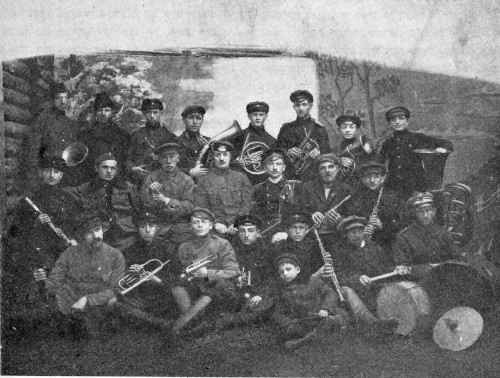
The Orchestra of the Fire Brigade
1. Benzion Harkavi, 2. Aharon Sorvinksi, 3. Aharon Geller, 4. Yitzchak Shabshivitz,5. Leibel Kranovitz, 6. Mulia Kaplan, 7. Osip Shtalmatzok (Christian), 8. Aharon Harkavi, 9. Yaákov Zelzer, 10. Chonye Kasnivitz 11. Bezalel Kaplan (conductor), 12. Meishe Epstein, 13. Azriel Kaplan,
14. Shimon Gorkovitz, 15. Zelig Proshinovsk, 16. Moishe Lebendovsky, 17. Binyamin Goldin |
This material is made available by JewishGen, Inc.
and the Yizkor Book Project for the purpose of
fulfilling our
mission of disseminating information about the Holocaust and
destroyed Jewish communities.
This material may not be copied,
sold or bartered without JewishGen, Inc.'s permission. Rights may be
reserved by the copyright holder.
JewishGen, Inc. makes no representations regarding the accuracy of
the translation. The reader may wish to refer to the original material
for verification.
JewishGen is not responsible for inaccuracies or omissions in the original work and cannot rewrite or edit the text to correct inaccuracies and/or omissions.
Our mission is to produce a translation of the original work and we cannot verify the accuracy of statements or alter facts cited.
 Mir, Belarus
 Yizkor Book Project
 JewishGen Home Page
Yizkor Book Director, Lance Ackerfeld
This web page created by Jason Hallgarten
Copyright © 1999-2026 by JewishGen, Inc.
Updated 12 Jun 2026 by JH