 |
|
[Page 402]
Translated by Rabbi Molly Karp
Based on an earlier translation by Avivit Jacobson and Hagai Frid
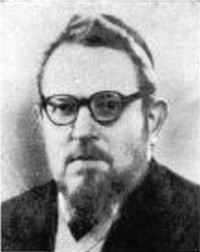
He was born in Lida in the year 5650 (1890), to his father Reb Neta, and to his mother Ethel.
His father was one of the most unique figures in the secular world of the commercial Karivia Street. He was one of the most respected wholesale merchants in the city. He was energetic, honest, and trustworthy, who invested his warm and dynamic temperament in his trade, and together with this his head and was always sunken in other worlds: in his public involvement (he established in the city a society by the name of Mishmeret Cholim[1] to extend aid to sick poor people, and he was the living spirit in it) and especially – in the world of chazzanut[2] and leading the prayers. (He was the regular prayer leader in the Undertakers' Synagogue until his death in the year 1917.) His used to say “ha, were it not for the worry of the livelihood, how many things it would have been possible to do for the city”…
It seems that this quality, the aspiration to see beyond the four cubits of the secular,[3] to the good, the noble and beautiful, Rabbi Yisrael Aharon inherited from his father, together with the gentle way of his gentle-souled mother Ethel.
In a traditional cheder and later in the Beit Midrash in Lida, the young Yisrael Aharon drank from and was quenched by the well of ancient Judaism. Together with that, he clung with all his might stuck to the volumes of new Hebrew literature, which opened new horizons before him. Old and new blended together in him without inner contradiction.
In Lida there was an atmosphere of wellbeing of Chibbat Tzion, and Yisrael Aharon devoted himself with all his soul to action. He gave his hand to the opening of a Hebrew library and over the course of a certain amount of time, until he found a permanent residence for it, he accommodated it in the family's apartment (which wasn't too spacious). This was an illegal act! He founded, together with his friend in action, Reb Chaikel Vishnivsky, the modern Melamed, a group of “Lovers of the Hebrew Theater” and they organized together with him Hebrew balls. And in the main, he was the living spirit of the activity in the Keren Kayemet L'Yisrael. When the Tsarist Russian government forbade this activity and the dissemination of the National Fund was strictly forbidden, the directorate of the KKL stood in the face of a serious problem of how to continue its activity in the cities of Russia. The concentration of the activity in the large cities, as before, was bound up with too much danger, since the police kept a close watch on all the Zionist activists. It was decided, therefore, to choose one of the smaller cities at the intersection of the railway. And the choice was Lida as the center, and Yisrael Aharon Shluvsky as the coordinator of this underground activity. Tens of thousands of boxes arrived in by train, somehow camouflaged, from here they would make their way went to every corner of Russia in which Jews had landed, in mail packages or train transports with the transport documents that displayed false sender addresses. After everything, there was in this more than a little danger, and more than once Yisrael Aharon was forced to leave his house from fear of arrest. Yisrael Aharon Shluvsky's name was well known in the Zionist center in Vilna, and mainly in Kalan, Germany, in the central office of the KKL. In the year 1913, he participated in the Eleventh Zionist Congress.
Only in 1935 did he get to realize the dream of his youth, and he ascended to the land together with his family. The leaders of the Zionists, Alexander Goldstein and Lev Yaffe, remembered his youth with kindness, the merit of his devoted and productive Zionist activity, and by their recommendation a special certificate for aliyah was allocated to him, for him and the members of his family. He merited to continue, here too, the holy work to which he dedicated the best of his years in Lida, this time in the renewed Israel! And there was no end to his happiness and the uplifting of his soul that he felt in this. He wasn't satisfied with the routine of his work, but he did his work in his usual way with holiness, “with all your soul”[4] and merited appreciation and esteem.
The news of the fate of the Jews in Lida appalled him. It seems he was the first one who awoke to the organization of Lida Emigres in Israel, and when the organization was founded, (and even before its founding,) he devoted himself with all his effort together with Rabbi Shlomo Podolski, may his memory be for a blessing, and Yosef Darshan, may his memory be for a blessing, and the rest of the committee (of the Organization of Lida Emigres in Israel) for the aid activity for the exiled and far-flung survivors. He was the first chairman of Organization of Lida Emigres in Israel until his death – 7 Adar 5707 (1947).
Translator's footnotes
by Yosef Yudelevitz
Translated by Rabbi Molly Karp
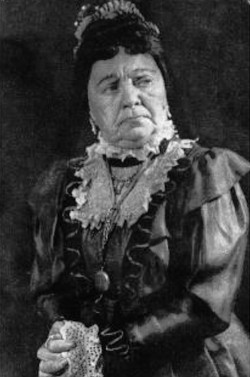
On the eve of the Festival of Sukkot 5728 [1967], one of the first women of the HaBimah Theatre, Temima Yudelevitz, died in the “Meir” hospital in Kfar Saba.
She was from one of the first companies of people of vision in the days of the Soviet Russian revolution who adopted for themselves the idea to establish a theatre in the Hebrew language, and Temima was among them.
Temima (Frumtza), was born in the year 1883 in the city of Lida, Vilna region. She grew up in a house of pious parents, in a conservative area. The education and learning in the cheder and in the yeshiva were for sons only. The girls in their learning reached the reading of Hebrew-German [Yiddish] in Tzeina Ureina[1] and the possibility of copying from the Brivn Shteler,[2] the Agron, letters to her intended, on a day that will be discussed.
But suddenly the sound of a shofar was heard. A strong wind rocked the Pale of Settlement and shook the young generation that was in the town. Rumors and conversations began about one Dr. Herzl, about a state for the Jews, about a city whose name was Basle, about delegates, and the like. Revolution was taking place on the Jewish street, and it struck like a hammer on the heart of every young soul. Temima was among the influenced. With great fervor she became engrossed in
[Page 403]
the daily activities of the branch of the Zionist organization in the city. Her participation in a clubhouse, which was called a “teahouse” for the purpose of disguise regarding the government, was an accepted and kosher institution in the eyes of the government of that time. In it all the activities of the branch were conducted: arrangement of lectures, collection of shekels, fundraising, distribution of literature, and the like.
A few years before the appearance of Zionism there appeared in our city one man, tall and thin, with a small pointed beard, and he was crazy for the Hebrew language. This strange person, a native of the small town of Zhetel, was Temima's uncle, may his memory be for a blessing, and his name was Reb Zalman. He himself was an autodidact, who escaped from the yeshiva in order to learn in secret from his parents [that is, that his parents should not know] the Hebrew language well. He was influenced by the generation of the enlightened of that time, by the writers Avraham Mapu, Peretz Smolenskin, Y.L. Gordon, and Gotlover. He even peeked at the compositions of Moses Mendelsohn. And this man decided to open in our city a kind of new cheder, different, a studio, which until that day no one knew or had heard of. Together with Chumash, Rashi and Gemara they learned with him the language of Ever and grammar, and the history of Israel.
Temima was one of his first students in this “cheder.” She went out of this school full of affection and love for the Hebrew language and the Jewish people.
Temima was also very talented at housework. “Blessed hands” they would say about her, for sewing, for embroidery, for knitting, etc. In the house were nine children and all of them learned, some in the yeshiva, some in the cheder, some in the general school. Father was a dear man and devoted to the family, himself educated in the yeshivot, but was not one of the most successful ones in matters of livelihood. Temima was a kind of “helper corresponding”[3] to Mother in keeping the house and the children loved her very much.
Temima had an inclination and a talent for theatre even from her childhood. She used to hold Performances in primitive conditions in partnership with children her age, in warehouses or in neglected buildings. These were naïve Performances, but the audience would enjoy them. Afterwards she moved to more serious plays. The local public would fill the “auditorium.” The appearance of “HaBimah” in Moscow was for her a natural outlet for her qualities, her concealed aspirations, for acting, for the revitalization of the Hebrew language and the resurrection of the nation in its land.
She left the house, the children, and the area, travelled to Moscow, and entered this troupe of “Blandzaende Shteren.”[4] Her situation, like the situation of the whole group, was very bad. Here is a section of her memories at the time of the beginning of “HaBimah:”
“These were crazy days. The hunger was great. I began to observe my surroundings and I saw how the friends were living under pressure and in distress. I took on myself an additional role, to help with our meagre economy. I prepared all kinds of menus that were possible to make with no necessities, and thanks to Maskin, who was engaged in the government, and sometimes used to bring a sack of potatoes, I would enrich our kitchen. I remember that despite the hunger we were always happy and cheerful. From the little that we had we would arrange celebrations of “banquets” and would even invite guests. I was a kind of “housewife:” also in this I saw a not-insignificant role. I still remember the big oven in the foyer, that all of us used to sit around, warming ourselves and waiting for Vakhtangov.[5] Sometimes the oven was warm, and sometimes cold. And Elias, she who played Chanan in “The Dybbuk,” would start to sing: “Oh Apostle” and all of us would help her. Then we forgot the hunger: “what are we Brodsky, what are we Rothschild?” We were actually the wealthiest and the happiest in the world. There were doubts, there was great suffering, there were very good days and very very bad days, but we overcame everything and brought the theatre to the level that it is in today.”
May Her Memory Be For a Blessing
|
|
| Temima in the Performance of “The Prince” |
Temima saw in the HaBimah theatre the vision of everything. She dedicated her young years to it, her adult years, and also a part of her years of old age. She did not build a family for herself.
Temima embodied in plays the types of Jewish women, the mother, the daughter, the grandmother. She was very natural in her acting. It is possible to say that she presented herself. She would form her heroines from the life of the surroundings, from which she breastfed.
The audience who watched, both in her childhood in the town, who huddled together in warehouses and primitive buildings, and in her adulthood in the magnificent auditoriums in the large cities, would enjoy her Performances the most. The audience would receive her with affection and applause at the time of the presentation, and with many letters after the presentation.
Translator's footnotes
[Page 404]
Translated by Sara Mages
|
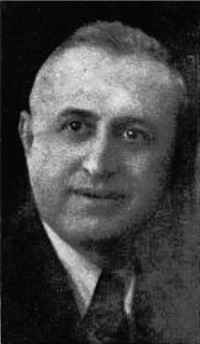
R' Shlomo Podolsky z”l was born in Lida in the year 5668 to his father, R' Nachum, an honest man who made a living from his hard physical work (as a mechanic in Zelig Vilenchik's tobacco factory). He was educated first in chederim[1] and later at the local yeshiva founded by Vaad HaYeshivot[2], under the management of R' Yakov Neiman (now head of “Ohr Yisrael Yeshiva” in Petach Tikva). At the advice of the head of the yeshiva the boy was sent to the central yeshiva, Novardok Yeshiva in Bialystok. Later he studied in Warsaw. In both places he earned a name for himself for his diligence and talents and was liked by his teachers and friends. After completing his service in the Polish army, he wandered again to a place of study - to Mir Yeshiva. Later he moved to Novogrudok [Belarus], this time - to help manage and strengthen the yeshiva that returned to its place of origin, and by then he was already a qualified teacher and was also offered the position of a rabbi in one of the towns. But his desire was Eretz Israel - although he far from the Zionist movement and, for a certain period, he was among its aggressive opponents in the spirit of Agudat Yisrael in Poland. Despite this, he never stopped dreaming of immigrating to Eretz Israel, and when he grew older - he got up one day - and immigrated to the great surprise of the Zionist circles in Lida.
In Israel he immediately found his place in the circles of religious Judaism, first as Reish Metivta (head of a yeshiva) of “Porat Yosef Yeshiva” in Rehovot, and later as director of financial affairs at “Yeshiva Heichal Hatalmud” in Tel-Aviv. He was a man of many qualities, both as a preacher and a man of action and, at the same time, a sensitive man of distinguished character who used his creative talent for educational and public activities. With his organizational skills he greatly helped to the development and the strengthening of “Yeshiva Heichal Hatalmud,” and by the virtue of his personality knew how to influence young and old alike. Under his influence, a wealthy man, who owned a building on Yehuda Halevi Street, volunteered to dedicate his building to the establishment of a religious institution under the management of HaRav R' Shlomo. In this manner “Yeshivat Torat Moshe,” which was intended for immigrating youth, was established. Next to it is a synagogue for worshipers from the surrounding area, an institution that exists to this day. He received every person with kindness and his heart was always open to anyone who needed his help.
With the arrival of the first news about the fate of the Jews of Lida, he was among the first initiators of the Organization of Former Residents of Lida in Israel, and the founders of Kupat Gemilut Hasadim [Interest-Free Loan Fund] to help the few survivors. He took it upon himself to provide help to those in need, by sending packages to the exiles who wandered around the world, and providing first aid to those who arrived in Israel, in the form of loans on favorable terms for their first arrangement.
After the passing of R' Yisrael Aharon z”l, the organization's first chairman, R' Shlomo Podolsky z”l filed this position with devotion and a sense of fulfilling a sacred duty until the day of his passing, on 25 Iyar 5719 (2 June 1959), and he was only fifty-one years old.
Translator's Footnotes
by A. L.
Translated by Sara Mages
|
Yosef Darshan z”l was born in 1899 to his father, R' Shamai, and his mother Reizel Darshan (grandson of the “Maggid of Kelm,” famous in his generation, R' Moshe Yitzchak Darshan). He acquired a good traditional Jewish education from the best teachers in the city (R' Ezra Altshuler among them), and general education in Russian from private teachers. During the years of the German occupation he managed the public library (together with his friend, Yosef Shpilkovski, may HaShem avenge his blood), and found satisfaction in this work which brought him closer to the world of literature that he loved. After the First World War he joined his father in his businesses. In 1933 he immigrated to Eretz Israel together with his parents. He engaged in trade: the import of fruit. Later - the supply of various minerals. From his childhood he excelled in his kindness and his honest character which was also revealed in his commercial talents. He was among the initiators of the Organization of Former Residents of Lida from the day of its establishment. He devoted his heart and soul to helping the former residents of Lida wherever they were. First - by gathering news about them and providing information, sending packages of food and clothes, etc. Then, by extending help in Israel in the form of direct aid, or a loan from Kupat Gemilut Hasadim [Interest-Free Loan Fund], which was a also founded with his active participation. Every person from Lida, who needed help, always found an open door and an open heart. He passed away on 20 Adar 5716 (3 March 1956). His wife, Miriam, may she live long, continues his work in the management of Kupat Gemilut Hasadim for Lida's immigrants. He left behind a son and a daughter.
[Page 405]
by A. L.
Translated by Sara Mages
Shmuel Bernholtz arrived in Lida when he was already middle-aged and in the fullness of his spiritual development. He grew up outside the city of Lida. In his childhood he was a student in a cheder in his hometown, Ostrów Mazowiecka, and later at Slabodka Yeshiva. In his adolescence he studied at Yeshivat HaRav Tchernovitch[1] (Rav Za'ir) in Odessa, (a place where, among others, he took lessons on Hebrew literature from Bialik[2]). Then - years of self-study on the Torah and education. He excelled in quick perception and a wonderful power of memory, and his knowledge from his youth and adolescence, was well preserved in his memory in a harmonious combination with the education he acquired in his adolescence years. He decided to dedicate himself to teaching, and after a short period of working in elementary Hebrew schools, in his place of residence and in Tomaszów Mazowiecki, he was invited to teach at the Hebrew Gymnasium in Bialystok. From there, he moved to the Hebrew seminary in Vilna [Vilnius]. In 1925, he accepted the invitation from Lida to take over the management of the Hebrew gymnasium “Tarbut” which, at that time, was at the beginning of its development.
During his years of activity in Lida, he acquired the right of a full-fledged citizen in the city, not only due to his role as a teacher of Jewish children, but also for his lively activity in the public and cultural life of the city in their various manifestations. He was an excellent speaker with clear articulation, and soon became the main speaker at every national and Zionist cultural event in the city. He was a typical polemicist with a quick and accurate response to the target. In all the numerous debates that took place in those years on the Jewish street, between the Zionists and their opponents, between right-wing and left-wing Zionists, between the Hebrew speakers and the Yiddish speakers, he was the Zionist “cannon” and won respect and even admiration among the members of his camp, from the General Zionists, and also from many of his fellow members, who appreciated his talents and his Zionist zeal. But, he also bought himself quite a few fierce and hostile opponents, because of the sharpness of his language and his blunt and whipping style. His lectures on the Bible and topics from the Hebrew literature always attracted a large audience. He also initiated the publication of the local (weekly) newspaper, Lider Woch, and was its editor during his entire stay in Lida.
|
|
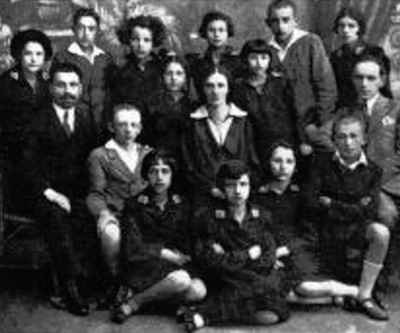
| Shmuel and Edith Bernholtz with the teacher Yeruzalemski in the company of a group of students |
In his role, as the director of the gymnasium, he was helped by his wife, Edith, who was also the official principal of the institution. She was born in Eastern Galicia and studied in Brody, a city that was known for its ancient Jewish tradition, but was influenced, especially in the new times, by both German and Polish culture. As a student of these two cultures since her youth, young Edith acquired a lot of Western culture during her school years at the University of Vienna, especially in the field of literature. The influence of the Zionist circles in Vienna, together with the Jewish tradition from home, turned her into a devoted Zionist. She met her future husband when they worked together at the school in Tomaszów. She continued her pedagogical work together with him also at the seminary in Vilna. With her broad education and her good taste, she greatly helped her husband in raising the level of the Hebrew gymnasium in Lida during its years of its existence. Over the years she made efforts to acquire knowledge also in the Hebrew language, but it was difficult for her. On the other hand, she had a lot of knowledge of Hebrew literature, either from the original, from the translations, or from social contacts in the circles of writers and teachers. In her daily life she was somewhat distant from the society in Lida and many saw this as stiffness, but those close to her knew how to appreciate the delicacy of the soul that was beneath the rigid outer crust. The Bernholtz family raised their two daughters (Ruth, may she live long, lives today in New York, and Aviva who died in 1938 at a young age) in Hebrew, something that was still rare in Lida at that time.
With the cessation of the operation of the Hebrew gymnasium in Lida, and its reduction to the framework of an elementary school, Bernholtz continued for several years in his position as director of the institution (with a short break when Mr. Fishman served as director in his place). Then, he handed over the management to his favorite student, Baruch Sternberg, may HaShem avenge his blood. The World War found the Bernholtz family in Vilna, where they had moved shortly before. and the circumstances of those chaotic days did not bring them to their desired destination - Eretz Israel. After many wanderings through Russia and Japan they arrived in the United States (as he told to the writer of this columns during his visit to Israel in 1953, he was on the Zionist committee in Vilna that dealt with the distribution of certificates for immigration to Israel among the thousands of refugees who gathered at the time in the city that was handed over by the Soviets to Lithuania. He remained at the end of the line and was unable to immigrate). It was difficult to adapt to the new and foreign environment. Nevertheless, Shmuel found a place of action in his field, as superintendent of Jewish schools. In the years 1944 and 1945, he published there in the Jewish quarterly Gendank aun Lebn [“Thought and Life”] monographs about M. L. Lilienblum and Y. L. Peretz, and also a monograph about Bialik in Hebrew and in Yiddish. The “new beginning” was more difficult for Edith, who remained deeply wounded in her soul from her time in Lida when their little daughter, Aviva, passed away. Her health deteriorated since then, and the wanderings around the world completely destroyed her. She passed away in 1947 after a long illness and was buried in New-York.
A few years after his visit in Israel, as mentioned above, together with his second wife, Shmuel's health also weakened. He lost his eyesight in his last years and after a lot of suffering he passed away in 1966. Hundreds of people from the world of Hebrew education, and from the Zionist movement, accompanied him to the cemetery. His student, Leon, may he live a long, (director of The Zionist Organization in the United States) eulogized him and praised his rights as a Hebrew educator and a Zionist activist.
Translator's Footnotes
[Page 406]
by A. Lando
Translated by Rabbi Molly Karp
Based on an earlier translation by Ronald I. Greenberg and Roslyn Sherman Greenberg z”l
The eldest son of Reb Shlomo Yudelevitz (“Shlomo the Yanover”), the brother of the “HaBimah” actress Temima Yudelevitz, may her memory be for a blessing, of Gershon Yudelevitz, may his memory be for a blessing, from Ginegar, and of Yoseph Yudelevitz, may he be distinguished for a long life, from Kfar Saba, Israel.
His father hoped to see him as a Rabbi in Israel, but the son inclined towards the Haskalah, and in particular did research on the lives of the Jews in the days of the Talmud.
In the year 5666 [1906], the “Haskalah Distributing Company” in Peterburg published his book “The Lives of the Jews in Nehardea.” On the advice of Professor Harkavy from Peterburg, he travelled to Berlin to complete his studies in history and archeology. On the heels of the [First] World War, his plans were disrupted, and since he was a Russian subject, he was held in Germany as a prisoner of war. Nevertheless, the opportunity was given to him to spend most of his time in the scientific institutes and libraries and he did not stop his studies even here. After the war, in Warsaw, in instruction in a Hebrew religious school. He returned to the city of his birth, Lida, after he married a daughter of his city, Malkah, of the Lando family. A few years before the outbreak of the Second World War, he ascended to the land of Israel. Here he continued his historical research which continued to be published in the religious periodical “Sinai” and also in the form of books. Among them:
- The City Sura, the Environs of the City, the Economic Life, Manufacturing, the Workers – “Sinai,” 5697, Booklet 2;
- The Pumpedita Yeshiva – Tel Aviv, 5695;
- The City Pumpedita in the Days of the Amoraim – Jerusalem, 5699;
- The City Kasrin[1] – “Sinai,” 5701, Part 8;
- The City Acco in the days of the Tannaim and the Amoraim –“Sinai” 5703, Part 13;
- The City Lod – “Sinai” 5702, Part 11;
- The City Neresh (in Babylonia) in the Time of the Talmud – “Sinai” 5704, Part 14;
- The Days of the Messiah and the King the Messiah – “Sinai” 5703, Part 12;
- Tiberias – Jerusalem, 5710
- Mechuzah -- Jerusalem, 5707
Since he didn't have the means to bring his wife to the Land of Israel, and meanwhile the war broke out, he stayed with my relatives who were also his relatives. Alone and separated from the noisy outside world, he sat and engaged in his research. He didn't come with demands on the world (“This is Torah and this is its reward”)[2] and did not demand much of life, and all his happiness was when the chance was given to him to publish the fruits of his research, which in the final analysis joined a literary-historical undertaking worthy of noting. He died in Tel Aviv in the year 5711 [1950].
Translator's Footnotes
by Avraham Gelman
Translated by Rabbi Molly Karp
Based on an earlier translation by Roslyn Sherman Greenberg z”l
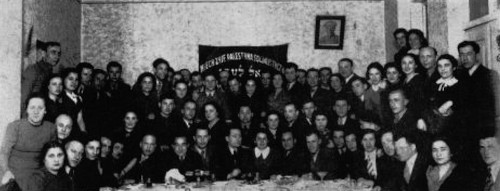
He was born in the year 1909 to his father Zalman and his mother Gerta (of the Podzimski family). His father was a prosperous industrialist, but Abrasha did not incline to commerce. After he completed his studies in the high school of Moshe Devoretzki, may his memory be for a blessing, he devoted himself with all his energy to the political activities, in the party of “Poalei Tzion,” in “HeChalutz,” “Dror,” and also he invested much work in activity for Keren Kayemet and Keren HaYesod,[1] for Kibbutz HaAvodah in Lida, etc. All this, of course, was not in order to receive a prize and without any benefit for himself. With this, he didn't like to stand out and never agreed to open or to manage collection. Members of the center in Warsaw or emissaries from the Land of Israel who visited in Lida, were all deeply impressed by Abrasha's activism.
He reached the land on the eve of the Second World War and entered Kibbutz Tel-Yosef. At the time of the war, when it became known to him that friends and acquaintances from Lida were in exile in Russia in prisons and in camps, he used his influence in institutions, and at his initiative, tens of parcels were sent to addresses that he had, which helped friends in their distress. Thus was Abrasha, the trustworthy, the devoted, who was always ready to help.
A few years ago he moved from the kibbutz to Be'er Sheva. Here he fell sick for the last time. It seems that he knew his condition, but he bore his pains in silence.
On Friday, May 8, 1969, he passed away in Be'er Sheva leaving in mourning his wife, a teacher in the high school, a married son who was an engineer, son of army age, a married daughter, and grandchildren.
On the 8th of June, on the 30th day of after his passing, his friends and dear ones from Lida gathered, together with the members of the family, to unveil the monument on his grave. The friend Eliyahu Damesek eulogized with moving words for the deceased, and raised his devoted public activity in Lida on a banner.
May his memory be blessed!
|
|
| At a Leave-taking Party in Honor of Abrasha Steinberg on the Occasion of His Aliyah to the Land |
Translator's Footnote
|
JewishGen, Inc. makes no representations regarding the accuracy of
the translation. The reader may wish to refer to the original material
for verification.
JewishGen is not responsible for inaccuracies or omissions in the original work and cannot rewrite or edit the text to correct inaccuracies and/or omissions.
Our mission is to produce a translation of the original work and we cannot verify the accuracy of statements or alter facts cited.
 Lida, Belarus
 Yizkor Book Project
 JewishGen Home Page
Copyright © 1999-2026 by JewishGen, Inc.
Updated 11 May 2026 by LA