[Page 220]
On the Way to Zion
and Zion As the Way
[Page 221]
Ascents from Lida
by Abba Lando
Translated by Rabbi Molly Karp
A few hundred families of the olim from Lida dwell with us today in Israel. Waves and waves of these olim arrived in the land in the last decades that preceded the Second World War, and after it. But they arrived little by little also in the years prior to that, a long time before the aliyah, in considerable numbers in the modern era. Now, in our offering of thanks that the lamp of Lida Jewry was not lost, there is a special interest in raising the memory of those same “first forerunners” of aliyah from Lida; we have clear information about them.
Reb Zalman Reli's
The name of his family – Ivanski – (the father of Reb Moshe Ivanski “Moshe Kende's”). In the land he was known by the name “Lider” for the name of the city of his origin. It was he who founded the Lider family in the land. He was the son of Reb Eliyahu Hindes, the scribe and judge in the court of law of the Gaon in Vilna, which, as an example of his greatness, used to pursue the Chassidim to the end. And here, “a deed of Satan” – his son Zalman became a Chassid! The depressed father sat shiva for his son who “went out to bad culture.” Only at the end of his days, when he came to know that his son was a “kosher Jew,” did he reconcile with him. Reb Zalman settled in Lida and was called Reli's by his wife's name “Relia.”
He was an affluent man, and with this he had a warm heart and was outstanding in his generous virtues. According to what is told, he saved many children from the hands of the “kidnappers” (who would kidnap Jewish children and turn them over to the Russian authorities, who raised them to be soldiers in the Russian army – the “Cantonists.”) And suddenly (he was then a widower, for the second time, and with him three small children by his second wife), he decided to make aliyah to the Holy Land. And the motivation? A pure spiritual aspiration, without any material or familial cause. After many troubles, and after a large part of his money was stolen from him by a Romany in Constantinople, he arrived at the shores of the land in about the year 5611 (1851), and when he ascended from the ship he kissed its ground. He brought a son and daughter with him. Another son (and he was Moshe Kende's) remained with the sister-in-law of Reb Zalman. He settled in Tiberias, which was endowed with extreme sanctity by the Chassidim. There his soul found the rest to which it aspired, but the troubles and the wanderings shortened his days, and he passed away a short time after his coming to the land.
From the coming generations of the Lider family, in their time Reb Zalman's son, in the land were known Reb Mordechai, who for a few years was “Supervisor of the Reisin Yeshiva,” and Reb Mordechai's son, Ren Azriel Zelig, a resident of Jerusalem, a “respecter of persons” a merchant with connections with the lands outside of the land, and among the functionaries in the needs of the community, one of the relatives of Y.D. Frumkin. He published a few articles in “Chavatzelet.”
Reb Mordechai, who had his fill of troubles from his youth, from the time he was left orphaned by his father, used to occasionally visit his brother, mentioned above, Reb Moshe Kende's, and brought news of the land of Israel to Lida.
Rabbi Reb Shimon Tzvi Horvitz
The second in our series. The chapter of his life and his activities in the land, are as if taken from within an imaginary story from the days of the first kabbalists from the period of the holy Ar”i.[1] Yet with the strange and the extraordinary that are in this story, there is enough to captivate even the interest of someone of our time, the skeptic and the realist, and to arouse admiration for the wonderful personage of the hero of the story, superlative is his perfect faith, in love of Israel, and in his yearning for the redemption of Israel.
He was born in Lida in the year 5625 (1865).[2] From his childhood he was ignored in his talents and his inclination for mystery. He learned Torah in the cheders of Lida, and when he was 8 years old, he was sent to Vilna, to the yeshiva of Reb Mila (Rameiless Kloiz), where he was diligent in learning Gemara, Poskim and Tanakh, and together with this he drank thirstily, even then, from the wells of Kabbalah.
The days were days of decrees against Israel on one side, and on the other side, the awakening of the idea of the settlement of the land of Israel. While Shimon was the small nine-year-old, an association was founded in Lida by the name of “Olei Raglayim,”[3] which set as its purpose the gathering of a sum of money among its members and to send one of them, chosen by lot, to the land of Israel, to see and to investigate what was being done there, and to submit a report to its members. Information arrived about the founding of the first Hebrew settlements, the announcements of the people of BILU, etc. All these doubtless did not disappear from the young man who was awakened to all that was taking place throughout the world, (a quality that was preserved in him also in the days of his old age). But how to bring the complete redemption near? The young Shimon was certain that the study of Kabbalah was likely to work wonders. When he was 17, in the year 5642 (1882), he went up to the land, and in the yeshiva of the Sephardi kabbalists, “Beit El,” he devoted himself to learning the hidden wisdom, in order to arrive at wholeness, to the necessary step. He conducted an ascetic way of life, fasted every Tuesday and Thursday, held Tikkun Chatzot, and prayed a lot. In the year 5666 [1906] he
[Page 222]
founded in Jerusalem, together with his friend Rabbi Chaim Yehuda Auerbach, the “Sha'ar Shamayim”[4] yeshiva, for the teaching of Kabbalah for Ashkenazi youth. All was for the purpose of bringing the redemption near. Much happened in his childhood, and afterwards he learned in the years of his steadfastness, in Jerusalem, about the “Children of Moshe” and the 10 tribes, who existed somewhere across the river Sambatyon,[5] and who had great courage, outside the boundaries of nature. But a decree was decreed upon them to remain in their place until the end time, and when their time would arrive – to come and redeem their brothers who were in exile. Reb Shimon arrived at a decision – he needed to discover their place, to come to them, and to convince them that it was not possible to suffer any longer, the decree was nullified, and their time had arrived to come and save their people. And who agreed? At the end of the 19th century, there was in Jerusalem a group of businessmen from the faithful of Israel who considered this plan as practical and even founded a society by the name of “Demanding Respect of Torah Scholars” to implement it. After trial and failure, in the year 5658 [1888], the matter was carried out in the year 5660 (1900), and the kabbalist Rabbi Reb Shimon Lider (those near to him called him by this name because of his city of origin) who was already famous in the land and outside of it, went out on this mission to discover the River Sambatyon and the lost tribes who were settled across it.
For the course of two years Reb Shimon passed days and walked for a long time on the roads of India, Afghanistan, Tibet, China, and Burma, sailed on the waves of the Ganges River (which is identified with the Gozan River that is in the Bible). For the need of his research, he concentrated on all the sources in the literature of Israel, the first and the last, and all the rumors that he heard on this topic. He read also in the famous book of geography of the traveler which was called “The Swedish Traveler” which was named for Sven Hedin.[6] However, Reb Shimon did not discover the River Sambatyon this time, but despite this he brought much real news about the tribes of Israel that he found throughout Asia, in China, in India and in Burma, mixed into imaginary stories that he heard about a city by the name of “Nin-Jen-Nen,” where there was a large settlement from Israel numbering millions, and was called by the world “the Red Jews” and the like.
The story of his journey, his research and his encounters he described in the book “An Informing Voice” which was published in Jerusalem in the year 5684, and which also has interest in it for those who do not believe in all that Reb Shimon believed in. At the head of the book, a poem “composed by one of the great writers” (and his style, and his modern rhymes, are absolutely and entirely not rabbinic) about the Bnei Moshe that are across the Sambatyon. Here are a few verses from it:
By a miracle one righteous man
There he was brought and he saw
And by a miracle he returned to us
And he told and we heard
And generation to generation he will tell
And then a father will tell children
There, is a desirable good land[7]
Blooming like the Garden of Eden.
-------------------------------------------
-------------------------------------------
And there are none to come to the land
And there are none to emerge from it
Fears closed in upon it
Sambatyon surrounds it.
And the Sambatyon on Shabbat is described:
Rest for the Sambatyon.
In the pleasure of Shabbat it is silent,
But the waves of tranquility are sailing,
And traveling on it in their innocence.
And no bush will move,
It will not shake the leaf of a tree,
Only Shabbat melodies around
Winged creatures will make a pleasant sound.
In the lap of the Queen Shabbat
Like a baby so delicate
The creature rests
And upon it rests the Shekhina[8].
It is not known who composed this poem. The writer A.R. Malachi, who after the death of Reb Shimon wrote an enthusiastic note about him,[9] and brought in his note a few stanzas of the poem, comments: “I did not see this poem in another place…and if is the fruit of Horovitz's pen, he is revealed in it as a fine poet.” And we will add to that, even if he himself did not write it, in his choosing it to add to his composition, he revealed with it a poetic soul.”
From his dream to discover the 10 tribes, he did not depart, and in the year 1933 (5693) he was among 16 rabbis that signed a long letter to “the honor of our dear completely righteous and pious brothers and to the Holy King that is at their head who from within the river Sambatyon are encamped” and etc., that they should come to redeem “our brothers who are placed in trouble and in captivity to the impure beneath the feet of wicked ones who are called Bolsheviks… and from the hands of the evil one, the offshoot of malice, from the seed of Amalek, may his name be erased, who is called by the name Adolph Hitler and etc.[10]
He was a lover of Israel in the deep meaning of the word. In “Sefer Sanegoria” that he published, (Jerusalem, 5700 [1940]), he offers “The Defense Attorney's Version” that one says before Tikkun Chatzot, in order to bring the redemption near. In the introduction to the book, he brings all the legends about the prophets of Israel who were punished for saying derogatory things about Israel. And indeed “transgressors of Israel are as full of mitzvot as a pomegranate…” With his belonging to a group that distanced itself from the new generation, he did not distance himself and even admired those striving for redemption in ways different from his own (yet parallel to them): his blessing accompanied them, and he always tried to give them his advice. When Herzl came to Jerusalem for an interview with Kaiser Wilhelm,[11] he sent him a letter in which there was advice according to the ways of Kabbalah, so that he would succeed in his mission. According to the members of the family, he even won a reply from Herzl, but in its being passed from hand to hand the letter disappeared and was not found again. General Yosef Avidar[12] tells with enthusiasm about the personality of Rabbi Horvitz, with whom he became friends in the year 5689 [1929] while he was commander of Haganah[13] forces in the Old City[14] at the time of the pogroms of that year. The rabbi also offered him advice on how to defend various corners in the Jewish Quarter, and showed him where hidden passageways were found there.[15]
In the Second World War, when Rommel's troops stood at the gates of Alexandria, Egypt, the elderly rabbi (75) saw with dread the danger that was approaching our land. Should he remain silent? He rented an airplane (Yes!) and accompanied by a number of his students, he flew 7 times around the Holy City, Jerusalem, while blasting a shofar and saying special prayers to repel the terrible enemy.[16]
He succeeded in his life to see the downfall of Hitler, but he did not get to see the revival of Israel. In the chaotic days of the year 5706 [1946], he decided to spend the holiday of Rosh HaShanah in Motza,[17] in the synagogue of his friend Sternberg. When he went out to be alone among the hills, he tripped and was injured in the head. His friend summoned an ambulance and a doctor from the nearby government hospital, but the help was not sent, according to the members of his family – out of bitterness for the aged rabbi, who was known to the men of the British authority as hostile to their regime. On the second day of Rosh HaShanah 5707 [1946], he was gathered to his people. Eulogies were not offered at his funeral, in accordance with his instructions, but many articles of appreciation were written about him in various newspapers in and outside of the land.
[Page 223]
Gershon Horvitz, May His Memory Be for a Blessing
He made aliyah from Lida in 1885, and symbolizes the coming of the new era.
In Lida there were many who adhered to the idea of the love of Zion. We already mentioned above the foundation of the “Pilgrims” society. The names of a few of the movement's activists are known to us from the leaders of the community in Lida: Reb Mordechai Feinstein (who came in the Haskamah of the book of Reb Natan Friedland, one of the greats of the Rabbis in his generation who supported the idea of the settlement of the land of Israel), Reb Shmuel Goldberg, who was one of the most active in the publicity and the gathering of money for this purpose and, apparently, served in his day as the principal representative of Rabbi Kalisher[18] in Russia, Reb Shmuel Tzvi Kaminetzki and the judge Reb Yaakov Kopstein (regular correspondents in the periodical “HaLevanon”), and more and more, and at their head – the new rabbi, Reb Yitzchak Yaakov Reines, who was known for his warm attitude to the idea already in Svencionys.
And meanwhile the first settlements had already been founded in the land of Israel. According to the demand of the administration of Baron Rothschild, it was imposed on those authorized by the council of Chovevei Tzion to choose six capable and industrial youths who would be sent to the land of Israel, and after their receiving basic training in agriculture, they would be able to serve as leaders for the settlements' farmers. Among the six chosen was also Gershom Horvitz, from Lida, born in 1855 (or 30 years old), the son-in-law of Aharon Pfeffermeister (listed below). A pupil of the Talmud Torah, and afterwards a student of the Mir yeshiva. In his leaving the bench of the yeshiva, he learned foreign languages: Russian, German, French. In 1885 he was sent to the land of Israel. During the course of a certain period of time, he worked in the settlement of Zikhron Yaakov. Afterwards he transferred to Rishon L'Tzion, a place where he worked as a gardener. He served as a madrich for Bessarabian olim in Be'er Tuviah. In 1897 he merited to be among the settlers in Rishon L'Tzion on a property of 60 dunam that was allotted to him from the Baron's organization. When the “Carmel Mizrachi” association was founded, he was chosen to serve as director of the central office. According to his sister-in-law, Mrs. Shimoni (the widow of the composer David Shimoni), it was he who brought in the eucalyptus tree.[19] He passed away in Rishon L'Tzion in 1938. He left two daughters, both of them in the land.
Aharon Pfeffermeister, May His Memory Be for a Blessing
He was born in Courland (1837) and after he became an expert in brewing beer, he established a factory in Pospashki, which is next to Lida. He lived in Vilna the whole time, a place where he grew near to the men of Chovevei Tzion. In 1887, after his beer brewery was set on fire by his Gentile competitor and was entirely burned, he moved to Lida, a place which was the dwelling place of his brother Yaakov Pfeffermeister, the founder of the great beer brewery, the first in the city. Here he was among the close friends and visitors at the house of Rabbi Reines. When emissaries from the land of Israel arrived in Russia (and among then Eliezer Ben Yehuda)[20] and Reb Aharon Pfeffermeister met with them and heard about the settlements from them, he decided to realize his aspiration to ascend to the land and become a worker of the soil. Already in 1885, his brother Baruch, the engineer, had ascended to the land (the one who built the great synagogue in Rishon L'Tzion) and his eldest son Shalom. With money that Reb Aharon sent to them, they acquired a thousand of the seven thousand dunam that were purchased adjacent to dunes south-west of Beit Dagan for the settlement of Rishon L'Tzion and began preparations for the family's aliyah. The matter lasted seven years: land preparation, cultivation, planting, building a residence and farm buildings, etc. On 17 Tammuz in the year 5652 (1892) the family went out from Lida on their way to the land: Reb Aharon and his wife Leah of the house of Dudzun from Kovno, and nine of their children. Distinguished people from the city accompanied the departees to the train station with Rabbi Reines, an enthusiastic Lover of Zion and a friend of the family at their head, who from amidst joy at the start of the return to Zion, announced the cancellation of the public fast that took place on that day.
Reb Aharon Pfeffermeister was one of the distinguished members and layers of the foundations of the settlement of Rishon L'Tzion. However, his way in the settlement was not a bed of roses. Since all the investments in his farm were made by himself, with cash, he saw himself as not dependent on the authority of the Baron and did not want to conform to their instructions. His brother Baruch stood for a long time in a protracted struggle with them concerning the marketing of grapes and the like. Reb Aharon was a member of the settlement council for many years, in the role of council treasurer.
His son-in-law, the writer and researcher of the land Yeshayahu Peres, describes his father-in-law's house:
“The house of Pfeffermeister in Rishon L'Tzion was wide open to all who came to it. In the great hall, along the length of the four walls, stood upholstered sofas, which in the daytime served for sitting, and at night for laying down, and on the great balcony the long table was set up. Reb Aharon was good-natured, and beloved by the dwellers of the settlement, in whose administration he participated. However, his wishes to see, at the time of his old age, all his sons and daughters sitting on the ground around him were not realized. His young sons and daughter went outside of the land for the sake of their studies. Only his eldest son Shalom, his eldest daughter Reichel and her husband Gershon Horvitz, the agronomist and the veteran agronomist, and Minna with her husband Shmuel Cohen (who in his time composed the music for the song “HaTikvah”)[21] remained linked to the soil of Rishon L'Tzion.
Their other descendants: Feiga (remained outside of the land, was the wife of the Zionist activist Tzvi Sheinyuk, who was very active in Lida); Shimon, Doctor of Chemistry, Bnei Brak; Miriam (the wife of Yishayahu Peres, mentioned above); Gershon, Tel Aviv; Yehudit, dentist in Tel Aviv; Dr. Yitzchak (died outside of the land); Dov, English teacher in Tzfat; Dina (wife of the composer Dovid Shimoni).
Rabbi Yaakov Yosef Dzimitrovski, May His Memory Be for a Blessing
Born in about the year 5638 [1878] to his father Reb Yitzchak HaLevi Dzimitrovski, may his memory be for a blessing (he was known in Lida by the name Reb Yitzchak the White – Itche the White). After his learning Torah in the city of his birth, Lida, and the yeshiva of Slobodka, until he was about 16, he left for a place of Torah, to Radin. There he was a student and visitor in the home of the Rabbi Reb Yisrael Meir, may his memory be for a blessing, (The Chofetz Chaim)[22] who was a friend of his father, Reb Yitzchak, from youth, and without a doubt he was greatly influenced by his teacher not only in Torah and in virtues but also in love for the Holy Land and yearned for it. (As is known, the Chofetz Chaim was expecting the redemption with simplicity and innocence every day. All his days he studied the laws of the sacrificial offerings so that when the time came, and he would hear the shofar of the Messiah, he would be ready to come and make an offering…). While he was in his father's house in Lida, a pamphlet by Rabbi Tzvi Hirsch Kalisher came into his hand, “The Demand for Zion,” which deals with the problem of the settling of the land of Israel and also with the problem of the renewal of the sacrificial offerings in that time, and apparently left a great impression on him. Without a doubt, the atmosphere of love of Zion, which was widespread in Lida, also influenced him. The Rabbi Reb Yitzchak Yaakov Reines, may his memory be for a blessing, an ardent lover of Zion, already dwelt in Lida in those years,
[Page 224]
on the Rabbinic seat. And when he was 18, the young Yaakov Yosef decided to fulfil the commandment of settling the land of Israel in practice, and set his steps to the land of Israel.
From the time of his coming to Jerusalem, in about the year 5656 [1896], he submerged himself in the tent of Torah. He married the granddaughter of Rabbi Reb Chaim Yaakov Shapira, from Kovno, who was appointed as Rav Av Beit Din in Jerusalem. He was an active member of “Agudat Bnei Torah”[23] whose goal was to disseminate knowledge of the Torah in the settlements. In the year 5668 [1908] he took upon himself, with the encouragement of Rabbi Kook, may his memory be for a blessing, a rabbinical position in the Ekron settlement, which he did for about five years, and according to what is told, he became so endeared to the members of the settlement that for many years after that they would come to him in Jerusalem for guidance and advice from him. He spent one year in the United States, where he was invited to serve in a rabbinic position in Lawrence, Massachusetts, but could not acclimate to the surroundings and returned to Jerusalem. Here he continued in his modest way of life as a teacher of Jewish law in the Nachalat Shiv'a neighborhood.
The great awakening that arose in the camp of Israel after the publication of the Balfour Declaration also swept away with it the Rabbi Reb Yaakov Yosef, who saw the beginning of the redemption in it, and already envisioned in his imagination the renewal of work on the Temple Mount. He saw it therefore as a thing whose time had come, to publish anew Rabbi Kalischer's pamphlet mentioned above*[24] (at his own expense), and further added to it a touch of his own, an article from his own pen (Kuntrus Smichat Z'keinim)[25] and in it was advice for renewal of ordination in Israel and the establishment of the Great Sanhedrin[26] in Jerusalem.
Great in the Torah and with this modest and humble, who does not seek greatness for himself, having generous qualities, and pleasant to all who turned to him, and like his rabbi the Chofetz Chaim, may his memory be for a blessing, every minute he expected the complete redemption. He died at a good old age on 29 Tishre 5726 [1966].
One of his sons, Reb Dovid HaLevi Dzimitrovski, dwells in Kfar Saba, and his second son, Dr. Chaim Zalman Dzimitrovski, serves as a professor at the Schechter Seminar in New York.
*
Lida also made its contribution to the Second Aliyah. Five of them we know. Not all of them came at one time, but all of them went their way safely, out of a clear vision of their purpose, and all of them were among the builders of the new life in the land, each one in their field of knowledge.
The first in this series –
Yosef Yudelevitz
A son of our precious city, who dwells with us in the land, in Kfar Saba, through good days, ascended to the land in the year 1908. He blended within him the influence of his ancestral house (Reb Shlomo the Yanover, a teacher in the Lithuanian style, and friend from youth of Reb Yozel from Novardok, but different from him in his temperament and spirit, easy to communicate with, a social man with a sense of humor),[27] the Hebrew education that he acquired from his uncle, Reb Zalman Yudelevitz, (an enlightened teacher, one of the enlightened Hebrew pioneers in the city), the Zionist spirit that was widespread in Lida under the influence of Rabbi Reines, who admired him, together with – the best of the ideals of the revolutionary movement in Russia of those years. He was active in the Zionist-Socialist party (Territorialists)[28] and was arrested for this activity in Russia in the year 1907. He was imprisoned in the prison for political prisoners in Warsaw and Brisk. After his release from the army in 1908, he returned to his old Zionist version and set his steps for the land of Israel. He went through the whole forging process of a Jewish agricultural worker in the land that clung to the slogan “Conquest of the labor and self-conquest for the labor,” labor with the hoe and the pickaxe, in the orchards, in the wells, and in all hard work. Four years in Rechovot, a year in Petach Tikvah, afterwards a director of work in the orchards of Karkur.[29] In the years of the war – he was in Yesod HaMa'aleh, by an invitation of Kalvariski,[30] as a gardener madrich for a group of German researchers, and was already married and the father of a daughter. After the daughter became ill and died, he was in Zikhron Ya'akov, by order of the agricultural center, as a madrich in the working of the tobacco fields, and afterwards for the conquest of labor in the drying of the Kabara swamps – until 1929. He returned again to the conquest of labor in the building of Bayit V'Gan (today Bat Yam). He reached the inheritance when a plot of land in Kfar Saba was assigned to him, and he planted in it an orchard for himself (planted – meaning actually with his own hands from the first seedling), from which is his livelihood to this day. He also educated his two sons for agriculture, and his daughter for teaching. His wife died in the year 1968. Until today he is active in agricultural groups. He continues to be active in communal life and from time to time wins readers in “Davar” for his responses to various public phenomenon. Power to the living!
[Page 225]
Chaim Krupski (Ariav)
The son of Reb Sholom Arieh Krupski (Sholom Leib the Melamed), one of the modern melamdim, who was “Master of Tanakh” and a grammarian and a devoted Lover of Zion. On the knees of the Hebrew tradition, which was illuminated by the Enlightenment, Chaim was educated until adolescence in the lap of the family, who entire aspiration was – for Zion.[31] He learned Torah in the cheder and the yeshiva and separately from this acquired a general education, in his preparation for the continuation of his studies in the Hebrew gymnasium of Jaffa. While he was still young, he participated in the Zionist activities in Lida, and was a member of the Council of the Zionist Youth. He realized his aspiration in the year 1912, which was the year of his aliyah to the land. He was accepted into the Hebrew gymnasium and was among the graduates of its fourth group of students.
With the outbreak of the World War, he became Ottoman in order to stay in the land. He enlisted in the Turkish army, in which he had an extensive military career: he completed officers' school, served as a teacher in a military school in Damascus, was a translator on the front (thanks to knowledge of languages), afterwards filled important roles on the Caucasian and Persian fronts. Over the course of some time he was arrested in the wake of the discovery of the NILI[32] group, which spied for the benefit of the Allies, but he was released and was returned to roles of responsibility, and with the announcement of the ceasefire a responsible role in the Turkish army was even offered to him. He rejected this honor and returned to the land of Israel.
In 1919 he entered work in the Committee of Delegates, and with the organizing of the Zionist administration in the land was appointed its Secretary. In 1925 he completed a law course. From 1929 he was General Secretary of the Jewish Agency, a role in which he served for about two years. From 1931 he was Secretary of the Farmers' organization. He organized the national Health Fund, was a founding member of the local councils, and one of the founders of the Farmers' Bank. He was a member of the workers' council of the General Zionist Organization, and was elected to the Knesset on the list of this movement. On behalf of his faction, he was a member of the Finance Committee of the Knesset.[33] He died in the year 5717 (1957).
Gitte Krupski (Frumkin)
The sister of Chaim Ariav, may she be set apart for a long life, also belongs to Aliyah B,[34] arrived in the land a year after him, in 1913, and her destination was the Beit Midrash for women teachers. But meanwhile the World War broke out, and she joined the Deganiah Bet[35] group, her dwelling place until this day, for a long time.
Elimelekh Zelikovitz (Abner)
Son of a wealthy leather merchant in Lida, Reb Shmuel “The Tenant” (the Hunter), born in the year 5659 [1899]. He learned in cheders and afterward in the Reines yeshiva. In the year 1913 he made aliyah to the land, together with his friend Yaakov Shiffman, may he be distinguished for a long life, and the two of them turned to the Hebrew gymnasium. Here he learned until the outbreak of the First World War, when he enlisted in the Turkish army. He was sent to a school for officers in Constantinople and was a company commander at the front. With the retreat of the Turkish army he remained in the land and worked as an agricultural laborer in Ruchama. In 1918 he was one of the first volunteers for the Hebrew Battalion. His next stations: Be'er Tuvia (a kibbutz at that time), Ben Shemen, Kvutzat Geva and the children's village next to Afula. The whole time he was active in the Haganah, from 1921 at the head of a council for determining the national guidelines for training and organization. Afterwards, in regular service in the Haganah center, he was Commander of the courses and one of the first activists for national programs. Until 1941 he was Commander of Tel Aviv and afterwards Commander of the southern Galilee. In 1944 he was accepted to the Tel Aviv Municipality as the Director of the Division of Urban Housing.
From the time that Tzahal was founded, his status as a General was permanent, and he was appointed as the first Commander of the Military Regime of the territories that were held. He died on I Adar 23, 5717 [1957].
[Page 226]
Yaakov Shifman (Ben Sira)
Born in Kanev [Ukraine] in the year 5659 [1899] and arrived in Lida, within his family, when he was about 11 years old, when his father, Reb Pinchas Shifman, may his memory be for a blessing, was accepted for a role as teacher of Tanakh, history and Hebrew literature in the yeshiva of Rabbi Reines. He learned in cheders, afterwards in Rabbi Reines' yeshiva, and in parallel, in the Jewish government school in Lida. In the year 1913 he made aliyah to the land together with his friend who was the same age, Elimelekh Zelikovitz, may his memory be for a blessing, and was accepted to the Hebrew gymnasium. In the years of the first World War and after it until 1921 he crossed the pioneer road of an agricultural worker, a police guard in the auxiliary police, a worker in paving roads and the like, in the Shephelah[36] and the lower Galilee, and within this, an intermediate occupation, as Secretary of the “Macabee”[37] center (he organized the first conference on Sukkot of 5680 [1920]). In 1921 he went out to London for studies. There he was granted a degree as engineer, and over the course of an additional year he became an expert in his profession within work at the “Shell” company. In the years 1926-1927 he was an engineer in “Solel Boneh” and in the years 1927-1929 he was a municipal engineer in Jerusalem.
Afterwards he was a municipal engineer in Tel Aviv. He developed extensive activity in the continuously expanding central city, beyond all that its first founders could have envisioned or planned, in paving roads, building bridges, erecting public buildings, and the like. He helped the engineers of the local authorities. He was a member and past President of the Central Council of the Union of Engineers and Architects, and also a member of various public associations for the advancement of higher education (The Hebrew University, the Technion, and others). He published many articles on professional topics. Today, he is an advisor for planning and engineering with a private office.
*
* *
A typical composition of a list of these first olim from Lida (that are known to us) in their diversity: from among the members of the Beit HaMidrash who were expecting the future redemption to come by the hands of heaven, by way of the members of the new Chibbat Tzion movement, and until the students of Achad Ha'am,[38] Herzl, and also Borochov.[39] We dwelt on them at some length by merit of their primacy and by merit of the expression that they gave to the aspirations of many, an aspiration which was still at the beginning of its fermentation, and which needed outside agitation which would hasten the process of turning the aspiration into a decision.
This agitation came with the first World War and in its wake, the Balfour Declaration and all the awakening that came after it. Within “the Zionist population” of the city, groups of youth crystallized whose Zionism they perceived as a new perception, active, as an obligating call. With the liberation of the city from the Soviet conquest, the first, in 1919, tens of youths begin to train themselves for aliyah to the land of Israel. But the paths to aliyah were blocked and permits for aliyah were barely given by the Mandatory government, by means of the land of Israel office of the Zionist Histadrut.[40] Only in the middle of 1920 did a permit arrive in Lida for 7 members of “Tzeirei Tzion”[41] to make aliyah. They had enough time to go out on their way in haste at the time that Red Army troops, in their renewed attacks on the Polish army, were again approaching Lida. About the troubles of this group, our friend Chaim Amitai tells us in Issue Number 8 of the anthology “Collections” from Nisan 5722 [1962] (a publication of the Archive and Museum of the Labor Movement) and from this a few paragraphs from his impressions:
“ - - - at that time seven friends were permitted by the land of Israel office in Warsaw for aliyah, and we went out immediately without delaying. That same time the Poles retreated from the city.
We went out on foot. While for our shabby suitcases we hired a simple farmers' wagon. And so we walked 103 kilometers until we reached Grodno. All the way we were gripped with fear, because from time to time the men of the retreating army would examine us, why and wherefore we “Jewish Communists” were fleeing. When we said to them that we were heading for the land of Israel, they looked at us in complete disbelief. After two days of exhausting walking we reached Grodno.
The situation was one of emergency. Almost no trains were travelling. We came to the railway station, and without our noticing, a few of our suitcases disappeared. We looked for them here and there, but – in vain. One gendarme stood and made fun of the “Jew-boy youths.” I approached and offered him a packet of cigarettes if he would try to find our suitcases. He, without delaying a minute, approached one of the corners, took out our suitcases, and gave them to us. He came for his reward, of course.
An army train stood in the station, heading for Warsaw. We entered the two brake chambers that were close to the roof of the car, and we arranged ourselves on the steps. After half an hour of travelling a soldier appeared on the roof of the car and asked for money, and if not, he would throw us out of the chamber. From an abundance of fear, we gave him a little money. After a short time another soldier appeared and he too asked for money, and if not, our end would be bad and bitter. Here we said to him that if he did not get away, we would throw him from the roof. He did not expect a reaction like this at all, and immediately went away.
The trip to Warsaw lasted nearly two days. We stayed in Warsaw for two weeks and from there we crossed to Lemberg. We spent a few days in this city. From Lemberg we set our faces to Vilna by way of Czechoslovakia. The whole time during our trip we were gripped by fear that the Poles would not let us cross the border. In the second watch of the night[42] we crossed to a Czechoslovakian train. Here we felt an enormous difference. We arrived in Vilna towards morning. We lodged for about two weeks in the “Rousseau Barracks.” The friends were tired and deeply anxious from the fear that accompanied them all the way…
After about two weeks, we sailed from the port of Trieste in a ship,
[Page 227]
“Africa,” in which we reached Port Said. Here we parted from the large ship and transferred to a small boat by the name of “Amaliah,” which transported sugar and rice to the land of Israel. We were 86 pioneers on the boat. When part of us stood on one side of the boat, it began to lean to that side, and the captain ordered us to stand in the middle without leaning to the right or left. Thus we were tossed all night, sick with vomiting, until we reached the port of Jaffa.
The reception by the English harbor police was not overly warm. From the port we transferred straight to the pioneer house that was in Jaffa, and we stayed in it for 7 days. Afterwards we moved to the lower Galilee to work on the Tiberias – Tzemach road. Some of us entered the work battalion named for Josef Trumpeldor,[43] afterwards they were among the first of Tel-Yosef. One went to Deganiah Bet and from there to Ein Harod, and one remained alone in the work on the road.
*
A short time (about two years) after this first group, an additional Lida-ite joined the pioneer camp in Israel, from the “Remote Ones in the Land of the North,” Gershon Yudelevitz, may his memory be for a blessing, whose family, with the nearing of the front to Lida in the days of the First World War, was transferred to Russia. On the Zionist ember that he brought with him from Lida, he also guarded in his double exile the HeChalutz “Volga Guard,”[44] and only when any kind of possibility opened up did he hurry to ascend to the land with members of his group.
Here he was one of the founders of the Ginosar group, and one of its supporting pillars, until the day of his death, which came upon him suddenly – in the year 5726 [1966].
*
The second Soviet conquest, the short one, at the end of 1920, stopped aliyah from Lida for some time. But with the liberation of the city, the activity of the Zionist institutions and the “HeChalutz” organization renewed, and aliyah was renewed. This was at its beginning a real pioneer aliyah, of youths who knew that easy lives were not expected for them in the land, but rather lives of manual labor (and sometimes even what was worse than that – also a lack of work). Most of them also did not bring a profession of any kind with them (the training in “HeChalutz” was more theoretical than professional, and at the most served as a kind of test of the power of the individual's acclimation to the condition of a difficult life.) But most of them became accustomed to the new conditions. However, a few of them dropped out, migrated to other lands or returned to Lida. Very few among those who dropped out were, in that period, middle-aged men, from the middle class, for there was the general opinion that at this stage they would become fit for the land of Israel, or young men with muscles or men of great means with initiative, who would be able to withstand the risk of being uprooted from the old house of their roots and being implanted in new ground.
Nevertheless, there were also a few exceptional individuals. Indeed, no one wondered when at the beginning of the 1920s, the whole family of Mordechai Krupski (Ariav) and his wife Tzarna, their souls are in Eden, veteran Zionists from their youth, and for a long time potential olim, got up and ascended to the land (and relatives of the family were already in the land). More surprising is the news of the aliyah of a Jew like Reb Shimon Zovkovski and his family, veteran merchants of an older age, who were never counted among the active activist Zionists. Rather – a hidden spark was ignited, influenced by the children who ascended to the land, and they decided that they too would ascend. And nothing more than in the manner of classical Zionism, they were made real workers of the soil! Simon's farmer friends heard and enjoyed the stories of his farm that was developed in Kfar Saba and about the cows that he would call, as an affectionate joke, by the names of the daughters of Nikolai the Second: Tatiana, Olga, etc.
And here – Reb Mordechai Kalmanovitz, the supervisor at the “Talmud Torah” who also arose one day and went in the footsteps of his sons, who ascended before him, and together with them founded an agricultural farm in Herzliya (which at that time was still agricultural). A message of regards from this family reached Lida, after some time, by way of the “Lider Vach,” in the form of a poem in Yiddish, the fruit of the pen of the son Eliezer (who holds the pen and the spade at the same time) a new style of “Soche” of Elyakum Tzunzer:[45]
In exile – shopkeeping,
Selling there
All day long;
Wearing himself to the bone,
And making ends meet only by some miracle.
Yet here it is a paradise;
And there are vegetables here,
And chickens and a cow.
He doesn't need a patent,
There are no competitors,
And no Sunday's rest.
The idea of aliyah to the land of Israel stopped being an idea for only individuals, and became the inheritance of many. The groups of youth who were marching in the streets of the city in cohesive rows, who were entering their clubhouses and engaging there in listening to lectures, in discussions and studies that are not included in any school's plan, stopped being seen as children at play. The matters began with childhood scouting that developed into the movements of “HaShomer,” “HaShomer HaTzair,” “HeChalutz,” “HeChalutz HaTzair,” “Beitar,” “HaShomer HaDati,”[46] etc. On what was done in the within the youth movements in Lida, we give permission to speak, below, to the members of the movements themselves, whose paths led them to the land of their aspirations (those of them who were able to tell us the history of their movement, and we are indeed sorry that there is not full material in our hands). And at the time that two youths from Lida went out for training to various places in Poland, tens of youths arrived from the ends of Poland to the training kibbutz that was established in Lida (and also about it will be told below). And if we tarried for a long time about the first olim, the platform will be too short to detail all of them from the time that the stream of aliyah from Lida increased in the 1920s, even more so in the 1930s, when not only youths were swept up in it, but also middle-aged Jews from various strata with families. Departure parties for friends who were making aliyah were frequent, as individuals and in groups, and the train workers already got used to the accompanying groups at the station (sometimes, with singing and dancing), and they knew – the Jews are travelling to Palestine… the aliyah to the land of Israel did not remain the portion of Zionists alone – “Yiddishists” from yesterday also ascended (who for some reason, were mostly counted – not always correctly – in the camp of the Mitnagdim) or prepared to ascend.
In the list of those departing from Lida that is in our hands (and to our sorrow it is not complete), are about 300 names of individuals and families that ascended to the land until the year 1939 and about 120 that broke a path to the land during the years of the horror 1940-1945 and following, “rolling from tunnels,”[47] by way of Lithuania, Rumania etc., from the remote regions of Siberia, where they were sent by the Soviet regime as “dangerous political elements” (and we will remember those who didn't get to return), from the forests of Belorussia, in which they did their part in the wars of the Partisans (and the honor to the graves of the orphaned that remained scattered
[Page 228]
in fields and there are none to remember them to say Kaddish for them. From the refugee camps throughout Europe. And it is hard to conclude this chapter of aliyah without mentioning the many hundreds of youths and elders as one, ascending in strength, not only according to their mood but that they really prepared for aliyah, or remained trapped in the siege. Those who originated from Lida in the land are scattered all across the land, in the city and in the village, on the kibbutz, on the moshav and in the settlement. And it seems to me that we will not err if we say that the Lida education – and maybe we will be more precise if we say – the Lida atmosphere trained them well for life here. They gave their full part in the building of the land and its defense, in agriculture, in the factory, in commerce, in education, and in all the various branches of life.
|
|
|
|
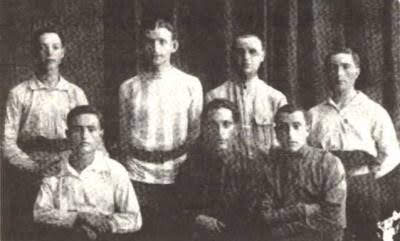
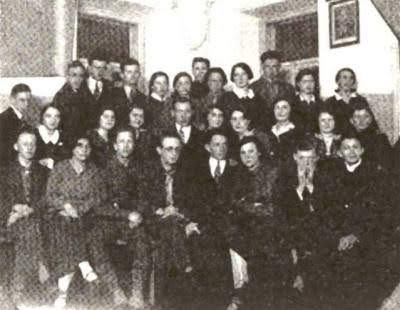
The First Group of Zionists from Lida – ascended
to the land in Av 5680 [July 1920] |
|
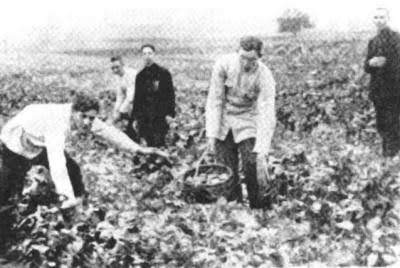
The “HeChalutz” Garden, 1912 |
| |
|
|
|
|
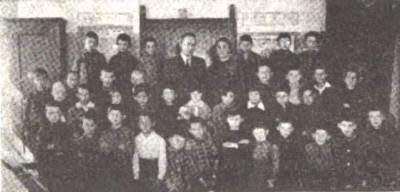
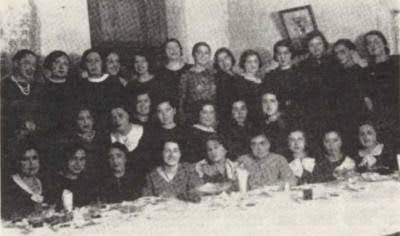
Grade 2 of the Tarbut School at a parting banquet for their friend Shoshana Neman (the daughter of the head of the yeshiva Reb Yaakov Neman),
on the occasion of her aliyah to the land of Israel in the year 1935.
The young olah is in the center with a bouquet of flowers in her hand.
The adults that are standing in the back row: the Director Shmuel Bernholtz and the teacher Breina Efron (Sternberg). |
|
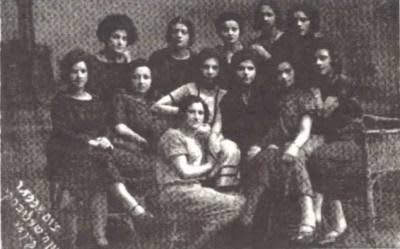
A Group of Friends From the “HeChalutz” Organization
on the Occasion of the Aliyah of Batya Shlovski-Klir (1926) |
| |
|
|
|
|
| “Tzeirei Tzion” |
|
The Young WIZO[48] |
Translator's footnotes:
- The reference is to Rabbi Isaac Ben Solomon Luria, the 16th century Kabbalist, who revolutionized the study of Jewish mysticism and is the father of “Lurianic Kabbalah.” Luria was also known as Isaac Ashkenazi, and was given the title of “Ha'ari,” The Lion, because of the initials of the phrase “Ha'eloki Rabbi Yitzhak” – the divine Rabbi Yitzhak, or, some say, the Ashkenazi Rabbi Yitzchak. Return
- Original footnote 1: The name of his family was Kaminetzki, but for reasons that are understood by those who emerged from Tsarist Russia, he changed his name afterwards to Horvitz, like the name of his wife. Return
- Pilgrims. Return
- Gate of Heaven. Return
- This is a mythical river across which part of the ten tribes were exiled by the Assyrian king, Shalmaneser. According to the myth, the river rested on the Sabbath. In Sanhedrin 65b we read “Turnus Rufus said to him: This is what I mean to say to you: Who is to say that now is Shabbat? Perhaps a different day of the week is Shabbat. Rabbi Akiva said to him: The Sabbatyon River can prove that today is Shabbat, as it is calm only on Shabbat.” Return
- Sven Anders Hedin, 1865 – 1952, was a Swedish geographer, topographer, explorer, photographer, travel writer and illustrator of his own works. Return
- Jeremiah 3:19 Return
- The Shekhina is the Divine Feminine that dwells among us. The earliest reference to Her is in Pirkei Avot, which states that if two people sit together and share words of Torah, the Shekhinah dwells among them. This is an important kabbalistic idea. Return
- Original footnote 2: HaDoar, New York, 10 Shvat 5707 [1947]. Return
- Original footnote 3: A copy of this interesting document was found for us by a son of our city, Mr. Shimon Goldman, a resident of Jerusalem, now in the United States, the son-in-law of Reb Shimon, wo found it among writings of the deceased. It was not known to him to where and in whose hands the letter was sent. Return
- October 28, 1898. Return
- 1906 – 1995, Israeli statesman, Haganah commander, author and ambassador to Argentina and the Soviet Union. Return
- The Haganah was the underground military organization of the Yishuv in Eretz Yisrael from 1920 to 1948. Return
- Of Jerusalem. Return
- Original footnote 4: “Davar,” Erev Rosh HaShanah Edition, 5629 [1868]. Return
- This is reminiscent of Joshua and the Israelites marching around the walls of Jericho seven times, blowing shofarot, to make its walls fall down. Return
- A neighborhood on the western edge of Jerusalem. It is located in the Judaean Mountains, 600 meters above sea level. Motza was the first Jewish farm founded (in 1854) outside the walls of the Old City of Jerusalem in the modern era. Return
- Original footnote 5: Dr. Yisrael Klausner – Chibbat Tzion in Lithuania, Book of Lithuanian Jewry, pp. 490-491. Return
- Original footnote 6: Maybe the meaning is the bringing of the tree to Rishon L'Tzion, which, as is known to us, the Mikve Yisrael school of agriculture claims the privilege of being the first ones on this topic. Return
- 1858 – 1922, a Hebrew writer and lexicographer, considered the father of modern Hebrew, and was one of the first active Zionist leaders. Return
- The Israeli national anthem. Naphtali Herz Imber, a poet from Galicia, wrote its lyrics in 1886. Samuel Cohen wrote the melody, based on a musical theme from Bedrich Smetana's “Moldau.” Return
- See page 62. Return
- The Sons of Torah Association Return
- Original footnote: The Book of Seeking Zion for the Society of the Settlement of the Land of Israel, by the Gaon Our Teacher the Rabbi Tzvi Hirsch Kalisher. The publisher Yaakov Yosef Our Teacher the Rabbi Yitzchak HaLevi Dzimitrovski, Jerusalem, 5679 [1919]. Return
- The Booklet of Ordination of Elders. Return
- The Great Sanhedrin was the supreme court in the Land of Israel in the early rabbinic era. The earliest record of a Sanhedrin is found in the writings of Josephus, who says that a Sanhedrin was convened in 57 BCE. Return
- See page 104. Return
- Territorialism advocated for the formation of a self-ruled Jewish collective in Palestine, or anywhere else. This view came together in the debate over the Uganda Program. In July 1905, after the Zionist Congress rejected this idea, led by the writer Israel Zangwill, the Territorialist Jewish Organization was established in Basle. The Balfour Declaration and the resulting Zionist awakening led to the movement's dissolution in 1925. Return
- Pardes-Chana Karkur. Return
- Chaim Margalit-Kalvariski, 1868-1947, an agronomist who purchased tracts in the Galilee and served as an administrator for the Jewish Colonization Association. Return
- Original footnote 7: And indeed all the members of the family (except for the parents, who died in Lida in the days of the First World War), ascended to the land of Israel: the daughter Gitte (Frumkin), may she be set apart for a long life, in 1913, the young son Dov, may his memory be for a blessing, in 1920, and the eldest son Mordechai with his family in 1925. Return
- NILI was a secret Jewish pro-British spy ring that operated under Turkish rule in Palestine during World War I, led by the agronomist Aaron Aaronsohn. NILI is an acronym for the Hebrew phrase “Netzach Yisrael Lo Yeshaker,” meaning “the Eternal One of Israel will not lie,” which was its password, from a verse in Samuel I 15:29. Return
- The Israeli Parliament. Return
- The Second Aliyah. Return
- Degania Alef and Degania Bet are on the Jordan-Yarmuk Plain south of Lake Kinneret. Degania Alef was founded in 1909. After World War I, the settlers ceded part of the land allocated to them for the establishment of another group, Degania Bet. Return
- The Judean foothills. Return
- The fourth Zionist Congress at Basle, in 1903, laid the basis of the future Maccabi organization. It emphasized physical development in service of the Jewish nation, and in 1921 it developed into the World Maccabi Union. At the same time, Maccabi was developing as an organization in the land of Israel, and in 1912, the Maccabi federation in the land of Israel was formed. Maccabi became the central sporting element in the country. Return
- 1856 – 1927. Achad Ha'am was the pen name of Asher Hirsch Ginsberg, one of the central literary figures of Cultural Zionism. Return
- 1881-1917. In 1901, his interests in Jewish problems led him to establish the Zionist Socialist Workers Union in Russia. Return
- The General Organization of Workers in Israel, HaHistadrut HaKlalit shel HaOvdim B'Eretz Yisrael. Return
- Youth of Zion. Return
- About 9:00 PM to 12:00 AM. The Hebrew Bible divides the night into four watches, or blocks of time. Return
- 1880–1920. Socialist Zionist leader and war hero, born in Russia. In October 1919 Trumpeldor agreed to lead Jewish forces defending the Upper Galilee from Arab attacks. On 1 March 1920, he was killed defending Tel Ḥai, Kefar Gil'adi, and Metullah; his last words were said to be “…it is good to die for our country.” Return
- One of the most famous “Hechalutz” groups that arrived in the land of Israel during the third Aliyah. It began in the city of Saratov in 1918. Its members were trained in agriculture, construction and labor, and lived collectively in Russia for about three years. They were among the first “Hechalutz” and the ones who formulated its goals, and were exemplary in their way of life and organization for many of the “Hechalutz” members in Russia. Return
- Elyakum Tzunzer (Elyakum Joker), 1840 – 1913) was a Lithuanian Jewish Yiddish poet, songwriter, and comedian who lived out the last part of his life in the U.S. A 1905 article in The New York Times called him “the father of Yiddish poetry” Return
- “The Guard,” “The Young Guard,” “The Pioneer,” “The Young Pioneer,” Brit Trumpeldor,” “The Religious Guard.” Return
- This is a reference to an idea about resurrection found in the Talmud: “Will the righteous outside of the land of Israel not come alive at the time of the resurrection of the dead? Rabbi Ile'a said: They will be resurrected by means of rolling, i.e., they will roll until they reach the land of Israel, where they will be brought back to life. Rabbi Abba Salla Rava strongly objects to this: Rolling is an ordeal that entails suffering for the righteous. Abaye said: Tunnels are prepared for them in the ground, through which they pass to Eretz Yisrael.” Babylonian Talmud, Ketubot 111a Return
- Women's International Zionist Organization. Return
This material is made available by JewishGen, Inc.
and the Yizkor Book Project for the purpose of
fulfilling our
mission of disseminating information about the Holocaust and
destroyed Jewish communities.
This material may not be copied,
sold or bartered without JewishGen, Inc.'s permission. Rights may be
reserved by the copyright holder.
JewishGen, Inc. makes no representations regarding the accuracy of
the translation. The reader may wish to refer to the original material
for verification.
JewishGen is not responsible for inaccuracies or omissions in the original work and cannot rewrite or edit the text to correct inaccuracies and/or omissions.
Our mission is to produce a translation of the original work and we cannot verify the accuracy of statements or alter facts cited.
 Lida, Belarus
 Yizkor Book Project
 JewishGen Home Page
Yizkor Book Director, Lance Ackerfeld
This web page created by Jason Hallgarten
Copyright © 1999-2026 by JewishGen, Inc.
Updated 15 Nov 2026 by JH