 |
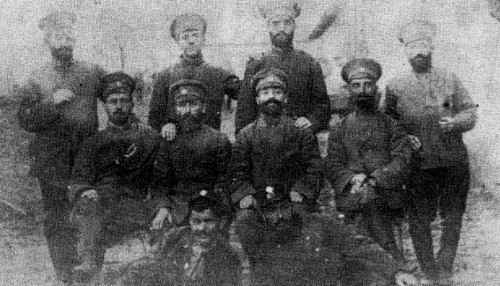
Among those standing from the left side, Shmuel Rutsky. Among those sitting, second from the left Boruch Slonimsky
|
|
[Page 83]
by Abraham Gelman
In memory of my mother and sister, Esther and Rivke, who perished in the Holocaust
Translated by Roslyn Sherman Greenberg
Lida was an industrial city with various sizes of factories and enterprises. The big rubber factory “Erdl” [Ardal] was famous in all of Poland. It was established in 1928 thanks to the initiative of the Kushelewitz brothers, chemical engineers. Partners were first the Kushelewitz family, the owners of the ironworks ”Benland” (Brothers Steinberg and Wilentchik) and the owners of “Drutindustry” (Chertak and Savitsky). After putting in a lot of money, the Polish financier Melup entered the business. A couple of years later the business expanded so much that before the outbreak of WWII around a thousand people were employed working three shifts. The head engineer Forman, a son-in-law of Mordecai Wilentchik, owner of a tobacco factory, was also a partner in the “Erdl” rubber factory. The engineers Gurwitz and Kushelewitz were also employed. Later the engineer Kushelewitz left the “Erdl” factory and started a small rubber factory of technical rubber products under the name of “Unigum”. The factory succeeded with time and employed ten or so people.
There was also in Lida a chemical factory, “Corona”, which made various inks, paints and dyes. The owners were S. Kotak and Pupko, a son of the shipping agent, Pupko. Simcha Kotak, a Socialist and Zionist worker, leader of the Judenrat, came to a tragic end because of the Nazi murderers.
A nail factory “Drutindustry” (owners Brothers Chertak and Savitsky, (today in Israel) also employed about ten workers.
Two ironworks, one owned by the brothers Shapiro, and the second under the firm “Benland” made various agricultural machines.
There were also two oil factories, one for olive oil, and the other poppy seed oil. During the season when the raw material was available, there were two shifts of workers. The partners were the brothers Poliatchek, the owners of the automatic mill under the firm name “Automat”.
There were two beer breweries that were famous in all Poland. One was owned by Elimelech Pupko, and the second was owned by Papiermeister. They transported beer in kegs and in bottles throughout Poland. There was also a division of the Vilna beer brewery “Shafen” under the management of Taub. There was also a division of a Warsaw beer brewery “Haverbush and Shileh”, under the management of Wallman and Rosenstein. Five sawmills made various wood products for carpenters. The proprietors were Gorowitz, Kranik, Poliatchek, Rafaelowitz, Papiermeister and Melnick. Each sawmill employed in season twenty to twenty-five workers. Most of the workers were Christians, and there were a number of Jews.
Five mills ground flour and various grains. The proprietors were the brothers Poliatchek and Trotsky, Wilensky, Melnick, Pupko and Sidorowitz. There were two windmills behind the city.
Two printing houses carried out various activities and published a weekly newspaper. The owners were Zeldowitz and Kaplansky. The head workers were Margolis and A. Demshek. Both printing houses had enough business from the county and city administrations, the movie house, and private undertakings. For some years there was a weekly newspaper called “Lida Life” under the editorship of Joseph Albert, who also wrote several books: “Proletariat Bandages”, “Toilers”, etc. Helping to distribute the books was the enterprise “Literary Pages” in Warsaw. The owners of the wool products and woolens factory were Levin and Chichemsky.
There were also home enterprises such as G. Feinstein and Isser Leib Levin, and various workshops.
In the area of restaurants and coffeehouses, Lida was also not lacking. “Bristol”, and “Americanka”, where the main patrons were the officers of the 77th Footsoldiers, and the 5th Fliers, were owned by Savitsky and Rodenitsky. There were confectionaries and other smaller sweet shops and restaurants, as well as delicatessens and wine businesses of the brothers Winogradov, Levinson, etc. There were big businesses of home materials, like those of Shimshon Pupko and Pinchas Rabinowitz, etc.
Hotels: “Grand Hotel”, owner Benjamin Landau, “Europesky”, owner Glauberman, where all the Zionist leaders stayed: Jabotinsky, Berl Locker, Boruch Zuckerman, Maier Yerry, etc. Other hotels were “Dagmara”, “Italia”, “Paris”, etc.
Four movie houses: “Nirvana”, “Edison”, “Malenke” and “Agniska” (the first three in Jewish hands).
Three apothecaries: “Stara Pharmacy”, owner Bergman – Burgomeister of the city, later the pharmacy bought out Levinson and Zelikowitz (a brother of Aloof Abner, died in Israel), the brothers Zuckerman and “Simikova Pharmacy (not Jewish).
Several pharmaceutical warehouses: Owners Sidorowitz, Nachumovsky, Shiff, and Baran.
Several gold businesses, watchmakers, jewelers. There were also big manufacturing businesses, shoe businesses: big wholesale warehouses for spices, fancy goods, writing materials, like Berl Dworetsky, Slutsky and others. Big ironworks, like G. Chertak, Steinberg, etc.
In Lida, the city combined with all the small shtetls around it, in the last years before the war, to form a bus route. The first line was Stutchin – Lida. Later Belitsa – Lida; Lida – Novogroduk; Grodno – Skidel – Lida; Baranowitz – Novogroduk – Lida; Lida – Vilna; Radun – Eisheshuk – Lida; Ivye – Lipnishuk – Lida; Vasilishuk – Lida. Lida almost became combined with all the nearby cities and shtetls. At the beginning there were losses, but later all the bus lines united in one cooperative, which soon succeeded, and they bought new big busses.
|
|
Among those standing from the left side, Shmuel Rutsky. Among those sitting, second from the left Boruch Slonimsky |
by Yaffa Gintzburg (Boyarsky)
Translated by Rabbi Molly Karp
|
With the outbreak of the First World War, the eve of the German invasion of Lida and its surroundings, my father bought two horses and a large wagon, in order to be prepared for escape in the hour of need. Even though the Russians were anti-semitic, father preferred them to the “Amalekites”[1] – as he used to call the Germans. My uncle also bought a horse and wagon, and the two families decided to go out on the road together – in the wake of the retreating Russian army - towards central Russia.
From day to day, the danger grew and approached in giant steps. And on one clear day, when the Russian army was retreating towards Minsk and filled the streets of Lida, they seated us on the heavily laden wagons and we went out on the road. We tried not to get too far from the Russian army convoy and even if they cursed and swore at us, they did not abuse us nor steal anything from us. Finally we arrived in the town of Shliov. It was erev[2] Shabbat and we decided to camp there and continue after Shabbat. We realized that the army lines were dwindling, which meant we would have the opportunity to be able to advance more easily.
We found a comfortable place in a hostel with room for both us and the horses and wagons. The night passed peacefully for us and Mother tried to persuade Father to stay in the town until the anger passed, but Father insisted: “I will not remain among the 'Amalekites' (the Germans).
On Shabbat in the morning the men went to synagogue and we, the girls, stayed with the mothers in the hostel. All of a sudden, a rain of missiles poured out on the town. And until we got to see the members of the family who were returning from synagogue in mortal danger, the fire had already taken hold of all ends of the town.
In a frenzy we went out on the road, and at a distance of three kilometers we encountered the German army that was advancing towards the town. We were interrogated by the officers and the possibility was given to us to continue our way. We had only gone part of the way when we encountered by two German riders. They began to rummage in our wagons, ordered the children to get down, and with swords, poked and prodded everything that was laying in the wagons. Finally they discovered the little barley that was kept for the horses. We pleaded with them not to steal the remaining that was intended for our horses, for otherwise we would not be able to continue on our way. But all our pleas were in vain. They ordered us to lower the sack and hand it over to them.
Suddenly I turned to my mother who stood next to me and said in Yiddish: “They are worse than the Russians.”
One of the Germans who understood my words, became filled with rage and fury. He took out his gun and pointed it at me. My mother burst out in screaming and crying, hid me behind her back and pushed me under the wagon, next to the horses' feet. At that moment the second soldier grabbed the first soldier's hand and lowered it together with the gun. The gun owner screamed and became angry and the two of them continued on their way, and left us to ourselves.
My father was struck with shock from so much fear, and lost the ability to speak. My mother was the first to recover and began to calm my father. I came out from under the wagon and apologized that I only spoke the truth. But my mother scolded me and instructed me not to voice my truth among others.
When we returned home to Lida, we found Grandfather at home healthy and whole, while the second house in the yard was occupied by German soldiers. A middle-aged German officer moved into our house as well.
My father became ill, he got an ulcer, and the source of his income dwindled, but the German officer who lived in our house would occasionally provide us with a little flour and white sugar. At the end of the matter, when they transferred him to another place, he turned to the city's German officer, who was his good friend, and reported to him that if he wanted to live in a neat and organized home, he would confiscate our house for him. To our great amazement, we suddenly received an order to leave the house and hand it over to the city officer. After persuading and beseeching, the city officer agreed to confiscate for us any other home that we would point out to him. But it did not occur to us to seek to take someone out of their house so that we could enter it. We decided therefore not to move or vacate our home. But our stubbornness was of no use. The city officer sent a number of soldiers and ordered them to remove all the belongings from the house and empty it.
With no choice, we concentrated all the furniture and belongings in the basement of the house and spent every night in it.
On the next day, a small house in the yard adjacent to our yard was made available to us. That house was in the hands of an elderly couple and the Germans transferred them to a better residence. We didn't want to go far from our home and yard so that we could keep an eye on our property.
One day my mother decided to approach the nearby town of Zheludok–where we had good friends–in order to obtain a little flour. She walked there on foot and her friends obtained for her 16 kg of flour. With the sack on her back she made her way back to Lida. On the way she encountered policemen who took the flour from her. Broken and tired, she returned home and fell ill for a number of weeks.
In general the Germans tried to humiliate the Jews. When the officer would pass on the street, the Jews were forced to step off the sidewalk, make way for him, take off their hat and bless him. The men were taken for forced labor. Everything they needed, they took without payment. This means that already in the First World War, the seed was planted and the seedling began to grow which would yield its poisoned fruit during the Second World War.
Footnotes:
[Page 86]
by Moshe Ganuzowitsch, of blessed memory
Translated by Phillip Frey
(Reprinted from “Lida Life”, a weekly for Lida and surrounding area, Lida, September 25, 1936)
As if he were alive he appears before me, not withstanding that I only saw him for a minute and since then twenty two years have passed.
It took place in East-Prussia, at the start of the first World-War. We, a company of Russian soldiers, were employed in the forest, preparing a position for our artillery. Our commander, a youngster from Gruzin, very energetic but harsh and reckless to the point of brutality, gives out commands, suddenly there appears a soldier from another company, leading a person in civilian clothing. I look him over: young, about 30 years old, he moves like a robot, his eyes appear to see nothing. His sadness-filled and wearied pallid face expresses nothing, neither joy , sadness, fear or frustration, not more than his body shivers lightly due to the cold autumn drizzle and his whole demeanor asks wordlessly a warm room and a glass of coffee. His accompanier, the soldier, leads him to the commander and hands over a note. Our commander reads and a smile appears on his lips. At first I understood nothing. Soon it became clear to me. Our commander places the stranger under watch and he sends one soldier for a rope. A shiver passed through my flesh: Our commander had been designated as hangman and this is the victim!
In fifteen minutes the stranger was no longer living.
Who was this? What was his transgression? Who knows? And what is the difference?
We are riding, more correctly, we are being driven packed like herring in a truck as prisoners-of-war. My friend, a happy lad, speaks to me and loudly fantasizes. Now we'll get a good rest after the difficult experiences at the front! What do you think? They'll give us a room for two or three prisoners. Clean, bright and warm it will be-- we are traveling to a cultured land?--- True, bread is probably in short supply in Germany. I figure, that we won't receive more than a pound or pound-and-a-half daily, but milk, butter, cheese—there's no lack of these. And what more do you need? A clean room, a bed, food, tea whenever you want it. You can read, write, sightsee and if you have money, you can ask permission and visit Berlin…and the war will certainly not go on very long!
Four, five months later, I and my friend are in the camp, fenced-in with electrified barbed wire, in one board dog-house, together with a hundred more on one common straw-bed. My friend newly out of the hospital, having struggled for long weeks with death, with the awful typhus disease. More than fifty die each day. He remained alive. A miracle! He is now privileged, my friend,: he receives a bigger portion of food, dried “vegetables” or hard beets with water, in order to “sustain” himself. Yes my friend is “rescued”. Unfortunately there is something not completely in order with my friend. He mixes up or forgets the words for various subjects. Reads with difficulty, has forgotten how to write. Waking him doesn't help, encouragement, it keeps getting worse. Until a horrible attack of insanity. He is lead away from us. Later I become aware: my friend has been freed…by a neutral country, sent back to father and mother…
One of my friend's imaginings did come to pass: for him the war had indeed ended- even earlier…
|
|
JewishGen, Inc. makes no representations regarding the accuracy of
the translation. The reader may wish to refer to the original material
for verification.
JewishGen is not responsible for inaccuracies or omissions in the original work and cannot rewrite or edit the text to correct inaccuracies and/or omissions.
Our mission is to produce a translation of the original work and we cannot verify the accuracy of statements or alter facts cited.
 Lida, Belarus
 Yizkor Book Project
 JewishGen Home Page
Copyright © 1999-2026 by JewishGen, Inc.
Updated 17 Apr 2026 by LA