 |
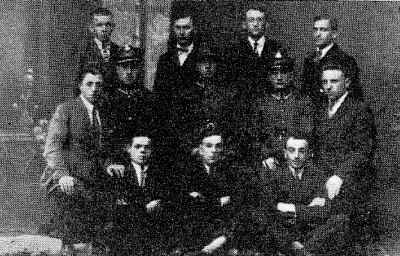
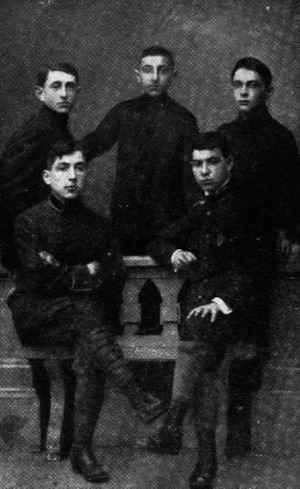
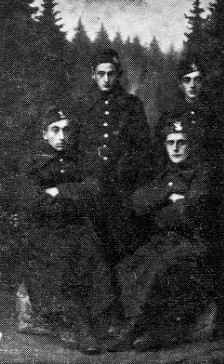
A group of young men from Koło in the Polish military
Seated (from right to left): Y. Pshedetsky, A. Markovitch
Standing: Trayber, Brukshteyn
|
[Page 337]
[Page 338]
(As been told by the elder Reb Avraham Gliksman)
Translated by Mira Eckhaus
I am about eighty years old today. I have attained an age that my ancestors did not know. My memories of the distant past are diminishing and fading, but one thing has not yet been forgotten by me and I remember it as if it were recent - and that is the great plague, called cholera, which raged in Europe in 1892 and also spread to Koło. The plague claimed many lives and there was hardly a house without a dead person. Many people, who were healthy and good-looking, and were even considered heroes, perished in a short period. The words of Job were fulfilled upon us: “Man is like a flower; he has just emerged into the world and is already being plucked”. (chapter 14, verse 2). Every day we buried 3-4 people, and sometimes even more. And there was great anxiety among the living. Who is in line? Who will pass away in the coming days?
Because of the plague, the city was almost closed: it was difficult to leave it and difficult to enter it. We did not know whether this great plague came to us from another city, or originated with us. According to the rumors I heard at the time, it came from far away - from India. And the doctors were at a loss, since no proven cure had yet been found.
What has not been done to stop the terrible plague?
The seven best people of the city were very active; they decided to hold a wedding for the children of the poor, in the grounds of the city cemetery. Perhaps thanks to the poor, the plague would be stopped! Righteous women went from house to house and collected donations and a dowry: clothes, bedding, furniture, household items - gifts for the young couple, who would pray for the city…
Short time after, the Shamash went out into the Jewish streets and proclaimed in a loud voice: Come, Jews, to the “purification room” in the cemetery, come to make the bride and groom happy, come to dine at the feast of the children of the poor held near the graves of the dead!
Everyone who wanted to live, young and old, flocked to the cemetery at the appointed time. No one was absent. Perhaps by this we will arouse the mercy of Heaven, and we will remain among the living. This time the musicians did not ask for any fee in exchange for their playing. In the cemetery, where weeping and wailing is heard all day long, this time the sounds of stringed instruments rang out. The respectable women sat together with the orphaned bride and the rabbi and the seven best men of the city, sat with the groom, who was orphan of both father and mother. The doors of the “purification room” were wide open and the entire audience witnessed the joy and cried: Come out! We too want rejoice in your joy! Don't keep them to yourself!
The musicians played and the community leaders, homeowners, and craftsmen danced the mitzvah dance with the beggars and the rabbles, and within the circle were the bride and groom. After the dances – there was the feast.
[Page 339]
As the wave of illness grew and spread, almost all work in the city came to a halt. The common people rushed to the Beit Midrash, opened the Holy Ark, and read chapters of the Psalms in a heart-breaking voice. Throughout the day, the reading of the Psalms by a minyan did not stop - one ended and another began.
Most of the day the bells of the Catholic and Evangelical churches in the city rang. The Poles and Germans also suffered many losses. Death did not spare them either. That is why they did not accuse us of being to blame for the terrible disaster.
The way of life in the city changed, as if we were in a quarantine or in a severe war. The news of the number of dead determined the mood. Morning after morning, when people met in the streets, they greeted each other with the blessing “Baruch mechaye metim!” (Blessed are You, Lord our God, King of the universe, who revives the dead), or asked: How are your family members? How is the vomiting? How are the intestines? What is the color of their skin? How is their strength? The last questions contained the symptoms of the disease.
The people of action did not rely solely on prayers and arranged an additional hospital to the existing one, a temporary hospital in the large theater hall and in the service rooms, the gallery and the offices.
When the city's best people were informed of someone who arrived exhausted, or of someone whose stool showed signs of blood and pus, they ordered to immediately transfer them to the theater hall. Volunteer medics stripped off his clothes, which were condemned to be burned, and the infected person was smeared with alcohol and his body was rubbed with brushes. The rubbing was the only cure. In addition, they gave the patient sour milk to drink, and the more they drank, the greater were their chances of staying alive.
Everyone saw themselves as being on the brink of an abyss. Superstitions spread among the ignorant, who began to seek advice from “idolatrous doctors” and even looked for a “scapegoat” – a victim they can hang on to.
And so, they harassed the Chazan, who came from a distant Russian city, and they spread a lie about him: he was the one who brought the plague. The rumor spread like wildfire, reaching everywhere. Who fabricated it? I can't remember. It is possible that the ignorant ones found a connection between his arrival from afar and the plague, which also came from afar. It is also possible that this plot came from a group of “musicians” who found no point in his playing during this period…
And here a new “reasoning” was found: Reb Moshe Sorek, a respected Jew in the city, claimed that because during his prayer, the Bechora prayer, the chandeliers were not lit in the synagogue (a fight had broken out between the two sides, each of whom proposed a different candidate for the position of Chazan), the sanctity of the place was thereby desecrated, and hence arrived the plague…
The plague claimed many victims. The gravediggers and the men of the Chevra Kadisha were exhausted. Commerce in the city came to a complete halt and the only concern was: Where will we flee? Is there a place in the country where the plague has not yet reached? People were gathering and consulting, making plans, but everything was worthless.
The city authorities, shocked by the situation, alerted the higher institutions.
[Page 340]
And here, new instructions were received from Petersburg and Warsaw about means to fight this plague. A sick person should not be left in a private apartment! The police went from house to house, conducting searches and “smelling” where the smell of alcohol was coming from… As soon as they found a person lying down, they ordered them to vacate the apartment. They put a wax seal on the door and the household members were forced to look for another place to live. After each death of a person, a disinfection was carried out: some of the belongings, clothes, and bed linen were condemned to burning, and some were immersed in boiling water.
Another means to fight the plague was the prohibition of drinking the polluted river water, and this prohibition also applied to water from the pumps. Only boiled water was allowed, and the water heater did not come off the table all day long, and the fire on the stove did not go out for a whole day.
When the epidemic also affected the little children studying in the “cheder”, another order came: to close the “cheders” and the schools. The children ran around the streets doing nothing. They spread rumors and suffered from idleness.
By the end of the year, the plague had died down. But who can count the number of dead?
By P. Friedland
Translated by Janie Respitz
“Homeward! Homeward!” were the only words of the Koło youth who were posted in the large cities of Poland when the First World War broke out. They grabbed their suitcases and made their way home to their parents. The will to be with those closest to them in these critical years was stronger than all other desires. It dominated. Everyone knew, that the metropolis promised more business interests and opened many doors, however… in such times other powers directed them.
The war will last long! – This was the premonition, although the German generals promised in advance that after six weeks the French will break and the Russians will soften. The resolution is far away, and who knows, if the weak Jewish houses will withstand these great events!
It was not easy to readjust to the small town. There was a difference between those who had dreamed of far away places and starting a new life and those who had already tasted it.
When the sounds of shrapnel filled the air people readjusted quickly, once again becoming provincial. Experience in the big cities helped them organize supplies for the days when bread and security were the only desires: How do we survive the war?!
A few days after we returned to Koło the front drew closer to our city. Military were streaming from the border lines. During the day it was dead silent. Everyone, without paying attention, planned and prepared, looked for direction. However, at night, the walls shook and the streets trembled: the Russian cannons returned and with them the cavalry and infantry. The artillery could not hold back the German army who were tearing eastward.
I remember the tension of those days: the Russian army slowly retreated and the darker elements exploited every day,
[Page 342]
robbing Jewish property. From all corners of the land, from Galicia and other districts, bad news arrived. The war had just started and Jews were already paying a heavy price.
Truthfully said: we were waiting for the Germans. We wanted them to come quickly to determine the vague situation. We wanted to be rid of the Russians as quickly as possible as they had placed nooses around the Jew's necks. The Jewish economic position was ruined during the pogroms.
For a few weeks there was nothing to do. Precisely at that time people's minds were feverishly working: building plans and destroying them, combining and cancelling things in which we had invested a lot of effort. The main thing we held firmly was: prepare for the worst and endure.
The Germans entered the city and with them new plans were born. In the first minutes it seemed we had an advantage over them and it was worthwhile playing the card, but then came the disappointment. No privileges and no rights. They handled things according to familiar principles: oppress the weak, and in exile we were always among the weak. The plans for “tomorrow after the war” kept changing: we must emigrate. We will make our way in foreign lands because we are capable. Emigration for us was necessary for survival. In far away lands and democratic countries perhaps we will be able to build a new home.
Where to? Those who established ties with the Germans began to learn German; boys, with relatives in America, English; the majority looked for evening Hebrew classes, looked for private teachers in order to prepare themselves for the Land of Israel, which still looked like a desert. In their youthful fantasies they were moving into an abyss without obstacles or difficulties. Like our mentors said: “Someone has to be the first!” and “investments are built on fiction!”.
If you make and effort, it will be reciprocated.
The following days contradicted all our expectations. The Germans made a strategic retreat from our region and the Russians returned and with great commotion as they approached our town.
[Page 343]
Although they did not have interference from enemy powers and arrived with a crash: they began bombing the city at three o'clock in the afternoon and did not stop all night, as if the town was target practice. The shrapnel damaged houses, wounded people, but there was no mass murder or pogrom.
During the breaks, when the machine guns were quiet, Poles broke into Jewish shops and robbed them. There was no one to stop them in their work. Everyone lay hiding in cellars. Life was worth more than possessions.
After this critical night we saw thousands of Russian soldiers in the old and new marketplace, a great fair: Cossacks, Cherkasys, Kyrgyzstanis, and even Mongolians. They were all armed, some on wagons, others on horseback. Vodka poured like water.
We lived in fear for eight days. There was a shortage of food products. Hunger was looming. All the roads were blocked and no food products were coming in. Where would they get fodder for their horses?
One sunny morning the military departed leaving behind a sad memento: hunger.
The assimilated elements of our town did not want to see the hateful attitude on the part of the Polish population.
I remember an “incident” with my teacher about some school work. She gave me an assignment to write a composition on the topic: “My Strong Love for my Homeland Poland”. She, an assimilated Jew, hoped I would sing “Hallel” (songs of joy and thanks) for the country, where anti-Semitism was raging, where there were cries: “Jews, leave to Palestine!”. My writing disappointed her. In my work I wrote about my feelings for my hometown, where I spent my childhood (who can forget!). I described all the magnificent corners as well as the landscape and ended with this: “We've had this feeling many times, that we are roaming around here like a fox in a vineyard – the grapes are now sour… enough of these illusions, we must search for a new home!”.
My ideas were also not completely understood by my friends in the “Young Zionist” organization when I said: “Let's go, where our eyes will show us.
[Page 344]
Let's not remain here hardened on the spot! When you will want to move, it may be too late!”. They thought I was exaggerating, describing the situation worse than it was.
One by one, slowly, people changed their minds. Almost everyone realized that you could not build a life on sentiment. The letters I received from England also described a bitter reality. I was longing for “Lasek”, for the waters of the Warta River, which flow slowly and peacefully, but, besides sentiment, there was a harsh, cruel reality.
In 1919, two years after the great events in the Jewish a general world, the Balfour Declaration and the Russian Revolution, I decided to leave Poland forever. The slogans “War the War” and “With Independence in Poland the Jewish Problem will be solved” remained on paper. Before the thunder and lightning began, many young people, myself included, left Poland.
We left for various countries, searching for the dream of a new world.
|
|
|
A group of young men from Koło in the Polish military
Seated (from right to left): Y. Pshedetsky, A. Markovitch
|
By Evel Yarmush
Translated by Janie Respitz
After the murders of the Nazis, all cruelty has paled, nevertheless I can not free myself from the impression left on me when I saw a man die in front of my eyes.
Koło, like many cities and small towns in Poland, suffered greatly from pogroms during the First World War. The city was bombed, the bridges burned, Jewish businesses were robbed and there were many victims who fell. Three innocent Jews lost their lives on that frightful day: Avrom Yakov Band (he was tortured to death by Cossacks in the forest, not far from the town Klodavo. The murderers buried him alive), the watchmaker Lipky was stabbed in his workshop and Khaim Yilovsky was shot near his house.
This was in 1914.Two months after the German occupation the Russians began a counter attack. The German military retreated. Fear engulfed the Jewish population. Sad news was reaching us from neighbouring towns. The Russians killed two innocent Jews in Klodova: Nokhem Tchechinsky and Yakov Rayevsky. Cossacks hanged them in the presence of their families. These torturous events did not stop: What will become of us? Will we escape the sword and fire?
One December day, around noon, we heard canon fire. It was the Russians bombing the last German positions. The remaining German soldiers went into the trenches on the boulevard.
We saw people running in the streets, screaming and looking for a place to hide. Everyone went to his own house and down to the cellar locking doors and gates. A rumour was spreading from house to house: they are already here; they were seen in the outskirts of town! God in heaven knows what will happen to us!… At that time, I was in the home for the Kempinsky family. I helped bring the small children down to the cellar.
[Page 346]
After I closed the shutters, I looked outside through a crack.
The marketplace was empty, not a living soul. Shrapnel hit the House of Study and tore off a piece of the outside wall. A second shrapnel hit Yakov Band's tavern. His fifteen-year-old daughter was killed. With lightning speed, the news reached people in their cellars.
When the shooting stopped, the owner of the Kempinsky's house, Khaim Yilovsky came in and sat with us for a while. We spoke about the latest events and no one thought another tragedy awaited us.
Around nine o'clock that night there was movement in the marketplace. It was a bright night, mid month. I saw Russian soldiers on horses and a gang of local hooligans holding empty sacks in their hands.
A few minutes later there was a knock on the door: “Open!” We were all overcome by the fear of death. There was no choice, we had to open. Avrom-Mendl Kempinsky and Khaim Yilovsky went out and opened the gate. I saw them bring in horses. Then there was the noise from a gun, as if they were shot in the room. The door was thrown open and Kempinsky fell in. the heart rending cries from Yilovsky's wife brought us out to the courtyard. Yilovsky was lying approximately 10 steps before the entrance with blood pouring from his head.
We carried the murdered man into the house and the cries of his widow and orphans broke my heart. The eyes of the deceased were still open as if they were asking: why did they destroy my young life?
I sat there the whole night and could not close my eyes. From time to time I could not control myself and cried quietly.
The next morning the funeral of the two victims took place. The road to the cemetery was packed. Who did not go to offer them their last respects?
Over forty years have passed since that tragic event and I cannot forget it.
By Dov Avishalom
Translated by Mira Eckhaus
A. Charity
I will speak in praise of our city: Jewish Kolo was blessed with acts of charity, its people showed a spirit of compassion and mercy for others. They did their deeds secretly, with no publicity. The women who excelled in this mitzvah will be remembered favorably, among whom was my mother, may she live long life, who was called by the people “Rebbetzin Chana”, and she is the daughter of Rabbi Issachar Dov Poznansky, the author of Torah books.
I remember, when my father went out to the market to buy groceries - my mother would remind him that he had to bring a pullet, to make a healing soup for a certain patient in the city. When the chickens in our coop laid eggs, my mother would designate the best of them for poor patients, who could not afford to buy food for their recovery.
Every Shabbat, a poor guest was invited to our house. We seated him at the head of the table and gave him the best of the food. At the end of the Shabbat, the guest received some money, and my father would drive him to his destination.
Some righteous women would go door to door collecting donations of money and clothing for respectable families who had lost their property. “Hachnasat Kallah” (charity to dower a bride) society collected pillowcases and pillows, feathers and fabrics, dresses and coats for poor brides. Sometimes a dowry and furniture were also given to the young couple. One poor bride received a large sum - $500. The wedding took place at the appointed time and the groom was overjoyed as he used the money to buy them an apartment and working tools. My mother once traveled to Danzig to collect donations and achieved her goal: she gave the amount to the needy.
Six children grew up in our home, and my mother increased the burden when she took in two orphaned children who lived in our house as if they were our parents' children. The girl grew up in our home until she was married.
During World War I, the townspeople hosted Jewish soldiers. For about a year and a half, a Jewish soldier lived in our apartment, as if it was his own house. When the war ended, we gave him clothes and money to help him get by in business.
These praises will be added to the crown of glory of the pure-hearted and seekers of goodness who perished during the days of the Nazi extermination.
B. The Hebrew Gymnasium
The Hebrew Gymnasium in the city was utraquist (bilingual), of the type of high schools founded by Dr. Broida in the city of Lodz. Jewish studies occupied a prominent place in the curriculum.
[Page 348]
The Hebrew language, grammar, the history of Israel, the history of Zionism and the writing of the Land of Israel - were taught in each class ten hours a week. The supervisor of Jewish studies was the poet Yaakov Cohen. When he came to visit the school, he praised the national spirit beating in the hearts of the teachers and students.
Many boys, pupils of the gymnasium, were privileged to immigrate to Israel before the Holocaust and worked in the city and village for the building of the country. The Zionist spirit was fostered and instilled by the teachers Y. Fox z”l and, may they live long life - Avraham Avital and Y. Weinstock, currently a Magistrate's Court judge in Tel Aviv.
The standard of study at the gymnasium was high, but still it was deprived of certain rights. Its graduates did not receive graduation certificates, and they were forced to take exams at a Polish gymnasium as external students. More than once, the examiners tried to fail them, however most of the boys succeeded in the exams.
Doctors, lawyers, teachers, engineers, rabbis and writers who were educated in Kolo - today live in Israel and are active in public life in the country.
C. Commemoration of the childhood friend A. D. Wasserman z”l
With Avraham David, one of our townspeople, who showed talent as a journalist, I studied in the cheder of Rabbi Katriel Shaladawsky. Together we memorized the lessons and also held a calligraphy competition: which of us was more loyal to our teacher, who excelled in his beautiful handwriting. We were good friends; our souls were interconnected.
Years passed and we parted ways: he began studying at the Beit Midrash and I began attending the Hebrew Gymnasium. No barrier arose between us, we remained friends, bound by shared ideals. Each of us brought his own field to the conversation.
When I moved to Warsaw, where I continued my studies, we exchanged letters. During the holidays we met again. We were thirsty for a long conversation. We argued a lot about questions that were at the heart of the world, each listening respectfully to the words of the other. I loved his reading. With his help, I got to know Hebrew poets from the Enlightenment period. I listened with interest to his stories about the righteous, the great Hasidic leaders. I enjoyed the Hasidic songs he sang in his pleasant voice, accompanying himself with violin playing.
He also expressed his feelings and thoughts in writing. He published articles in a local newspaper and even in a newspaper that appeared in Warsaw, the capital of Poland. He was very talented in drawing characters of the common people.
D. Mentioning the names of our ancestors - for what purpose?
There is value in mentioning the names of our ancestors. When we mention their names, our youth and our father's house come back to us. The values we inherited from our ancestors follow these memories.
The Jewish communities that were destroyed and wiped out left us a legacy, which we will pass on to our children. The legacy of the love for the nation of Israel.
By B. R.
Translated by Janie Respitz
The Gabbais (beadles) in the Houses of prayer, synagogues, Houses of Study and charity organizations must be included in our folk – pantheon. They did extremely charitable work without pay. With a lot of compassion, they fulfilled their tasks, protecting our institutions, sparing every bit of change for the good of the people. Where do you find such Jews, these honest incorruptible men?
Reb Volf Butzker was not a tax farmer, also called Gabbais. He did not approach his position for honour and glory. The community bestowed the task on him and he carried it with honour and responsibility. He fulfilled this position for many years. He was the Gabbai in the House of Study and other communal organizations. Being the Gabbai in the House of Study was not easy. It was not a House of Prayer or synagogue with bought seats. The House of Study was open to all, rich or poor, Hasid or Misnagid (orthodox Jews opposed to Hasidism). A watchful eye had to make sure daily frictions were not brought in and people did not come there to take care of their “private accounts” …
People did not only come to the House of Study three times a day to pray. It was also a place of learning. Witness to this were the shelves filled with holy books and the long tables. Until Reb Volf Butsker became Gabbai, the books on the shelves were disorganized and were eaten by moths. The lighting was paraffin candles and oil lamps.
“Is the community so poor?” Reb Volf asked at a meeting of Gabbais and people who came to pray and worsened the condition of the House of Prayer. After hearing his plan for renovations there was fear: where will we get so much money? However, Reb Volf was stubborn: Let there be light! Let it be clean! The book shelf should bejewel the southern wall! This will not be a hospice!
All of his suggestions were accomplished and he got involved in the work. The House of Study was renovated and inside looked new: electric lighting, a book cabinet and clean.
[Page 350]
After the House of Study came his vision for the hospices. He removed the shame from the town which did not have insight into the poor. They rebuilt the hospice and appointed a cashier who gave each poor stranger a few zlotys and provided him with a place to sleep for three nights with three lunches. The cashier was Bram.
Various institutions asked for his help, they knew he would be supportive. The religious school “The Tree of Life” elected him to their board. Here he also accomplished something: he made sure children from non-wealthy families would be accepted tuition free.
A small episode about his generosity in relation to Jews and Gentiles. One of his neighbours, Saltishik, wanted to get out of paying rent. This matter reached the municipal court. The non-Jew insisted he was not guilty. The judge called the priest who demanded an oath from the accused. When the priest arrived Reb Volf said to the judge: I want to avoid a false oath so will renounce my money!!!
This fact moved hearts: Gentiles and Jews spoke about it.
The House of Study is no longer around as well as the last Gabbai, Reb Volf Butzker who was killed with hundreds of worshipers in Chełmno.
|
|
|
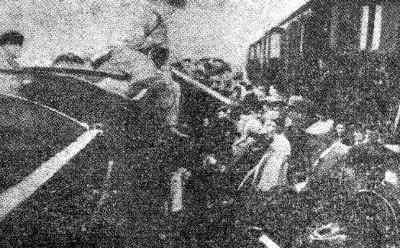
Jews being taken from Paviertche to Chełmno |
By A. Porat and L. Abramowicz
Translated by Mira Eckhaus
Many in the city respected Reb Abraham Frost, a humble and honest man who supported his family with his own labor, and whose life's purpose was to help the poor and suffering. Some of their concerns took precedence over his own. Every week, on Friday afternoon, he devoted his time to the city's poor, who had not prepared even a single meal for Shabbat. Together with Reb Glicksman, his partner in Torah study at the Shteibel, he would go to the houses of the wealthy people and collect food supplies. When it got dark, the two of them would bring the food to the dark apartments of the respectable poor who were too ashamed to ask for help.
The poor and beggars from all corners of the country who happened to come to our city, found support in Avraham Frost. He was one of the Gabbaim who distributed “Kwittelach” (notes with the name of a householder who would host the poor or the guest). Sometimes the homeowner mentioned in the note refused to accept the guest - and then the poor man returned in shame to Avraham Frost. From here he did not go hungry; Reb Avraham shared his portion with him and said: “I - if I do not fill up today, I will find food for myself another day, but the guest… who knows how many days he did not eat warm and satiating food…”
For many years he supplied shoes to government institutions, and he used his connections with officials to help a Jew in difficult times. More than once a businessman was arrested as a result of informing. So, Reb Avraham knew how to relieve the unfortunate. Here is one of many cases: on the eve of Passover, Reb Avigdor Baum was arrested, and all the intercessors were unable to get in touch with the government officials. Reb Avraham then turned to the prison superintendent, and obtained permission to hold a proper “seder” in one of the prison cells. This “seder”, in which several members of his family participated, somewhat alleviated the prisoner's pain.
Reb Avraham Frost was devout and earned full trust in religious circles, who were very careful about every mitzvah, and especially on Passover: Then they will prepare for themselves a special matzah – “Matzah Shmura”. He and Reb Yaakov Bram provided this matzah to dozens of families in the city.
The business of “Matzah Shmura” began in the month of Adar. At that time, flour was ordered in the city of Shaleshin, from a mill that was under the supervision of the local rabbi, who during the grinding made sure that the flour did not come into any contact with anything leavened. The flour was brought to the city under sever guard, and here it was distributed in special bags sewn for this purpose.
The baking was done on the eve of Passover, after the leaven had been removed from the entire house. Several Minyans of devout people, in shifts, would come to the bakery and prepare the matzahs. They kneaded the dough,
[Page 352]
they passed the rolling-pin over each piece, dotting the thin circle - and while they were doing it, they sang prayer songs. Among those involved in this work was also the Rabbi of the city.
Abraham Frost, who originated from the city of Golin, was a descendant of a family of rabbis (a tradition spanning twelve generations), but he never made it a crown to boast about. His life was one of toil and humility. He considered our world only as a corridor…
His manners with people were as good as his name. We will fondly remember his wife, Reizel, daughter of a scribe, who helped him in all his ways and made it possible for him to help the city's poor and act for the public's needs.
|
|
|
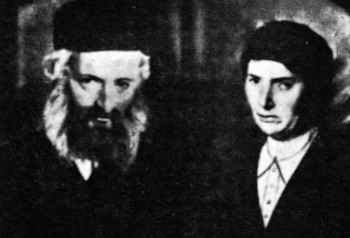
Reb Avraham Frost and his wife Reizel, who were annihilated in the extermination camp |
Among the first emigres of Koło, who immigrated to Israel on the third Aliyah, was one Hasidic family – the family of Avraham Motel. The Balfour Declaration and the wave of Aliyah also stirred up this family, hardworking and modest people. They were childless and throughout their lives they sought to do something for the public in order to fill their lack. During the First World War, Malka Motel was one of the volunteers for the “Bilike Kich” operation to feed the war refugees who found shelter in our city. Everyone honored the woman of valor and glorified her dedication to the public good.
Upon their arrival in Israel, Avraham Motel joined the settlement and development of the land, he was accepted into the railway workshops as an upholsterer and worked there for about ten years and was highly regarded. During the period of the Arab Revolt, while walking from his job, he was attacked on Nazareth Street in Haifa by gangs of murderers and did not return home.
After her husband's death, Malka Motel wanted to perpetuate his memory. She turned to the community in Haifa and offered her home to a “retirement home”. Her home would be a place where old men and women could spend their last years of life in peace and not know the shame of hunger. She did not ask the community for any compensation, as she acted in our city of Koło: she volunteered to work there and did not receive any reward. Until her last days, she earned her living through hard work.
Translated by Mira Eckhaus
The city of Koło had two suburbs: one was the Kalisz suburb in the north of the city, which was sparsely populated and sparsely housed, and the other was the Warsaw suburb, which was a kind of neighborhood in itself. The nearby village left its mark on it, as well as its flavor, and it was evident that it had been imprinted on it by its own way of life. About one hundred and fifty Jewish families lived there, which composed the majority of the population, the rest were Christians and Evangelicals, the latter - only a few dozen.
This quarter of the city, starting from the street called “General Dombrowski Boulevard” – began with a spacious lot, on which was located the large sawmill owned by the Rauf family. Nearby was the flour mill of the Neumann family, which was a large building. Next to it was the Polish trading house “The Syndicate”, which was created for an economic war against the Jewish shopkeepers in the city. Opposite to it was a modern municipal bathhouse, which was open to everyone.
This street was not like all streets. If we were to give it an image, we would think of it as the Hebrew letter “kaf sofit” with its tip tilted to the right. On the right side, houses were built in a long row, one next to the other. However, this was not the appearance of the left side, which was across the road paved with fieldstones. Opposite the row of houses was the field intended for playing soccer, and it also served as a place for negotiations on market days, once every two months. Further away was the municipal garden, the park named after the composer Munyushko. On Shabbat and holidays, teenagers, Jewish children, and even older people would walk along its paths and avenues and rest on the benches shaded by the tops of ornamental trees. The flower beds and fountains and the pavilion covered in climbing plants and its secret corners - who wouldn't remember them? Gardeners took care of this garden and made it a charming corner of the city.
Opposite the garden was a short, narrow alley, and at the end was the second flour mill which was owned by the Gutman and Zalmanovich[a] families. From here on, the suburb of the city began – fields strewn with potatoes and various vegetables.
At the turn of the street, near the Magistrate's Court and the Finkelstein brothers' barbershop, two streets crossed the boulevard, one on each side: the street on the left was “May 3rd”, in which was the Nashalski family's agricultural machinery factory, and the street opposite it - on the right - was Torunska Street, formerly called Sompolno Street, because the road to the city of Sompolno ran from here. With the changes in power, the street was renamed to one bearing the name of the first organizer of the Polish Legions, Marshal Józef Pilsudski.
[Page 354]
The Boulevard Street was long, but there were only few buildings on it. On one side of it was an empty lot, which was used as a pasture. There were two factories on the Boulevard. On the left was the Fogel family's factory: a tulle for roofing, and on the right was a porcelain factory owned by the Pole Freidenreich.
Those of the city of Koło who survived the Holocaust probably still remember the small shack on the Boulevard Street, which housed Petlovsky's candy store. In this store, you could also get a light, hot meal in the winter, and cold drinks and ice cream in the summer. Those who went to a soccer match or those who went to the municipal park would visit this store to refresh themselves.
Next to this shack, a path led to the old Jewish cemetery. The path passed through pastures, ups and downs, to the gates of the resting place.
Further down the Boulevard Street, near the leaning bridge over the Warta River, stood the buildings of the Evangelical church and a municipal school.
The sources of livelihood for most of the residents of the Warsaw suburbs were different from those of the residents who were living in the city center. Even the livelihoods left their mark on the earners: grain and alcohol merchants took the first place. Since they were close to the villages, they established close ties with them. Sometimes it seemed that the village had invaded the city and left its mark there.
From the farmers of the village, the residents of the suburb learned to grow vegetables in their yards and also to take care of cows and goats, not for the purpose of selling milk, but for household needs. Poultry coops were found in almost every yard. Several Jews from the suburb also aspired to earn their living from the land, among them were Reb Neta Schwartz, who ran an oil press, and Reb Nathan Brandt, who owned a manor in the village of Lubini.
Before the farmers entered the city center on market days, they stopped in the streets of the suburb by the Jewish merchants who checked the sacks and baskets on the cart. Sometimes several merchants would “compete” on the goods of one farmer, each wanting to get ahead of his friend and win the goods. And the “Gentile” smiled at the shameful competition that often ended in a fight and beatings and… compromise. The goods were bought in partnership.
When the grain merchants saw that they were losing out from this competition, they decided to organize their purchases in partnership. I remember two partnerships: one of the Brandt, Schwartz, Silberberg, Blum and Goldberg families, and one of the Fox brothers and their sons. These partnerships did not last long, they broke up at times, but after a while they reunited again, because the fierce competition had depleted them financially.
The sacks of grain were brought to bulk warehouses. From there, they were brought to the flour mills or to the large warehouses of the wholesalers Ritschka and Cherniak, who transported grain wagons on freight trains to the country's major cities, or were exported to Germany.
The big merchants were in contact with the surrounding estate owners. They would travel to the Polish landowners and do their business secretly. Some paid in advance, before the harvest, and some
[Page 355]
also spent money on interest and thereby bought a “right” to the crop… The small merchants traveled between the villages, visited every hut and farmer's house, and wondered in their conversation about the produce in the silo. I will give here the opening of a routine conversation:
“What do you want to buy” - the farmer greeted the Jew who stepped on the threshold of his house.
- It is known that a stupid Jew buys whatever he can get his hands on… - replied the merchant.
In the Warsaw suburbs, the hostility of Christians towards their Jewish neighbors was most evident. The Christian residents were incited by the activists of the Endecja party, who aroused both envy and hatred and ordered them to cut off all contact with the Jews. In order to eliminate their dependence on Jewish shops, the anti-Semitic Christians established a consumer goods store on Torunska Street, called “Spoina”. One by one they attracted the customers, they attracted them by selling on credit and at discounted prices, a lure that they could not resist for long. Everywhere they advertised their slogan: “Everyone to his ally and to what belongs to him”.
The anti-Semites did not find this enough and founded a “Syndicate” - a department store for iron, craft tools and agricultural implements. Those who did not have cash paid with their produce.
Since this trading house was close to the villages, it attracted many of the Jewish shopkeepers' customers. The goal of the syndicate officials was to bring the Jews into bankruptcy, so that they would not survive and would eliminate their businesses. When they failed to do so, they compiled a “blacklist” of Christian customers who bought from Jews and threatened them with a boycott…
In 1914, Reb Yosef Ze'ev Brandt founded the first synagogue, “Linat Tzedek”, by erecting a small house in his yard for this purpose. The small temple was the place of prayer for the residents of Torunska Street. Three times a day, they came there for Shacharit, Mincha, and Maariv prayers. Reb Yosef Ze'ev Brandt devoted himself wholeheartedly to this synagogue, and he would preach on Shabbat on matters of the day, always on matters of Zion and Zionism.
Those who were leading the prayers were: Reb Meir Minstein, Naparstek, Isser Yaakov Blum and Reb Neta Brandt. The regular Ba'al Koreh was Reb Yosef Ze'ev. He would also voice his comments on what was happening in the world of politics, during the break between Mincha and Maariv.
This synagogue also centered the “Bikur Cholim” operation, in which funds were also collected for “Malbush Eromim”, whose activists collaborated with the activists in the city center.
And these are the names of the worshipers at the “Linat Tzedek” prayer house:
The Gabbai Yosef Ze'ev Brandt, his sons - Shmuel-Zvi, Reuven and Nathan (the first lives in Jerusalem); Nathan Schwartz, Aharon Yaakov Schwartz, Shimon Schwartz, Wolf Schwartz; Yaakov Oshter; Ephraim Zilberberg and his son; Chaim Goldberg; the brothers Isser, Neta and Shmuel
[Page 356]
Goldberg; Israel Yitzhak Michelson and his sons: Yaakov, Melech, Zvi; Nathan Brandt and his sons: Mordechai, Aharon and Meir (the latter live in Israel); Isser Yaakov Blum and his son Aharon: Zelig Brookstein and his three sons; Getzel Fox and his sons; Shlomo Arber; Faivish Bordovsky and his son Avigdor; Faivish Diamant; Treitl Hirsch Rosenthal and his sons; Leszczynski; A. L. Koninsky (in Israel); Eliezer Shmuel Koninsky and his sons; Itche Meir Eidelman and more.
In the Warsaw suburb there was a second house of prayer, on Boulevard Street.
After 24 years of operation, the “Linat Tzedek” Synagogue was closed. The people were transferred to the city. And the last news received from Reb Yosef Ze'ev Brandt, may God avenge him, and Esther Chaya Brandt and her son Mordechai, may God avenge them, who were exiled to Galicia, to the city of Krosno, was in April 1942.
Finally, I will mention one of the residents of the suburb, Reb Neta Brandt, a man of great activity. He assisted to the Zionist fundraising campaigns, was the vice chairman of Keren Hayesod (his work with Rabbi Y. L. Fishman, who acted on behalf of Keren Hayesod, is remembered); he was among the founders of the first reformed cheder “Torah Veda'at”, served as the economic manager at the Hebrew Gymnasium, and did not receive a reward for his efforts. He died on the 24th of Adar, 1936.
|
|
|
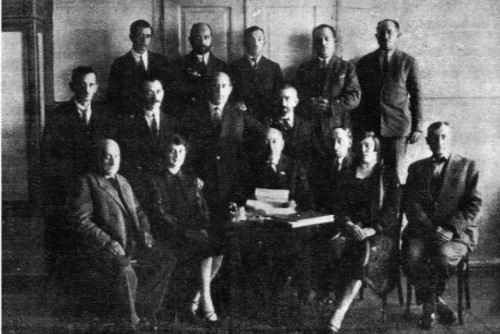
First row (right to left, seated): Moshe Leib Levin, Yaakov Rauch, Yehoshua Engelman, Yitzhak Gutman Second row: Tchorz, Firnikz, Avraham Feldman, Akiva Cohen Standing: A. Koninsky, Krashnevsky, Nathan Brandt, Feibosh and L. Bezhostovsky |
Original footnote
by Avraham Kempinsky
Translated by Mira Eckhaus
In 1922, I first became acquainted with the city of Koło, to which I had moved to study Torah.
I was an eight-year-old boy when my melamed in the town of Władysławow (Rozyszcze) informed my father that he had given me all his knowledge and now I needed a better teacher than him. This unusual news, of course, pleased my father; but it also worried him: again, there was an expense in the education of the boys… Where would he get the money to hire a special melamed, since there are no student-friends in this small community.
One morning my father took me to the market. From there we rode in a cart to Kunin and from there to Koło. We didn't talk much on the way. He had one answer for all my questions: We are traveling, my son, to find a Torah-learned melamed who will advance you in both sacred and secular studies.
We walked around in Koło, and my father inquired with his friends if there was a responsible melamed in the city to entrust a young son to, with whom he could also live. Since no one was found, my father turned to the religious school “Etz Chaim”, some kind of a reformed cheder, and asked them to accept me.
I remember the moment we stood in the office of the principal, Yitzhak Meir Buch. This man, with a distinguished face and a long, white beard, fixed his searching eyes on me. My father presented to him the difficulties of education in our small town, and asked him to include me among the students of this institution. I cannot remember the details of the conversation; however, I had the feeling all the time that many obstacles were piling up in my way.
After a tedious conversation came the disappointing answer: “He is too young and I do not have a suitable class for him!”
- “Don't look at his height, but” - - - My father pleaded with him in a pleading voice.
- “And where will he dine?” - The principal softened somewhat.
- “I will take care of it” - replied my father - “he will not starve in such an important the city”.
- “But he must be tested first!” - announced the principal.
My father approached me and whispered in my ear: “The exam is what will decide the outcome! Be strong! Be a person of integrity!”
The bell rang. Break time had arrived. The teachers-melamedim gathered in the office, looked at me and my father, and then the principal said to the melamed Avraham-Yehuda:
- “Test his knowledge!”
He immediately took out a Bible, opened it to Parashat “Mishpatim”, and said, “Read!”
- “These are the laws that you will put before them” - I began to recite aloud a psalm - “Six years he will serve.”
- “Who will serve? A Hebrew slave, or a foreign slave?”
- “A Hebrew slave!” - I replied with courage - “because a foreign slave is a slave forever”.
The examiner kissed the book and closed it. My heart suddenly pounded: So fast? Did I fail?
With a smile, he said to the director: His 'Hebrew' is fine, and he also knows the meaning of the words.
The principal still hesitated.
- “Now I will ask questions!”
I was excited. I was afraid of the second exam. But this exam was not aimed at me. The principal asked me to leave, and he talked to my father about salary matters.
When my father came out to me, his face beamed, and I knew that from now on I would learn Torah in the “big” city.
From Władysławow to Koło, this passage encouraged me. Koło seemed to me as a large city compared to my town. I entertained myself: here I will have good time, not everyone is entitled to this, I will be independent, my friends will be older than me and I will learn from them, how to stand up against “abominations”. However, my joy did not last long: days of “eating days” began - I dined every day with a different family in the city, because there was no boarding school at the school. Food was not abundant everywhere, and my appetite grew especially on those days when the meals were meager and limited.
Most days of the week I was never full. At the bookbinder's they ate dumplings and tzimmes and soup and dry, coarse bread every day. The shoemaker's table was also a poverty table. I never had the privilege of coming when the whole family was dining. They left me a plate and a bowl and two slices of bread. The only gain from this meal was the sugar cube, which I put in my pocket for an hour on an empty stomach. I drank the tea with discretion, as is customary in poor houses.
From the bad days - to the “good days”.
The top and best place of all places was at Shoel Shorek, a textile merchant, the richest of the rich. This day was a holiday for me. The table was overflowing with food. The sight of the casseroles and the plates was enough to satisfy me. The white tablecloth and the silver spoons and forks - were not found in every home. The meal lasted about an hour. We ate politely, dish after dish, and there was no compulsion. On a weekday, the first course was “gefilte fish”, which tasted like the taste of heaven. After them came noodle soup with circles of fat floating on its top. A fragrant smell from the kitchen announced the arrival of the roasted meat. And finally - compote and sweetened tea, without any restrictions. What is the value of a white bread when there are better dishes than it?
In this house, I sometimes even received a few pennies from the landlord. These were “farewell money”, when he would travel to the big city to buy goods.
[Page 359]
The second-best place was at Hirshia Tuiger, a vegetable merchant.
During the fruit season, I was the happiest man: every apple and pear that began to rot was given to me. Here they ate not on plates but in casseroles. The members of this family were known in the city as eaters, and a proverb was common about them: “zey flatsn nisht fun knah, nar fun fetkeyt”.
In the evenings I was free so I went to the synagogue. Here I listened to the conversations of the adults about politics and quarrels about the slaughters. Here I even heard about an incident that horrified all the residents of the city: the burier stripped the shrouds from the dead and sold them to the peasants… And the hair on my head stood on end with terror. When I returned to my place of residence, in the basement room of a poor family, I took a sugar crystal out of my bundle and took a glass of water, and with that I ended my day. I said the “Shema” prayer intentionally, a supernatural cure against bad dreams.
Sixteen years have passed since I left Koło and I didn't believe I would return to it. From the nearby city of Kunin, I followed everything that was happening there, and I exchanged letters with several people involved in the Working Land of Israel movement - but I never visited it.
One day I was invited to lecture on 11th of Adar at the Adar at the Tel Hai Memorial Academy. With great pleasure and with an eighth of pride, I went out to Koło - to give the first reward for the Torah I learned here. I wanted to go to every place I dined at and express my gratitude, meet my melamedim and shake their hand. My heart was overflowing with blessing for everyone, to the point of embracing everyone who came towards me.
The theater hall in the new market was packed to the brim. I stood there again as if I were taking an exam. I unloaded all my knowledge.
After the lecture, we exchanged stories about the distant and the near - about the settlement in the land, which is facing a difficult war with the Mandate regime, and about the period of intercommunal violence that began in the land at that time…
Koło, November 18, 1939
I made my way here by foot and by car, in order to proceed quickly, not to lose even one hour. The war is in full swing. It was dangerous to delay here as you may be killed. The honor of Poland has been violated. The country has been trampled; its warriors have been defeated.
I passed through a few streets - there was a silence of a cemetery. This city was vibrant, what had happened to it? I asked one of the people who was as anxious as I was, holding his bundle in his hand.
- What is happening?
- “The evil spirits are raging; we should run away and save our lives.”
I raised my legs and continued on the run.
Translated by Janie Respitz
The families of Rabbi Reb Leyb Pordonsky of blessed memory, Reb Itche Feldman of blessed memory and Reb Dovid-Aron the ritual slaughterer of blessed memory were intertwined and cultivated as one.
Each member of the three families is a chapter unto its own. Each with its virtues and qualities. They all belonged to the Hasidic elite of the city and people willingly sought their friendship. By the way, these families were also connected through marriage. Older people remember the ritual slaughterer Reb Dovid-Aron very well, even his appearance: tall with a wide long beard down to his chest. There was always a cheerful smile on his face. He worked as a slaughterer for many years and he was loved by all social classes. The Pordonsky family descends from him.
The rabbi Reb Moishe-Leyb Pordonsky was a Ger Hasid. The Hasidim made him their community spokesman and prayer leader in the small Hasidic synagogue and said: “People love his sweet praying and of course, the Master of the Universe does as well”. He was so absorbed in learning his wife ran their wine business. She was the daughter of Reb Mikhl Trayber of blessed memory. She worried about daily existence and he, the world to come. Evenings and on the Sabbath Reb Moishe would study Talmud and Mishna with the respectable men in town.
One of his five sons Mikhal-Simkha Pordonsky held a respectable position in the Zionist organization in Kolo and was also active in the merchant's association; a second son was a ritual slaughterer in Kanin. Of all his sons and daughters, one has remained, Dovid Pordonsky. He lives in Rhodesia[1].
Reb Itche Feldman was a man who was known for his charity and gentle character. He worked hard for the religious school “The Tree of Life” and was active in various social philanthropic organizations.
His wholesale business of textiles was well known in town and in the whole region. He always found time for communal organizations, however, not for personal gain.
From the Feldman family one grandchild has remained. She lives in Israel. Almost all were killed during the tragic war years.
Translator's footnote:
By Pinchas Przedecki
Translated by Mira Eckhaus
A. The First Modern Hebrew School
On Blankakova Street, in the house of the Pole Jankowski, the first Hebrew school in Koło was established in 1912, marking the “revolution” in Hebrew education. Apparently, no Jewish homeowner wanted to rent an apartment to an institution that would compete with the “cheder”.
In this school we studied Hebrew according to a new method “Hebrew in Hebrew”, and the teacher was Mr. Goldberg, who came from Warsaw. His innovation in Hebrew: We pronounced the vowels in the Ashkenazi syllable, that is: “Kamatz katan” – O; “Shuruk” - U; “Tzere” - AI and not as the syllable unique to Congressional Poland. The pious murmured and grumbled, saying: “Will you, like the Jews of Lithuania, bend your tongue?”
Moshe Kot taught us the history of Israel, but in reality, the lesson was a Zionist speech, he demanded that his students return to the days of David and Solomon.
Polish was taught by Mania Varembron and the principal was a man named Eisenberg, an external teacher. He taught us arithmetic.
The soul of the school and the main teaching were the Hebrew language and the history of Israel. The teachers were slightly embarrassed when the Michaeli children returned from Israel and they spoke Hebrew in the Sephardic syllable, which is common today. Our teacher Goldberg could not adapt to this syllable, which is careful about accentuation, and continued to speak to us in the Ashkenazi syllable.
The students at school did not pay attention to the syllables, but they envied the boy Ben-Zion Michaeli Michaelovich who spoke fluent Hebrew, as if he knew the entire Bible by heart. He would call everything by its Hebrew name and more than once would surprise the teacher.
B. “Hatikva” Sports Association
The German army during World War I brought the game of soccer to our city. The boys of Koło were not satisfied with engaging in this sport alone, they began enthusiastically to engage in athletics, rhythmic gymnastics and physical culture. We found a good and dedicated trainer, the instructor Taube from Lodz.
After only six weeks of practice, we held our first public performance in the municipal park - it was a “Kiaramazh” that attracted crowds. The program was varied: an orchestra, pyramids, secret mail (each visitor received a number upon entry which served as his address), a raffle, etc.
After the initial success, a performance was held at the Municipal Theater. I will mention two participants in the pyramids, who enchanted the audience: the “top” of the pyramid was Avraham Zilberberg and one of the pillars, Yehuda Bizhinsky.
[Page 362]
C. The Orchestra and the Anthem
“Competitors” arose for our Jewish folk musicians and the fire department orchestra, when the “Hatikva” Sports Association expanded the scope of its activities. A second innovation in the city was the establishment of a brass orchestra. The following instruments were purchased: horns, trumpets, trombones, flutes and percussion instruments. It wasn't long before our boys mastered the instruments.
Since then, the members of the “Hatikva” were not satisfied with only singing the anthem while marching through the city streets - at the head of the marchers walked the members of the orchestra, making sounds that inspire movement and life. Young and old alike came out of their homes to watch us. Children imitated the parade, marching and singing:
Press on, firmer, stronger, brothers
Bravely, heroically, set your steps
Already aligning every limb
Lively, freer – just don't worry!One, two, three, four
Just march – lift your limbs
Just move, just stir yourself –
Press on, brothers.
Who composed this anthem? Who was the conductor of the orchestra? It's hard to remember the details, after all, forty-nine years have passed since then.
With the establishment of the Polish state, “Hatikva” Sports Association was liquidated - its members were called up to serve in the Polish army, but sports continued, nurtured by the youth. Instead of one sports association, three or four football teams were founded, each party and its own team.
D. In the First World War, in 1914
The Jewish youth in Koło did not let the Poles take over the community, insult, or abuse the weak. They responded to every provocative act forcefully with a two-fold blow. When the haters of Israel saw that the Jews were not deterred, that they were acting as one united body, they treated them with respect.
I remember one attempt to go on a rampage in the city of Koło - a plot that was foiled in its early stages. In the early days of the war, dozens of Polish peasants gathered in one of the city's suburbs, waiting for vehicles to transport them to the nearby small town of Kutno, to join the ranks of the army. Since the Russian organization in those days was poor and there were not enough vehicles, they stayed in the city and, out of idleness, they decided to mistreat the Jews: rob and beat, and have fun with Jewish girls.
This news reached the Jews and a Jewish defense was quickly organized, led by the Podhlebniks. Groups equipped with cold weapons hid at the entrances to the city. When the Polish thugs came out shouting “Hurrah, beat the Jews!”, they encountered an ambush and were soundly defeated.
When the thugs returned to their villages beaten and wounded, they said with shame: “The Jews from Koło are not like all the other young Jews, they are not “Yids”, but “Hebrews” …”
By M. Ben-Yitzchak
Translated by Mira Eckhaus
| For the souls of my mother Zipporah, my brothers and sisters, who perished during the Holocaust… |
My mother blessed seven candles, corresponding to the seven sons and daughters, on Friday evening. We asked her: What are your lips whispering in your prayer? She evaded answering. Only once, when she was urged, did she say that a person needs great grace in walking the path of his life, because it is always full of endless twists and turns. And we did not delve into the depths of the repentance.
The son on whom the family was proud was Yehuda[ME1.1], and not because he was the eldest son, but because of his love of reading - from the day he learned to read, he always held a book in his hands. And when the family spoke about the future of the sons, they predicted a place for him in the tabernacle of Torah.
When Yehuda turned 13, it was decided to help him reach the path he wanted to follow: he was sent to the big city, to devote himself to his studies. But as soon as he left, Satan arose to hinder him. The biggest obstacle was the disaster that befell our married sister: her few possessions caught fire, and the family had a serious discussion: Who should we help first? Then father sent an urgent letter to my brother: “Return home!” And the reason for this was known to him.
Then came the answer: “I got “hours” from my tutoring. I will support myself until you have enough means. I will not be a burden to you”. And this answer satisfied my mother.
- Stubborn! - Father grumbled - He will starve!
- And here he will starve for Torah! - Mother defended him, and the whole family agreed with her.
It didn't take long before a letter was received from him in which he announced that he had left school and entered a workshop to bear the burden of existence. However, he continues his studies, he set hours for Torah study.
And again, a letter was sent to him: “Return home!” But he replied: “I walk along the road and keep my path, although it is full of twists and turns”.
And the greatest evil that befell him and us was the world war, which broke out almost without announcement. We were cut off, and he remained in the distant city, abandoned and lonely.
- It's our fault! - Mother sobbed - We left him without support, and he's still a boy.
We all gathered, the adult and the young to find a way to help him. Each one said what he said, but here was no solution. Yehuda was in a territory that was occupied
[Page 364]
by the enemy, contact with him was cut off. Whenever letters arrived by the Red Cross, there was joy in the house. His words were brief, but heartwarming. From his letters, which changed from time to time, we concluded that he was experiencing all the hardships of life. We sought an indirect way to reach him. But we did not find a suitable way. There was a fear that we would arouse suspicion that we had a role in undermining the government.
One day a refugee arrived to our city. We brought him into our home, fed him and clothed him, and we learned that he came from the city where our brother lives. We asked to hear from him perhaps incidentally he had met him. We showed him the picture: Have you seen him? We waited impatiently for his response. He looked at the picture and replied: My memory has weakened and I cannot response “yes” or “no”.
While recounting the suffering of the citizens of his city, he brought up something that seemed both a consolation and a Gospel of Job: He once had the opportunity to eat with a family who were eating their meager meal, and each received soup sparingly: five spoons, and the one who counted the spoons was a stranger who had joined them during the bad times. A quarrel broke out in the family, because they suspected the young man of making a mistake in the count, out of malicious intent. Then the young man gave up his portion.
- What did he look like? How old was the guy?
- About fifteen, or sixteen!
- The same age as Yehuda! - My mother sighed.
The long war ended, the blockades were lifted, the mines were cleared, but transportation was not restored. But Father did not wait until the broken roads were repaired, and decided to leave the big city to look for Yehuda, to find him alive. He prepared the suitcases and filled them with whatever food we had, and also took some clothes with him.
Father returned with a guest, our brother whom we had missed and looked forward to meet for many years. But how different he was from the brother we had known before. He was very thin and his speech was strange. He stayed with us for a week and wanted to return back to his city. What was the hurry? He replied that his “hours” had become regular lessons and he could not neglect them, lest the students leave him. Everyone begged him, but he insisted that he should return as soon as possible.
What was he teaching? We did not know that clearly. When Yehuda set out on his journey, we said to ourselves: It is better for him to be far away but connected to us, than for him to be near us physically and distant. After all, once he visited our house, he walked around like a stranger.
Several months passed, and again he informed us of a change of address and a plan to go abroad, overseas. He wanted to find there what his destiny had destined for him. Father wrote him a letter, and this time it contained a promise to help him finish his studies: we would skimp on food and drink and obtain a loan. But first he should return home for consultation.
No response came to this letter and the other letters we sent. His silence created an atmosphere of sadness for us. About two months have passed and he was still silent. We checked the content of our letters, to see if we had offended, God forbid, the sensitive boy who was suffering in the tent of Torah, and we found nothing wrong. Father
[Page 365]
wrote with courtesy, Mother poured out her words with love, and we, the brothers and sisters, all the things we added were criticized.
- What's wrong with that? - Grandma became angry at the parents' sadness. - If a child doesn't write to his parents, it's a sign that he is full and content. Only in times of crisis will he write more letters…
If Yehuda had known what he had done to us, he would not have punished us with silence. The joy had ceased in our house, the laughter had ceased, and even the little ones had no mind for amusement. Our little sister dreamed of him one night, and behold, he returned home with a beautiful girl, his fiancée. And he himself had a long mustache and a bag in his hand. We did not laugh at her, because those older than her had daydreamed about him.
When the silence grew longer, we went to ask Yehuda's friend of the same age, with whom he had been corresponding, perhaps we could get something out of him. And indeed, from him we learned about a new livelihood: Lately Yehuda has been sitting in a large restaurant and writing letters for people who cannot do it themselves. Apparently, this is also a livelihood in the big city.
One day a bird jumped in the window. Today - Mom said - a letter or a guest would come! And the guesses were wrong.
We waited patiently, and not everyone forgave him. Everyone had a different suggestion, and we couldn't reach a decision. Finally, Mother's patience ran out, and we sent a telegram with payment for the reply in advance, perhaps he didn't have a penny in his pocket. Less than an hour passed, and the letter carrier brought us a letter from him. It was on Friday evening, after dinner, Mother read the letter aloud, although we already knew its contents:
“Don't be surprised, my dears, that I rarely write to you. During the day I study and work, and in the evenings, I teach others - I teach evening classes. Please come to my classroom and see: I am the young man, sitting at the head, teaching Torah to students, elderly workers. In the front rows sit people with bald heads whose faces express their hard life. The people's eyes are red, they long for sleep. But the thick lips express stubbornness and determination to overcome their tiredness and learn. The heavy sitting of people indicates that they are burdened; on their shoulders lie thirty to forty years of life. Most of their years their ears have only heard the noise of machines and the pounding of hammers, and now, at their middle age - they hear new sounds, new words; their eyes, which is used to seeing a great burden, to which they are forced to raise their heads, will now lower themselves down to the pages of the book, to observe the letters. I speak to them, and they seem to be listening to someone else - to their household. Each of them ponders about the nap I have robbed them of: the next day they must get up early in the morning to work, to go out to their toil. Sometimes, one student yawns, and the neighbors, as if by command, counter him. Others look at me pleadingly: Teach me all of Torah in a nutshell! But there is also some comfort! Sometimes I see people at the back lines nodding their heads, as a sign of agreement. lips moving, and I feel that my Torah has been absorbed; eyes widen - light shines in them. I did not expect that I would find an echo of my words so quickly.
You must be asking: What is my salary? The salary for the “hours” - moments of happiness”.
[Page 366]
When Mom finished reading, silence fell in the room: Is this the end? Could it be?
She looked at Father, as if she wanted to discover his deep thoughts. But when the silence lengthened, she said in a voice filled with joy: - Here, at last, he made it! He worked in a factory and learned; he found “hours”, and he continued his studies; he was hungry and he did not abandon the Torah…
Father got up and went into the kitchen. His footsteps echoed from there; he paced back and forth. Grandma fell asleep with a smile on her face due to the pleasant news. And we, the children, did not know the meaning of the silence. An unusual letter. We must pass judgment on him.
Dad returned, sat down at the table and sweetened a cup of tea, all lost in thought. For some reason he didn't follow in Mom's joy.
You see - Mom repeated her words - at last, he made it! He's finished his…
Finished? - Dad woke up - and it seems to me, he's just getting started…
And it was difficult for us to find the end of the thread and reconcile the two: Is he really finished? Or is he really just getting started?
|
|
|
|
[Page 367]
|
|
|
Seated (from right to left): A. Duvdevani, Michael Hanftwurzel Standing: Menachem Lachman, Klapper, --- |
Translated by Mira Eckhaus
|
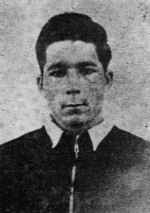
He was born on 20 Sivan 5688 in Tel Yosef to his parents Ayala Stern and Zalman Geffen (Confitin). He studied at the local school and completed 12th grade.
Chaim stood out among his comrades in his dedication to the cultivation of field crops and his responsibility. He was among the first to volunteer for the Palmach and participated in several campaigns. During the difficult times, he participated in all the battles of the “Haportzim” Battalion: in Jerusalem, in Nebi Samuel, in the Latron sector, in the conquest of Katamon and the breakthrough to Mount Zion, and more.
During the truce, he transferred to “Golani” brigade, which was stationed in Nazareth. Under unknown circumstances, his life ended. He was buried at Tel Yosef.
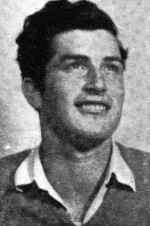
He was born in Koło on May 4, 1917. In his youth he attended the Hebrew Gymnasium and was active in the Zionist youth movement. On the farm in Częstojew, where he received his pioneer training, he held a prominent position in the organization. He was the economist and raised this position to a high level.
He immigrated to Israel, with a group of his friends, on the “Asimi” ship in 1939, and was among the founders of the “Nitzanim” group.
[Page 369]
During World War II, he fought against the Nazis and participated in the battles of El Alamein. He played an important role in the mapping department.
During the War of Independence, he worked in a group of drivers. While going out in one of the convoys, he was injured, but managed to return home. On March 26, 1948, during the siege, he stood at an observation post with a machine gun in his hand, defending his village, which was being attacked by the Egyptians.
He fell in this battle.
He left behind a wife and daughter.
|
Nathan Dobzhinsky, the son of Yitzhak and Hinda of Koło, was born in Tel Yosef on Elul 19, 5689, during the 1929 Palestine Riots.
In his nineteen years of life, he earned himself a respectable place in the life of the farm, thanks to his noble qualities: simplicity, confidence, and dedicated work.
During the War of Independence, he abandoned his work in the sheepfold and joined the Palmach. On July 9, 1948, Nathan arrived at the Tzirifin camp, the base of the first battalion of the Yiftach Brigade. It was the day before the first truce. The next day, with the renewal of fighting, he was sent into action, to participate in Operation Dani. He was among the conquerors of the Arab villages in the Ramla area: Inba, Gimzo, and Daniel; and in the Lod area - Hadita. On July 17, his battalion was tasked with taking over the important road junction in Beit Sira, which connects the Ramallah-Latron and Beit Naballa-Latron roads.
The company commander was killed in the battle, and Nathan was sent to collect the squad, which was in charge of covering the retreat. Here, on his way back to the control post, he was hit by a mortar shell and died.
He was buried on Mount Herzl in Jerusalem.
[Page 370]
|
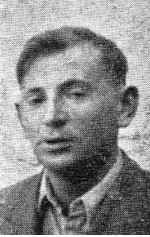
He was born in Koło in 1909. Until 1939, he lived in our city and earned a living by his own labor. During the war, he fled to Bialystok and was deported by the Russians to Siberia. With the Polish army, under the command of General Anders, he arrived in Israel in 1944. Here he built a family and was engaged in tailoring.
During the War of Independence, he enlisted in the army and was killed during an Egyptian bombardment. He left behind a wife and a son. He was 39 years old at the time of his death.
May his memory be blessed.
|
JewishGen, Inc. makes no representations regarding the accuracy of
the translation. The reader may wish to refer to the original material
for verification.
JewishGen is not responsible for inaccuracies or omissions in the original work and cannot rewrite or edit the text to correct inaccuracies and/or omissions.
Our mission is to produce a translation of the original work and we cannot verify the accuracy of statements or alter facts cited.
 Koło, Poland
 Yizkor Book Project
 JewishGen Home Page
Copyright © 1999-2026 by JewishGen, Inc.
Updated 16 Jul 2026 by JH