 |
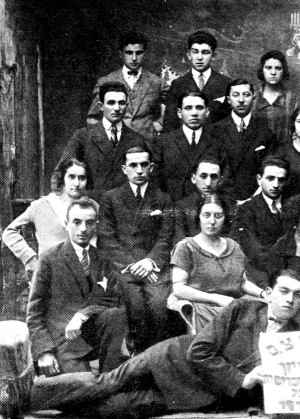
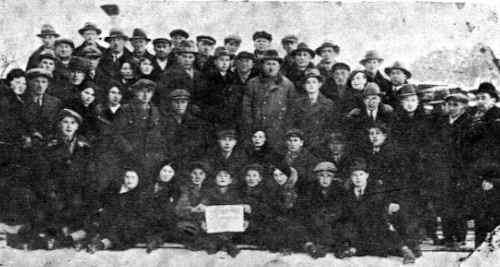
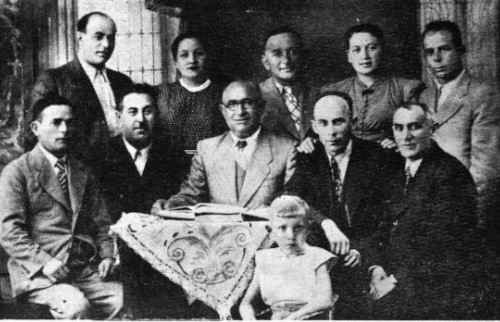
Seating: Zalkind, Madalinsky, A. L. Kaninsky, Luxenberg, Levin. (Reuven Madalinsky's child)
Standing: Kreitzman, Rauch, H. A. Schultz, Schultz Rauch, Goldberg
|
|
[Page 100]
By A. L. Koninsky
Translated by Mira Eckhaus
The first contact the masses had with the Poalei Zion Z.S. party in our city, in the 1930s, was rooted in the struggle to purge public institutions of indecent legacies and protectionism. The party gained the trust of the masses not through slogans, but through actions, in openness, and in standing fearlessly.
On the surface, the struggle with the authorities was over petty matters; but these were, in fact, the rope that held the impoverished artisans, whose rights were being restricted day by day. The youth in the city were attracted to the party because of its active Zionist work – Aliyah to the Land of Israel in any possible way. Instead of polemics, the party dealt with real things. Year after year the party's impact in the periphery grew, reaching its peak in 1931. Its success in the “community” election campaign that year did not come as a surprise. The party won seven representatives out of twelve. A large part of this achievement must be attributed to the elected members - honest members who devoted themselves wholeheartedly to the needs of the public. In the evenings, on Shabbats, and even during work hours, they would respond to those in need, who sought encouragement and advice.
The pressure from the authorities, the hatred for Israel that grew and grew, the destruction of Jewish livelihoods - all of this sowed confusion among the masses. Decree after decree came and there was no end to the distress. The public emissaries needed great strength and strong faith, so that they would not fail in their mission.
In public meetings held by the party, the problems were raised in all their seriousness. The “common folk” did not want to hear promises that would be fulfilled in a remote time. The most important question was, “How will we survive today and tomorrow?” The party called for a joint effort and for unity in order to stand as a fortified wall against the unfolding storm.
An important chapter in its activities was “Aliyah B”, which was intended to enable dozens of families in Koło and the surrounding area (in nearby towns) to immigrate to Israel and start a new life.
In the local Zionist action - distributing the shekel, collecting donations for the foundations, in supporting the training camp in the city, in organizing public opinion during the trouble years in the country - the party did great things. In 1931, the party called for a large demonstration against fascism, which endangered world peace. On its initiative, a boycott of German products was declared in the city. A sharp protest was made against reaction, both distant and near. The masses were called to readiness for the coming days.
One of the party's representatives on the city council and in the community administration, appealed in
[Page 101]
1934, to the local institutions and asked them to allow him to immigrate to Israel with his family, settle in the Land of Israel, and join the ranks of the builders. However, he was not granted permission quickly because precisely at the time when the decrees were being imposed frequently, people with experience in the struggle were needed. Nevertheless, the members could not refuse the request of a member who had devoted thirty years of his life to public action.
|
|
Seating: Zalkind, Madalinsky, A. L. Kaninsky, Luxenberg, Levin. (Reuven Madalinsky's child) Standing: Kreitzman, Rauch, H. A. Schultz, Schultz Rauch, Goldberg |
From 1936 the situation worsened. Everyone felt that a great tragedy was approaching. The party representatives did not give up, and the opposition to the various decrees somewhat encouraged the spirits.
Anyone who writes about these years, the years before the Holocaust, will consider the resistance of the public representatives as sparks of light that illuminated the shadows on Jewish Street.
[Page 102]
By Members
Translated by Mira Eckhaus
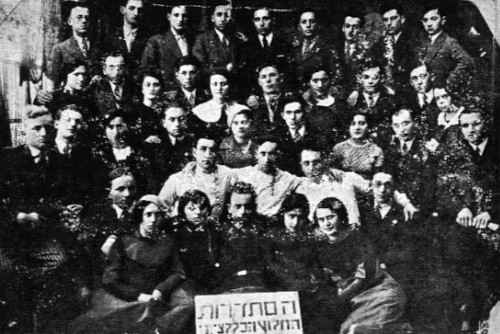
The “Hechalutz” organization in Koło existed intermittently from 1919 to 1925. When Poalei Zion (Z. S.) and Freiheit gave us their power to “Hechalutz”, new blood was injected into it: the branch operated continuously from 1925 until the Holocaust.
The name “Hechalutz” appealed to many, but when the branch members were faced with the obligation of “realization” - to go for pioneer training - the great dropout began. After each meeting, the activists asked: Which of the hundred members will remain?
Parents whose children were in the “Hechalutz” strongly opposed the training, which they saw as free labor for a Gentile. They also opposed the cooperative life in the kibbutz, for who would help them in their old age? Therefore, they sought to uproot this “idea” from the minds and hearts of their sons and daughters.
In 1931, the “Hechalutz” branch in our city was given a major task: to support the first ones from the Borochov training kibbutz in Lodz, who came to establish a company.
The branch club became a place to live for the newcomers until they got their own apartment.
The lifestyle of the training company influenced the city's residents and the youth. They no longer said “The black work should be done by a Pole”, because they learned from the work of the kibbutzniks that labor had become something sacred.
In the training kibbutz were planned “escapes” of the branch members without the knowledge of the parents. Mothers forbade their daughters from visiting the kibbutz, lest they be “infected” with the pioneers. They complained that the kibbutz was a “communist nest”, but representatives of Poalei Zion (Z.S.) foiled the plots.
About twenty members of the branch went on training, and most of them even made Aliyah to Israel. The long training caused many troubles for the committee. The parents attacked them: “Why should my children be the scapegoat?”, “Why has my son stopped sending letters home?”, “Why is the center delaying the Aliyah? Until when, until when?”
The “Hechalutz” branch has had years of ups and downs: every piece of news about a large certificate quota has raised the reputation of the branch; every crisis in the country was a heavy blow. The delays in the immigration of members have been exploited by the opponents: “Look about your solution, even individuals cannot immigrate!”
Those who completed the training in Grochów or Suchedniow had a great influence. When they returned to the city, they emphasized responsibility, pride, and recognition of the value of the worker. The training revolutionized their souls.
Among the welcome activities held at the branch were evening classes in Hebrew
[Page 103]
and geography of Israel. The teacher was one of the members. The lesson was practice in speaking Hebrew, writing and reading from a Hebrew book for adults. The lessons had an atmosphere of the Land of Israel.
The big day at the branch was “Tel Hai Day”. At the beginning of the day, funds were collected for the “Aliyah Fund”, and in the evening, a memorial service was held in memory of the heroes of Tel Hai. The program included speeches, recitations, poetry, and vivid images of the way of life in the Land of Israel.
|
|
Today, fifteen families from Koło live on kibbutzim and moshavim. One of the group's founders was Moshe Koren (Kozitz), who is now a member of Geva.
|
|
|||
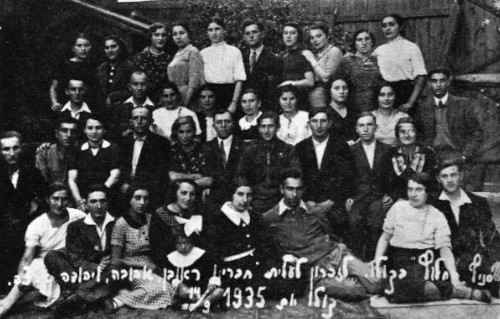
Before the immigration of members of the Tzeirei Zion to Israel First row (right to left): Isaac Volkavitch, p. Yudkevich, Pletzner, Koman, Dobzhynska, A. Zashulowski, Vorone Second row: Rosenthal, Hinde Schulz, Zelig Lachman, Le Mans, Franie Levin, Treiber, Fox Third row: I. Sander, Nasek, M. M. Altresh, Haresh Wallenberg, Barab, Brookstein, Dabzhinsky, Fardanska Fourth row: Lask, Greenbaum, Glitzenstein, Meir Gorky. Fifth row: Yosef Fagel, A. from. Levkavitch |
||||
By Members
Translated by Mira Eckhaus
The immigration to Israel of many members of “Freiheit” testifies to its being a pioneering youth movement, and if the gates of the Land of Israel had not been closed and the difficult conditions had not prevailed during the prolonged training prior to immigration to Israel, then most of the “Freiheit” members from the city of Koło would certainly be with us in Israel.
In 1922, with the establishment of Y. S. A. Y. (Yiddishe Socialistishe Arbetaer Yugent), the youth of Poalei Zion right, the nucleus of this youth movement was also formed in Koło.
Its first members were about ten students of the Hebrew Gymnasium and about two dozen working children. Despite the ridicule of the existing labor parties that the possibility of succeeding for a new youth organization is null, this movement took root because it carved on its banner two slogans that were bound by reality: pioneering and the union of all socialist Zionist youth. And indeed, in 1926, with the union of the Z. S. Y. (the young group of Z. S. movement) with the Y. S. A. Y., the Socialist Zionist Youth Movement “Freiheit” was established.
Among the first members of “Freiheit” in our city were: Gedaliah Lantzitzky (he was a member of Maoz Haim and died young), Yaakov Lipnovsky, Eliezer Levkowitz, Moshe Bornstein, Binyamin Kreitzman, Manie Beirach, Luba Frost, Gershon Cohen, Yarme Podemsky, Leib Butzker, Dvora Dobzinski, David Shmulevsky, Shlomo Gotzman, Avraham Harap, Sander Markowski, Avraham Markowitz, Sarah Paltz, Yatke Kibel, Yatke Wolkowitz, Yosef Fogel, Avraham Lechman, Tzadok Soika, David Shika and Chava Haim.
And these were the main actions of “Freiheit”:
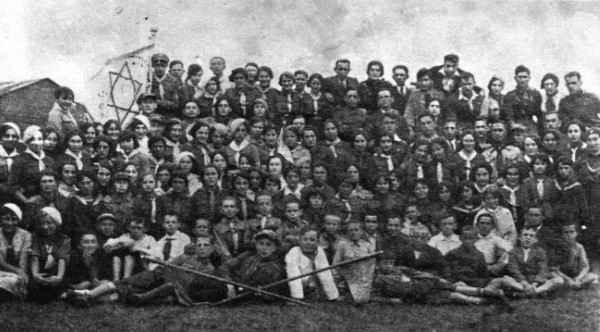
The summer camps of “Freiheit”, which took place far from the city - became a regular thing. Every year dozens of working children participated in them, and sometimes “Freiheit” children from the provincial towns also attended them. Here a little laughter arose on faces that for most of the year were imprinted with sadness and worry. In the vast fields and among the forest trees, all the children straightened up and took on the form of free and healthy people. Many hours were even devoted here to study. Children
[Page 107]
who attended a Polish elementary school learned the shape of the Hebrew alphabet here. What they didn't grasp after a long day of labor, they picked up in the summer camp.
The party members Abraham Leibisch Koninsky and Leibel Luxenburg assisted to the operation of the summer camp project.
The young group of “Freiheit” was the Free Scout Brigade, “Freier Scout”. The party's activists, Akiva Kara, devoted himself to this activity. Every evening, dozens of elementary school children would gather, and they would read the “Kinderland” journal, listen to the lecture of the counselor, as well as sing and play.
During the events of 1929 in Israel, when a severe crisis struck the Zionist movement in the diaspora, the spirit in “Freiheit” was not shaken: not a single boy or girl left the movement in order to join a non-Zionist youth movement. On the contrary, the “Hechalutz” branch was strengthened these days. In 1930, two dozen “Freiheit” members were accepted into the Poalei Zion (Z.S.) party, and as a result, a shortage of counselors was felt in the movement. At that time, the member Avraham Markowitz was sent to the movement's first seminary. Upon his return, he became the lively spirit in the branch.
|
|
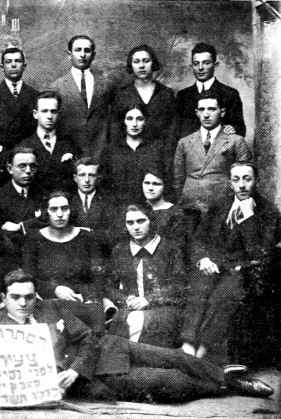
Seating (right to left, bottom): Sander Markowsky, Adek Stupey, Yarme Podemsky, David Shika, Eva Albert, Shia Walkowitz, Gershen Cohen, David Shmulevsky Second row: Yosef Fogel, Luba Frost. Dr. Grosfeld, Dvorah Dobzinski, Eliezer Levkowitz. Avraham Markowitz Third row: Hersh Albert. Michal Padchlebnik, Gedaliah Lantzitzky, Chaytshe Shmulewska, Avraham Harap, Binyamin Kreitzman, Sale Kreitzman, Berish Markowsky Fourth row: Rivka Levin, Shimon Bezshustowski, Berkowitz, Mordechai Lipnovsky, Manie Beirach, Yona Fix |
[Page 108]
He brought the children of the Jewish proletariat in the city closer to the working Land of Israel. His faithful assistant was Sander Markowski, a modest and educated boy, who also influenced the youth with his good qualities. After a day of hard work, the club became his home. While all the children went to their parents' houses, he remained alone and prepared the chapters for the conversations.
Finally, the sporting action of “Freiheit” will be noted. The movement's soccer team was first called “Kraft” and later changed its name to “Hapoel”.
Only about three dozen “Freiheit” trainees survived the Holocaust. Most of them are now in Israel.
|
|
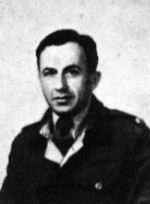
with the member. A. L. Koninsky (in the center) |
By Ezriel Rajchert
Translated by Mira Eckhaus
I will devote a few words to this youth organization, which in the 1930s played a significant role in the Zionist movement in Koło. I was active in this organization, and from it I gained my first knowledge of the new Land of Israel and Zionism.
The “Hanoar Hazioni” Organization was founded in 1928, but the nucleus of the General Zionist Youth Association, which shares the same spirit, was sown in our city in 1929.
At first, our association was named “Herzliya” and we were affiliated with the Lodz center. The first to bring the word of this movement to the students of the school was our member and a resident of our city, York Tempelhof. He was aided by the outreach work of the emissary Meir Lev from Lodz. With the freshness of his language and personal example, York influenced us, the boys and girls, who were searching for a purpose in life.
The results of the outreach work carried out among the students of the gymnasium were not long in coming. Our association was supported by the Torah scholar Moshe Baharav, who was known in the city as a passionate and dedicated Zionist. He served as our teacher and counselor. His lectures on political issues were distinguished by their clarity
|
|
[Page 110]
and depth; his lectures on the Land of Israel and his discussions of ideological problems were like pillars of fire to us. In his talks he made a great contribution to the group of counselors, who later bore the burden of the organization.
Our association was the need of the hour. It grew in Koło after a “vacuum” was created with the liquidation of the “Hashomer Hatzair” nest in an ideological crisis. Embarrassment descended on the nest's founders due to the new winds that were blowing in this movement. The new program of “Hashomer Hatzair” did not find a foothold in Koło. Those who tend to the left found their place in “Poalei Zion” and the “Bund”.
In 1931, all the youth associations of the general Zionists in Poland, who shared similar values and there were no significant differences between them, united, and were since then called the “Histadrut Hanoar Hazioni”. Our association also joined this organization, but due to this merger, several of the activists left the association.
The branch was headed by Aharon (Newtek) Cherniak, who showed great energy and talent. Under his leadership, the members operated until the outbreak of World War II. The following members will be fondly remembered: Dov Klepshevsky, I. Zilberberg, L. Kempinski, G. Yudekevich and R. Shubinska, who worked to elevate the branch and increase the scope of its activities.
|
|
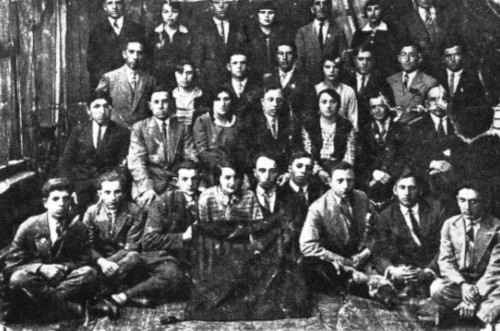
Seating (first row, bottom): Zelig, Treiber, Schulz, R. Setel, Levin Second row: Feldman, L. Kinstler, Bram, Sorek, Peltz Third row: Koenig, Wegoiser, Wiener, Kutnovsky, Gutman, Sibusch, Feldman, Rosh, Schulz Fourth row: H. Szoldowska, Kinstler, Zalmanovitz, Kempinska, Kreitzman, Wiener, - - - Bezshostovska, Kenig, Koninska Fifth row: Blum, Kreier, Schika, Schulz, Schulz, Schwarz, Silberberg, Silberberg, Krause |
[Page 111]
It should be noted that most of the members of the “Hanoar Hazioni” came from local schools, from the upper classes, and their education influenced the level of society. The branch uprooted the tendencies towards assimilation and instilled national recognition in the hearts of young people who were far from Zionism.
The branch had additional goals: we trained members for agricultural life in the country and sent them to training kibbutzim. Upon completion of their pioneering and professional training, they immigrated to Israel through legal and illegal means. One of the important cells in the branch was the cell of the “Hechalutz Haclal Zioni”, which was founded on the initiative of our friend B. Sibush.
In the years 1930-1934, our Histadrut had 250 members, and our branch was one of the most active and vibrant branches in the movement.
During the Holocaust, our members were scattered in all directions, they were active in the ghettos, the underground, and the forced labor camps. Only a few survived and, after long wanderings, immigrated to the land of their longings. We will remember our friend Yehuda Gotlibowski, who immigrated to Israel in 1939 and was among the founders of Kibbutz Nitzanim. During the siege, during the War of Independence, he fought and defended the farm and fell on his watch.
|
|
|
|
JewishGen, Inc. makes no representations regarding the accuracy of
the translation. The reader may wish to refer to the original material
for verification.
JewishGen is not responsible for inaccuracies or omissions in the original work and cannot rewrite or edit the text to correct inaccuracies and/or omissions.
Our mission is to produce a translation of the original work and we cannot verify the accuracy of statements or alter facts cited.
 Koło, Poland
 Yizkor Book Project
 JewishGen Home Page
Copyright © 1999-2026 by JewishGen, Inc.
Updated 09 Feb 2026 by JH