|
|
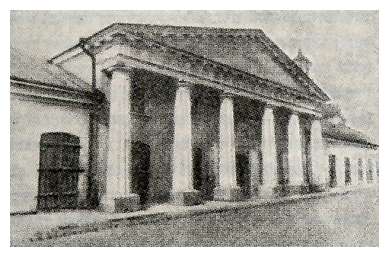
| The Ratusz, the ancient town hall, viewed from the south on the Sabbath, when the shops were closed |
|
|
[Column 44]
Translated by Guillermo Levrio
The Jews of Grodno escaped the massacres of 1648–1649, but nearby communities in its district, including Lida and Ostryna, were struck, and many refugees from the sword found shelter in Grodno. R. Nathan Neta Hannover, author of Yeven Metzulah, an account of the persecutions, writes: “The people of the Lithuanian lands fled to the holy community of Vilna and to the great holy community of Horodna, and there the enemy did not come.”[1]
Meir ben Samuel of Szczebrzeszyn's Tzok Ha-Ittim, likewise devoted to those persecutions,[2] relates that “workers of iniquity and worthless men who remained in the land of Lithuania plundered every last coin from the Jews and killed them with a sharpened sword,” and that “the people of the countryside feared and trembled; some hid in the holy community of Horodna.”
At its sessions of 1649 and 1650, close upon the massacres, the Council of the State of Lithuania called upon the communities to aid the refugees: to provide communal support to those left with nothing, especially women, and to help those capable of supporting themselves become established and maintain a livelihood in their new places. At its next meeting, on the sixth of Tevet 1654, the council decided “to maintain two thousand souls in our State of Lithuania” because of “the multitude of poor and destitute people driven from their country and their estates by the afflictions that passed among the nations. They wander and are cast about, stripped of everything, literally hungry and thirsty, and the overwhelming majority go barefoot and naked, without clothing or garment.”
Every community and settlement was required to maintain a number of refugees for five months: “for every half-złoty in its state assessment, it shall support one person,” and an equal number “according to an estimate of the community's means.” In addition, refugees living in the country who could support themselves were not to be prevented from residing there or from undertaking “whatever commerce they wish for their life and sustenance.”[3]
At that meeting the Grodno community was assessed an internal council levy of thirty-six Lithuanian shocks and twelve gedolim,[4] or about ninety-one złoty[5]. Grodno was therefore required to support 182 refugees according to its assessment and an equal number according to its means, a total of 364 persons–more than eighteen percent of the quota for the entire State of Lithuania[6]–at a time when Grodno's total Jewish population numbered only a few thousand.[7]
Between One War and the Next
From 1655 to 1657 the Jews of Grodno suffered during the Russian occupation of the city. The Christian townspeople took advantage of the change of regime and
[Columns 45-46]
tried to persuade the new authorities either to expel the Jews or at least restrict their right to trade. Grodno was then occupied by the Swedes from 1657 to 1661. The prolonged wars brought epidemics to the city, while its inhabitants suffered requisitions and various contributions that impoverished the community and greatly increased its debts.
During his reign from 1669 to 1673, King Michał Korybut Wiśniowiecki of Poland confirmed the previous rights and charters of the Jews of Grodno. Under King John III Sobieski, from 1674 to 1696, they enjoyed a brief period of tranquility. The city's standing revived in his reign when, beginning in 1678, sessions of the Polish Sejm were held there to aid its reconstruction and for political reasons. Among other matters, the Sejm that year confirmed in Grodno the Treaty of Andrusovo concluded between Poland and Muscovy in 1667.
These sessions of the Sejm and their accompanying gatherings, however, greatly intensified the problem of accommodating officials and other visitors. Even at the assembly of 1678, Grodno lacked sufficient lodgings for the deputies, some of whom left before it ended. The Jews, who supposedly “seized” costly dwellings and filled them to capacity, appear to have been blamed. As early as 1633, King Władysław IV had justified his prohibition against the Jews of Grodno acquiring new houses or enlarging old ones by citing “their excessive concentration in this city and the harm caused to Christians.” King Sobieski further restricted the Jewish residential area in Grodno and forbade Jews to settle on plots subject to municipal jurisdiction.[8]
The hostility directed against the Jews caused the communal leaders deep concern. They too forbade members of the community to establish “their residence in the houses of gentiles,” especially near the market, and the Council of the State of Lithuania reinforced these prohibitions at several meetings.
Many violators nevertheless “broke through the fence of the enactments” and transgressed the bans and excommunications. In 1679, after Grodno had become “a royal city trodden by many great princes,” and lest “the nations rage and the peoples devise a vain thing, Heaven forbid, against our brethren the Children of Israel–and who knows what may result and whether some evil may spread to the entire state,” the council again ruled that any Jew lodging in a gentile house, even temporarily, or building on a gentile plot, would be placed under ban. The only exceptions were properties belonging to members of the nobility and therefore outside municipal jurisdiction.[9]
The Great Northern War reached Grodno in 1705. Russian, Saxon, and Lithuanian armies concentrated in the city; Swedish forces besieged it and later destroyed it after a campaign lasting several years. In 1740 a plague struck the city and killed many inhabitants.[10] As in every time of war, turmoil, and epidemic, the Jews of Grodno suffered, and many left the city for nearby towns or more distant places. One contemporary record states that Grodno “remained empty.”[11] In addition to these disasters, a fire in 1748 caused widespread damage.[12]
False Accusations and Blood Libels
The Jews of Grodno suffered greatly in the seventeenth and eighteenth centuries from Jesuit persecution and the false accusations leveled against them.
They were accused of witchcraft and of plotting to desecrate the sacred bread, the Host. In 1675 Grodno's clergy claimed that, contrary to the obligation imposed by a 1662 agreement, the Jews had not blocked the windows of their shops facing the parish church and the old market through which Catholic religious processions carrying the Host passed. The Jesuits further complained that the Jews had not even installed glass panes in those windows, allegedly in order to mock the sacred objects of Christianity.[13]
The Jesuits of Grodno also made an entertaining pastime of kidnapping Jewish children and imprisoning them in their monasteries for baptism and conversion. Friedenshtein relates that this abomination embittered the Grodno community. Like other Lithuanian Jews of the period, it had to ransom the children by appeasing the kidnappers with bribes–the very object of their tormentors' desire. When ready money no longer satisfied the Jesuits' appetite, the community was forced to issue promissory notes for the ransoms, at exorbitant interest, and sank into enormous debts from which it could not free itself for generations.[14]
In 1667, the Pinkas of the State of Lithuania records, a “murderous act of revenge” on a religious background occurred “at the time of an assembly” in Ozery near Grodno.
The Jews of Grodno were not spared blood libels either. R. Aryeh Leib Epstein, a native of Grodno and rabbi of Königsberg, describes one such accusation in 1731 in his Sefer Ha-Pardes. He adds that one of the community's leaders, R. Zalman ben Chaim, and several other residents were forced to leave the city, and that “the property of householders collapsed and they lost their wealth; they were compelled to borrow tens of thousands, besides all the other afflictions, one trouble joined to the next.”[15]
Traditions concerning blood libels in Grodno during the first half of the eighteenth century were preserved among its Jews for generations. Shimon Eliezer Friedenshtein records them,[16] as did the late Rabbi Yehuda Leib Ha-Kohen Fishman, later Maimon,[17] from accounts he heard from Grodno's elders during a visit at the end of the nineteenth century. According to the tradition received from their forefathers, the rabbi writes, the vile accusation recurred
[Columns 47-48]
in Grodno from time to time while R. Mordechai ben Yehoshua Halevi Epstein served as a communal leader from 1700 to 1733. R. Mordechai spent money in every direction to clear his community of the blood libel.
Economic Struggle and the Burden of Debt and Taxes
The prolonged and frequent wars dealt Jewish commerce a severe blow. Many Jews found a foothold in the brewing and fermentation of alcoholic drinks–spirits, mead, and beer–and in tavern keeping. Under an agreement with the municipality,[18] the Jews of Grodno obtained a monopoly on the beverage trade and became the city's principal producers.[19] In time, however, municipal leaders began distilling and serving spirits themselves. The Jews resisted in various ways, including by force,[20] and conflict between the townspeople and the Jews spread into this field as well, especially during the first half of the eighteenth century.[21]
Records from the end of the seventeenth century still mention several Jewish merchants from Grodno who traveled on business to the fairs at Leipzig[22] and Frankfurt an der Oder. Among them was Eliezer ben Moses, known as “the officer R. Leizer,” meaning the wealthy and distinguished R. Leizer. Described in the records as the king's secretary and broker, he received from King John Casimir in 1649, “as a universal favor,” the right to engage freely in tavern keeping, brewing beer, distilling spirits, and fermenting mead.[23] In 1660 he was granted the lease of customs revenues in the Brisk Voivodeship and collection of taxes from the nobility throughout Lithuania.[24]
R. Leizer was also among those who lent large sums for the needs of the Council of the State of Lithuania.[25] He was one of the three “heads of the Jews of Grodno” who appeared before King John Casimir in 1649 to secure renewed confirmation of the right to rebuild the synagogue on the site of the one destroyed by fire and to reconstruct houses on Jewish Street, which had also been damaged.[26]
At the end of the seventeenth and throughout the eighteenth century, the Christian townspeople's economic struggle against the Jews of Grodno intensified in every sphere.
In 1698 King Augustus II granted a privilege to Grodno's Christian fishermen's guild forbidding Jews to trade in fish of any kind, whether live or prepared.[27]
In 1718 the Grodno municipality obtained a royal order once again prohibiting Jews from building new houses or enlarging old ones and requiring them to return to Christians houses and plots under municipal jurisdiction that they had previously purchased. The order forbade Jews to buy or lease immovable property, or accept it as security for a debt, and prohibited them from employing Christian servants and laborers. The purpose of this last decree was to preserve the labor force required by the nobility on their estates.
Christian merchants from other cities were also forbidden to trade with the Jews of Grodno. Jewish buyers who went out to the roads beyond the city and purchased produce being brought to market were forbidden to leave Grodno before nine o'clock in the morning.[28]
Despite this royal order, the matter repeatedly resurfaced. The Jews of Grodno found various ways–including organized resistance backed by a threat of communal ban against anyone who refused to comply–to oppose the enforcement of such decrees, frustrate them, or weaken their effect.
In 1727 Grodno's townspeople again complained that their Jewish competitors did not obey the law, the enactments of the Sejm–from which many of the economic decrees against Jews originated–or official orders; that they left the city before nine to purchase foodstuffs; and that they prevented the townspeople from brewing spirits or beer for their own use or for sale.[29]
In 1730 the Grodno municipality repeated these accusations. It further alleged that Jews drove up prices when purchasing and taking delivery of goods; undercut the prices fixed by the municipality through the use of false weights and measures; enticed Christian servants by offering them higher wages; failed to pay municipal levies on their plots and lots; and prevented Christians from engaging in tavern keeping.[30]
|
|
| The Ratusz, the ancient town hall, viewed from the south on the Sabbath, when the shops were closed |
The municipality also complained about the leaders of the Jewish community. When it erected a new building to replace the old town hall (the ratusz in Grodno's central square), before the convening of
[Columns 49-50]
the Sejm in the city, it discovered that the Jews had erected numerous shops without permission against the wall of the old town hall, making it impossible to set up the scaffolding required for construction. When the builders began dismantling the wall, the Jews drove them away with stones and bricks. When the mayor was brought to the scene, they surrounded him amid an uproar and beat him severely; the builders barely managed to rescue him. In a later complaint the municipality alleged that the Jews had not merely prevented the wall from being demolished, but had also erected seven new commercial buildings beside the old town hall.[31]
This time the authorities defended the Jews. Since the Christian townspeople of Grodno, without waiting for the dispute between the Jews and the municipality to be adjudicated, had taken violent action against their adversaries and destroyed their shops, King Augustus II placed the Jews under his protection and forbade the townspeople to harm them.[32]
Two years later, in 1732, the Jews protested that the orders were not being enforced and that the municipality was violating the monopoly on the spirits trade held by Grodno's Jewish tavern keepers.[33] In 1741 the municipality once again brought against the representatives of the local kahal the accusations already listed above.[34]
Alongside the townspeople's economic pressure and the debts left by the wars, the burden of taxes and payments imposed upon Lithuania's Jews also increased during the eighteenth century. The total poll tax levied upon all Lithuanian Jews had amounted to 9,000 złoty in 1613. It rose to 12,000 in 1649, to 20,000 in 1680, and finally, as noted above, to 60,000.[35]
From the “Brisk assembly” of the “counts and heads of the principal communities” of Lithuania in 1713 onward, the Grodno community and its district were required to pay 4,400 złoty of that total, or 7.3 percent.[36] At the “small assembly” held in Horodna in 1727, its assessment was 5,235 złoty, or 8.7 percent of the whole. By comparison, Brisk and its surroundings were assessed 4,965 złoty, Pinsk and its district 4,308, and Minsk and its district 6,206. Approximately the same proportions remained in force until the final assessment adopted at the Slutsk Council in 1761.[37]
The burden became so heavy that many individuals, and even entire communities in the Grodno district, fell behind in paying what they owed to the communal treasury. In 1713 the anxious leaders obtained permission from King Augustus II to collect debts from Jews under the jurisdiction of the Grodno community even when those debtors were outside the boundaries of their own settlements.[38]
When the Jews of Grodno could no longer discharge their obligations, the district nobility–who generally joined the townspeople in harassing the Jews and dislodging them from their economic positions–authorized their deputies to the Sejm in 1720 to support the efforts of the “impoverished and scattered” Jews of Grodno, so that they might meet their commitments to their creditors, including the nobles themselves.[39]
This support was made conditional upon the abolition of the chazakah, the exclusive right granted by the community. The nobles even demanded that communal leaders who violated the prohibition be subject to the death penalty. In effect, this was another attempt by the nobility to eliminate an institution that, to their financial disadvantage, prevented Jews from competing with one another for leases such as taverns and similar enterprises. The Grodno community, like the other communities, did not retreat. It continued to confirm chazakot, which amounted to monopoly rights, in return for payments that provided an important source of communal revenue and strengthened the community's authority.[40]
The enormous debts that weighed upon the Grodno community, impoverishing and strangling it, nevertheless forced its leaders to continue taking short-term loans in order to meet earlier obligations that had become urgent. Because the community's capacity to repay was already doubtful, its creditors dictated whatever terms they wished. This is evident in a record from 1742 concerning a loan of approximately ten thousand złoty that the Grodno community received from a nobleman in Volkovysk for one year at ten percent interest.[41]
As security, the communal leaders transferred to the lender all revenue from the korobka, also called the krupka: a communal levy on kosher meat, candles, and other necessities. The name is believed to derive from krupa, groats, on which the tax was first imposed.[42]
The guarantee for repayment extended to all the community's other income and property, including its wells, synagogue, and bathhouses; collectively to every member and to all income they received from any source and in any place, including abroad; and to all their movable and immovable possessions, including equipment, livestock, household goods, and clothing. Above all, it bound “their own persons, their wives, their children of both sexes, and their descendants.”
If the Jews did not repay the debt, the record stated, the creditor was entitled to take possession of all the income and property named above. He could also seize and imprison every guarantor, individually or collectively, and hold them until the debt was repaid, without such action being regarded as coercion. The communal leaders further undertook on behalf of all the members that, should any dispute or litigation with the creditor arise in this matter, the community would seek protection from no authority or person whatsoever. The creditor, for his part, was free to appear against them with his promissory notes before any court he chose.
[Columns 51-52]
Horodna–A Great Center of Torah
In the seventeenth and eighteenth centuries, and afterward as well, the Grodno community became renowned for its houses of study and yeshivot, crowded with students, and for the rabbis, halakhic authorities, judges, heads of academies, and scholars who lived there.
The first rabbi to serve as head of Grodno's rabbinical court and academy in the period under discussion, following the massacres of 1648–1649, was R. Jonah ben Isaiah Teomim, author of Kikayon de-Yonah. Born in Prague around 1596, he came from there to Kraków, where he maintained an academy in his home and supported many students. He later served as head of the rabbinical court and yeshiva in Nemyriv, Luboml, and Belz before assuming the rabbinate of Grodno, where he also taught in the yeshiva.
From 1644 to 1655 his signature appears in the place assigned to Grodno's representative on enactments of the Council of the State of Lithuania. He was invited from Grodno to the rabbinate of Pinsk, but the succession of massacres, killings, and fires that overwhelmed the Jews there caused him to leave Poland. He went first to Vienna and was later called to serve in Metz, where he died in 1669. After fifty-three years of teaching Torah among Israel, he left thousands of disciples who had studied under him.[43]
R. Moses, son of R. Nathan Shapira, author of Megalleh Amukot, was appointed rabbi of Grodno after R. Jonah Teomim. He is recorded as the third signatory in the Pinkas of the State of Lithuania on a ruling of the Chomsk Council of 1652 and on the enactments of the Selts Council of 1655. He died in 1665.[44]
R. Isaac ben Abraham, a disciple of R. Jonah Teomim, served as rabbi of Grodno after R. Moses ben Nathan Shapira. In 1664 he signed an approbation as “head of the rabbinical court of the holy community of Horodna.” He later became rabbi of Poznań and was known in his day as “R. Isaac the Great” for his mastery of both the revealed and esoteric teachings. He possessed a great treasury of books, including manuscripts by early authorities.[45]
R. Judah ben Benjamin Wolf of Tropa served in Grodno after R. Isaac ben Abraham. He signed enactments of the Council of Lithuania in 1664; in one of them he appears under the designation “the district of Horodna.”[46]
R. Chaim Chaika ben Samuel Halevi Horowitz succeeded R. Judah. His signature appears on enactments of the Council of Lithuania from 1667 through 1673.[47]
R. Moses ben Abraham, “of the line of Tzvi,” author of Tiferet le-Moshe on Yoreh De'ah and glosses on the Talmud, served as rabbi of Grodno after R. Chaim Chaika ben Samuel Halevi Horowitz, apparently from 1673 until 1681. He may already have been head of Grodno's rabbinical court and yeshiva in 1653.[48] He signed rulings of the Council of the Four Lands at Lublin in 1670 and at Łęczna in 1681,[49] as well as a series of enactments of the Council of Lithuania in 1676 and 1679.[50]
The council owed him considerable sums of principal and interest. He left a bequest “for a kloyz of the holy community of Horodna, for the Great House of Study.”[51] His widow added to the bequest and “built a magnificent house of study, a structure of upper and lower stories raised like a landmark.” He died and was buried in Grodno.
From 1683 to 1691, R. Mordechai Ziskind ben Moses Rothenburg served as rabbi of Grodno. He had previously been head of the rabbinical court in Witzenhausen in Hesse and, from 1691 until approximately 1714, served in Lublin. One of the leading scholars of his generation, he wrote Responsa of R. Mordechai Ziskind Rothenburg, published in Amsterdam in 1716, a work containing historical information about Jewish life in the seventeenth century. His signature appears on enactments of the Council of Lithuania and later of the Council of the Four Lands. He signed approbations in Grodno from 1688 through 1692.[52]
From 1691 to 1714, the Grodno rabbinate was occupied by R. Simcha ben Nachman Rapoport, also known as Lifshitz. He had previously served in Rovno and left Grodno to become head of the rabbinical court of Lublin and its district. He died in Szczebrzeszyn in 1718 while traveling to Lwów, where he had been invited to assume the rabbinate. His name appears among the signatures of the Council of Lithuania and the Council of the Four Lands, and on approbations to books issued in Grodno from 1689, when he signed at Dubno-Horodna, through 1710.[53]
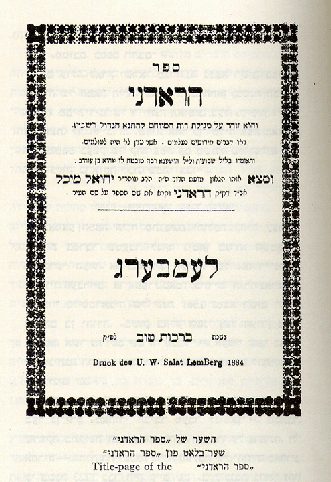
It appears that at the same time as R. Simcha Rapoport, another rabbi named Yechiel Michel also served as head of the rabbinical court in Horodna. He was the author of Sefer Ha-Radani, a commentary on the Zohar's treatment of the Scroll of Ruth, published in another edition under the title Midrash Ha-Ne'elam in the Zohar Chadash. The man who brought the work to press named it after the city in which its author had served as rabbi. The booklet first appeared in Amsterdam in 1712.[54]
After R. Simcha ben Nachman left Grodno for Lublin in 1715, R. Baruch Kahana Rapoport, known as R. Baruch Harif, was invited to serve as rabbi of Horodna. He had been head of the rabbinical court of Vilna and was then living in Fürth, Germany. According to Rechovot Ir, he did come to Grodno in 1718 and signed an enactment in the register of the burial society, but returned to Fürth after a short time. R. Aryeh Leib Epstein, a native of Grodno who later served as rabbi of Königsberg, relates in Ha-Pardes, citing his teacher, that R. Baruch also preached in Grodno but “did not wish to leave Germany.” In approbations he issued during this period,[55] he signed: “Baruch Kahana Rapoport, residing in the holy community of Fürth, whose authority extends over the holy community of Horodna and its district in the State of Lithuania.”[56]
After R. Baruch Kahana Rapoport declined the invitation to assume Grodno's rabbinate, the community remained without a chief rabbi for about two years. The first signature on an enactment of the Council of Lithuania adopted at its session in Indura in Shevat 1720 is that of “Aryeh Leib, chosen by the holy community of Horodna.”
[Columns 53-54]
|
|
| Title page of Sefer Ha-Radani |
Records show that in the same year[57] the authorities reprimanded Grodno's communal leaders for electing a rabbi without the king's consent.[58]
R. Aryeh Leib ben Nathan Neta of Slutsk, teacher of R. Aryeh Leib Epstein, author of Ha-Pardes, served as head of the rabbinical court and yeshiva in Grodno from 1720 to 1729. In 1725 he signed an approbation there. He died in Grodno in 1729.[59]
He was succeeded on the rabbinical throne of Grodno by his son, R. Zechariah Mendel ben Aryeh Leib. Born in 1707, he began serving in 1729 at only twenty-two years of age and remained in office until his death in Grodno in 1746, at the age of thirty-nine.[60]
His successor was R. Yechiel Michel Margoliot, who served as rabbi and head of the yeshiva of Horodna from 1746 to 1752. He had previously lived in Kraków. Tradition in Grodno, where he died and was buried, and the accounts in Shivchei Ha-Besht relate that he attended upon the Ba'al Shem Tov, who encouraged him to seek the rabbinate of this city and even accompanied him there for that purpose.[61] One of his halakhic replies to the rabbis of his generation is preserved in Teshuvat Shmuel by R. Samuel ben Joseph, rabbi of Indura, published in Vilna in 1859.
After R. Yechiel Margoliot, R. Moses Joshua ben Samuel Shmelke Segal Horowitz served as rabbi and head of the yeshiva of Grodno and its district. He was renowned in his generation, and his approbations appear on works by the leading scholars of the time alongside those of the Vilna Gaon and R. Jonathan Eybeschutz. During the controversy between R. Jonathan Eybeschutz and R. Jacob Emden, R. Moses Joshua supported Eybeschutz and took part in the Council of Yaroslav that considered the dispute. He signed the Pinkas of the State of Lithuania several times in the enactments of 1761 as “residing in the holy community of Horodna,” and signed approbations in Grodno from Tishri 1761 through 1784.[62]
Among the Torah scholars who taught in Grodno during this period, the following should be noted.
R. Aryeh Leib Epstein, author of Ha-Pardes, was one of the great Torah scholars of his generation. He was born in Grodno in 1708 to R. Mordechai ben Yehoshua Halevi, a communal leader who, as noted above, devoted his strength and fortune to clearing his community of a blood libel. R. Aryeh Leib studied under R. Aryeh Leib, rabbi of Slutsk and later of Grodno, and served as preacher in Horodna's Great Synagogue and Great House of Study until 1741.
He was then appointed rabbi of Königsberg, where he taught Torah and wrote numerous works on the commandments, halakhah, Kabbalah, and ethics. The most important of them is Ha-Pardes, in which he described his city Horodna in a play upon its name: “the city perfect in beauty, Horodna, where Torah and greatness dwell together.” His books are a valuable source for the study of Jewish life in his period and contain important and rare information concerning Jewish Grodno. He died in Königsberg in 1775.
One of the leading members of Grodno's rabbinical courts during this period was R. Elisha ben Abraham, author of Kav Ve-Naki, a concise commentary on the Mishnah that includes halakhic indications and explanations of words. The book was first printed in Amsterdam in 1664 and later appeared in various editions,[63] among them a Grodno edition of the orders Zera'im, Mo'ed, and Nashim in 1792–1793. He died in Grodno in 1749.
Other Grodno scholars of the period included R. Elchanan Berliner, known as “R. Elchanan Ba'al Tosafot,”[64] and Samuel ben Moses Dlugacz, editor and commentator, author of Sefer Ha-Maggid with Rashi's Commentary, a German Translation, and Aggadot Shmuel on the Twenty-Four Books, published in Amsterdam in 1699.
Grodno's scholars occupied an honored position among their colleagues. The Council of the State of Lithuania placed particular confidence in the community's judges.[65] When the celebrated dispute between the Vilna community and R. Samuel ben Avigdor, the city's last chief rabbi, broke out in 1770, the rabbi appealed to the Grodno community.
[Columns 55-56]
Grodno intervened forcefully and asserted its authority over the Vilna community in the matter.[66]
At approximately the same time, Grodno's first societies devoted to the study of sacred texts were established: the Talmud Society in the 1730s and the Mishnah Society around 1760. Both remained renowned in the city for generations.
A craftsmen's synagogue for tailors, beside the Great House of Study and with its own instructor, is first mentioned in Horodna in the 1730s.[67] This suggests that by then those who worked with needle and thread had already felt the need to unite in a distinct body, undoubtedly an artisans' guild.
Grodno became famous not only for the Torah spread there by great scholars. Halakhic instruction and the “Horodna custom,” regarded as an established and authoritative tradition, went forth from the city and were followed even by distant communities throughout the Jewish Diaspora, according to competent authorities. One of them added that no one should be astonished or see exaggeration in the name “Ha-Radani” applied to the city, for it was entitled and worthy to bear that name.[68]
Echoes of the Sabbatean Movement
The Grodno community also produced an advocate of the messianic movement of Sabbatai Zevi: the “herald” R. Zadok ben Shemaryahu of Horodna, who appeared around 1695.[69]
R. Jacob Emden writes of this Sabbatean prophet in Torat Ha-Kena'ot, page 56, on the authority of his father, the Chacham Tzvi, who had known him: “Before the company of R. Judah the Pious and its messianic propaganda, a man came from Lithuania called R. Zadok. He prophesied that the Messiah would come in 1695 and composed allusions to it.”
Several documents containing R. Zadok's words, together with an account of him by one of his associates, have since come to light.[70] The priests in his city wished to imprison him until Rosh Hashanah 1696, and the community sent him away because of the danger. He apparently wandered to Germany. Reports about him spread through Poland, Silesia, Moravia, and Bohemia and reached Italy as well.
Moses ben Aaron Ha-Kohen of Kraków, who converted to Christianity in 1696 after his disappointment with R. Zadok's tidings, wrote of the excitement stirred by his propaganda: “Was there not a great commotion among the Jews in 1695? Did they not empty their houses and sell their property? They slaughtered their cattle and bought provisions for the journey, in order to ascend with the Messiah to Jerusalem.”
It is also known that during the years surrounding the activity of R. Zadok the “herald,” from 1683 to 1694, an emissary from Hebron, R. Abraham Kobenki, traveled through the communities of Europe. He was an ardent Sabbatean and one of the most important emissaries sent from the Land of Israel at the end of the seventeenth century. Among the places he visited were “the State of Lithuania and Reisen, Brisk, and Horodni,” whose Jews satisfied him “with their bounty, silver, and gold.”[71]
A man from Grodno who settled in the Land of Israel in the second half of the seventeenth century is also recorded: R. Leib Hazzan, who arrived in 1666 and had studied in Grodno under R. Jonah Teomim, author of Kikayon de-Yonah. R. Leib later served as an emissary from Safed in Germany. During litigation over a matter between the Safed community and an emissary in Jerusalem, R. Leib revealed a pronounced sympathy for Sabbatai Zevi.[72]
The Community Across the River, Beyond the Niemen
In the middle of the eighteenth century an independent Jewish community gradually took shape in the suburb on the left bank of the Niemen. In Hebrew it was known as the city's migrash, or as Achori-Nahar, “Across the River,” abbreviated Acho”n. In Grodno Yiddish it was called the fershtat.
The lustration of 1561 already records a Jew named Abraham ben Judah “in the market, in the second part of the city beyond the Niemen, who settled there some time ago,”[73] although King Sigismund Augustus granted the townspeople permission to settle there only in that same year.[74]
Another Jew, Eliezer ben Moses, is mentioned in 1653 as the owner of a vegetable garden “behind the royal game preserve beyond the Niemen.”[75] It seems that precisely during and after the disasters that befell Grodno in this period, an increasing number of Jews began to settle in the suburb. By 1723 a “large synagogue” already stood there and regular services were held in it, according to the register of the Everlasting Light and Students of Ein Yaakov Society in the suburb.[76]
The author of Ha-Pardes tells of “a prominent Jew from the holy community of Königsberg, may its Rock protect it,” who in 1735 “traveled from his home to the State of Russia,” undoubtedly on business, and lodged “beyond the River Niemen,” that is, in the suburb.[77] This is unsurprising: lying beside the Niemen, the suburb stood upon a route of the expanding trade that ran from Warsaw in the west to the river in the north and onward to Prussia.
In 1741 the Grodno community complained to the authorities that the Jews of the suburb refused to pay their share of the royal taxes to the Horodna community, even though they were required to belong to it “by force of the royal charters granted to the community in this city at the time of its foundation.”
According to the complaint, the Jews of the suburb first built a small synagogue for themselves and later established a slaughterhouse for cattle and poultry. They began conducting wedding ceremonies and circumcisions despite prohibitions issued by the communal leaders in the city. Moreover, they sought shelter under the jurisdiction of Treasurer Sołłohub, within whose territory they lived,[78] in order to avoid paying what they owed to the Grodno community. They did so although they derived considerable profit from
[Columns 57-58]
extensive trade in the city in beverages, grain, other goods, and products made from malt.
It should be remembered that, as already noted, the Grodno community was then submerged in debt, and affiliation with it entailed bearing a heavy burden. At the same time, the large communities commonly tried to lighten their own load by placing disproportionate taxes and payments upon their “surroundings”: the small settlements, including suburbs, under their authority. There is no reason to assume that Grodno behaved differently.
At the beginning of the eighteenth century, communities in the Grodno district, led by Indura as their elected representative, had also rebelled against it. They cast off the authority of the metropolitan community and declared themselves an autonomous district administration centered in Indura and under its rabbi. In 1720, however, the treasurer intervened against this separation of the district from the principal city of Grodno and restored the previous arrangement.[79]
The Across-the-River community did not become entirely independent of Grodno until many decades later. In the meantime, it continued developing its internal communal life. In 1767 the Mishnah Society Beyond the Niemen of the Holy Community of Horodna was established there, as attested by its surviving register.[80]
In 1789 the time also came for the Across-the-River community to free itself from dependence upon the community in the city. After persistent efforts and the expenditure of large sums, it obtained the consent of “the great duke Potocki” and “the great bishop” of Vilna, Massalski, for a plot of land to be set aside locally as a cemetery.
The need for a cemetery in the suburb had long been felt because of the poor communications with the city: a ferry crossed the Niemen in summer, a road over its frozen surface in winter, and during the thaw the suburb was completely cut off.
Nor was that all. “We did not possess liberty or freedom to establish a place for a cemetery,” relates the introduction to the register of the Across-the-River burial society, founded in 1789.[81] “Until now we were compelled to carry our dead and convey them across the River Niemen. Several times they nearly reached the gates of death and encountered immense danger, for it was necessary to take them past many of their houses of prayer, and the bearers of the bier risked their lives from the stones hurled at them.”
In addition, for forty years before 1789, “the holy burial society was obliged to give the Franciscan hospice an ox or cow every year, because our dead were taken by that route to the cemetery.” The record therefore blessed Him “who changes the times” for delivering the community from these “cruel and terrible sufferings.”
Even after permission was granted to bury the dead in the suburb itself, it came with a condition: funerals were to take place between sunset and daybreak, quietly and without public display.[82]
In the course of time the Across-the-River community reunited with the community of Grodno as a whole. The suburb nevertheless retained its distinctive character for generations, together with institutions parallel to those in the city proper. By a turn of fate, one of them–the cemetery–has survived as the last Jewish communal institution serving the few Jews who live in Grodno today. We shall return to this subject later.
|
|
|||
Original footnotes
|
|
JewishGen, Inc. makes no representations regarding the accuracy of
the translation. The reader may wish to refer to the original material
for verification.
JewishGen is not responsible for inaccuracies or omissions in the original work and cannot rewrite or edit the text to correct inaccuracies and/or omissions.
Our mission is to produce a translation of the original work and we cannot verify the accuracy of statements or alter facts cited.
 Hrodna, Belarus
 Yizkor Book Project
 JewishGen Home Page
Copyright © 1999-2026 by JewishGen, Inc.
Updated 27 Oct 2026 by JH