 |
|
|
[Columns 17-18]
Chaim Keshales
The Jews in Bulgaria up until the year 1898
[Columns 19-20]
[Columns 21-22]
To the first settlers among Bulgarian Jews in Israel, to the first Zionist activists in Bulgaria who took
a leading role in laying the foundations for the realization of the idea of the State of Israel.
[Columns 23-24]
[Column 25]
Translated by R. Yehuda Aharon Horovitz
Edited and donated by Matthew Brown
We do not have historical or archaeological sources that would allow us to answer with certainty the question: When did the first Jews settle in Bulgaria?
The Bulgarian historian Prof. Zlatarski writes in his book on the history of Bulgaria that the first Jews came to the Balkan Peninsula and settled on Bulgarian soil in the 8th and 9th centuries. However, this hypothesis of his is refuted by a series of historical sources and archaeological remains found near Gigan and Vidin, which we will discuss later.
The great Jewish historian Rosanes, born in Bulgaria,[1] claims that according to many ancient sources, the first Jews settled in Romania - then Byzantium and, presumably, also in Mysia - today's Bulgaria - as early as the days of the kings of Israel, during the First Temple period, in the 6th century BC. Rosanes also refutes the claims of historians who believe that the first Jews settled in the Balkan Peninsula, including Bulgaria, after the destruction of the Second Temple in the 1st century AD.[2]
Many historians find hints in the books of the prophets that indicate the presence of Jews in these places. Evidence of this is also found in the book of Ezekiel. From the books of the prophets, it can be concluded that the Jews who lived in Palestine at that time knew about the lands to their north; after all, they are the territories of the Balkan Peninsula today, and perhaps even lands further north. It is assumed that the Jews of Palestine became acquainted with these lands during their trade trips, and there were also Jewish settlers who would pass on information to their relatives in Palestine about what was happening there.[3]
The historian Hasdai came to the conclusion, based on coins discovered in archaeological excavations, mainly from the Second Temple period, in the territory of Romania, that there were Jews in present-day Romania from ancient times. If we accept his assumption, there is reason to believe that at that time there were also Jews within the borders of present-day Bulgaria.[4]
In his study “The Commercial History of the Jews in Ancient Times,” Professor Herzfeld confidently assumes that the first Jewish settlers in the Balkans came together with the people of Tyre and Sidon, or separately from them, and that they took part in the establishment of the first merchant settlements in the Balkans on the shores of the Adriatic and Mediterranean Seas.
The role of the people of Tyre and Sidon in the development of seafaring and trade in this ancient period is well known. It is a historical fact that those brave sailors also built many cities along the shores of the Mediterranean Sea, and probably also on the shores of the Black Sea. The state of the Sidonians existed during the First Temple period within the borders of the present-day state of Lebanon. The people of Tyre and Sidon were close in language to the people of Israel. Our people had an economic structure
[Column 26]
similar to that of Tyre and Sidon. The basis of the economic life of both peoples was agriculture. However, the possibilities for agriculture among the Sidonians were very limited and they were forced to seek other sources of livelihood. Thus, they also became the first sailors and merchants known in history.
The economic development in Tyre and Sidon had an impact on the neighboring people of Israel. The tribes of Asher and Zebulun lived in the north of Palestine, near the Sidonians. It is known that both tribes produced sailors who took part, together with the people of Tyre and Sidon, or independently set out on voyages in the Mediterranean and Black Seas and developed trade relations with the countries nearby in those days. Their activity led to the establishment of commercial centers, where Jews apparently also settled, whose role was to maintain trade relations with the mainland. It must therefore be assumed that during their travels the first Jews also settled along the Black Sea coast, including present-day Bulgaria. The Greek historian Diodorus wrote about visits by Sidonians to the Black Sea coast. The Russian historian Maksutov and the Serbian historian Šviger note in their research that they found traces of Semitic words, especially Sidonian, in the languages of the Balkan peoples. The Bulgarian historian Shkorpil assumes that the ancient city of Varnos, not far from the present-day city of Varna, was founded by the people of Tyre and Sidon.
After the Return to Zion, during the reign of Cyrus, Jews remained in Babylon, and from them–or their descendants–they moved north, penetrated the Russian steppes and founded trading settlements on the shores of the Black Sea and the Sea of Azov. These Jews are frequently mentioned in the writings of Russian chroniclers. In his article in the collection “They Fulfilled Their Duty to the Fatherland”, p. 977, Katsev-Borsky notes that the influence of the Jews on the local tribes, including the Bulgarian tribes among them, was extremely great; traces of this influence can be found in ancient Bulgarian words, which, in his opinion, originate from Hebrew.
After a while, these Jews moved west and penetrated Romania and Bulgaria from the north. According to Katsev-Borsky, Jews also arrived from the north, together with the armies of King Asparukh, who founded the first Bulgarian kingdom near the city of Preslav . These assumptions, which contain much truth, say that in addition to the Jews who came from the south by sea, chemists and merchants, during the First Temple period, Jews also came to Bulgaria from the north, in the 2nd or 3rd century BC, during the Second Temple period.
In his campaign against the Scythians in 513 BC, who lived in present-day Romania at that time and were frequent invaders of the Balkan Peninsula, King Darius also passed through the territory of present-day Bulgaria. In his armies there were also many Jews, who served as mercenaries or as merchants who accompanied the
[Column 27]
army. It is likely that some of the merchants also settled in this area.
It seems that this was also the case during the time of Alexander the Great, when his armies included mercenaries from the lands he conquered. There is no doubt that among the various suppliers to his army, there were also many Jews, who settled in the Balkan cities, including Bulgaria, in the 4th and 3rd centuries BC. Further proof of the existence of Jewish settlers in those places is Herod's letter to the emperor Gaius Caligula, in which he mentions Jewish colonies in the Balkan Peninsula.
After the destruction of the Second Temple, the wicked Titus dispersed the Jewish population in the Near East and Europe. Some of the captives were taken into slavery and some fled from their places themselves. One of the Roman legions was stationed on its return from Jerusalem along the Danube River. It is likely that he also brought with him many Jewish slaves. These are the same Jews who left behind the proof of their existence: the two tombstones found: one near Gigan and the other in Bononia-Vidin[5].
The question arises - how did the Jewish slaves escape to freedom and establish their settlements in those places? Indeed, it is well known that even before the destruction of the Second Temple, Jewish colonies existed throughout the Roman Empire. Those settlers, veteran Jews, considered it a sacred duty to redeem their fellow slaves from captivity. It is assumed that there were also Jewish settlers in the cities on the banks of the Danube, who redeemed the Hebrew slaves from Roman captivity. King Herod's letter to Emperor Gaius Caligula is the first written document indicating that the Jews were within the borders of Bulgaria even before the destruction.
After the destruction of the Second Temple, the first “apostles” - the spreaders of the teachings of Jesus Christ - also appeared in the world. The “apostles” were Jews, who preached among Jews, from whom they created the “New Testament,” and one of them was the “apostle” Saul of Tarsus, known as Paul. Paul's letter to the Jews of Thessalonica - after all, it contains proof that there was a large Jewish community in Thessalonica, which Paul would have tried to influence.[6] And if there were Jews in Thessalonica, then it must be assumed that they were also within the borders of present-day Bulgaria.
The “apostle” Peter, who passed through the entire Balkan peninsula on his way to Rome, also, like Paul, preached, mainly, among the Jews. And it seems that Jews were scattered throughout the Balkan settlements, if he saw fit to visit them and preach to them, in order to convert souls to the “new religion.” From that period, there are already new finds that clearly indicate the existence of Jewish communities within the borders of Bulgaria; first, coins. One of the coins was found in the city of Haskovo (the city's rabbi, Rabbi Shlomo Brod, wrote a special article about it in the newspaper “Hashofar”). Another coin, found in archaeological excavations in the city of Ruse, is from the Bar Kokhba period. It is not known whether these coins were the property of the Jews who lived in those places, or whether they were brought by Roman soldiers, although it is conceivable that the coins were in the hands of local Jews.
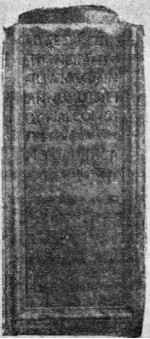
During archaeological excavations conducted in Gigan, an ancient city on the Danube, near the Bulgarian city of Nikopol, a tombstone was found,
[Column 28]
and Prof. Gabriel Katsarov was able to decipher the name “Arch-Synagogues Josephus” - head of the synagogue of Joseph.
According to Prof. Katsarov, the tombstone dates from the 2nd century AD. It is assumed that it is from a local cemetery. This proves that in the Roman city that stood here on a hill - Gigan, there was a large Jewish community, headed by rabbis - and Rabbi Joseph, who is mentioned on the tombstone, was one of them.[7]
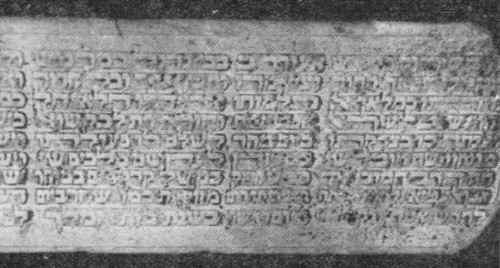
The Chief Rabbi of the Jews of Bulgaria in 1893-1896, Dr. Mordechai Greenwald, found in the ancient cemetery of the city of Vidin - the area where the Roman city of Bononia used to be located - a tombstone with an inscription on which only the word “Ananias” could be deciphered. According to Dr. Greenwald, the name is Jewish and is the name mentioned on tombstones, discovered during excavations in an ancient Jewish cemetery in Rome. This proves that in the Roman city of Bononia (now Vidin), there was a Jewish community in the 2nd century AD.[8]
These two archaeological finds, from the period of Roman rule in the region, prove that in those two fortified Danube cities, large Jewish communities existed during the Roman Empire, in the 2nd century AD. It can be assumed that Jewish communities also existed in the other cities on the Danube, as well as in the interior of Bulgaria.
In 397 AD, the Roman Emperor Theodosius - in view of the persecution of the Jews in these regions - sent a letter to the Roman governors
|
|
[Column 29]
of Mysia, Illyria and Macedonia and Mysia. (It was nothing but today's Bulgaria.) This letter states that he had received news of persecution of Jews and the destruction of synagogues; the emperor ordered the Roman legates to maintain order and announced that he would hold them responsible if similar cases occurred. This letter constitutes further proof of the existence of Jewish communities at that time within the borders of today's Bulgaria.[9] In the 4th century AD, the Roman Empire was divided into an Eastern Empire and a Western Empire. The capital of the Eastern Roman Empire, Byzantium, was Constantinople - today's Istanbul. The territory of Bulgaria was within the borders of the Eastern Roman Empire. As is known, the great Roman Empire disintegrated, both due to internal conflicts and the incursions of barbarian tribes from the north. These tribes penetrated the Balkans several times, destroying and destructing everything in their path. The local Jews also fell victim to these invasions; communities and synagogues were destroyed. It is not known exactly what remained of these communities for the refugees.
Proof of the existence of Jews who remained here from Roman times are the orders of the Byzantine emperors Phocas and Leo III to impose the Christian religion on the Jews of the empire.
Rosanes discovered in his research that the spoken language of the Balkan Jews shows traces of the Greek language - the language spoken by the Jews in these places during the Byzantine period. During the Ottoman Empire, synagogues known as “Romaniotes” were preserved here. According to Rosanes, all this serves to testify that even after the barbarian invasion of the Balkans, including the territories of present-day Bulgaria, and even after the founding of the First Bulgarian Kingdom by King Asparukh, ancient Jewish communities remained here - remnants of the communities that existed during Roman rule.[10]
Among the surnames of Bulgarian Jews today, one can find names such as Romano, Papo, Dekalo and others, which originate from the names of Jewish families who lived in these areas during the period of the Roman rule.
Khan Asparukh, the son of the Bulgarian Khan Kubrat, who ruled a large part of the Russian steppes, invaded the lands of Bulgaria with his armies in 679 and founded the first Bulgarian kingdom near the city of Pereslava where the remains of his capital city of Abova are today.
We do not have precise details about the existence of Jewish communities in these places at the time of Asparukh. However, it must be assumed that there were such, mainly near the Danube River: in the cities of Vidin, Nikopol; as well as in the interior of Bulgaria in Sofia, Pleven and others. Proof of this can be seen in the synagogues of the so-called “Romaniotes” or “Grigos”. This opinion is also expressed by Dr. Marcel Kalev in the “Compilation” dedicated to the memory of Aharon ben-Yosef (p. 136). This is also assumed by D. Katsev-Borsky in his article, which was published in the collection: “They fulfilled their duty towards the homeland”, (p. 98). He adds that the Jews had an influence on the people of Asparukh even before their invasion of the Bulgarian lands, and he also suggests that this influence was
[Column 30]
strengthened, precisely, due to the fact that in the territories conquered by Asparukh, Jews lived even before his conquests.
During the reign of the Bulgarian Khan Krum [803-814], the borders of the Bulgarian state were expanded and reached the Aegean Sea. When he conquered Salonika, the Bulgarian king took 30,000 people captive - among them many Jews. These Jews settled in various cities in Bulgaria, and thus the number of Jews in this country increased.[11]
From the reign of Boris I, [852-889], there is already accurate data on Jews who settled on the lands of Bulgaria. King Boris I is known as a ruler who accepted the Christian religion and brought about the Christianization of the entire Bulgarian people. Before he accepted Christianity, he also heard an explanation of the Jewish religion. After Christianity was established as the official religion of the state, doubts uncertainty , and as a result, a special delegation traveled on behalf of the Bulgarian Church to Pope Nicholas I. The Pope was asked to answer the delegation's 106 questions.
Pope Nicholas's response is still preserved in the Vatican Library. From this response it becomes clear that the delegation of King Boris I asked the Pope, among other things, “What is the day of rest that should be observed, since there are people who observe the Sabbath, whether it is possible to eat meat from any animal, and whether a certain custom should be observed in the slaughter of animals.” These questions prove that Jews lived in the kingdom of Boris I. It must also be concluded that the influence of the Jews was great and that their communities were properly organized.[12]
There is also data on the presence of Jews in Bulgaria and their influence on the Bulgarian people from the time of the brothers Cyril and Methodius, who created the Slavic alphabet. This was in the year 864. According to Katsev-Borsky (in the collection “They Fulfilled Their Duty to the Fatherland”), Cyril testifies about himself in his autobiography that he learned Hebrew grammar from the Khazars in Russia, whose language was similar to the Bulgarian language, and they were the Khazars who were led by “Jewish” kings who used the “Hebrew” language. The brothers Cyril and Methodius were born in Thessaloniki, and this city had a large Jewish community at the time.[13]
Rosanes also states that Cyril and Methodius borrowed letters from the Hebrew “alphabet” when they composed the Slavic alphabet - letters that are not in the Greek “alphabet”, and to this day there is a similarity between them and Hebrew letters. For example, the letters “shin” ש and “tsadi” צ are similar to the Slavic letters. The influence of the Jews was especially felt in literature - the brothers Cyril and Methodius, like the Jews, used letters instead of numbers. The “calendar”, which Cyril and Methodius prepared, begins on September 1 (a date close to the Jewish “New Year”) and in this too Jewish influence is evident. In all this there is proof that in Salonika, and most likely in all the Balkans, including Bulgaria, there were Jews.
During the time of the Bulgarian king Shishman (979-1049) who ruled the western territories of the then Bulgarian kingdom, which also included today's Macedonia, there were Jewish communities in the cities of Ohrid, Skopje, Kostur and Bitolya. In those days, Rabbi Tuvia
[Column 31]
Bar-Eliezer lived in Kostur, who, as far as is known, wrote the oldest book written in Bulgaria - “Lekach Tov”. Later, another rabbi, who lived in Ohrid, wrote a “Commentary on the Bible”, which is still preserved in the Bodleian Library in Oxford. The Russian historian Globinsky notes in his research that the Patriarch of Ohrid in the 12th century was the Jewish convert, Leon Munk.[14]
In 1018, the Eastern Bulgarian Kingdom was conquered by the Byzantines. Byzantine subjugation lasted 168 years, until in 1187 the brothers Assen and Peter raised the flag of rebellion and renewed the independence of the Bulgarian Kingdom. For this period of 168 years, we have no details about Jewish communities in the western part of Bulgaria. In 1170, the Jewish traveler Rabbi Benjamin of Tudela [Toledo] passed through the Balkans. In his travelogues, he mentioned Jewish communities in Thessaloniki, Drama, Skopje, Gallipoli, Constantinople, and more. Although he does not mention cities in Bulgaria, it must be assumed that there were such Jewish communities within the borders of this country as well.
The Second Bulgarian Kingdom was headed by King Assen I (1187-1196). In order to pacify the country and strengthen it economically, this Bulgarian king made economic alliances with the states on the Adriatic coast and asked merchants from Italy and the city of Dubrovnik, on the Adriatic coast, to settle in Bulgaria. It is known that trade in these places was then in the hands of the Jews - and from this we can also conclude that at that time many Jewish settlers arrived in Bulgaria, who increased the power of the Jewish communities in this country.[15]
During the reign of Assen's brother - King Kaloyan (1197-1207), the armies of the Crusaders, led by Richard René, passed through Bulgaria. Their goal was the Land of Israel, to liberate the tomb of Jesus Christ from the hands of the Muslims. Richard René laid siege to the city of Philippopolis, today Plovdiv, captured and killed many Bulgarians and Jews. King Kaloyan came to the aid of the captured city, inflicted a defeat on Richard René's armies, and they were forced to retreat to the nearby city of Assenovgrad. In revenge for the murder of the Bulgarians and Jews, King Kaloyan ordered the execution of the head of the local Greek church, as well as many Greek leaders. This historical fact testifies that in the 12th century there was already a Jewish community in Plovdiv.[16]
Kaloyan's successor was King Assen II (1218-1241). During the reign of this king, many Jews lived in Bulgaria, enjoying special rights and freedom of action. Pope Gregory II complained in a letter he sent to the Hungarian king Béla IV, who was a contemporary of Assen II, that the Bulgarian king not only refused to join the
[Column 32]
Roman Church, but also accepted Jewish heretics into his country. This pope, who always claimed that Bulgaria was “full of Jews,” wanted to launch a crusade against Assen II.[17]
During the reign of King Assen II, many Jews lived in the capital city of Tarnovo. Professor Irchak also wrote about these Jews in his work on the history of Bulgaria. According to him, during the reign of Assen II, despite the king's positive attitude towards the Jews, a special council was held in Tarnovo, at which a proposal was made to take severe measures against the heretics and the Jews. At that time, a man named Dionysius translated six sermons against the Jews into Bulgarian. During the construction of the railway to Tarnovo, a tombstone from that period was found, inscribed with the name Leon Acusi. It is likely that there was once a Jewish cemetery on this site.[17]
From the time of King Assen II there is a document known as the “Coronel Manuscript” written by Rabbi Yaakov ben Eliyahu to his brother, the convert Pablo Cristiani in Spain. Pablo Cristiani is a well-known figure in the history of the Jewish people from the debate he had in Barcelona with Rabbi Nachman of Gerona, the famous rabbi Ramban (1195-1270) [Nachmanides] during the reign of King Charles I of Argona. From this document we learn that it was written during the reign of King Assen II after his victory over the Byzantine emperor Comnenus near Klokotnitsa in southern Bulgaria. Historical documents show that Emperor Comnenus hated Jews and during his reign the Jews of Byzantium suffered greatly from him. In contrast, the “Coronel Manuscript” testifies to a good situation for the Jews in Bulgaria. Comnenus fell into the hands of Assen II, and the latter ordered two Jews to gouge out his eyes and thereby repay him for the persecution of their Jewish brothers in Byzantium. After Rabbi Yaakov ben Eliyahu brings to his converted brother what happened to the Jew-hater Comnenus, he warns him of God's vengeance for the evil that he, his converted brother, is causing to his Jewish brothers. The “Coronel Manuscript” serves as further evidence of King Assen II's good attitude towards the Jews in Bulgaria and, on the other hand, of the good situation of the Jews at that time in Bulgaria.
During the reign of the Bulgarian king Ivan Alexander 1331- 1371, the situation of the Jews did not worsen. In 1346, King Ivan Alexander expelled his first wife and married the Jewess Sarah, who was given the name Theodora. Rosanes writes that in the National Museum in London there is a picture of Ivan Alexander and Queen Theodora. Although she accepted the Christian religion, Theodora extended her protection to her Jewish people. Professor Irchak mentioned in his historical work on Bulgaria a name of a rabbi from Tarnovo who was put on trial and for whom Queen Theodora interceded.[18]
[Columns 33-34]
“A rumor came from my lord who melted our hearts and weakened our hands that you rose up against us to war with a high arm. And one [=messenger] ran to meet another and one preacher to meet another to say that you have extended your hand against the Talmud, which is the cornerstone of our religion and the pillar that enlightens our eyes in the circles of justice that comforts us. Who could believe our report that our own flesh and brother pursued us for no reason. Look and see if there is any pain like our pain.
And now I will tell you what happened to Todoros the wicked Greek, whose heart and eyes are fat, and who rules in the will of his heart. He went and became a devil to our people and defiled our religion, plundered their property and plundered their wealth. And when the Jew came before him, he would close his eyes and mock him, as if sitting in heaven, and give him a blindfold. And the Lord our God hardened his spirit and strengthened his heart to take revenge on his enemies. And this Todoros the Greek came to fight with Assni and did not seek his peace but waged war with him. And the king Assni killed in the battle most of his horsemen and the choice of his men, and Todoros the wicked fell into his net and was caught in his trap. And King Assni put his feet in the bronze [=chains] and his heart melted and became like water. Then the king called two Jews and said to them, “Give glory to your God, because your enemy Todoros has fallen into my hands. His eyes have darkened in their sockets and will not be restored to their sockets, and take revenge on him because he was captured in battle.” And the Jews took him and threw him to the ground. And he pleaded with them, and they had mercy on him and did not avenge him according to his deeds and forgot his evil deeds and did not darken his vision. And the king's anger was kindled against them, and he commanded that they be taken up to a high and steep mountain to the heart of heaven, and they flew without wings and did not reach the middle of the mountain until they became limbs and sank like lead in mighty waters. And he commanded two men to gouge out his eyes, and they did so, and the king's anger subsided. “And the God who turned around the counsel of Agag will annul your counsel and the counsel of our enemies, and will frustrate your thoughts and the thoughts of our enemies and will fight our battles.””
Manuscript “Coronel”
[Column 35]
The successors of King Ivan Alexander were his sons: Ivan Shishman and Ivan Strashimir. During their reign, the influence of the Jews was also great. In 1355, the Bulgarian Church again organized a special council to discuss what measures should be taken against the sect of the “Bogomils” and “Jews”. But apparently, the decisions of the church council did not affect the life of the Jews in Bulgaria. As proof of this, Rosanes brought a historical document, dated October 31, 1376, written by the council of the Jewish community in the city of Bedin, which is Vidin - the ancient city of Bononia. This document mentions the full autonomy that the Jews enjoyed in this city during the reign of King Ivan Shishman and the good attitude shown to them by this king and his brother Ivan Strashimir[19].
In 1374, during the reign of those kings, the first settlers from among Ashkenazi Jews also arrived in Bulgaria; Jews, who were expelled by the Hungarian King Ludwig I. These Jews were given permission to settle in Bulgaria and were also welcomed. Rosanes notes that traces of the influence of these Jews can be found in the language and names of the Jews of Bulgaria even today.[20]
In 1398, the Bulgarian kingdom was conquered by the armies of the Turkish Sultan, Bayezid. The Jews of the capital, Tarnovo, stood shoulder to shoulder with the Bulgarian army, defending the city. For this reason, Sultan Bayezid, after the conquest of Tarnovo, ordered all Jews to be expelled from it. One Jew, who appeared before the Sultan, to congratulate him on his victory, was killed by the Sultan's order. In Tarnovo there still exists a place called “Jewish Grave”- according to legend, that Jew was buried there.[21]
We do not have details about the fate of the Jews after the conquest of Bulgaria by the Ottoman armies. However, it is known that in the
[Column 36]
first years of this conquest, during the reign of the same Sultan Bayazid, there were Jewish communities in Serdika - Sofia, Bedin - Vidin, Philippopolis - Plovdiv, Nicopolis - Nikopol and other cities. This fact indicates that the Jews who lived in Bulgaria in the first years of the Turkish conquest are among the same Jews who lived here during the last period of the independence of the Bulgarian Kingdom, and who formed the basis of all the Jewish communities in Bulgaria during the 500 years of the Ottoman yoke.
In summary, it can be noted that the Jews have lived in the territories of present-day Bulgaria since very ancient times, many years before the Christian era. The Jews arrived in this region as chemists and merchants from the south, via the Bosphorus, during the time of the First Temple and after; from the north, via the Russian steppes, during the Babylonian exile and after; from the south, via Salonika, and from the west, via the Danube and by land. The wave of Jewish settlers who arrived in the area would grow stronger or weaker, depending on the circumstances, but it never stopped. The Jews who came here after the destruction of the Second Temple found older settlers there. The Bulgarians, when they invaded, also found Jews in the area. The Jewish communities continued to exist in the territories of Bulgaria, even after the conquest of this country by the armies of the Turkish sultan Bayezid. The Jews of Bulgaria - and Jews of Bulgarian origin - in Israel today are descendants of all the Jewish settlers, whom we mentioned above, and traces of each and every period of their lives we find, according to Rosanes, both in the spoken Ladino language and in the surnames of the Bulgarian Jews. Throughout this long period, the Jewish communities, such as they were at that time throughout Europe and Asia, did not cease to exist. The rulers of the region changed frequently over the millennia, various peoples disappeared, tribes assimilated - but the Jews remained steadfast and always lived in these places.
|
|
[Column 145]
Footnotes:
[Column 146]
|
|
JewishGen, Inc. makes no representations regarding the accuracy of
the translation. The reader may wish to refer to the original material
for verification.
JewishGen is not responsible for inaccuracies or omissions in the original work and cannot rewrite or edit the text to correct inaccuracies and/or omissions.
Our mission is to produce a translation of the original work and we cannot verify the accuracy of statements or alter facts cited.
 Bulgaria
 Yizkor Book Project
 JewishGen Home Page
Copyright © 1999-2026 by JewishGen, Inc.
Updated 16 Dec 2025 by JH