 |
|
|
[Pages 11-23]
|
|
|
|
[Page 14] |
|
|
the Kapliczka (wayside shrines) [Page 15] |
|
|
[Page 17] |
|
|
[Page 19] |
|
|
[Page 21] |
[Page 24]
by M. Z. (Jerusalem)
Translated by Mira Eckhaus
|
Where were you God on the day of rage, on the day of the Holocaust for the rest of Israel? Why didn't you show up and save us? |
For a miracle to take place to glorify your name - God |
| And why didn't the heavens move when thousands of eyes were raised to you hoping that you will have mercy on them before they die? |
And you did not give this sign! And they, with the faith you planted in them, walked naked and depressed to the open grave |
| And why didn't you perform this miracle and save them? And why didn't you raise your hand against the Gentiles and take revenge? |
And they didn't abandon you even in those moments, and before they died, they sanctified the name of God by reciting “Shema” prayer. |
| I have a quarrel with you, O Lord, for the delivery of your people into the hands of the vile man and did not come to save them |
Where is your army, a jealous and avenging god? Where has your mercy been since then, from those days – when you knew how to have mercy on your people and did not let them die for the sanctification of God? |
| For not appearing when your loyal people, men and women, naked, were placed in front of the enemy |
Where were the miracles and wonders that you used to do in the past? Why didn't you show the signal? Were you tired? |
| And they wished to receive some sign before their death; |
Have your powers, O Lord, run out - and you no longer able to overpower the Gentiles and have mercy on your people on the day of disaster? |
|
|
by Dr. Shraga Pivel Kalai (Jerusalem)
Translated by Mira Eckhaus
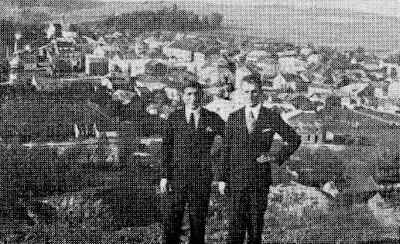
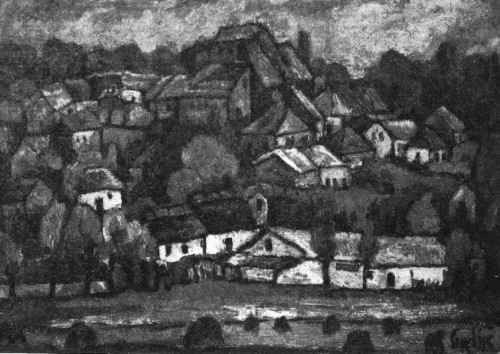
Sometimes I close my eyes and take a walk in the city where I spent my childhood, our small and humble town, although I left there over forty-three years ago, before I turned nineteen. In my mind, I walk through the city starting from one end of the city, near the pine grove at the crossroads of the villages of Lanki and Szalki, opposite the last Jewish house in the town, the Shoel Kater House.
I walk along the unpaved road, passing by the courthouse building, a building that also houses the prison, descending from the “Zagura” downhill, along the wall that encloses the “Beit Chaim”, until I reach the bridge spanning the “Der Patek” stream, which extends here in the form of a lake (quite shallow), and in rainy years its waters would rise and cover the bridge. As children, we loved to bathe in this place in the water pool to the right of the bridge.
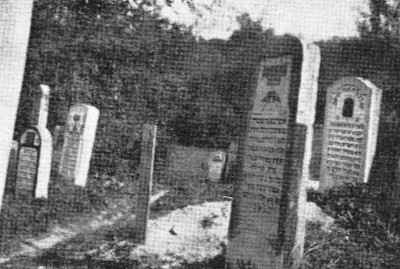
And I am still in the suburbs of the city, facing the “Cemetery” gate, this is the gate of the “tent” that I always walked through with strength and trepidation. And even though I accompanied Grandma Chaya Rachel for forty consecutive days, as she went to prostrate herself at the grave of Grandpa Moshe Leib, the husband of her youth, to be an intercessor and plead before the Heavenly Court (Beit Din shel Ma'alah) to overturn the evil decree issued by the evil ruler, Mayor Gabrishevsky, who declared our house a ruin that is forbidden for habitation; (because my cousin Shmuel Schlider marched with the flag in the Zionist parade); and even so, I would not dare to pass there alone at night.
And as I leave the bridge, walking towards the city edges, a narrow dirt road branches off to my right, leading to the quarter that was once called the Jewish Street, “Żydówska Ulica”, and to the left, along the wall of the Jewish “cemetery”, a path leads to the slaughterhouse, passes through the livestock market (Targowice) and continues far into the forest behind Tchaikovsky's farm, this is the farm that was called by the people the White Yard.
And as I continue on the main road, I reach the heart of the town, among the crowded houses, the residence of the dayan Reb Yosef Kliger, Reb Feybish Kris, Reb Avraham Breitfeld, next to Yankel Freitag's bar, the house of Wolf Machlis, and then the oil press of Reb Yaakov Wolf Weiser.
There, in front of Simha Lotringer's hostel, another
[Page 26]
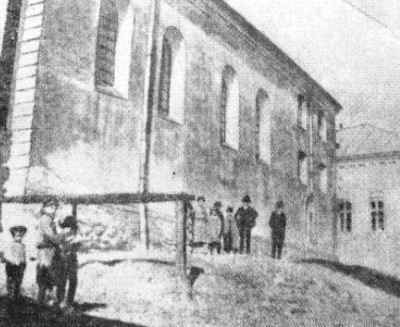
narrow alley branches off into the Jewish Street. Here, on the corner, was the house of Yehoshua (Shua) Dreyer. Here the road rose slightly and led to the town's center (rynek). To the right stood the house of Reb Itzikel Landau. Next to this house an alley led to the Great Synagogue and the Beit Midrash. Opposite the alley, one section of the main road branched off and led through the market to the Bezuchowski House, to the Ruthenian house of prayer on one side, and to the main street (Batorego) of the “Bathhouse” on the other.
The straight continuation of the main road passed Itamar Ahre's tobacco trading house, the house of Yona Shreier on one side, and the house of Reb Shaya (Isaiah) Shor on the other.
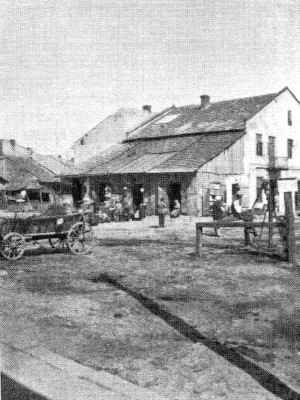
And so, we arrived at the center of the city with the Jewish shops and stalls and the water pump in the center.
On ordinary days, not market days, in addition to the permanent shops, the market was scattered with temporary stalls selling fruit and vegetables, baked goods and sweets, various sewing notions, and alike. On market days, however, it was impossible to pass between the numerous stalls, between the carts and the animals, people and beasts.
The straight road on the main street led to the post office along the courtyards of the Catholic house of prayer. There the road branched off on a steep descent to the right, to the main road which led to the suburbs of the town and the road to Lviv. Continuing almost straight, a road led to the suburbs of a town called “Kozina” and on the left the road descended to the quarter called “Zamlinia” (“Behind the Mill”).
In the corner next to the Ruthenian house of prayer was one of the centers of the “cheders”. There, not far from the Kloyz of Belz, were the “cheders” of the melamedim Yossel, Yehuda and Berl, which was right next to the Ruthenian house of prayer. From there a road led parallel to the previous road and passed by the soda factory, Nachman Kol's house, and from there you passed by the bathhouse, by the Kloyz of Chortkov, and thus you arrived again near the school, downhill on this side, and continued to the “Zamlinia” (“Behind the Mill”).
The town was not so small, and the clowns were lying when they claimed that it's so small that one who enters the town with a yawn leaves it before the yawn has even reached its end; and certainly, the clowns of the generation who slandered it were exaggerating when they said that the town was so small that at night it was brought “on a wheelbarrow” to the council house, so that it would not catch a cold. In our eyes, the boys, it was a great city to God, like Ninveh in its time, a district city that ruled over 99 villages and settlements, including several cities such as Strelisk, Branewka, Khodoriv, and Brzozowiec; the city of Bobrka served as the seat of the district head and the court. Every Thursday of the week was a market day when farmers from all the villages of the district would gather. In addition, there were several days a year designated for large fairs. In those days, merchants and peddlers from all over the area would gather in our town. In this respect, only the Lviv region (the metropolis of Galicia) seemed to us to be a larger settlement.
And give to every man enough for his livelihood,
and to every body enough for its needs, so your
people, the people of Israel, will not need the help
of one another or another people.
The town appears before my eyes as it was at the beginning of this century, in the first decade and for most of the second decade. I do not know what the number of Jews in Bobrka was at that time. It is possible that I have forgotten this due to the distance of time and it is possible that I did not know this even when I was there. However, from the censuses in the years 1900-1910, a certain estimate can be made. In 1910, there were 2,500 Jews in Bobrka (47% of the total population of 5,310 people) and in 1920, 2,502 Jews lived there (44.5% of the total population of 5,628 people). Families were, as a rule, large in number, and it was not for nothing that the common heartfelt supplication among the Jews was: “And grant me and all the members of my household our sustenance and livelihood generously and not in scarcity, lawfully and not unlawfully, with ease and not with hardship, directly from Your bountiful hand, just as You gave a piece of bread to eat and clothing to wear to our father Yaakov, who is called a wholesome man…”
There were no factories in our town, just as there were none in other Galician towns, and our people were not capable for clerical jobs; and even if they were capable for them, they would not accept them. It is therefore not surprising that the main problem was: What will we eat from now on? – We need a livelihood!
The Jews of the city were mainly engaged in small scale trading; they bought the crops from the farmers and sold them other goods that they brought from the nearby region - Lemberg, which is Lviv. There were few people who were engaged in large scale trading at that time. The nobles who lived in the capital or abroad were engaged with little trade in forests, served as livestock traders, exporters, and farm leaseholders. Apart from these, there was a very small percentage who made a good living, especially those who traded in goods over which they had a monopoly, such as tobacco, oil, salt, and especially alcoholic drinks; everyone else lived hand to mouth. Many made a living from their craft: tailors, shoemakers, bakers, carpenters, dyers, furriers, carters, barbers, butchers, etc. Their livelihood was more or less secure, although it was limited, because most of the Jewish residents had no money. There were two or three Jewish doctors and lawyers. The doctor would be summoned when they had “run out of options”. When a person fell ill, they would first summon the medic, who was called “doctor”. This role was filled by the galebs (barber-surgeon(. They knew how to draw blood, to apply cupping, to attach leeches, and to measure the temperature. A thin vein of emigration abroad began to appear at the beginning of this century, mainly to America. But at that time, people didn't travel to America, at that time… they “fled” to America. You could wake up one bright morning and hear people talking, did you hear? - So-and-so fled to America!
Many traveled, stayed there for a few years, earned a few hundred dollars, and returned. Upon their return, they established their status, gained new experience, and brought enough capital to establish their own business. There were also cases where not many days passed and the capital brought from America quickly went down
[Page 27]
the drain due to a bad investment, and then they went to America again. I myself knew several such families.
It was difficult to settle in America in those days, both because of the hard work and because of the difficulties of absorption in the new foreign environment, where a Shabbat-keeper could not easily find a living. And this is because at that time all the people of our town were observants. Most of the adults would pray in public even on weekdays. Very few avoided coming to the house of prayer on Shabbat; on the Days of Awe, no one was absent!
Bobrka was considered a typical Jewish town, with small wars over the gabbai position in the Beit Midrash, over the leadership of the community, and certainly, there was the big war when the rabbi passed away and it was necessary to appoint a new rabbi.
Until World War I, the general education had not penetrated to the city. There was one government school with six classes, and the Jews tried to avoid sending their sons and daughters to school, and they did not do so unless the policeman from the community committee came and announced that there was a compulsory education law, and if they did not send their children to school, they would be punished.
Very few sent their children to continue their studies at a high school in a large city near Lviv. A high school student, in a special uniform, returning home during the holidays was an unusual phenomenon.
In 1910, the Rabbi of Stratyn, Reb Yitzhak Isaac Langner, settled in our city. On Shabbats and holidays, especially on the Days of Awe, the city was bustling with Hasidim from all the cities of Galicia, as well as from Hungary and Bukovina. There was only one hostel in the city, so the houses were full of Hasidim. The people of the house rented their beds and they themselves slept on the floor, in the attic.
The rabbi's arrival strengthened the Hasidic movement. Hasidim of other rabbis would also come to hear the rabbi's prayer and participate in the “Tisch” that the rabbi held after the prayer. Only on Shabbats, when the Rabbi of Stratyn traveled to visit his Hasidim in another city, did the Hasidic followers of Chortkov, Belz, Dolina, Burshtyn, etc. sneak out and travel to their rabbi.
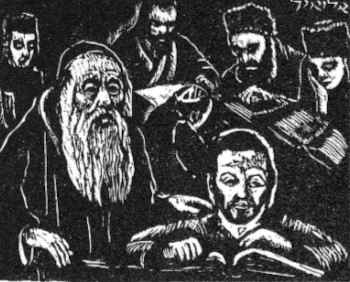
The Beit Midrash was full of scholars from before dawn until late at night. On the fifth day, before Friday, a group of diligent scholars would sit and study the weekly Parasha with the commentary of the “Or HaChaim”, and at midnight, Feybish Kris would send out warm, fresh “bulbenikes” to revive the soul.
Nevertheless, here and there, one of the young men would break the “suffocation ring” and run away from home. Some of them only made it as far as the large city near Lviv, while others wandered as far as Vienna, where they prepared for the matriculation exams as external students.
The city rabbi at that time was Reb Binyamin Galler (who had previously served as rabbi in Krivetz. Three of his sons, Aharon Galler z”l, and, may they live long life, David and Mordechai, immigrated to Israel in 1920). During his tenure, the city dayan was Reb Yosef Kliger. There was also a teacher, Eli-Shmuel Wein (who immigrated to Israel with his wife at an old age. They passed away in Jerusalem in the Old City and were buried on the Mount of Olives).
Life went on slowly without revolutions. In the Gnostic era we would sing “He who gives salvation to kings and government to princes” in honor of Franz Joseph I, and they were “naïve” who believed that he loved Israel and that his heart was set on only one thing: how to do good to his subjects, our fellow Israelites, and in secret he puts on tefillin every day. And indeed, there was one thing that the Jews of Galicia did not experience - the authority did not persecute them or carry out massacres and pogroms against them, and therefore the Jews were content with little and were happy with their lot. The common saying was, “In Russia they eat well and in Galicia they sleep well”, meaning without fear. What the parents thought about their sons' future and what the sons themselves thought about it, no one knows. Anyone with an ounce of sense could see that there was no future for a Jew in Galicia. The boys grew up, they married wives according to the custom of those days by matchmaking, from within the city itself or from the immediate vicinity. And so, a new shop was opened, and livelihood was always in the hands of heaven.
In the nearby city of Lviv, there were high schools for boys and girls, teachers' seminaries, and other educational institutions. I remember only a few cases where boys went to study at high school. There were cases when the authority wanted to send talented Jewish boys at its own expense to continue their studies in Lviv, but not a single Jew in Bobrka agreed to this, for fear of desecrating the Shabbat.
It has already been said that the people made a living from small scale trade. There were those who did not wait for the Gentiles to bring their goods to the city. They would go out to meet them outside the city, stop the carts and ask: What do you have for sale? More than once they were driven away by the Gentiles in disgrace and shame.
There were also those who would wander through the villages, visit the homes of the Gentiles and buy butter, cheese from them to sell in Lviv (the Jews of Bobrka did not eat dairy products, let alone meat products of the Gentiles, and the Strictly observants did not eat at all animals that were not slaughtered in the Jewish community), poultry, roosters and chickens, geese and ducks, half a sack of potatoes, a little wheat and other types of grain - they brought the goods to the city and sold them to the Jews.
We should also add to the professionals in the city the religious teacher Maurice Diamond, who served in his position for about fifty years (his son, a doctor, emigrated to Yugoslavia - and his fate is unknown). It is difficult to say that the religious teachers instilled love and respect for the Jewish religion, but Mr. Maurice Diamond would come every Shabbat to pray in the synagogue. We had only one Jewish teacher (not from the city), Mr. Meir Dingut. During World War I, Mr. Dingut was captured by the Russians, wandered through Birobidzhan to China and immigrated to Israel. He studied English and served as an English teacher at the Real School in Haifa for many years. Mr. Dingut died recently (in 1959) in Haifa; his son is a famous doctor in Haifa.
Until World War I, there was no Hebrew school in Bobrka. But there were young men who spoke Hebrew. Here and there, there was someone who subscribed for the newsletters “HaTsfira” or the “HaMitzpeh”.
And if someone would ask – how did they know the Hebrew language? There is no wonder! In the Beit Midrash houses and in the Kloiz houses, young men sat and studied Gemara with Tosafot, Shas and Poskim. They would get up early and study until late at night. There were also cases where under the Gemara books they would hold a book of general education.
The young man Shimon Klarer, son of the melamed Sunny (Nathaniel), will be fondly remembered.
[Page 28]
This young man was a Torah scholar, a prodigy, sharp and knowledgeable, a humble and quiet man, for whom life had become cruel.
In addition to the poverty and deprivation that accompanied him from the dawn of his childhood, he was drafted into the army, participated in battles in World War I, was injured and became disabled. All his life he aspired to immigrate to Israel and when the opportunity came that he could join the first pioneers, he was worried that he would become a burden on others due to his disability. He married a woman from Burstein and opened a shop. His fate was the same as the fate of all Polish Jews. May God revenge them!
This Shimon, who came from a poor family, was a “wise scholar” and knew a lot. He would read Hebrew newspapers and encourage others to learn Hebrew. On his advice and initiative, during the first war, were ordered the Valkovsky's letters, from which we learned the precise Hebrew accent and grammar; on his advice, we subscribed to the weekly newsletter “Al HaMizpeh”. We created a small group that studied the “Tanakh” with commentaries and, most importantly, we learned all the chapters by heart.
|
|
The melamedim in the town set a special category. The melamedim were divided according to the various stages of education. There were melamedim for small children, melamedim of the Chumash and Rashi, and melamedim of Gemara with Tosafot. I don't know if I can remember them all or if I can sort them all according to their ranks. In one thing they were all equal: They were deeply impoverished, acquainted with suffering and disease.
I studied with three melamedim. At the age of three I started studying with the melamed Berl, at the age of five I started learning the Chumash, and since then I have alternately served in one of two different roles: “Opfreger Un Bentshen”, meaning “asking questions or blessing”. The whole point of the “Opfreger” was: when a young man arrived to study the Chumash, his parents held a big feast at their home on Shabbat.
The boy wore festive clothes and was covered with watches and gold and silver jewelry. The Opfreger, who was also covered with watches, would stand up and ask him:
- Come here, my boy, and the boyo would answer him:
- I am no longer an angel, meaning: I am no longer a child.
- And what are you?
- I am a gentle and good boy and I am lucky.
- And what are you studying, boy?
- I'm lucky to learn Chumash.
- What does Chumash mean?
- Five.
- Which five?
- Five books, first “Genesis”, second “Exodus”, third “Leviticus”, fourth “Numbers”, “Deuteronomy” is the fifth book.
- And what are you studying, boy?
The book “Leviticus”.
- What does “Leviticus” mean?
- He called. -
-Who called? Did the rooster call?
- God called to Moses, saying…
Then the blessing stood up and said, “May God bless you, and protect you…”
I filled another role with the melamed Berl. He would bring me on Shabbats to the homeowner who had children who had reached the “time to learn”, and I would recite the weekly Parasha to the household members; This was his way of marketing his “produce” to them.
I was already seven years old when my father was eager that I would start studying Gemara, but the melamed Berl did not want me to leave him - and most of all he was probably afraid that my friend Matis Mol, the son of the banker Neta Mol, would also leave him with me. What did the melamed Berl do? He instructed me to bring Gemara from tractate “Bava Metzia”. And we, three young men of seven years old, began to study Gemara. The name of the third young man (who was seven years old) was Itamar, from the village of Volkov, who was staying in the city with relatives so he will be able to study in a cheder, no one knows what his fate was.
I studied Gemara with the melamed Berl for one “Zman” (semester), but finally he was unable to teach me anymore and I moved on to the melamed Yehuda. I studied with him until I was ten years old.
Children would start studying in the cheder at the age of three, and even earlier. We would spend the whole day in the cheder, from morning to evening, until we were old enough to attend “their” school. During the short winter days, we would also study for a significant part of the night.
The attendance at the Gentile school was in order to participate in gymnastics lessons, games, and for the trips to the surrounding woods. Early in the morning
[Page 29]
|
|
we went to the cheder, where we studied until prayer time, then we went to school. As soon as we returned from school, we went to school again (when did we prepare lessons? - I don't know).
To this day, I still remember, with excitement, the walking to the cheder at night, equipped with two slices of bread with a salted fish tail in the middle, or spread with a home-made plum jam which tasted like wafers made with honey.
In a blessed year, when the winter was severe and the frost had lasted a long time, and the geese had fattened properly and the fat was plentiful, the slices of bread were spread with a considerable layer of goose fat, into which some schmaltz had crept. And if you added a few “cloves” of garlic to them, you had tasted one of the sixty flavors of heaven. That, at least, was the opinion of those who were not blessed with slices of bread smeared with goose fat and were forced to make do with a piece of a tail of a salted fish.
A special chapter should be dedicated to the melamed Pivel, who is my uncle. Only older boys studied with him, including married young Torah scholars who were supported by their in-laws. I didn't get to study with him because at the “Zman” I was supposed to start studying with him (which was my father's wish), he passed away (in 5671).
The melamed Pivel was not only a teacher and pedagogue; he was also a guide and educator; he ensured that his students learned “Derech Eretz” (desired mode of behavior). A student who saw the rabbi from afar would button his coat and behave in a Hasidic manner.
He too would say that anyone who studied with me could not be “Am Ha'aretz” (ignoramus). Pivel was a famous Ba'al Tefillah (prayer leader). He would pass in front of the Ark in the small synagogue.
Usually, they would start the prayer late (a Hasidic custom) and would extend the prayer. For the “Tal” and “Geshem” prayers, people from all the synagogues would come to hear the melamed Pivel's pray. He was not rich, he lived his entire life in poverty, and died at a young age. My late father, who was only a few years younger than him, died 23 years after him (in 5694).
They were three brothers: Yoel of Pomoran, the melamed Pivel, and Michal Shamir, my father, a”h. All three were grandsons of Rabbi Pivel of Munkács, after whom I am named. All three of them were Ba'al Tefillah, Ba'al Koreh (Torah Reader), and playing musical instruments. It was a common saying among the people that when the three brothers attended a wedding, there was no need for a “Klezmer musicians”.
As mentioned, I did not get to study with my uncle Pivel (we share the same name and he loved me very much). After he died, his brother-in-law (his wife's brother) Sunny (Nathaniel), who taught Gemara, came to our town.
He was a disgruntled Jew, hardworking, and known to be sick. We had no room in his apartment to run the “cheder” so he rented a corner in the hallway from a poor widow whose occupation was feather plucking. She cooked her meals on a stovetop grate and the house filled with smoke like a bathhouse. Even on a winter day the rabbi would open the window, and when they asked him for the reason of it, he would reply: “It is better to die of cold than to die of suffocation”. It is no wonder, then, that when I left the cheder and began to study on my own in the Beit Midrash, I also recited both the blessing of the Gomel and “Baruch Sheptarani”.
It is worth mentioning the melamed named Chana Meir Buntz. He was a man of great spirit and when he saw that his students were tired, he would tell them an entertaining and stimulating legend. I will cite two such legends here. Rabbi Chana Meir apparently saw that his students were about to fall asleep and told them the following story:
As in all cities of Jews, there were three types of melamedim here: melamedim for small children, melamedim of the Chumash and Rashi, and melamedim of Gemara. Nach (Prophets and Writings) was not taught here. “Pasuk”, as Nach was called in our city, would be studied during irregular hours.
For the most part, the melamedim were not worthy of fulfilling the role they were
[Page 30]
|
|
Forced to fulfill because in times of crisis and depression, melamedim sprang up like truffles and mushrooms. A Jew who had lost his assets and all the ways of livelihood were closed to him, tried to become a melamed: a Torah scholar who was supported by his father-in-law and had lost all his dowry down to the last penny; a shopkeeper whose shop had completely burned down, and he had nothing left to sustain his family; or simply a Jew who had bad luck and lost all his money in a bad business and was unable to open an alternative business.
Anyone who has not succeeded in their livelihood, every poor person, every bitter soul, tried to become a melamed. Thus, in our town, you could find a melamed who had a bakery that baked honey cookies (dyed with artificial color) that were sold mainly to the surrounding Gentiles who came to the market days. On Shabbats, he sold on credit fermented liquor and cans of sardines to the refined young yeshiva scholar and the gilded youth. Another melamed mainly sold tar for greasing boots and lubricating oil for the axles of carts. His wife did run the business, but on the free days he would help her with the business, and on market days the students did not study Torah.
The melamed Yedli (Yehuda'li) will be remembered fondly. He taught Gemara to the adult students. His wife was engaged in baking bread and buns from black flour. Teaching on one side and baking on the other, and yet the livelihood was not abundant.
As mentioned, most of the Jewish community made their living from retail trade. They bought agricultural produce (for half price) from the surrounding Gentiles and transported it in carts to the large city near Lviv, and from there they brought industrial products to the city: fabrics, tools, toys, books, writing implement, and the like.
As we have been told, the townspeople themselves decided their fate. It is said that when they were about to build the railroad that would connect the city of Stanislaw to the city of Lviv, this railroad was supposed to pass through the city. However, the townspeople rebelled and filed protests, and even reached the king… lest the train, God forbid, disturb their Shabbat nap after the feast. They fought with protests and telegrams - they fought and succeeded, and the station was built seven kilometers from the city, and their livelihood was removed a hundred kilometers away.
The social and economic structure of the Jewish population in Bobrka was very similar to that of most Jewish towns in Poland and Galicia after World War I. Most of the Jewish population made their living from small scale trade - buying the crops and the produce from farmers in the surrounding villages, and selling it to the residents of the city or to the residents of the area near Lviv - and from shops, bringing goods from Lviv and selling them to the residents of the city and the peasants of the villages.
There were several merchants in the city who conducted businesses such as importing goods on a large scale not only from nearby Lviv but also from Vienna, Budapest and Prague. There were also several grain merchants, livestock merchants and timber merchants, and similar goods, who marketed their goods abroad. There were also wealthy Jews who owned their own estates or rented estates from the Polish Landowners. In general, all those who conducted business with the Polish Landowners in estates, in forests, in breweries, and in the distilleries, lived a comfortable life; among them were both wealthy and noblemen, and for this reason they were considered privileged and influential in the town. There was another class that was among the wealthy, a group that received permission to trade in monopoly goods such as tobacco, schnapps, salt, and oil.
There were also a significant number of Jews who were engaged in crafts, in the same crafts they had inherited from their ancestors, such as tailors, shoemakers, carpenters, seamstresses, hatters, furriers, hairdressing, printers, and bookbinders. Later, new professions were added such as builders, tinsmiths, coopers, locksmiths, watchmakers, bakers, painters, etc. There was a candle workshop in the town, and a soda factory that prepared a stock of ice from the artificial lake that was dug on its plot, and “carved” ice several times a year. Its ice cellar served as a refrigerator for the entire town all year round. There was also a factory for burnt bricks. Nearby was a lime factory owned by a Jew, but the workers were Gentiles. In all the surrounding Polish Landowners' yards (and there were many) there was a distillery for schnapps, whose managers were Jews.
A special industry was developed: chariot with Jewish coachmen carried passengers to the train station and back to the city. The main means of transportation in the area near Lviv was by carriages. Although there were Jews who engaged in carriages using the horses and carts of Gentiles and made a living from it, however there were also several Jewish carriage drivers who had their own horses and made a living from the carriages.
But, as mentioned, the main source of income for the town's Jews was retail trade, brokerage, and shopkeeping and peddling.
[Page 31]
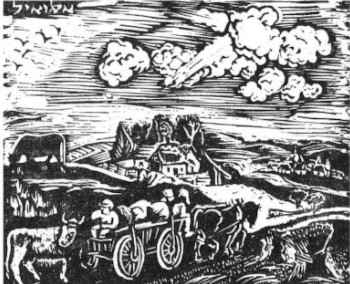
In those days, there was no bus transportation. The roads were dominated by horses harnessed to four-wheeled carts, guided by the whip of an experienced coachman. Almost every night, carts set out from Bobrka for Lviv. They usually set out in the darkness of the night, close to midnight. They would stop at Davidov's inn, halfway along the road, 15 kilometers from Lviv. The inn was large and spacious, able to accommodate several carts with their goods. There they would feed the horses. The coachman and the passengers would take a short nap after drinking a glass of schnapps and set off before sunrise.
There were no paved roads in those days. The roads were roads of partially compacted dirt. In the summer they would sink in mud and in the winter, they would sink in snow, sometimes to the point where the cart had to be left under the snow all night.
They would usually arrive in Lviv in the morning. They would spend the whole day in the city and in the evening, they would tie up the horses and go home. On stormy nights they would only arrive in Bobrka in the early morning.
The big merchants would usually travel by train; they would buy the goods and hand them over to the coachman who would bring them home. And there were some coachmen who were known for their honesty and could be trusted to act faithfully, to protect the goods from theft, from robbers and from spoilage due to rain and snow.
Sometimes the cart was full of passengers sitting on boxes and barrels, and if the owner of the cart was a member of the “Animal Cruelty” Society, he would jump out of the cart when it was going up the road - and there were many such climbs - and push the cart on its passengers in order to ease the load on the horses. Obviously, in such a case, the passengers would also jump out of the cart and help the coachman.
The journey to Lviv in a cart was a kind of adventure, especially if you traveled with a coachman was a person of vision and spirit, “knew how to play” and could tell stories. If the coachman was a Hasid, he would recount some of the miracles of the “Tzadik”, and if he was a simple man, from a good family that had lost its property, he would leave the city with his lips whispering the prayer of the journey, and at times you were half asleep, you could hear the coachman recite verses of Psalms by heart.
When they arrived in Lviv, the coachman would immediately head to an inn or a designated area to house the cart and horses. The passengers would disperse, each in his own direction; the merchants would go to the shops to sell the goods they had brought with them and buy goods to bring home. The coachman would untie the horses and place them next to a manger full of oats and hay, and while the horses were busy eating, the coachman would inspect the cart, the shaft and the ladders; take off the wheels and smear the axles with tar or thick oil. And when he finished his work, he would enter the inn to sip a glass of schnapps and eat a hot meal.
by Dr. S. P. Kallay
Translated by Sara Mages
As the year 1941 flowed in its usual way, Bobrka's Jews lived their daily monotonous life. In the morning, some Jews went to the synagogue and some to Beith ha'Midrash carrying a bag of Tefillin (or a Talith and Tefillin) under arm. The children went in the morning to the gentile's school and in the afternoon to the Heder. The wagon drivers delivered flour to Lvov and brought back from Lvov all the commodities needed in the city.
All the bad news and all the sad events always happen on Tish'a B'Av [nine of Av]. On that year, Tish'a B'Av fell on a Saturday and was postponed to Sunday. But the authorities could not postpone the war for the next day, so they hurried and announced it on Friday before the start of the Sabbath.
Besides the declaration of war by Hoser the municipal policeman, who was drumming his drum throughout the city, notices from Emperor Franz Josef the First, to his beloved citizens, were plastered in the city, informing them that he did not have a choice, but to declare a war on those who murdered the lovely crown prince Franz Ferdinand in Sarajevo. Therefore, he found in right to mobilize all his young citizens so they can go and protect the homeland from the enemy.
We were young and we did not understand much about politics, but what's left in our memory is the fact, that this Sabbath was a black Sabbath, and we can't remember another Tish'a B'Av when so many tears were shed like that Tish'a B'Av. And no wonder! There wasn't a home without draftees, and there were homes where two or three were required to report; sons, son in-laws, brother in-laws, uncles and cousins.
The bad news came like a thunder on a clear day. Mothers separated from their sons, brides from their grooms and wives from their husbands. Everyone was hurrying, urging and saying; “he duty of saving life overrides the Sabbath Laws”. The families escorted their love ones to the city center on their way to the train station. Suddenly, the town was emptied.
Everything happened very fast. Rumors circulated that the Russian army - mostly the Cossacks - were camping in the nearby woods.
New arrests took place every day. Here, they arrested the Pravslavi priest, and the following day the church's care taker was also arrested. The story about the arrest of the Polish municipal clerk left a great impression on us. He was taken out by force only wearing his cape and without a coat. Only then, we realized that we were encircled by “Moskalophilim” - Russian sympathizer spies.
Not too many days later, and the military movement started. Foot soldiers, cavaliers and horses hitched to guns, marched day and night. All the transport was done by horses, and the authorities confiscated the horses from the gentiles, leaving pieces of papers in their hands.
The town was teeming with soldiers. The Emperor sent his best and most loyal army from Shetreirmark in the Tyrol. The cheerful youth who were secure in their victory, shouted in joy; ”We will bring the head of the ‘Ros’, we will return to you shortly”.
Everything was in abundance. The soldiers purchased everything they were able to put their hands on, and paid generously. The stores emptied real fast, and the Jews put a little cash aside to cover travel expenses for their escape from the enemy.
Not many days passed, and only a few returned. They returned broken and fatigue, without arms and without legs. The trains were full with a new army heading to the frontline bringing back the dead and wounded.
[Page 32]
|
|
Allweil |
The town's schools were used as military hospitals. Every day, groups of Russian guards were caught in the forests. The battle got closer to us, and we were able to hear the echoes of gun fire. Also the rumors increased: the Cossacks are terrible, they rob, rape and burn. The Jews who wished to stay alive started to run away.
And I must mention the measure of the wisdom of our town's Jews. They collected all their possessions in the cellars, closed their homes, “sealed” their windows with wood planks, packed a small bundle containing a Talith, Teffilin and one shirt, and left - where to?
We also did the same. On a Thursday afternoon, we packed one package for each one of us, and went to the train station in order to travel - to escape!
At the station the officials were laughing at us - “How are you going to travel? All the rail cars are designated to the military use, for the soldiers. There is no room for private citizens”. We were not embarrassed, we returned home.
Jews also escaped from the nearby villages. One day, when I was older, I asked myself: Why and for what reason did the Jews escape? - If they did not escape maybe they would have been saved, their homes would not have been burnt and their possessions would not have been robbed. Later on I found out that I was not right. The Russians invaded like vandals. They did not take pity or protected those who welcomed them with the customary greeting of salt and bread. They burnt, robbed and raped. One of the farmers who happened to be in town with his horse cart came to our home. On Monday we traveled with him.
We did not go too far. We stopped at the village of Nizritsov not far from the city of Stary. The landowner's yard was broken into and robbed. On Sunday, we traveled only a distance of a few kilometers when the Russians caught up with us. We did not have a choice but to return.
The week before, we left a three floors house full of the best. When we returned we found that our home was ruined, burnt and destroyed. We stood in front of it shocked, naked and hungry, and our hearts were aching.
More than half of the town's population escaped. Some of them reached Hungary, Bohemia, Moravia and some even reached Vienna. The government supported the refugees and took care of the children's education who remained refugees until the end of the war. There were those who settled in them new locations and never returned to our town. Few found a way to immigrate to the United States before 1917, the year the United States joined the war.
The situation of the Jews who remained in our town was very bad. The Russians spread a libel that the Jews poisoned the water and lined them up against the wall in order to shoot them. They burnt the Jewish homes after they allowed their gentile neighbors to rob them. Rabbi Eyzek Lander collected his congregation around him and recited the confessional prayer before death for them. It is told that the he saved the remaining Jews by offering the Russians that they will drink the water, and so they did.
And we should remember with kindness the Jewish Russian soldiers, who risked their lives to save the Torah scrolls from the burning Beith ha'Midrash and the synagogues (the great synagogue was not burnt).
The Russians treated the Jews population as hostile population. They limited their movement, forbidden them from traveling from city to city and sent them to force labor.
The merchants operated their businesses with the help of the gentiles who were free to travel. The storekeepers opened their stalls and the craftsmen opened their workshops in the ruins or in the few buildings that were saved.
For a full year the Russians guarded the fort and a lot of blood was shed there. In the summer of 1916, the counter attack started and the Russians were forced to retreat. It was a very difficult period of time for the Jews. When the Cossacks and the Circassian arrived, the Jews hid in their cellars and in the ruins abandoning their property in order to save their lives.
Towards the end, the evil Russians increased their actions against the Jews. The more I think about it, the hardest it is for me to understand how a nation could be so full of sin, wickedness and evil. At the last moment they abducted any Jew they were able to grab, even the elderly. They pulled them out of their shelters and hiding places, and took them with them. They walked them all the way to the Podolotisk border, and from there they sent them by trains to Kyiv and to also to the city of Panza.
What kind of danger was waiting to kingdom of Russia from those Jews?
What kind of benefit could Russian gain from these Jews?
The battle took place in the city. The Russian guns stood on top of the mountain in the center of the city, and the Austrian army stood “behind the mill”. On Saturday, before Mincha service, the first Austrian unit entered Bobrka. The Jews, dressed in their Streimlach, came out of their hiding places, and to the sound of the whistling bullets, they kissed the Austrian soldiers. And the Jews did not know that their real war just started.
|
|
JewishGen, Inc. makes no representations regarding the accuracy of
the translation. The reader may wish to refer to the original material
for verification.
JewishGen is not responsible for inaccuracies or omissions in the original work and cannot rewrite or edit the text to correct inaccuracies and/or omissions.
Our mission is to produce a translation of the original work and we cannot verify the accuracy of statements or alter facts cited.
 Bobrka,Ukraine
 Yizkor Book Project
 JewishGen Home Page
Copyright © 1999-2026 by JewishGen, Inc.
Updated 16 Sep 2026 by JH