 |
Seated from right to left: Ptasznik, Dr. Rechtszpet, Lajbl Goldsztajn, Abram Liwer, Dr. Wajnziher, Icchak Grinbaum,
Mrs. Fürstenberg, Szymon Fürstenberg, Szlomo Frenkel
|
Visits of dignitaries in Będzin {cont.}
[Page 311]
Wiktor Alter
One of the leaders of the Bund and of its main ideologists and fighters.
He lectured in our town in 1925 in the “Corso” theater hall and attacked the Polish government vehemently for its anti-Semitism, discrimination of Jews and their expulsion from its economic life.
Detectives who attended this lecture stopped him, but he did not pay attention to them and continued his lecture. As a result, one of the police officers angrily got up on the stage and took him forcefully to the district governor. An hour later, Alter was released but he did not return to the lecture hall because the audience had been dispersed by the police.
In the evening he met his party members in a party at their “Mraser Club” clubroom.
The stage director Dawid Herman
He was one of the best Jewish stage directors in Poland. Like the other most well-known ones in those days – Abram Morowski and Michael Wajchart, who had worked all their life for the Jewish stage, also visited Będzin, but not infrequently like them. He used to stay in our town for months at the invitation of the “Mooza” drama association, which he prepared plays for under his direction.
“Mooza” wanted to be a good theater and did not spare any effort to achieve this goal. Herman presented the play “The Family” by Nomberg, which portrays the confusion and disintegration in the life of the middle class after the Russian revolution of 1905. The play, which proved to be a good one, was also staged in neighboring towns and it was the height of achievements of the Będziner theater.
The “Mooza” actors who survived speak very favorably about the director Herman, whose attitude was friendly though he was strict and required total dedication of the actor's talent.
I remember him in his reading at a reception in our town. The “Corso” was completely filled by an audience who knew how to appreciate and admire the artists. The stage was dark and on it sat the guest at a small, dimly lit desk, and read works of Perez Frishman and Ash. The audience applauded excitedly.
After a short while Herman visited Będzin again, this time with his own troupe, and performed the play “At Night in the Old Market” by Perez. Two former “Mooza” actors participated in this play – Nachum Melnik and Mosze Poczinski (now active in the field of theater in the U.S. and Australia, and they also appeared in plays and in “Kol Israel” [“Voice of Israel”] in Hebrew and Yiddish during their visits to Israel in the fifties). They had been trained in stage acting in Herman's school in Warsaw and later joined his troupe.
Icchak Grinbaum
Icchak Grinbaum symbolizes the glory of the Polish Jewry and its Zionism.
Zionist Będzin identified with his way, and its leaders. Icchak Wygodzki, Neta Londner (of blessed memory) and Abram Liwer were of his greatest supporters.
He came to Będzin often and his lectures excelled in their powerful expression, wide horizons, depth and persuasiveness. The topics that he used to bring up in his lectures were the situation of Zionism and our political status in Poland.
|
|
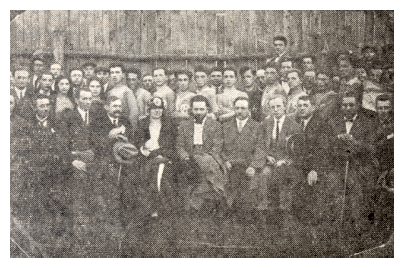
| I. Grinbaum in Będzin on the occasion of the opening of the “Hakoach” sports field | |
Seated from right to left: Ptasznik, Dr. Rechtszpet, Lajbl Goldsztajn, Abram Liwer, Dr. Wajnziher, Icchak Grinbaum,
Mrs. Fürstenberg, Szymon Fürstenberg, Szlomo Frenkel
|
The Jews of Będzin were loyal to him and consistently voted for his party which included a delegate in the Sejm, [the Polish parliament], Dr. Szlomo Wajnziher, a citizen of Będzin. He was very popular and well-loved by the people of Będzin. However, since the “Agudat Israel” people caused a breach between “Achdut Yisrael” and the National Front, by presenting a separate listing for the elections to the Sejm, Dr. Wajnziher failed in the elections and Jewish Zagłębie, which comprised of more than 70 thousand citizens, was left without representation in the Polish parliament.
Grinbaum is connected to Będzin even today and whenever he meets his few friends from our town he remembers his glorious past.
Dr. Joszua Tahon
He was one of the best and most loyal activists of the Zionist movement in Poland for decades. He was a distinguished Hebrew writer and philosopher. He was a delegate in the Polish Sejm until his death in 1937. He was a brilliant orator and a militant supporter of the Hebrew culture and its revival.
He visited Będzin in 1925 at the invitation of “Tarbut”. His lecture on political problems was attended by crowds, who knew his popular articles in the “Haynt” [Today] in Warsaw and in the Polish “Nowy Dziennik” [Polish Daily News] in Galicia. His lecture was a spiritual pleasure to its audience.
That evening a general meeting was held of the “Tarbut” association to which all parties mobilized their members in order to gain as many representatives in its board as possible. At this meeting the guest elaborated on the importance of the Hebrew language, preached for devotion to the language and expressed a wish that Hebrew would not only be a holy language, but also a living language of the people, a language in the street and in the marketplace.
Perez Markisz
He visited Będzin in 1926 at the invitation of the left “Poalei Zion”. In his lecture at the “Corso” theater he mentioned the need for a change of values in our literature. However, although the lecture was completely on a literary topic, the speaker did not avoid political matters and strongly criticized the tyrannical regime which had started to sprout in Europe.
[Page 312]
|
|
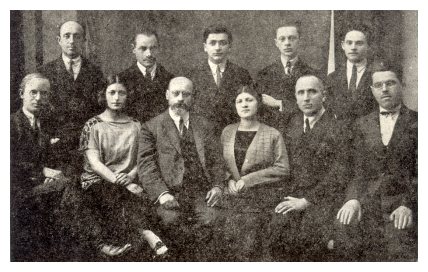
| Dr. Joszua Tahun with the “Tarbut” [culture] committee in Będzin in 1925 | |
Standing from right to left: Abram Sztrochlic, Dawid Liwer, Mordechai Hampel, Tewel Klajnman, Cwi Pfefer.
Seated: Guest of “Zaglembier Zeitung” [Jewish newspaper], Joszua Lewkowicz, Icchak Wygodzki, Bajtner, Dr. J. Tahun, Mrs. Liwer-Kaminer, Abram Liwer. |
I can still see him, very handsome, wide-shouldered, his curly hair unkempt, standing on the stage and speaking fervently. We listened to him although we didn't agree with all his conclusions.
Since he stayed in my late brother's house, Aron Hampel, one of the heads of “Poalei Zion”, I spent a few hours in his company and was deeply impressed by his personality. He was not a Zionist, although he had visited Eretz Yisrael in 1921 and was immensely impressed. At first he showed understanding to the idea that Zionism was the solution to the Jewish problem, but as time went by, he rejected Zionism, and was captured by communism and moved to Russia. However, his loyalty to it did not help him and he suffered a tragic death.
Eliszewa, poetess
At the invitation of the “Tarbut” association, this poetess, of Russian origin, visited our town in 1927 with her husband, Mr. Bichowski, her former Hebrew teacher in Russia.
She appeared in the “Corso” hall on a Sunday before noon and read from her poems and stories, which were wrapped with a tone of gentleness and delight.
The writer of these lines warmly welcomed this poetess, a contemporary Ruth the Moabite, “Ruth of the Volga banks” and introduced her work. She left us on that very day without a special reception, because she had a performance in another town.
Daniel Perski
He was one of the “Tarbut” activists of in Poland. In 1928 he visited Będzin and was the guest of the writer of these columns. I knew him well and enjoyed his merrymaking and joyful mood. I was happy to find old copies of “Hapoel Hatzair” and “Dawar” in my house and was amazed at his excellent memory when he mentioned my name as a reporter of “Hatzfira” and “Hayom” in which I published articles about the life of the Jews in Będzin and Zagłębie.
On Saturday afternoon he held a literary lecture in Yiddish. There was also a meeting of the “Tarbut” members in our town in which we outlined, with his participation, our future plans to increase our Hebrew activities.
Perski stayed in Będzin for ten days, visited the “Gordonia” clubroom, spoke in Hebrew with its senior members Cwi Kutner and Jonatan Wajsbort, two of my most beloved pupils who fell in the War of Independence. He also visited the “Hashomer Haleumi” clubroom and was impressed by the youth who were educated in the spirit of hagshama [realization].
Jakob Riftin
He was one of the leaders of “Hashomer Hatzair” and “Mapam” and a Knesset member.
He visited Będzin in 1928 on the occasion of a fundraising for Eretz Yisrael workers' fund.
He appeared in the “Warso” hall and in a beautiful and exciting lecture in Yiddish he enumerated the many blessed achievements of the movement of the workers in the Eretz Yisrael and called the audience to support it and act for it.
In the middle of his speech members of the “Hitachdut” interrupted him shouting “Hebrew! Speak Hebrew!”. This was a protest against the discrimination of our language in the conference of a working Eretz Yisrael, held that month in Warsaw, with the participation of Ch. Shorer and other “Histadrut” delegates, in which “Poalei Zion” members demonstrated for the Yiddish language.
The lecturer was neither intimidated, nor surprised and spoke angrily in surprisingly excellent Hebrew, which shocked the demonstrators who fell silent. The lecturer reprimanded both sides and called them to avoid a language quarrel and prefer the interests of the “Histadrut”. In those days two separate fund drives for KPE”I [Palestine Workers' Fund] had been run, one by “Poalei Zion” and the other by the “Hitachdut”.
|
JewishGen, Inc. makes no representations regarding the accuracy of
the translation. The reader may wish to refer to the original material
for verification.
JewishGen is not responsible for inaccuracies or omissions in the original work and cannot rewrite or edit the text to correct inaccuracies and/or omissions.
Our mission is to produce a translation of the original work and we cannot verify the accuracy of statements or alter facts cited.
 Bedzin, Poland
 Yizkor Book Project
 JewishGen Home Page
Copyright © 1999-2026 by JewishGen, Inc.
Updated 18 Aug 2026 by OR