 |
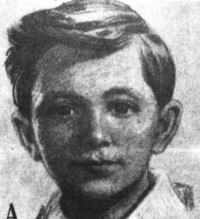
His last request to the firing squad was to be allowed to play one last tune… Perhaps he played “Hatikva” on his violin that had been playing.
|
|
[Page 495]
by Jacob Soroker
Translated by Y.A. Horovitz
Edited by Roberta Jaffer
Musical life in old Bălţi - a town neglected and forgotten by the Holy One blessed be He, and especially among the Jewish population, which at that time numbered nearly 14,000 people, most of them from the middle class (at best!) who seemed - apart from earning a livelihood - to be interested in nothing, and yet this phenomenon, which cannot be explained, existed. And we, the few witnesses who remained alive, must talk about those wonderful deeds and people. In this essay I intend to tell (briefly as I can) only about deeds related to classical music, which is called “serious music”.
“Musical life” is a connected concept that depends on elements such as tradition from generation to generation, a financial base, support from authorities and benefactors, etc., etc. All of these were… completely lacking in the Bălţi of that time. Every initiative was based on “naked enthusiasm,” on amateurism and dilatancy. It goes without saying that in the Bălţi of that time there was no school or musical institution (state or private); musical education (in most cases, playing the piano and violin) was realized according to the “homemade” method. Each private teacher taught to the extent of his ability and possibility. As is known, in Jewish families it was customary to teach girls (rarely boys too) to play the piano. A piano in the home was a symbol of wealth and culture. Playing the piano - an important virtue for a girl who was about to get married…
In the city there were renowned piano teachers such as Mrs. Hoffmann (married name - Begun), Tiflitsky (who moved to Bălţi from Odessa), Rita Mandelblatt, Golko, Sonia Finkelman, Mina Merenfeld: all of them taught in their homes for a reasonable tuition fee.
I remember only a few names of boys who succeeded in playing the piano. One of them, Chaim (Pima) Wallich, was the son of the well-known photographer in Bălţi - Pinchas Wallich. (As it turned out after the war, Pinchas Wallich was murdered by the Nazis near the town of Soroka: Chaim's mother and grandmother died in a concentration camp in Transnistria). As a child, Chaim received professional instruction from his sister Ida - Chaim was tall, with long and strong fingers (an important trait for playing the piano). Diligence and love of music brought him to a high level in playing. I often had the opportunity to play with him both at home and in public (in Bălţi and other towns in Bessarabia) accompanied by Chaim Wallich (I myself played the violin) - he performed his role excellently. In adulthood, Chaim left the musical profession (a difficult and unprofitable profession, especially in those times and conditions). He studied architecture and became a first-class architect. He lived in Moscow for many years, received the title of “honored architect”, was awarded medals of excellence, decorations, etc. In the 1940s he worked on the restoration of many cities in Ukraine and Russia (including Sevastopol) that were destroyed during the
[Page 496]
war due to bombings and shelling. Later he planned projects for buildings and complexes in the capital of the USSR. Among them were the Great Circus, the Institute of Scientific Information, the Central Medical Library, and more, many residential buildings, including a large tower-shaped building on the embankment of Fronze Street, which Muscovites still call the “Wallich Tower.”
Vallich [Wallich] had to fulfill his duty to the government and communist office art and participated (together with another Bălţi expat - the sculptor L. Dubinovsky, see below) in the erection of monuments to the “Heroes of the Soviet People” Kotovsky, Fronze, and others. Chaim Wallich died in 1982 in Moscow. Articles about the deceased appeared in the Soviet press, one of them under the title “The Honorable Son of the Moldavian People” (!) The Soviet “internationalists” strove to conceal not only his art, but also his origin, and the name of Chaim Wallich, who was cleansed of everything related to Judaism: and from a Jew named Chaim ben Pinchas he was reincarnated as Lifim Petrovich - the son of the Moldavian people!
Another Bălţi person with rare musical talent made a name for himself, and he too was not in music but in sculpture. This is Eliezer (Lazar) Dubinovsky (1910-82). Who in Bălţi at that time did not know Lazar with his beautiful voice (lyrical tenor), who appeared at all local concerts and events, balls and celebrations? In addition to singing, the boy was drawn to painting and sculpture, and this became his permanent profession. The most prominent statues and monuments in Chisinau were erected by Lazar Dubinovsky.
He was awarded the title of “People's Artist”, a member of the Academy of the USSR. With all this, he does not forget his “first love” - music: he would perform in concerts, in halls and on the radio, sometimes also at the Chisinau Opera Theater (his favorite role was that of Monsieur Triquet [a French tutor] from Tchaikovsky's “Eugene Onegin”). Lazar died in Chisinau in 1982. Before his death, he managed to visit Israel, but… only as a member of an official Soviet delegation. In his will, the artist Dubinovsky bequeathed a sculpture-monument that he created in 1977-78. At the invitation of the Jewish community from Romania it was placed in the community's museum in Bucharest. The name of the monument is “The Holocaust” and it embodies the image of a man covered from head to toe in a tallit. Thus, the artist used both the means of modern sculpture and also adhered to the Torah: “You shall not make for yourself a statue or any image…” Dubinovsky's work - the image of a Jew immersed in prayer - is moving and shocking. And the fact that it was placed not in the artist's “homeland” but in “semi-Soviet” Romania speaks for itself.
The sister of the aforementioned Chaim Wallich - Ida was born in 1912 in Bălţi, in 1934 she graduated from the Prague Conservatory. From 1944 to the present day, she has lived and worked in Moscow. Ida Wallich is one of the most prominent scientists in the field of musical bibliography. Since 1950 she has worked in the Central Soviet Library, the Lenin Library, as the chief bibliographer. Ida is the author of a multi-volume bibliographic series - “World Literature on Music”.
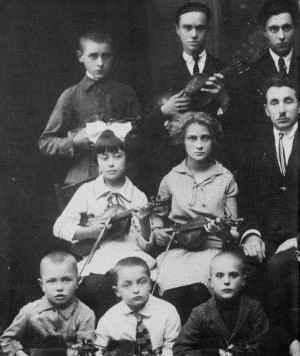
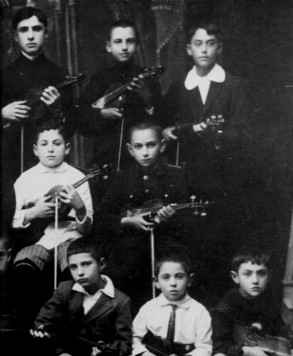
There was a private violin teacher in Bălţi whose work turned out to be extremely successful. His name was Benjamin (Ben) Ackerling. It was said that he received his education in Vienna. In 1920 he settled in Bălţi and began teaching children to play the violin. His spoken language was German (“German teacher” - that was convincing!) but he also knew Yiddish. His ability and talent for teaching children were excellent even though he himself did not play (due to a hand disease). Many children in Bălţi studied with B. Ackerling, most of whom reached a high professional level. Here are some of them: Yechezkel (Oscar) Dean (1912-84), who was for many years the principal violinist of the Chisinau Symphony Orchestra, an “artist with rights”, docent at the Conservatory; Joseph Bernstein (see below); Zvi (Grisha) Spector, who received his higher education at the Tchaikovsky Conservatory in Moscow, played in the Film Studio Orchestra. (Grisha's father - Kalman Spector was a watchmaker by profession and also an amateur flutist who participated in all musical events. Kalman's brother - Moshe was a talented violinist and passionate about music); Ackerling's student was also the author of these lines.
The life of B. Ackerling, who contributed greatly to the culture of the city of Bălţi, who founded a real school of violin playing, was tragically cut short: at the beginning of the war (1941) he did not find it necessary to emigrate (and hoped to be accepted as a German) - a fatal mistake that cost him dearly. The Nazis and their partners in action - the Romanians, when they learned that he was not a
[Page 497]
German, not a Jew, he was murdered in the most brutal way.
With great pleasure I begin the life story of B. Ackerling's most famous student - Joseph Bernstein. He was born in Bălţi in 1914. His father, Arie, was a middle-class merchant but, to his credit, he gave his only son an excellent education. (There was another daughter in the family named Vita: all the members of the Bernstein family, except for Joseph, who immigrated to Israel, died at the beginning of the war.)
Joseph began studying the violin, as I mentioned, with Ackerling and in a short time his rare talent was discovered. In the late 1920s, Arie sent his son to Germany to continue his studies with Karl Fleisch (a Jew of Hungarian origin, one of the famous violin teachers of the time). Joseph was among Fleisch's outstanding students. He also received the guidance of the great Romanian violinist and composer George Enescu. During the summer holidays, Joseph would visit his hometown and perform in concerts. I remember his playing in a concert in 1928 or 1929; I don't remember what pieces he played, but I still remember being surprised by the young violinist's professional level - he was 15 or 16 at the time.
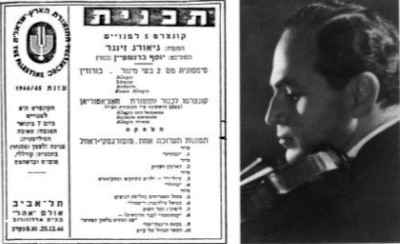
In 1936, the Palestine Orchestra (now the Israel Philharmonic Orchestra) was established in Tel Aviv at the initiative of the great violinist (a Jew from Poland) Bronisław Huberman. The new orchestra found refuge for many Jewish musicians who were persecuted by the Nazis in Germany and Austria. Among them was Joseph Bernstein, who was accepted as concertmaster. A new and interesting period began in his life. In addition to playing in the orchestra, he performed as a soloist with the orchestra. Among other things, he performed works by Beethoven, Mendelssohn, Tchaikovsky, and the concerto by the great Armenian composer Aram Khachaturian, written in 1940, was performed by Bernstein in its premiere in Israel on December 20, 1944, in Tel Aviv under the baton of George Singer. After that, Joseph played the same concerto - with great success - in Jerusalem, Haifa, Cairo, Alexandria, Beirut, and other cities. He went on to play in Europe and America with famous conductors such as Eugen Sankar [Szenkar], Herman Sarkhan [Hermann Sarkhan], Michael Taube, and others. Bernstein gave the premiere in our country of Enescu's Sonata No. 3 (“in a Romanian folk character”). He organized a quartet - the “Tel Aviv Quartet” in which he himself was the first violinist. The second violinist was one of the veterans of the Philharmonic Orchestra, Ben-Ami Zilber (1915-85) (Ben-Ami Zilber was the husband of the great singer Bracha Tzfira and the father of the famous singer Ariel Zilber).
In 1947, Y. Bernstein traveled to Israel, pinning his hopes - and he had every chance - of making a brilliant career in this country. In 1948-1949, he participated in a festival in the Berkshires [of Massachusetts] organized by the conductor Sergei Koussevitzky - the world-renowned musician. He wrote about Joseph: “He has an extraordinary talent and an extremely high artistic level. In addition, Mr. Bernstein is a man of fine culture.” (Joseph was fluent in six languages - Hebrew, Yiddish, English, German, Romanian and Russian).
Despite all this, the wonderful violinist encountered serious problems. A severe crisis reigned in the “musical market”. He was finally accepted into the New York Symphony Orchestra, but shortly afterwards he was struck down by a fatal illness. Joseph Bernstein died in 1976 at the age of 62.
The musicians of the old Bălţi… as usual uneducated, with scant knowledge of theory, but, nevertheless, enthusiastic and loyal lovers of the fine art. One of them was Isser Shvartzman, a naturally talented man. He received his first lessons at home. His father was a well-known klezmer player - Moishe Shvartzman, nicknamed “Moishe Bass” (every klezmer, like the legendary Stampanio and Pdotzor, had, of necessity, a nickname, as usual, according to the instrument he played: it is clear that Moishe played the double bass). Isser played several instruments - cello, trombone, horn, accordion, piano. He was also a talented orchestrator (although Autodidact!) But Isser Shvartzman had - from the point of view of Marxist ideology - a serious disadvantage: he owned a small music store.
When the Soviet authorities came to Bălţi, they deported Isser and his family to Siberia. Apparently, the sale of harmonicas, bows, and sheet music caused a great loss to the construction of world communism… Isser Shvartzman's nephew - Moshe Fidel made a name for himself as an excellent pianist in the city of Yassi (Romania).
[Page 498]
I would like to note that our family is also a family of musicians: My father, the late Leib Soroker (1895 - 1981)
was born in Bălţi, died in Jerusalem, and was one of the first professional musicians in Bălţi. During the motion picture era, he played, together with a group of local musicians, pieces that he himself adapted to illustrate the presentation of the “silent” films.
There was another family, a real musical “dynasty”, the Feldman family. One of them, Joseph, a multi-talented cellist and singer, also received a higher education as a technological engineer at the University of Prague. Joseph Feldman died when a bomb exploded at his workplace (one of the dairies in Bălţi). His sister - Kroine - an excellent pianist who participated in all artistic events. His brother - Bozia - an accordion player, in the 1930s he left Bălţi and settled in France. Kroine's son - Yoel Feldman made a name for himself as a music teacher and composer of popular songs (he still lives in the town of Stri [Stryi], in the Ukraine).
Completely different is the fate of Moshe Levtov - one of the first professional pianists in Bălţi. Moshe, the son of Pinchas Levtov, owner of a Hebrew and Yiddish bookstore in old Bălţi: But Pinchas Levtov was not only a bookseller, but also a book publisher; his name and activities were known throughout Bessarabia.
Moshe studied piano in Bălţi with Mrs. Mina Merenfeld and Ida Wallich, then he completed his studies at the Lvov Conservatory and taught and played in that city for many years. Now M. Levtov and his family live in Haifa. His son Vladimir (Zeev) is an excellent pianist and his grandson - Natan - also studies piano under the guidance of Grandpa Moshe…
Above I spoke about the Bălţi klezmers and I would like to add a few more lines on this subject. I remember some klezmers myself; my late father told me about others. Here are some names: the violinists Chaim-Yukel, Berl Galatzan (“Berl-Klezmer”), his son - the violinist Ben-Zion Galatzan and one son the flutist Chona Galatzan (who emigrated to the USA), bass player Moshe-Yudel, violinist Mendel Koltz. It is worth noting that the “lauter” (Romanian folk musician) Kostaki Farno was of Bălţi origin; his work is written about in professional literature; among his students and colleagues were also Jewish musicians.
In the list of folk musicians, I would give the most honorable place to the bard Zeilig Berdichever (1903-37), who, although not a musician in the usual sense, became a troubadour beloved by the masses. He wrote words and composed melodies, and his songs are distributed not only in Bessarabia but also beyond its borders. Berdichever's songs “fused” with folklore and are now an inseparable part of the folk artistic treasury.
The promoter of Berdichever's songs, who performed them publicly and published some of them, was the singer and composer Leibo Levin (born in Bukovina, 1941-83), who recently passed away in Israel.
Public musical life in Bălţi at that time was quite vibrant (considering the circumstances of the time and place). The city had two regular cinemas - “Lux” and “Modern” (which were run by Stiebelmacher - in the local context he seemed like a great man to us!). During the period of the film industry, the films were accompanied by a team of musicians - L. Soroker, Joseph and Kroine Feldman, Moshe Fidel (whom I have already mentioned), the cellist Avraham Warzer, the violinist Avraham Shmukler and others. The performances of various Yiddish theater groups were famous and beloved among the population, as usual musical theater with a small orchestra, songs and dances. This is a topic worthy of a special essay.
Concerts by local musicians were, of course, based entirely on volunteerism. After a long day of work - in a workshop, behind the stand, in the office - music lovers would gather at one of their homes (there was certainly no money to rent a hall). Rehearsals would begin… So, I had no right, because of my young age, to play in the “orchestra”. My father would take me to all the rehearsals as a listener. These were the first musical recordings in my life and I will never forget them. (After all, in those days there was, at least in our house, neither a radio nor a gramophone with records). I remember the playing of Beethoven's “Egmont” overture, Schubert's “Unfinished Symphony”. In any case, it is understandable that the “orchestra” excelled thanks to… the lack of many instruments. For example (I remember well) the first theme in Schubert's symphony, due to the lack of an oboe, was played on… a concertino (a type of small accordion that has now fallen out of use
[Page 499]
Sometimes concerts were organized at the Hebrew Gymnasium (where my “debut” as a violinist took place, in 1928, as part of a festive ball; in my “program” there was a piece - I still remember it - with a length of… a minute and a half). Incidentally, the Hebrew Gymnasium had a permanent brass band.
Internationally renowned artists would come and perform at Bălţi, such as the violinist George Enescu, the wonderful singer and film actor Joseph Schmitt, and others. Rossini's “Aria” under the baton of Ignazio Masini. All of this proves that the cultural level of the audience was quite high.
I must end my memories of musical life in Bălţi with a very sad story. (Is there a Jewish chronicle that does not end with a minor chord?) It is about a Bălţi boy-musician who became a legend and a symbol of heroism, love of music, love of life. The boy's name is Abraham (Mussya) Pinkenzon. He and his heroic deed are written about in the newspapers, both in Israel, in Western countries, and even in the USSR. And I will briefly repeat the facts: When the war broke out, the Bălţi doctor Zeev (Wolf) Pinkenzon fled and arrived in the town of Ust-labinsk in the North Caucasus, with his wife and 12-year-old son Mussya - a violinist of rare talent. In 1943, the Hitlerists also arrived here, and as a result - terror, executions of innocent people, Jews first and foremost, Wolf with his wife and son, who was never apart from his violin, were executed. Mussya, before his death, felt like playing and he received the generous permission. The boy picked up his violin and began to play. Then a bullet ended the song along with the young musician's life: a villain who considered himself the heir to Bach and Beethoven murdered the one who would have been Oistrakh or Perlman.
What did Mussya play at the last and terrible moment? Was it the “Internationale” as the Soviet sources claim? Maybe it was another tune - “Hatikva”?
|
Mussya Pinkenzon, a young violinist from Bălţi, was executed by the Germans in Caucasus in the summer of 1942. His last request to the firing squad was to be allowed to play one last tune… Perhaps he played “Hatikva” on his violin that had been playing. |
[Pages 500-501]
|
|
|||
[Page 502]
|
||
| Violinist Joseph Bernstein, born in Bălţi, soloist in the Eretz Israel Orchestra | ||
|
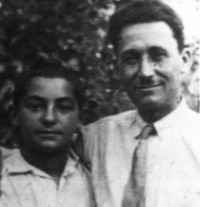
Two generations of violinists, born in Bălţi: one of the first professional musicians in the city of Bălţi, Leib ben Natan Soroker [1895, Bălţi – 1981, Jerusalem] with his son Yaakov [Photo from 1935] Yaakov Soroker [born in 1920 in Bălţi] - violinist and musicologist, doctor of musicology. He began studying violin with B. Ackerling in Bălţi, later in Chişinău with M. Paster. He received his higher education and scientific degree at the Tchaikovsky Academy in Moscow under the guidance of David Oistrakh. Y. Soroker authored and published many works on various subjects of musical art [including 8 in monograph form]. In 1976 he immigrated to Israel and has since lived and worked in Jerusalem. |
||||
by Y. Mazor
Translated by Jerrold Landau
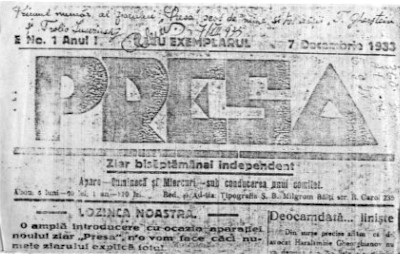
The title is pretentious[1], since Beltz had no daily, weekly, or monthly press. At least, we can discuss attempts to establish a press, and that is what we will deal with in detail.
The daily newspapers of Romania from the capital city, as well as the Jewish newspapers in the Romanian or Yiddish language, or even from Russia, would reach Beltz each day. The Kishinev-based newspapers in particular would also include a great deal of news regarding what was taking place in Beltz, gathered by their regular correspondents in Beltz.
For example, the correspondents for Undzer Tzeit for approximately twenty years were well-known people from Beltz, such as the lawyer Tzvi Heinichs, Kleiman, Zeev Gamerman, and others.
It should be noted that the correspondents from Beltz provided news on a constant basis to the Jewish newspapers of that era, such as Hatzefira, and Hameilitz, already from the middle of the 19th century. The correspondents for the Russian newspapers Bessarabskaya Slova, Bessarabskaya Pochta, Nashe Vremya were Messrs. Avraham Zigberman and Chaskelovich.
The Romanian newspapers, and even the sports newspapers, also had correspondents in Beltz. Zeev Vergulis (Vlodia) was one of them.
The Zionist newspapers Tribuna Evreiască from Iași, Coventul Evreiesc from Bucharest, and Curierul Israelit from Bucharest – the Romanian Jewish newspapers – as well as all Zionist newspapers in all languages in the various areas of Romania, reported on what was taking place in Beltz in any area relevant to the readership of the newspaper.
Therefore, it can be said that Beltz was not cut off from the wide world, and was not some remote backwater. Beltz could have been able to maintain its own regular newspaper, since its economic status was respectable. Kishinev continued to be the cultural and Zionist center, and a Russian stronghold, even after Bessarabia was annexed to Romania; however, it did not have a central newspaper in the Romanian language dedicated to the Jews of Bessarabia or to the general population. Therefore, Beltz could, in a natural fashion, be the second place after Kishinev. That would justify the existence of a newspaper in the Romanian language for the younger generation who did not know Russian or Yiddish.
That is what many people of Beltz thought, and from that stemmed sporadic efforts by a group of Jewish youths, who had initiative and journalistic leanings, to publish a daily newspaper in the Romanian language during the beginning and middle of the 1930s.
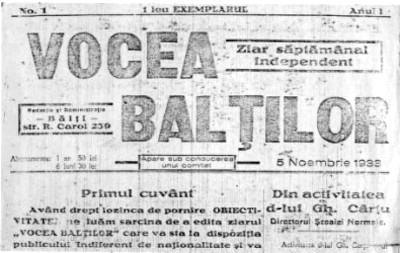
Two of them should be especially noted. Schweitzer and Yechiel Tischler. They published a newspaper called Vocea Baltilor,
[Page 504]
which lasted for two years. However, apparently it did not find the necessary financial support to expand the newspaper, which remained a small, provincial, local bulletin.
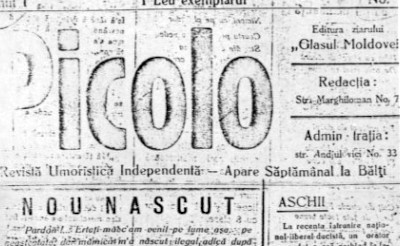
That group also published a humorous, satirical newspaper called Picolo, but that attempt also failed.
From the few surviving issues that were in the hands of Yechiel Tischler, who received them from Schweitzer who had left Beltz for one of the countries of South America prior to the onset of the Holocaust, we can get a fragmentary picture of the atmosphere of Beltz.
The young journalists regarded their task as protecting civic rights, helping the regular person in his stance against bureaucratic abuses, fighting for justice, and critically scrutinizing the city administrations when they did not fulfill their roles appropriately; to give the reader the opportunity to express their complaints and describe their problems.
Perhaps this was too high a task for a group of novice journalists.
We will present here several snippets that can complete our picture of Beltz from that period.
It is important to note that the Romanian language in which the newspapers were written was at a high level. The young Jews who edited the newspaper had studied in the Romanian government gymnasium [high school]. Of course, Jewish students excelled at their studies. They were even able to master the Romanian language as if it was their mother tongue.
The style was literary, attesting to their writing skills, and even their literary craftsmanship. In fact, it is known that many of the journalists in the Romanian press, especially in the liberal newspapers, were of Jewish origin, albeit with Romanian names. Anti-Semitism even accused the Jews of ruling over the Romanian press, and when anti-Semites reached government positions, they organized a purification and removed the Jewish journalists from the press. One should know that the shaper of the modern Romanian language was a Jewish philologist named Gaster.
One example of a topic that occupied the writers of the Vocea Baltilor newspaper was the floods of Beltz, and the great suffering that they caused to the poorer classes who lived next to the Reut River.
The historical ballads formed a significant portion of the journalistic material. These ballads were weak in terms of craftsmanship. They were written with the influence of the culture of the Romanian period. The humorous, satirical theater, and the theatrical couplets of the French-style “café chantant” musicians were popular during that inter-war period, especially during the early 1930s. This was the golden age of the petite bourgeoisie.
[Page 505]
|
|
||
| Local newspapers Presa, Vocea Baltilor, and Picolo | ||
[Page 506]
|
|
||
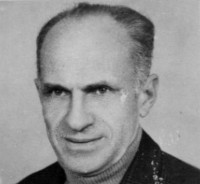
| Yechiel Tischler, one of the local editors of Beltz |
||
Translator's footnote:
|
|
JewishGen, Inc. makes no representations regarding the accuracy of
the translation. The reader may wish to refer to the original material
for verification.
JewishGen is not responsible for inaccuracies or omissions in the original work and cannot rewrite or edit the text to correct inaccuracies and/or omissions.
Our mission is to produce a translation of the original work and we cannot verify the accuracy of statements or alter facts cited.
 Bălţi, Moldova
 Yizkor Book Project
 JewishGen Home Page
Copyright © 1999-2026 by JewishGen, Inc.
Updated 25 Feb 2026 by JH