|
|
|
[Page II]
|
[Page III]
Dedicated to the Memory of our Beloved, who were led to slaughter, not like sheep, but like a community of saints to a sacrifice, after cruel physical and spiritual tortures. They died without having done any wrong, by the hands of cannibals and their local helpers, their neighbors and former friends, who became their enemies and murderers.
It is for their sake that we live a free life in our re–established Fatherland but, alas, we cannot collect their holy bones which are spread throughout the fields of slaughter in the unclean earth of the enemy countries, for the purpose of burying them in the Holy Land of Israel.
Therefore, may the Merciful One shelter their souls under His wings forever, and bind them in the bond of Life.
[Page IV]
| Name | Year of Aliyah |
|
| 1. | Beri Dvora, nee Klinger | 1936 |
| 2. | Borochov Nuska, nee Altberg | 1938 |
| 3. | Drezdner Klara, nee Altberg | 1934 |
| 4. | Drezdner Moshe | 1934 |
| 5. | Elner Arie | 1935 |
| 6. | Elner Yosef | 1933 |
| 7. | Flashner Zvi | 1935 |
| 8. | Goldenberg Philip | 1934 |
| 9. | Goren Arie | 1935 |
| 10. | Goren Yitzhak | 1929 |
| 11. | Hirshhorn–Rozen Mordechai | 1933 |
| 12. | Horowitz Yakov | 1937 |
| 13. | Imber Shoshana, nee Goldfliess | 1938 |
| 14. | Levinson Ita | 1936 |
| 15. | Meltzer Efraim | 1937 |
| 16. | Meltzer Michael | 1935 |
| 17. | Neu Sabina, nee Grinfeld | 1938 |
| 18. | Neuman, Dora | 1934 |
| 19. | Polishuk Meir | 1935 |
| 20. | Rosenfeld Meir | 1936 |
| 21. | Rosenstock Moshe | 1933 |
| 22. | Rosenstock–Hochman Sara, nee Entner | 1933 |
| 23. | Rosenstock–Hochman Zeev | 1933 |
| 24. | Turkel Eliezer | 1937 |
| 25. | Turkel Israel | 1932 |
| 26. | Wachtel Avraham | 1921 |
| 27. | Wachtel Sioba, nee Milgram | 1921 |
| 28. | Weiser Saul | 1936 |
| 29. | Younger Gershon | 1937 |
[Page V - English]
By M.S.
Before the Second World War there were only a few “Olim” (immigrants) who came to Eretz Israel (Palestine) from Trembowla. There was therefore no need for an organization. The situation changed after the war, when survivors of the “Shoah” (Holocaust) began to arrive. They, together with the dropouts of the Anders–army numbered, after a short time, more than a hundred.
It was in the early fifties, when Naftali Weinraub, Yona Willner, Yitzchak Soldstein, Meir Polishuk (all of blessed memory), Yisrael Goldfliess, Nathan Warman, Yisrael Rosenfeld, Zvi Flashner and Meir Selzer came together and decided to establish an organization of Trembowla–Olim in Israel.
The first public activity of the new organization was the gathering on the even of Rosh Chodesh Sivan (around June), the anniversary of the date of the third “action”, when Trembowla was declared “Yudenrein”.
We have met since then on that date year after year, except in 1967, when, because of the Six Day War, the gathering had to be postponed.
The late president of the Trembowla Society in New York, Mr. Joseph Weissman, of blessed memory, participated in the gathering in 1956, and our friend, Abe Weissberg, participated in 1977.
In recent years we have also had annual gatherings in Haifa on the anniversary of the first “action” in Trembowla, in Cheshvan (around October).
The first project of the organization was the establishment of a free loan society, in order to help the newcomers to settle in the country. Most of the funds were contributed by members in Israel.
The second enterprise was the settling up of a plaque in memory of the Trembowla Jewish Community in the Cellar of the Holocaust In Jerusalem, among the plaques of the Jewish communities of Eastern Galicia, like Czortkow, Kolomea, Zbaraz, Zaleszczyki, and others.
The third project was the planting of the Trembowla grove in the Martyrs' Forest in the winter of 1965. Mania and Avraham Weissberg represented the Trembowla organization in New York.
During all these years we were aware that it was not enough to have a free loan society in the name of our holy martyrs, a plaque in the Cellar of the Shoah, a grove in the Forest of the Martyrs. We knew that in order to perpetuate their memory we must issue a memorial book, as did thousands of organizations, written by the survivors and the relatives of the perished ones.
At every meeting the subject of the “Book” was brought up, but the reaction was very slow. Year after year we appealed to the members of our organization to
[Page VI]
Write about the Jewish community of Trembowla, its institutions, its organizations, about personalities, about the plain people, about anything and everything related to Trembowla. We asked that they write in any language: Yiddish, Polish, German. We would translate. And we promised that everything written would be published.
An editorial committee was established and it began to meet regularly, and its members started to submit material for the “Book”. The articles were read at the yearly gatherings and, slowly, material began to arrive from the members.
We also asked the members of the American Organization to write, and as a result we received four compositions in English. These were translated into Hebrew and appear in the book in both languages.
We also asked for pictures and what we received is being reprinted.
We did not pretend to produce a literary masterpiece. We only wanted to produce a picture of our Trembowla Jewish Community as it was.
We tried our best.
The Editorial Committee did everything possible to collect the names of our holy martyrs of Trembowla, and we are sorry if any names were omitted because of lack of sufficient information.
And now we want to thank all those who helped this, our endeavor, to materialize. We thank all those who wrote and those who contributed towards the expenses connected with the publishing of the book.
We thank our friend, Abe Weissberg, for his enthusiastic support, and the American Committee and membership.
We thank the members of the Organization in Israel.
[Page VII]
By Sabina Herbst
It was the end of May 1943. There were about 1,800 Jewish people in the Trembowla ghetto. At that time, many of them were from the neighboring smaller towns and villages. My dear husband was one of the first victims of the Nazis in the year of 1941, and I was left alone with my child who was three years old at
|
|
| Chaim Herbst, his wife and daughter |
That time. Jews were walking in the ghetto street like shadows, sad and depressed with only one thought in their mind – where to run and where to hide.
A pogrom by the Nazis was expected any hour, any minute. I took my daughter Ziunia, who at that time was not quite five years old, and went out secretly
[Page VIII]
from the ghetto to find a place to hide. I went to a few gentiles, who once were customers in our store, and begged them to find some shelter for me and my child in their house. Everybody refused. We spent the night in the woods with many other people. We returned in the morning to the ghetto; it was still quiet. Everybody was asking, “Do you have a place to hide?” I was tired to the point of exhaustion. Ziunia was crying, tired, thirsty and hungry. She told me, “I don't want to know about anything – just give me something to drink and put me to sleep.”
Since the age of three, I was running with her to shelters to hide, in hunger and fear, but she still could not understand why we had to hide. I explained that we were in danger of being killed, but she didn't know what it meant and asked, “How does it look when someone is killed?” I explained to her exactly what it meant – that the Germans were hunting us with guns and when a person is shot, the blood runs, he dies and he is buried forever. “No mommy, I want to live. I will be quiet.” I taught her that lesson when she was three and a half year's old.
We felt like hunted animals filled with fear and anguish. People kept asking one another, “Where is America; where is the whole civilized world; are we all condemned to die?” That same night came the attack. Every house in the ghetto had made caves under the furniture, or hiding places in the attic, to hide from the Germans. We went into a cave, which was prepared in advance – the same place that people were previously taken out by the Nazis for extermination. Among the people in the cave was my older brother, Moshe, with his wife, Fania, and 15 year old daughter, Genia. My brother's older son, Zalmen, age 18, was taken in 1941 to Bergen–Belsen to the gas chamber. In the cave was my sister–in–law, Henia, with her child, Wolf Rosenstrauch's wife and children, and approximately sixty other people. Before we managed to close the cave, the murders came in and started to pull out all the people. I was sitting with Ziunia in my arms in a corner and heard the cries of the victims. I have no words to express that feeling, expecting to be taken out any minute. I saw a Nazi came down to the cave and take my niece, Genia, with Rosenstrauch's little five year old girl. Genia begged to be left and asked if it was possible to run away. I can never forget the sight of my beloved niece begging for her life. My brother, Mose, was lying on the ground of the cave unconscious, and as soon as he gained consciousness another Nazi came in and grabbed him. It was a miracle that they didn't see me with my child, my sister–in–law, Fania, and my sister–in–law, Henia, with her child. (The rest of Henia's family – husband, sister, brothers and father – perished in the previous actions.) The Germans threw burning straw in the cave and when no sound was heard, they thought that nobody was there and left.
We went to another house, where we found a few other single people without families – depressed and disgusted with no more spirit or will to live. I did not
[Page IX]
Know what to do or where to go. The Germans were liquidating the ghetto to make Trembowla “Judenrein” free from Jews. I gathered all my courage to go out to other houses of the ghetto, hoping to find someone to join us to go somewhere together. Hernia left with her child…I didn't know where she went. At that time, the ghetto consisted of only a small number of houses in Sobieska St. (called “koplowka”). I was walking through the gardens and buses in fear, filled with anxiety. The houses were empty. I saw the corpses of people who once were my neighbors, a sight I will never forget. Overpowered by fear, I started to return to the house where I left my child sleeping and my sister–in–law, Fania, waiting for me. Fania was completely apathetic. She said she didn't care any more; she had lost all her dear ones – husband, children, sister and family; she had nothing to live for. Thile I was walking back, I noticed that Sklarek and two other Nazis were walking to the same house. Sklarek was a German Gendarme stationed in Trembowla. He was always walking in the company of a big black German Shepherd dog, watching that non Jew escaped from the ghetto and that no one bought any food into the ghetto. Everybody feared him. I ran quietly into the house to be with my child and thought to myself, “now comes the end of everything.” Sklarek approached me and said in German, “Come to work.” I answered, “I have a small child.” He said, “You don't want to, “ and took out his gun to shoot. I was motionless. At that moment, the sound of a whistle was heard and the voice of other Germans who were telling him they found more Jews. Sklarek put back the gun and told me, “You can go. I don't need you.” As soon as the Nazis left with a group of Jews, I gathered a few necessities, took my daughter and sister–in–law and started walking to a nearby village, about 10 kilometers from town.
Podhajczyki
The name of the village was “Podhajczyki”. On the way, we were attacked by bands of Ukrainians who were collaborating with the Nazis in killing Jews. They took whatever we had. Ziunia was crying. Some gentile women were looking and said to the attacker, “Leave them alone; look at the crying child.” Luckily, we were left alive, and we went on our journey to Podhajczyki. Upon our arrival in the village, we came to the house of a farmer who was once a customer in our store. When the war broke out, we had given him merchandise from our store to hide. He had a wife with two little girls and was a religious Catholic. Many people who were running from the ghetto at that time were being killed by Ukrainians or Germans. We were sheltered in the attic of the farmer's house. The wife gave us food to eat, but told us that they had no room for us. I begged her with tears to
[Page X]
save our lives. “Do it please for the sake of my child, I do not care for myself.” After talking over the matter with her husband, she came to tell us that they had a hiding place underground. We also found out from the farmer that all the people from the ghetto were take to Plenbanovka,” a suburb of Trembowla, and all men, women and children were shot by a German firing squad and buried in a previously prepared mass grave. Some people were still alive. I listened in horror and disbelief, but in spite of all that, I didn't want to die, and looking at my child, I was willing to go on. Fania was completely passive, but didn't want to die by the hand of the Nazis.
Late that night, the farmer took us down to the vegetable garden on his premises and next to the foot of a big tree there was an entrance to a hiding place, covered with a big square stone plate. First Fania was lowered down. Then he handed her my child, and I was last. When I heard the sound of the closing of the entrance, I thought to myself, “now we are buried alive.” The cave was about 8 feet long, 5 feet wide and 8 feet deep. It was dark, damp and dreary. We had some rags to cover ourselves. I was filled with anxiety and fear, that we would have to die here of starvation, a most terrible death, looking at my starving child. We could not go out by ourselves. We depended completely on the mercy of the farmer. I could not share my thoughts with Fania. I didn't want to frighten her. She had enough of her own tragedy. My daughter asked me what would we do here. It is dark and cold. I was trying to comfort and reassure her that in the morning it would be different; that now it was night and we had to sleep. Every hour seemed an eternity. Finally, we heard the sound of the opening of the stone plate at the foot of the cave and being lowered down on a string was a bottle with tea and a pot of food and spoons to eat with. I was overwhelmed with a feeling of hope. We started to eat eagerly. It was pitch dark and Ziunia got very impatient. I was telling her stories, made all kinds of promises, but the anxiety grew. Every hour was endless, and I felt that it was impossible to stay here. In the evening, the farmer opened the cave again and asked how it was inside. I answered that we had lost the spoons, it was pitch dark and we needed some light. He brought down a kerosene lamp, but it could not burn because of lack of air. He then made a couple of holes in the ground above the cave. We could see daylight, hear the bells ringing in the church and became a little more hopeful. The next day, there was a rainstorm; it got dark; it was thundering and lightening, and the water was pouring in through the holes. The water reached above our ankles. I was holding my daughter in my arms and thinking that maybe it would be better to drown her and all our suffering would be over. Suddenly, we heard a sound and a voice from above. It was the farmer who had just come from town. He asked, “How is it in there?” “The cave is filled with water,” I answered. “Give me the child, quickly,” he said. Fania handed him my daughter. I could not reach so high. Then she helped me climb up and
[Page XI]
then the farmer pulled Fania out. We felt relieved to get out of the cave; went into the house, washed ourselves, got something to eat and were put into the attic again. The next day, we were told to go because they had no place to hide us. I started to beg them to have mercy and find something for us. After many tears and long persuasion, they told us they would try to find a hiding place.
The next night, we were taken to a nearby barn, in which they had goats, chickens, and rabbits. Our hiding place was made between the slope of the straw roof of the bard and a straw wall which was made especially for us. The space was about 7 feet long and three feet wide. We could sit there, but my sister–in–law could only lie down, being too tall to sit. Through the cracks and corners of the roof some light came in. During the days when there were no Germans in the village, we crept out of the hold to straighten out and do some exercise, which was some recreation for Ziunia. We also spent time outside the straw wall. We could all sit down and talk. My daughter could play with the rabbits which had been brought up to the attic by feeding them leaves, which were thrown to them almost every day in the summer. The biggest treat for my daughter was a sunflower. She ate the seeds and the rest she could feed the rabbits. Many times, they threw leftover food and pieces of moldy bread in the attic. Ziunia grabbed it. I cleaned it up and gave it to her to eat. At the same time, she was worried that the rabbits would go hungry. We were given a small loaf of bread for three days; hot water in the morning and evening and some soup for lunch. Sometimes they gave us a tomato, a carrot and a scallion fresh from the garden. It was enough to keep us alive. I made up countless stories to tell my daughter to keep her interested. She complained that there was nothing to do. I told her to braid my hair and tell me some stories she learned. All our talks were in a whisper. My sister–in–law was mostly lying down, quiet and depressed; I was trying to make conversation with her and asked her to serve us the meals we got.
“Tell Me Why”
One sunny summer day, Ziunia looked through the cracks of the roof and seeing the bright sun and children playing outside, she said, “Tell me, mommy, why do we have to hide here in the dark without daddy and without food, and other children can play in the sun and have their father?” I had no answer. I was choking, trying to suppress my painful emotions, but tears were running over my cheeks. My daughter patter my face with her little hands and said, “Don't cry mommy. Daddy will come back, and we will be together again.” I had no such hopes, but at the same time I didn't want to believe that I would never see him again.
[Page XII]
Our clothing was falling apart. I asked Mrs. Rajski to give me a needle and thread, and I tried to sew the holes together. She gave me a skirt and an old jacket from her husband. She was a religious woman and whenever I found her resentful for our being a burden to them, I used my religious persuasion which helped a little. We gave the farmer all the valuables we had. I had sewn them into the vest I wore and luckily this was not taken by the bandits. I found out that they were hiding another Jewish family, the Einlegers. They later left them, but they know about us which was to our benefit. That farmer belonged to the Polish underground and used to have meetings at his house. In the winter of 1943–1944, German soldiers were stationed almost in every house of the village, but the farmer knew how to avoid them by pretending that his family was sick, so the Nazis stayed away. At that time, we had to be especially careful not to make any sounds. At night one of us was always awake when the other slept, to keep guard. We heard their singing in the evening and picked up certain verses which were amusing to my daughter. I tried not to run out of stories. I told her that the war would end soon and that we would be free; we would go to America. She had an uncle Leo, and Aunt Martha there who would teach her to play the piano. We would have plenty of food. I would cook big pots of good dishes. I would bake big loaves of bread as big as a table. She would be able to shout and sing. There would be no more whispering.
At this time, I would like to mention that my younger brother, Leo, with his wife Martha, were in Vienna when the war began. My sister–in–law succeeded in leaving for the U.S.A. in 1939 on a visa from my aunt; but my brother could not go because he did not have Austrian citizenship. He got a permit to go to Cuba. In May 1939, he entered with several hundred other Jews who were fleeing from Austria on a French vessel, Flandre. When they reached Havana, they were allowed to land. They tried other countries, but they were refused everywhere. They were cruising for six weeks on the ocean, and finally France let them in. My brother was interned for three months. In the meantime, Hitler invaded France. My brother was in the Pyrenees for eight or more months and after many hardships, he came to the U.S.A. on a visa from our relatives in 1941. At that time, I received a telegram that he arrived in New York.
All through the winter in the attic, we covered ourselves with straw and an old coat which I had with me. The entrance to the attic was covered with a straw mat which made it darker. The waiting seemed endless. We could not wash or change clothing. There were times when there was much shooting and burning, and I was always afraid that the barn would catch fire. Sometimes, I could not believe that this was happening to us. Only my child gave me the strength and courage to endure all the suffering. I was trying to fight off the moments of despair and told myself that I must be strong. I could not break down. I have my
[Page XIII]
child to live for. I must go on. We need each other. We were in the attic for ten months.
Finally, in March 1944 we were told by the farmer that we could step down from the attic and that we were free. The war was still going on. There was loud thundering of the bombs as the Germans were fleeing, and the Russians came. We got a ladder to come down. I could not believe that it was true. We were still filled with fear. We were weak, undernourished and could hardly walk. We got something to eat and started to walk to Trembowla. On the way, we met Russian soldiers. Some gentiles invited us to their house and gave us food. We did not rejoice; our spirit was broken. We felt alone, unwanted, betrayed by the whole world. My daughter was crying. She could not walk, and I could not carry her. She was whispering for weeks; she couldn't raise her voice. I encouraged her to shout and promised to teach her to sing, but I had to wait in anguish, afraid that she had lost her voice. In Trembowla, we met more survivors, my sister–in–law Henia Selzer, came with her daughter Musia. They were the only survivors from their family. We embraced each other but we had only tears in our eyes. More survivors started coming out from their hiding places, about twenty to thirty people. We all gathered in the house of Dr. Sass. It was shocking to learn that so few of us were left. We felt physically and spiritually broken to pieces. There are no words to describe the pain we felt when we were faced with the unbelievable reality. My sister–in–law, Fania, said, “I wish I would have gone together with my family. What do I have to live for?” It is strange that after going through all that hell, everybody felt the same way. The war still was going on and there were rumors that the Germans were coming back. We started to run again, closer to the Russian border, until we came to Podwoloczysk. We found a few houses there with survivors in a crowded room. Many houses were demolished from the bombs. Suddenly, an epidemic of typhoid fever broke out and almost everybody got sick. We were taken by buses to a nearby village, “Kaczanowka”. The abandoned houses were turned into hospitals. Bundles of straw were used for beds. There was a nurse, a Jewish girl, who was previously working with the Germans under disguise as a gentile. She helped us greatly, but there was little medication. Many of the survivors died. My daughter and I were released after three weeks, but my sister–in–law, Fania, had to stay on. I didn't know where to go from the hospital. I was walking from house to house, begging people to take me in with my child. My offer to them was to sew dresses, blouses, etc. Finally, a woman with two children invited me to stay with them. She allowed me to use her potatoes and vegetables to cook soup, and I brought some of it to the hospital for my sister–in–law Fania. After her release, we had to leave the village because the woman refused to house all three of us.
We went back to Podwoloczysk, where I met my sister–in–law, Henia, with
[Page XIV]
her daughter. They lived in a very crowded place, but invited us to stay with them. After being there a few weeks, we went back to our hometown, Trembowla, which was occupied by the Russians. They were occupying my father–in–law's house and returned it to me. I struggled to make a living, went through a lot of hardship and fears. I remembered the address of my aunt who lived in the U.S.A. and wrote her a letter, so she would know about our survival. She notified my brother, Leo, who was in the U.S.A by that time and was saying Kaddish for us. I started getting letters and packages from my brother and sister–in–law and was filled with new hopes of putting together my shattered life.
On May 7, 1945, Germany surrendered and the war in Europe ended. I will never forget that day when a friend of ours came knocking on our window to tell us that the war was over. A parade and music were going on in the streets, and Ziunia wanted to go out and see it. Soldiers were parading. Some were hugging and kissing, rejoicing with their friends and family. My daughter looked on and said to me, “Maybe, I will find my daddy here.” The tears were choking me and running over my cheeks, and I only had one question in my mind. Where would I go and what would I do. I felt so lonely and forlorn that I had to go home and sit down and cry. I have no words to describe that feeling. We subsequently left the house in Trembowla and went to Bytom, a city in Poland. From there, we went on to Austria, with the help of the “Haganah”. We were stationed in Ebensee, in a camp which was once built by the Nazis as a death camp for the Jews. We found machinery from the gas chambers and other equipment of the concentration camp still there. After being there three months, we were transferred to Germany, to an area occupied by the Americans, and after two years in a camp for displaced persons, we arrived in the U.S.A in 1948.
[Page XV]
By Sabina Herbst
I met Chaim Herbst in the Zionist Organization, where he was an active member. He was an idealist and worked with devotion to inspire the Jewish youth with love of their heritage and the Hebrew language. At the time the idea of a Jewish State was still a dream. How happy he would have been to see it!
Chaim had a beautiful Hebrew library and he mastered the Hebrew language. David Turkel, of blessed memory, was his best friend, and they worked together towards a common goal. They organized an elementary Hebrew school and Chaim was a very successful teacher.
We were married in 1936 and in 1938 our daughter was born. In 1941 the German–Russian war broke out and Chaim was one of the first victims of the holocaust. I shall never forget Chaim, my dear friend and husband.
By Myra Herbst Genn
It was a magnificent spring. Blue skies, the bright sun warming the earth. The first green shoots breaking through the ground and the world coming alive with color. There was a loud, urgent knock at our window. The war is OVER! There'll be no more running and hiding. We are FREE! Now my father will come home.
We rushed outside. Music in the streets. Crowds, khaki uniforms everywhere; soldiers handing out chocolates to children. I search through the crowds; surely my father will be among them. But the faces of the soldiers belong to strangers. The memory I clung to for the three desperate years – in the ghettos, hiding in caves, in the attic – will remain only a memory. There's just my mother and I. Two people alone; thrust into a big empty world. How do you begin again when death is all around? And spring! – that teases with false promises.
[Page XVI]
(written in Polish, April 11, 1943 and received July 26, 1968)
The 7th of April this year was a horrible day for the inhabitants of the Ghetto and to people who had a spark of human feeling left. The things that happened exceeded all that was told so far until now, and they cannot be compared with the last local “action”. The barbarism of the past centuries is pale against the present one which is in complete contrast to the culture of the 20th century.
|
|
| Four Manheim sisters, Three Selzer sisters, Hava nee Ellman–Horvitz and her husband, her brother Jacob, Israel Siegel |
People were shot in the houses, in the streets, in the gutters, in the yards, in the squares of the Ghetto and outside it. The living ones were led to the square near the market, were undressed to their underwear, their shoes removed, they were stripped of their last possessions and led outside the city to the place of their last rest. The procession of the living dead ones moved slowly while the children clung to their mothers crying loudly and with tears, and the mothers wore expressions of pain and fatigue and were moaning. And there were some (like old Seret), quiet, upright, with uplifted heard, a serious expression, looking right and left, taking leave with a nod of their heads, from friends, streets and houses, which surely reminded them of better times, went quietly to the place of execution.
[Page XVII]
Under the mountain of Plebanowka the white crowd was once more seen moving slowly and soon the last act of the tragedy was heard – a “salvo” of guns.
On that rainy day, sad and cold – as if adjusted to the serious moment – the first group of about 300 people was led in the morning to the railway bridge in Plebanowka to the common grave, and the second group, in the afternoon, of about 500 people. And every time, instead of funeral music the machine gun played, and they threw into the common grave those who, at that moment stopped feeling, and those whose sufferings became stronger, and others who were spared a bullet by the cruel fate and who finished their lives under the pressure of the human mass. They didn't even cover them with earth. And for the children they didn't even waste a bullet.
At dusk the grave began to teem. A row of ghosts in human bodies began to creep out– and some able to walk, others to creep and others to turn. The stronger ones reached the village, the weaker ones the railway, as if waiting for the iron dragon in order to forget in its hugs “the pleasures of life”; and the remaining listened as if to the sound of the guns, hoping that this time they would not be spared.
The next morning this weird grave on which life was ebbing out, was refilled with a few wagons of bodies and covered with a thick layer of earth.
A part of the killed ones was transported towards evening to the old cemetery which witnessed sad scenes. One of these victims was Mania Selzer – she lived near the train ramp. She was shot in the market place where she remained for a few hours. The bodies were collected on a wagon and it became clear that she was not only alive but fully conscious, and she begged the favor of the men who were burying – the militia men, whom she recognized. She kissed their hands, called them by their names, and begged them to treat her gently. She maintained that she was still strong enough, and that she could live, if she would be helped. She was thrown roughly on the wagon together with the bodies, was transported to the cemetery, and left to her fate. At this particular time it could not have been otherwise because the killers were going around there and they were afraid. Finally, late in the evening they left.
On the cemetery she asked for help from strollers who went around there but they were afraid. At last an elderly woman from Rakowica, who helped her, laid her down somehow in the company of the dead bodies, gave her water and comforted her. At night she brought her a bundle of straw to lie on the for night in the ready grave, because those who knew her forgot her and did not come to help her, which was terrible and unforgivable.
The poor wounded one had to lie in the cold night in that ghastly surrounding. Hyenas appeared, in human bodies; they took off the (remaining) clothes of the dead bodies, and from her they took her last pennies. In the morning
[Page XVIII]
she was taken to the Ghetto hospital. The poor girl wanted very much to live because until then she hardly enjoyed life, and she had wonderful prospects for a splendid future. Under the effect of morphine she had the illusion that she would live, but the pity of it was that she was wounded not only in the legs, but in the abdomen and the intestines were outside. A belated operation, gangrene, and general weakness – the condition was serious. In the evening the illusion vanished. The poor thing knew that the situation was critical. Weakness increased. She felt that her strength was leaving her. She was fully conscious until the last moment. She remembered seeing her parents in the market place and her sister, Helena, who after she was shot in her face, had to proceed outside the city to the common grave. After the terrible sufferings in her last moments, she fell asleep under the effect of the morphine, which turned into eternal sleep.
I knew her. She was pretty and gentle, and after her death she was beautiful. The expression on her face was calm, without any trace of terrible suffering. The breeze of the wind which stole into the room through the open window, stroked her face and hair, as if it tried to awake her to life, but in vain.
[Page XIX]
By Moshe Briller
Some time ago I happened to come upon two pictures. One was an old one, acquired long ago. It was a picture of Kvutza of Hanoar Hanzioni in Trembowla, with my sister Clara, Fancia Horowitz and a few other girls, some of them our close friends. The other picture was given to me just recently. It was a picture of my older cousin, Chanusia Horowitz. What sad memories! What painful thoughts they evoked.
A generation gone and lost forever!
One has to look at these faces, to read in their eyes a drive for self–expression, a desire to live and to drink to the full from the cup of life. If life is a stage and the
|
|
| Trembowla at the foot of the “Castle” hill |
People its actors, then life is also a dream of varying intensity and of changing character. It is filled with suspense and excitement, with disappointments and sufferings. It gravitates between comedy and tragedy, between hope and disillusionment, between joy and despair. But the lives of these young people on the pictures were cut short, their hopes never materializing their disillusionments ending in the greatest tragedy our “Atoh Bochartonu” nation ever experienced.
[Page XX]
Trembowla. To us, born and raised there, it was not only a town, it was a world in itself. It was a place where every stone spoke to us, where every house carried some memories and meaning, where every street told a story. Most of all, it was a town filled with people, old and young, everyone with his own problems, his own worries and his own outlook on life.
It was town and a town it still remains.
But there were people in it, our own brothers and sisters – and they are gone – gone forever. There must be some life in this town, but I am afraid that if I visited it now it would make on me the impression of a ghost town, bereft of its soul, of the life that gave it a meaning, of the laughter that maybe, in the stillness of the night, still resounds over its emptiness. For we were an integral part of this place, our roots deeply implanted, our lives apart of the general life, our joys and sorrows intertwined with that of the rest of the population.
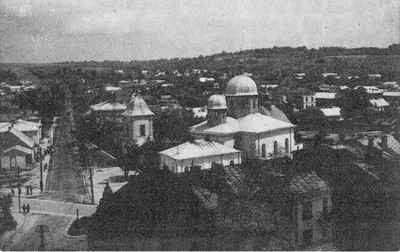
I remember the town. It rested sleepily between hills and mountains of a Podolia country–side. A small river ran lazily through its center, dividing it into an old and new town. In the spring this river would rise from its all–year slumber, swell with the rising waves of water, thunder with the ice chunks it carried on its rebellious shoulders, scare the fearful with the noise created by this spring awakening, and present the brave, daring and curious with a spectacle of unforgettable beauty. In the hot days of summer, the same river would swarm with a multitude of bathers, its banks covered with men, women and children clad in an endless variety of bathing apparel. There would be chatting, laughter and gossip. Mostly these (men) would be the perennial idlers, living from day to day, from month to month, hoping for employment and a steady occupation, dreaming for a miracle in a world filled with stagnation and hopelessness. On other days, the same idlers would be seen standing on one of the bridges or sprawling on the river's grassy bank, dreamily observing a bough, a few leaves or a broken board slowly drifting over the smooth surface of the river.
What did they dream about?…What happened to their dreams?…
Another unforgettable thing of beauty was the “Zamek” – the fortress. Built on top of a high, fairly steep mountain, it kept vigil over the town itself, the surrounding villages with roads leading to them, and over another mountain: the “Pokrovka”. Who, born in Trembowla, would not have sharply outlined in his memory the shape of the “Zamek”? The winding approaches that brought one to its top: the wide, strong walls and turrets that once, centuries ago, had served as a military outpost in the wars against the invading Turks? Who would not remember the statue of the lady who, with one outstretched arm pointed to the East, while in her other hand she held a dagger directed at her own heart? Legend or historical truth, it was an imposing view. No wonder so many people like to have their pic–
[Page XXI]
ture taken at the feet of this majestic and martial Venus. But the “Zamek” also offered some other features of interest: something akin to a beautiful park with wide alleys running between trees; benches lined up along the alleys, and the open spaces; wide areas of green lawns; resting places; an open, valley–like area for concerts, dances and shows of various character; lovers' lanes; a fir forest stretching for miles, and leading to the neighborhood town, Strusow.
Saturday was the day for the Jews of Trembowla to walk up to the “Zamek” and to enjoy the cool, fresh, unpolluted air, together with the natural beauty of the part. Groups of people could be seen everywhere. They assembled by families or groups of friends. Children could be seen running around, rolling down the little hills, chasing one another or playing hide and seek. Their young laughter, their high–pitched voices would fill the air with sounds of play, joy and happiness. Their mothers and fathers watched them with eager, loving smiles on their lips, always ready to supply them with a fresh, crisp cookie, a piece of strudel, a knish, or some other delicacy – and in the process of doing it not forgetting themselves. At the other places one could see young people engaging in the game of socializing: the boys trying to impress their girl friends, the girls using all their inborn charms to attract their beaus. Laughter and giggles were the only louder sounds coming from such groups.
I myself – I remember – loved to wake at sunrise in the summer, dress, take a book along and venture up the “Zamek”. Lying on the grass on my belly, with the book in one hand as an alibi. I would pick handfuls of berries and direct them into my mouth. How good it was to dream on such mornings!.... How beautiful the world looked!…How far – in one's imagination – one could be carried away!…I saw myself crossing oceans, visiting foreign countries, listening to the most beautiful concerts, participating personally in the creation of music, and in general experiencing all the wonders and delights for which my nature craved. How good it was to be young and to daydream, even if reality was a nightmare and even if one realized that such dreams would never come true….
Yes, life was difficult, but it had its rewards.
In the absence of big–city recreation, and being too poor to acquire our own objects for play, game and entertainment, we created our own toys, our own entertainment. Luckily, nature and Trembowla's scenic beauty supplied us with ample means for self–gratification and self–expression.
Yet – and this is the sad truth – we lived in an ocean of hatred! At the time we did not realize it, and if we had no one would have believed it. What was fated to come was too inhuman to be believed. Only the devil could have thought of crematorium, gas chambers, shooting squads, Einsatzgruppen and all the other inventions of the modern “age of progress”.
[Page XXII]
Surely our people, the Jews, led a quasi–normal life. One cannot call it otherwise even if in reality it was not normal. A people constantly squeezed out from its positions, constantly pointed out as the country's parasite, driven from occupations, bereft of almost all the avenues of livelihood, persecuted and victimized, can not and could not regard life as normal. It was difficult – especially for the young generation. It was hopeless and impossible. Yet, with our inborn tenacity (to succeed, progress and never to surrender), we kept on striving to better ourselves. Against impossible odds we tried to immigrate to other countries and to build our life on a new basis. Few succeeded. For the far greater majority it was only a mirage, never to be reached; an impossible dream. The doors to other countries were tightly shut. Pious expressions of sympathy for our bitter fate did not help us. Persecutions and oppressions remained, in the leaders' words: an “internal, national affair”.
No need to delve deeper. By now it is history, a generally known fact. As usual, we were standing alone, and there is no need for apologies, not even our own apologies. The explanation is simple: we were a convenient scapegoat in international politics. All accusations, all explanations are useless, in fact, ridiculous. If we were not better than our neighbors, then we surely were not worse. But if it can help our neighbors to still their conscience, then let them go on with this myth of our alleged faults and sins. They are welcome to it.
Our youth was resourceful, idealistic (in most cases) and, despite all misfortunes, misery of life and perennial poverty, optimistic. Before the war there was no despair.
On the contrary, most of our glances were directed towards a far corner, the land of our national birth, of our ancestors. We ardently believed in the great teachings of Herzl. To rid ourselves of our bitter fate, we would have to become a nation again. We would have to rebuild our land, settle on its soil, turn its sandy, rocky wastes into fertile fields. No wonder that so many youth Zionist organizations flourished in Trembowla.
I myself belonged for years to Hanoar Hazioni. I still remember the serious faces of the youngsters that made up its ranks; the speeches of the leaders, the lessons in Jewish history, the study of Zionist theories and aims, of the geography of Palestine, etc. The evenings after school and after the completion of work were spent in these organizations. It was work, serious work, but also fun. An integral part of our gatherings were discussions – “pogandanki”. There we broadened our minds, there we learned to live together with others, to cooperate in a spirit of “Kvotzot”. We sand Hebrew songs and even old Jewish folk songs. They often expressed our on–goings for a better and freer life, our nostalgia for a return to the land of our fathers. They had in them the simplicity and warmth of our own home–
[Page XXIII]
life; they also contained notes of defiance, of a willingness to fight it through, to go on despite all difficulties and despite the animosity in the midst of which we lived.
I remember and I still hear it. In the stillness of the night I often hear these songs, only by now they have grown into powerful symphonies that express the whole misery of a nation doomed, the anguish of the mothers and fathers who soon will hear the despairing voices of their children brutally torn from their mother's bosom and then witness their death. They might even hear themselves crying out and then, broken spiritually, surrender to the butcher's knife. Maybe their outcry of despair even reached heaven, knocked at its broad portals, but all in vain. There would be no response – not even an echo. All would be lost, irrevocably lost!
Or those dances – the horas. Wild, exuberant. Feet hitting hard against the floor, bodies interlocked in a powerful rhythmical motion that carried them around in an uninterruptible circle. Songs and dances that provided the rhythmical frame for the feet in motion. Joy and restlessness. An expression of youth, of hope, of optimism.
The older generation was God–fearing, industrious and enterprising; deeply devoted to their families and their way of life. Their existence was a constant struggle for survival – mere survival. Despite the myth of Jewish wealth, there were only a few families who lived above the level of poverty. On a Western–World basis they were paupers; in comparison with the rest of the Jewish population in Trembowla, they were well off. The majority lived on the verge of poverty. Life was difficult, competition keen. Jobs were almost non–existent – especially for a Jew. Except the few professional and artisans, a Jew could engage only in business, small retail business. For most it was a hopeless task.
They were sustained by their deep religious faith – a faith that was also a way of life. They lived from Sabbath to Sabbath, from one holiday to another. All week they could survive on a piece of dry bread, but on the Sabbath it was different. They Synagogue was the place where they could meet other Jews, discuss current happenings, speculate about their future, and for a while, a Jew could forget his troubles and take a respite from his daily worries. There too, he could pour out his heart to the Almighty God, feeling and hoping that God would not forsake him in time of danger.
Perhaps at this point I should mention some of the names of the men and women, youngsters and the elderly who, during their allotted time on earth, strolled the streets of Trembowla, who regarded the town as their own place. After all, a human being even by International Law has a right to his birthplace. But, their appropriate name could be “Million”, in fact, “Six Million!” Let it suffice to mention the names of my own family: My parents, Israel Abraham and Chana Briller;
[Page XXIV]
My sister, Klara and my brothers Max and Milek, of blessed memory. God keep them in peace – God keep all the millions in peace.
I remember – let us all remember! We owe it to these martyrs – we owe it to our Trembowler. We owe it to the children whose lives were cut short by the brutal arm of the Nazis and their helpers. Let us remember – we cannot and should not forget. It is our holy obligation.
[Page XXV]
By Jack Koenigsberg
Nostalgic Trembowla, or Trebivly, as we Jews preferred to call it, was dotted with many picturesque villages Every village had at least one to three Jewish families living in harmony with the Ukrainian population. The townsfolk called them “Dorf's Yidden”. To the degree they were regarded not on a part with the townspeople as far as worldliness, Biblical and Talmudic knowledge were concerned, but in reality they were at least equal if not superior. It was the dream of every Jew to settle among his brethren in town as he felt a separation from the Jewish center.
The community life of the Jew in the village was independent religiously. Several villages combined, managed to have a minyan every Saturday and on holidays, and the competition for the Schulhonors equaled only competition in procuring a livelihood.
I remember the minyan in Zelenche, also the minyan in Semenov: the beautiful voice of Moishe Gerie, the beautiful reading of the Torah by Schmuel Milgrom.
One feud particularly comes to my mind: who was to get Hasson Torah and Hasson Bereshis on Simchas Torah. The congregants could not agree and because of this came a break in the minyan, and a second minyan was set up in Semenov.
The average Dorf's Yid was financially in a stronger position. He participated in all the Kehila activities although his influence was limited. Still, he was assured of a burial and of rabbinical guidance. He sent his children to the town cheder and enjoyed all cultural progress.
When in 1904 a Gymnasium opened in Trembowla, it was the Dorf's Yid who shied away from it as alien, and feared it would lead to conversion.
I remember when they refused to buy wine for Pesach from Nachman Briller because he sent his son to Gymnasium.
Outstanding Talmudists were dominant among these village Jews. I would like to mention a few that I remember: Jacob Doved from Malov, Mendel Rishdvianer, Meyer Semenever Shmelka Weissman Volitzer, Shulem Krovinker. I heard many of them were consulted when it came to engaging a Rabbi for the town.
When Moishe Babad was to be placed as Rabbi in Trembowla, it was Meyer Semenever who had to put his stamp of approval that he was talmudically capable.
Most village baalatatim visited the town twice weekly: Tuesday on market
[Page XXVI]
Day and Friday for merchatz (steam bath). Some townspeople played host at all times to the Dorf's Yidden – particularly Schmerl Mellner and Nachman Soifer.
It is with pain in my heart and a tear in my eye that I think of these sages. I will cherish their memory and will, as much as possible, implant their images in our coming generation.
Moische Semenover – “Belokopetnik”, as the peasants used to call him– got husbands for his daughters from the Yeshiva. He chose only the knowledgeable ones, and those with extraordinary ability, and not necessarily the most orthodox.
His sojourns to yeshivas were frequent and time–consuming, but the results were always rewarding, for among the yeshiva “bocherim” he met his future son–in–law Chaskel, a very tall, handsome, unusually bright young man, a native of Yassy, Rumania. His family settled in the vicinity of Stanislav.
After marrying Sheindel, and enjoying his three years “kest” he followed the usual pattern of becoming a merchant, dealing in grain. He soon tired of this life which was limited and not challenging. In secret he acquired knowledge not in the confines of Jewish studies. It was the time when the “Haskala” began to pierce through the self–imposed Jewish Ghetto. Soon it was known that Chaskel was indulging in “Tarbuth Raa” and his position became precarious. He always found Talmudic justification for his indulgence in foreign culture.
As time went on he acquired a lifestyle that was not acceptable in his environs. He became more and more brazen, and began introducing new words and phrases into the Yiddish language, words like Liberty, Equality, Emancipation, thus frightening the Jewish Community.
In 1907, when the general elections took place to the Parliament in Vienna, he was the only one who dared to come out against the Polish candidate who was supported by the orthodoxy, and urged all to vote for a Zionist named Mahler. This was unforgivable, and he was forced to leave Semenov with his family, and settle in Chernovitz, Bukovina. He kept contact with his family by a yearly visit allegedly for “Kaver Avoth”. He continued his Talmudic symposia with his erudite brothers–in–law, somehow always winning the decision.
In Chernovitz, he became a successful insurance agent, where his Talmudic knowledge was helpful.
He raised three sons who became well known. Strangely enough they were not raised in the Jewish spirit, and were lukewarm to the Zionist movement.
They abandoned the name Shor, and adopted other names. The eldest was
[Page XXVII]
known as Dr. Philip Menchel, who was the editor of the Chernovitzer “Tag Blatt”. He died in New York in 1940.
Chaskel Shor's world left its mark on several generations. His beautiful aphorisms which I heard as a child still ring in my ears. His philosophy, his ethics, his morals, all left a deep imprint on his fellow men.
Today I say sadly: there are no survivors of the second and third generation due to the Holocaust.
[Page XXVIII]
Translated by M.S.
The first World War was cruel, hard and long. Many Jewish families left Trembowla out of fear of the Russians, and fled to the West, into Austria. They wanted to get away from the fighting area and to hide under the protection of Kaiser Franz Josef in Vienna.
In the first battle near Husiatyn the Austrian Army suffered a defeat. I remember, as a 7 year old boy, the impression of the retreating Austrian Army, with the wounded on the wagons, on their way westward towards Podhajce and Stryj.
|
|
| Winter in Trembowla |
The Russian Army proceeded without difficulty. There is a story about an old woman by the nickname of “Bataliche”, who went out with two empty buckets to meet the Russian marching units in order to bring them bad luck, according to a superstition. Trembowla fell into the hands of the Russians for a period of three years until she was liberated in 1917 by the German and Austrian Armies.
In the years 1918 – 1920 there was steady fighting in eastern Galicia between the Poles and the Ukrainians, and in 1920 there was a war between the Poles and the Bolsheviks. In that year the Poles succeeded, after the miracle on the “Vistula”
[Page XXIX]
In repulsing the Bolsheviks. A peace treaty was concluded and the border between Poland and Soviet Russia was established.
In the years 1914 to 1920 Jewish life was limited to existing. To live, to exist and to hope for better days. Life slowly returned to normal and the standard of living began to rise gradually. The elementary schools and the high school were reopened, and the youth began to awaken. Shmuel Einleger, (of blessed memory) upon his return from Vienna, organized “Hashomer”, following the example of the Vienna “Hashomer”. This was the first youth organization that bore a Zionistic character. It was after the Balfour Declaration, when the enthusiasm of the youth was strong. The founders and first members were : Shmuel Einleger, Lipa Briller, David Greenberg, Bumba Einleger, Yitzchak Weissberg and his brother, Avraham, Lonka Fischer, Hela Eisner, Broniz Ginsberg, Zoska Braun, Shlom Einleger, Chava Ellman, Rifka and Henya Selzer, Manja Ginsberg, Lonka Breenberg, Aska Rosenberg, Nuska Zlatkes, and others.
This “Hashomer” organization didn't last long. The original purpose was to create a new Jewish Pioneering type of person who could adjust himself to the life in Eretz Yisrael, which was then being built up. But this purpose was not achieved. There was no basic, realistic program, and the organization was dissolved.
After some time the former members of “Hashomer” came together in order to plan, awaken and organize the city youth, and establish a cultural institution. After long discussions they decided to set up a library. And so the “Ivriah” Library came into being, developed, and became the pride of the city. The former members of “Hashomer” created this “Ivriah” Library and the “Hashomer Hatzair” organization that was the first youth organization in the town had 150 members.
It should be pointed out, in this connection, that after the war there was nothing in town: no organization, no movement, no cultural activities, except for the Jewish sport organization for football. There was, therefore, no connection with any organization in Tarnopol or Lwow. The only cultural activity was the reading of newspapers: the “CHWILA” of Dr. Reich in Lwow, “NOWY DZIENNIK”.
Of Dr. Thon in Krakow, the “NASZ PRZEGLAD” of Dr. Greenbaum in Warsaw – all three in Polish – and the “HEINT” and “MOMENT” in Yiddish.
The group of young people whom we know already from the “Hashomer” organization which no longer existed: Shmuel Einleger, David Greenberg, Lipa Briller, Bumba Einleger, et al, got together and started to talk about a public library. But how does one do it? There was no experience, no money, no hall, no furniture, and the main thing there were no books. After long discussions an idea came up: to collect used books; to go from house to house and solicit books for the library. They said it and did it! There was an empty room in Gelles' house, and
[Page XXX]
there they put the pile of collected books on the floor. They acquired two tables, two old cabinets, boards for shelves, and in this way the “Ivriah” Library came into being – the first Jewish library in Trembowla – without any money, without any means, only with the great enthusiasm of its founders. In the beginning a modest fee was charged in order to encourage future readers.
There were expenses for light, cleaning and heating. They started to think about new books. Ties were established with publishing companies in Lwow and Krackow. The management undertook financial responsibilities. However, the money from membership dues was not enough. The time for the payment of the notes came near, and the treasury was empty. Those who endorsed the notes in order to support the institution stopped signing new notes. There was a threat of bankruptcy. For days on end the serious financial condition was discussed, seeking a way to avoid the impending crisis. Where would help come from? But there was no reason to despair. A new idea came up: to arrange a series of amateur performances combined with dancing afterwards. The income would be assigned for the library. Preparations began immediately. Connections were made with Tarnopol, Chorostkow, Kopyczynce where the youth already had experience in such activities. There was no time to lose. A play was selected and rehearsals started. These took place in the homes of the would be actors who were: Pepa Meltzer, Alter Azderbal, Natalia Schmitzler, Regina Meltzer, Bumba Einleger, Senio Kotlarski, Yehuda Leisner, Icio Rubel, Dora Kotarski, Sarka Besen, Moshe Brik, Shlomo Feld, Naftali Weinraub, Chaim Genser. The performance was in Yiddish and took place in the “Proswita”. As was customary, invitations were sent out and a few days before the performance couples of the performance committee went to ask for gift for the buffet: cakes, etc. The donated items were produced by the committee and were later sold at a profit. The result was that towards morning the buffet was empty and the treasury was full.
The first play was a comedy “Chinky Pinky”, directed by Acht, the dentist. It was an unexpected success! All the tickets were sold and the hall was full.
In this performance the unknown talents of Pepa Meltzer and Alter Azderbal were discovered. The audience was bursting with laughter. The actors had to appear before the curtain several times and the audience applauded enthusiastically, and loudly.
The second play was a tragedy named “Gott, Mensch and Teufel”. The main actor and director this time was Senio Kotlarski. The third play was again a comedy named “Kaptzonson and Hungersman”. The main roles were played by Bumba Einleger and Senio Kotlarski. Then the tragedy “Bar Kochba” was presented and Chaim Genser played the part of Rabbi Akiba.
Following these activities, some literary evenings were arranged by Meir Mell–
[Page XXXI]
man including readings of Jewish writers and poets. All these evenings were very successful and all the tickets were sold out in advance. This continued for a few years, and the income derived therefrom enabled the Committee to maintain and develop the Library until it was closed in 1939.
In the meantime, some changes in the structure of the active people took place. Most of the founders left to study at universities. But they did not forget the Library. While staying in university cities they became the ambassadors of the Library. They kept in touch with it, followed up new publications, acquired them as soon as they appeared, and sent them to Trembowla, even before they were reviewed by the critics. Books in Polish, Yiddish, Hebrew and German were acquired. It was during the period that the Library developed most rapidly. New books were acquired from time to time. New members were registered. The monthly fee was raised. The income grew and with it the number of books. The room was getting to be too small to hold all the books and it became necessary to look for a larger space.
The period between 1926 and 1939 was the golden era of the “Ivriah” Library. At that time Bumba Einleger was general manager, followed by David Greenberg. When David went to study in Krakow, Dora Neuman took charge. A very fruitful cooperation followed between her and David in Krakow; he used to acquire new publications and transfer them to Trembowla. Translations from Russian were fashionable at that time, as well as books of a social political character. There were also translations from German, English and French. Of special significance was the so–called Library of the Nobel Laureates, and among them the excellent translations from French by Boy–Zelenski.
After Dora Neuman left for Israel her brother Pinchas, David Margulies and Leopold Gellis took charge, which they continued until the end of the Library's existence upon occupation by the Russians. Besides those mentioned above, there were many volunteers who did important work. In the years between 1937 and 1939 the number of books in the Library was about 15,000.
The readers were not only Jews: Polish and Ukrainian intellectuals were also among them. There were also readers from the neighboring towns like Strusow, Budzanow and Yanow.
In the last years the Community Council assigned two rooms in its building for the use of the Library. At the same time new cabinets were acquired. The functioning of the library became very efficient. New catalogs were made and numbering was revised. The Library work was reorganized. The exchange of books, reception and return was carried out quickly and efficiently.
Due to the success of the “Ivriah Library the Poles and the Ukrainians established their own libraries, the Poles in the Sokol Building and the Ukrainians in the Proswita. These operated in a similar manner but did not reach the level of
[Page XXXII]
the “Ivriah” Library, neither in terms of organization nor in the number or quality of books.
On September 1, 1939 the Nazis attacked Poland and on the 17th the Red Army entered Trembowla. After a few days the “Ivriah” Library was closed and sealed by the NKWD. The same happened to the Polish and Ukrainian Libraries. By the end of 1939, all the books of both the “Ivriah” and Polish libraries were transferred to the Proswita. A special team set up by the NKWD worked for a few months censoring and rearranging the books. Those books that did not “fit” were hidden (burned?). One general library was left for the district of Trembowla.
The “Ivriah” Library was a social phenomenon of a special kind. It influenced, in a decisive manner, the spiritual, social and political development of a whole generation of which the legal and illegal political organizations were composed. Among them were the following Zionist youth organizations: Hitachdut–Poale–Zion, Bnei Akiva, Hanoar Hazioni, Betar. These Jewish youth organizations participated actively in the elections of the Zionist Congress, in the work for Keren Kayemeth, in the elections to the Polish Sejm (Parliament), for the Zionist List No. 17, in the local municipal elections.
The “Ivriah” library was a cultural and educational institution of a scale larger than the proportional size of the Jewish community of Trembowla. It was unique among all the institutions of Galicia. It was active for seventeen years with the help of volunteers. The war destroyed an institution that was built up by devoted people who invested in it a great deal of work and energy.
The “Ivriah” Library was not the property of any political party, nor any private group, but it was the property of Trembowla's Jews. It was their glory.
[Page XXXIII]
Once upon a time there was Youth – boys and girls – dark or fair, tall or short, heavy or slim, lively or dreamy, talkative or on the silent, reflective side – but human, with all the general characteristics of youth, good and bad.
Yet, it was a Youth different from all other Youths. It was a Youth born in an age destined to become the most difficult, the cruelest and the costliest in terms of human sufferings and sacrifices; an age that was exceptional even from the viewpoint of our Jewish history which was seldom free from the severest and most inhuman forms of persecution.
|
|
| A group of students of the Trembowla high school with Reisberg of blessed memory |
However, let us know dwell on it. The youngsters I am to write about did not, at that time – before the second World War – think in terms of death and extermination camps. Though the clouds above their heads grew heavier each day, though the rumblings of the madman of Europe became more and more ominous, they – these youngsters – went on with their daily chores, tried to live, and did live a life close to normal. They were optimistic, despite the poverty, the constant oppression and the hopelessness of their surroundings. The young had always had faith and these youngsters were no exception to the rule.
And so they were energetic, lively, some occasionally dreamy, but full of zest for life, a drive to succeed, and full of plans and schemes for the future.
[Page XXXIV]
They were teenagers – mostly students of local schools, or in some cases apprentices to local masters of trades. They understood their situation and they knew the animosity of the population in whose midst they lived. They recognized reality but did not despair. Most of them belongs to some Zionist youth organization – and there were many of those: as many as the various existing shadings in the political outlook and orientation of the various groups in the Jewish population. They all wanted one thing: to return to their old homeland, to become a nation alongside other nations, with its own government, own cities, farms, kibbutzim; own schools, culture, theaters, opera, orchestras; own manufacturing, industry; and first in importance to cease to be the “Wandering Jew”, an outsider among strangers who did not was us.
Hanoar Hazioni was one of such groups. It was a Scout organization– Jewish Zionist Scouts. Ideologically it was at the center of the Zionist movement – neither too far to the left nor too far to the right. “Algemeine Zionisten” they were called.
First, a word of caution: One should not forget the word “Zionist” did not at that time have the same connotation as today. Zionism was a movement, innocent and peaceful in its aims. Even our enemies – and there were many of them – did not look at it as an international threat. The stigma of “nationalists”, “aggressors”, “Imperialist lackeys”, “racists” and all the other names of the modern lexicon were not as yet invented at that time. We were not classed as an international devil, a scarecrow, and children were not frightened by the mentioning of our cruelties and atrocities. At that time the European governments were only too anxious to rid themselves of Jews, and the Polish government unofficially tolerated us, even though officially students were forbidden by law to join political organizations. Hanoar Hazioni was anyway only partially a political organization.
I joined it when I was fourteen or fifteen years old. I was attached to a group called “Kvutza”. This was the smallest group in the organization, the nucleus around which the whole structure would start growing. Kvutzot were organized by age. I belonged to one group. My sister, Klara, to another group, together with Cynka Stern, Betka Weiss, Fancia Horowitz and others. My sister, Judith, belonged to a younger group; my brother Max, to a still younger group.
A Rosh–ha–Kvutza would stand at the head of each kvutza, not an awesome figure, not a dictator or general, just another boy or girl, only older, with more experience and knowledge. We were all chaverim, except that the Rosh–ha–Kvutza was invested with more authority and responsibility. Who would not remember such leaders as Istzchak Goldstein, H. Neubauer, Drimmer, and then the younger set, people dedicated, serious, intelligent and strongly convinced that the work they were doing was useful if not outright necessary
I remember the location of Hanoar Hazioni. We changed quarters a few
[Page XXXV]
times. Financially we were poor and we could hardly afford to pay rent. We were also young, and the young are exuberant in their outpouring of emotion; it was difficult to contain us, to keep us quiet. Like young birds we felt ready at all times to fly high into the air and to fill heaven with our chatter and trills. Of course, the neighbors complained.
Our latest abode was in Mr. Rudolf's house, right at the foot of Pokrowka. Who could have forgotten this building! To enter the room one had to walk around the house and use the back door. First one entered an almost dark alcove, then through another door entered our room. Long tables on all sides filled the space around the walls and near the windows. Benches stood along the tables. They would serve us as sitting places when we ha to listen to speeches or when a “pogadanka” – a discussion – was in progress. The middle of the room, between the benches and tables, was reserved mostly for dancing. But the room did not have the dismal, gloomy and dingy appearance one would expect under the circumstances. We used our ingenuity to improve its appearance. Long strings of multicolor paper chains hung around the walls and from the ceiling, sometimes in the shape of a Mogen–David. Pictures of Theodor Herzl, Chaim Weizmann and Ben Gurion hung on the walls. Slogans and other inscriptions in Hebrew decorated the front wall. And these were by no means permanent decorations. We kept changing and renewing them, lovingly and with care. Every holiday, every political, national event called for some special display, and our imaginations supplied us with an abundant variety of original and appropriate material. For this dingy room was not only a meeting play; it served our needs as a social club. We loved it and like typical lovers, clad it in all kinds of trinkets.
To meet our expenses we did almost all that had to be done by ourselves. We also kept saving every penny we could and contributed it to our common account. We asked Trembowla citizens for contributions and in that way managed to stay alive as an organization. I remember once, on a Purim evening, disguising myself and, with another few boys of the same age, knocking at people's doors, playing instruments and singing songs for them, and asking for a donation. We did not do too badly, but what I mostly remember is the sense of exhilaration I felt at having changed my appearance and being almost (as I believed!) unrecognizable. It was a kind of relief to be another personality, free from everyday social restrictions and obligations, and to be able to engage in some young boys' pranks.
Our activities varied.
The gatherings, usually once or twice a week, were interesting, educational and geared to appeal to the intellect and capabilities of the members. The Rosh–ha–kvutza would deliver a short lecture, read a story of Jewish interest or bring up a topic of a question for discussion.
We learned much – but when I think about it today I realize that we did not
[Page XXXVI]
Learn as much as we could have. “Youth is wasted on youth” is an American saying. Which youngster would not prefer to look out of a window and observe people or nature? Or which teenager would not rather dream of some pleasant exploit in the fields, the woods or the sports arena, than listen to a lecture on history, geography of Palestine or some current politics? It was only natural, yet, many of us learned and absorbed enough knowledge to serve us later in life as a basis for further exploration.
Also literature. I think we should be very thankful to Hanoar Hanzioni, or for that matter to any Jewish Zionist organization, for awakening in us a love of our own literature. What did we know up to that time about out own literature? At school we studied Michiewicz and Slowavck, Sienkiewicz and Zeromski. But how much did we know about our own Sholem Aleichem, J. L. Peretz, or Mandele Mocher Sfarim, or about Chaim N. Nialik? And yet, treasures of beauty could have been found in the works of these writers, and how near to our hearts. They opened new horizons to us. Literature and the study of our own history made us understand ourselves better, as well as the world in which we as Jews had to live. Even more important, such readings gave us better understanding of our own Bible. No man is an island. No man exists in a vacuum. All of us, even geniuses, are a product of the society in which we live. We are molded by prevailing customs, by the laws of the country and by the ideas current at a given time. My Studying and reading our own history and literary works, we gained a broader perspective into our own past. We began to see our great forefathers in the light of the centuries in which they lived. We realized that our own time is only a continuation of what was created and said in the long centuries of our past, and that we are strongly linked to these happenings, even if they occurred in antiquity. We could place our forefathers in their proper perspective and by realizing the differences in time and culture, understand better their ideas, their work and the laws which stemmed from them.
We also gained a better understanding of our own times and the ideas prevalent in our modern society. Works of men like Herzl, Achad Haam, Pinsker and others, could only inspire us, fill us with new ideas and show us the path which eventually would lead us to a betterment of our positions and that of our whole nation. Men like Ben Gurion and Weizmann taught us that we must act, that independence and nationhood could be achieved only by hard work and by unselfish devotion to the idea of rebuilding and reclaiming our ancient homeland.
We also practiced what we preached. Some of our people, for example, H. Gerson, joined “hachshara” – the experimental camps, where they could learn agriculture and other kinds of hard, physical work – all in preparation for eventual aliya to Israel. Some of us realized our dreams, for example Froim Meltzer, who joined the ranks of the builders of the Yishuv. But not many, as the Mandatory
[Page XXXVII]
power kept the gates to our homeland almost shut, and only a few were lucky enough to reach their goals. There is always a Haman to embitter our lives!
Belonging to Hanoar Hazioni did not mean only work. We mixed work with pleasure. Young people need to play as much, if not more, as they need their daily bread. They cannot be serious for long – and there was laughter, there was dancing and there was singing!
I can still hear the joyous songs of horahs and other dances – young people joined arm in arm, jumping in wild, exuberant outburst of song. It was an outcry that easily could have broken through the gates of heaven – if… The rhythmical beats alone could scare one not aware of the nature of this ear–splitting commotion. Everybody danced, even those with “two left feet”, and, more important, no one regarded it as a chore. We loved it and we enjoyed it.
Singing was in itself a way of life. We sang whenever we could catch a few free minutes. We sang between lectures, before and after. We sang while marching in formation on the streets, and while sitting somewhere in a clearing in the woods.
We sang when we were happy, and when not so happy. We sang wherever two people came together, and whenever these songs would not disturb outsiders. We sang in small groups and in larger groups. We sang out of sheer delight of hearing ourselves, and we sang to join the crowd. Our songs were pure expressions of our youthfulness, of our daydreams and our longings for a better tomorrow. We sang like nightingales and larks – the song became a part of our daily speech, of our joys and sorrows.
We even arranged shows. I remember organizing a small orchestra and training some of our girls and boys in choir singing. We rented a Ukrainian hall and presented a show for the Trembowla public. It was very successful. We sang some songs and did some dances on the stage. There were readings of poetry in Hebrew and Plish, and there was a setting of a show to the music of “Hayarden” and “Ve Ulai”. A few girls sat in a make–shift boat and pretended to row it while singing the song “Hayarden”. If my memory is correct, they were Cynka and Mania Stern, my sister Klara, and maybe some others who participated in the singing; also Hersch Gerson, one of the better singers. The melody of “Hayarden” soared above a sustained, long note in the lower register. It rose and fell, the melodic line moving slowly, and full of emotion – and then towards the end dying echo–like away in a soft pianissimo. Even closer to the heart was the song “Ve Ulai” – beautiful, slow, sad and deeply touching.
Of all the songs, the deepest impression was made on me by “U'Balaila Bamidbar”. It was sung by two young boys from Tarnopol. We were outside on a nearby “Hachshara”. The night was dark, cool, and there was an almost deadly silence in the air, when suddenly we heard the two boys raise their voices in song. It was as though two birds sang in perfect harmony, and with so much feeling that
[Page XXXVIII]
I felt tears gathering in my eyes and then freely flowing down my cheeks. The stars shimmered invitingly in the skies, and for a moment I was under the impression that it was a night in Israel and that millions of stars twinkled their approval of us, inviting us to spread our tents on the sands of the endless desert and to join in the soulful uttering of this simple song.
Often we arranged outings, “tiulim”. Weather permitting, we would not stay indoors. Especially on Saturday afternoons in the summer months, we would venture out into the open fields, the woods, the “Zamek”, or the Pokrowka. Lectures would be combined with dancing in the open, singing or just socializing. We were always active – never a dull moment.
I remember, once on a Saturday afternoon, a few of our chaverim and chaveroth, getting out of town, up the “Zamek”, and passing the few miles of forest, to arrive and enter Strusow. The town stands out vividly in my mind: the small, poor and dingy–looking homes, the sleepy atmosphere of the streets; here and there a lonely Jew in his long, Shabbat “kapota”, or a few children playing hide and seek and then, upon noticing us – the strangers – quickly disappearing behind closed doors, only to watch us from behind slightly raised window shades. We even caught sight of a lonely goat nibbling grass behind the fence of a lawn, and a few chickens wandering around in front of a hut.
We finally succeeded in meeting some friends. We spent some time with them, talking, laughing and – if there was an occasion – flirting. We had our snack of buttermilk and black bread, and soon were on our way home.
The day was sunny and beautiful. It was warm; only a slight breeze could have been discerned in the air. There was no need to rush and we progressed slowly through the woods, singing and laughing, talking and thinking out loud that we had a wonderful day and that we should arrange such outings more often. We were not far from Trembowla when we felt a sudden, unexpected change in the air. Dark clouds appeared from nowhere and in a short while covered the whole sky. Tempest–like winds began shaking the trees, slashing at everything that stood in their path. It became dark – pitch dark. A torrent of rain struck with sudden strength and left us powerless in the face of nature's fury. There was hardly an escape. It was difficult to see one's way and when lightning began to explode with the strength of an artillery barrage, we began to run blindly, mindless of any danger, oblivious to the state of our clothes, which by now were completely drenched. We ran into one another or into some trees. We fell and got up; ran again. Every stroke of lightning illuminated our path for a moment, only a second later to leave us blinder than before. Soaked through and through, we kept running. Frightened, wet and exhausted, we finally reached a safer place. At that moment lightning struck, followed by a terrifying thunder. This time the lightning hit a shed in a nearby village. In a few seconds the whole forest seemed to be on fire.
[Page XXXIX]
There is no need to describe the effects of this event. We learned nothing – two weeks later we went on another outing.
Yes, memories! But what would adolescence be without such memories?
Once upon a time there was Hanoar Hazioni, but the young people that belonged to it did not by any means live happily forever, not as we would like to expect it.
It is ironic, but nonetheless true…and as it would be inappropriate to conclude a mostly happy story with an unhappy ending, let me at least say these few words:
“Chazak!” – to the survivors.
To the unlucky others, I would say that they are not forgotten. We, their brothers and sisters, see them often in our dreams. We cherish these dreams, for they are flashbacks into our youth, our childhood experiences and friendships.
Peace be with them!
[Page XL]
by Meir Selzer
Trembowla is located in the Podolian Heights, the western part of which belonged to Poland before World War II. These heights rise 400 meters above sea level. Trembowla, which is situated on the Tarnopol-Chortkow railroad, has a special natural beauty and her surroundings are called the Switzerland of Podolia. The distance from Tarnopol is 30 kilometres in the northwest direction. To the south is the town of Kopyczynce, also about 30 kilometres away. Trembowla is located in the valley of the Gniezna River, at the foot of the castle ruins.
|
|
| Trembowla – general view |
Trembowla is divided into two parts: the old city at the foot of the castle (“shloss” in Yiddish) to the west of the river, and the new city, east of it.
The castle with the ruins of the fortress is the glory of Trembowla. A walk to the top of the hill and through the shady, fragrant pine groves, the clean air, the wonderful landscape which spreads out afar, was an important element of the Oneg Shabbat of the Trembowla Jews. Young and old, women and children walked around sedately, breathing the refreshing air and enjoying the peaceful atmosphere and the beauty. The castle used to inspire a special mood upon the walks – a spiritual uplift, a feeling of purity. There was no shouting on the castle height, no noise. Its atmosphere was soothing, calming.
[Page XLI]
After the two pine groves, there was a forest of shade trees which spread until Strusow in the northwest.
West of the castle there was a creek – Dmuchalec – and in the 30's, a modern and beautiful swimming pool was built there.
At the foot of the castle hill, southward, there was a spring which was called Tarnowski Well. Jews used to come there on Shabbat from far away to enjoy its cool water.
Southward, opposite the castle, was the Pokrowka Hill will the electric station.
The Gniezna Stream flows calmly through the middle of the town. On her banks are three flour mills and three bridges: two for pedestrians and carriages, and one over which the train passes. Because of the many wars which occurred in the area, the bridges were often destroyed and then rebuilt.
Along the Gniezna stream there are a few beaches which the inhabitants of the town enjoy in the summer. When it is covered with ice in the winter, the youth can skate on it.
The main street is along the Tarnopol-Chortkow road which, until the war was called Chrzanowska Street in memory and in honour of the local heroine in the 17th century, Sophia Chrzanowska. There is a statue of her on the Castle Hill. The street is also called Corso, and single people, couples and groups would walk back and forth in order to see and be seen. The main part of the street spreads from the city centre towards Plebanowka. The Greek Catholic Church, the Dom Narodny, the “Sokol”, the Polish Sport and Culture Centre, the new Catholic Church, Fischer's Hotel and other nice buildings are located here. The railroad station is in the alley next to the hotel.
In the centre of the city, the Magistrate (City Hall) stands as does the Catholic Monastery, the Greek Catholic Church; otherwise, there are only Jewish houses: Mordechai Ploin's house where he lived and also had his hardware store; Taube Ginsberg's textile store; Rifka Rudolf's store. Opposite, there was the Jewish Community Building with Silberg's Pharmacy; the Melner family's textile store and Hirsh Weissberg's hardware store downstairs. The Kultus Klaus (Shul) and the office of the Jewish community were upstairs. Yitzchak Hirsh Wilner's house was the next building. The wholesale grocery was downstairs and the living quarters upstairs. Rosia Sommerfeld lived in the next building which was one of the biggest buildings in Trembowla. Dr. Chaim Kolin lived and had his office in this building. This was at the corner of an alley which was also inhabited only by Jews.
The Butchener Klaus was in this alley. Next to it Leib Kerbholz, the tinsmith, lived. Then there was the abode of Usher the rope maker. All these houses were situated along the wall of the monastery. The old part of the city was across the bridge on the other side of the river. To the right was a section inhabited only by
[Page XLII]
Jews. Most of the Shuls were there, for example: Beit Hamidrash, Di Alte Klaus, Di Husiatiner Klaus, the Kopyezenitzer Klaus, Yad Charutzim (craftsmen). There also stood the big Shul which was burned down in the beginning of the second decade of the century (in the year 1910 or 1911).
Close to the river was the public bath house which was generally used on Friday in honour of Shabbat, mainly by Jews.
In the old part of the city is Sobieski Street (as it was called before the war). Here stood the house of Rav Eliezer Leiter, the Rabbi of the town Sobieski Street continues southward and leads to the Monastir. These are ruins of an old fortress which is located in the midst of a big forest. At the foot of the height on which the ruins are located, towards the south, the Gnieza River flows into the River Seret, which is a tributary of the Dniester River.
Trembowla is surrounded by suburbs and villages. To the east are the Sadi with its fruit orchards. They are called this because of the many gardens of choice fruits: sweet and sour cherries; apples; the first to ripen are called Papirowka because their peelings are as thin as paper. Then, Reinette's ripen last and their peeling look like leather. They are very hard, and taste best in winter. Also, there are various kinds of pears: big ones called “kasha” pears, very juicy and delicious; and very small ones called “tzukrowki” because of their sweetness and “KolNidrei” pears, because they ripen around Yom Kippur. Then there are plums: Reine-Claudes from which jam is made. There are many currant bushes and gooseberries. The fruit, vegetables, chickens, ducks, etc., are brought by peasant women every morning and especially on Tuesday, the market day. The housewives buy and bring their purchases home. The Sady is on an incline right after the Christian cemetery. In winter, the youth indulge in sleigh riding on the road coming from Loszniow.
North-east on the incline of a hill, are the Scianki. To go there, one passes the Jewish cemetery (which no longer exists). In the same direction, across the River Gniezna, is the way to Tarnopol. There, after the railway bridge on the right side of the road, was the Trembowla soccer field. In the 20's the local soccer team, Fortuna, used to play games against guest teams from other cities. There were only one or two goyim who participated in the games, the rest were Jews. Its president was Salek Steinig-Ashkenazi, and among the players was Dudek Sass, the foremost soccer player of Trembowla who also excelled in other sports. Some of the others were Yulek Einleger, Filek Schechter, Isaac Koppel, Bumba Einleger, Alexander Kotlarski (the goal keeper). This was the first team. There were five teams. The third was the team of the young boys in which Yaakov Speicher, the mute one, played in the centre.
In the 30's, the soccer field was transferred to the Planty. In those days, Moinio Pfefferblith, of blessed memory, was the outstanding soccer player.
[Page XLIII]
The road to Tarnopol led through the suburb Krowinka, in the forest of which the most delicious wild strawberries grew.
In the opposite direction, east, was the road to the suburb of Plebanowka in which some Jewish families lived. Among the other villages were Lanniow, Boryczowka, Dolhe, Ostrowczyk, Zascianocze, Semenow, Podhajczyki, Yagielnica, Darachow and more. The towns of Strusow, Yanow and Budzannow were part of the district of Trembowla.
The railway was a very important institution in Trembowla. It was the link which connected our town with the outside world. The coming and going of the trains marked the exact time, instead of a clock. Three passenger trains went daily in both directions and connected the inhabitants of Trembowla with the outside world. Besides these, there were the cargo trains. The railroad was a few meters from our house. A few minutes before the train passed by, the roadblock went down and carriages used to stop before our house.
In times of war, the train communication was very lively. Soldiers and war material were carried in them and we could conclude from the direction of the traffic what the situation was at the front. After the destruction of the railway bridge, because of the approaching fighting, there used to be a lull in the railroad traffic and grass grew between the rails.
In the late 30's, the “Torpedo” was introduced. It consisted of two express cars on the Lwow-Kopyczynce line which shortened the trip considerably.
Another very important institution was the high school (Gymnasium). It was founded as a state school in the first decade of the century and served as a cultural factor of first importance. The Gymnasium provided general knowledge and served as an introduction to higher education. It was also a factor of assimilation to the Polish culture in spite of the Zionist spirit which prevailed in Jewish life, and it competed with traditional education. The Polish language predominated in the process of the Polonization.
Trembowla is a very old city. It is a district town – Starostwo. The head of it was the Starosta. Trembowla was, since early times, a free city which means that she did not belong to a private person, a count or a duke, but was the living place of free citizens. She, like Przemisl, was the sea of the Ruthenien Prince. In a certain era, the ruler was a Prince Danilo.
The castle served for defence against the attacks of the Turks and the Tartars, who probably conquered more than once the whole area. Especially famous was the war against the Turks in the 17th century in the time of Sobieski.
At that time, the commander of the area was Count Chrzanowski. In his days, the Turks started a very fierce attack on the castle and the commander intended to surrender. It happened that when the commander was sitting in counsel with his comrades on the eve of the surrender, that the countess appeared suddenly in the
[Page XLIV]
hall with a drawn dagger in her hand. She directed the dagger towards her heart and said that she would stab herself if the commander carried out his intention. Her brave appearance inspired those present with courage, and they decided not to surrender but to go on fighting. At the time, King Sobieski came to their assistance and they were rescued f rom subjugation and shame. In commemoration of the event, a statue of the countess was erected in the middle of the square, showing her with a dagger in her hand in a very pathetic pose.
After the third division of Poland among the three powers: Prussia – Russia and Austria in 1795, Trembowla and the whole area came under the rule of the Austro-Hungarian Emperor and the land was called Galicia. From then on, Trembowla was in Eastern Galicia, the capital of which was Lwow (Lemberg). At the head of the City Hall, or Magistrate, was the Mayor or Burgomaster. There were some Jewish city councilmen. My great-grandfather, Naphtali Selzer, of blessed memory, was a member of the City Hall in the middle of the 19th century, and therefore, was called Naphtali Radnik.
The Jewish community had some measure of self-rule. The Head was President (called in German: “Kultus Praesident”). After World War I, the Presidents were Yitzchak Hirsch Wilner, Professor Goldblatt, Isaac Podhorzer, Professor Franzos (who was our last President).
From 1914, the time of the outbreak of World War I and until the end of World War II, Trembowla was an arena of fighting.
In August, 1914, after war broke out and the Austrian breakthrough to Russia, Jews from Kamenec Podolski and other Russian cities were brought to Trembowla as prisoners of war. I remember how shocked the Trembowla Jews were at the sight of our brethren brought as prisoners. They were received warmly and were provided with food and assistance.
The successful march of the Austrian Army into Russia did not last long. Soon the fate of the war was reversed and the Austrians were forced to retreat. The Jewish inhabitants of Trembowla, frightened by the prospect of a Russian invasion, left the city taking with them bigger or smaller bundles. I don't know if any of the Polish of Ukrainian inhabitants fled before the Russians. Some of the Jewish refugees reached, in their flight, Vienna, and remained there until after the war.
The period of the Russian occupation began and it lasted three years. On entering the city, the Russians burnt many houses in the centre of the town, which was very puzzling. They did the same thing three years later while retreating; this was more understandable.
In 1915, the Austrians staged an attack against the Russians, in the course of which they arrived near Buczacz, but the offensive failed and the Russians remained another two years.
[Page XLV]
In the year 1916, we heard about the death of Emperor Franz Joseph which saddened us very much, because the emperor was a moderate rule and was beloved by the Jews.
In the summer of 1917, a new offensive came, this time by the Austrians with the assistance of the Germans. We were looking, with great hope, towards the arrival of “our” Germans. There were sporadic air raids which frightened us very much. The Russians retreated, this time for good, and the retreat dragged on for many days. All the convoys passed near our house.
One day we saw a strange commotion in the high school which was near our house and served as a hospital. The hospital was vacated, patients and personnel evacuated, and the furniture was piled up in the middle of the yard. Towards evening, the building was set on fire. The fire was very big and we were afraid that it would spread to our house. All night, we stood at the gate, ready for any eventuality. The next evening, the railway bridge was exploded and the morning after that, the Germans arrived. The Germans proceeded into Russia and in their wake, came the Austrians.
Valerian Heck, the high school principal from before the war, returned and the high school was re-opened (in the two small buildings which were untouched by the fire). There, entrance exams were given and I was accepted as a high school pupil.
At the end of the school year, in the summer of 1918, the Austro-Hungarian empire collapsed and World War I came to an end in the West (not in the East). Through a special arrangement, Eastern Galicia was ceded by the Austrians to the Ukrainians, who established a Ukrainian State with their own army and their own currency (Karbowancy, Grivny). School activities were discontinued; private courses, for pay, administered by Franczuk and Mazur were established, in which the instruction continued for one half a year only, and then stopped.
The war between the Poles and the Ukrainians went on ferociously during this period, and in the summer of 1919, the Poles entered Trembowla. Again, the high school was opened, this time under the principalship of Kurcz.
In the year 1920, Pilsudski led the Polish army “The Legions” until Kiev. The Bolsheviks arranged a counter-attack and as a result of this, they entered Trembowla.
The ruling system of the Communists was very strange. There were requisitions and confiscations of property until the Polish army, in cooperation with Petlura, repulsed the Bolsheviks and a peace treaty was signed.
The border on the Zbrucz River became, again, the national border between Poland the Russia, as it was previously between Austria-Hungary and Russia.
From the year 1920 until 1939, the Poles ruled in Trembowla. There was no war but there was suppression of the Jews and Ukrainians, there was “Pacifikacja”
[Page XLVI]
and there was a general economic war. There was a boycott movement (swoj do swego po swoje); there was “wojna gosposarcza owszem” by Slawoj Skalvkowski, and there was “numerus clausus” in the universities. Jewish young people, graduates of high schools, studied law and philosophy. (They learned mostly at home and went to Lwow or Krakow for tests). Those who could afford it, learned abroad and later had to go through nostrification.
In the years after the death of Pilsudski in 1935, antisemitism gained momentum, especially under the influence of Hitler. There were pogroms (in Przytyk and other places). The Poles thought they would gain from Hitler's provocation against Czechoslovakia, and staged a drive about Cieszyn and Sylesia across the Olza River. In their foolishness and impertinence, they strengthened Hitler and weakened Czechoslovakia, which could have become their strong ally against the common enemy.
In August 1939, after the Ribbentrop-Molotov agreement was concluded, the eyes of the Poles were opened, but by then, it was too late. The Germans had already their base in Slovakia and from there, the first bombers came and bombed Trembowla on September 5. Chaim Drimmer, of blessed memory was killed on that day.
On September 1, 1939, was broke out and the Germans started their march to conquer and destroy Poland. The Russians entered the eastern part of Poland on September 17 and, without any effort and almost no casualties, annexed half of Poland. From then on, Trembowla became a part of Western Ukraine.
In Trembowla, which had presumably 10,000 inhabitants, some 1,500 Jews lived. Trembowla was in Galicia and naturally her Jews were the Galician type. They were admirers of the German culture, and enlightened and semi-enlightened people whose language was mixed with German expressions taken from the language of Goethe, Schiller, Heine and Lessing. However, in the years of the Polish independence, the Polish language of Mickiewicz and Slowacki as well as Polish manners, proliferated into Jewish life and parents began to use the language in their contact with their children.
The adjustment to the Polish culture proceeded very rapidly as pointed out before. The young people spoke only Polish and read Polish – original Polish literature and translations from the world literature into the Polish language. In this field the library “Ivriah” under the devoted management of David Greenberg, Bumba Einleger, David Margulies, of blessed memory, Dora and Pinchas Neuman, may they live long, did a great job. The “Ivriah” Library served as a window to the spiritual world, to the youth and adults in Trembowla, and contributed a great deal to the cultural level of the Jewish inhabitants of Trembowla. (A special chapter is being written about this Library).
The cultural Polish factor of a special magnitude was the State High School
[Page XLVII]
which was mentioned before. It was only natural that the graduates of the elementary school were registered in the local high school in order to acquire knowledge and a high school diploma, although this did not ensure an academic career. The Jewish pupils of the Trembowla high school were a minority, although above the numerical proportion between the two parts of the population.
The attitude of the Christian minority to the Jewish students was quite decent. The Christian students did not hesitate to profit from the help of their Jewish colleagues, not only in the German language. I encountered difficulties because I did not want to write on Shabbat and because of the hostile attitude of the class teacher.
Lessons of the Jewish religion were given by Mr. Reissberg and they included only the instruction of Jewish history, out of the books of Dr. Meyer Balaban and Dr. Schiffer.
Instruction in class started with the Catholic prayer which was recited standing, and while the Christian pupils used to cross themselves, the Jewish pupils stood with hands folded on their chests. There were pupils who learned Jewish subjects in the afternoon, privately – Tanach and Talmud – but they were in the minority.
There were some Jewish teachers in the high school. My first history teacher was Professor Mildwurm who taught in high school before World War I, and returned after the war. Similarly, the teach of German, Professor Goldblatt. German was also taught later on by Dr. Topperman. There was one Jewish teacher of Polish, Dr. Frankel who was more Polish than the Poles themselves! There was a young math teacher, Littman. In elementary school, there was one Jewish teacher, Zenia Kaczke, née Greenberg.
[Page XLVIII]
Translated from Hebrew by Sh. Zucker
Written on the 35th anniversary of the Second Action, April 9, 1978. Motto: Childhood is a homeland and there is no difference where it was viewed, whether here or there. It is the nucleus for the growth span, and it is the hub of the Universe.
In Poland, there was a traditional joke about the Conductor, (whose job was to pass through the train cars and to announce, loudly, the name of the approaching town), that it was impossible that even a simple gentile would not be affected when he neared the station of the Holy Belz, seat of the Rabbis of the House of Belz. When he passed through the station of the dwelling place of these sages, he decided to shout out the name “Belz” in a particular chant. With sincerity and prolongation, he cried out Belz-z, characteristic of the Belz Chassidim at their prayers.
|
|
| A view from the “Castle” hill |
Trembowla, in contrast to Belz, was an ordinary district city in the south of
[Page XLIX]
Poland in the region called, by the Jews, East Galicia, from the time of Austrian rule. There were few Jews in this city and when the train passed through the centre of the town on its way from Tarnopol, the southern regional city, to Kopyczeynce-Gzortkow, until the border city with Romania in the district of Bukowina, which is Zaleszczyki, the conductor did not show any emotion when he announced the name of the city, for it was only a small station passing in the fertile Podolia Heights, rich in its grain crops. Such was the city to the passers-by, but for us, who came from Trembowla, she was more than just a city. For us, she was Childhood or a Homeland, as I noted in the motto of my article. For us, she was the source of life that is no more. She was one of the cities of Poland that had a Divine voice emerging and roaring (as the Gemarah states about our Land and Temple). “Alas that I destroyed my House and burned my Temple”. Not only the voice of Torah, but the voice of the Jew has ceased and is heard no more in her streets. For us, she is only memories and woe to such memories.
Today is 35 years since the Second Action in Trembowla. This Action was already without illusions for, as I have related in my recollections of the Holocaust, everyone who remained alive from the camps saw, and if he did not see, certainly heard from reliable witnesses, Jews or other non-Jewish citizens of the town who saw with their own eyes, how the people were taken out of the Jewish Quarter (which was created solely for this purpose), and brought to the market square in order that all be concentrated in one place. From there, they were taken out of the town and shot on the brinks of pits which had been prepared a few days previously in the village of Plebanowka, situated a few kilometres from the city.
Is it possible for one who has experienced such an atrocity to forget it? Can it leave your memory for one moment? Does not the echo of such an atrocity follow man throughout his life, though he lives afterwards under completely different conditions? Such was the city 35 years ago and is no more. It is certainly more than 30 years and that here in Israel, I mourn her constantly, remembering the destruction of our city and the martyrs who were and are no more.
A few years ago, we, the few remaining remnants, decided to publish a book to perpetuate Trembowla. I confess that we remembered belatedly, for the writing of recollections connected with the city and the Holocaust should have been carried out a long time ago. Indeed, I admit, that during this time since the Holocaust, which is half the span of man's life on this earth and sometimes much more than this, much is forgotten. But better late than not at all. Let us gird up our lines, strengthen our memories and unite our thoughts on this matter. What we still remember, let us write down on paper so as not to be forgotten and it will be an everlasting memorial to our martyrs. Yet, not only for them will we erect a monument, but stress in every article and story what we have lost and how great is the
[Page L]
loss for us and the entire nation of Israel – the destruction of the diaspora of Poland and Lithuania and all the Jews of Eastern Europe.
The writer, David Frishman, once wrote in an introduction to the works of Mendele Mocher Seforim, that if Polish and Russian Jewry disappeared from the horizon (Heaven forbid!) we would be able to reconstruct the Jewish types and their period in Poland and Russia from the writings of Mendele, so realistic and alive were his descriptions of the Jews and their lives in his books. The writer, Abraham Kariv, who dwelt here with us and died recently, said: “The evil prophesy of Frishman unfortunately occurred, but how distorted a picture we get from the descriptions of Mendele in his books, for only the ridiculous and comic side of the lives of the Jews are apparent, which was what Mendele wanted to emphasize and denounce. From this, we cannot comprehend the life of the nation as a whole”.
Justly, Kariv criticizes Frishman, for from Mendele's books and writings, we do not see Jewish behaviour in its true light. We do not get the brilliance of the Divine Presence that dwelt with the Jews in the Diaspora of Poland and Russia on Sabbath and Holidays. We will not know the family gathering at the Seder on Passover nights; nor the preparations for this Holiday in every Jewish home; nor their trouble in putting in the Succot in preparation of receiving the “ushpizin” (the Diving Guests) in their Succot; nor their holiness and purity during the month of Elul in preparing for the High Holy Days. We cannot see how, living among the Gentiles for 2,000 years, they succeeded in retaining their spiritual independence; their complete inner world that was so fortified and strong, that no winds from the Gentile atmosphere were able to undermine it and penetrate it.
We will not know their hospitality, the enthusiasm of the Hassidim at their Rabbi's side, the traditional dances and the joy on Shmini Atzeret and Simchat Torah. For many generations, the Jewish spirit was preserved in its purity. As Bialik expressed in one of his poems, only very few individuals left that closed world that the Jews of Poland and Eastern Europe had created for themselves, despite the Enlightment Movement that prevailed on this Jewry and wished to destroy it.
Once, a few years ago in Israel, when I eulogized a Jew who had died here but his childhood, youth and up-bringing had been in Poland, I emphasized that one of his important traits was that he always tried to transplant, here in Israel, the good and beautiful attributes that he had brought with him from the small town. There is no need to list these attributes for they are known and remembered by all: - hospitality, assistance to one's fellow-men, help to the needy, an affectionate and friendly attitude to neighbours and relatives irrelevant whether they be close or distant relations, befriending the lonely, warmth radiating to all the depressed and the dejected and, more and more. Therefore, in our book, we will accentuate the good and beautiful life of the small town.
[Page LI]
Let us place their lives as an example to be followed by the next generation in its modesty; making do with little; dedicated to ideals; longing for the Land of Israel; love of Zion and love of the People. This will be ample reward for us – remembrance of the past and a light for the future.
|
|
JewishGen, Inc. makes no representations regarding the accuracy of
the translation. The reader may wish to refer to the original material
for verification.
JewishGen is not responsible for inaccuracies or omissions in the original work and cannot rewrite or edit the text to correct inaccuracies and/or omissions.
Our mission is to produce a translation of the original work and we cannot verify the accuracy of statements or alter facts cited.
 Terebovlya, Ukraine
 Yizkor Book Project
 JewishGen Home Page
Copyright © 1999-2026 by JewishGen, Inc.
Updated 14 Apr 2026 by JH