 |
|
|
[Page 627]
[Page 628]
[Page 629]
Translated by Rabbi Molly Karp
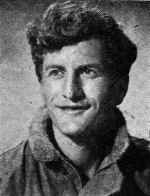
The son of Aharon Yisrael and Rivka of the Morgenstern family (grandson of the Admor[1] of Sokhchov and Sokolow). He was born on the 4th of Adar in the year 5688 [February 25, 1928] in Sokolow and ascended to the land in 5694 [1934]. He finished the “Bilu”[2] school and the “Haskalah”[3] gymnasium in Tel-Aviv. He worked in a textile factory, attended a continuing education program, reached the level of technician and was about to continue his training in the United States. From the age of 14, he was in Gadna,[4] and afterwards in the Haganah.[5] Due to protracted illnesses, he stopped his studies and activity in the Haganah twice. However, by the strength of his abilities, and his dedication, he quickly completed what he had missed, succeeded in his learning, and acquired expertise in Hebrew and general literature. He had vast knowledge of music and its literature.
|
In the year 1947, he was about to travel and study at the University of Philadelphia, but due to the worsening of the national situation, he did not want to leave the land of Israel, while saying “the interest of the society comes before the interest of the individual.” At the time of the United Nations' decision about the partition [of the land],[6] he lay in the hospital with a serious illness. When he emerged from there and his turn arrived to present himself for army induction, January 1948, he hid the remnant of his illness and his weakness from the doctors and went out for full service. He completed a sergeants' course and guided recruits. Because of others' shirking combat service, he discontinued his friendship with some of his friends from youth. He participated in the Mishmar Ha-Emek battle and was appointed squad leader. He declined an offer for service at headquarters and chose to be with his men at the front line. While defending harvesters in the fields of Tel-Adashim he fell in battle with a gang on Lag Ba-Omer,[7] the 15th of Iyar 5708 (May 27, 1948). His body was transferred from Nazareth to Tel-Aviv, and he was brought for eternal rest at the cemetery in Nachalat Yitzchak on July 30th, 1948.
May his soul be bound in the bundle of life.
Translator's notes:
by Yitzchak Nahari (Yagur Farm)
Translated by Rabbi Molly Karp
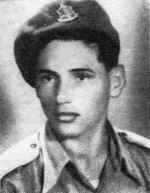
Like all the children of his generation, he went through the seven chambers of the Nazi hell, until his arrival in the land of Israel. He saw the loss of his parents in exile to the distant Uzbekistan while he was still at a tender age. He was always in wanderings and in camps. When he came to the land of Israel in a group of children of Teheran, we knew only this, that he was one of those who paid a high price in that cruel war.
He was born in 1930 in Sokolow in Podlaski, and he was only 9 years old when the Second World War broke out. Together with his parents he was moved around the various camps in the distant Siberia and in the strange Uzbekistan. He knew hunger and hardship in his childhood. He was orphaned of his mother and father, and in the company of orphaned children, he came to the land of Israel by way of Teheran in 1943.
|
I found him in Jerusalem when he came amidst a group of youths his age (in his group there was another member of our city, may he be set apart for life, Aharon Rubenstein, the son of Benjamin, who currently serves as Director of a school in Ashkelon). The groups and the kibbutzim in the land reached a decision to absorb those 800 children, to give them a warm home, to educate them, and make it possible for them to become acclimatized in life and in society.
On the Yagur farm they decided then to absorb a large group, and when I met two people from Sokolow in the group, I decided to recommend accepting this group to my farm. After brief training at Magdiel (for their consolidation into a group), at the end of the summer of 1947 the group arrived in Yagur.
Pinkhas especially stood out in this group, was quickly absorbed in the land of Israel society, and as he was the first to join in for everything, he joined Yagur's school.
Pinkhas was full of life, sociable, he sang, played harmonica, but he had an intimate private domain
[Page 631]
and from time to time he would seclude himself in his corner and devote himself to his hobby – he was a talented painter…
Pinkhas, who went through all the horrors of the destruction, distress and suffering, was not broken. His strength was revealed in his desire for learning, the strength of his will, and his feeling of truth. He yearned for only some happiness and tranquility. He would sometimes isolate himself. Sad, and in his serious face you saw his pain, and his longing for the father and the mother of whom he had been bereaved in his childhood.
He continued to learn and work and forge his character.
He loved animals, and was bound to the barn with his soul, he saw Yagur as his home, he was connected to the place. He loved his new life, and everyone loved him.
His life was indeed full, but - short. He fled from a war of destruction, and in his youth he laid down his soul, which was wounded in its depths and thirsted for redemption, in a new war for the rebirth of Israel in its land and for its redemption in it.
At the age of 17, he tried to join the Palmach,[1] but was not accepted. He tried a second time, and here he was called for service. He devoted himself to a new role with all his might, and excelled. He was an officer in the Israel Defense Force.
Pinkhas fought his war as a free Jew in his land, but he did not get to see our complete freedom. The Palmach group was given an order to attack a fortified height in an enemy country in the north. The action was done at night, from the side of the sea, and from the bullet of an enemy, Pinkhas fell in the dark of the night.
Pinkhas Sobol died on 4 Iyar 5708 (13 of May 1948) and was not brought to a Jewish grave.
A symbolic piece of land is dedicated to him at the cemetery at Yagur Farm, with a monument of eternal memory among the heroes of Israel.
Translator's note:
by CH. Bar-Shalom (Givatayim)
Translated by Rabbi Molly Karp
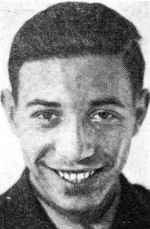
He was still a tender child in those years, when his parents saved him from the claws of the Nazis and fled to Russia with him.
Their way was long, with great suffering in Soviet Russia in the years of the war, but they protected the boy Dov, like the apple of their eye, from cold, hunger, and diseases.
|
They also saw to his general and Jewish education with ferocity in those days of chaos, and when they ascended to the land in the year 1949, they brought Dov with them as a large youth rooted in the spirit of his people.
He was in poor health due to a difficult surgery on his ribs that he had in Russia, and because of that he could have been released from service in Tzahal,[1] but Dov, may his memory be for a blessing, answered the call of the IDF with joy and in the year 1950 he joined for his service.
On October 2, 1950, he served in his unit in the area of Eilat. On that day, the Tzahal soldiers were attacked by an ambush, and a few of them fell. Dov volunteered together with the others for a reconnaissance mission to track the murderers and on the way, he fell from an enemy's bullet.
We will remember his name forever among the heroes of Israel.
Translator's note:
|
|
JewishGen, Inc. makes no representations regarding the accuracy of
the translation. The reader may wish to refer to the original material
for verification.
JewishGen is not responsible for inaccuracies or omissions in the original work and cannot rewrite or edit the text to correct inaccuracies and/or omissions.
Our mission is to produce a translation of the original work and we cannot verify the accuracy of statements or alter facts cited.
 Sokołów Podlaski, Poland
 Yizkor Book Project
 JewishGen Home Page
Copyright © 1999-2026 by JewishGen, Inc.
Updated 14 Nov 2025 by JH