(Memoirs of a Farm Boy)
by Mordechai Yalon
Translated by Ariel Distenfeld z”l
|
|
[Page 234]
by Mordechai Yalon
Translated by Ariel Distenfeld z”l
|
Our home in the village Tritki (or as it was called Kritkis) in eastern Galicia, a distance of some 30 kilometers from Brody, was a typical rural village house, which underwent several renovations that made it look slightly like a town house. The front wall was covered completely with twisted vine. This strain of vine was brought years ago from Vienna by our father, who went there for a surgical operation, and it rooted itself well in our soil and even bore clusters of grapes. The grapes would ripen before the month of Tishri (September-October) and mother used to make wine for Passover from them. The wine was sweet and sour, very tasty. It was glatt kosher since mother was very careful to avoid touching the grapes as they ripened, and she would wrap them in paper to protect them from nectar-seeking bees. Our family was very proud of this strain of grape vine, the likes of which was not known in the entire surrounding area.
In front of the house was a colorful flower garden that was under the care of the girls, my sisters. The house was surrounded by an orchard of various fruit trees: apples, pears, cherries, plums and more. In the large yard were the farm buildings, a cow shed with a few cows. In the yard flocks of chickens, geese and ducks were walking and quacking relentlessly. Past the buildings the fields stretched to the nearby forest.
Our mother, Sarah-Leah was a short and fragile woman, wise and shrewd, quick and enterprising. She was fluent in Ukrainian and Polish, as well as a little German. Her wisdom and ability to solve problems were famous in the village, and because of it she was beloved by the peasants, especially the farm women who would come to consult her about personal problems. When a farmer's wife had an argument with a neighbor, she would come to “Avramkova”(so named after my father Abraham), and she would make peace between them. Mother and my sisters were
[Page 235]
invited to every wedding in the village. On the eve of the wedding the bride would come to our house, curtsy to mother and ask for her blessing. Mother wished them good luck accompanied by a worthwhile monetary gift. On the following day mother would bake a large wedding challah, decorate it with golden paper and send it with one of the sisters to the bride's home. On the Christian New Year, the village children would come to our home, scatter wheat kernels on the floor and bless us for a good crop year. Mother would then give them a gift of money.
As noted, we had varied and intensive agriculture. The main crop was hops. This crop was widespread in this area of Galicia. This is an annual plant that grows and winds around wires stretched to a height of 14-15 meters. Its cones would later undergo a drying process in a well-ventilated building, over flat beds woven from reeds. After the drying, the cones would be squeezed into large jute bags. During January and February, agents of breweries would come and buy them for good money. This sector, if well attended to, was worthwhile and profitable.
Mother oversaw all the agricultural business. She would hire the workers, make the work order, in short, she was the moving force in the farm. Father was sort of an “external minister” – and would arrange for all the materials needed by the farm. I remember that for a long period he acted as a trusted representative of the government, overseeing logging in the forest. (Our area had abundant forests.) For some time he was a clerk in a nearby flour mill, so that the burden of the farm was mainly mother's. The daughters helped with housekeeping. They also tended the flower and vegetable gardens, milked the cows, took care of the chickens, etc. Baking bread was mother's chore. She baked round loaves with a great aroma from week to week.
In Tritki there were two Jewish families, ours and the family of my uncle Tuvia (my father's brother) who also had a large farm with varied crops and grew hops. Another uncle was in Podkamien. Some distance outside the village there was a ranch leased by Reb Hirschel Halbertal, a Belz Chassid and a friend of our family. Relations between the villagers and the Jews were good. There were no signs of hatred or antisemitism. Even among the Christian sects (Catholic and Russian Orthodox) friendship prevailed. The village was part of the municipal council or the town of Lopatyn, but it had a local jury to decide on internal affairs. Father was the chairperson of the group that used to gather once a month in our home. I remember that once we had a land dispute with one of the farmers. The matter went to court and the deliberations were long. The plaintiff farmer was represented by a lawyer, and mother, the “defendant”, argued for herself. At the end we won. I would like to note that mother's arguments were very convincing and the judge stated that mother “should have studied law.”
In the village there was also a group of musicians (a quartet consisting of a violin, bass, flute and drum)
[Page 236]
headed by Kononovitz, a tall, broad-shouldered gentile. The group used to perform at weddings and other celebrations in the village. On the eve of each wedding, the group would go from house to house and give a short “concert”. For a fee, they did not skip our house. The melodies which they played remind me today of suites by Bach.
As stated, our village Tritki was about a Sabbath border from Lopatyn. According to my childhood concepts, Lopatyn appeared to be a metropolis. There was a custom house, a justice of the peace, a post office, police station and also a jail. There were two synagogues, one of the Chassidim of Husiatyn and one of the Chassidim of Belz. The rabbi of the Belz Chassidim was Rabbi Chaim Leibish Hamerling and the rabbi of the Husiatyn Chassidim was Rabbi Mendel Laszczower. The ritual slaughterer of the town was my uncle (my mother's brother) Reb Eliezer Shu”b, the son of Reb Joseph Shu”b (my grandfather) [Wilder]. He was also the town's mohel (circumciser). The bathhouse was used jointly, and friends and rivals used to meet there. They also had a city council or municipality headed by a gentile, a government school and two churches, one Catholic and one Russian Orthodox. Every Sunday and during the Christian holidays gentiles from the surrounding villages would come to pray, and afterwards would fill up the square in the center of the town .The grownups would shop in the Jewish stores and the youth would flirt with the farm maidens or get drunk at the bar of Reb Zelig Katz, the son of the community chief, RebYekutiel Katz. In the upper town there was a wide-open space which was used as a promenade by the locals. Two rows of residential buildings with shops stood to the right of the square. All the Jewish trade activity was concentrated there. In the middle of the square stood a fenced statue of St. John, next to which the peasant women would sit and sell fruits and vegetables to the town Jews. The bottom of the square led to a street shaded by a row of ancient trees. To its left were the industrial buildings for the production of spirits, and to the right the large house of Reb Elyakim Gasthalter, the rich man of the town, the lessee of the large estate. Next to his house was the dwelling of Dr. Rosenblum, the town physician. He was adorned with a Franz-Josef beard. This physician, when a patient came to him to seek a cure for his ailment, would ask “Well, did you visit Reb Eliezer Shu”b yet? Go to him first and then return to me and tell me what he said.” Reb Eliezer was renowned in the town for his medical knowledge, and the physician Rosenblum would consult with him about each serious case. The town also had a small river and the youths would bathe in it. The town well was famous for the quality of its water and passers-by would imbibe water to refresh themselves. It was said in town that it was good for stomach ailments. The inhabitants of the town, the gentiles, lived mostly in the outlying quarters.
I was a son of Tritki and yet a Lopatyner, like someone with a dual citizenship. In Lopatyn I studied with my uncles, Reb Zusia and Reb Michal Wilder. Also there I studied Hebrew and Latin “calligraphy” with Asher Barash. Almost all of my aunts and uncles on my mother's side lived there, as well as my father's relatives and family friends. There also lived my brother-in-law Reb Pinchas Winkler, a smart and honest man,
[Page 237]
with a sense of humor. His house was at the entrance to the town, and we would pass it on our way to Lopatyn, and his wife, my sister Chava-Rivka would always offer me good cakes. We would go to Lopatyn to the bathhouse and to pray on Sabbaths and holidays. On Yom Kippur eve we would hold the pre-fast meal by Reb Eliezer Shu”b. I had good friends in Lopatyn, and on free days like Lag B'Omer and on Sabbaths we would get together and hike to the nearby forest, singing and making merry. I recall one song that we used to sing with enthusiasm and it remains imbedded in my memory, and I quote it here in full.
Israel is not lost yet/as long as we live/Israel is not lost yet/as long as we die.
We are walking, we are jumping/over valleys and mountains/we want to take the land of Israel/from the Turk.
We are dancing, we are singing/and give thanks to G-d our father/we want to take the land of Israel/from the Tatars.
We dance and sing/in happiness and abandon/we want to take the land of Israel/from the stupid Turk, the king.
The first stanza of this song was already well known, but it appeared too brief to me so I added two new stanzas. We would sing it to the tune of the Polish anthem “Poland is Not Lost”, to teach you that we were then already fully committed “Zionists”. I remember that in 1910 the Kaiser Franz-Josef celebrated his eightieth birthday and the Jews of Lopatyn decided to hold a luxurious blessing ceremony in his honor. Several young men and girls got together to decorate the study house for this event. We brought pine branches from the forest. We collected flowers and decorated the walls of the study house as was fitting for the Kaiser beloved by the Jews of Galicia. We organized a boys' choir which was supposed to perform together with the cantor who was invited, I believe, from Brody, to conduct the ceremony. At the appointed hour, the synagogue was packed with people. The Belz and Husiatyn Chassidim sat together and the ladies section was full of women and girls. The cantor opened with “Hear O Israel” accompanied by the choir and with “Praise the Lord with me” and afterwards “He who blessed…he will bless his majesty Kaiser Franz-Josef” and the choir ended “In his and our day Judea will reach salvation” etc. The public gave an ovation and the choir had to give an encore. The ceremony left a strong impression and was a subject of conversation among all the town's Jews.
With all of that, I greatly loved the village where I lived: the green fields, the forest landscape, the hubbub of the workers. I loved the clucking of the hens, the mooing of the cows and neighing of the horses. During the potato harvest we lingered in the fields by the bonfire and roasted potatoes. From time to time I would join the village shepherd, Yoshku Kirik who tended the village flock.
[Page 238]
(Every farm owner in the village had an obligation in turn to assign an assistant shepherd to the main one). This Kirik was a good-hearted gentile and a wonderful flute player. Many of his melodies are etched in my memory. He would wander with the flock into the depths of the forest and knew how to exit it without difficulty. Once we walked far into the forest until we came to its other end, and there I discovered a new settlement which I previously did not know existed. Kirik told me that it was the town of Stanislawczyk. I remembered that my uncle lived in that town, my mother's brother Reb Shmuel-Leib Shu”b and I wanted to visit him. I asked permission from my “supervisor” who granted it and I was very happy.
I also had some friends among the village boys, my schoolmates. One of them was Martin “ shaygetz ” who was an excellent student, smart and with a quick and exceptional intelligence. He desired greatly to learn Hebrew and I taught him the alphabet, and within a few months he was able to construct sentences and also to understand a little. (I heard that years later he was a judge in Lwow). Here is a small episode connected with this Martin. Once we were lying in the forest, under a large pine tree, doing our homework. Suddenly, a baby squirrel fell from the treetop right on his head. He covered it with his hat and captured it. He gave it to me as a present and I took him home. At home I put him in a cage and fed him pieces of sugar and nuts, which he would crack while standing on his hind legs. With time he grew and became a domestic animal. He became used to the house and did not run away – he would go out through the window to the orchard, jump around on the trees for a while and return home. He would run after me like a puppy, happily standing on my shoulder or my head. My happiness did not last long. Father wanted to give him to the chief of the National Guard. My crying and begging were for naught, and the cute squirrel was transferred to the “ paritz ”(“local nobleman”) with much sadness and sorrow…
During the summer every day at dawn I would hear the banging of the peasants hammers on the scythes, to sharpen and polish them in preparation for the wheat and hay harvest. Every year, during the month of May, the girls of the village would gather in the evening in the large square and would sing and dance around the chapel which stood in the center of the square. I remember sections of Polish and Ukrainian melodies till this very day. When darkness fell the youths of the village would take their horses to pasture over night. They would tie them down so they could not go far and leave them alone. The boys themselves would sit in a circle, make a big fire and their songs would be heard over a great distance.
The major activity on the farm was during the harvest. Mother would hire harvesters, the men with scythes and the women with sickles. They would spread out in the field, harvesting and stacking up pile after pile at a certain distance from each other. On each pile they would make a hat-shaped sheaf to protect it from the rains, which in this time of the year would come suddenly. When the wheat harvest ended, the hops harvest started. The hops harvest was carried out by female workers,
[Page 239]
mostly young and agile, who would pick the cones and put them into baskets. The latter would be emptied into sacks, and in the evening mother would weigh the sacks. The wages were according to kilograms, and the ones with the most kilos got the highest wages.
The completion of the hops harvest was joined with the end of the wheat harvest and the workers would celebrate the end of the harvest noisily and with much commotion. Mother was at the center of the ceremony, which was dedicated to the admired “Avramkova”. And this was the order of the ceremonies: early in the day the workers would weave a wreath of flowers and bestow it on mother's head. Two flower-bedecked maidens accompanied her together with the rest of the workers singing in a procession up to the house. When they arrived in the house, the maidens would bow to mother and the other members of the household, and mother invited them to the party to take place in the evening. The workers left and the preparation for the party began. One room was emptied of its furniture, and several kegs of beer and distilled spirits, herring and a quantity of bread were brought in.
In the evening the girls and the local boys gathered. Mother sat at the head of the table, wearing the wreath of flowers, like the “bride of the party”. The girls bowed to mother and blessed her. After the ceremonial part was completed, mother took the wreath off her head and the partying began, drinking, dancing and singing until midnight. The family members, especially the sisters, were busy serving the guests. Only father went to the next room, studying “Ein Yaakov”. Midnight, the room emptied and silence reigned. Only the sisters were busy restoring the room to its previous state. This custom was repeated annually at the end of the harvest and the gathering, and thus did the girls of the village express their admiration for our family.
Behind the statue in the town's square, there was a small factory for the production of soda water belonging to a Jew named Hasten. The children would gather there and collect the glass marbles scattered on the floor there and play with them. These marbles were used to play with walnuts during Passover. The factory owner used these marbles to plug the soda bottles after they were filled. This Jew did not make a good living from the soda water business, and after a time he left Lopatyn and moved to Serbia. His son who was one of my good friends kept in touch with me by mail for a long time.
During Simchat Torah a group of us boys would gather at the small bar of Floh and drink together. His son, Saul Floh, was a wunderkind and amazed everyone with his talent. He would paint cards for Chanuka, drawing and making miniatures of different likenesses from metal and wood, the handiwork of an artist. Today he resides here in Israel, in Rehoboth, living off the labor of his hands. Time and distance somehow separated us, but I shall always remember the artistic pleasures that I experienced in his company.
In front of the house of Dr. Rosenblum, the town physician, there was an enclosed veranda, totally covered with bougainvillea, a dense climbing plant, and on the entry door
[Page 240]
there was a metal sign with his name engraved upon it. Underneath there was another small sign engraved with two abbreviated words “Univ Med”. These two words caused considerable “headache” to the Lopatyn children who did not know how to decipher their meaning. With time this riddle was solved by itself.
I also remember that in Lopatyn they conducted an excavation in one of the streets. I don't remember if the excavation was for sewers or some other purpose. But I do remember that the excavation uncovered human skeletons, Christian religious articles, and I think other items which pointed to belonging to the Jewish religion. I was a small child then and I remember a stormy time in the town. The excavation was halted for a long time and I don't remember how this business ended and how relations were settled between the two communities, the Jewish and the Christian.
I remember a popular figure in Lopatyn, a Jew by the name of Yudel the Wassertrager, “the water hauler”, who with the help of a yoke which he carried on his shoulders, would supply water to the Jews in the center of town who were not blessed with their own wells, as distinguished from those in the outskirts. This Jew, was created as if from birth for the water hauling work. He was tall with large bony hands and depressions in his shoulders which fit the movement of the yoke. He wore boots both winter and summer, and on his head he wore a black-visored hat, unlike the custom of the Galicians, more in the style of Volhynia. His Yiddish accent also was not Galician but a mix of Ukrainian and Volhynian. This Yudel was probably one of the “adoptees” in town, like several families who were adopted by Lopatyn Jews and naturalized there. (At the time of the forced military service in Russia, many Jews escaped from towns in Russia and Ukraine and found refuge across the border in Galicia. They were adopted by many local Jews, were given names of family members and became regular citizens). Among the “adoptees” were several families who assimilated among the locals, and with time were treated like relatives. I remember among the adoptees one named Eliezer Spodak, who in spite of living in our town for more than two or three generations was not weaned from his Lithuanian accent. Whenever he led the prayers at the study house he would proudly flaunt his accent, as if in spite.
This Yudel Wassertrager had two sons. One of them resembled his father physically like two drops of water. He also helped his father in his work. The second son was a tailor who moved to Lemberg in his youth, where he left the religion and became a “deitch” (“German-like”), wore short, fashionable clothes, and had no resemblance to his father or brother. For the holidays he used to come to his parents' house dressed in a black suit, cut according to the fashion and with a hard hat on his head. When the three would march to the study house for prayer, the contrast in their dress would attract the attention of passers-by.
I had a special feeling of sympathy for this Yudel because of his innocence and honesty. He profited from his yoke and accepted his fate. He was an enthusiastic Belz Chassid and I especially liked to sit next to him in the study house
[Page 241]
during the days of awe and observe how he would look at the Yiddish commentary in the prayer book and search for the meaning of the words in the poetic prayers. This Yudel Wassertrager was a precious Jew.
Among our cows there was one that we named “Tyrolka”. It appeared that she hailed from the Tyrol mountains, and we loved her very much. She stood out in the village herd in her beauty, and gave a lot of milk – it was said up to twelve liters per day. Once “Tyrolka” became ill and father invited Reb Moti (der langer Moti) from Lopatyn, who was an expert in bloodletting for animals. After he phlebotomized her she felt a little better and we thought that she would recover. However, after a day her condition worsened and we feared she would die momentarily. Father called a gentile from the village and he slaughtered her with a sharp scythe. That day was a day of mourning at home with great sorrow. We could not bear seeing her lying there slaughtered and we asked the gentile to take her away.
When I lived in the village after I stopped studying with the uncles in the town and I remained at home, I concentrated on studying Shazkes' grammar, Bible and secular studies and father would teach me Gemara in the evenings. My brother Hanoch would provide me with the necessary books from Lwow and advise me as much as possible, giving me Hebrew reading booklets published by Tushia and foreign books as well. I also began to teach my brother Isaac, who is two years younger than I. Two or three times a week I would visit Lopatyn to exchange ideas about studies with my friends, especially with my cousin Leib Kurtz, who was a great help to me. As said, we made short trips, played games, and already we dreamed of Zion. Incidentally, I remember I was about four years old and my brother Hanoch was still at home – he returned from Lopatyn with the devastating news that Theodore Herzl died. We were all in shock, including my father who was not a sympathizer of Zionism.
The First World War broke out in 1914. In the middle of the Sabbath a general draft order was announced. Single men and young marrieds were transported in wagons to enlist in the nearby city. Before long the Russians invaded eastern Galicia (we were very near the Russian border). Doom and gloom were everywhere in the town. All cultural activities, such as they were, ceased. The Jews in the town would congregate in circles in the square, in the study house, the kloyz (small synagogue), and especially in the bathhouse and would be involved in politics. The “confident ones” were certain that Austria would triumph while the doubters kept quiet. Slowly there developed commerce between the Lopatyn Jews and the Jews from the nearby Russian towns. For the first time I saw a Russian Jew bringing pigs to market in Lopatyn in his wagon and I was shocked. It was forbidden to even touch a pig.
Our agriculture also shrank for lack of workers. Growing hops decreased drastically and economic conditions declined. I continued self study as much as I could, and the handful of books that I possessed did not satisfy me. I began to think of a way to get out. I did not see any future in staying here. After a year or more, the Austrians returned and reoccupied Galicia. I learned then that my brother in Lwow escaped to Vienna and I was sorry that our contact was interrupted. In the meantime our mother passed away and I decided to look for a way to leave the house.
[Page 242]
I convinced father and he agreed that I should volunteer for the army, even though I was underage. And I did so, not out of patriotism, but to go out into the world.
In the army I suffered for a short while and afterwards I was assigned as an assistant in office work and my situation was good. When I was discharged at the end of 1918 I did not return to Lopatyn and I went to Vienna. For a while I was in preparation near Vienna and in the beginning of 1920 I went with a group of pioneers to the land of Israel. My mother died at the end of 1915. In 1925 I was informed of the death of my father. And in 1945 I received the bitter news that my brother Isaac as well as my sisters and my relatives in Galicia were killed in the holocaust. May their memory be blessed.
|
|
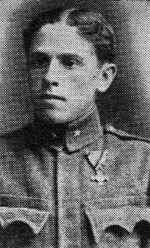
[Mordechai Yalon] as a Polish soldier |
by Prof. Yechezkel Kutscher
Translated by Moshe Kutten
Edited by Barbara Beaton
|
|
|
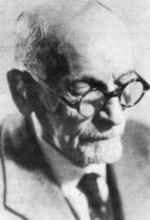
Editor's note: photo of Hanoch Yalon |
I had the privilege of becoming acquainted with Dr. H. Yalon, of blessed memory, in the early 1930s, and the manner in which he was introduced to me summed up the tragedy of his life. This is how it happened: After the Kabbalat Shabbat service at the “Yeshurun” Synagogue, I was with one of my university teachers. As we left the synagogue, a man whose very appearance radiated dignity, joined us, and a lively conversation developed among the three of us. When he left, I asked my teacher, “Who was that man?” And the reply was, “You don't know? That was Hanoch Yalon, the most important grammarian in Eretz Israel.” My question and the answer I received encapsulate the tragedy that followed Dr. Yalon throughout most of his life.
It can be said that, to this day, the public remains unaware of who Mr. Hanoch Yalon was, including authors and researchers of the Hebrew language. To this day, no clear answer has been given to the question, “Who is he?” Even now, “those who really know” repeat the same answer: “the most important grammarian of Eretz Israel.” Neither my teacher (who was close to him), nor any other scholars knew that one of the words Yalon most disliked was medakdek[1] “[grammarian].”
[Page 244]
While the grammarian dwells on tiny details: “Say this… do not say that,” Yalon was a linguist in the full sense of the word, a scholar who brought about a revolution in our entire understanding of post-biblical Hebrew, and in whose light the scholars of Hebrew – those concerned with the post-biblical language, and to some extent even with the Bible itself (according to the Babylonian vocalization tradition) – still follow today.
The general public, and even those close to Yalon, have not, to this day, grasped the far-reaching impact he has had on the study of the Hebrew language. At most, people are aware that he was “the vocalizer of the Mishnah” [applied the nikud[2]] in the Albeck–Yalon edition. But vocalizing a Hebrew text is, generally speaking, more a craft than a science! The public does not know even in the best of cases, that the vocalization of the Mishnah was only the tip of the iceberg, most lied beneath the water. What was the essence of the revolution he brought about? He was essentially the primary discoverer of the true language of the sages – a linguistic stratum fundamentally different from biblical Hebrew. Before his work, this language was preserved almost exclusively in archived manuscripts. While Prof. Yaakov Nachum Epstein, of blessed memory (who influenced Yalon considerably), preceded him, Epstein primarily focused on lexicographical issues – namely, the study of words and the textual problems of rabbinic Hebrew. He did not delve into the structure of the language or the functioning of its systems, which the text served to express. Researchers before Yalon, when describing the sages' language, relied only on the printed versions of the Mishnah and Tosafot, as well as other printed texts. However, it was discovered as early as a few dozen decades ago that copiers and printers had distorted the language of the Mishnah over the last 1,000 years. These people seemed to have secretly conspired to remove anything that seemed unusual when compared to the Hebrew of the Bible. Anything that deviated from biblical Hebrew was regarded as a mistake.
The extent of these “corrections” (i.e., “mistakes”) is illustrated by the word “adam” [human]. In every dictionary of rabbinic Hebrew, this word is recorded in the form in which it appears in the Bible – namely, adam. However, upon examining manuscripts, it became clear that the original form used by the sages was adan, which has been observed hundreds of times in manuscripts to date. At times, we can even observe in the manuscripts themselves how a scribe erased the letter nun and replaced it with a mem. Yalon drew significant conclusions from these discoveries, particularly regarding the vocalic structure (nikud) of the sages' Hebrew. He asserted the importance of utilizing good manuscripts. Through his research, Yalon succeeded in proving that in the days of the sages, the biblical form of the second-person pronominal suffix – such as retzon·kha (with a kamatz, long “a” sound, under the letter kaf) – was not used. Instead, the form was ratzon·kh (with a kamatz under the letter resh and a shva, a short “e” sound, under the letter kaf). From his examination of the manuscripts, it became clear that in the sages' Hebrew there were no forms such as nit'kavvein or nit'arreiv, but rather nit'kavan (with a patach, under the letter vav) and nit'arav (with a patach under the letter resh). This was the pronunciation still used by Sephardim and Yemenites when they read the texts of the sages.
Yalon's research in this area (collected in his book “Introduction to the Mishnah Voweling”)
[Page 245]
completely changed the landscape of research on the language of the sages, establishing a solid foundation that remains an invaluable resource for scholars studying the sages' Hebrew.
The very revolution he brought about in this respect would have been sufficient on its own to earn him the position of the leading Hebrew linguist among the researchers of the Hebrew language of recent generations, yet he accomplished even more by bringing about a second revolution, no less significant than the first.
A Jewish youngster who had grown up within the traditional Talmud Torah framework of Eastern Europe, and who had undergone some degree of “enlightenment,” felt that the Hebrew words he used while studying in the beit midrash – and even in his Yiddish speech – were “corrupted”. While he was saying “be'al korkhach” (shva under the letter kaf) [“against your will”], under the grammatical rules it should have been said “be'al korkhacha” (a kamatz under the letter kaf, adding the “a” sound after it). The young Jew also found a flaw in the language of prayer: Why would the word kitsba [limit], in the Days of Awe's prayer–” ein kitsba le'shnotekha” [“there is no limit to Your years”] be mispronounced as “kitsva.” It also became clear to him that the title “rebbe” he named his teacher was the distorted version of rabbi, corrupted by those Jews who were devoid of any knowledge of Hebrew grammar.
When that young man arrived at the university and had the opportunity to study under non-Jewish scholars, he completely cast aside the traditional pronunciation and speech of the [Eastern European] Jews. It even happened that this young man – who had thrown behind him the “corrupted” Hebrew tradition of Eastern Europe – came upon some “peculiar” Hebrew material presented to him by a non-Jewish professor. He failed to recognize his own “corrupted Hebrew” in what he saw before him (this refers mainly to the students of Professor Kähler). Other distinguished Jewish scholars had similar experiences, with the exception of ShaDa”L [Shmuel David Luzzatto].
Yalon, through his research, transformed the situation entirely. While teaching at the “Mizrachi” Teachers' Seminary, he listened attentively to these so-called “corrupted” forms, which he heard from students of Yemenite descent (who preserved an excellent tradition of rabbinic Hebrew) and from students of various Sephardic communities. Unlike many teachers, he did not dismiss these “distortions.” On the contrary, he soon realized that many of these “corrupted” forms appeared not only in manuscripts of rabbinic Hebrew, but also in earlier sources–the manuscripts of the Babylonian vocalization system (known only from the second half of the 19th century and the early 20th century). And indeed, Yemenite “corrupted” forms were already found in these ancient manuscripts.
Thus, Yalon came to recognize the importance of living linguistic traditions, especially those of the Yemenite Jews, and he encouraged one of his students, Mr. Y. Shabtiel, to publish an insightful article on this topic. It was to Yalon's credit that approximately 25 years later, Prof. S. Morag produced an important book on the Hebrew language of the Yemenite community;
[Page 246]
and it is indirectly to Yalon's credit as well that a research institute for Jewish traditions was later established at the university under the direction of Prof. S. Morag.
Today, we understand, partly thanks to Greek and Roman transcriptions, that the so-called “corrupted” forms preserved by the eastern communities are ancient and originated in the very period when rabbinic sages' Hebrew was still a spoken language. Amazingly, the word “rabbi,” which Ashkenazi Jews pronounce as “rebbi” (with a segol under the letter resh), has been found in ancient Greek texts and in a Roman transcript. Similarly, the Sephardic pronunciation, “ribbi” (with a chirik under the letter resh), has also appeared in ancient Greek manuscripts in Eretz Israel. These findings support the idea that various ways of pronunciation practices existed side by side in Eretz Israel as early as the time of the sages (approximately 200 BC). The reasons for the formation of these different vocalizations remain unclear at this time.
At times, the tradition of a particular community preserved forms that were otherwise known only from the transcriptions of the Septuagint.[3] A case in point is the form of the name “Yishai,” the father of King David. In the Hebrew Bible, the name is usually spelled as “Yishai,” which is missing spelling [spelling with vocalization not included] – without a dagesh in the letter shin. In the Septuagint transcription, however, the name appears as Issai, indicating that the translators perceived the letter shin as geminated (there is no shin in Greek, and the letter sigma was used in its place). Remarkably, this pronunciation with a doubled shin has been preserved to this day in certain Sephardic prayer books. This provides evidence for the existence of a biblical tradition that presumably reflects a pronunciation coexisting alongside the one known from the Masoretic vocalizers.[4] This insight, too, was primarily uncovered thanks to the work of Hanoch Yalon.
Among Yalon's scientific achievements, special mention must be made of his discovery that, in medieval Europe, the pronunciation that today we call “Ashkenazic” was not yet known. That is to say, a word such as “davar” (thing) is not pronounced like dovor, but rather as we pronounce it today according to the Sephardic tradition. He arrived at this discovery by assembling evidence from various sources: notes from Rashi, hints from medieval grammarians, vocalizations from ancient macḥzorim (prayer books) (among them the famous Worms Macḥzor), transcriptions of Hebrew words in Latin letters, and more. This discovery raised an intriguing question: If his conclusions were correct, where then did the Ashkenazic pronunciation, which was so widespread in Europe, originate? The problem is complex [and opinions differ among the researchers]. No one disputes that the pronunciation of the Masoretic scholars in Tiberias, who vocalized the Bible, was in this respect essentially “Ashkenazic.” Even the Jews of Yemen pronounce the kamatz (long a) in a manner similar to that of the Ashkenazim. For example, the word māri – “my lord,” is pronounced by them as though it were mōri. Prof. Max Weinreich, a prominent Yiddish researcher, sought to answer this question by offering another intriguing hypothetical guess. He suggested that Jewish refugees brought this pronunciation pattern with them after the destruction of the Babylonian exile. This solution is highly questionable, also because there is no certainty that the pronunciation of the Jews of Babylonia was in fact “Ashkenazic” in this respect. In contrast, Yalon, who alludes to this perspective in his article, argues that the Germanic element in Yiddish is what caused this phenomenon. For example, the German phrase “ich sage” (“I say”) becomes
[Page 247]
“ikh zog” in Yiddish, where the original “a” shifts to an “o” vowel with a different coloring. This vowel shift affected the “a” in the Hebrew components of Yiddish as well.
The examples above illustrate the significant importance often attributed to the so-called “corrupted” Hebrew material embedded in the unique Jewish traditions of various communities. In recent decades, research on this material has become an integral part of Hebrew linguistics, now being carried out in the aforementioned center established for this purpose at the Hebrew University.
It is the way of the world that revolutionaries, those who forge new trails in science, cannot always be selective about the tools they use for their breakthrough, nor can they be meticulous about details during their revolutionary work. In other words, there are moments when a linguist leading a revolution may overlook small details; it is typically those who follow after him, whose path has already been paved to a large extent, who refine and polish the new system, and clarify the findings of the pioneer who preceded them.
Not so with Yalon. With tireless effort, he would examine and re-examine his sources. He did not discount small details, and he was not satisfied until he revisited and clarified everything that required investigation and elucidation. He did not hide difficulties he had been unable to overcome from his readers. He was a “perfectionist” in the best sense of the word.
His achievements, as described above, also deserve deep appreciation due to the fact that Yalon was ill throughout his life. Migraines haunted him from childhood. They were the worst kind, and they left a mark on him in other ways. He served as a teacher at the teachers' seminary “Mizrachi” for three decades. All of his achievements in the study of linguistics were done during his few free hours, and while constantly struggling with his illness. Following his premature retirement from teaching at the teachers' seminary due to his illness, he also had to worry about finances. However, his wife Zipora is fondly remembered; she stood by his side at all times and supported him in every way throughout his life. And there is no doubt that it is thanks to her that the late Dr. Yalon succeeded during his lifetime in building a Hebrew scientific library of the highest quality, and thanks to her, he was able to sit at home and carry out his scholarly work without assistance from any scientific institution whatsoever.
For decades, Yalon sharply criticized the findings of institutional academic research. In his despair, he felt that, having passed the age of his prime, his voice was simply crying out in the wilderness. He was unaware that, almost in secret, a young generation of linguists had emerged who, thanks to him, had abandoned the path of established institutional Hebrew linguistics. Yalon continued to express his frustration, stating, “I have labored in vain, and I have spent my strength for nothing.” What he did not know was that several of the young university lecturers, along with Prof. Lieberman, had taken the initiative to publish a jubilee volume to honor him for his scholarly work. This book, indeed, came to fruition (credit for this is also due to the publisher “Kiryat Sefer” and the Kohut Institute in the United States).
[Page 248]
It included contributions from the most prominent Hebrew linguists in Israel and abroad, a detailed bibliographic list, and a comprehensive review of Yalon's scientific work.
Before the book was published, the academic establishment also remembered Yalon (and some say that rumors regarding the jubilee book contributed to this). The university decided to honor him with an honorary doctorate, together with his friend Prof. S. Lieberman, may he live a long life. And a few weeks later, he also received the Israel Prize. Gradually, he became convinced that not only had his labor not been in vain, but that his teachings had truly taken root in academic institutions. He also enjoyed comfort in his final years, since the Academy of the Hebrew Language purchased his library under generous terms, allowing it to remain in his possession until the day of his death.
Thus, in his final years, he was granted peace of mind, and he continued to work – content with his lot – until the very day of his death, despite his worsening physical weakness. He gathered all his scattered articles and was fortunate to see most of his book in print. True to his habit, he read, reread, and reread again the galley proofs carefully. Prof. S. Abramson's kindness ensured that the large volume was published fully and properly corrected.
It is impossible to conclude this article without two remarks for the sake of historical truth. Yalon never occupied a university chair. This is not among the shining pages in the history of the Hebrew University, which ignored Yalon and thereby caused serious harm to itself and to the generation of scholars it failed to cultivate. The fact that it granted him an honorary doctorate is only a partial atonement for this “failure” (I use a gentle expression), whatever the reasons for this failure may have been – and reasons there were!
And it is especially perplexing that the Israel Academy of Sciences did not choose him as one of its members. The matter is all the more astonishing, considering that the Hebrew University awarded him a doctorate and recognized him (according to rumors) for his unparalleled achievements. He is regarded as one of the four great scholars of language that the Jewish people has produced in the past hundred years! How could the Academy fail, despite certain difficulties, to honor him? By honoring the late Hanoch Yalon, the Academy would, first of all, have honored itself and enhanced its own prestige. It was an opportune moment, surely one that would not return, to demonstrate that it is not merely an academy of the Israeli scientific establishment and its affiliates, but a true academy of sciences, unafraid to appoint among its members a man who had not been part of that establishment, and had even fought against it. This failure, graver than the academy's other shortcomings, will certainly not serve as proof that it is endowed with nobility of spirit. Our children will not understand how, compared to scientists whose memory faded into obscurity all too quickly, a man like ?anoch Yalon, who paved new paths in the study of the Hebrew language, was not considered worthy of being counted among its members.
These failings will not diminish Yalon's teachings; indeed, it is proclaimed loudly in those very institutions themselves, and it will live with us for many, many years to come.
Translator's footnotes:
by Prof. Dov Sadan
Translated by Moshe Kutten
Edited by Barbara Dubey
A.
My friends, who have more expertise than I have in general, and in particular have more knowledge of the teachings of our teacher and rabbi, Reb Hanoch Yalon, asked me to be the speaker in honor of the book published in his honor. And since I deeply value their respect, I felt obligated to fulfill their wish and took it upon myself to say a few words. If they are deemed to be fitting, then the credit belongs to them; however, if, Heaven forbid, they are found lacking, then the responsibility for the fault is mine alone. I prayed that I might be worthy, for those who honor me may treat my words with the leniency appropriate for someone of my stature – a man of average standing – all the more so since my remarks were made during a time when the balance of merits and obligations hung delicately in the balance.
This is a precious and delightful book, one that we have come to cherish: “Hanoch Yalon's Book.” It is a collection of articles published by Kiryat Sefer and edited by the scholars Saul Lieberman, Shraga Abramson, Yechezkel Kutscher, and Shaul Esh. Friends and students tune in attentively to the book that has been written in his honor. If one were to search for a fitting title encapsulating his contributions, it would be the phrase defined in the very book that S.Y. Agnon himself wrote: “Reb Hanoch Yalon is the foremost scholar of our language in this generation.” Indeed, the entire book serves as a testament to his wisdom, both in a direct way and in a more subtle, indirect way.
By saying that the book teaches us directly about his wisdom, we mean to point to the essays that discuss him and his work – beginning with the introductory piece by the distinguished editors, who undertook the task of compiling this volume on the occasion of Reb Hanoch Yalon's 75th birthday, may he be granted many good years. By the time the collection was arranged, another decade had passed, marking 40 years of his fruitful activities, may they be multiplied. Following the introduction – to which one may now add that in the meantime the scholar's work has expanded greatly and gained wide public recognition, as he was honored with the Israel Prize from the State and an honorary degree from the Hebrew University of Jerusalem – comes a concise list summarizing the key dates and milestones of his career. And after that, there is the encompassing article by Yechezkel
[Page 250]
Kutscher about the scholar's path in his study of the Hebrew language, in its sections and divisions, and Shaul Esh's comprehensive article, with a detailed bibliography of the scholar's essays during his 40 years of work. These two articles constitute an excellent introduction to the fundamental part- the compilation of the scholar's articles in the scrolls of the book, as a complete doctrine in our hands.
By saying that the book teaches us about the sage's wisdom indirectly, we mean through the insights and words of knowledge and research - the contributions of scholars and writers. Some contributors are his former students, who clearly reflect their respected teacher's influence in both the subject matter and in their discussion style. Others are his colleagues, whose words express gratitude and acknowledgment of his teachings. The structure of the book highlights the connection between trees and the fruits they bear. And just as fruit feeds from plentiful and flowing sources, those who benefit from abundant and generous teachings go on to become sources of strength themselves. The editors of the books invited me to join their ranks, but even though I am willing to accept, I still have my doubts about whether I am worthy of this honor, feeling too insignificant to be considered a true friend of our esteemed scholar, and too old to be his genuine student. I often regret not having been born into the world a bit later so I could join the circle of those who heard him teach. All I can say of myself now is that I served him modestly when I was editor of a platform addressed to the general public – the supplement of the newspaper “Davar.” He would publish his writings in those days when he felt it his duty to fulfill the saying: “It is a time to act for the Lord – for they are breaking Your law,” [Psalms 119:126] that is, to act for the sake of the Hebrew language and culture, even if it means departing from convention. As is well known, the greatest learning comes from serving and being close to wise individuals. And I was granted an added measure of learning: At first, through his words spoken in public, I came to perceive “what” he was, but later, through his words in private, in writing and in speech, I came to perceive “who” he was – a character of firm substance. I recognized him as a person who acknowledged nothing but the truth, a truth attained through the very essence of spiritual and emotional toil. And when he conveyed that truth, it was not merely free of flattery toward others, but it was free of the most subtle and difficult form of flattery of all: flattery toward oneself. In simple terms, he acted not out of fondness but out of a sense of duty.
Indeed, there are those whose testimonies about their teachers, regarding their character and conduct, are highly regarded. However, these individuals often spent many years serving and learning from their teachers, whereas my own time of service was only a few short years. However, although I do not have much to say as a servant that could genuinely help answer the question: How did this greatness, this abundance, continue to grow? – I can still offer some insights as a neighbor, which may somewhat assist in addressing the question: How did this great source develop, especially in its early stages? By neighbor, I refer to the proximity of Yalon's native town of Lopatyn to my own hometown of Brod [Brody in Yiddish]. Both towns are located in the northern corner of eastern Galicia, close to the border between the two empires: Habsburg Austria and Romanov Russia.
[Page 251]
The town of Lopatyn was privileged in the last generation to produce a pair of distinguished figures: our teacher, Reb Hanoch Yalon, of blessed memory, and Reb Asher Barash, of blessed memory. Anyone familiar with their writings, which differ in style and content, understands that examining them in the light of known truths requires consideration of what it means to be human, as expressed in the words of Shaul Tchernichovsky's poetry:
“Human is nothing but a small patch of earth,
Human is but the image of his native landscape;
Only what his ear absorbed while still fresh,
Only what his eye imbibed before it became sated with seeing…And only when the days have multiplied, and in life’s great struggle,
When the scroll of his days unrolls and spreads before him —
Then one by one they come,
And the meaning is revealed of the signs and symbols
That were engraved upon it at the dawn of his creation —
Human is but the image of his native landscape.”
Indeed, there is a distinct difference between the son of Lopatyn, the storyteller – whose native landscape inspired his tales and served as their very foundation – and the son of Lopatyn the researcher, who focuses on a different, more abstract realm. This researcher studies the language of Scripture, the teachings of the sages, and the language of prayer and poetry. He investigates how pronunciation is represented in writing and print, and how it is preserved in the speech of various communities. His work includes examining both written and oral traditions, exploring earlier sources in light of the later ones and vice versa. He meticulously probes the materials of language and their refinement until they come together into a comprehensive concept. This effort yields a complete and continuous portrait of the living development of our language, constructed methodically and with discernment. And what, after all, does all this diligent and impressive body of work have to do with a tiny dot on the map, like his birthplace, the village of Tritki, or the town he grew up in, Lopatyn, or even the city where he pursued his education, Lvov? After all, his hometown had not equipped him with credentials. In truth, what preparation could studying Ben-Ze'ev's “Talmud of the Hebrew Language” or the grammar books of Shatzky or Tavyev offer to someone destined to become one of the great linguists of his generation? Nevertheless, his life and work affirm the truth [expressed so eloquently by Sh. Tchernichovsky] that a person is defined solely by the landscape of their birthplace – whether Tritki, Lopatyn, or Lvov – if we consider these places not as mere dots on a Slavic geographic map, but as landmarks on the historical map of the Jewish people. Just as these places were significant to him as a child, youth, and young man, he grew by moving from the geography of another people into the history of his own people.
To understand how Reb Hanoch Yalon's reputation first began to grow from the landscape of his homeland and surroundings into the abundance of scholarly work in Jewish studies and literature, we need to examine the environment and background in which he was raised and shaped. At the outset of this examination, we must correct a distorted statement that has become almost conventional – appearing in various books and being repeated by writers. Those who speak of those regions and their renowned figures in those days tend to use a simplistic framework, asserting that after the great flowering of figures like Rabbi Nachman Krochmal (the Ranak) in philosophy, Rabbi S. J. L. Rapoport (Shir) in research, Erter in art, and their disciples and followers, a period of decline and degeneration ensued. The narrative suggests that these regions thereafter produced only epigones, mere imitators that even the best among them, such as Shlomo Rubin, Naftali Herz Imber, Meshulam Zalman Goldbaum, Natan Neta Samuely, and Yeshayahu Silberbusch, offer at most
[Page 252]
half of half a consolation.
The narrative also suggests that if, indeed, two generations ago there were individuals such as Shimshon Bernfeld, David Neimark, Mordecai Ehrenpreis, and Yehoshua Thon – their wisdom and their writings were short lived, divided between rabbinic duties and public affairs, and overshadowed by the allure of foreign cultures; and only in the most recent generation, largely influenced by the Hebrew literature in Russia – with its triangular constellation of Bialik, Mendele [Mocher Sforim], and Ahad Ha'am – did a significant awakening occur. This revival sparked a new circle of talent drawn to the light by this influential trio. Around them, a flourishing of ideas and creativity emerged, as evidenced by the number of great literary figures in Galicia. While it is true that the influence of that triangular power is significant, even a great sun does not, by itself, cause a desert to bloom. Therefore, the prevailing narrative requires reexamination. And once examined, it becomes evident that this narrative is based on an assumption that is widely accepted yet equally misleading: the tendency to assess the spiritual vitality of one or another province in Eastern Europe solely by the intellectual forces that emerged there during the Enlightenment and its aftermath. This approach defines their “sunrise” and “sunset” using this narrow measure. Indeed, when this narrative talks about a “sunrise” in these provinces, it overlooks the bright lights that emerged within Chassidism. It fails to mention significant figures such as Rabbi Moshe of Sassov [Rabbi Moshe Yehudah Leib Erblich] or Rabbi Meir of Premishlan. It neglects to acknowledge Rabbi Tzvi Hirsh of Zidichov [Rabbi Tzvi Hirsh Eichenstein], Rabbi Yitzchak Izik of Komarno [Rabbi Yitzchak Eizik Yehuda Yechiel Safrin], or the “Seraph from Sterlisk” [Rabbi Uri Sterlisker]. The narrative also omits Rabbi Shalom of Belz [Rabbi Shalom Rokeach] and Rabbi Chanoch Henich of Aleksander [Rabbi Chanoch Henich HaKohen Levin], after whom our teacher, and many other individuals from Lopatyn and the surrounding area, are named. It does not even consider the scholastic achievements of figures like Rabbi Ephraim Zalman Margaliot, Rabbi Shlomo Klugar, and [the author of] “Minchat Chinuch” [Rabbi Joseph Babad]. It seems that there is a misconception that the spiritual strength of those regions during that time is not adequately recognized, as if only the lights of the Haskalah were the sole witnesses – and the only witnesses – to the spirit and its power. Consequently, when those with this viewpoint discuss a “decline,” they overlook the fact that such a decline applies only to the Haskalah itself. For in those very days, Chassidism and especially Talmudic scholarship produced truly remarkable figures from [the author of] Sho'el u-Meishiv (Rabbi Yosef Shaul Nathanson), to [the author of] “Beit Yitzhak” [Rabbi Yitzhak ben Eliezer], the Maharsh”m [Rabbi Shalom Mordechai HaCohen Schwadron], as well as Rabbi Meir Arik, Rabbi Shalom Lilienfeld, Rabbi Avraham Menachem Mendel HaLevi Steinberg, and others. These were not “sunset” days; instead, they were days when Torah study flourished and it was a blessed season for prodigies and diligent learners. This vibrant environment nourished a great awakening of talent and sustained our literature and scholarship.
It should also be remembered that Galicia was fortunate. Even though it was subject, like Bohemia, Moravia, Silesia, Upper and Lower Austria, Tyrol, and the like, to the same crown lands of the Habsburg dynasty, and although the same laws applied to all the Jews, it could have become like them, but it chose not to become like them. It resisted the Enlightenment and did not succumb to it all at once, and even when it did yield, it was never entirely overtaken. It absorbed the Enlightenment's core ideas while casting off its superficial aspects. Moreover, in every generation, the Enlightenment had to renew its hold thereby adapting many of its methods and some of its fundamental ideas to the pair of rivals that held their ground. Every one of its conquests was achieved only through those rivals, as the Enlightenment lacked the inherent strength to thrive on its own inner strength. And these are sad thoughts. Just imagine, if the Enlightenment had conquered Galicia all at once and completely, Galicia would not have produced what it did for Hebrew literature. The yearning for foreign tongues and assimilation gnawing at the edges, would have reached
[Page 253]
her very core. As a result, everyone would have become speakers of foreign languages, like the people of Bohemia, Moravia, and the like – assimilated into foreign cultures, both from within their own people and among outsiders. Indeed, from the very beginning, the Enlightenment continually renewed its energy and path, regardless of the changing times, so that each generation experienced its influence in a similar way. We see that Reb Hanoch Yalon embraced the Enlightenment in the last generation with Lessing's “Nathan the Wise” (both the original and Gottlober's translation), Ben-Ze'ev's book of grammar and Mendelssohn's “Be'ur” [“Bible Commentary”] as his tools of persuasion again. However, there is considerable doubt whether these biographical similarities warrant applying the same definition to all who embraced the Enlightenment over the course of five generations. Such treatment risks distortion that calls for correction, since becoming enlightened in earlier generations differs from doing so in the last. Back to our topic of discussion, our attention is now turned to the son of a Chassid, one of the followers of Rabbi Yehoshua [Rokeach], the rabbi of Belz, and the brother of one who resided in his court. He himself, as mentioned, was named after the author of “Lev Same'ach” [Rabbi Avraham Aligra]. He was raised at a pivotal time – a time of rising divisions and rebellious factions – between the “Shomer Yisrael” and “Agudat Achim” assimilationist movements on one side, and the “Machzikei ha-Dat” ultra-Orthodox on the other. Then a different division of fronts came – “Ahavat Tzion” and Herzlian Zionism – a cultural and literary movement that flourished in its two languages, Hebrew and Yiddish. Parenthetically, the flowering of Yiddish also arose in this same region. Yaakov Shmuel Imber (brother-in-law of Reb Hanoch Yalon) is regarded as the father of poetry in the region; he was a native of Jezierna, which is not far away, and is also the birthplace of the prose artist Abraham Moshe Fuchs. Needless to say, from nearby Zlotsov [Zloczow] came the poets Yaakov Mestel and Moyshe-Leyb Halpern, and from Kryvitchi?[1], close by as well, David Königsberg; and last but by no means least, from Bialy Kamien, near them too – Uri Zvi Greenberg, who was crowned with two poetic diadems,[2] and who stands at the very summit of the breakthrough and rise of the power of poetry.
Having seen the beginnings of Reb Hanoch Yalon's growth in its place and time, it is only proper that we now look at the circle in which he was rooted and from which he drew his growth and strength. When he awakened on his own path, he found himself in a distinct group – a unique group with a character all its own – namely, the circle of writers, or more precisely, the budding young writers of his environment. Their leader, both by age and awareness, was Reb Eliezer Meir Lipschuetz, whose unique qualities, in many respects, characterized the group, if not all of them, then certainly most. One of the group's defining characteristics was its commitment to Zionism. Zionism was not new in Galicia, on the contrary, it had already become a spreading current, gradually gaining ascendancy. Yet he and his companions gave it new meaning; to them it became a practical path forward, leading all of them eventually to make Aliyah to Eretz Israel, some before World War I and others shortly thereafter. E. M. Lipschuetz made Aliyah first along with S.Y. Agnon, Asher Barash, Shalom Streit, and Avraham ben Yitzchak (formally Sonne), then Mordechai ben Yechezkel and Hanoch Yalon followed. Almost all of them shared a similar biography-they were products of the cheder, and had not attended the public elementary schools that promoted the values of the Enlightenment, and they certainly had not attended
[Page 254]
the state high schools, which were often seen as centers of alienation from the people. Their learning was primarily acquired in one house or another, in the homes of pious and Chassidic Jews, and upon this foundation, they built their paths. And even when their minds diverged from the experiences and traditions of their parental homes, their spirit and temperament never truly separated from them. Another defining aspect of the group, which precedes the former, is their shared use of Hebrew as the one and only language of expression, both in writing and in speech. In it, they both tasted and imparted a flavor of beginning and end alike, and that is the secret of their shared charm. Each, according to his own stature and expertise, was graced with that same unity of atikta ve-hadta [ancient and new]. One can feel this in a poem by Avraham ben Yitzhak, or in stories by S.Y. Agnon and Barash, as well as in a tale by Mordechai ben Yechezkel, in an essay by Eliezer Meir Lipschuetz, and, last but not least, in a scholarly study by Hanoch Yalon. One school shared common roots: a deep attachment to the literary and linguistic heritage of past generations, while also integrating this heritage in a way that feels both traditional and modern. The achievements of Reb Hanoch Yalon, however modest they may seem, deserve special recognition. The general style of this group – with all its individual distinctions – tends to be more comfortable with narrative and poetry, whose strength lies in imagery, color, and metaphor, and is less suited to the realm of research and analysis, which relies solely on logic and abstraction. But that is precisely what defines the uniqueness of Reb Hanoch Yalon – his ability to navigate the entire spectrum of our literature through the generations. He is also a brother and companion to the writers of his own age, discerning their art with keen insight. His devotion to our literature forms the very basis of his commitment to our language. He has forged a pathway that unites the ancient expression with the modern spirit, creating a scholarly style that positions him alongside the finest among his peers. The last defining aspect of the group is its members' adherence to tradition. Quite literally, E.M. Lipschuetz began his writing with the study of a fascinating figure from the Galician Enlightenment, Jacob Samuel Bick, a man who introduced two lines of revision into that movement: he acknowledged the significance of the two elements most despised by the Haskalah itself – Chassidism and Yiddish. And, as is likely, Lipschuetz was not inspired to write about that personality within the constraints of what was known about him at the time; rather he wrote because he sought a kind of prototype for himself in his own time within the Enlightenment—that is, the possibility of sustaining a Hebrew tradition within the popular foundations of the Zionist and Hebrew movements. He remained faithful to his path throughout his life – not only in the realm of thought, but especially in that of action. In this sense, he is a brother in spirit to his Eretz Israel compatriots and contemporaries who likewise made Aliyah – among them Reb Binyamin and Reb Avraham Yaakov ha-Kohen Brawer.
But the matter of tradition applies not only in religious and linguistic fields but also in literature – and the members of the group upheld it, each in his own unique way. S.Y. Agnon dared to become the storyteller of Jewish totality, while Mordechai Ben Yechezkel, chose to present the treasures of folk legend untouched, and not in the manner of other writers of his generation who treated them as their own domain and often reworked these stories to suit modern tastes. Instead, he approached them with a deep understanding of the character of the people. Similarly, Hanoch Yalon discovered that our language, with all of its charms, is continuous and one, and represents a vital line of our culture that has persisted throughout history, from its departure from our land until its return to it.
[Page 255]
And the essential thing lies not in the discovery of a deliberate tradition, but rather in the discovery of tradition itself – in what Mordechai ben Yehezkel, in his essay “Shvilin” [“Paths”] in the book “Hanoch Yalon,” describes thus:
“The strength of tradition lies in its inner growth, in its hidden weaving, spun silently across the surface of life in the multitude of colors of its fabric – and man is unaware of it as it takes form. It continues to grow and bear fruit and multiply even in days when the community no longer knows whether it exists. The fabric of society grows with it unknowingly, like the skin of the lizard that grows with its body – fitting its form and spirit, and bringing grace to it, and grace to the world through it. A healthy community, which feels no pain in its body or its limbs, likewise feels no burden of tradition – just as the lizard feels no burden of its skin. On the contrary, its very sense tells it that this skin is but the flesh's own covering, protecting it and its very being. It takes care of every wound to it, for its wound is the wound of life itself.”
What has been said in those graceful lines about tradition in general may be said as well about the tradition of language – of which Reb Hanoch Yalon is the greatest scholar of our time. Let us then conclude and say: Blessed is the generation that is not orphaned. And what is a generation that is not orphaned? One that has within it both a mother and a father for tradition. And all that I have said – I have said only in fulfillment of the commandment of honoring one's father.[3]
Translator's footnotes:
by Getzel Kressel
Translated by Moshe Kutten
Edited by Barbara Beaton
It is difficult to say the name Hanoch Yalon without adding before it: “Moreinu v'Rabbeinu” [“our teacher and master”], and after it: “the greatest linguistic scholar of our generation.” That is how I referred to him several times throughout his life in articles I published about him, either when he released his books or when he received honors (an honorary doctorate from the Hebrew University of Jerusalem, and the Israel Prize). He expressed some resentment towards me, and as was his way, he stated, with genuine modesty that people exaggerated their praise of him, etc. However, when S.Y. Agnon, of blessed memory, crowned him with the title: “the foremost scholar of linguistics of our generation” (at the beginning of his article “Meshmanei Haaretz” in the book “Hanoch Yalon”), his modesty was no longer of use, and he was compelled to “bend his head like a reed” [Isaiah 58:5] before reality. Although public spotlights finally illuminated his name and work, many editors among us heard his name for the first time it seemed, when the Bialik Prize was awarded to his colleague and friend, Mordechai ben YecHezkel.
For about 50 years, Hanoch Yalon published research papers, comments, critiques, and more. Everything revolved around one central axis: our Hebrew language. Indeed, there had been no lack of Hebrew linguists in Israel, for they have accompanied our language throughout all the generations, and it is doubtful whether the vitality of our language could have been maintained without them. Yet it was precisely this modest scholar – and he was truly deserving of this title in every respect – who brought the study of Hebrew linguistics to new heights in our time. And such an achievement, in a field that has a long research tradition, is, as is well known, neither simple nor easy. But before discussing Yalon's work, it is important to provide some introductory information about his hometown and his biography. These details were previously shared by the author of this article and Professor Dov Sadan in the newspaper “Davar” (in the years 5723-4 [1962-63]), so we will only summarize them briefly.
First of all, it must be noted that this was a group whose work was worthy of being called a school of thought, whose impact on Hebrew literature in all its branches was considerable. These were young men from Galicia's small cities and towns who came together in the big city, Lvov [Lviv], holding their Talmud in their hands. Here lived the man who became their teacher and guide, directing their path toward the future. He was Rabbi Eliezer Meir Lipschuetz. It is difficult to imagine how vast the influence of Lipschuetz's was on this group, whether they resided in Lvov or in other cities and towns. A single trait characterized all the members of the group: hesitation and reluctance about appearing before the public with the first fruits of their pens. They were not confident in themselves, especially
[Page 257]
given the overt and covert disdain in those days, for anything that came from Galicia. Look, for example, at Berdyczewski's well-known article on Lipschuetz's book “Rash”i”, and you will find between the lines a spirit of rehabilitation and an acknowledgment that a new style in Hebrew literature had arisen. All the members at the head of this group, without exception affirmed it with their work, each in his own field.
I had heard about the hesitations of the members of this group many times, and they were confirmed by the editor of the newspaper “HaShiloach,” Prof. Yosef Klausner. He did not publish any material from Galicia without Lipschuetz's confirmation that the material was worthy of printing, and that it was not plagiarized (an incident that actually occurred). Over time, this group no longer needed such “approvals.” It would have been fitting to acknowledge them collectively, as they ultimately became a source of pride for modern Hebrew literature. And recognition of this group should include a depiction of the atmosphere and the conditions in which these individuals grew and flourished in Galicia, as well as an understanding of how Lipschuetz “triumphed” with them. All of them remained grateful to Lipschuetz throughout their lives, knowing how much they owed him.
Members of this group included, among others, Rabbi Benjamin, and the sharp, bright scholar Rabbi Yosef Babad, who concealed his true identity behind pseudonyms (the most notable being the “Tusefai”). His brilliant studies published in “HaShiloach” on matters of law and jurisprudence served as a model and exemplar in both form and content. (He was compelled to disguise his name because of his position as a rabbi.) Other members included Asher Barash, S.Y. Agnon. Hanoch Yalon, to a certain extent, the poet Avraham ben Yitzchak, Mordecai ben Yechezkel, and Avraham Yaakov Brawer. Each of these individuals had his own distinct and well-formed persona in literature and scholarship, but most shared a common trait: a habitual, natural command of writing in Hebrew. There was a certain tragedy in the fact that on the same day, the two lions of the group passed away – Reb. S.Y. Agnon in literature, and Reb Hanoch Yalon in the study of language.
Yalon's student, the scholar Prof. Yechezkel Kutscher, published an excellent comprehensive essay in “The Book of [Hanoch] Yalon” that was released a few years ago about Yalon's research on the Hebrew language. It is fitting that every devotee of our language should go there, and from there proceed with renewed confidence to Yalon's own books and studies. But before that, I shall recount a very characteristic and instructive incident that reveals the place this great sage holds in our cultural community: Prof. Kutscher published an article entitled “The Work of Dr. Hanoch Yalon. Yalon” in “Haaretz” (April 13, 1962), in which he expressed his astonishment that such a great event – namely the conferring of honors by the Hebrew University upon two of the great scholars of our generation, Prof. Saul Lieberman and Hanoch Yalon – occurred without garnering any attention. Indeed, until Kutscher's article appeared, the article written by the author of these lines in the newspaper “Davar” two weeks earlier, was the only one in all our press. Later on, I received a letter from Yalon, in which he wrote, among other things: “I read your article and enjoyed it. I think it was the only article written about the event.” It meant that he also wondered about the lack of coverage, and as Kutscher wrote: “It is incomprehensible that the press did not report on the event
[Page 258]
of the conferral of the honorary degree,” etc. Prof. Kutscher was naive and did not know what we, who are close to our press, know…
Yalon began publishing his work when he was already 36 years old. This is a rare phenomenon in the literary and research fields. On the other hand, that fact teaches us that he did not publish his work before it was ripe in all of its details. His entire scientific development after that was purely a result of this maturity. First of all, Yalon considered the Hebrew language as a single organic entity throughout all generations, encompassing all its traditions among the Jews of the entire world. Seemingly, the first rule that Yalon had set is the one established at the beginning of his career: “A grammar book written for the Hebrew language must consider the language as a single entity, and should not follow the methods of non-Jews who tend to separate the Hebrew language link by link.” However, from this point to the full realization of this principle, the path is still a long way off, since this requires tools that only a select few among the wise possess.
The primary tool is obviously the mastery of the Hebrew language, knowledge gained from direct engagement with the literary sources of the Rishonim and Talmudic sages, may their memory be blessed. This mastery cannot be derived solely from dictionaries, as Yalon repeatedly warned. Another matter is even more important: It is essential to conduct a thorough examination of the text on which the foundations of our language rest, in all its sources – printed editions, manuscripts, and the many parallels. The linguists among the nations of the world, who confined Hebrew to the biblical period, did so not only because from that point onward Hebrew ceased to be of practical use to them after that time – a notion they maintained even when they knew that such a cutoff was artificial and harmful to their understanding of biblical Hebrew – but also because no non-Jew has yet arisen – even among the greats – who has acquired an organic mastery of the sources of our Rabbinic sages; and the examples are well known. From here it is but a small step to wonder about the rich linguistic knowledge possessed by the Jewish scholars of the Middle Ages and the Modern Era. More than once, I had heard Yalon say that vast treasures of knowledge of our language are hidden and buried in the linguistic studies of the Enlightenment period, and he lamented the fact that these treasures had not yet been brought out of the archives and the piles under which they lie concealed and buried.
To this single organic wholeness of our language and its study throughout the generations, Yalon added his own innovation by creating a school of thought, which he nurtured and guided primarily through the pages of his independent, “partisan” journal, “Kuntresim le-Inyene ha-Lashon ha-Ivrit” [“Bulletins of Hebrew Language Studies”]. (The booklets were reissued a few years ago.) The journal is filled to the brim with linguistic studies of an unusually high scholarly level. After years of delay, Yalon reached a conclusion of far-reaching significance for the study of the language, one whose implications are still evident today. The meaning is that, in those days (30 years ago and more, and to some extent even now), living traditions of Hebrew pronunciation existed among various Jewish communities, both near and far. These traditions are of immeasurable importance for linguistic research and for the establishment of the language's rules. It was Yalon who recognized and distinguished the Yemenite tradition, both in its spoken form and in what is preserved in their books, insofar as these had not yet passed through the hands of “correcting” grammarians.
[Page 259]
It was Yalon who discovered these “corrections” made by grammarians over many generations. These grammarians who claimed to correct the “grammatical errors” failed to recognize that these so-called “errors” constituted a hidden treasure of ancient traditions. Yalon raised the alarm about this issue countless times. Yalon was the one who demonstrated that these grammarians treated the Hebrew language as if it were constrained by a Procrustean bed of rigid rules, ignoring the rich and vibrant tradition of Hebrew as it was spoken in Jewish communities around the world. He substantiated all this with extensive evidence gathered from a wide range of sources, examining them 77 times with the utmost meticulousness. As a result, he revealed what had been a sealed reservoir, in the complete sense of the word, of knowledge that allowed us to reconstruct or explain what had been lost through the fault of generations of copyists, printers, and “corrective” grammarians.
This method of casting light on the language of the Bible through the words of the sages was, of course, practiced by many scholars of the language over the generations, particularly by Jewish scholars. Yet none had pursued it with the same dedication as Hanoch Yalon. The special section he included in his published booklets attests to this commitment. In studying linguistic traditions preserved by various communities, we rely on the testimony of Prof. Kutscher, who indicates that Yalon not only established this field of study but also trained successors in it, making it his own unique innovation. The scope of this new discipline, which investigates pronunciation traditions, has become extensive. It even encompasses, for example, the Yiddish of the Middle Ages and even the Spanish pronunciation preserved by Ashkenazim from generations past.
Now, after Yalon's passing, I may relate that in my article on “The Book of Hanoch Yalon” I hinted that Prof. Kutscher's research does not speak adequately of Yalon the critic, who for years was a man of strife and contention among the Hebrew linguists of Jerusalem. Much could be said about this by the sponsor of those critical writings, Dov Sadan. (They were published mainly in the newspaper “Davar”, that is, in the literary supplement under his editorship.) After the publication of my article, he wrote to me about this as follows:
“Regarding Yalon the critic – Kutscher did well not to go into details. (I did not see the article before it was submitted, and he understood on his own that this was the proper course.) My attitude toward my period of criticism is ambivalent, and I deeply regret the pain I caused some of those I reviewed, for in every critique there is a little, or a great deal, of gaining respect through another's disgrace. And where, after all, is the 'golden mean'.”
Such are the words of a true scholar, one whose anger has subsided. Yet anyone engaged in the science of language must address this “period of criticism” of Yalon.
Finally. as a last remark, anyone who deals with Yalon must note and emphasize his style, so characteristic of the entire school mentioned above. Whoever reads and studies his articles sees before him – it seems to me, for the first time in Hebrew – a magnificent Hebrew style in linguistic research, one that could be included in any fine literary anthology. Every sentence is carved with its own distinctiveness and beauty, and the reader of Yalon's articles is also greatly enriched by the form of the writing, which, as far as I know, had no equal in linguistic scholarship before his time.
Two great figures of Israel departed this world on the same day. And here it may be said without a trace of exaggeration that they left behind a void, terrifying in its magnitude.
|
JewishGen, Inc. makes no representations regarding the accuracy of
the translation. The reader may wish to refer to the original material
for verification.
JewishGen is not responsible for inaccuracies or omissions in the original work and cannot rewrite or edit the text to correct inaccuracies and/or omissions.
Our mission is to produce a translation of the original work and we cannot verify the accuracy of statements or alter facts cited.
 Radekhiv, Ukraine
 Yizkor Book Project
 JewishGen Home Page
Copyright © 1999-2026 by JewishGen, Inc.
Updated 3 Feb 2026 by LA