 |
|
|
Compiled and translated by Miriam Rozen
Translated by Theodore Steinberg
|
This material reflects a short period (October-November, 1941) in the activities of the Romanian police and gendarmes in Ataki.
Moshe Gorodecki (Firal Sodkes' son) received these materials from Yad Vashem in Jerusalem. Miriam Rozen translated them from Romanian into Yiddish and edited them. |
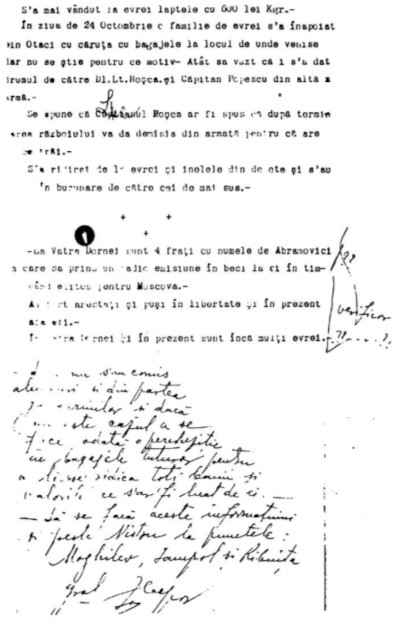
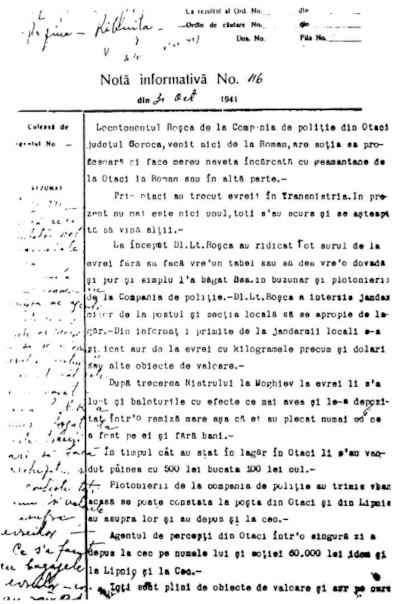
Informative NoticeNumber 116 from October 31, 1941.
Lieutenant Roșco of the local gendarmerie, who came here from the city of Raman with his wife, a teacher, sent to Raman and other cities vehicles packed with suitcases.
Jews came through Ataki bound for Transnistria. Now there are no Jews in the city. All have been “vanished.” Others are awaited.
At first Herr Lt. Roșco took from the Jews all their gold, providing no receipts, no recompense, simply putting it into his pocket. Roșco had forbidden the gendarmes from the local division to approach the camp. From the information received from the local gendarmes, it is clear that kilograms of gold as well as dollars and valuables were taken from the Jews.
After the Jews crossed the Dniester toward Mohilev, all of their packs and remaining things were taken from them, so that they left only with what they were wearing, and without money.
When they were in Ataki a loaf of bread cost 550 lei, an egg 500 lei, and a liter of milk 600 lei.
One can learn from the post office department in Ataki and Lipnik that the co-workers with the police sent money home and converted it into checks.
The agent of the finance division of Ataki put
[Page 344]
6000 lei into checks in his own name and that of his wife in Lipnik.Everyone was found with many valuable things and gold.
On October 24, a Jewish family returned from Ataki to the city from which they came for some unknown reason. People saw that Lt. Rosco and Capt. Popescu gave permission.
Another document says that Lt. Roșco said that after the war he would leave the army because he had enough resources to live.
(Shows no name or signature)
The Chief Inspector of the GendarmerieDecree
Major Teodorescu Sakeloria Alexandru from the Chief Inspector of the gendarmerie was sent to the Ataki-Mohilev, Soroka-Yampol, and Rezina-Rivnitza area to attend to the evacuation action of Jews. He came today, November 2, 1941, and returned after finishing his work.
Aide to the Chief Inspector of the General Gendarmerie
(no name given)
November 2, 1941, Bucharest
Major Teodorescu SakaloriaBe so good as to send a group of agents to the area of Ataki, Kaseuts, Razina-Besarabia to attend to the evacuation of Jews from their former areas.
The Chief Inspector of the Gendarmerie received information that the unit that received the order to carry out his action (military and civilian) committed abuses and some of them took large sums of money and valuables.
To uncover these abuses, you are allowed to investigate and make examinations.
You will inspect how the banking operations are conducted to convert funds and valuables.
Expand this research also to Mohile, Rivnitza, and Yampol.
[Page 345]
Report your findings through the local gendarmerie via telegraph, telephone, or in writing.General Jam Tafor
November 4Stated in the presence Of Major Teodorescu
Statement
I, the undersigned lieutenant in the service of Police Unit 60, declare:
On October 18, I came to the division with the last group of gendarmes from Yedinitz, which had led the last column of Jews from the Yedinitz camp to Koseuts. There I received an order from Capt. Popescu that I should form a group of one officer and six gendarmes to search the Jews who had been evacuated to this side of the Dniester. During this search, we took from the Jews documents and their remaining money, which was converted at the bank into rubles, and their jewelry. The money was used to pay for transporting the Jews' goods in carts. The money and jewelry were put into the national bank without a receipt. The documents were put in the gendarmerie, where Lt. Balia was supposed to be in charge.
Capt. Roșco proposed that the gold and valuables should be registered in the name of each officer who had confiscated the things and he should be given a receipt. But the representatives of the national bank refused to count the money, saying that they worked on the basis of trust and honor.
Later we received an order from the bank representatives that we should also confiscate everyday merchandise belonging to Jews and turn it over to the bank without a receipt. I did this until October 26, when I received leave to visit my family.
I returned on October 31. Now the search brigades consisted of one officer, one lesser officer, a delegate from the national bank, and three gendarmes. The confiscated money and jewelry were put into sealed cases and the other merchandise in sacks. The confiscations ended on November 6 when the deportations of Jews ended.
/Signed/ Lt. Andrei Kakuz
Ataki, November 7, 1941
Stated in the presenceOf Major Teodorescu
[Page 346]
StatementI, the undersigned Lt. Roshlen Augustine, the commander of the 60th Police Unit of Ataki, declare, under orders from Major Teodorescu:
I was the commander of the 6oth Police Unit on October 15, 1941.
Capt. Popescu was responsible for the whole deportation action of the Jews, beginning with the unloading from the trains to the camp and from the camp to the crossing of the Dniester.
- The action of evacuating the Jews began on October 5. Who began it I do not know. On that day Colonel Falada left Ataki and put me under Capt. Popescu.
- The next day, Capt. Popescu invited me to his office and gave me the following oral orders:
As delegate of General Headquarters and representative of Col. Falada, he was fully empowered to conduct the action of transferring the Jews to the other side of the Dniester. He had been given the right and he bore the responsibility for conducting the action. I received his orders and I summoned the personnel from Police Unit 60 to carry out those orders. He informed that many thousands of Jews were in the town, and a number of trains would arrive. It was necessary to search the Jews and their possessions before the evacuations. There were cases of theft of baggage and mass murder of Jews due to the absence of the necessary guards. To my question of whether there written orders, he answered me sharply: “In this situation, people work without written orders. The working methods are perfected daily according to the achieved results.” He ordered me to name four officers from the police unit, a representative from the bank, and four gendarmes to search the evacuated Jews.
He entrusted me with the administrative leadership of the police unit as well as giving attention to the transporting of the Jews and their baggage until the entrance into the camp according to his instructions, because he suspected there were cases when valuables were hidden. I also had to control the gendarmes in order to prevent theft.He chose the men to go on watch patrol and showed me the place and position of each patrol. After that, responsibility fell on Police Unit 60, which had the right to change without the permission of Capt. Popescu.
The 60th Police Unit was responsible for:
- Taking the Jews from the train to the camp.
- Security for the danger of the Jews and their possessions.
- Transporting and guarding the Jews from the security checkpoint to the tunnel.
[Page 347]
Capt. Popescu personally organized the division of officers and gendarmes to conduct the searches, gave them specific instructions about whom and when to search. Every day he would assist in the action. I never interfered.The unloading from the trains went this way:
I had to inform Capt. Popescu when the train arrived, its number, where it came from, how many cars it had, and had many Jews it brought. The captain had to decide whether to unload the cars or leave the people inside.
Until October 30, the Jews, after exiting the train, were taken by carts to the camp. The Jews paid 1,000 lei for each cart.
On October 30, Capt. Popescu announced to the officers and to the representatives of the city council that he had received an order from Czernowitz instructing that from then on, all merchandise would be considered valuable. The Jews would receive no more carts and could take with them only what they could carry on their backs.
The remaining things would be put into warehouses prepared by the city council. The baggage would be taken to the warehouses under the watch of the gendarmes, representatives of the city council and of the national bank. Then the warehouse doors would be sealed, with the keys taken by the city council representatives, and there would be two guards for each warehouse.
Thus we did with the first two transports. The rest were put into warehouses without doors and with windows lacking glass. Some of the baggage was left out in the open. The city council supplied the warehouses. Popescu was there and I think he saw the poor conditions of the warehouses.
The situation was such that the local population often stole Jewish possessions on the road from the train to the warehouse.
Popescu ordered me to strengthen the guard and even to beat those who would not submit to the discipline.
I responded with a report:
Capt. Popescu was not happy with how the military guards and patrols were doing their jobs. Henceforth every guard had to have a club for cases when Jews, local people, or lower ranking soldiers would not follow the guards' orders.
To Major Teordorescu's accusations that people beat Jews, whether to make them go faster or to take their things, I say that this was not according to my orders. I ordered the gendarmes to use clubs only in order to disperse the population and to prevent robbery.
[Page 348]
If the Jews would not leave their homes and go, they should be beaten so as not to hold up the evacuation. I told the gendarmes they should not strike barbarically, only on the body.In the houses and courtyards of inhabitants of the streets from the trains to the warehouse there were hundreds of loafers who wanted to steal Jewish property. In order to drive them off, I had each one hit with a club. When the gendarme Koszokoru, who could not disperse the crowd that was preparing to begin its robbery, asked me, “May I shoot?” I answered, “No! Take your club and fight.” I think I handled this correctly.
Several delegates from the national bank, Lt. Garavay from Kattin, lower officer Marina Yevgin from the 60th Police Unit conducted the searches and the conversion of lei into rubles under the leadership of Capt. Popescu. Money and jewelry ended up in pouches or pockets, the documents in sacks. In the evening, everything was given to a representative of the bank with no receipt on his part. I never heard that we should keep records. After the arrival of Unit 60, the captain ordered that we should enlarge the search brigades. After three days of work, I reported to Capt. Popescu that the search system was not working, and I gave him notes for a protocol for searching and making records about giving valuables to the bank in order to establish who was responsible for what.
Capt. Popescu responded angrily:
“There are no written records about actions with the Jews. As far as money is concerned, in time we will have a bookkeeper.”
After this conversation, I ordered the officers to provide each day the sums that they took to the bank. At the same time, I forbade the gendarmes to conduct searches. They could only pay attention.
My order was not carried out because the number of people who had to be evacuated every day was too large.
Several days later, October 25, Popescu organized four new similar search committees of officers, gendarmes, and national bank representatives. They set up wooden chests in which to put the confiscated money and jewelry. In two or three days, the chests were sealed shut.
The committees functioned according to the captain's instructions. Once they conducted searches in the homes, another time in the street, then in the carts.
At night, the same committees turned over the chests with money and jewelry to the national bank, which was in the same building where Capt. Popescu lived. If the chests were not full, they were filled the next day and then the money was counted. Coins were generally not counted. I was never present when chests with jewelry were opened, so
[Page 349]
I do not know what went on there.The chosen commissions confiscated the Jews' money and jewelry. They themselves noted the number and value and sent them to Czernowitz, with, I believe Capt. Popescu's knowledge and permission. As far as I know, there were two or three protocols. Popescu had not subscribed to any protocol.
I believe that no one was in control.
I do not know exactly how the valuable documents were handled. Lieutenants Bilea and Garavay can provide more detailed information.
About arranging the Jews arriving in Ataki, I declare:
The part of the town where the Jews were found was called the camp.
The first days after our arrival in Ataki, two or three echelons of Jews arrived each day.
The arriving Jews would be brought from the train station to the place of those already evacuated. One day, so many people arrived that the carts were filled from the train station to the camp.Popescu had permitted people to be quartered in homes. There were 20,000 Jews then in the town, and no more than 2,000 could be evacuated per day. The garrison doctor warned that the camp posed the danger of epidemic. Capt. Popescu ordered that the people be evacuated in two days.
Regarding the evacuations from the camp, I state:
Popescu gave the order to search the Jews of the city in order of their arrival in Ataki. But the order was not always maintained. So, for example, those who came from Vatsa Dornei were partially evacuated. Some remained for several days under the pretext that they were in quarantine and had not yet exchanged their money.
The gendarmes led the Jews after the search to the exit point in this way: they organized convoys of ten carts or of 100 pedestrians accompanied by five gendarmes and one lower officer. At night the movement stopped. At the crossing point, the gendarmes from the police divisions stood guard. The gendarmes from the post and the border guards counted the Jews, and the pontoonists organized the crossing of the Dniester.
I can also state that I have information that one day a lame man showed up who said he was Popescu's agent and took money and jewelry from the Jews. Lieutenants Marino and Markalescu can give a more detailed report about this case.
About my position regarding this procedure, which I hold to be neither correct nor legal, I state:
On October 17, 1941, I sent to Tigina Lt. Popescu
[Page 350]
Dimitru with administrative questions. Primarily he had to report to General Tafar about our situation and ask if it was necessary to give a written report. The officer returned on the 22nd and told me that Tafar heard only part of his report. He appeared to be angry and did not want to hear the rest of the report. Later I sent Lt. Marino with a report to Czernowitz, but he did not find General Tafar there.Major Iliescu, commander of the Soroker gendarmerie, which controlled our work, approved of our methods of carrying out the action.
Regarding the conduct of the officers and gendarmes, I state:
From the very beginning I made them understand our mission and our conduct in the situation. I regularly controlled the gendarmes in their work and after work. I punished the guilty. I asked Capt. Popescu to assign me another officer who would help me for three hours a day, because everyone was involved in the evacuation and I alone was occupied with the conduct and administration of the division.
I will also state that at the time of the searches, people took from the Jews wedding rings, earrings torn from ears, as well as people's watches.
This is my statement, which I sign as Lt. Eugeni Dașka.
November 6, 1941
Ataki-Soroka
Stated in the presence
of Major Teodorescu
Statement
I, the undersigned Junior Reserve-Lieutenant Marino N. George-Eugen from the 6oth Police Unit, state:Early on October 12, 1941, I arrived in Ataki with a platoon. There I met Col. Falada and Capt. Popescu, who led the action of taking Jews to the other side of the Dniester. I received an order to station soldiers as guards in the searches and to help the national bank convert lei to rubles. In the morning I exchanged the money. In the afternoon I conducted searches with Lt. M. Garavay from the Khattin gendarmes, who, during the searches, who confiscated from the Jews their gold and silver possessions and Romanian lei that they still had after the exchange. Two days later, the remainder of the division arrived with Lt. Roșco and we all conducted searches according to Capt. Popescu's orders. This work was done
[Page 351]
only by officers and not by soldiers. The confiscated items and money stayed until the afternoon and in the evening were given to the national bank with no accounting on their end. The captain often instructed that it was a matter of trust. On the first day, it was decided to establish an inventory list according to the list for confiscated valuables signed by representatives of the bank and Capt. Popescu. The confiscated money was not accounted for.Roșco often raised the question about the formality of transferring the money and items. Only on October 22 did I receive a verbal order from the captain to assist in counting the money that had been daily confiscated and at transferring the jewelry. Finally, they should have established an act, but this was not done. But we wrote on paper the sums of money and jewelry that would have been signed by the bank representatives. Pavalaescu signed one document, but refused to sign the rest.
On October 29, they organized combined committees of officers, bank representatives, and soldiers. All participated in the searches, including the soldiers. The gold and jewelry were placed in sealed chests, the documents in sacks. I was at the bank three or four times for opening the chests. There were no records of the amount of money or things.
Capt. Popescu gave no written orders for the searches. The situation arose two or three times a day. Searches were conducted once in homes, once in the streets, and sometimes in the central square of the city.
On October 24, I received an order from Lt. Roșco to begin at the train station, where there were Jews from Radautz. Later we were transferred to another spot, then in the afternoon back to the first, and from there to another spot. Usually the Jews were searched according to their order of arrival on the transport from the cities. As the Jews themselves said, those deported from Vasta Dernai had been in Ataki a longer time because of the quarantine.
Objects of gold and silver, earrings and rings and other things were not confiscated on the first day, only later.
Lt. Roșco did not conduct the searches. He followed the order of Capt. Popescu to pay attention to the transport of Jews from the train station to the exit point by the Dniester.
At first the Jews were taken across with their baggage. Later they were given no carts, and most of their belongings remained in the station and were later taken to the city council's warehouses. No one examined the baggage.
The confiscated valuables were taken to the bank with no account
[Page 352]
and no control on their number. Jewelry (gold, silver) was sorted by bank personnelLt. Roșco many times warned the soldiers that they should not steal money and objects. They were searched, and stolen items were given to the national bank with no account from their side.
This statement was written and signed by me, Under Reserve-Lieutenant Ye. Marina advisor to the Kasatsia Court.
Ataki, November 7, 1941
Stated in the presence
of Major TeodorescuStatement
I, the undersigned Reserve-Lieutenant Bilea Valeriu from Police Unit 60, state about the manner of conducting the action of evacuating the Jews to the other side of the Dniester and the searches.
I was a member of the police unit from Yedinitz that guarded the camp. The commander was Lt. Popavitsh Victor. When we received the order to evacuate the Yedinitz-Khattin camp, we formed convoys of 2,500 people each and started out on the way to Ataki-Koseutz, led by an officer. I led the last convoy, which had 2,800 Jews. We reached Ataki on October 16, 1941, and received the order from Capt. Popescu to take my convoy across the Dniester that night, after conducting searches. Because I was very cold from being in the rain for five days, I turned the Jews over to Lt. Gorovu.
On the first day, I helped Lt. Roșcu. Later I was ordered to take part in the searches because of the number of Jews arriving in Ataki, and there were not enough searchers. I worked according to Capt. Popescu's instructions. Aside from documents and money that the Jews hid in various places on their bodies, I also found lei converted to rubles that they needed for crossing the Dniester. I confiscated 220,000 lei from the Jews that I gave to representatives of the national bank. Popescu was at the confiscations for two days, and when I confiscated 180,000 lei, I gave them to Popescu in the presence of Kakuz Andrei. The next day I confiscated small sums of 4, 5, and 6 thousand lei. With the money, I paid for the carts that transported the baggage from the camp in Ataki to the exit point.
I gave the money to the bank representatives without getting a receipt from them. They said there was no time for such formalities and we had to operate on trust.
[Page 353]
I worked at the searches for four days. Then Lt. Roșco gave me the job of sorting the documents, which was formerly done by Lt. Gorovu. The valuable papers were not inventoried. I began sorting the valuable documents on October 29. These searches were conducted by various people according to the orders of the bank representatives and Capt. Popescu under the pretext that they were seeking new, more nearly perfect forms of carrying out the job. I know that they transported large sums of money, jewelry, and valuables to Czernowitz.Aside from money and jewelry, they also confiscated fabric, leather, wool, etc.
(unsigned)
Stated in the presence
of Major TeodorescuStatement
I, the undersigned, Reserve Junior-Lieutenant Stefan Anton from Police Unit 60, state:
I arrived in Ataki on October 14, 1941. On October 15, I received from Lt. Roșco an order from Capt. Popescu to conduct searches of Jews with the help of a group composed of an officer and 4 gendarmes. Capt. Popescu instructed me that we should confiscate Romanian and foreign money from the Jews, in addition to rubles, gold and silver jewelry. The personal searches were conducted at first by officers, later by soldiers.
Everything was turned over to the national bank without receipts. The baggage was inspected without being registered. The system of searching often changed.
(unsigned)
Number 1.020 of November 10, 1941
The Gendarme Inspector of Kishinev
to the Chief Inspector of GendarmesWe Report
- In Police Unit 60 there were no cases of typhus. The remaining baggage was inventoried by a commission under the supervision of Lt. Roșco.
- In Markuleszt were found 1,200 Jews killed in the last train on the way to transport them across the Dniester.
We telegraphed the Inspectorate from Czernowitz that they should no longer send Jews via Markuleszt. The ten cars with baggage sorted
[Page 354]
by the local commandant were taken away. Only small things remained, nothing valuable.
We announced a quarantine in the unit for 15 days, beginning on November 14, 1941, with measures for fuller isolation and disinfection.- We also announced quarantines in the patrol in Yampol and the fifth platoon in Rivnitzia of Police Unit 23 and number 15 of the gendarmerie in Rezina, where there were cases of typhus.
Information Announcement
of November 11, 1941The action of conveying the Jews through Ataki to the other side of the Dniester was carried out from October 5 to October 15, 1941, by Lt. Col. Falada, delegate of General Headquarters, and from October 15 until today by Capt. Titus Popescu, also a representative from General Headquarters.
In order to carry out this action, Capt. Popescu Titus was given Police Unit 60 led by Lt. Augustin Roșco.
The evacuation was conducted with great difficulty–rain, mud, and the situation in Ataki, which was almost totally destroyed.
Until October 30, the Jews who came to Ataki could convey their baggage in carts. Arriving in Mohilev, they were forced to give up their baggage because no carts were there. Their remaining things were put in warehouses that belonged to the city council.
From October 30, 1941, the government in Bessarabia decided to emphasize agriculture. Therefore, they mobilized all peasants to work in the field and they were forbidden to transport Jewish belongings in carts. So the Jews had to leave their baggage in Ataki immediately on leaving the train cars. Thanks to the initiative of Police Unit 60, they decided that the abandoned baggage should be taken into the shtetl and put into improvised warehouses. The shtetl was in ruins and there were no better warehouses.
Many weeks ago, the warehouses became subject to theft.
The consignment of the baggage to the warehouses was done in very poor conditions.
The searches to confiscate Jewish money and valuables came about in this way:
Capt. Popsecu and the representatives of the national bank–Bunescu, Favelescu, Antonescu, Lekroru, Popescu, and Merkulescu–organized eight
[Page 355]
brigades, four led by delegates from the national bank and four by police officers. Later, the number of brigades was reduced to four, in each of which was a representative of the police and of the national bank and three gendarmes.At the crossing of the Dniester, we confiscated from the Jews their undeclared and unexchanged money and jewelry.
At first, people filled their pockets with the confiscated valuables, gold, and silver. From time to time, they emptied them in a room of the so-called bank. They were not counted and there were no receipts from the bank. Later on they were put in uncovered chests that were given to the bank with no receipts and no counting.
When I came to Ataki, one single employee filled the chests, gave them to the bank, opened them, and counted them without supervision. Only Capt. Popescu assisted him.
The guilt for that incorrect procedure falls on Capt. Popescu–and on the representatives of the national bank. The police officer had warned that the bank officials would not count the money and give the necessary receipts. To this, Capt. Popescu responded that in these conditions there could be no written records.
The police even caught someone who conducted searches without having the right to do so and thus stole things. He was Popescu's agent. There were also cases when the bank representatives conducted searches outside of the usual places.
The money was taken from Ataki and Czernowitz in unsealed chests. The money was not counted, since no control existed and no one knew what people had transported. Smaller amounts–50, 100, 250 lei–were not counted at all.
(no name and no signature)
(The beginning is missing). In Ataki you will investigate the cases of abuse by the officers and gendarmes of the 60th Police Unit during the deportation and transportation of the Jews across the Dniester.In order to facilitate the orientation in the matter, we present a dossier that includes informative material and declarations from the officers of the 60th Police Unit, put together by Major Teodorescu from November 4 to November 9, 1941, regarding the issue.
Expand the investigation into Mohilev, where you will perhaps find evidence and show what witnesses say about the misdeeds.
You should also investigate in the train station and in the local post office to see whether sums of money were sent in packages by the gendarmes to
[Page 356]
their families.If the Headquarters and the national bank will send delegates for the investigation of misdeeds by their organizations, you are delegated by IGZh (Chief Inspector of the Gendarmerie) to take part in the investigation. You will give the report and the necessary documents to the chief inspector of the gendarmerie.
Chief Inspector of the Gendarmerie
General I-Tafar.
ReportNovember 20, 1941
On November (?), Herr Colonel Constantinescu from the Ministry Council came to Ataki. He was accompanied the whole time by Capt. Popescu and by a major from the Border Patrol, wo passed himself off as the commander of the local garrison. Constantinescu, seeing how the residents of the town regarded him with curiosity as the Jews were unloaded from the train cars, yelled at Lt. [sic] Popescu and reproached him, saying that the residents showed no fear of the gendarmes, because the gendarmes did not shoot at them, to which Popescu responded that they could not shoot people just for looking.
Constantinescu directed all of his complaints to the gendarmes and not to the representatives of the national bank and not against the search activities.
When he stood near the exit point to the Dniester, a soldier, right in front of him, tore te winter hat off a Jew's head. The soldier was not punished.
Capt. Popescu had many agents whom he permitted to go among the Jews, both when they were unloaded from the trains and in the camp. I do not know to what purpose. But I do know that gendarmes seized two of the agent-informers who had permission from Popescu when they exchanged rubles and sold them. The agents would buy rubles on this side of the Dniester for 6-10 lei and sell them to the Jews for 30-35 lei per ruble.
Popescu's agent-informants were permitted to go among the Jews freely, and they could make large sums by selling rubles.
(name and signature not shown)
[Page 357]
|
|
[Page 358]
|
|
|
JewishGen, Inc. makes no representations regarding the accuracy of
the translation. The reader may wish to refer to the original material
for verification.
JewishGen is not responsible for inaccuracies or omissions in the original work and cannot rewrite or edit the text to correct inaccuracies and/or omissions.
Our mission is to produce a translation of the original work and we cannot verify the accuracy of statements or alter facts cited.
 Otaci, Moldova
 Yizkor Book Project
 JewishGen Home Page
Copyright © 1999-2026 by JewishGen, Inc.
Updated 08 Jul 2026 by JH