|
|
[Page 259]
[Page 260]
|
|
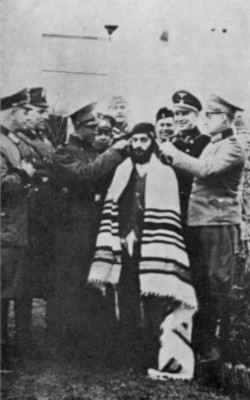
| Nazis abusing a devout Jew in the middle of the market square in Ostrowiec |
by Yehoshua Urbas
Translated by Theodore Steinberg
The news that the war had broken out spread like lightning through the streets of Ostrowiec and caused terrible turmoil. Life was suddenly paralyzed.
There was a stampede in the city. Parents ran to their children–children ran to their parents. People also ran to stores to stock up on food, fearing the hunger that was to come.
On the streets people began to dig protective trenches where they could take shelter in case of bombardment.
In the course of a few hours life, which had been so normal, was completely overturned. It could no longer be recognized…
Soon the first mobilization was carried out. Special couriers appeared in the streets and distributed among the inhabitants calls to appear for the army. Because there was no time to accomplish this by mail, special couriers were sent.
So a notification came to the home of the Falkman family for Yonatan, who was twenty-five years old.
There was no one at home except for the little children. The mother and sixteen-year-old Ezra, who helped support the family, were at work.
Yonatan came to eat his lunch. It was twelve o'clock, the time for his afternoon break. He took from his shoulders the yoke with the buckets and began reading the notification.
“Yes, it's calling for me!” he said, and his face, with its wide nose, gave a start and lost for a moment its natural ruddiness. He sank into thought…
Finally he began to eat his lunch, cutting a piece of bread, small, as usual, dipped in borscht.
Then he stood up and began to pack his bag, the same bag that two years earlier he had emptied after regular military service.
Into the bag he put a photograph–a photograph of his fiancée Malkah, some envelopes, writing paper, and shaving equipment. He also wanted to take with him a picture of his mother, and he deeply regretted that his mother had never been photographed. She never had because she was an observant and God-fearing woman.
While he was packing, sixteen-year-old Ezra arrived. He was terrified. The packing gave him a fright. It is known that the departure of his brother Yonatan for the army affected him terribly…
In such a family, where there was no father, there was among the children an especially deep relationship with each other and with their home.
After the packing was finished, Ezra said, “Come. I will go with you to the train, Yonatan…”. He said this in such a voice that he sounded like a breaking dish.
But they did not leave then. They waited for their mother.
But they could not wait long. The notification called for those who were mobilized to appear at the train station at precisely two o'clock.
Her children did not know where to look for her. She, their mother, was never found in a single place, because her work required her to be in different places.
Ezra ran to search for her among the neighbors but–without results.
Finally Yonatan embraced the children, said goodbye to his sisters–
[Page 272]
Yocheved, Reizel–and his brothers–Yerachmiel, Chaimke, Pinchas–held them close, then took up his bag.
The way to the train station was not long. Ostrowiec, after all, was not such a big city.
It was somewhat divided in two: one part of the city was the market, with its surrounding Jewish area. The other section began behind the hill, the long, broad avenue that led to the Christian quarters, to the park, to the factory, and to the train station. It was about two kilometers.
But on that day the two brothers looked at the road for a long time. The road was troubled…because no one knew where it would lead?…
On the road the two brothers were silent. Each thought about himself…
Yonatan, who was being mobilized, thought about the situation, about his mother and the children whom he was abandoning, who would be left hungry. As he was thinking, Yonatan saw himself at home, helping his family. Soon after the family had been left without their father, who had died an unnatural death, the whole burden of feeding the family had fallen on the shoulders of seventeen-year-old Yonatan. At home were the children with their helpless mother, who in this terrible situation did not know where to turn. Consequently, he, Yonatan, had not learned a trade, because he had to go to work immediately so he could earn money. He became a watercarrier. He bought a yoke and began with two buckets, huge buckets. At first the other water carriers really did not like him, because they feared the competition. But later they found him to be a good friend: --he had increased the price from five groschen to seven groschen for two buckets. At first, he did not like being a water carrier, but later he got used to it. He felt about his profession like most manual laborers that he was serving a purpose in order to earn money and to exist.
In the evening, when he returned home after a workday, he gave his mother the money he had earned. At the same time, she returned home with the little money she had earned. Both of them–she and Yonatan–left home early in the morning, he with his yoke and buckets and she with a can in her hand. He carried water that he drew from the well on the street, and she carried milk in her can. She got milk at the dairy and carried it to the homes. For each liter of milk that she sold, she made a profit of two groschen. She did this until ten o'clock. Then she went home and made something for the children to eat. Then she was off again, this time to another job, taking in laundry from one or another household.
And so things went on for several years.
Ezra, the younger brother, now accompanying his brother to the train station, also thought about home: he remembered the time when Yonatan went away for military service. For a year and a half, he was abroad. That was the hardest time, as he recalls…His mother, more than ever, talked to their father…she was immersed in her thoughts…They had to relinquish their home, which consisted of a room and a kitchen, and go to a smaller room that held only their beds. Moreover, their long table was not there. In no way did it fit…Nu, so the children began to do their lessons at the little table. The days passed painfully. Nights–hungrily. Many evenings ended with cries from the little ones, Chaimke and Yocheved, who did not understand, who could not understand, that sometimes one had to go to bed without an evening meal. So, when Yonatan returned home oh, then everything changed. Life was as it had been. Their mother was happier. So were the children. They also began to make a soup in the morning. “A frugal soup.” He, the big brother, went with the children to a
[Page 273]
bookstore. Once he borrowed from them a “necessary book” from neighbors…Their home was clean, warm, as it had been before. With Yonatan home, the house was heimlich and good. Now…Now they were taking him away again. For how long?
“How long do you think the war will last?
Yonatan did not answer.
Ezra, understanding Yonatan's thoughts, wanted to comfort him, to say something, but his tongue would not move.
Then, as they approached the train station, he said, “Don't worry, Yonatan. I will look after them…I will begin to work hard, harder than before, so that Mama and the children will not go hungry…”
Yonatan arranged his bag on his back, looked at his brother, thought directly about him. And it seemed that now, for the first time, he saw his character, that of his little brother. He wondered at his body–so thin…so small and emaciated.
Yonatan heard what he said, saw how the blood rushed to his face.
At the station, when he hugged his little brother, clutched him, he said, “I know that you will do it. You are already a man, not a child. You are no longer a child. It is not permitted…Now you have become a man. You will pay attention to our home…I have taken our father's place. Now you must take my place. And…when I return, perhaps you will be as tall as I am, and also a good earner…”
They said goodbye and kissed.
And Yonatan went to the train.
Many people were already standing by the train, a big crowd: aside from those being mobilized there were many others–fathers, mothers, men with suitcases in their hands, women, children, old people.
Women appeared with flowers in their hands for the called-up soldiers.
Peasant men and women–with warm bread–accompanied their sons with all their goods.
Alongside the train stood officers. At the station door–an orchestra played various military marches.
This was the first train of mobilized soldiers, all men who had been discharged–a train that had to go from Ostrowiec to the already engaged army that had begun the defense against Hitler and Germany.
Mothers were soaked with tears, their scarves fluttering in the wind.
“You should return. You should return!” yelled Ezra to Yonatan as he guided his steps to the train.
Suddenly, as he approached the train as Yonatan was already on the last step, with his right hand grasping the handle of the door, at that moment was heard the shrill whistle of the alarm siren, cutting through the air with a terrible sound that made everyone shudder. Everyone, without exception, began to run. Over their heads appeared German airplanes. They filled the sky. The noise of the airplanes mixed together. There was total confusion. After the first explosion, people ran wildly, sought somewhere for protection. It was a mob, a tumult. People fell over each other, then got up and ran.
The chaos increased when a cloud of smoke encased the whole platform after the first explosion.
After that explosion, Yonatan jumped from the train and landed on the stone platform, where Ezra grabbed his hand, and they ran away from the train.
After the second explosion, they separated, lost.
“Yonatan, Yonatan!” screamed Ezra.
Running into the crowd, he ran around seeking his brother.
The clatter of the wagons deafened him. He did not see the falling, the loud rolling of the train cars. His eyes were blinded by the thick clouds of smoke and dust that came from the bombs.
[Page 274]
“Yonatan, Yonatan,” he called, bent over and protecting his head with his hands.
But Yonatan did not hear.
Yonatan was already laid out on the earth.
His head, Yonatan's, covered with thickly grown, long black tufts of hair, lay with his face up, his mouth half open: blood seeped from his half-open mouth. His pack, his military pack that was on his back, between his shoulders, with its leather straps had cut deep into the flesh of his arm as he fell. He breathed heavily; his breath rattle. Near him lay a piece of a destroyed wagon.
When Ezra saw him, he ran to him and fell with his face on his body: “Yonatan!” He tried to rouse him, as one shakes someone who has fainted when trying to wake him…
Yonatan did not respond.
Ezra, despairing, hit his head against the stones.
Then he pulled himself together and tried to help his wounded brother, tried to ease his pack, to ease the strap on his arm. And in the confusion he called out for help.
But his cries mixed together with the other terrible cries of many people.
Tearing the young man away from the wounded was the first task when “first aid” appeared on the ruined platform. A horse-drawn ambulance from the “Red Cross”. came and began to remove the wounded.
The ambulance, after the wounded were loaded, began to move.
Ezra followed it.
The ambulance picked up speed.
Ezra did, too.
The ambulance disappeared from his sight.
Ezra continued to run in the same direction.
Out of breath, sweaty, breathing hard, with blood-flecked clothing–the blood of his brother Yonatan, whom he had embraced–young Ezra arrived at the hospital yard.
The wounded, who had been placed in the ambulance, were now on the floor, in the corridor, while places were prepared for them in the hospital rooms.
Ezra tore a path through the people who were arriving and began to seek his brother among the wounded.
“There he is!”
His cry, the sudden cry of a boy, a shocking, spasmodic cry, drew the attention of the hospital personnel: a nurse, a medic, and a doctor.
The nurse, a concerned young woman, took the boy by the hand.
“This is no place for you.”
She led him into the corridor.
But that did not help. Ezra could not help himself: however often he was led out, the boy always managed to appear near his wounded brother.
Finally, when the hospital personnel, with the help of the police, had cleared the courtyard of the desperate visitors, freeing up the way to the door, Ezra could not get through. But he could not go home…
He remained standing by the hospital window, listening closely to the voices of the wounded. With his eyes on the door, waiting, at every opportunity, to everyone who came out–the nurse, the medic, the doctor–he asked the same question about his brother Yonatan Falkman's condition…
“He is wounded…”
The nurse took pity on him and came out to him several times to give the latest report on his brother's status.
Finally, she grew tired and said, “Young man, go home. With your crying, you're not helping the wounded at all…”
This only increased his suffering.
Night fell, a very dark night. Tired, weak,
[Page 275]
worn out, unable to go home, he lay down on the grass and bit the earth with his teeth, whispering, murmuring into the darkness: “God, Father of orphans, judge of widows”–words he had often heard from his mother–“help. Let Yonatan live, not die…If someone must die, let it be me. He is more valuable than I am…”
But the boy's crying was unceasing when he heard the bitter news that his brother had died.
He got up and started running, not knowing what he was doing, running, running, running always.
Only when he approached the door of his home did he stop. He stood still and asked himself, “How shall I tell my mother?…”
He saw his mother as he had never seen her…She fell down, she fainted. She did not know what she was doing…She argued with God…She wrung her hands…and–what else did she do, hearing such terrible news?
But actually, none of these things happened.
His mother was not at home.
The children were sleeping, aside from Reizel, the eleven-year-old, who had awakened when he came in.
Suddenly their mother arrived. She was not crying. Ezra approached her.
“Mama…”
“What?”
“Yonatan…”
“I know everything, my child. I know everything already…”
She sits down. Her face appeared glassy.
No. Their mother does not cry–She is not in any condition to allow even a tear in her great disaster…
|
|
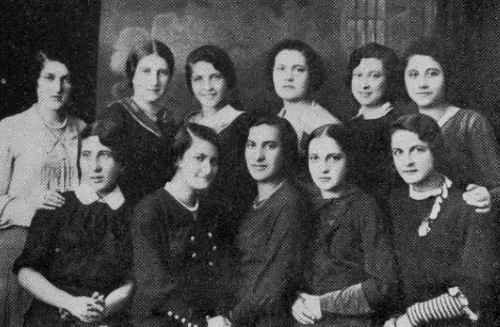
| A group of members of the “B'nos Agudas Yisroel.” Only three from this group are still alive. |
|
|
JewishGen, Inc. makes no representations regarding the accuracy of
the translation. The reader may wish to refer to the original material
for verification.
JewishGen is not responsible for inaccuracies or omissions in the original work and cannot rewrite or edit the text to correct inaccuracies and/or omissions.
Our mission is to produce a translation of the original work and we cannot verify the accuracy of statements or alter facts cited.
 Ostrowiec Świętokrzyski, Poland
 Yizkor Book Project
 JewishGen Home Page
Copyright © 1999-2026 by JewishGen, Inc.
Updated 18 Sep 2024 by LA