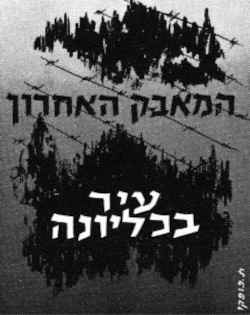
|
[Page 253]
|
By the knowledge of my eyes that saw the bereavement |
| - A. Shlonski |
[Page 254]
[Page 255]
by Eliahu Damessek
Translated by Yehuda Kotton
September 1, 1939. The Germans invaded Poland. The fate was sealed, the signal was given, and World War II had begun.
The Poles saw this surrender-defeat as an end to their political independence, whereas the Jews deeply felt in their limbs that the end of their safety and lives on Polish soil was approaching, and that the destruction of Poland carries with it the tidings of destruction and imprisonment for Polish Jewry.
The first instinctive reaction was: a panicked flight from the big cities and districts where the Nazi villains had already set foot. Entire families and individuals began to flee for their lives, with no purpose or direction, and without knowing where they were headed.
Many of the refugees also came to Lida to continue from there on their way to Vilna. The youth and adults in Lida were also preparing to leave the city. Many packed their belongings and put a backpack on their shoulders to set off.
Everyone's eyes were aimed towards the Russian border.
But all of a sudden, like a thunderbolt on a clear day, a decisive and surprising event occurred. Sixteen days after the attack on Poland (16.9.1939), the radio announced that an agreement had been reached between Stalin and Hitler on the division of Poland between Germany and Russia. Lida was included in the territories annexed to Russia. A few minutes after this surprising announcement, a speech was broadcast in Russian in this language:
“Brothers and sisters from former White Russia” You who spent more than twenty years in the territories annexed to the State of Poland will now be liberated by us. We extend a brotherly hand to you, bring you into the bosom of our great family, and give you our protection.”
It was with great joy that we received this news and many who were about to flee to Lithuania, took a backpack off their shoulders. Many of the Jewish public danced in joy and kissed in the streets. Laughter and tears merged together, and for me it seemed that my joy outweighed the joy of everyone, since I stayed with my lonely mother and didn't have to leave (my only sister who got married before the war lived in Baranovichi, 110 km from Lida).
For a number of days there was no military or civilian rule in Lida. Crowds gathered in the streets, labor unions and other organizations were preparing to merrily welcome the Russian army as they entered the city. Some of the homeowners made red flags. The city was quiet; The shops were closed, and work in the workshops and factories was shut down. there was a general sabbatical; The Polish mayor kept the city quiet, and the Jewish and Polish populations demonstrated exemplary order. At the entrance to the city, a large gate with red flags was erected. The Russian army was to enter the city through it.
At 9:00 p.m. on September 18 1939, the first three Russian tanks, adorned with red flags, were seen with a white flag between them as a sign of an armistice. Above one of the tanks, it was announced loudly that the Soviet army would enter Lida tomorrow. The tanks advanced down the main street and disappeared into the darkness.
The next day, at dawn on 19 September, the streets were filled with people despite the drizzling rain. The members of the professional associations with their flags, erroneous organizations gathered near the Gediminas Castle ruins. At 10:00 A.M., everyone lined up, led by the flag carriers and the fire brigade orchestra. The procession advanced towards the road, through which the Russian army was to enter the city. Four kilometers from the city they met with the advancing army. Representatives of the city greeted the Soviet army. A Russian officer answered briefly and the whole procession moved forward. Near the ornate gate at the entrance a delegation welcomed those who came to the city with bread and salt.
At 2:00 P.M, the Soviet army entered Lida along with the various delegations that greeted it to the sound of orchestras, playing music and singing. The streets were full and packed despite the pouring rain. From old men to teenagers, they went out to welcome those who came and covered them with flowers. Tears of joy that streamed from my eyes were mixed with the raindrops. The darker the sky became, the brighter my face radiated from joy and cheerfulness.
Part of the army turned towards the historic citadel, and a senior officer thanked those gathered for the warm and cordial welcome.
The army that arrived in Lida immediately began a large-scale propaganda campaign among the population, which filled the streets, until late at night. On every street corner, groups of soldiers stood surrounded by crowds, answered questions from the audience and told about life in Russia.
In the evening, movie machines appeared on the streets of the city, and in the walls of open-air houses, propaganda films about the peoples of Russia were screened.
The tanks and military cars that roamed the city were filled with youth, children and cheers of age: “Long live the Soviet Union”! “Long live Stalin, the great leader and teacher!”
After a few days, the Russians took over the city and life began to flow according to the Russian route. The large factories and workshops were nationalized, and the authorities took over all the economic life of the city. The owners of the factories began to work together with their workers and former officials, and the population accepted it with no other choice.
At the time, I was working as a printing worker at Kaplinsky's printing house, and when he was nationalized, I was immediately hired as a government employee, publishing the local newspaper in Belarusian: Opiriad (Forward). The editor was a Jew named Abramson.
Since there was a need for workers, I tried to help hire my previous “landlord”, Kaplinsky and Mrs. Zeldovich, whose factories were nationalized. I argued that these were not only property owners but also real workers and excellent professionals. My efforts bore fruit, and they both worked until the end of the occupation. This is also indicative of the liberal atmosphere. toa certain level that still prevailed in those days.
by Ze'ev Ivanski
Translated by Rabbi Molly Karp
The German-Polish war descended on Lida like thunder – really like thunder because the Nazi enemy force struck it from the first day of the war. The air field was erased by focused shelling, the train station and the city itself, they too were bombed and panic seized the entire population. Until the last minute they did not believe that indeed things are heading for real war, and the jets that appeared to kill and to destroy seemed to the eyes of many to be “ours.” The matter of the partition of Poland in the Molotov-Ribbentrop agreement still was known only to a few secret-knowers among “policy makers” and “knowers of all” that in the Batei Midrash (and it is reasonable to think that they indeed knew well even the details of the division that they drew up “on the palm of their hand” without maps and out of “intuition” alone).
No one, of course, guessed that the fall of Poland would be so fast and decisive. I was fifteen years old then, and I remember the weeping of the mothers whose sons were taken for the war, the rumors that flowered in the air, the nights that I would go out with Father for guard duty in the streets, guard duty that was organized by the civilian institutions. One night we found one of the Polish officers laying in the gutter of the street, next to the restaurant that is in Vinogradov's yard, entirely covered in vomit and feces, waving in a drunken voice “we will not hand Warsaw over!!”
Indeed, Father said to me, this is their appearance now, and this is our situation. He discussed with me that night and as if the heart prophesied “our generation is irrelevant, maybe you, the youths, the children, will be able to save, the burden is descending upon you and the fate of the family – is in your hands.”
The rumors grew more frequent. Radio Poland was almost no longer heard. The people of the city were divided between those who sets their steps towards fleeing to the Soviet Union, and the others who remembered the German conquest of the previous world war, and said: “it's nothing,” “we will continue to live after they are finished.” It was difficult to abandon the families, small children, property, livelihood. There were delusions, fruit of the desire to not believe in the worst. All these became irrelevant with Molotov's announcement of the entry of the Red Army into “Western Belorussia” and “Western Ukraine” became known, since the Kingdom of Poland disintegrated and didn't exist anymore.
From the time that the remains of the Polish troops passed through the city an alarm was heard that the bombing was approaching, but it quickly became known that it was a false alarm. I, who as a youth was curious and less cautious, went out to look at the retreating army. As one who was accustomed every Sunday to the “parades” of the Polish garrison, there was something unusual, shocking, in the appearance of a defeated army that moves humiliated, without any fuel. There were luxury cars stuck on the sides of the road, more respectable cars continued by means of pairs of horses and this was a poor and humiliating sight. Without saying anything, a defeated army marched – a long line of officers, soldiers, symbols who for the most part, never even came into actual contact with the enemy – and with them the proud Poland marched and left our area, this “ Hillel Ben Shachar”[1] and from here it left without return.
I remember the attitude of the Poles at that time.
Whoever knew the period at the end of Poland's independence when it was approaching Nazi Germany, waving her sword at small Lithuania really from the grave, grabbing a piece of Chechen at the mouth of the abyss, whoever remembers the abuses of the Polish students and the intelligentsia, the flowing venom, the tidings of hate, the policy of “economic struggle”[2] – it is not possible that he would not have been surprised at the turnaround that took place in the days of the first defeat.
Suddenly they were reminded that indeed the Jews also were members of the covenant.
“We are in one boat” – Polish and Jewish mothers whose sons were drafted into the war found shared language and together shed tears and mourned for those who went and did not return.
There was an atmosphere of a turning point on the street – an atmosphere that existed for no more than two weeks, until the entrance of the Soviet army and the “betrayal” of the Jews who did not hide their feelings of sympathy for the army that liberated them in those days from the fear of the Nazi conquest, and which brought a rosier future and at least brighter hopes to the masses of working Jews and destitute poor people, and also to a large part of the educated youth, before whom all roads were blocked, and who remembered the humiliation and abuse.
I will always remember that night that was between authorities:
The Polish army snuck away secretly under the cover of a continuous alarm siren, and days without a government descended on the city out of fear of riots and robbery. Already in those days rumors were widespread and they prepared for everything bad. I remember that night when all the city did not sleep, the main street hummed with humanity, with hordes who anticipated what the light of dawn would bring on its wings.
Lines for bread began, money lost its value, and farmers sold only in exchange for salt, merchandise, and silver coins.
This was one of the long tense nights that is carved in my memory, one of the nights of the turning point in the history of humanity. That night between one government and the next, when the new is hidden in the unknown tomorrow, not the distant tomorrow, but really on the next day.
And the old went by without returning.
It appeared at dawn in the images of lone horsemen, and it was already known that they were buying wristwatches, that they were kind and disciplined.
All watched for the entrance of the Soviet army.
Towards evening the first tanks appeared, the likes of which, until then, Lida had not seen – these were the “Stalins.” The paving stones of the streets and also the houses shook from their power.
I remember that we anticipated seeing the first face – a figure from a new world, unknown, the great riddle that dwelt not far away, but was so distant.
The first head, and this was the first Soviet head that I saw, was the head of a young tank crewman that dared to stick it out of the turret hatch of the tank. I remember that this was a young face, fresh, a young Mongolian face and from within the strange, the new, world looked at me for the first time, the savior from the Nazi terror, and threatening the whole world of dreams that we the youth had woven.
The entrance of the tanks began towards evening, and on the next day a vast, orderly, procession of soldiers entered. Here there were well-armed horsemen, grey foot-soldiers, mechanized, strong – there was a deafening silence.
They told about the farmers that were shot to death by fanatical Poles because they suspected them, that they came to greet the Red army. The Poles reacted in an original way – and brought confusion not only to the population, but, it is reasonable to think, also to the Red army. Radio
[Page 257]
Vilna spread a rumor at the order of General Zeligovski that in Germany a revolution broke out and Hitler was overthrown. This raised the morale of the Polish population and was absorbed even on the street.
I remember the mass gathering that took place in the zamak (castle) at which the commander of the Red Army spoke, and his mouth expressed what he absorbed from the rumor and which was surely his heart's desire: “Hitler's head was cut off – we are advancing on Germany! Long live the world-wide revolution! Long live the Red Army!!” and etc. When this authorization was received there was rejoicing and happiness, but it is understood that it was not for many days, since in those days Lida was flooded with waves of refugees that came from the west.
From that magnificent procession of the Red Army my Father's instructions remained in my memory: “Yes,” said Father, “these are not the Bolsheviks of 1918 and 1921. This is another nation and another army – these are not the ragamuffins that emerged starving for world domination – this is a mighty power, organized, who has it in its power to take control of the world.”
With the entrance of the Soviet Army rapid organization began. Indeed the shopping panic did not pause and it caused more of the Russian army's desire for acquisitions than a real lack. A local government was quickly established, a militia was organized, and this was the first time in the history of our city that so many Jews were seen in it.
The streets teemed with soldiers and sometimes you would see groups of men conversing with the officers. There was indirect contact and there were many Jewish officers, “our officers,” that Jews would cling to out of true affection. The Jewish street was swept up in sympathy for the Red army, and this encompassed all echelons.
I remember one picture from the army's propaganda approach which is engraved in my memory from that time. In the area of the market a large public assembled around a handsome Soviet officer. On the side stood a Gypsy palm reading fortune teller. She requested the Soviet officer's hand too. He extended his hand to her with a smile of dismissal and ridicule, and after she prophesied his future according to the common version, he gave a speech in the ears of all those present:
“And what can you tell me about the future, that I will be promoted, that I live in a regime in which I will ascend if I am talented, and if I serve my homeland faithfully, “that it will be good for me”, and how it will not be good for me in our great, free, working country?”
Years went by and that same picture rises frequently before my eyes, of the teeming street and in it the Gypsy fortune teller facing a Soviet officer who is giving a speech in the street, and the street is entirely amazed, curious, expectant.
The Soviets brought to the city a different gust of wind, there was an atmosphere of a change of values. The Jewish youth, thirsty for a little nationalism, freedom, feeling valued, missions, and in the main welcoming “authorities,” was swept away to a large extent by the new atmosphere. Great courage was needed, great faith, and maybe an innocence greater than this – the innocence of youths 15-16 year old, the age that we were then, in order to cope with the challenge of the Stalin regime.
A Zionist Underground
Lida was one of the few places in which a Zionist underground arose, and it was carried on the shoulders of the youth who had only just emerged from childhood. It is certain that these were not the only ones who remained faithful – but we are speaking of is organized faithfulness. The underground that was established by us was a fighting one.
The first push for underground activities came with the vast stream of refugees that flooded Lida. Lida became a transfer station to Lithuania. Who did not pass through here? – all of the pioneer camp, that succeeded in escaping, leaders of Polish Zionism, council leadership of the youth movement, and in Lida a shelter was found. There were houses open to passers-through – the house of Dr. Groi, the house of the Slonimtzik family, our house, and many others. Many passed though these houses. In time I met in the land with a Holocaust survivor who, when he heard I was from Lida, and from the Ivanski family, said to me “I owe a great debt to you and especially to your mother. Three times I tried to steal across the border, and three times I returned to your house, and your mother rubbed my frozen feet, and while doing so she thought of you, and pondered whether some house would be found that would give refuge to you too (the wandering son) in a time of trouble.”
The days were days of curfew and a military situation. In those days I and Yoel Groi, may his memory be a blessing, (the son of Dr. Groi, who was arrested afterwards for Zionist activity and died of starvation in deportation) learned in the state gymnasium, and from there we tried to connect with the few who were ready to spring into action. The days of Chanukah approached and we decided that on Chanukah flyers would be distributed and there would be an underground activity. We connected with members of the movement: a friend from childhood (who after many hardships, and protracted imprisonment, reached the land a few years ago) is Yaakov Pupko, with Miriam Slonimtzik, who lives today in Tivon, after she survived as a Partisan in the forests, with Zalman Raznitzki, who was murdered afterwards by the kapos in Vilna, with Leibele Guviansky, the son of the shochet, who was murdered afterwards by the Nazis, and others, and we decided on the organization of a widespread action. Yoel Groi and I took upon ourselves the printing of a few hundred leaflets and we carried this out industriously, in children's hand printing.
Miriam Slonimtzik took it upon herself to distribute the announcements in the classes of the previous Hebrew school, “Tarbut.” Zalman Leibeleh Guviansky and Yaakov Pupko took it upon themselves to distribute the announcements in the synagogues and the study houses. In the announcements it was said:
“Today is the Festival of Chanukah, remember the Festival of the Maccabees, don't surrender! We will not give up on our language, our festivals, and our aspirations!
If I forget you, Jerusalem, let my right hand be forgotten, let my tongue cling to the roof of my mouth![3]”
We prepared hundreds of announcements, and on Chanukah the sign was given.
When the school children opened their tables tens of announcements went flying in the classrooms. The frightened teachers began to gather the “chametz” and burn it[4] while in the grip of excitement and panic. One must remember that these were compulsory teachers, and their fear was great. However, the announcements continued to fly about.
In the synagogues the announcement notes began to drop from every siddur and every podium, and even there panic and amazement gripped the Jews. For many more days they talked in the city about the daring of the people of the underground in these crazy and dangerous days.
Echoes of the action reached us youth, and we were surprised with all the rest about those who dared to do this work.
The days went by and the ring around us began to tighten. I suggested to Yoel and Yaakov that we get away. We analyzed the situation and agreed that the only way to continue the Zionist activity was with an attempt to reach the land of Israel by all means. One of the dubious ways, the longest and most uncertain, led us to Vilna. Yoel and Yaakov were only sons, and it was hard for them to abandon their parents. Zalman Ratznitzki joined us on the road.
On one of the cold January days, I left the house and joined
[Page 258]
one of the last organized groups that had gone out, and I was then 16 years old. I went out to the long road that led me to the land of Israel.
I parted from my good friends, and on one of the evenings the members of my household were about to part from me. I did not know then that I would not return and see my father again, my young brother Mordechai, my sister Genia, my dear mother, and all of the members of my household.
Mother said: “We will see each other again!! We will not be separated!!” She made an effort to show a laughing face so that I would remember her like that – brave, daring. But the old nanny who had raised me from infancy, burst out in weeping, and when the door closed behind me, I heard the weeping of the members of my household. The heart said maybe what the head did not want to conceive.
Many days went by and I remember the white border, and we were trudging in high snow, and it was cold and the road was hard and long and dangerous. In the convoy there walked with me Aharontzik Levinson, who did not get to reach freedom, Zalman Raznitki, upon whom the destroyer also ascended, a few refugees.
It seems to me that alone from this convoy I reached, with hardships, many dangers, in a miraculous way, a safe shore.
Much blood was shed since then, and the fields have been drenched, and murder was rampant in every corner. I escaped from its claws, however all the precious, the beautiful, the beloved, remained there…
From behind the screen of blood rise before me these few memories of innocence, the bravado and faithfulness of adolescence, which maybe in their merit I remain a remnant, this impression of mine – like a marker upon a grave.
Ein Harod – The United Kibbutz
Translator's footnotes:
by Miriam Yooungman (Slonimtchek)
Translated by Yehuda Kotton
All the Jewish residents of Lida were immersed in a sense of well-being and joy when the Soviet army entered our territory. Whereas I was not caught up in all this cheerfulness. On the contrary, I was terribly sad and miserable.
I recently returned from the executive camp of the “Zionist Youth” movement full of hopes for the realization of a completely different vision. I was young and wasn't ready to give up. Maybe it sounds absurd, but I mobilized all the mental powers stored in me, in order to do something, to look for a way out, and the obvious way out was then to cross the border to the free Vilna and from there on.
Refugees started arriving. I mobilized on my own initiative to help the refugees. First of all, I looked among them for acquaintances from the movement. I arranged accommodation and food for them. Our house was full of refugees. Acquaintances of my parents, merchants who were in contact with them, also started arriving. We had enough room for everyone. Some stayed with us for weeks or even months. People crossed the border, others were caught or returned.
I knew no rest. I lived in anticipation of something happening. Then, one day in December 1939, I met Zalman Reznitsky and he revealed to me that they had decided (he didn't say who) to add me to a group whose purpose was to maintain the connection with the Zionist youth in the city and to motivate them. Since Hanukkah was approaching, I had to distribute leaflets in Hebrew in the area of ??the former “Tarbut” school. The leaflet was approximately 5 x 10 cm in size and hand printed.
It was a call for teachers and students not to forget what they learned and to not deny it. Such as: “Hebrew teacher, do not betray your people.” Or – “Hebrew student, don't forget the heroism of the Maccabees”! and so on.
Needless to say how childish and innocent it now seems.
We did not intend, of course, to declare war on Russia, or to cause a revolution among the youth. It was just a show of boundless loyalty, and a willingness to bear the consequences. Of course, none of the family members knew about it, including my sisters. It was my biggest secret.
I received the flyers on the eve of Hanukkah, and on that evening I had to distribute them. It was a rainy autumn evening. I wore a wide raincoat and under it were the posters and the glue. The beginning of my journey was to the school, the one that was built near the outbreak of the war with so much love and dedication. I managed to stick flyers on the surrounding fence, on the front windows and even on the front door. I distributed the remaining flyers in other streets.
Feeling well, I returned home, proud and happy, but we didn't have time for action anymore. The heads of the “underground” Zev Ivansky and Zalman Reznitsky left Lida on their way to Vilnius. Ze'ev did manage to reach Israel in 1939.
Resigned to accept fate, I sought the closeness of people I had previously valued as passionate educators and Zionists. I withdrew into myself, and since it was clear to me that I would no longer be able to move to Vilnius, I dedicated myself to my studies.
by Yaakov Pupko
Translated by Rabbi Molly Karp
The days are the days of the Soviet entry into Lida, days of twilight, days of ambiguity, changes in government, in society, in the human landscape, days of the eve of the Shoah that we, young teens, members of the Zionist youth movements, did not expect.
The Red army, the Soviet order, descended upon us by surprise. They aroused curiosity and interest. Indeed, fundamentally, we saw ourselves redeemed from a much greater evil – from the coming of the Nazis. But nevertheless we knew that something that we could not give up, the apple of our eye, hung in the balance. We felt that it was on us to fight and in that hour we did not know what the price of the struggle for the dreams of our national revival upon which we were educated and grew up would be. We knew that a great danger to our bodies had passed, and a danger to our souls, our dreams, and the way in which we sought to go, had opened.
On one of the days we had a plan to go out to Vilna with the last train that passed (we did not know then that it would be so for only a short time) to Lithuania. We sought to escape to a place from which there would be any chance for us to reach the land of our dreams. We hoped that from there we would be able to continue on our way. We were youths at the age of 16 and the decision was not easy. It was necessary to violate the will of parents and family and we sought to be advised by a man who was near and reliable. And thus, I remember, that one time we approached a previous educator of our class and the Director of the “Tarbut” school in our city, Mr. Sternberg. He was a teacher who was very beloved by us and we knew that he would not disappoint.
We found him as a patient in a house with small babies, bewildered and depressed by the pressure of the days. But when we requested advice from him, only one short and cutting comment escaped from his lips: “If I was young like you and free like you, I would not hesitate for even one minute.”
Today, past the days of the killing, the blood, the slaughter that my eyes saw much of, I cannot but admire this courage of the spirit, to offer up dangerous advice (especially for him) in those days that were so crazy for young teens.
And so we were found one day quickly organizing ourselves, in haste[1] – a small group of members of “HaNoar HaTzioni” and Beitar in Lida on our way to Vilna. We went out in the direction of the train station in order to get on the last train to Vilna. We did not tell anything to anyone, not to the parents, to the family, only that here an unexpected mishap occurred. Somehow the matter became known to the parents and when we arrived at the station we found them waiting for “the precious sons” – and thus we missed the train on which we had hung so many hopes.
From here on things unfolded dynamically and with the cruelty of the great period of transformations, of Sovietization. After the army parades and the noisy street discussions, came the ordinary gray, sad and depressing day.
Thus we were found facing the warmth of our faith with the reality of the crushing, cruel locomotive.
Participants in the underground in Lida already wrote in this book about the beginning of the organization of the underground within the members of “HaNoar HaTzioni” and Beitar in Lida. I desire to continue and weave into this entry a continuing story about the innocent and simple opposition of a handful of Zionist youth.
After the combined shock and strong impression that the chapter of the announcements left, and the protest on Chanukah 5700 (1939), and after the many prisoners of the active and important nucleus from within the Beitar movement (Grishka Furman, Yoel Gro, Fima Yablonski, may God avenge his blood, and may they be distinguished for long life Henech Rubinovitz, Sarah Rubinovitz, and others) and the departure of a number of members of the underground activists by means of fleeing across the border to Vilna, Ze'ev Ivanski and Zalman Raznitzki (who did wonderful activity in the distribution of the announcements), there came a low point in secret Zionist activity. It seemed that the despair and frustration were growing greater among that section of the youth who knew the devoted activity for the sake of the Zionist idea and its willingness to suffer for it. Our underground nucleus dwindled. It dwindled but it did not stop.
From here on we continued to seek a way to revive the whispering ember of opposition, of hope, of rebelliousness. We were a group small in number, but without any doubt there were other groups like these. In my coming to tell the exploits of our group it is my desire to erect a monument to the memory of those whose path and thread of life were cut off by the great Shoah.
As was said, despite the fact that everything seemed gloomy, the heartbeat of the desire was not to submit. It is no wonder, therefore, that when the idea of a secret meeting of members sprouted, not one of the tens of invited members delayed their participation, despite the risk that there was in the matter.
I remember that in the spring of 1940 we met in the home of Rachel Galper, may God avenge her blood, a member of “HaNoar HaTzioni” who did not flinch from opening the doors of her house for the need of this secret meeting. This was a meeting of young men and women ages 16-17 who were not swept up in the stream and remained faithful to their path. They did not change their faith with every temptation of the world of tomorrow, and they rejected every attempt at integration into the existing regime. We sat about three hours gathered around a Lotto game, the only means of camouflage that we could produce. During the course of those hours we were in a comprehensive discussion on the problems of fate that were placed before us. We were young, lacking experience, innocent, but in all of the discussion not one shadow of contemplation arose that another way or another solution existed for the problems of our nation, besides the Zionist solution.
We analyzed the situation, we anticipated the dangers and the gloomy chances and we swore to continue no matter what would happen. We went out of this meeting silently, with a feeling of satisfaction, relief, and profound shared destiny –
We went out with holy trembling for the future.
And only today when I am reminded of this meeting I perceive the greatness of the danger in it, that indeed our innocence and lack of caution could have cost us dearly, and not us alone. Rather that the enthusiasm, the adherence to an idea, the inner drive, strengthened us in the presence of the dangers that lay in wait for us.
Over time it became clear to us that all the organization in this fashion was doomed to failure. It was necessary to stop the activism in this form and to contract its scope. From here we decided to hold meetings not in the previous format, but rather in the most limited group. This was the conclusion that was required in the existing conditions. And so we too began to operate. From that time I found myself in a small, secret group – composed of three people,
[Page 260]
with my friends in the cell were Shmuel Sanzon, and Aryeh Gavanski, may God avenge their blood (the two of them found their deaths at the hands of the German murderers). The memory of these two friends, with whom I walked together in difficult and fateful days – will not ever depart from my memory.
The three of us would meet daily. We would exchange ideas about all the urgent problems and analyze what was occurring around us from a national-Zionist point of view. We forged ourselves ideologically and spiritually, and we gathered strength for what was coming. We created for ourselves a small world in which we thought and expressed ourselves according to the dictates of our conscience. This was a world of entirely different character than the external world that surrounded us, and in which we had been living. We would gather every book with Zionist content that we found and immerse ourselves in reading it. Every national holiday we would celebrate together in an atmosphere of spiritual uplift. Our thoughts and our experiences we would list in a ledger that we protected well, lest it be discovered by anyone. Later when I returned from imprisonment and the camps to the city of my birth and the house of my parents I searched for the ledger in the house that had survived the great conflagration, but I did not find it, just as I never in life found my friends who poured out their thoughts, their meditations, and their experiences into it.
However, this world of ours was narrow, and the loneliness was well felt. When we would meet someone like-minded, we would draw great encouragement. Together with this we felt great sorrow over those who abandoned their belief and began to adapt to the reality. However a few times it was revealed to us that here too it was not right to judge by appearances. Thus it happened when we were hurt badly by the very nature of the harsh reaction of our teacher from the past Persetzki, after the discovery of the announcements on the learning benches on Chanukah 5700 (1939). We decided to visit him to learn his opinion up close. The three of us went to his house. Our joy knew no boundaries when it became clear to us in the midst of our conversation that our veteran educator and teacher not only did not stray from his path but the opposite – he remained faithful to his perspective and encouraged us to continue on our path. It became clear to us that he was compelled to react as he had reacted in the episode of the announcements on the festival of Chanukah, and he did this in order to prevent severe outcomes in the wake of this deed. Our conversation continued for a long time. We heard from him informative things about the creations of the author A. Tz. Grinberg,[2] about the Jerusalem on high,[3] about Hebrew poetry, about the land of Israel. And nothing more than that we left his house with a small possession – an anthology of poetry and in it were some of the poems of A. Tz. Grinberg.
And in this way our fears were dispelled. We were excited, and no less excited than us was the teacher Persetzki himself.
A short time afterwards we connected with groups of the national military organization that operated in Vilna. Actually these groups located us after protracted surveillance on their part, and after they hesitated about our reliability. And in this way the connection was formed between us: one evening after a meeting between me and Sanzon and Gavanski when we parted with the blessing of “Shalom” in Hebrew, we heard a man of the organization who followed us in secret after the word of parting and this convinced him finally of our reliability. From that time we became a squad in the organization. We were active in the smuggling of people to Vilna, and in the arranging of the people of the organization who were visiting in our city.
Lida, because of its proximity to the border, served as an important center for smuggling people and for the crossing to Vilna, as long as it was under Lithuanian rule, and as such, it was an island of contact with the Jewish world and an opening of hope for aliyah. The border became more and more closed and the problem was not only accommodation for those going out to the border but also those returning from it after an encounter with a patrol and after failures. This was a dangerous and secret task and we withstood it in those months with devotion and great effectiveness.
Let these words of mine be an expression of the struggle, of the opposition, a monument and a memorial for my modest and daring friends who were active in that small cell, within the waves of adaptation, hatred, informing, persecution, and terrible dangers.
Translator's footnotes:
by Yitzchak Ganuzovitz (Ganuz)
Translated by Rabbi Molly Karp
|
For my teachers – who planted in me deep love for Hebrew and the heritage
of the ancestors – and the song of their lives that was cut off in the
middle.
For my friends from childhood who the human animal devoured in their bud, and they did not deserve it – This candle stub is offered with fear and love. |
Waves of pride flooded our hearts at the time that we stood silent to the sound of the anthem whose ripples swelled with festive exaltation and the strength of faith. Countless times we stood for the sound of our song, in different and strange situations. But in every instance that song arose in our memory. That “HaTikvah” that rises and emerges from the recesses of our childhood. Always we are reminded of it. Events from before and storms from afterwards blur very slowly as if “nullified in sixty.”[1] But never did the shape of the classroom fade for its students or teachers and that flowing song-prayer that conquered us then.
We had not yet reached the age of mitzvoth[2] and the feeling of loneliness and bereavement hung like a sword over the void of our world. The age of our maturation was bound in the fateful period of destruction and annihilation and folded inside it were rebelliousness and pain before it had been properly clarified to us. Years passed since then and cast the dust of their time on those events. This dust blurred much of what was engraved on the tablet of our hearts since then. Later events were softened by the terrible translucence of the previous ones, and to some degree straightened out their bumps as an iron goes over worn-out laundry. There is more, and now we see the things as if from within the film of a dream. It was, and it was not. Or that we see ourselves standing on the beams of scaffolding in a new and entirely other building, and only if we tilt our heads downwards with self-confidence can we strengthen ourselves in the face of dizziness and be forged in the face of terror, we will see those days tiny and luminous.
The event that was, was thus.
A rumor fell between the walls of the school and found legs for itself among the companions – this week they would stop learning Hebrew. The rumor was passed from mouth to ear and sowed resentment and heartbreak. The first to hear about it was Meirka. He was the shortest of all of them. His dwarfish height and his duck-like walk sometimes made him a joke among the girls, who for some reason at their age of 12 or 13 already wore the appearance of maturity, and were inclined to look at the boys of their class as if from the heights of Olympus at those placed on a lower level. They who were exchanging whispers between them, and every look says, “we already know everything!” Indeed there existed then a division in the class between two groups, each of whom lived its own social life. Boys separately and girls separately. A typical thing for youth at this age. “We the boys are the common people, and they are the fake aristocracy,” Shimon would declare angrily about them, when they would pass back and forth with linked arms in front of the group of boys at the time of the great break in the long hallway that was full of hustle and bustle. The group would burst out in loud laughter and one prankster would trail a long way behind them on the thumb side, wagging his rear.
The teachers walked around gloomy with their spirits heavy upon them, and their faces were sealed with a sharp and thoughtful expression. The new director who arrived at the school as an emissary of the regime of the Soviet conquest that had not long before entrenched itself in our city, set a kind of solar eclipse and change of regulation in the excited atmosphere of the students' world. He was the one that disrupted the whole order of their days, and served as a harbinger of something unclear and unknown.
With all our hearts we were fond of our previous Principal, who was now removed from his position, and like the shadow of a ghost was slipping away unnoticed, while the eyes of his students were lifted to him with an expression of compassion and sorrow. He guided us for five years, from the time that we were young children in Grade 1 until our time came to leave the Hebrew elementary school and be scattered, each one towards that to which his life's luck would lead him. Until now we were prevented from understanding the secret of the power of the one that imposed order and exemplary discipline in the class, something that another teacher was unable to do. He never raised his voice and he never raised his hand against a student, even when waves of bitterness and anger were flooding his heart and a moist redness veiled his eyes that sat deep in their sockets. In these moments he remained stuck at his lectern next to the table that was covered in green paper and his words would stick into his students like a nail, silencing even the bold and brave among them. His voice would wear strength, a monotony of sounds. His speech flowed and occasionally stopped when he spoke to the guilty, or touched on a weak spot that served as a reason for the dissolution of passions at the time of the lesson. His power was neither in strength nor in glory, but something above that. He would master his sensitivity or he would disguise and obscure it by mental means that exceeded human power. We never knew him to laugh or reveal a fraction of his inner self. His lessons in Hebrew literature interested us and all this together caused them to go by without disturbances, a thing that the other teachers did not achieve. There was in him a talent for absolute control over his students as one who was born for the profession of instruction. This was a gift from God like the muscles of a soccer player's legs or the pleasant voice of the singer.
While we were still in the lower grades he organized among us an association for Hebrew speakers whose name was “Ben Yehuda.” The members of the association solemnly pledged to speak only Hebrew, at home, in the street, and in every place and with every Jew that he would chance upon. In the possession of every member was a checkered notebook and each week the teacher would mark the letter “ayin”[3] in the square as a sign that the bearer fulfilled his declared obligation. With devotion and piety he devoted himself to instilling Hebrew within us. At the time of the breaks he would pass through the playground with his slow steps, with his hands clasped behind him and inclining an ear towards the players, what is the language that they are exchanging. Tzvi used to tell, swearing on his life and the life of Grandmother, the only relative that he had remaining on earth, that on a winter evening at the time that a snowstorm raged in the streets of the city and he was walking about for his pleasure with his friends from the market street, screaming and praising with all kinds of words and four-letter words, he perceived the figure of the Principal moving behind him. “This is the reason members of the association suspended my membership for a month” he would scream in Yiddish when his stinging cough would stop intermittently. “May his name and the names of his father's father's fathers be erased” he would add in Hebrew while the chevre[4] would prostrate themselves on a pile of stones that were scattered in the schoolyard.
The sun and the ice joined together, bursting out from beyond the windows of the classroom, and hinted at warmth that was conquering all existence to greet the footsteps of the spring, which for some reason was delayed. Wavering faded grey clouds hung in the sky, and were reflected gloomily in the window.
Bewilderment took over in the souls of the students at the appearance of the bare walls
[Page 262]
of their classroom, from which not long before pictures of personalities close to their hearts and printed Hebrew announcements had been taken down, and their place was taken by distant personalities with strange names. Indeed, we pondered then, many things had reached their conclusion. The blackboard hung on the wall. Abandoned and forsaken in a strange mishmash of letters, numbers, lines, and in its center, broken partitions, traces of the cloth that touched it. The image of Stalin, in a golden wood frame, looked on from above, with his metallic gaze threatening all those present and an expression of enmity spread over the ends of his moustache. All this aroused in most of them a feeling of rejection that was in the foreignness, of their passing before the icon of the holy mother that was hanging from a pillar of the church. The basket stood next to the oven that was coated black, its papers going up on its edges and leaning from it. Beneath the ceiling a white stripe appeared that separated between grey and grey. A memory of the slogan “heartfelt Hebrew wrapped in youthful dreams and deeds” that the day before yesterday called from this wall.
The emptiness of the room fell into petrified silence, and each one conquered himself where he sat listening to his own delusions and awaiting with trembling what would happen in the next few minutes. The first lesson with the new Principal. He began the lesson in Yiddish and concluded it in Russian. Someone stuttered something in a loud voice. These words of his burned with pain and brought up reflections that flickered like a black and complicated ball of thread within itself.
– It is not permitted for him to begin then also not to conclude!
– Chevre, it was not permitted to him, in no way was it permitted! Zerach shouted with his cheeks red from blushing with blood that broke through to the pale skin of his cheeks.
Rachel stood up on the bench. Strange, a girl so big standing on a bench. She was a brunette, dressed in a short, ironed skirt tightly wrapped around her childish body. This body appeared more feminine while she was standing above everyone, and her face was adorned with a distant and peaceful spring sadness. Her short braids, fastened with crimson thread, fell on her white neck. She raised hands to quiet those who clenched their fists and screamed anger.
Chevre, quiet, I want to tell you something… she stopped weighing her thoughts… it is incumbent upon us not to speak in any other language… we are the members of the “Ben Yehuda” association… her voice was excited, permeated and saturated with maturity. Her arms trembled, she breathed heavily, and she wanted to continue. But a voice that had in it a dash of masculinity overcame her and fell like thunder before a storm. This was “Taras Bulba.” He left his bench and stood in the aisle between the benches. He was short and plump and he had a reputation as the first wrestler in the class: he lifted one hand above his head and with the other he tapped with a pencil case: that he should explode into pieces of pieces and pieces! – Who? Punches were thrown at him.
– That he should stand with his head down and his feet up!! – Who are you talking about?
– Nu,[5] this is our new Principal, this puffy face, who will dance a quadrille on his palms on the bustling streets of the city, we will not speak Russian and not Uzbeki and not Esperanto and not I don't know what, we will speak in Hebrew…
– And we will tell him openly, let life be torn apart, this is our language…
– Chevre, we will not tell him anything and we will not permit him to tell us!
– We simply will not let him speak and that's it!
– The classroom was agitated and shaking like a beehive. The sounds of the bell blended into the loud commotion and fell into their terrible, terrifying thoughts.
We had not already had many Shabbat nights. How good was Shabbat night when you were sure that on the next day there were no studies and you could lay in the bed as long as your soul wished without them daring to awaken and arouse. On evenings like these and others like them groups would walk around, groups in the silent alleys of the city while their feet were stepping on the white snow carpets and their gaze was stuck above the low houses that were shrunken within themselves, and on the horizon of the sky leaning like a black basin spotted with stars. Many are the thoughts in a person's heart and many plans for what was to come. “A little more and we will finish school and where will we turn?” “Chevre, I say to you that we will not be here for a long time. Let's all of us go up to the land, some sooner and some later, we will meet there.” “Yes, Shoshana is already there, she went up years ago and it is good for her there.”
“Lots of time will go by until you are able to go up, it's only when you grow up and convince the parents.”
Describe to yourselves – Motke would draw out his words, lost in a dream, a meeting like that, there…
He would blow on his fingers that were shriveled from cold and rub his hands against each other – and we [the boys] are already big and the girls from our class are already big….
– “Even this little one will be big” someone would stop him when he would point with a loud laugh at Shmuel who was head and shoulders taller than all those around him and who walked within himself with a broken neck and was thrilled with his arms hanging limply by his sides.
– “They say, chevre, that there will be war soon” Shlomo would decide pensively, “and then who knows?”
– “There will not be a war, I say to you upon my word that there will not be.” He was one that was stopped from going and was trying to convince them all, bringing ideas from the words of the great ones of the state, what they said and what they foresaw about them with the good spirit that was upon them.
The students hurried and took their places. Their cries were heard but the expressions on their faces revealed the inner storm that raged within them. Like a cauldron of languages on a fire when the heavy lid is put on, it rises and percolates from the power of the steam sizzling in it. A thin silence[6] prevailed in the room, like the silence before a storm. Even the leaping of their hearts was silenced and their ears craned to a soft voice that was beyond the door:
“He is walking!”
From the hallway the reverberation of the steps of the new Principal reached them. Heavy steps, confident and bold, that continued for a long time. The door was opened wide and he entered. Tall from his shoulders up, masculine and broad-shouldered. Beneath his nose a small moustache was prominent, blackish and small; a mocking smile towards them that revealed two rows of healthy white teeth was stuck on his broad face:
“Zedersvowieche Otschinki”
A mute steely silence took over. Not one person rose to bless him. He crossed emboldened to the center of the room and with a mechanical movement set his case on the table. His face was curled up and wore a terrifying expression of anger. He stood tall and swept his eyes over those who were sitting, whose blood sank each into his own depths, with their eyes fixed on the ground, seeming like frost gripped them. Someone silently drew a sigh from his heart.
“This is how they educated you to welcome a teacher!!” He hissed in Yiddish from between his tight full lips, and he averted his eyes from those seated, to the window that was open to broad horizons.
[Page 263]
“To receive an uninvited guest” Zerach mumbled. His voice trembled like a faulty wire. With difficulty they discerned that this was Zerach's voice. Not one of the students turned his head backwards towards the bench where Zerach sat with wondering frightened eyes, silent and anxious, as if made of stone. The Principal remained in his position. The skin of his face reddened and his gaze was fixed towards the corner from where the voice had burst out.
“The one who said that should stand!” His angry and steely voice was heard.
Mute silence trembled in the empty space of the room. Something heavy and stony descended on all of them and poured over the limbs.
“I said this!” the agitated, crushed voice of Zerach was heard. He raised himself up on his feet, leaning slightly on the wall that shone with its whiteness.
All the onlookers turned towards him. The footsteps of the Principal reverberated thunderously towards him. With all his Goliathan body he drew closer to him and the dull thwack of a slap in the face broke through the silence. In one corner someone tapped on the shelf of the bench. This was the shelf that was attached with hinges that served as a small table, and beneath it was the place for the bookbag and books. After it a second and third tap from a few places together. The pounding became louder, grew stronger, and gripped them all, except for the girls who sat terrified, with terror rolling in their eyes. A hubbub arose, and the tapping took on a rhythm as if someone stood next to the blackboard and conducted a choir. Noisy chatter accompanied it. This was a tested means – a pencil between the sole of the shoe and the floor, with the foot constantly moving.
The Principal returned to his place, waiting at the center of the room with puzzled eyes, his mind disturbed, not knowing what to do. He seemed at a loss for ideas and his face reflected the troubled weighing in his mind. This minute seemed like a victory of the students, and the storm increased. He hesitated a little, looked around him, and left the room with a cheer thundering behind him.
Long, long moments passed, creeping slowly, fraught with the unknown that would come in their wake. In the entrance hall stood a figure that appeared failed and weak; this was the deposed educator of the class. Standing and not entering the area of the classroom. His stature was diminished somehow… his face was pale and an expression of pain, grief, and sorrow was stamped in his gaze. He knew this class for years already. He knew each one of them as if they were his children. In these years the connection was woven and tightened. In the recent upheavals that had erupted between the walls of the school and in the atmosphere of depression that prevailed, he had walked lonely, orphaned, and bereft of his children all at once. Now despair was seen from within the depths of his deep eyes, as if he was entirely flooded by it. Sorrow and bitterness too heavy to bear clung to his broad brow and his silvery hair. Then the hubbub ceased, suddenly vanishing. A hush was cast over the classroom. From between the rows of benches someone rose and in an emotional voice began to sing “HaTikvah.” Wavering voices joined him, trickling in but becoming stronger with that sudden feeling that brought them all to their feet. Flowing singing conquered it all. Most of the girls sobbed and a wet film flooded most of their eyes. This was choked singing. A kind of saying of “Kaddish” together for a precious chapter of life that died and went away.
The teacher advanced towards us, dragging his heavy legs with an expression of mourning on his face. He lifted his head a little. He grabbed the hairs of his unkempt head and he seemed about to fall, and he emitted a sharp and forceful sound towards us….
“Provocateurs!!”
The song became loud unintelligible stuttering and was silenced when all of them became petrified in their places. The gaze of the teacher was stuck in the distance, as if it penetrated the walls blankly and hung somewhere not in this world. A kind of tall oak, producing a profusion of ink, while the teeth of the saw are inserted into it, and penetrate it until the very end, and then, before its falling, a shudder passes through it that makes it jump from its place, stopped by the saw, to the very edge of its glory. Thus the teacher was permeated in all his clumsy masculine body. He leaned over the edge of the table, on the daily journal of the class, and a bitter and choked wailing burst out of his throat.
Translator's footnotes:
by Theodore Pupko
Translated by Roslyn Sherman Greenberg
| There was a river there, More beautiful than all rivers. Rich and poor amused themselves there. Who was our equal?
There was a forest there,
There was a castle there,
There was a prayer house there,
Lida was such a city
It was, and alas, it's already not there! |
by Israel Solovietchik, Kibbutz Ein Hacarmel
Translated by Zeev Sharon
The birth of the great Flight the magnificent movement of the Jews from Europe toward the sealed borders of Israel started at the beginning of World War 2, in the years 1939-1940, after the defeat of Poland and its division between the Nazi invaders and the Soviet Union.
Enormous streams of refugees wandered the roads from place to place. Many Jews uprooted from their residences in the Nazi-occupied areas hoped to reach areas of Soviet occupation and ceased wandering when they got there Members of Hehalutz and Zionist youth movements began looking for ways and means to reach the shores of Eretz Israel. The Soviet authorities watched these activities. Persecution of Zionists and Zionism was a favorite target of the Yevesktsia and the Jewish militiamen whose numbers increased.
In many places we tried to break through the borders, particularly in South Poland, but not always successfully.
While we were wondering how to widen the gaps in the Southern border we heard that the Soviets were returning Vilnius and its district to the sovereign Lithuania State.
Before the new borderlines were stabilized, we moved most of our people in Hakhshara (Preparation) Kibbutzim, youth movements and Zionist parties to Vilnius. To our sorrow their number was too small.
We had to care for thousands of members including youth who were scattered in their homes all around Ukraine and Belarus, waiting there anxiously for the opportunity to continue their immigration route to Israel. In addition to that, the pressure of the stream of refugees from German-occupied areas increased.
A large-scale effort was established to widen the transit connections and to search for new ways out that would answer the demand for passage by hundreds and thousands.
After a meeting of the movements activists committee, we decided to focus our main activity on the new Lithuanian border. The Hakhshara Kibbutzim reorganized in Vilnius. The Joint and the Kehila committee established kitchens and managed social activities. The Zionist movements began to develop widespread activities whose main objective was finding ways to immigrate and connections to (Eretz) Israel. I and a group of friends were assigned to organize the activity at the northern border and Lida was chosen as head quarters. From here the activity spread, branching along the northern border and covering [many] towns and villages.
The Jewish community of Lida was faithful; Zionism had made deep inroads in the city. Many among the young ones had already emigrated to Israel and others were scattered in various Hakhshara Kibbutzim. Even here were swarms of Yevsektsia and militia people, doing their best to inform on us to the authorities and cause arrests and sabotage to the maximum possible extent.
We were forced to take security measures and go underground in order to prevent the headquarters activity from being betrayed. Lida was set as the reception site and first boarding house for people before moving on in groups to the border crossings.
My parents' apartment was used as an office and the initial reception area for members. My parents were aware of the kind of activity we were involved in and of its danger.
Arrests became common. Nevertheless, here (Jews) could find a warm home, endless devotion, care for their needs and lots of help. As the activity increased and branched out, as tens of dozens of people arrived every day, it was necessary to move the meeting and reception place, in order not to endanger my parents and my family.
Thus we chose a Jewish hotel, which by chance was located close to the border police (station). We believed that in such a place the steady appearance of new people would not attract attention. In the beginning we didn't notify the owner of the hotel and we just placed some of our members to welcome the arrivals. People who were about to go there received a password that changed every two weeks. At first the password was: good morning, can one get hot goat milk here? The group leader or individual had to ask the housekeeper this question. Our comrade, who was always close to the housekeeper, started a conversation with the man and gave him the necessary information. As the demand for goat milk increased we had to reveal our secret to the hotel owner and he too served us with great faithfulness.
Lida served as a transit site and temporary place for thousands of refugees of war. The Jewish population was able to distinguish within this huge stream the pioneer youth-movements and the Hehalutz people, help them and give them hospitality. Despite this, there were also not a few Yevesktsis in town, and (even) some traitors within the movement, who turned their coats and became enthusiastic Communists and collaborators with the Soviet Secret Police.
We felt that we are being traced and we received reliable information that the organizers of the Zionist Flight were being sought. Names, identification and descriptions of some of our members had been given to the detectives.
The situation became worse It became necessary to change personnel, reduce the activity and maybe even to stop it for some time. The information that spread in cities and towns about our activities in Lida brought us a wave of new people every day and it was difficult to cease our work entirely.
The frequent arrests of our people, the increase in border guards and the seizure of many groups inevitably resulted in a reduction in activity that still went on, despite everything, until the outbreak of the German-Russian war.
The role and place of the city of Lida and its people will forever remain in the memories those active in this troubled era.
[Page 265]
by Sarah Schiff (Rabinowitz)
Translated by Roslyn Sherman Greenberg
It's the first of September in the year 1939. War mobilization. Those two words that day fell over the streets and alleys of Lida like a great windstorm. They passed from mouth to mouth, from house to house.
To me, those two words were completely unfamiliar, and I listened with a certain curiosity. Very often my parents used to recount events that they lived through in the First World War. In my childish mind, those events often sounded like outlandish stories that left me with a feeling of fear. Suddenly, it was no longer fiction, it was reality. On the first day of the war, the German planes were already flying with their death-dealing noise in the skies over Lida. The bombs they dropped left casualties in various parts of the city.
Lida was a very important place for the Germans. In Lida were the fifth Flying Squad and the 77th Squad. Beside that there were also many factories, which employed hundreds of workers.
With each bombardment, people stood looking up at the sky, not understanding that it posed a danger.
I walked around our little street and listened to every group of people, standing and passing their latest news to each other. Each one told a different version. All were extremely frightened, and the panic was great. Masses of people stood by the large placards that were pasted up on the walls of the houses. Some read them with belief and hope. Others read the large black word with doubt and disbelief.
The Polish government had assured their citizens that the enemy would not touch a single button of a Polish uniform. They asked that all stand strong and bold against the German invaders.
In our house, words of consolation didn't help. My brother was at the front. My parents cried day and night, imagining the worst.
Only Berele and I were still not completely engaged with the war. At night, when the streets were covered with a black veil, my brother and I, like thieves, ran to the big Lida synagogue not far from our house. There every evening gathered young people from the Bais-R.
For many years our lives were strongly bound up with the teacher Moyer –above, on the second floor was the Bais-R. There they instilled the love of Zionism deep in our hearts and minds. Each of us waited for the moment when the great dream of travelling to the Land of Yisroel would become a reality. With the start of the war, all the political organizations were closed down, but we learned the news in our meeting place in the Big Synagogue.
Our discussions those evenings turned around the question, what will we do when the Germans occupy Poland. In our young minds there were many scenarios running around. Each one believed in his own reality.
As fast as the war started, and unexpectedly, that fast and unprepared did it end.
When large platoons of Polish soldiers were running in disorganization from the front, when thousands of Jewish young people hand packed their rucksacks and prepared to leave their homes, in order to flee from the dreaded enemy—suddenly a rumor spread that our area was taken by the Russian Army.
Poland fell after 12 days. Warsaw held on for three weeks.
On the 17th of September early in the morning there were already masses of people standing impatiently on Suvalsky Street waiting for the arrival of the Russian Army. No one paid attention to the rain that was coming down.
Suddenly we heard in the distance resounding cheers. Everyone started pushing closer to the street to see what was happening. “They're coming already,” someone shouted over the others. In the distance I saw many mounted soldiers in long dark pelerines on horses.
Thousands of mouths opened wide to welcome our redeemers from the German murderous hands with happy shrieks. There were however also others who stood uneasily and indifferent to everything.
I didn't know to which side I should belong—to those who shouted “Hurrah”, or to the uneasy spectators. Not knowing what to do, I started to think about the passing soldiers and looked for Jewish faces among them. Every dark soldier whom I saw, and who also had a long nose, I called out in a loud voice, “There is a Jew,” thereby receiving not just one poke in the side from a friend. Very often one of those with a long Jewish nose answered my outcry with a smile.
The Red Army rode on horses, made wet by the first autumn rains. The men, and also the horses, were tired. After them followed columns of foot soldiers. They walked in disorder but happy. They looked with curious glances at all that surrounded them.
The red pennants hung on tall sticks like soaking wet rags. A large slogan that was printed on a military truck assaulted the eyes with its large, fat, red letters: “Freedom, Equality, Brotherhood.”
The streets of Lida were filled with the homeless. Their clothes which they wore one on top of another, were sold each day one at a time, in exchange for food. The synagogues and Bais Midrashes were filled up with the unlucky Jews who left their homes. Every Jewish family that had just a little feeling of compassion and national duty, had taken in refugees.
Our house was always full of strangers. Some of them remained for a longer time while others ate, slept several nights, and then disappeared. The refugees were divided into two categories: One part had run from the Germans and wanted to settle in a Soviet Russian area, the other part were Jews whose entire lives were bound up in Zionism, and they strove to get to the border of Vilna, which at that time was still not under the power of the Soviets. In Vilna, there were committees from every Zionist party that took in the homeless and organized them.
Lida was the meeting place between Vilna for those who wanted to cross the border. Young men and women left their relatives and started on a terrible journey, where they were threatened with Bolshevik imprisonment or Siberia, hoping that in the end they would reach Eretz Yisroel. Everyone knew that if one remained in the territories occupied by the Red Army, one had to give up the Zionist dreams and also not be assured of freedom.
Many refugees who thought they were coming to the Russian paradise were quickly disappointed in the first couple of weeks, and they sought a way to go back, toward Western Poland. They went to the Soviet power and asked for permission to return to their families. The Soviets ordered that whoever wanted to return, had to come to register with them.
Hundreds of Jews stood in the long lines at the N.K.V.D. to receive permission to cross the western border. Not one of them got out of there. Instead of taking them west, they packed them into trucks, and took them to the east, to far off Siberia where many of the unlucky died in need and hunger. Alas and alack also to those who were caught crossing the border. They also met the same fate as the others.
Lida, was at that time, like a big market. The city did not have the strength to take in so many people. Every street and alley cooked and boiled.
The young people who had before the war belonged to the Zionist organizations, with the arrival of the Bolsheviks, became dislodged from a strong stream on to the banks of a river. Suddenly they were torn out of their habits and ideas and thrown open to fear of arrest. The N.K.V.D. spread out a net of informers whose task it was to give the Zionist activists from before the war, into their hands. Everyone was afraid of his friend—maybe he is a traitor, and he will tell the N.K.V.D. what one did before the war.
Mainly the ones who were terrified were those who had belonged to the Bais-R school and to the “Shomer HaTsair.” The first were afraid of the Soviet followers, and the second those who had the nerve to espouse Marxist ideas.
Day by day young people were arrested as well as older people. The families of those arrested didn't even know where they were. Fate laughed especially at the Communists, who had sat many years in the Polish jails and in the terrible living grave, like “Kartuz Bereze” was. With the arrival of the Soviets they came out in freedom like martyrs. One looked at them as heroes of the day. Not long did their popularity last. One by one they were once again taken from their beds at night and thrown into jail—but this time in the N.K.V.D.'s own prisons.
No one was able to understand what was happening here.
For about three months there was daily fear of arrest; exile, wandering and mistrust. These were the main reasons that caused the underground operations of the Bais-R. The striving for freedom, the striving for aliyah to Eretz Yisroel, this brought the approximately ten boys and girls to do the most terrible work that put them under the threat of N.K.V.D. imprisonment with every step.
Other Zionist parties also formed conspiracy groups, which led people over the border to Vilna.
Hundreds of young people flooded the streets and alleys of Lida, and disappeared as quickly as they came.
In our house it became very lively. Boys and girls from various cities and shtetls came to ask for my brothers, Molye and Berele. They took the people in, found places for them to sleep and eat. In a day or two, the people disappeared. I understood that my brothers were occupied with a conspiratorial work, and I was sorry that they were hiding it from me at a time when my friends would be sitting all evening and talking secretly with my brothers.
Time passed quickly and brought new happenings. One day I came home from the street and discovered a great upheaval in my house. My mother was wringing her hands, Molye went around the house like a crazy man, Berele sat and thought, and I understood he was upset.
“What happened?” I asked them. My mother started saying, “They want to make me unlucky. The house is always full of suspected people and Feigele has to suffer because of them.”
I felt a stab in my heart. Something happened to my sister! I knew immediately that they came to take Feigele to the N.K.V.D.
“She will be back soon,” I consoled my mother. And it was indeed as I had foretold. She came back in the middle of the night, pale and frightened.
They wanted to find out from her what my brothers were doing and asked her if she knew someone named Tenachum Rabinowitz—he had crossed the border into Vilna and they caught him. To their great regret, they got no information from my sister.
Very often we could see peddlers through the window of our house. One was a known N.K.V.D. informer. Before the war he belonged to HaShomer Hatzair, but he didn't inform on any of his friends.
Several days after the happening with my sister, suddenly Nachum Zatspetsky flew into our house and warned Molye and Berele that they were about to be arrested. He urged that they should flee quickly. The whole day everyone in the house was occupied with preparing my brothers for the journey.
In the evening, in a frost of 42 degrees, when people were afraid to stick their noses out of the house, Molye and Berele were ready to leave their home. I cried and asked them to take me along.
And yet I was happy after my brothers left. A few days later, I was sent a “password” from Vilna and I was asked to gather the people who wanted to apply to us with the “password.” Today I was already equal with Grishke Farmanen, Yoel Groi, Chanoch Rabinowitz and others.
The task that they laid on me, I undertook with earnestness and much conscientiousness. Every day people came asking for me. We already had our wagon drivers who drove the people at night to the border. And I realized that it is not so simple. We had to gather the groups of people behind the city, where the sleds were already waiting to drive them 35 kilometers to the border crossing. They had to cross the border on foot, under the watchful eye of a bribed border guard.
The winter of 1940 was a very cold one. There were frosts up to 40 degrees without end. And it was very bad for those for whom the march was not successful. It happened that the border was heavily guarded then, and the people were forced to go back to Lida with frozen feet, ears, noses… After such an unsuccessful march, more than one lay in bed for weeks at the house of one of our friends, where his wound would be healed.
The danger increased with every day both for us and for those who let themselves be smuggled over the border. If not for the agitators among us, we would have given up our work and have crossed the border ourselves.
On March 12, 1940, in the evening, we transported 11 friends to the railroad station. They had to go by train to a certain point near the border where one of the crossing leaders was already waiting for them. Nachum Zatspetsky, who came several months earlier to tell my brothers to flee, was among the 11. How great was my terror when several hours later a breathless Yoel Groi came to tell me that all 11 were arrested when boarding the train.
The following morning, when I went out to Suvalsky Street, to meet with the “Friends”, I suddenly saw on a sled Yehuda Korelitsky, Moshe Dorevsky, and Isar Liebers. Around them sat N.K.V.D. agents with unholstered guns.
Moshe Dorevsky saw me too. We looked each other over. “They are already goners,” I thought.
They were caught crossing the border from Vilna to here. Their task was acting as liaison. That very same day I had sent a letter to Yehuda Korelitsky's mother in Baranowich about her son's arrest. The next morning she was already at our house. A guard in the jail was bribed to deliver a package of food and clothing. Through the same guard, I received a message from Yehuda Korelitsky: “Shalom, Sarah! I am very sorry that because of our falling into the hands of the N.K.V.D., Isaac's letter that he sent with us, didn't reach you. We had to throw the letter into the snow, along with other important documents we had for you. I can only tell you what Isaac said—he wants you to come to Vilna as soon as possible. He also asked us to give you kisses, but for that you'll have to wait until I am released. But the most important thing—you should know that Nachum Zatspetsky is a traitor. You have to all leave Lida and continue….
With shaking hands I tore the letter to pieces. I told my frightened parents, who were sitting and waiting for me, what was in the letter, that I must immediately disappear from the house. “Ssh,” my mother calmed me, “It doesn't mean that they are coming to arrest you. No one will inform on you.” She didn't forget to add, “And I thought that when your brothers left, that would be the end of our troubles.”
I marveled at Yehuda's mother. She sat calmly as if nothing had happened to her son. “You know what,” she suddenly said, “Let's go to the movies.”
“Maybe this is really a plan,” I thought—after all, I mustn't remain in the house.
In the waiting room of the movie house, “Edison” there were two officers sitting opposite us. They didn't take their eyes off me. In the theater, where we took our seats, the two officers sat behind us. It seemed suspicious to me. Quietly I told Mrs. Korelitsky about my uneasiness because of the two officers. She laughed and assured me that they probably just wanted to make my acquaintance. Her words did not calm me. I sat as if on hot coals and I didn't understand anything happening on the screen. My thoughts were constantly on the officers.
Going home, I was afraid to look around. I felt that they were following me. When Mrs. Korelitsky turned her head and saw them behind us, she became upset. She warned me not to go home. It was, however, too late to run away. Not going home would not help me at all.
When we reached the door to our house, two men in civilian clothes appeared from behind the porch. I understood that I was already a “goner.” Soon the two officers also arrived. I was terribly frightened, but I put on an angry expression and called to them, “What do you want here, in a strange courtyard?”
“Calm yourself,” one of them answered. “Go into the house and you'll learn everything.”
The picture I saw in the house shook me up. An N.K.V.D. agent with a gun in his hand was guarding my five friends who were sitting in the room. My sister was standing, pale and scared, leaning against the oven. My parents sat on the couch as if numbed. Upon seeing me, they jumped up as if on command, and they ran toward me. One of the officers took out a printed order to arrest me.
For the first time, I felt calm because I realized that sitting in the movie house, I had prepared myself. I was ready to go with them, but one of the officers told me, “You can prepare yourself properly. You have to eat and take some clothing with you.” I looked at him and saw a concealed sorrow in his eyes. I understood that I wouldn't be returning very soon.
I ate, as I had been told, combed my hair, but I didn't want to take any clothing because I wanted my parents to think that I would soon return.
“Don't worry,” I told my parents, and with those words, I left the house. The N.K.V.D. took my friends and Mrs. Korelitsky with them.
The devil is not as terrible as they describe him, was my first thought when they brought us into the N.K.V.D. headquarters. I had always been afraid even to go near the large building where the N.K.V.D. was located. Now, I saw, that there were people in the N.K.V.D. Going down the corridor, I heard from behind the closed doors, laughter, conversation, and cries.
The rest of our friends were already in the large room where they led us. We were all together. Our guards let us into the room and left, leaving us without supervision.
We were all in a good mood. Our laughter from Yoel Groi's jokes sounded quite carefree. Each of us tried to outdo the other in telling how we were arrested. We were only worried about what our parents had lived through because of us.
We sat and talked for several hours quite freely. We thought we would sit here through the night without any interrogations. Suddenly, in the middle of my recounting the story of the two officers who followed me, the door opened and a man ran in wearing an N.K.V.D. uniform. He had a red face and eyes that popped out. His military blouse almost reached his knees. It was not girded by any belt. He was tall and thin. To me, he looked like a dog that had broken its leash.
With his arrival, the room suddenly became silent. No one dared move. His pale eyes measured each one of us. They stopped on Pimke Yablonsky who was sitting on a stool and smoking.
“Who gave you permission to sit and smoke?” he screamed at him. Pimke slowly rose and extinguished his cigarette.
“Everyone, against the wall, on the ground,” he ordered us. He himself went to the desk, searched a little in a thick folder and sat down in a leather armchair there.
Again, his eyes flew over us, and this time they stopped on me. He looked at me for a while, and then called with less anger: “You are Sarah Aronovka Rabinowitz?”
“Yes, that is I,” I answered him. I wondered how he knew I was Rabinowitz, since there were two other women beside myself—Rivka Senzon and Mrs. Korelitsky.
He looked at me with a mocking smile and said, “Such a young girl and already a counter-revolutionary, but we will turn you around.”
As his meaning was clear to me, the matter was finished, since right away he took a paper out of the desk and called out each of our names. Each one had to respond to his name. Everything would have been in order, except that there were 13 on the list, and we were 15 in the room. Rivka Senzon and Mrs. Korelitsky were extras. He ordered them to leave quickly and to keep their mouths shut. 12 boys were left, and I was the only girl.
It was all night before our captors ended their interrogation. They asked every particular about our lives up to the Polish-German war, and what we were doing now. (Most of us were students.) It was light by the time he ordered us removed from the room.
They immediately separated me from the group. An N.K.V.D. agent drove me over the streets to prison. The free pedestrians who hurried to their work, took a couple minutes of their time to stop and look at me with great pity.
On March 14, 1940, when I was 17 years old, the door of the Lida jail closed on me, and my freedom was taken away.
|
JewishGen, Inc. makes no representations regarding the accuracy of
the translation. The reader may wish to refer to the original material
for verification.
JewishGen is not responsible for inaccuracies or omissions in the original work and cannot rewrite or edit the text to correct inaccuracies and/or omissions.
Our mission is to produce a translation of the original work and we cannot verify the accuracy of statements or alter facts cited.
 Lida, Belarus
 Yizkor Book Project
 JewishGen Home Page
Copyright © 1999-2026 by JewishGen, Inc.
Updated 27 Jan 2026 by LA