 |
Abraham Reichental
|
by Abish Reichental
Translated by Zygmunt Frankel
|
|
|
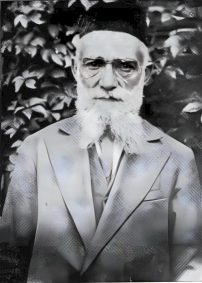
Abraham Reichental |
He was born in 1874 in the shtetl of Lizhensk. In his early years he realized
that in such a small place there is no room for the working person. He went to
America where many of his relatives and acquaintances already lived. He later
became ill and returned home to his parents. He then met Yenta Shachtel, his
future wife. Yenta's parents frowned upon the relationship. It was undignified
that their daughter should marry a butcher, so they sent her away to her sister
in America. Abraham felt the pain of love and followed her. In spite of the
difficulties they faced they wed and brought 8 children into the world.
When WWI broke out Abraham was called up to the Austrian army. Coming back from the war Abraham occupied himself with building a new life. From Sunday till Friday he was occupied with his daily work. However on the Sabbath he shone with spirit. Although he belonged to the middle class he always censured the 'providers' of the town who he believed discriminated against the working people. He always stood at the side of the weak ones.
[Page 427]
His attitudes were developed from his life experiences. His two trips to America taught him in the great school of life, he knew about hard work and had experienced great adventures during the four years of the First World War. In his hours of rest he told tales of his experiences with multi-colored humor.
He nurtured and encouraged his children, who showed great talent for learning. His oldest son, who had a desire to study, he sent to University. The middle class people elected him to the Kahal and City Council. In WWII fate brought him to Lemberg (Lwow). There he survived until Hitler's occupation. From then onwards all traces of him were lost. Like all Jews he perished with his children Leibish, Shloime and daughter Hayele.
by his relatives Harry, Sarah and Benjamin
translated by Zygmunt Frankel
|
|
|
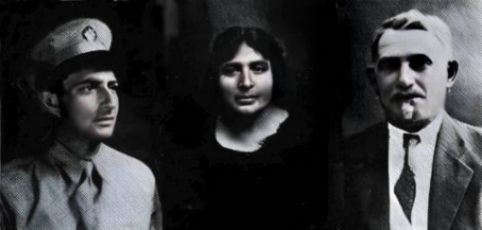
Jacob Reichental, his wife and son |
Jacob Reichental was born in Lizhensk in 1869. He had roots in Lizhensk going back several generations. He was a modest man with an easy and good humor. As a young and energetic man he immigrated twice to America. Then he came back to Lizhensk again and married his wife Tsharne who gave birth to his five sons. He was a man of understanding, moderate in his way of life, read the Yiddish press, which at that time was considered 'enlightened'[1]. The tradesmen and working people elected him as their representative in the Jewish community (Kahal) and as a City Councilor. He worked in those institutions conscientiously. During WWII[2] American Jews sent food and clothing for the poor population and a kitchen for the school children was established. Jacob and Isaiah Reichental took upon themselves the task of ensuring that no injustice was done to the poor children. Shortly after the first war he felt the anti-Semitism in Poland and Jew hatred and immigrated to America and brought his family over. After a short time he bought land in Raanana Israel and sent his oldest son Joseph to work the land until he had the opportunity of settling in Eretz Israel. In the year 1933 Jacob went to Israel where he built himself a small house and grew fruit on his plantation. In 1936 he was ready to go to America to fetch his wife, however he never got to bring her to Israel. That same year he fell sick and died.
Translator's footnotes:
|
JewishGen, Inc. makes no representations regarding the accuracy of
the translation. The reader may wish to refer to the original material
for verification.
JewishGen is not responsible for inaccuracies or omissions in the original work and cannot rewrite or edit the text to correct inaccuracies and/or omissions.
Our mission is to produce a translation of the original work and we cannot verify the accuracy of statements or alter facts cited.
 Leżajsk, Poland
 Yizkor Book Project
 JewishGen Home Page
Copyright © 1999-2026 by JewishGen, Inc.
Updated 29 Jun 2026 by LA