 |
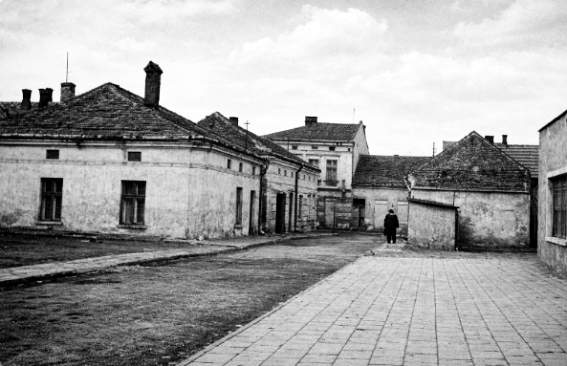
The business center that the Germans set up near the gravesite
|
[Page 209]
by Nathan Feit
Joseph saw the image of his father, saying to him: “the names of your brothers will be engraved on the stones of the ephod, do you wish that your name be missing. (from the Midrash Rabba)
Institutions
When we write about Lizhensk, we must tarry by the gravesite of the Tzadik Rebbe Elimelech of holy blessed memory.
On the 21st of Adar, as well as on other days of the year, thousands of Jews from within Poland and from outside of it would come to supplicate at the gravesite of the Rebbe, to express their sorrows and to request salvation and redemption. The voices of weeping and lamentation would ascend from the gravesite. The grave itself was drenched with the tears of the tribulations of Israel. Jews believed that whomever would come to pray at the gravesite would merit the Garden of Eden, for thus did the Rebbe say during his lifetime.
The Nazis destroyed the gravesite, and the Poles, who were afraid of a renewal of Jewish life in the place, blotted out its foundations and built a gas station on the site. Thus was I told.
|
|
|
The business center that the Germans set up near the gravesite |
[Page 210]
There were approximately 500 Jewish families in Lizhensk. On par with the economic situation of the Jews there, Lizhensk stood out for its level of culture, society, and politics.
We had a large synagogue there, a Beis Midrash, a synagogue named after Rebbe Elimelech, a prayer hall for Agudas Yisrael, the Mizrachi minyan, as well as a modern mikva and a bathhouse and sauna. However the pride of our city was the cultural institutions, which sustained themselves despite great difficulties and tribulations.
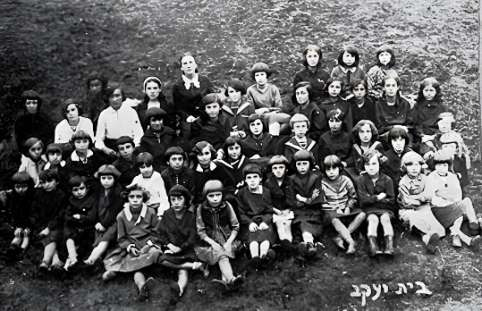
We had a very well developed Talmud Torah, where children received an expert Jewish education. There was also a Beis Yaakov school for girls. The Tachkemoni School was very well developed. It had a religious nationalist outlook, and was under the supervision of the Mizrachi Zionist organization.
|
|
|
The Beis Yaakov school for girls |
The Zionist organization of Lizhensk had a very well stocked library called “Tarbut”.
A very well developed charitable fund functioned in the town. It helped many people in their day to day struggle for subsistence. This fund was under the supervision of Reb Yitzchak Shpatz, one of the important people of Lizhensk. He also served for many years as the head of our community.
The Jewish bank was also very well developed. It did a great deal for the many needy of Lizhensk. It flourished under the directorship of Reb Yosef Gozik and became an important force in the city.
For many years, a fund existed called “Anfartig Gelt” (money to free oneself of bother). People of the city from all walks of life participated in this fund. It was formed in order to control the scourge of beggars going from door to door in the city. Money from this fund was
[Page 211]
distributed in set sums to beggars who came to the city, so that they would not bother the city by begging door to door, and they would not bring disgrace on the Jewish population, which was surrounded by gentiles on all side.
In order to house these visitors, who always came along with the crowds who came to visit the grave of Rebbe Elimelech, a free hostel was established in the city, called “Hachnasat Orchim”. There, they could rest their heads, which were tired from their wanderings. Reb Shmuel Horn was the director of this hostel.
|
|
|
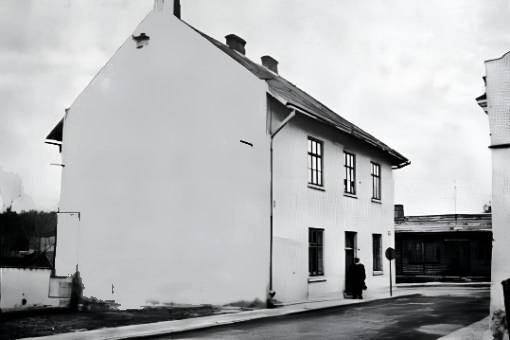
Hachnasat Orchim and the Talmud Torah |
Lizhensk excelled in its well organized charitable and assistance organizations. Lizhensk was also active in political and societal affairs. There were several different groups: Agudas Yisrael, Agudas Yisrael Youth, Mizrachi, and Mizrachi Youth. There was a general Zionist organization, which was the center for the entire spectrum of Zionist activity, including the Zionist Youth, the Revisionist Zionists, along with Gordonia and Poale Zion. There was also a leftist Bund organization in the city.
Rabbis, Scholars, and Activists
Until 1938, the esteemed Rabbi Yechezkel Segal Landau conducted the rabbinic affairs of Lizhensk. He had previously been the Rabbi of Strolisk. He was the son-in-law of the well-known philanthropist of Lemberg Reb Velvele Wachs, and he was one of the most keen of the Belzer Hassidim. From my earliest youth, I used to spend time at his house, and I was able to watch him and understand his ways. He was an extreme fearer of Heaven, an accomplished scholar, and disinterested in personal gain.
[Page 212]
In his authoritative manner, he elicited respect for himself even from among his strongest opponents.
He was well known in Polish rabbinic circles. He served as chairman of the large rabbinical convention of Galicia. He compiled a book about his sermons on Sabbaths and festivals, as well as from other occasions. It is unfortunate that his manuscripts were lost during the time of the holocaust.
My father of blessed memory used to say about him: On Sabbath eves while it was still day, it was possible to discern that he attained a different form. At the time of the greeting of the Sabbath he was ignited with a flaming fervor which he carried with himself throughout the Sabbath. I recall his “Nishmat” prayer, as well as his hymns during the third Sabbath meal, when his numerous family members came to join him. His diligence in Torah made people look upon him with honor and awe. Of course, he also had his opponents, as was the case in any city. However, his righteousness and self sacrifice for anything related to Judaism and the strengthening of the religion inspired even his opponents to hold him in esteem.
Once, on the Sabbath at the time of the reading of the Torah, the rabbi proclaimed a ban on making use of a certain workman in the city, since he would act in a “permissive” manner[1]. The next day, on Sunday, that person came to him and demanded strongly that the rabbi retract that ban. He threatened him with a scandal, and indeed his outcry almost caused a veritable scandal. The situation reached to the point of danger, however the rabbi was not moved.
Rabbi Yechezkel Landau served as the chairman of the “Talmud Torah” until the day of his death. His struggle for its maintenance was very difficult. He spent many sleepless nights, in particular at the approach of the semi-annual time that the money for the payment of the employees was given over to him. Despite all this, he succeeded in attracting the best teachers and employees to this institution.
I was always amazed at the patience of the Rebbetzin. Her house was always open to all that were needy. Without exaggeration, it is possible to say about her that the verse “poor people should be among your household” was fulfilled. Frequently, the house would be filled with poor guests, and there would always be enough to provide for them all.
After the passing of the rabbi, he was survived by his son Rabbi Yoel Moshe Landau, as well as one daughter. His son-in-law Rabbi Menashe Frankel served as the head of the rabbinic court of Lizhensk until the outbreak of the war.
His son Rabbi Yoel Moshe Landau conducted himself according to the adage “love the work but hate the rabbinic position”, and he supported himself through business. He was extremely intelligent, and an accomplished scribe. Most of his free time was dedicated to communal affairs. He was the secretary of Agudas Yisrael and Beis Yaakov, as well as a member of the communal council. Dozens of people, who knew him as a good writer, would turn to him during the course of a day with a request that he write their official requests, in particularly to the income tax department. His home was always open to these people.
He served as a pleasant and good prayer leader in the synagogue and the large Beis Midrash. During the time of the last war, we became convinced as to how great was his trait of love of his fellow Jew, and how much self-sacrifice he devoted into fulfilling this trait. From distant Persia, he searched and found the addresses of all of our exiles that were in Russia, and he sent them packages of food and clothing. Thanks to him, many families were saved from starvation and destruction.
[Page 213]
|
|
|
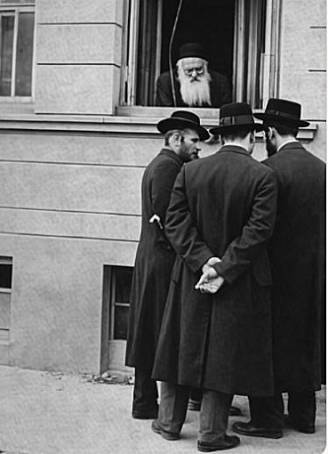
Reb Shmuel of blessed memory peering out the window |
Reb Shmuel Tzitzer
He occupied the seat of rabbinic judge in our city for fifty years. His name was Reb Shmuel Birenbaum, but he was called Tzitzer on account of his birthplace. He always wore a tall hat, his face was adorned with an impressive beard, and he always had a smile for anyone whom he met. All of the people of Lizhensk loved him and honored him. He was always able to calm people down, and he won people over with his hearty laugh. He mediated between disputants in political and factional affairs. He served as a ritual circumciser (mohel), prayer leader, and chairman of the burial society (Chevra Kadisha) for all his years in the city.
Reb Naftali Hollander of blessed memory
This man lived among us until before the war. He graced the city with his pleasant character. He was an accomplished scholar of Torah, and his home was saturated with Torah, business, Hassidism, and leadership all together. During the course of his life, he concluded the study of the Talmud numerous times. He would only leave the doors of his home on rare occasions, and this was only for purposes of a commandment, such as to attend prayers or to attend a ritual feast. His home was a gathering place for the descendents of the Tzans and Sienawa dynasties. He was a member of the communal leadership, the trustee of the charity of Rabbi Meir Baal Haness, and served as well in other such honorable communal positions. He always conducted a public third Sabbath meal in him home. All of this was possible due to his wise and dutiful wife, who herself ran the business of maintaining the concession for the capital city.
In 1909, Mottel Reis, Moshe Karp, Fishel Spergel, and others founded the Tarbut School. This school was founded as an actualization of the desire to educate the next generation.
Until 1914, the year of the outbreak of the First World War, this institution functioned without interruption. The principal Folkes, a man of great spirit, headed it. He educated classes of children who excelled in actualizing Jewish and Hebrew culture, knowledge, and Zionist aspiration.
The years of the war resulted in a break in the communal Zionist activity. The best of the youth were conscripted to the army, and all activity dried up.
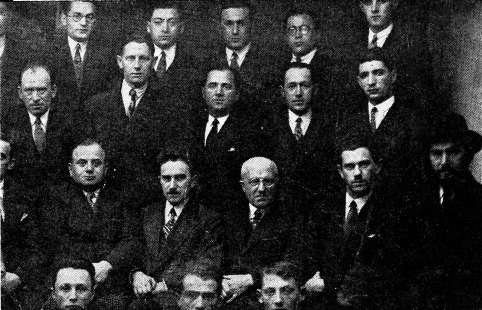 |
In 1916, when it was felt that peace was at hand, and the young men of Lizhensk began to talk about returning home, about ten or twelve youths banded together and decided to revive Zionism in the town. At our head was Chanina Glicksman, and through his efforts, a Hebrew library was organized. We collected scattered books, and also raised money through a public appeal. We created a fund for the purchase of new books and rental of a hall for the library.
Thus, a headquarters for Zionist activity was re-established in Lizhensk. At that time, the lawyer Dr. Arnold Berger lived in our town.
[Page 215]
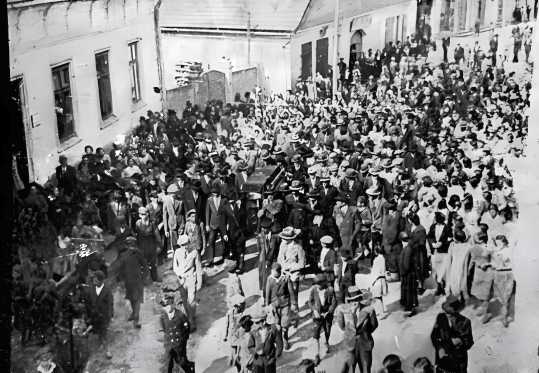
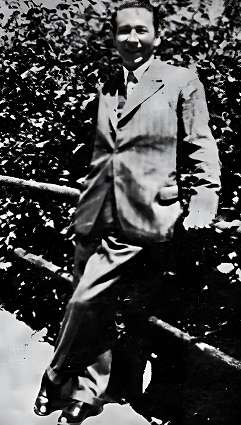
He was assimilated and was estranged from the Jewish community. He was active in the Polish scout movement. Suddenly a change took place with Dr. Berger. Something happened to the man, either due to shame or some other reason. Something sparked his Jewish soul and he joined our ranks. We placed him at the helm of the Zionist organization.
|
|
|
The funeral of Dr. Berger |
As the chairman of the movement, he began to undertake activities, and he dedicated himself to fundraising. Through his efforts, a large monetary fund was set up, the library grew, and its influence spread without bound. It became the center to which everyone turned. The group of readers expanded, and a new spirit swept the town. Even people from the surrounding area came to us in order to obtain books to read. I had the merit of being the director of the library for some years until 1921.
In the meantime, Chanina Glicksman returned and resumed his blessed work. He organized the dramatic club, which would present three plays every two months. These plays gave expression to the feelings of the generation, and won over people to Zionism. Chanina was an experienced staged producer, and everyone recognized his enthusiastic organizational skills.
In the meantime, our soldiers returned from the army, from the fronts, from facing death in the face, and were ready to work for Israel. Due to the difficulties with their relationship with the gentiles 'their brothers in arms', a great interest was awakened in them for Jewish brotherhood. Such feelings in the head of Fishel Spergel injected new blood into our movement. The town lived a Zionist life. The living heartbeat of the Land of Israel was felt in every area of Lizhensk.
[Page 216]
Word of Lizhensk and its activists reached far and wide. The headquarters in Krakow did not want to provide workers for us. Whenever we requested this of them, we would receive the answer: “You do not need any activists and organizers from outside, since you are blessed with your own powers”. Not only did we not receive any help from our headquarters, but in addition the headquarters told all of the towns in the area to request assistance in organizational matters from us.
Thus did Lizhensk turn into a town that was steeped in Zionism, and a regional headquarters for the area.
With the passage of time, we began to concern ourselves with the issue of aliya, and evacuating the exile. The Zionist spirit moved slowly to its practical realization. We were no longer satisfied with Zionist talk and a spirit of longing for the Land of Israel. Emphasis was placed on pioneering activities, preparing from aliya, and practical Zionism.
In 1917, I joined together with Zalka Teicher in a bee keeping enterprise. We did very well in this endeavor, to the point where were always invited to national bee keeping conventions. These conventions were attended almost exclusively by Poles, and we had a good opportunity for spreading information during these conventions.
I remember that from when we wished to engage in agriculture for the purpose of making aliya and guide the masses toward practical Zionism, we turned to Dr. Berger and requested that he give us his 30 dunam garden to be used for bee keeping. Dr. Berger responded to us positively, on the condition that we did not restrict ourselves only to bee keeping, but rather that we turn the garden into a school for horticulture and gardening, and that we teach as well as engage in the actual work. He himself directed the activity, and our preparation work was quite complete.
More than twenty young men organized together and worked together day after day in this endeavor. We turned to the Joint in Krakow requesting that they grant us money for the purchase of bees and hives. To their credit we should point out that the money was given to us generously, and the young men engaged in no other work than the work they did in this garden. The path was not easy, for the parents murmured, the community saw this as a deviation from the accepted path, and the people of the town saw this as a dangerous revolution and a revolt against accepted tradition. However we continued in this manner until 1921, when the community, headed by the late Mr. Shpatz began to change their relationship to us and began to help us to the best of their ability.
With the passage of time, through this means, dozens of young people from Lizhensk trained in agriculture, bee keeping, raising of trees, and actual physical labor. Through this activity, many of them made aliya to the Land of Israel, and engaged in bee keeping and agriculture.
Many returned to Lizhensk during the time of the depression, however many became established in the land. It is possible to state, quite objectively, that if there were pioneers from Lizhensk among the first in the land, it was because of our work, which was one of a kind at that time…
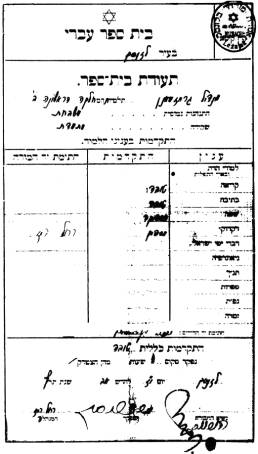
Our institution became very serious in training of beekeepers. We were one of the few bee keeping enterprises in Poland with an experimental glass hive. Every graduate received a certificate of success in bee keeping, signed by us. This certificate was respected both in Poland and the Land of Israel.
From among those who made aliya and remained in this profession in the Land, there are: N. Horowitz (Roitman), the two Grismans (one has since died), Zalka Teicher himself, and others.
[Page 217]
|
|
|
Moshe Grisman of blessed memory (in his army fatigues) taking leave from his charges prior to his aliya |
We conducted expert theoretical courses, with the spirit of aliya, and with the purpose of raising the professional level in the Land. When the Joint sent its inspectors to visit us in Lizhensk in order to see what has become of the money they granted to us, the inspectors were astounded by the courses we offered. We received great praise, including from the central office of the Joint.
I will now permit myself to write down a private detail that is connected to the subject dealt with here.
I was ready to make aliya, and I was requisitioned by the directorate of Mikve Yisrael as a director or bee keeping and an instructor in this profession. When my papers were already in order, my parents approached me with a letter from a relative who had already been in the land for a long time, begging my parents and relatives not to permit me to make aliya to the Land of Israel. It was the year 1921, the year of the murder or Brenner and his group, and the beginning of the Arab nationalist awakening. My parents opposed my aliya, and made me vow not to endanger myself and to bring down their souls in agony, etc. I gave in and did not make aliya, however I left Lizhensk due to my great turmoil. This long period that was filled with spiritual pressure and physical success.
My Zionist activities in Lizhensk obviously came to an end. I was about 400 kilometers away. However, when I returned there in 1928, I found the town filled with activity, which encompassed the best of the people and the youth of the town.
My absence from Lizhensk was not felt. On the contrary, many powers were added to it, and the activities grew even further and were spread out in different and manifold areas. Upon my return, I found my town to be an honorable center of Zionism.
Among the outstanding Zionist activists was Dr. Avraham Dovshitz, a well-known physician in the region. He was respected by his patients, and he also was a person of great public ability.
[Page 218]
He was an outstanding orator, a man of the people who was dedicated with all of his soul, and an exceptional organizer.
Others included the aforementioned lawyer Geller. He was an accomplished and enthusiastic man, given over to the Zionist idea with all of his soul. He added a personal element to the activities, and he brought a cultural European style to our activities. His past as an assimilationist and the return of this European nationalist to his own people bestowed honor upon Zionism and justified its concept.
The gallery of activists includes Moshe Karp, Fishel Spergel, Shlomo Weinstein, Mottel
|
|
|
Dr. Wolf Dorfman of blessed memory |
Fusman, Netanel Karp, my brother Moshe, Dr. Wolf, Dr. Dorfman, Sender and Sin Horn, Shmuel Langazem, and others. Each one of them added his own stamp to Zionism, colored by his own outlook, and helped to expand the national basis.
Moshe Karp was a Renaissance man who was expert in obscure Talmudic discussions as well as the thought of Kant and Spinoza. He was an expert speaker, publicist, and spreader of Torah. He was a window to the culture of the wide world as well as the rabbis. He established a name for himself not only in our town but also in the Zionist population of the entire region.
Fishel Spergel excelled in his oratory abilities. He was able to keep people spellbound for hours on end,
[Page 219]
and to arouse in his audience a passion for any direction that he wished to lead them. The public meetings with Fishel Spergel were always an unforgettable experience in the town. His overflowing personality always awakened the desire for knowledge and intellectual stimulation.
The other extraordinary people who followed after them performed their deeds quietly and with diligence. They added a unique splendor to our movement in the town. Their personal charm insured that even the fiercest opponents of Zionism did not attempt to frustrate us, for these people had no duplicity in them.
When I remember all this, I take pride that our small town Lizhensk was full of spirit and activity. I know why it is so deeply etched in my heart. Its ways were very pleasant in communal and Zionist matters.
by Tzipora Carmi (Steinbok)
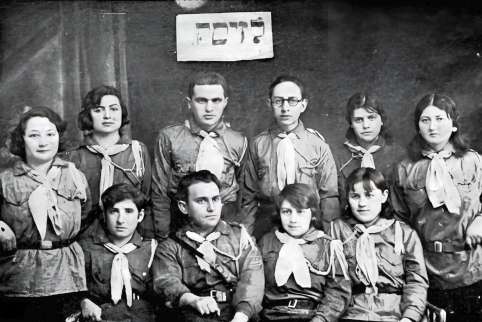
As in other towns of Poland, the influence of the Zionist youth pioneering movement did not pass over our town. This expressed itself primarily in the organization of the youth into various movements as well as independent activity within these movements.
The beginnings were modest. We were a small group of girls, primarily those who were diligent in studying the Hebrew language. There were no Hebrew schools (Tarbut), and therefore we were forced to invite a private teacher who taught us the language. In summer evenings, after the conclusion of our classes, we would gather together and read Zionist works by the light of a kerosene lamp. We would thus quench our thirst for new outlooks. We would absorb with thirst any ideas of redemption, and we would hope to improve our lives, and to forge our own paths in life.
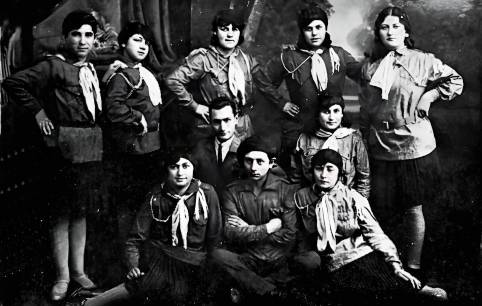
Later on, Yosef Altschuler organized a group of boys and girls who would go on hikes outside of the town to observe nature. We would march in procession, singing songs in rhythm, enjoy the natural environment, and engage scouting activities. These expeditions would take the youth out of their usual environment, and transport them to the world of freedom and creativity.
We did not have a specific ideology, however for some reason, we were separate from the others and saw ourselves as connected to the outlook of Shomer Hatzair.
|
|
|
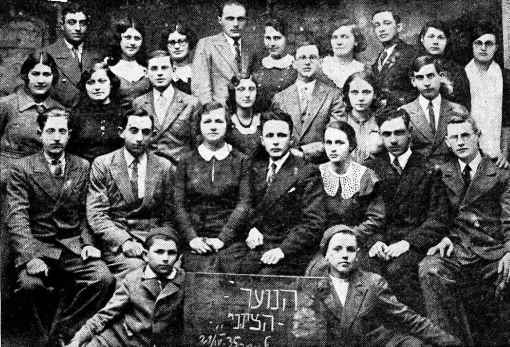
The Zionist Youth of Lizhensk (from the sign included in the photo, it is evident that the photo is from 1935) |
[Page 221]
With the passage of time, other groups began to arise and flourish in town. There was an abundance of different ideas, and there were discussions, and divisions in outlook and viewpoint. There were those that fell under the rubric of Hashomer Hatzair; the “General Zionist Youth” and “Hebrew Youth” movements also arose, which were founded by Yosef Zelinekovski.
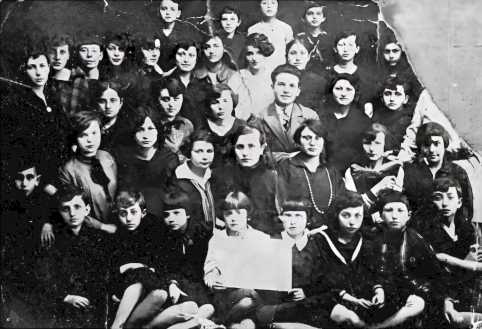
This latter movement struck a chord with us for some reason, and we transferred over to it. However, a portion of the youth were not satisfied with the current scope of movements, so the sister of Mala Steinbok of blessed memory with the help of Lola Blatberg of blessed memory founded a branch of the Gordonia youth movement in the town. This was named after Gordon, who was its spiritual father. Suddenly, we found ourselves in an engaging and interesting social experiment. This movement foretold a new future, in which there would be personal renewal and a change in the life of the nation, without deviating from its tradition. It instilled in the youth an appreciation for the workers movement, which was missing up to that time, and whose absence we sensed in the national realm. I became enthralled with it, and on one bright day, I found myself among its ranks.
We began to establish ourselves as a movement in the town. The competition between the various youth movements was great, with each one vying to attract the youth toward itself. We prepared the youth to greet their future as young pioneers in the Land of Israel. This was done by education on that topic from a young age, as well as in the preparation (hachsharah) farms at an older age. This latter provided the practical training for aliya. We observed the national remembrance days, including the anniversaries of the deaths of Herzl, Bialik, A. D. Gordon, and the death of Yosef Trumpeldor. We engaged ourselves in the difficult task of fundraising for the funds for the Land of Israel. We did not withhold ourselves from practical activity.
Our work was not easy. From the outside, the gentiles disturbed us. The Polish schools forbade the organization of Jewish youth. The “shkotzim” also did their part by throwing stones when we returned from our evening activities. We were forced to set up our headquarters in a discreet alley, in order to keep it far from the eyes of gentile friends and our hostile teachers.
However, we had greater difficulties from within. The traditional Jewish community foiled our steps, and threatened us with something akin to excommunication. Our parents thought of us as rebels and revolutionaries, heretics, and destroyers of the foundations of the traditional Jewish family. In general, they saw in the pioneering idea that naïve youths desired to uproot themselves from their parental homes to venture into the unknown. They mocked us, derided our activities, and saw in our actions dangerous new trends, leading to a personal and communal precipice, Heaven forbid.
I remember a trivial personal event, which was typical of the pervading atmosphere in which we worked. For a small time, our headquarters was next the Hassidic synagogues. On one occasion, when Dr. Yeshayahu Shapiro lectured to us (who incidentally, was quite instrumental in the founding of the movement in our town), I heard a tumult in the hall, and everyone gathered around and surrounded me. Apparently, my father of blessed memory, who was a zealous Belzer Hassid, came into the hall in order to catch us in our misdeeds. I succeeded in jumping and disappearing out of the window, lest he chastise me, and pour his wrath upon me for the embarrassment that I was causing him.
Our activities were also challenging in the midst of the youth. We had to convince the youth
[Page 222]
of our ways, and train them to accept Socialist values. This was not simple. They saw us as being too left wing, foreign to their spirit, and dangerous to their status in the town. However slowly, the idea of the working Land of Israel began to take hold, and a change in attitude took place. Socialism began to become an integral part of their mindset.
I remember one incident in my life that left an impression upon me. I was sent secretly (due to fear of my parents) to a camp for counselors in the mountains for a full month. I was there with a group of leaders of the movements, such as Kanches Labun and others. We clarified the aims of the movement and the means of organization. There were a variety of different youth movements represented among us, including: Akiva, the General Zionist Youth, Mizrachi, Hapoel Hamizrachi, Aguda, Beitar – which conducted military education, Gordonia – which was under the influence of the united group,
|
|
|
Gordonia in Lizhensk |
and even a small group of communists. We had the helpful assistance of various adults, such as Dr. Dorfman of blessed memory, Dr. Geld of blessed memory, and Dr. Dovshitz, may he live long, who now works as a physician in Israel.
The value of the youth movements was very great. They brought effervescence to the Jewish street. For the first time, youth from the well-established families met with youth from the simple folk. They were all banded together with the aim of preparation for aliya to the land. Many began to speak Hebrew while they were still in the Diaspora. We became close to nature, to communal life, and agriculture. Finally, when any of the youth would make aliya to the Land, they would be able to set down roots, and become absorbed into their villages, kibbutzim or towns.
Who knows, if the holocaust would not have taken place, perhaps the majority of the Jews of Lizhensk would have made aliya.
[Page 223]
Most of the youth were content to make aliya, the parents would have been pressured to be close to their children, and the great tragedy of the Jews of our town could have been averted.
To our sorrow, not everyone had sufficient insight to shake off the chains of tradition, which were rooted in the past, and to join the camp of those who were actualizing Zionism. The revolution of the mind of our brothers and sisters and all of our dear ones was too slow, and the destruction took place. It is most unfortunate.
|
|
|
The Hebrew Youth: Y. Rothman is standing on the left |
by Dov Ausubel
When I see children going to school in freedom and not in fear here in Israel, I cannot help but remember what the situation was like when I was their age, when I was studying in cheder and school.
I will start my story with what we call here kindergarten. In Lizhensk they call it “with the Rebbe in cheder”. There were a few such cheders in town and the Rebbes / pedagogues all, on account of their profession, had to make use of three verses from the book of Genesis which include the word “anochi” (I). At the beginning of the year, they would say – “Bring me children, for if not I will die”.[1] In the middle of the year, when the father would come to complain that his child had not learned anything and does not known anything, the Rebbe would say the second verse with “anochi”: “Am I in G-d's stead”. At the end of the year, when he did not have any bread after a year of difficult work because not everyone had paid their tuition fees to him, the Rebbe would say “If that is the case, why do I exist?”.[2]
The first of the Rebbes was Reb Yosef the teacher of blessed memory. He was tall and thin with a white beard. He taught in his home, which was on the street of the synagogue. We children would sit and mill about the room or outside, and every so often the Rebbe would call a different child to come to him, to lean over the large book. With the assistance of a sharpened toothbrush handle, he would show us the letters and vowels. Thus, every fifteen minutes, a different child would come to learn, until he had covered the entire class.
This started at age three. At age four and a half, we already started studying Chumash (the Pentateuch).
The commencement of the study of Chumash was festive, accompanied by an eternal
play of a classroom scene between the Rebbe and student. Every time, before we
started to study Chumash, a dialogue would take place between the Rebbe and the
student, where the Rebbe asks and the student answers. This is the eternal text
of the dialogue:
The Rebbe asks: “What are you studying, oh child?”
The student responds: “I am no longer a child. I am already a lad.”
The Rebbe: “What are you studying, oh lad?”
The Student: “Chumash”.
The Rebbe: “What does Chumash mean?”[3]
Student: “Five”.
Rebbe: “What is the significance of five?”
Student: “There are five books of the holy Torah.”
Rebbe: “What are the books called?”
Student: “Bereshit (Genesis) is the first, Shmot (Exodus) is the second”, etc.
Rebbe: “Which book are you studying, oh lad?”
Student: “I am studying the third book.”
[Page 225]
Rebbe: “What is the third book called?”
Student: “Vayikra (Leviticus)”.
Rebbe: “What does 'Vayikra' mean”?
Student: “And He called”.
Rebbe: “Who called?”
Student: “G-d called to Moses our teacher and said told him about the sacrifices. And just as a sacrifice in holy, so am I, a young lad, also holy. Therefore my Rebbe began teaching me the Chumash of Vayikra.”
Thus did we continue to study, with every word translated by us into Yiddish.
Aside from teaching, Reb Yosef the teacher of blessed memory occupied himself with charitable matters. All of the poor people knew his address, and since he taught all day long until nightfall, he had to deal with these matters during the study time. With one hand he would be showing a student from where to read, and in the meantime, he would be conversing with a poor person. Once in a while he would turn to the student and say “go ahead and read”, etc.
We never had a long or short vacation. There was only a vacation during Passover and Sukkot, and these period were referred to as “between the terms”.
There was another Rebbe known as Shayale (short for Yeshayahu) of blessed memory. He was short with a diabolical beard. He taught in the Beis Midrash, in a small room near the entrance. He taught in the same style of Reb Yosef the teacher of blessed memory, with the dialogue, and an arrow that pointed out the place in the book. What was unique about Reb Shayale the teacher was that, once in a while, he would doze off during his lessons. When the student stopped reading and noticed that the Rebbe was asleep, Reb Shayale would awaken and prod the student to continue reading, for he “was listening to everything”. Then he would doze off again.
Thus, we had to continue to read in front of the dozing Rebbe. When he awoke, he would stretch out one hand to a mischievous child who was not learning. He would grab him with his hand, snap his fingers and say, “so you should remember for next time”. With his second hand, he would show the student the right place.
Another Rebbe was Reb Yisrael Isser of blessed memory, who taught in the Talmud Torah. This was a brick building, with unplastered walls. At the entrance to the town, one could see from the distance a red, two-story building rising from the ground. The lower floor housed the communal offices and the residence of the custodian, who also served as the Sabbath gentile for the town. They would call him to put out the lights of the synagogue on Sabbath evenings after the prayers. The “Hachnasat Orchim” (guesthouse) was also on that floor, and the upper floor housed the Talmud Torah. On the side of the building, there was a big sign in Hebrew letters: “Talmud Torah”, and on the bottom left corner of the sign there was the signature of the sign painter, David Miller may his blood be avenged.
There, Reb Yisrael Isser taught children. In addition, he also sold sweets to his students for coins that the children brought from their parents. In this Talmud Torah, there were other teachers such as Reb Moshe Asher of blessed memory, who taught older students,
[Page 226]
and Reb Chaim Broner of blessed memory, who taught Gemara to the oldest students. From among these, I must also mention Reb Moshe Chaim of blessed memory, who never taught me, however I remember him due to his additional role as the Torah reader in the synagogue. He was short and had a white beard. During the time of the reading of the Torah, he would stand on a stool in order to be able to reach the height of the Torah reading podium.
All of the teachers taught Torah with the same special melodies for various parts, such as Rashi's explanation on the verse “And I as I was coming from Padan Aram”[4] in the portion of Vayechi, and the verse in the portion of Emor: “Speak to and say to the children of Aharon”. I wonder to this day how these melodies spread out and reached everyone.
Prior to Passover, we would study the Song of Songs with its special tune, incorporating Yiddish words. Here as well, both the tune and the added Yiddish text were “universal”, and known to all of the teachers. This is also a wonder.
We also had a Hebrew school, where the language of instruction was Hebrew. This was in the home of Avramchele Rokach on the street of the Synagogue, and later on Reisha Street in the home of Yankele Gelroba. There we studied Hebrew for two hours a day, from 2:00 to 4:00 PM. The teachers were Posner, Bromberg, Weinstein, and Aldholtz. From 4:00 to 7:00 we studied sacred subjects with the teacher Betzalel Stulbach of blessed memory. Thus from the age of 6, when we began to study in school, we attended classes from 8:00 AM to 7:00 PM.
In the winter, at 7:00 PM, it was already dark, and we young children had to go home in the darkness that was frightening to our young souls. On some winter nights the Christian “Kolednici” (carolers) would go out on into the streets of the town with their torches in order to remind the Jews of the birth of Jesus their messiah. One of the missions that they took upon themselves was to threaten the Jews who they ran into on the streets. In order to avoid this danger, the Rebbe would dismiss earlier those students who lived far away. This was the only time that we got home early.
We lived on miracles. If a day passed where I did not receive beatings or curses from the shkotzim at schools, I received them from the gentile teacher. If by chance I did not receive a beating from her, then the Rebbe would beat me in the afternoon. If I did not even receive a beating from him, then I could say Hallel (Psalms of praise) the next day, for an entire day passed without beatings. Praise G-d for miracles.
If the teachers Szewowa or Rubianska were able to shout in anger during the class at a Jewish child, for the Jews were a punishment sent to them by heaven, then what could the shkotzim say to this, for in this area they were very diligent students.
When I merited in my own life to see in Israel Jewish children going to school with a schoolbag on their shoulders and with joy in their hearts, without fear of gentiles, of an anti-Semitic teachers, or of roving Kolednici, and without hearing curses from the educators, I now see another reason for the existence of our state, and my heart is filled with gratitude over the great achievement. It is unfortunate that we were forced to pay a very dear price for this, the price of the terrible holocaust.
[Page 227]
Translator's footnotes:
by Eliezer Chaviv (Lieblich Bas)
My childhood was ordinary, not extra special. It is possible to skip over it. I was a child like any other Jewish child. However, when I got a little older and was sent to the Rabbi to study Gemara and conclude my studies, a change took place with me that seemed unique.
I began to glance toward secular literature, and I privately wished to become acquainted with the books of Mapu. I kept this to myself, and perhaps there were other children who harbored that desire as well. However we all kept it secret, and we did not let each other know. The suspicion was very great. This was the smell of something banned.
In 1915, I was drafted into the Kaiser's army. I was distraught over the loss of years in the service of the army, however that was where I found my freedom. I devoured books during my free time. There I cut off my peyos and shaved my small beard. There I also began to study German and Polish.
My mother, who was a widow, wished to make me into a rabbi, and she was unable to do so. I leaned toward a profession, and I studied accounting. It was impossible for me to go to the professional school in Sambor. I was forced to study in a circuitous manner. In this manner, I trained to work in that profession. In the army, and in Budapest where I was stationed, all officials with a professional bent, and not only those of low rank, related to me.
By 1918, I was sick of the army. I deserted and returned to Lizhensk. I lived in hiding in the town. I wished to make aliya but it was not possible. I gave in to my mother and became engaged and then married. By chance – and with good fortune until this day – my wife shared my desires, and her father also wished that we should make aliya. It was told to me secretly that when the discussions were taking place regarding the match, my father-in-law was interested in two things regarding the future: If I presented myself as a man, and if I had the will to free myself from life in the town and to make aliya. He wished to see his daughter build her home in Israel.
In 1921, I left my wife behind and made aliya.
Many tried to talk me out of making aliya: The group of associates in Lizhensk who were deeply involved in the affairs of the town, without being able to see any other way, were influential upon me. I, who wished all my life to see changes in the outlook of this group, broadened my horizons by reading, study, and army service, and this was helpful to me. It did not enter my mind that I should remain there and continue in communal and holy matters along with the rest of my group. The economic situation in Poland and Lizhensk was such that there was no guarantee of the future, and even the present was not secure. However, it was a personal matter that pushed me toward aliya. I could not accept the fact that Zionism should be persecuted by the various groups in the town, and by those who set the communal path. This provincialism of the various communal leaders and their followers pained me. I was a Zionist.
I decided upon it, and I made aliya.
I lived for a year and a half in the Land of Israel without my wife. After that time, I brought her over.
At first, my life in the Land was full of suffering, hunger, and spiritual anguish due to lack of work and means.
[Page 229]
However, this was the general situation with the pioneers, and I saw nothing special about this regarding myself.
At this time when I look back upon my life, it seems to me that this original pioneering journey that I undertook from Lizhensk to Israel, alone, without the support of a group, imparted strength and content to my life. Thanks to this strength, I succeeded in the Land, and my heart is pained that I was one of the few who came.
The multitudes did not follow after me. We merited a life of value, a life of independence with all that that entails. We suffered with blood and tears, but we also had freedom, hope, and the pleasure of grandchildren and great-grandchildren.
One of my sons was sacrificed on the national altar during the time of the British Mandate, and my heart is pained over the murder of my dear son. However our hearts are also pained over the loss of our dear ones over there, who died without tasting the taste of pioneering and sacrifice prior to their murder.
[Page 230]
|
JewishGen, Inc. makes no representations regarding the accuracy of
the translation. The reader may wish to refer to the original material
for verification.
JewishGen is not responsible for inaccuracies or omissions in the original work and cannot rewrite or edit the text to correct inaccuracies and/or omissions.
Our mission is to produce a translation of the original work and we cannot verify the accuracy of statements or alter facts cited.
 Leżajsk, Poland
 Yizkor Book Project
 JewishGen Home Page
Copyright © 1999-2026 by JewishGen, Inc.
Updated 21 Apr 2026 by LA