 |
|
|
[Page 39]
Translated by Monica Devens
Jewish education in Bessarabia, which reached noteworthy levels after the First World War, became integrated into Jewish education generally in Russia. In Russia itself, and also in Bessarabia, the condition of Jewish education at the beginning of the century was quite poor. In the towns within the Pale of Settlement, the typical “cheder” reigned supreme. After the “cheder,” two paths opened up for the graduate: the Beit-Midrash [=house of learning] and the Yeshiva to continue in Judaic studies or the practical world - work and commerce, generally.
In 1918, Bessarabia came under Romanian rule, which was interested in ripping out by its roots the influence of Russian culture and language and, on the contrary, did not oppose the teaching of Yiddish and Hebrew.
Due to the lack of buildings for schools, Jewish educational institutions were forced to make due with rented or public buildings.
An additional severe problem was the problem of teachers for the “Tarbut” schools and also textbooks.
Lacking a budget from the government, schools existed through tuition paid by the parents of the students and meager support from the Jewish community.
Despite all this, Jewish education was successful in progressing, from kindergarten to high school, and the Zionist youth movements continued this blessed tradition. The thirst for Hebrew books was satisfied by the numerous libraries that were established in every place.
In this context, one can say that “the deeds of the sons are a sign for the fathers” because the adult generation began to refresh its knowledge and to need Hebrew and, because of this, to a deep national movement in all areas of life, which ultimately led to coming to Zionism.
Under the influence of the spirit of the times, a turning point began in conservative education. The spirit of progress and tolerance slowly pierced the consciousness of the people of the Pale of Settlement, too.
With the fall of the ghetto walls, it became known that the Jew was capable of reaching the level customary in Europe in the areas of science and knowledge.
In Khotyn, there was a respected man, gifted with personal magnetism, Chane Reiss, who succeeded in his struggle for knowledge, for the ideas of progress.
Without getting into an ideological argument with those opposed to modern education, he established educational and cultural institutions in order to give an impetus to the young generation: we are speaking of the school, of “Kruzhok” [=circle in Russian] and of the “Talmud Torah.”
Those in charge of traditional education were in crisis, worried that education would push Jewish consciousness aside and lead to assimilation.
Chane Reiss rejected these fears because he, too, was anchored in the soil of Judaism faithful to its roots. He tried to come to a pleasing mixture of original Judaism and the new reality. He tried to prove that one must establish knowledge and Torah together and that one does not harm the other despite their existing differences.
Through his travels in many countries, his sharp eye grasped values that occurred in the world and that led to the crumbling of systems, also in Judaism.
Chane Reiss dedicated his efforts for the benefit of the youth and was concerned that the children of the poor, too, would enjoy the fruits of knowledge. He brought outstanding teachers, established a choir at the “Kruzhok” school, organized an orchestra to teach the youth music.
He was concerned about physical exercise, too, and ordered exercise equipment. He instituted a uniform among the athletes to erase the differences between rich and poor.
Libraries were established at the schools, a desirable meeting point for both youth and adults.
[Page 40]
One must note with satisfaction that the fears of the skeptics were proven false: there was no disengagement from original Judaism, both traditional and national.
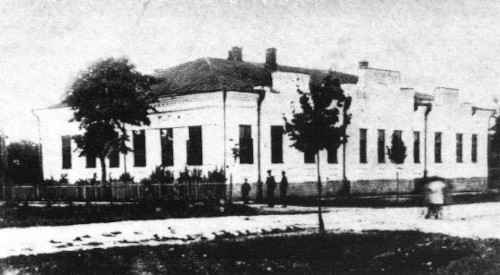
The “Tarbut” School in Khotyn included the synagogue of the Zionists, the school, a library, and a hall for lectures and meetings. The building belonged to the Tutelman brothers who received an annual rent. In 1935/36, the brothers decided to sell the building and the Zionists intended to buy it, even though it was beyond their financial means. An additional reason for hesitation: there were rumors during those years that Serbia would be annexed to the Soviet Union and the question arose whether it was worth making the effort necessary to acquire the building.
There were those who were of the opinion that, even if the Russians came, it would be possible to turn the cultural house into a community center for the needs of the residents of the city.
In 1940, the Russians indeed came and turned the “Tarbut” school into military headquarters. They put up a fence around the building and the previous owners feared even to tread on the sidewalk that was around the building. The Russians fulfilled the Biblical verse: “You will build a house, but you will not dwell in it …” [Deut. 28:30].
The “Tarbut” school was established by the Zionists in 1918-19 in the old building of Yehoshua Weinstock. The first teachers were: Zalman Malamud, Weinstock, Leib-David Stolyar, Lam, Nissim Krivoy, and later Chava Zeidler joined them.
In the beginning, this was an “improved” Cheder. In 1922/23, the school moved to the center of the city and, in that year, earned the official recognition of the Romanian authorities, whose license required annual renewal. The school was under the supervision of the “Tarbut” center in Kishinev [=Chişinǎu] and the students were required to take exams in front of a special panel that was appointed by the Romanian Ministry of Education.
The “Tarbut” school was almost the only one that collected tuition from the students. Additional income came from supporters of the school, from events, and a little bit from the community.
The members of the “Sustaining Committee” were: Yosef Appelboim, chair, Mordechai Axelrod, A. Barak, Berl Weissolder, Elazar Zaltzman, Mordechai Telfus, Yitzhak-Meir Tissenboim, and Hersh Feferman.
Hebrew was the language of the school.
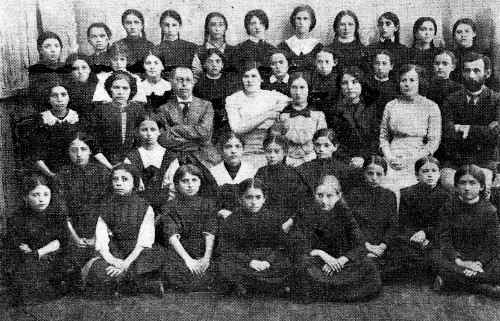
Chava Zeidler, as one certified in education, was the official principal as far as the authorities were concerned and was responsible for the general fields, but Zalman Malamud was the actual principal and responsible for the Hebrew fields.
“Tarbut” schools were established in most of the surrounding cities and their center was in Kishinev [=Chişinǎu], with Lawyer Shmuel Rozenhaupt at its head. From time to time, representatives who were interested in the Hebrew fields at the school came on behalf of the center. The center also took care of obtaining the annual licenses from the Bucharest authorities.
Zalman Malamud
Zalman Malamud was, without a doubt, one of the outstanding figures in the field of education and culture in Khotyn. He organized early morning and afternoon courses in Hebrew for the students of the government school.
He worked a lot at the “Tarbut” school and imposed Modern Hebrew there. His approach to his students was pedagogical, through individual attention to each one of them. Even during the years when he did not serve as the “Tarbut” school principal, most of the population of the city saw him as its intellectual leader, second to none at the school.
He knew how to find a comfortable mixture of religious studies with secular studies and to remove the fabricated partitions between them. He was an observant Jew, one of those who attended synagogue, read Torah, passing during the High Holidays
|
|
[Page 41]
|
|
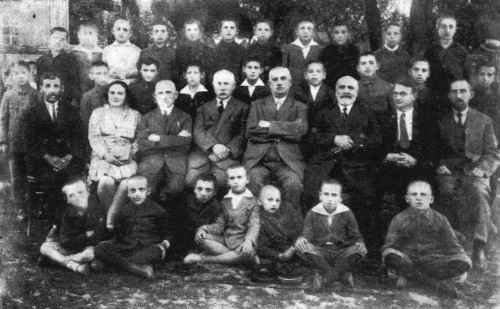
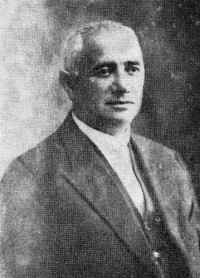
Sitting (from right to left): Kuperman, Nachman, Schreier, Wasserman, Landviger, …, …, Mikelman |
in front of the ark. He worked on behalf of the Keren Kayemet [=Jewish National Fund] and was the secretary of the “Mizrachi” party.
He had a strong yearning for the Land of Israel, but did not have the privilege of getting there. He passed away in 1941 at the concentration camp in Sikerin [=Syrets], alone and abandoned; no one accompanied him on his final journey.
The people of Khotyn lift up the memory of this dear man with admiration.
Chaim Wasserman
Chaim Ben-Yaakov Wasserman was born in Khotyn in 1877 and was known as a teacher and principal of the Kruzhok school. He made his living principally through giving private lessons. Chaim Wasserman established a primary school in Khotyn and later a seminar for teachers.
He taught for more than 40 years until the Nazis and their helpers executed him during the mass slaughter that occurred in Khotyn on July 9, 1941 when he was only 64 years old.
Shalom Schreier
Shalom Schreier was known to all the inhabitants of Khotyn as a teacher in the “Kruzhok” Talmud Torah, which had been established by Chane Reiss. Due to his musical talent, he was active in the school orchestra and beloved by his friends. His wife, Esther, too, distinguished herself as a teacher at the school for girls. She used to write songs for holidays, to the delight of her students.
Shalom Schreier was one of the founders and leaders of the self-defense league. He was beloved by the hundreds of his students at the Talmud Torah, where he taught language, music, physical education. He worked extensively in the field of culture and education, with the orchestra, with self-defense, with firefighting; he was the gabbai [=synagogue functionary] of the Beit Midrash [=house of learning] for many years (in the courtyard of the large synagogue). There is no doubt that his personal example left its mark on his students.
The melamdim were not people particularly certified in teaching and also did not see this as a profession. Teaching was mostly a kind of refuge for people whose sources of livelihood were cut off and who could no longer be tied to their parents, before or after marriage. Having no choice, they established for themselves a “cheder” in order to support themselves and their families. Unique individuals from among the melamdim succeeded in penetrating the delicate soul of the child and fulfilling their desired purpose.
The main point of the studies was limited to the foundations of Judaism and to instilling what was called in our day, “Jewish consciousness.” The lack of training of the teachers left its mark on those who acquired Torah from them.
Below we will remember the melamdim who disseminated Torah to the children of Khotyn:
R' Shlomo-Zemach Hillel'ke was the melamed of 40 young children who studied in a spacious room in which there were several desks. The “Cheder” was in the apartment of the melamed, where it was difficult to differentiate between the “Cheder” and the kitchen, the workplace of the melamed's wife, Elka.
Shmulke Aharon Mohel'es, counted among the enthusiastic Hasids of Chortkov [=Chortkiv]. He was known in Khotyn as a great scholar of both the revealed and the hidden. He served as a trustee in the work with the trees in the forest of the Reiss family, but because he was a child therapist, he preferred teaching, which was a more lucrative profession.
[Page 42]
Yaakov Yosef Ha-Melamed, of the Husyatyn Hasids, was tall and attractive to people. He took care to accept students with a similar level of learning and, in this way, structured the various classes. He also used to organize competitions between different groups of students. The author, Yaakov Fichman, was also among R' Yaakov Yosef's students.
R' Yisrael Lerner, known by the nickname Yisrael'ke Ha-Rav, was the son-in-law of Ha-Rav R' Chaim Roizman. He came to Khotyn from Podolia and was considered the best among the melamdim. He prepared his students for rabbinic ordination. His learning was also expressed through the books that he wrote.
Avraham Ben Shmuel Leib Schreier, together with Neta Michnik, established a miniature yeshiva for the teaching of Talmud. He bestowed his spirit on his students, among whom were the sons of the ADMOR [=Our Master, Our Teacher, and Our Rabbi] Tversky. Some of his students were accepted by the Chachamei Lublin yeshiva in Poland.
On his way to Transnistria, the outlaws pushed him out of the cart, which continued on its way. He ran back to the cart in order to get his pack with his tallit and two pairs of tefillin, but while running, he was shot and killed by the Germans and was never properly buried.
R' Nisse'leh Posek prepared his students for rabbinic ordination. He had few students. He took great care about his students' behavior in daily life.
R' Nisse'leh Posek had the honor of educating three generations of students.
The various teachers were among those who were the architects of the modern education and new society of the city of Khotyn. Each one had his approach to education, given a lack of an accepted instructional approach, but all of them together saw in their profession not only “an ax with which to dig” [=a tool for personal gain], but rather a goal in life, to improve it for the benefit of the entire society. Among them were those who applied themselves to writing, in poetry or in prose, being involved in all aspects of the life of the city.
Fradkin came to us from Lithuania and was an activist in “Ha-Mizrachi.” He wrote a lot of poems. His household language was Hebrew or perfect Russian. He hebraized his name in Israel.
Chaim Hersh Vaynshteyn (known by the nickname, Der Staver Melamed) [Yiddish?] taught using the new Hebrew in Hebrew method and managed to acquire daily use of the language for his students within a year. On Shabbat, the students used to gather at his house for conversation and to exchange books. At this opportunity, each student would give a brief summary of the contents of the book that he had read, for the mutual benefit of the students, that their knowledge would be enriched. In 1909-1910, Vaynshteyn was forced to flee the city because of the police.
Among the teaching staff were counted: Shabtai Lerner, Russian and Hebrew teacher; Tsila Lerner, the principal of a special school for the children of the refugees who were expelled from their villages in 1914 due to the outbreak of the war; Chaim Wasserman; Sonia Berg; Itta Geller, the daughter of R' Itzik Shochet; Nakman, a native of Lipkan [=Lipcani], Communist, member of the former “Bund,” teacher of general studies; Itti Geller, the daughter of Zalman Shochet (the brother of Itzik Shochet), math teacher; Moshe Shtern; Aharon Weissberg, who, due to the efforts of Michael Landoy, moved to Yasi [=Iaşi] in 1919 and was, for a long time, in the leadership of the “Maccabi” federation in Romania; immigrated to Israel in 1944 and died there in the 1960s; Moshe Shtern settled in Brǎila; Lipiner, known by the nickname Gedalia Schreiber, because he wrote requests to the authorities; he was authorized to open a library at the school after the school of Z. Malamud ceased to exist and the library there was transferred to Lipiner; Yoel Prokuror, Yiddish teacher; Azriel Yanover, Yiddish teacher in the “Bizhensky Schule,” a school for refugees. He also wrote poetry.
There were two government secondary schools in the city, gymnasiums, one for boys under the leadership of a blatant anti-Semite and one for girls, which required attendance on Shabbat. Although the Jews made up a third of the population, there was only one Jewish teacher in these schools.
R' Yechiel Kretchmer
Naturally the past is wrapped up in our memories in a light that softens the shadows of ugliness with its beauty.
But there are images that, even then, when our city of Khotyn stood, were bathed in an atmosphere of splendor and glory.
Among those images arises in my memory my teacher and rabbi, R' Yechiel Kretchmer, head and shoulders above the others, a righteous Jew.
The boy, Yechiel, had a difficult childhood, being among the poor. He got to where his got through his own efforts, through diligence and commitment. His vision diminished over time, but he still continued to study because he had a blessed power of memory. He was also engaged in managing the municipality's finances.
He succeeded in endearing Hasidism to us, the youth, which, in its artistic-literary reflection touches, and does not touch, on everyday mundane life, through imitation and routine.
He had the privilege of returning youth who had embraced foreign ideas to the bosom of original Judaism and there is no doubt that, even those among them who had gone over the threshold and pastured in fields that were not theirs, remembered, in times of their distress and disappointment, the words of R' Yechiel about the intellectual property of the Jewish people and found in this peace for their souls.
Yoel Prokuror
Yoel Shnayderzohn, who was known in Khotyn by the nickname “Yoel Prokuror” (Yoel the prosecutor), was a teacher of private lessons only. Only in the last years in Czernowitz [=Chernivtsi] did he earn the privilege of becoming a teacher in a school. The comedians of the generation said about teachers like him: his elders wanted to obtain Torah for him with a melamed, but due to the hardship, he himself became a melamed …
Yoel Melamed barely earned a living, though he and his wife
[Page 43]
treated others with generosity. In particular, they showed affection for the youth. Young people hung out days and nights at Yoel Melamed's house. Even non-Jewish young people would come to his house and sing Yiddish songs along with our young. Among them was also a young man named Lawyer Shilin, who later became the Khotyn district officer.
Due to these youth gatherings, the eye of the government was watchful concerning Yoel's house and the police came frequently to search his apartment.
The youth didn't only engage in conversation and song, they also ate and drank whatever came to hand, all, of course, on Yoel Melamed's account. And when there was a need to bail Hersh-Ber Ayzenberg out of jail, Yoel Prokuror pawned his fur coast in order to free the young man.
During the 1930s, Yoel settled in Czernowitz and there good luck shone upon him. Not only did he earn an honorable living as a real school teacher, they even called him “Professor.”
But in truth, Czernowitz remained foreign to him; he felt himself forlorn and wretched and the title, “Professor,” did not warm his soul. When yearnings for real warmth came upon him, he would come to Khotyn to spend time with people who shared similar ideas.
Yisrael Goichberg - Teacher and Poet
Yisrael Goichberg, the teacher and poet, died at the age of 76. Many of his students who admired him came to his funeral, which took place on the second day of Shavuot.
Yisrael Goichberg was a rare teacher who transformed the school into a palace, even though a basement was allocated to him as the place of teaching. As the case may be, he almost always taught in poor areas. He taught in Williamsburg and Brownsville for many years. Though anyone who came into his class from the the teeming street felt as though he was in a holy place.
Yisrael Goichberg was endowed with many talents, not just in teaching and poetry, but in music, drawing, and directing.
There are teachers who don't enjoy their profession - something that is frequent in other professions also - and that has a negative influence on the students, too. Most of the teachers are average and adapt to their work.
Goichberg saw in teaching a national mission, holy work. In teaching and in his behavior in general, he acted with complete naturalness, without unnecessary manners.
He was a master teacher who influenced young students and adults alike. His influence on his students was immense because they felt his simplicity and his decency.
His approach to teaching was famous among the teaching circles. The students got used to speaking and reading Yiddish. He would sit for hours and hours to choose reading material for the students, following their special inclinations. When he arranged a celebration at the school, he took care that it would involve pictures, written material, drawings, and the celebratory atmosphere that he succeeded in creating.
Many distinguished persons recount their memories of the influence of their teachers, not just in education, but also in their world view. Goichberg is counted among this type of teacher.
Y. Goichberg was a poet with a very developed musical sensibility, having come from a family of cantors. He wrote didactic poems, a type typical of teacher-poets. He knew what he wanted to say and expressed his thoughts clearly, without hints, without symbols, and there was no need to look for a key to his poems. He also wrote poems for children and youth.
Yisrael Goichberg left behind the richest intellectual legacy: “Gesangen fun unser Dor” [=“Songs of our Generation”] - songs about the American city of Boston, where Goichberg settled when he came to America in 1913. His teaching activity began there, too. Children's songs “Gut Morgen,” “Kamtza un Bar Kamtza” - a story in rhyme. “Verticals” - poems, “Nemirov” chronicle in rhyme. Goichberg's two last books were published in 1963 by the Y. L. Peretz Press in Tel Aviv: “Mit Leb un Leben” and “Mit a Shmeichel.”
Yisrael Goichberg had a Jewish and general elementary education. He studied at an “improved cheder” in Khotyn and completed his secondary schooling in Kamenets-Podolsk [=Kamyanets Podilskyy]. Between 1917 and 1921, he studied in Iowa and was a technology engineer.
Despite the fact that in his last book, “Mit Leb un Leben,” there are many songs of a family nature, they influence every reader through their poetic-human content and their measure of restraint in joy and pain at one and the same time.
Some of his poems have become folk songs and their composer has almost been forgotten. Yisrael Goichberg told me that, during a visit to Israel, he was invited to a school during the music lesson. The students sang Goichberg's song, “Three Infants,” in Hebrew and the teachers asked him if he knew who the composer of this charming song was. They were surprised to learn that he himself was the composer.
Many composers set Goichberg's poems to music.
Many children's poems were written by Goichberg under the influence of his two children, who were the source of his inspiration. In the simplest words, he succeeded in introducing a child to lofty feelings.
There is almost no textbook that does not contain Goichberg's children's poems.
In 1948, the teacher's committee produced a book of children's songs (“Die Goldene Fave” [=The Golden Peacock”]), edited by Goichberg, with illustrations and musical notes. It contains dozens of poems written by Jewish poets for children.
At the start of the book, Goichberg's wonderful song in praise of the pioneers of the Land of Israel appears, a poem that is recited at celebrations in the schools and that has been included in modern Passover Haggadahs.
Goichberg was connected to the popular Shalom Aleichem Institute for more than 45 years, where he was the chair of the pedagogical committee, editing teaching programs, and participating in editing children's brochures, in short - an excellent teacher.
[Page 44]
Leib David, son of R' Nachman Stolyar
They called him Leibele Stolyar with affection, and not just his family, but relatives, acquaintances and friends, because he was beloved and respected for all his lofty qualities. He was educated, with a sensitive soul and a warm heart.
He was born in Zhvanets, the region of Podolia, a town whose community leaders were dedicated to the idea of the revival of our people in Zion and the revival of our language. The young generation was educated in this spirit, Leibele Stolyar among them.
He studied at the Jewish school, which was founded by the enthusiastic Zionist and famous teacher, R' Shalom Altman, of blessed memory. After he graduated from school with distinction, he was sent by his father, R' Nachman, a God-fearing Jew, to a yeshiva in Kamenets-Podolsk [=Kamyanets Podilskyy]. There he imbibed the sources and absorbed Torah and knowledge from the acclaimed heads of the yeshiva. He also attended a program on Modern Hebrew and studied its grammar and its literature.
In 1914, the family settled in Khotyn and Leib Stolyar served as a teacher at the “Tarbut” school, where he was beloved as a teacher and educator by parents and students alike. After he married Nesia Shuster, he moved to the city of Donduzhen [?] and worked there in teaching, too, with success.
In 1937, the couple emigrated to Colombia and even though he didn't teach there, having to do hard work in order to earn a living, he dedicated time, not in order to be rewarded, to groups of adults, teaching them Hebrew, a language of which he was very fond.
He later immigrated to Israel, however he didn't have the privilege of enjoying life because a serious illness struck him and, on May 26, 1965, caused his death after much suffering.
It is appropriate to note the contributions of Khotyn residents in the areas of culture, poetry, and prose, and also in religion:
Ha-Rav Ha-Gaon R' Shaulikel: wrote a commentary on Baba Metzia and Baba Kama and an unfinished commentary on Baba Batra [=tractates of the Talmud].
Shlomo Shkolnik: a teacher at a Talmud Torah, wrote a commentary on the Book of Psalms. Being a cantor from a family of cantors, he wrote cantorial music.
Fradkin a Hebrew teacher and poet.
Shalom Schreier published a book (?) in 1893 in Khotyn, “Der Ben-Zmanim in Ele Ofanim [Yiddish?],” in which he wrote about the hustle of the melamdim to find new students.
Shabtai Lerner (Khotyn 1879-1913). He spent his youth in Belz. He was a Russian and Hebrew teacher. He wrote folk poems and composed tunes for them. He wrote plays and appeared as an actor on the stage. He translated poems from German and Russian. From among his works, one should point out “In der Fremd,” “Die Yiddische Tarbe” [Yiddish?]. He died of tuberculosis.
Yisrael Goichberg pharmacist, technological engineer, and poet. He was born in Aligesht [?] in 1893, educated in Jewish schools. He graduated from the city school in Khotyn. In 1913, he emigrated to America and was a technological engineer. He began to publish poems in 1914 in various periodicals. He translated Lermontov's poem to Yiddish: “Demon.” He published poems: “Gesangen fun unser Erd” [Yiddish]. He taught at the “Shalom Aleichem” school.
Azriel Yanover (1875-1938) came to Khotyn in 1895 as a teacher. His play, “Die Gesterte Liebe” [Yiddish], was performed in Khotyn. He published poems and articles. He took part in the newspaper, “Unser Zeit,” in Kishinev [=Chişinǎu].
Simcha Malamud, a Khotyn native, poet and author. In 1923, “Lieder un Erzeilungen” [Yiddish] was published. He belonged to the “Arbeter-Ring” [=The Workmen's Circle] in America.
Heinich Ackerman was born in 1901 in Malinits [=Malynivtsi], next to Khotyn. His first poem appeared in “Der Morgen,” which was published in Kishinev [=Chişinǎu]. He emigrated to America in 1920 and published poems in Yiddish in most of the newspapers in America. He also published articles under the pseudonym, “A Malenitzer” [Yiddish]. He also published poems in Russian. Together with Moshe Starkman and Zelig Dorfman, he published the anthology, “Refleksn” [Yiddish], in April 1932.
Eliyahu Lipiner wrote a book about the history of the development of writing.
Gershon Kirzhner, a Khotyn native, remained in the Soviet Union. In 1935, he published a book of poems, “Haynt un Morgen” [Yiddish], in Czernowitz [=Chernivtsi].
Moshe Gitsis was born in Khotyn in 1894, emigrated to America in 1909, returned after a few months, and studied pharmacy. During the First World War, he served in the army for a year. In Khotyn, he engaged in writing, in sport, and in staging. His wife, Manya Zeldman, filled many roles on the stage. In 1918, Gitsis moved to Kharkov [=Kharkiv] to do further study in pharmacy and from there to Bucharest. In 1922, he emigrated to America. In 1923, he married Manya Zeldman. Here are his works, in order of publication date: “Glacken,” a drama (1926); stories (1932); Die Zon in Mizrach (1936); Amerikanische Rapsadie (1939); Der Weg zum Barg (1945) [all Yiddish?]; between 1943 and 1948, he edited literary anthologies and published many stories.
Shtefansko reporter, received a stipend from the community.
Shlomo Shochet from Berdychiv, son-in-law of Shlomo Shochet of Khotyn and brother-in-law of Feibush Shochet, wrote poetry.
David Leib Kuperman
David Leib, son of Yaakov Fishel Kuperman, the ritual slaughterer, was born in 1889 and died during the Nazi bombing in Ukraine in 1941.
A kind and lovable man was torn from us in his best years. He was noble of spirit, a learned man, a teacher and educator, with a broad outlook on world problems and the workers' movement.
He always worked diligently to deepen his knowledge, researched and created. He edited a book of Mishna and Talmud treatises for beginners with an explanation of difficult words,
[Page 45]
composed textbooks for beginners with illustrations, though these compositions were never published due to a lack of funds.
He occupied an honored place among the educators of the young generation. He was a Hebrew teacher in various schools and in Kruznik [=Kruzhok?] at the end. He established a generation of Hebrew speakers. He was kind with everyone, never disappointed anyone who turned to him for help or anyone who was in difficulty.
He was dedicated to the Zionist idea his whole life. In his youth, standing outside official involvement, he gave his time to Torah and communal action. He educated his students for immigration to Israel and achievement.
Yehuda Chane Axelrod
My father was one of the refined and pampered young men of his time, having within himself a mixture of the old and the new, Talmud and Poskim [=Jewish law adjudicators] in the same basket with literature and the Enlightenment. He didn't use his Torah as “an ax with which to dig” [=a tool for personal gain]. He was a bookkeeper for various factories and took care that the workers not be deprived of their earnings and their rights by the employers of and he was sympathetic to the workers. He interfered in disputes on their behalf and sought to punish the offenders. He was also a talented arbitrator and agent in interpersonal disputes and brought about peace between husband and wife. He was known publicly as an honest and modest man for whom justice was a guiding principle.
His income was not sufficient to support his 8 children and still he did not complain nor sin in his speech. He was always content with what he had and he always said the expressions, “He who gives life also gives sustenance” [Aramaic] and “This, too, is for the good.”
He bequeathed to us faith and security, love of life and contentment with little, and we guard that bequest as a treasured asset and try to embody it in practice.
My father suffered a lot due to being separated from his children who traveled across the sea. This was the portion of many parents.
My father, Yehuda Chane, was among the founders and activists of the Zionist “Tarbut” school. The “Tarbut” school, the glory of the Jews of Khotyn, brought about great benefit to those educated there.
Zev Hornshtein
Zev Horenshtein was born in Khotyn in the 70s of the preceding century. He studied at the “Cheder” and the Beit-Midrash. R' Zev was inclined toward the spirit of the Enlightenment that blew about in those days and was among the first to join the “Hibbat Zion” movement and “Hovevei Sfat Ever” and, later, Herzlian Zionism.
R' Zev considered it a personal obligation to learn spoken Hebrew, which had started to show the first buds of its revival. Between the pages of Gemara, one could always find the pamphlets of Pinsker, Nordau, and Smolenskin, a Hebrew grammar book, and other books on learning the language. Already during the time that he sat on the Beit-Midrash benches, he sent articles to Hebrew newspapers such as “Ha-Tzfira” and “Ha-Meliz,” in which he described the lives of Jewish youth in his forsaken town in southwest Russia and its problems.
At the beginning of the century, R' Zev Horenshtein gathered around himself some learned yeshiva students - Zalman Malamud, Vaynshteyn, and others - and helped them to found a Hebrew school in the town of Kupyn in Podolia, where he lived at the time after his marriage to a daughter of the town, Edya Blokh, the wife of his youth.
The home of the young couple was a meeting place for the educated of the city and meetings were held there concerning Zionist and communal matters.
After a few years, the Horenshtein family returned to Khotyn along with the group of teachers from Kupyn who established a Hebrew school in Khotyn. This school had a decisive influence on the education of the young generation.
The most outstanding characteristic of the communal activism of R' Zev Horenshtein was found in his anonymity. He did everything as an unknown soldier, as a man fulfilling his duty and nothing more.
In 1924, Zev and Edya Horenshtein decided to immigrate to Israel. In those days, it was a rare occurrence that a large family with children would leave its established economic position in the Diaspora and immigrate to Israel, without any economic or political impulse. The Horenshtein family saw in this step a direct outcome of the fact that they were Zionists. Their friends in the Zionist movement charged them to meet the test of realization.
R' Zev Horenshtein did not cut his ties to the city from which he came after he immigrated to Israel. He stayed in constant contact with the activists of the city and continued his Zionist work, like an unofficial and modest ambassador.
Below are the words that appeared in the “Ha-Arets” newspaper on September 23, 1946, marking 30 days after his death: [I don't see anything here!]
Moshe and Shoshana Shtern
Moshe Shtern, the late-born child of a biblical scholar - the Hasid, the Rabbi from Chortkiv - R' Shmuel and his wife, Reizi, was educated like his brothers and sister, in traditional Judaism and with the spirit of national revival. The talented youngster was not satisfied with the Torah that he learned from R' Nissan Posek and continued on with Hebrew and general education. Later, when he was appointed as a teacher at the “Tarbut” school in Khotyn, he succeeded in earning the affection of students and parents alike. He graduated from the Beit-Midrash for Teachers in Vienna, under the leadership of Prof' Zvi Perets Hayot z”l [=of blessed memory].
From his youth, he was devoted to the idea of national revival and he worked a lot for the “Tze'irei Tziyon” movement, for the national funds, and in all areas of communal and Jewish life.
When they proposed the candidacy of Mishi Shor for the office of chairman of the community, Moshe Shtern opposed it vigorously with the reasoning that one who did not speak Yiddish, the language of the masses in Khotyn, and to whom the spirit of the people of Israel was foreign, was not suitable for this honor.
His faithful life partner, his devoted wife Shoshana (Roza), daughter of R' Yehuda Moshe and Rachel Zaltzman, was an educated woman, gentle of spirit and kind-hearted, who offered aid to all in need of advice and action. She, too, was active in the “Tze'irei Tziyon” movement and in the national funds.
In 1925, they settled in the city of Brǎila in Romania and continued their blessed community work there. Their home was a Hebrew home
[Page 46]
in the full sense of the word and their son, Yehuda, spoke fluent Hebrew. Their life's dream was the immigrate to Israel. In 1932, Moshe visited Israel with a teachers' group in order to check out the possibilities of their immigration. Unfortunately, they did not succeed in realizing their life's dream. With the outbreak of the Second World War, they were expelled to Transnistria and after many difficulties, they died there, leaving behind them their son, Yehuda. But he, too, didn't last long. Sick and tortured, he died right when there was a spark of hope that they would transfer him, along with the rest of the orphans of Transnistria, to Romania, in order to immigrate to Israel to join his aunt, Dvora Malchin, and his uncle, Elazar Zaltzman, who succeeded in reaching Israel after the troubles that they experienced in Transnistria.
With the annexation of Bessarabia by the Soviet Union in 1940, there were widespread rumors that the Jews of Bessarabia would be forced to leave Romania and, if not, would be rounded up in camps. Hearing this, Moshe and Shoshana decided to leave Brǎila and to return of their own free will to Khotyn.
His previous work as a Hebrew teacher in this city was a thorn in the eyes of the Soviet authorities who decided that people like that must be eradicated. He was not given any possibility of work and Shoshana supported the family.
With the outbreak of the war and the conquest of Bessarabia by the Romanians, the Shtern family was expelled along with the rest of the Jews to a camp in Transnistria. Along the way, farmers and soldiers looted from them all their property and left them naked and without anything. On his way to a village to sell his last pair of pants, Moshe felt ill, collapsed, and died. During the great transport to the Shafinik [=Vapniarka?] camp, Shoshana died along the way from hunger and cold, as happened to many other Jews.
The principal, Zalman Malamud
I want to bring up old memories of Khotyn, from when I was a student in the class of this distinguished teacher. He told us about the poet, Mordechai Tzvi Maneh, about his love for the land of Israel, and about his wonderful poem, “My Soul's Desire,” in which the poet expressed with excitement his flurry of emotions. The teacher recited the poem with intonation and, seeing that the matter entered his students' hearts, did not hesitate to place in our ears the melody of the poem, even though he did not excel in the art of singing. We saw clearly that he identified with the words of the poem. It got to the point that tears choked his throat out of excitement.
And another instance that is impossible to forget. Many years passed, we grew up and prepared to enter the army, but we decided, due to the agitated events of 1936-38, to immigrate to Israel “illegally.” Two of his students were forced to leave the city on Shabbat in order to reach the port city in time. We went to the synagogue in order to say good-bye to our teacher, who was emotional to the point of tears when he heard the purpose of our visit during the Torah reading. The gleam in his eyes proved to us that he was sorry that he wasn't able to join us.
Bringing up these matters, one thought troubles me: why did no one get up and warn us and say: Jews, save your lives!? In truth, there was one man who voiced a warning in 1937 because he felt the power of the earthquake that was forming, but the rest of those in charge did not pay attention to his warnings, perhaps because they were deep in a period of “ignoring.”
A few of the youth of Khotyn felt uncomfortable and tried to escape from this great prison. I, too, was honored to be among them and, without a doubt, due to the feeling that was nurtured in us by various causes, but above all by our teacher, Zalman Malamud, and his “Tarbut” school.
Azriel Yanover
Azriel Yanover was born in 1876 in the town of Chemerovits [=Chemerivtsi] in Podolia, was a teacher in an elementary school in the town, and later settled in Khotyn. He was a Yiddish teacher in the girls' school, “Biezhinsky Schule,” under the supervision of Chane Reiss. Under the regime of Antonescu in Romania, around the time of the outbreak of the Second World War, the teaching of Yiddish was forbidden. Yanover was loved by his students and the people of Khotyn generally.
He took part in communal activities and cared for the charitable organizations in the city. He was also active in the medical federation, “Azze” [?], founded by Dr. Khoyrish [?].
He was among the activists of “Poale-Tzion” [=a Zionist youth movement] in the city and of “Borochov Jugend.” He wrote poems in Yiddish, some of which were published in “Unser Zeit” (Kishinev) [=Chişinǎu], “Czernowitzer Blatter,” in “Oypgang” [Yiddish], and in other publications. He wrote children's poems that were very well received by the school children and were declaimed at various opportunities. He wrote a play, “Die Farshterte Liebe” [Yiddish], which was performed several times in Khotyn. The famous allegorist, Eliezer Steinberg, was counted among his friends and also David Pinchevsky. The poet, Itzik Manger, stayed at his house during his service in the Romanian army in Khotyn.
He died in 1938 at the age of 62 after a serious heart illness.
The city's time was ripe precisely during the period of disasters in the years 1904 and 1905. Some young people returned from abroad at that time - doctors, lawyers, chemists - who contributed to the social awakening of the city. They encouraged cultural activities along with other foundations.
Mendel Reiss - among the strikingly wealthy of the city - had several sons who were all bankers like their father, except for one, Chane Reiss, who was exceptional from this viewpoint. He was not involved in banking and not in commerce. After his divorce, he was without a wife and involved in community matters. Every year, he would travel to Germany or Austria and bring back from there the new spirit that he would infuse in the “Chug” (Kruzhak) [Kruzhok?], which he had founded in Khotyn.
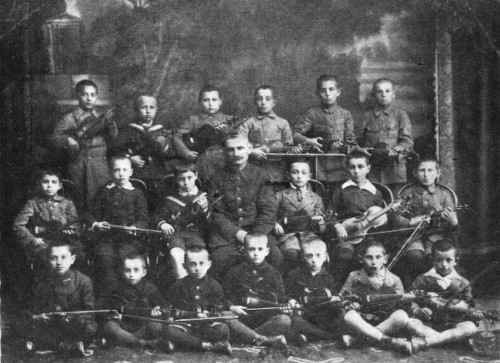
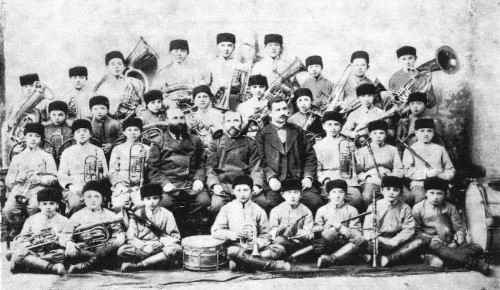
Chane Reiss founded an orchestra for wind instruments that attracted the community similar to the Beit-Midrash formerly. The orchestra was founded in 1904 and re-organized in 1910. The 45 members of the orchestra
[Page 47]
|
|
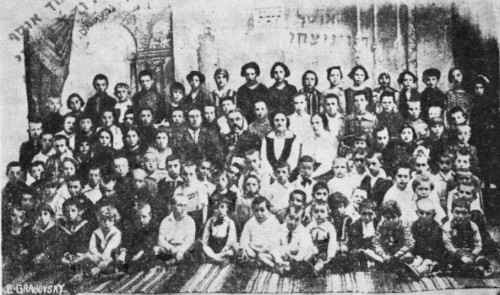
In the center: Chava Zeidler, Zalman Malamud |
|
|
In the center: Pivnik, the music teacher |
[Page 48]
|
|
|
|||||
|
|
||||||
|
|
[Page 49]
|
|
In the center: Wasserman, Shkolnik, Schreier |
worked as volunteers, not in order to get any reward. Chane Reiss brought musical instruments from Leipzig and invited a conductor, a knowledgeable musician, from Kyiv. The reputation of the orchestra preceded it and when the Tsar came to Kamenets-Podolsk [=Kamyanets Podilskyy] in 1915, the orchestra went to welcome him as befits royalty.
The orchestra played concerts four times a week, a major feat of strength for the youth. One can say that this was one of the best orchestras in Bessarabia. On the matter of its professional level one can bring the evidence of General Drexler, the head of the conservatory in Saratov, who was then the chairman of the Russian Red Cross. He was in Khotyn during the First World War and was deeply impressed by the orchestra. The general promised that the players of the “Kruzhok” would receive scholarships to the Saratov conservatory.
The promises of the general were not kept, due to the hard times. After the war, he left Russia and I chanced upon him in a restaurant in Berlin where he was working as a waiter.
Many Jews were saved during the First World War due to the mentioned orchestra. A general came to Khotyn who asked for a list of all the players of the city in order to draft them into his division. A list was put together that had the names of many young people with the idea of saving them from destruction. Among them were some who didn't know how to tell one instrument from another. The general took them all and after two years, they returned home healthy and in one piece.
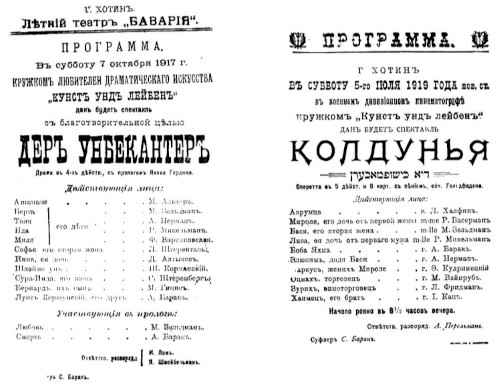
In 1909 and 1910, we were privileged to see in Khotyn an amateur theatre under the leadership of Binyamin Khalfon, Yossel Geyman, and A. Babitsh from Zhvanets.
For two solid years, they successfully mounted several plays, among which were two operettas of Avraham Goldfaden: “Shulamit” and “Bar Kochba.” The lead roles were played by Sonia Gitsis, the wife of Yisrael Kharif [=sharp].
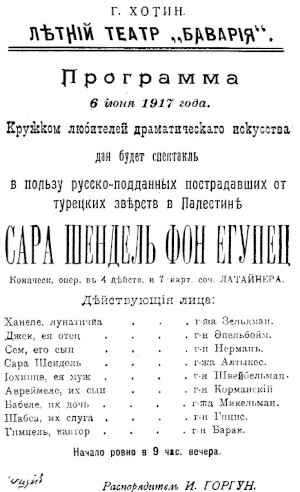
Despite its great success, the troupe did not last for more than two years. After a drawn out pause, an amateur group was founded from among the youth: Moshe Gitsis and Avner Barak succeeded in maintaining the drama club until 1920. They presented the plays of Yaakov Gordin, Peretz Hirschbein, Shalom Aleichem (“Scattered Far and Wide”) and the like. Avner Barak and Manya Zeldman should be remembered among the outstanding players. The revenue of the theatre was dedicated to the “Jewish library.”
From time to time, the “rebels” tried to mount plays in their spirit, but they only managed to do it once.
A certain time before the Second World War saw the founding of a theatre under the auspices of the left-wing circles of the “Kultur-Ligue” [=The Culture League]. The staff of 20 to 30 people worked under the leadership of the director, Yankel Barak. The authorities were suspicious of the actors because they leaned towards communism and they pursued them relentlessly. Because of that, they didn't manage to have
[Page 50]
|
|
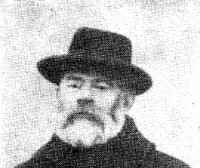
(first from the left) |
stable work. The frequent incarcerations of the actors caused disruptions and pauses. Among the actors were: Sonia Grinberg, Esther'ke Grinberg, and Roza Gitsis. R' Yisrael Kharif, Roza's father, was not happy with his daughter's social circle.
Yisrael Gitsis, known as R' Yisrael Kharif [=sharp], enthusiastically supported all the theatrical activities in Khotyn. He inherited from his father a well-to-do people's house, which was always open for the welfare of Jews and Christians. Those who came to his home were forest merchants, clerks, and friends. The Rabbi from Chortkov [=Chortkiv] would also be hosted at his home when he visited Khotyn.
Yisrael Gitsis was the gabbai [=synagogue functionary] of the large synagogue. His wife, Sonia, excelled in her acting with the drama circle and filled principal roles in Goldfaden's operettas as well. Their son, Moshe, wrote plays himself, organized and staged performances. The daughter, Roza Gitsis, was affiliated, as has been mentioned, with the “Kultur-Ligue” [=The Culture League] and excelled at singing, acting, and dancing.
I remember the days in which we began to take our first steps into the big world and to become interested in its goings on. Secondary school pupils and older students organized themselves in clubs and arranged literary events for reading, singing, and acting.
Moshe Gitsis and his friend, Itzik Getea, were the initiators. They ran the rehearsals and prepared the plays in Russian. The performances were very successful.
The First World War brought a pause in the work, though over time they came closer to the drama clubs and put on plays in Yiddish. There they met Avner Barak, a very talented young man, and Yisrael Barak, who always filled the role of prompter. One should also mention the wonderful actress, Rivka Mikelman-Kudrinsky, who lives in New York.
The performances in Yiddish were very successful in the summer theatre. Khotyn residents enjoyed these programs immensely and all the tickets were sold immediately. This continued until 1920, when Manya Gitsis-Zeldman left Khotyn and the stage. Her connection to the Khotyn theatre also ended with this. But what she started in Khotyn was good training for the future when she began to act in Chicago.
The Zionist federation had drama clubs, too. Among the members who took part in this activity should be mentioned the engineer, Yosef Seltzer, Berl Weissolder, Eliezer Veizer, Fishel Gitelman, Hersh Veisman, Yenta Kirzhner, and the actor and director, Nachumovich.
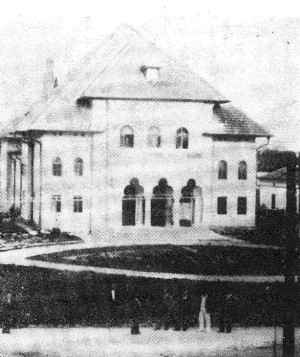
The old “Schneiderman” Hall, which was long known as the hall of Yona Zilberman, was the cultural and artistic center of the city of Khotyn. The great actors of the Jewish theatre appeared on the stage of “Schneiderman” Hall, as did non-Jewish actors.
The speeches of the great Zionist leaders were delivered in “Schneiderman” Hall, party meetings were held there, cultural receptions, symposiums, Purim and Hanukkah parties. In truth, the Hall was Khotyn's summer theatre, even though it was used until the late autumn.
“Schneiderman” Hall was in the center of the city, surrounded by a lovely garden. Khotyn residents used the Hall at every opportunity. They loved plays, enjoyed hearing a talented speech, and also came to Zionist meetings, which sometimes ended in brawls.
During the rainy season, it was not comfortable in the Hall due to the cold and damp; there was also the danger of slipping at the entrance; but despite the mud, they loved the Hall; it was ours, it was the theatre of our city. They waited impatiently for the announcements of Foima, the porter, concerning plays that would be put on in the evening.
The young people waited for darkness to descend in order to hide among the trees surrounding “Schneiderman” Hall and with trembling expectation. Once the play began, the group would climb over the high fence and sneak into the theatre. Words don't count like actions! Their plan did not always succeed. Often an adventure like this ended with ripped pants or scratched faces. But they accepted it all with love and just to enter the theatre without a ticket.
Other theatre lovers waited at the entrance until the start of the play and then began to bargain with the theatre owner to buy a ticket at a reduced price. From time to time, someone would try to enter with a broken chair in his hand as if he belonged to the “troupe.”
“Schneiderman” Hall, despite its muddy floor and all the rest of its disadvantages, was the pride of our city. We lived a life of culture there in the period between the two World Wars. In those days, we were separated from the Russian world and had not yet managed to strike roots with the Romanian regime, which was introduced in Bessarabia. However, anti-semitism came from both sides at one and the same time: from the Ukrainians, local residents, and from the Romanians, who came from nearby.
[Page 51]
|
A library, named after Chane Reiss, a promoter and activist in the area of culture, opened next to the Jewish bank. His private library, which contained many valuable books, formed a strong foundation for this enterprise. Based on Chane Reiss's estate, a real library was established in his house with a reading room next to it.
Bank clerks volunteered to work in this library. Meron Derzhi headed the library committee and Ms. Etka Shitnovitser (Schmidt) served as librarian. Over time, another librarian was added - Mila Barak (Yurist). The youth and the students were very helpful with the daily work of the library.
The library had 500 permanent readers. More than 120 readers exchanged books on a daily basis. The library also attracted a large number of young readers.
The library had books in Yiddish, Hebrew, Romanian, and Russian. There were many Christians, too, among the readers, finding books that appealed to them.
Books were brought from Warsaw, Riga, and other places.
The reading room was always full because all the newspapers and periodicals could be found there. The library was a cultural center, a meeting place for the educated and the youth. This lasted until the conquest of Bessarabia by the Soviets.
|
|
[Page 52]
|
|
|
JewishGen, Inc. makes no representations regarding the accuracy of
the translation. The reader may wish to refer to the original material
for verification.
JewishGen is not responsible for inaccuracies or omissions in the original work and cannot rewrite or edit the text to correct inaccuracies and/or omissions.
Our mission is to produce a translation of the original work and we cannot verify the accuracy of statements or alter facts cited.
 Khotyn, Ukraine
 Yizkor Book Project
 JewishGen Home Page
Copyright © 1999-2026 by JewishGen, Inc.
Updated 29 Sep 2026 by JH