 |
|
|
[Page 50]
by Leibush Glomb
|
|
I was raised in Hasidic culture, and have always been curious about Hasidism in Grabowiec and elsewhere – its features, customs, way of thought, and love of joy. Now that the Holocaust is over, I consider it my sacred duty to preserve its memory and ensure that it is not omitted from this memorial book, the spiritual monument we are erecting in memory of the Jews of Grabowiec.
[Page 51]
Several Hasidic groups had their own small synagogues in our town. Among them were the Hasids of Husiatyn, Kuzmir, Belz, Radzyn, and others.[1] Other Hasidic groups in town followed their own leaders, but they had few members, and were unable to establish their own synagogues. They joined groups that were to their liking.
We can still hear the sounds of prayer by cantors and prayer-leaders who had pleasant voices and gained a good reputation. They were sociable, and led the prayers of the congregation that awaited salvation, staunchly believing in the Torah and all that was sacred to Jews.
The area of Sobibor, the death camp where the Jews of Grabowiec and the surroundings were exterminated, still resounds with the last sighs of the devoted Jewish community of our town, a community that never ceased waiting for the Messiah, and constantly prayed and studied the sacred texts. Cruel death decimated them – rich and poor, proud and humble, scholars and secular people, all united in their faith and spirit. The same fate took them all.
No longer will holidays be celebrated in Grabowiec, and the Hasidic synagogues will never ring with prayer again. A Jewish town has become deserted, and is as though it had never existed. It was burned on a pyre by a nation of ravenous beasts, without a single grave to attest to its existence. All that was precious and sacred was desecrated, and only the remnants of the generation that was decimated bear the grievous memories and write them down, make lists and histories, and erect monuments.
Our fathers and forefathers were pious, and their lives centered on the study house and the various synagogues; that was where people gathered. Each synagogue had its own character and customs.
Let us now write about the Hasidic synagogues of our Grabowiec community, as best we can recall.
Hasidism
As in all the towns of Poland, Hasidism was very popular, and kept people's spirits up. Each person was welcomed into the group warmly, and in turn absorbed spiritual energy, reinforcing his love for the nation and for good deeds. Hasidism was a crucial part of the town's daily life and culture. Although each Hasid went his own way, based on his leader's teachings,
[Page 52]
which often differed widely, they all found a home in Hasidic Grabowiec. All the groups preached love for people and for the nation, and found some good in each Jew. Love is the guiding principle common to all Hasidic groups, a love that grows out of joy and humility. Those who cannot love cannot be humble, and are therefore despondent.
The different Hasidic synagogues in Grabowiec constituted a miniature diaspora; the adherents of each group found the way to follow the teachings of their leaders. All the features of a Hasidic group resulted from the personality of the leader. He personified one of the main principles of Hasidism: there is no separation between religion and daily life, heaven and earth. It is all a single authority, motivated by a single force: that of sanctity.
The Grabowiec Hasids congregated in the small synagogues that set them apart from the rest of the community. Some of them were unusually devoted to studying the texts, legal as well as mystic, and often stayed awake at night to lament the absence of God, the destruction of the Temple, and the deplorable condition of the Jewish people.
The Husiatyn Hasids
How did the Husiatyn Hasids come to Grabowiec? They originated some distance away; these Hasids began as part of Rizhin Hasidism, which was especially prominent in the towns of Galicia, Romania, and Bukovina.[2] Travelling to Galicia was exhausting and time-consuming. We know that during World War I, the leader of Rizhin Hasidism, Rabbi Yisro'el, left for Vienna and then for the Land of Israel.
He was renowned in our town as well. The leader of Husiatyn Hasidis, Rabbi Mordechai, now became a leader in his own right.[3] He was considered extremely righteous and wise, and a wise man is better than a prophet. After the death of Rabbi Yisro'el, the entire group began to follow Rabbi Mordechai. His study house was a magnet for scholars and famous rabbis. Husiatyn became frequented by Hasids from other towns. He was known and admired in Grabowiec, as he was one of the major Hasidic leaders of his time, who founded a new branch of the Rizhin Hasidic dynasty in Husiatyn, and was especially significant in the history of Hasidism.
The Husiatyn Hasids in Grabowiec remained faithful to his deceased father, and continued to travel to Husiatyn, to Rabbi Mordechai's son Yisro'el, who attracted many followers.
[Page 53]
He was wise, knowledgeable, and helpful to those who sought his counsel. Every Hasid who visited Husiatyn became imbued with love for other Jews, above all. The Rabbi would commiserate with those who wished to unburden themselves to him, and say, “The combined power of friends who love each other sincerely reaches the highest heavenly spheres.” His admirers came from near and far, and he was revered even by those who weren't among his official followers. He attracted even those who had strayed from religious observance, and they rejoined the path of their fathers.
The founder of Rizhin Hasidism was termed “King of Israel.” One Jewish tradition regards teachers as kings; indeed, the leaders of Rizhin Hasidism were kingly in appearance and noble character. Above all, they radiated love. After Rabbi Yisro'el left Vienna and settled in the Land of Israel, his followers revered him like royalty. Indeed, some of his behavior resembled royal custom. He sat in a golden chair and traveled in an ornate carriage; his household dishes were golden. When asked why he behaved in this manner, he responded, “Even if a king doesn't want to be treated royally, he should be so treated.”
He was a fourth-generation descendant of the great maggid of Mezritch, the heir of the Ba'al Shem Tov who spread Hasidism far and wide.[4] Born in Pohrebyshche, Ukraine, his father was Rabbi Sholem Shachna, the son of Rabbi Avraham the Angel.[5] His mother, Chaya, was the daughter of Rabbi Nachum of Chernobyl. Other Hasidic leaders of the time admired the infant, as is clear from the following words of Rabbi Meir of Przemyślán: the only reason Rabbi Avraham the Angel was born on earth was to bring the soul of the Rabbi of Rizhin down from heaven. The infant's uncle, Rabbi Mordechai of Chernobyl, maintained that the child had inherited the soul of the Ba'al Shem Tov, and therefore bore the same name: Yisro'el. He recounted that when Chaya, his mother, was pregnant, Rabbi Avraham Yehoshu'a Heshel of Apt rose up to honor her, and announced that she would give birth to a Torah scroll.[6]
[Page 54]
Everything I recount here about the Rabbi of Rizhin was told by my father and other Hasidim in Grabowiec, who were wonderful story-tellers. Each of their tales was rich in the Rabbi's proverbs and teachings. Their conversations left an indelible impression; as I add them to the Grabowiec Yizkor Book, I would like to commemorate the religious life of our town as well as the secret beauties of Hasidism, the greatest movement in the history of the Jews during exile, which revealed itself in Grabowiec as well.
I often listened to the stories of the Rabbi of Rizhin and knew that his father had died when he was very young, only six years old. He was brought up by his brother, Rabbi Avraham of Rizhin, who was known as the “little angel.” However, he, too, died young and childless. Rabbi Yisro'el freed his sister-in-law of the obligation to marry him.[7] Rabbi Yisro'el was appointed the leader of the Rizhin Hasids, and followers soon began thronging to him. Those who came to him were immediately attracted to him. As Professor Meir states, “His glances were so charming that even his greatest enemies had no choice but to surrender.”[8] Gentile nobles and landowners would also visit him to ask for a blessing, and offered him valuable gifts.
The first Hasidic community he led was in his birthplace, Pohrebyshche. He then moved, first to Skvyra and then to Rizhin, which became an important center of Hasidism, and lent its name to him.
His demeanor and way of life were, as I have mentioned, royal. His household effects were extremely lavish. He rode in a carriage with fine horses, and employed male and female servants. His dishes were of silver and gold.
In 1838, he was arrested by the Russian authorities and charged with ordering the execution of informers. He spent twenty-two months in a solitary cell, in the Kyiv prison. Dozens of other Jews were arrested at the same time, some of whom were punished by whipping and others exiled. When he was released the day after Purim in 1840, he returned to Rizhin, but his suffering wasn't over. Although the murder charge had been lifted, he was suspected of plotting to become king of the Jews. Policemen visited him daily and watched his every move, disturbed his sacred work, and prevented other Hasids from visiting him. He decided to move to Kishinev with his family.[9] When his followers found out that the authorities were planning to exile him, they bribed the Kishinev governor and obtained travel documents for him to Moldavia. The Rabbi left with two of his helpers for Iaşi, on the border. When the arrest warrant arrived, the Rabbi was far from Kishinev. The agitated governor sent a delegation to the Russian consul in Iaşi in order to arrest the Rabbi, but
[Page 55]
the Rabbi's followers were too quick, and had already spirited him off to Austria, where many Hasidic leaders were living in the area of Galicia.
The Rabbi's followers in Grabowiec told many stories about his hasty flight and the many dangers and difficulties he encountered until he crossed the border. The Russian authorities asked the Austrians to turn him over. This led to a conflict that reached the Austrian parliament. The Russians pressed the Austrian government, but the Austrians found various legal reasons to turn down the request. The Rabbi received Turkish citizenship, which his descendants inherited. He was described as a citizen of Jerusalem. The Rizhin Hasidic group began to flourish once again.
One of the leaders who shared in the renown of Rabbi Yisro'el of Rizhin was the Rabbi of Husiatyn, Rabbi Mordechai. The Grabowiec Hasids often recounted his ideas and conversations, and considered him Rabbi Yisro'el's heir and replacement. Rabbi Mordechai's warmth and love delighted all his visitors. His heartfelt prayers reached the heavens, and encouraged all listeners to search their souls. His followers enjoyed riches, spiritual as well as material; the Rabbi nourished their souls and also blessed them with good livelihoods. He encouraged his followers to sing and dance, as the way to increase brotherly love. He required his followers to give to charitable causes whole-heartedly, and himself was a shining example of such generosity. He had a special affinity with young people, who were always welcome.
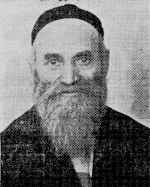
His son and heir, Rabbi Yisro'el, continued these customs. He was Rabbi Yisro'el Friedman of Husiatyn, who was a devoted teacher to his followers. His second wife was the daughter of Rabbi Chaim of Ottynia, the son of Rabbi Baruch of Vizhnitz.[10] He was the son of Rabbi Mordechai Shraga of Husiatyn, and the grandson of Rabbi Yisro'el of Rizhin, was born in 1847, seven years after the death of the grandfather whose name he bore.
In 1894, at age 47,he was crowned as the Rabbi of Husiatyn, and thousands of followers began to visit him. During World War I, he, like all the leaders descended from the Rabbi of Rizhin, left Husiatyn for Vienna, where he lived until 1937. He then moved to the Land of Israel as he had longed to do for many years. He encouraged his followers to do the same; some of them did so, as they considered his commands sacred.
He settled in Tel Aviv, where he lived for the rest of his life, at 19 Bialik Street.
[Page 56]
In 1943, he headed a delegation of Rizhin Hasidism leaders that visited religious towns in the Land of Israel.
He died in 1949, at age 91, and was buried in Tiberias. His will stipulated that he be buried in the Mount of Olives cemetery, Jerusalem; and if that should be impossible, he requested to be buried in Safed or Tiberias. He sensed that burial in Jerusalem might not be possible. No one had any inkling of that in 1939.[11] He was buried near the grave of Rabbi Mendl of Vitebsk.
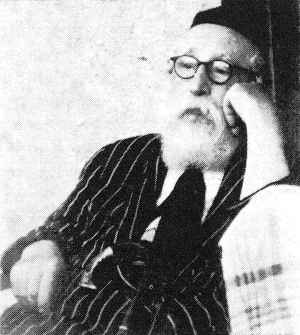
His son-in-law was Rabbi Ya'akov of Husiatyn, the son of Rabbi Yitzchak of Bohush, who was born in 1908 and married Rabbi Yisro'el's daughter when he was 17.[12] He then moved to Husiatyn, where he was much admired, but was not the group's leader. He moved to Vienna with his father-in-law during World War I. He was one of the first Hasidic leaders to join the movement to settle in the Land of Israel. In 1937, he moved there with his father-in-law, and was crowned as the leader of Husiatyn Hasidism in 1949. He spoke several languages and was at home in the secular world. He died in 1957, and was buried in Tiberias.
Rabbi Yisro'el of Husiatyn continued to spread the great spiritual legacy of Rizhin Hasidism in the Land of Israel. His personality embodies all the fine traits of this Hasidic strain: charity, glory, love, compassion, and majesty. People admired his aura of sanctity, and he was honored everywhere.
His Grabowiec followers perpetuated his teachings all their lives. These followers included Talmudic scholars as well as experts in the mystical texts that they continued to study. The Rizhin synagogue in Grabowiec resounded with the melodies composed by Rizhin leaders over the years. This atmosphere of sanctity was especially marked on Shabbat, when Jews took on a more festive and spiritual aura.
Friday Nights[13]
The atmosphere during Shabbat twilights was special: the Hasids sat together for the final Shabbat meal and prayed by way of music. All the synagogues filled with liturgical songs of longings and faith. The creeping shadows erased the distances between people, and the songs sounded as a single expression of longing for the Shabbat that was about to end. The Husiatyn Hasids had a saying, “He who is not musical cannot be a Hasid.” These Hasids sought the most profound and purest expression of the Hasidic soul, through music. Some of them could analyze each melody in great detail, and abhorred
[Page 57]
discordant singing. The sweetest singers were Moshe Zinger, Itshe (known as “Itshe the White”), Baruch Melamed (Hendel), Elkanah Kahn, Avraham Rapaport, David Vald, and others; all sang beautifully. Some people visited the leader often and learned new melodies, which quickly became popular in Grabowiec.
During winter, when snowstorms were raging and it seemed that the world was about to return to a state of chaos, the final Shabbat meal as the holy day was fading was celebrated at the home of the Husiatyn Hasid Yosef Gero of Moldtitch.[14] They listened to wonderful Hasidic tales that became a kind of oral law. Songs punctuated the tales and the dishes that were served. Some participants remembered stories told by many leaders, and regaled the company with them. Among these were Noteh Fink, Shlomo Hustik, Mendl Hustik, Yantchi Boyn, Gershon Boym, and others, who switched easily between tales and aphorisms. As the tales unfolded, the teller and the tale became a single mysterious entity. Everything came alive. Not only did the listeners hear the tales, but also visualized them vividly.
For many years, beginning with my childhood and up to the outbreak of World War II, I spent Shabbat evenings with the Husiatyn Hasids. I remember well the conversations, and songs. One person would begin to speak, others chimed in, and the tales began to flow. The space was populated by Hasids, old and young, whose world consisted of Hasidism. It was silent, and their breathing was audible. The wind rampaged outside, while indoors the sound of water boiling in the samovar filled the air. The oldest Hasid, Yisro'el Messer, or Yosef Gero, or another of the old-timers, began speaking. He described the Rabbi's table and the people around it in the order of seating. The listeners were carried away to the Rabbi's “court,” where they saw and heard the sanctity and majesty of Rabbi Yisro'el, whose lineage reached back to the Ba'al Shem Tov. They heard of the significance and influence of the Ba'al Shem Tov's teachings and their widespread impact throughout the soul of the nation, as they take on new shape and value in each place and with each new teacher.
The atmosphere was one of sanctity and purity. When people
[Page 58]
such as Yosef-Mordechai Hustik and Nachum Glomb emerged from that spiritual paradise and returned to the material world, they seemed unable to grasp where they were… It was then that music extended a helping hand, the Hasidic melody that warms the heart and sweetens the blows of problems and suffering; the chant that accompanies every Hasid as he leaves the home of his fellow Hasid and stays with him always. The melody sometimes swells like a flood, and sometimes percolates through the depths of the soul, but never disappears. The Husiatyn Hasids and their melodies come from the same source and cannot be distinguished apart. Hasidic melody is the language of the yearning soul, and the true joy of those who seek God, as in the verse, “Let the hearts of those who seek God rejoice.”[15]
I would like to take this opportunity to memorialize the long-time Husiatyn Hasids, whom I mention with great respect: Yosef-Mordechai Hustik, Noteh Glomb, Shalom Vaynrib, Kalman-David Licht, David Papir, David Boym, Yitzchak-David Gero, Feivel Hustik, Zalman Trug, Berish Trug, Sha'ul Vald, Berl Brikman, Yitzchak Brikman, Elyakim Sherer, Ya'akov Lerer, Mordechai Reiz, Binyomin Shtern, Avraham Trug, Hershel Reiz, Simcha Hustik, Chaim-Leyb Mernshteyn and his son Mordechai, Leibush Hendel.
The list goes on; I mention only those I remember vividly to this day.
|
|
|
|||||
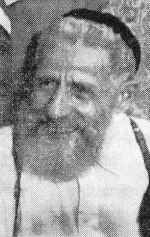
He was known to all as Gershon, Feigele's son, but his last name was Kriger. He was a kind-hearted Husiatyn Hasid, always ready to help anyone who was desperate and needed help.
[Page 59]
The Kuzmir Hasids
The Kuzmir Hasids had a noticeable presence in the town, and many important townspeople prayed there, such as Efrayim Zinger and his son Leibush, as well as Yeshaya Morochnik, an extremely rich person who owned two estates. He, the Jewish landowner, rode in a fine carriage. Another personage was Eli Kutcher, who ran a leather-goods store (his son Baruch took over the store when Eli was too old to do so). He always had Hasidic books on his desk, even during business hours. Hershele Ellis was a great scholar, and was one of the most devout Kuzmir Hasids who kept all the commandments. Chaim Brendel owned a grain business; his daily schedule included all the prayers of the day, and he was one of the pillars of charity in the town. Others were Leyzer Shisler, who was very devout, and Mordechai Shimon, an artisan who became renowned for his scholarship. Everyone set aside time daily for religious study.
The Kuzmir synagogue was a center of prayer and Hasidism, and was always full of young men, bachelors as well as married men, who studied with verve; the lovely sounds wafted out into the street. Over time, the young men from other congregations began to compete with the Kuzmir men, and religious study in Grabowiec reached new heights.
The Hasidic rabbi of Kuzmir lived in ZamośĆ and was related by marriage to Leibush Zinger, one of the important Kuzmir Hasids in Grabowiec; he would stay in Leibush Zinger's house whenever he came to Grabowiec, to which all the Kuzmir Hasids would come during his visit. They clustered around his table on Friday evenings and during Shabbat, and visited him on weekdays asking for his blessing on their enterprises and his help with personal problems.
The Kuzmir dynasty was founded by Rabbi Nachum of Chernobyl, the author of Me-or Eynayim, who shed light and love over his followers.[16] He was an early follower of the Ba'al Shem Tov, and adopted many of his mentor's qualities. He was always concerned about inculcating his followers with humility, a tendency that led them to be closely connected to each other. He used to say, “The numerical value of the Hebrew letters alef, dalet, mem that make up the term ‘adam’ is the same value as that of the interrogative ‘ma’ (‘what’). Our leader Moses, the epitome of humility, said, ‘What are we?’[17] Our sages therefore said that Moses had the greater reputation than Abraham, who said ‘I am dust and ashes.’[18] Moses was not self-aware, and spoke in the plural ‘we’. That is the essence of humility: erasure of the self.”
He also used to say, “Love your neighbor as yourself – that is a major rule in the Torah.[19]
[Page 60]
The Torah was given to the entire nation of Israel at Mount Sinai, which was an occasion of true unity, where they were as one person with one heart. If the Torah was given to everyone, and all share in it equally, why do some lord it over others? Pride is the worst quality. Love and brotherhood can flourish in the absence of pride.”
This sense of humility, encouraged by Rabbi Nachum and his son, Mordechai, which came down to Rabbi Avraham, author of Magen Avraham, was transmitted to the leaders of Turisk and Kuzmir Hasidism, the heirs of the Chernobyl dynasty who preserved the precious heritage of Hasidism.[20]
It might be this very humility that gives rise to the power of sanctity. Those who are able to overcome their own pride (“What are we?”) are able to stand and fight when necessary. The Kuzmir Hasids of Grabowiec exhibited this quality in public life.
The town of Kuzmir, on the banks of the Vistula, which was the summer home of King Casimir the Great and his Jewish wife Esther, first became famous in Hasidism as the home of Rabbi Yechezkel Toyb (died in 1856) the author of the compilation of commentaries Nechmad mi-Zahav who was a student of the Seer of Lublin, and was known as “the tall man from Plonsk” because of his great height.[21] He was the founder of many Hasidic courts, such as Zwoleń, Jabłonna, Nove Mesto, and Modzhitz (the latter group is renowned for its music). Eventually, another Hasidic leader descended from the Rabbi of Chernobyl settled in Kuzmir again. This was Rabbi Mordechai'le Twerski, author of Ma'amar Mordechai and the son of Avraham the preacher of Turisk.[22] He soon had a large number of followers, and visited them in their homes, as he loved to travel. He was a musician, who sang and played instruments, and his prayers were always intoned in a strong voice.
Rabbi Mordechai of Turisk and his father, the preacher of Turisk, were famous for their love of Notarikon and Gematria, two of the traditional 32 methods of understanding the Torah.[23] All their books and innovations were based on these two methods. Grabowiec was home to many followers of the preacher of Turisk; after his death, they switched to his son, the Rabbi of Kuzmir, and followed his methods of Hasidism and study; he settled down in Kuzmir, after wandering and seeking for years.
It took years for Rabbi Mordechai'le to find his permanent home as a Hasidic leader. He was first active in Włodawa, until the Russian authorities banished him. He then settled in Dąbrowica, in Galicia, only to be banished by the Austrian authorities. His next location was the city of Chelm, which he also had to leave. He then moved to Lublin, before finally settling in Kuzmir, where he had many followers, and could live in peace. However, it wasn't long before he had to leave Kuzmir for Kielce, and finally for ZamośĆ.
[Page 61]
The Kuzmir Hasids of Grabowiec were fond of the phrase, “We will go with our young and with our old.”[24] Hasids did not differentiate between young and old. The dancers in the circle included old and young, striplings and graybeards, bachelors and married men. They joined arms across each other's shoulders with the same fervent wish: “ Purify our hearts to serve You in truth.”[25]
The Belz Hasids
The Belz synagogue was another gathering place for many Torah scholars and Hasidic adherents. They may have been less fervent. They included bachelors who celebrated the holidays with excitement, and held many meals in common, worshipping God through joy.
The name of Belz became a byword for spiritual elevation, and still stands for love and devotion, steadfastness and faith.
In Grabowiec, as well, Belz was a symbol of four generations of Hasidic leaders who were renowned in the history of Polish Hasidism. The Hasidic rabbis of Belz constructed a fortress of Torah and Judaism, Hasidism and devotion.
Belz was a small town in the heart of Galicia, yet became a major center of Hasidism. For generations, Jews from all social levels streamed to Belz, including residents of Grabowiec. When they returned, they recounted the words of wisdom and learning they had heard from the Rabbi during festive gatherings around his table on holidays and Shabbat, and on other special occasions. He prayed with deep devotion, and taught his followers to contemplate and study the essence of Hasidism. He often fasted to discipline himself, yet rejected despair and called for the joy that leads to a higher spiritual plane and acceptance of God's will.
The Shabbat scene: With his followers around the table, the Rabbi takes a small piece of challah for himself, and instructs his helpers to hand out pieces of challah to the Hasids waiting eagerly. Next, he turns the platter of fish in all directions, tastes a bit of fish from the platter's sides, and instructs his helpers to distribute the fish to his followers. He then requests his sheepskin coat, dons it, and returns to his room. This interlude, termed “a break” by the Belz Hasids, can last up to two hours (a not unusual length of time). Most of the followers, exhausted by travel, nap at the table; some devote the time to study. When the break is over, the Rabbi returns to the table, performs the ritual hand-washing once again, and continues the meal. All the dishes are distributed to the Hasids, who consume them devotedly. Silence falls, and the Rabbi begins to speak of religious matters while the men around the table listen avidly.
[Page 62]
The Belz synagogue in Grabowiec was in the center of town, among homes. It was pleasantly warm on winter nights, and it was wonderful to sit there and hear moving tales of Hasidism. I can hear Eliezer Shur's voice now, repeating the words of the Rabbi: “The Torah commands us to ‘let your brother live with you,’ and only then can you really live. If you don't observe that command you aren't really living, and your life is worthless.”
It is hardly surprising, then, that in those days the Belz synagogue was a symbol of charitable deeds and mutual aid. One of the notable figures was Matte Katz, a Belz Hasid who donated to charity generously, and gave even more in secret. The concept of anonymous charitable giving reached new heights within the congregation.
The Hasidic Rabbi of Belz was one of the Jewish leaders who tasted the bitterness of two occupations of Poland – first, that of Communism, then of the cursed Nazis. When he fled from the ruins of the Hasidic center of Belz, which he witnessed personally, he found temporary refuge in the area ruled by Russian Communists. The reports of his leadership despite the Communist decrees and persecution are truly inspiring.
He was rescued from the arena of murder in the summer of 1943, when the survivors of ghettos and labor camps were killed. He witnessed events of indescribable horror, and suffered from the loss of his entire family, children and grandchildren, through unnatural killings (may God preserve us). However, when one of those close to him mustered up the courage to tell him that his oldest son, the martyr Moshe, had been flung into a burning synagogue and had been incinerated along with the Torah scrolls, he responded, “That is God's gift to me: I, too, have made a sacrifice.” Is there a more powerful and shocking expression of total dedication to God's sanctity?
The dedication of Belz Hasids is exemplified by the actions taken to save the Rabbi, which are unparalleled in the entire history of the terrible destruction that overcame the Jews of Europe. These acts are truly miraculous.
After much wandering among various countries and nations, the Rabbi finally reached the Land of Israel. The Jewish residents welcomed the Rabbi joyously, and the excitement of the Jews of Jerusalem when the Rabbi arrived was incredible.
The joy brought to the Land of Israel by the arrival of the Rabbi of Belz continued throughout his life, until his death on August 18, 1957.
[Page 63]
The Radzyn Hasids
The synagogue of the Radzyn Hasids was where the most important residents of Grabowiec gathered. Almost all of them were scholars, who valued religious studies above all else. They all wore a tzitzit with a blue fringe, colored by a dye that is understood to be extracted from a sea creature.[26]
I was very young when we learned the relevant passage in the biblical Book of Numbers: “And the Lord said to Moses, saying, ‘Speak to the Israelites, and you shall say to them that they should make them a fringe on the skirts of their garments for their generations and place on the fringes of the skirt an indigo twist.’”[27] At the time, I didn't notice that my own tzitzit had no blue fringes, nor did those of my elders. The description of the rebellion of Korach and his followers against Moses and Aaron placed no special emphasis on the blue fringe, either.[28] “What did Korach do? He gathered two hundred and fifty heads of Sanhedrins and gave them tallises that were all blue. They came to Moses and asked, ‘Does an all-blue tallis need a tzitzit?’” When I grew older and came to know the Radzyn Hasids in our town, I noticed that their tzitzits were different from those of non-Radzyn adherents.
It was then that I came to know the blue tzitzit of the Radzyn Hasids.
The tzitzit of the Radzyn Hasids in Grabowiec has a long history, all the way back to their leader, Rabbi Gershon-Henich, who was a student of Rabbi Simcha-Bunem of Przysucha and Rabbi Mendl of Kotsk.[29] Simcha-Bunem charted a new road in Hasidism and Torah scholarship. One of his star students was Rabbi Mordechai-Yosef Leiner.[30] He was a truly righteous man, with an illustrious lineage – a descendant of Rabbi Meir ben Isaac Katzenellenbogen, the rabbi of Padua, who was also known by the acronym Maharam, and whose lineage was described as reaching back to the biblical King David.[31] After the death of Rabbi Simcha Bunem, Rabbi Leiner became a follower of his disciple, Rabbi Mendel of Kotsk, until he rebelled against him.
The reason for his rebellion has been much debated. Rabbi Leiner began his own Hasidic group, which soon attracted Hasids from other groups as well as fine scholars. He was considered one of the great leaders. He headed his group for only thirteen years until his death in 1853, and was followed in Izbica by his son, Rabbi Ya'akov, until the latter died in 1871 at the sanatorium in Druzgenik.[32] Leadership of the group then fell to Rabbi Gershon-Henich, the most gifted of his four sons, who lived in Radzyn; the name of the group was then changed to reflect its new location.
Although still young, he was very active. He wrote many commentaries on the Bible, published scholarly books by his grandfather (Mei Ha-Shiloach) and father (Beit Ya'akov). He also wrote and published books of his own: Sod Yesharim (concerning holidays), Tiferet Ha-Chanochi (on the Zohar), Eser Milin Be-Hassiduta (on daily life), Daltot Sha'ar He-Chaim, and other unpublished books.
[Page 64]
Eventually, he was caught in a storm of his own making: he noticed that one of the Torah's important commandments – that of the blue twist (techelet) in the tzitzit – was not being followed.
That was the start of “the battle of the blue” among Jews. Rabbi Gershon-Henich wrote the learned book “Sefunei Temunei Chol”, which listed the pros and cons of identifying the chilazon that produced the blue dye. He quoted commentaries by the Tannaim, Amoraim, and Poskim, spanning the centuries from the 1st to the 16th centuries C.E., which clarified the issue: “Although we are not surprised by the fact that we have stopped obeying this commandment, due to the many troubles and vile decrees we have suffered from, as well as our wanderings and the high cost of the techelet, we have been unable to obtain it. It is incumbent on every generation that fears God to continue searching for this magnificent adornment, in order to make it available once again for the Jewish people.”
Not only did Rabbi Gershon-Henich publish his book, he began traveling in order to find the chilazon. He returned a year later, successful, and wrote his book Petil Techelet. The book includes wonderful descriptions of his travels as well as scientific descriptions. He describes the great aquarium of Naples, the scientists' work cubicles, and the sea in which he identified the chilazon sea creature from whose blood the techelet was extracted.
The Radzyn Hasids in Grabowiec, who were important scholarly innovators in their own right, enthusiastically repeated the tales of Rabbi Gershon-Henich. In recent years, I witnessed their love and admiration for his grandson, Rabbi Shmuel-Shlomo, whose spiritual character was similar to that of his father, Rabbi Mordechai Yosef (the author of Tiferet Yosef), and his grandfather. He was a great scholar and leader, a visionary whose qualities were especially noticeable during the Holocaust period, when he lived in Włodawa and was murdered there. His life and death are worthy of study.
His religious expertise and righteousness were attested by his teachers. His father always supported a number of scholars at his house so that they would educate his only son. Several of these scholars told me about the young man's rare qualities. I also heard this from one of the great Torah scholars of Poland, Rabbi Leybl Landoy, Rabbi of Kołbiel, son of the Rabbi of Izbica and the brother-in-law of the Hasidic leader Rabbi Shimshon Sholem Kalish of Amshinov; the latter became the head of the Chachmei Lublin Yeshiva after the death of the great Rabbi Meir Shapiro of Lublin. The Rabbi of Amshinov became a close friend of the young Rabbi of Radzyn, and
[Page 65]
spent many pleasant hours debating fine points of Torah and Jewish law. When he saw us, he would say that he was incapable of following Rabbi Shlomo's reasoning for more than an hour or two at the most; he illustrated this by grabbing his head in his hands.
For several years, he refused to assume the leadership, claiming that he was unworthy of the honor. When he could no longer resist pressure from the leaders and masses of Hasids, he began devoting himself to educational work. He returned to his father's home in Radzyn, saying the living in cities was difficult. He then founded a Great Yeshiva, named Sod Yesharim (“Secrets of the Righteous”), which accepted the best scholars. He also founded many small Yeshivas by the same name, which served as preparatory schools for the Great Yeshiva in Radzyn.[33]
Rabbi Shlomo's true stature was revealed only in the last three years of his life. His achievements during that period are incredible. He traveled through ghettos and camps like a savior angel. He gave no thought to himself or his own family, and concentrated on helping others. At the same time, he called for resisting the murderers and non-cooperation with them, and rebellion by any means possible. His actions and words became renowned, giving him the status of a living legend. His behavior and comments resounded throughout Jewish Europe and left a mark; he became a living legend.
His last stop was the town of Włodawa, not far from Radzyn. I would like to end this account with a tale I heard from the Hasid Mordechai Reichman of Haifa, who was with the Rabbi until his murder. He describes the following incident: as he was entering the Rabbi's house, he saw a man he knew leaving, holding the Rabbi's only winter coat. Once he was in the holy presence of the Rabbi, the latter realized that he must have seen the man with the coat, and said, “Motl, you're probably surprised at seeing someone else with my coat. I want you to know that this man came to my house. I knew he was destitute and lacked even bread, so I looked around in my house and found no food for him. I then searched my clothes closet, took out my coat, and gave it to him so he could sell it and buy some food.”
When I heard this tale, I remembered the story about the “Holy Jew” of Przysucha, who would give away his shirt to a Jew who had no clothes. One Friday, his teacher, the Seer of Lublin (may he rest in peace) saw his gifted student wearing a torn, dirty shirt. The Seer took out a clean, ironed shirt from his closet and gave it to his student, the “Holy Jew,” to wear on Shabbat. The Holy Jew went to the bathhouse to cleanse himself before Shabbat, and saw a Jew next to him who was taking off a ragged, dirty shirt.
[Page 66]
The “Holy Jew” waited until the man was immersed, placed the shirt he had received from the Seer or Lublin next to the man's clothes, and left.
Radzyn Hasidism went through various phases up to the last terrible period of the annihilation of Jewish communities and the extermination of six million innocent, pure Jews, including our Rabbi Shmuel-Shlomo (may his merits protect us) and thousands of Radzyn Hasids. To his very last day, he collected money, food, and anything else that might be helpful. He started cheyders for young children, took care of all their needs, and called to resist the enemy by taking to the forests.
As the situation worsened, five days before his murder, he decreed a three-day fast. He prayed in the morning with a small number of Jews, instructing them to follow the Yom Kippur custom, whereby he himself stood on one side of the cantor and one of the Hasids at the cantor's other side. After the service, the Nazi brutes encircled the building, broke into it, and arrested the Rabbi.
On the fifth day of his detention (Shabbat, the eve of the month of Sivan, 1942), he was taken to the Włodawa forest and shot (may God avenge his blood). Before his death, he spoke to the Jews who were with him, saying, “Jews, don't surrender to these murderers. Shema Yisro'el!”[34] His life was taken as he finished the sacred words. May all the deceased rise on the day of redemption!
|
As a young child, I was already interested in the special customs of each Hasidic group in our town, and studied their qualities, habits, and melodies. I will now do my best to describe them objectively. As I write about them, I sense the radiance of their way of life, which was marked by brotherhood and mutual aid, spiritual achievement and true religious worship. They were holy Jews whose words and actions will continue to influence and teach us long into the future.
[Page 67]
Rabbis
The names and renown of our town's rabbis were passed down from one generation to the next. Unfortunately, they cannot all be included and memorialized in this Yizkor Book. Therefore, it is upon each of us to set down every detail we remember – every name and every fact concerning the great figures who lived and were active in our community before it was so gruesomely extirpated.
Rabbi Sholem Yosef
The first rabbi I remember was known as the Rabbi of Józefów. This was Rabbi Sholem Yosef, who actually came from Józefów. He led the prayers at the Husiatyn Hasids' synagogue. He was famous for being peace-loving, and was also a great scholar, with whom the young scholars in our town loved to have learned conversations. He also taught young men. He would be consulted on various matters, both private and communal; people always took his opinion into account.
The Yellow Rabbi
He lived and breathed brotherly love, and was not involved in practical matters. He spent his days studying religious matters and praying. He was modest, and would repeat the Talmudic interpretation of Mishna Sanhedrin, which states that God had created humans last in line, so that when they began
[Page 68]
to feel superior, they could be told that even the flies were created before them.
He taught and prayed in the synagogue of the Kuzmir Hasids, and adopted the beliefs of the “simplicity” trend.[35]
Rabbi Eliezer Shur
He was primarily concerned with studies and perseverance in studies, and believed that studying was the essence of Judaism. People needed to study in order to know how to behave. He believed in the biblical promise that if a person applies God's commands to daily life, his life is assured.[36] The Torah helps us to live and teaches us how to avoid a lawless existence and to honor life. He prayed in the synagogue of the Belz Hasids, where he was greatly esteemed. He considered honoring people just as important as honoring the Torah.
Rabbi Aharon Yosef Shur
Rabbi Aharon Yosef Shur also prayed in the Belz Hasids' synagogue. On the High Holy Days, he prayed in the study house, where he also delivered sermons. These were accessible to all, even the unlearned, but especially to the scholars. His sermons mainly focused on what people should follow in their daily lives and how they should live; but the more sophisticated ideas also found willing ears. He would say, “Human life is a constant battle, and the powers are not evenly matched. The evil powers are always alert, whereas the good powers sometimes take a nap, and must always be roused and prepared for the ongoing struggle, to overcome temptations.”
The Black Rabbi
He was called the Black Rabbi, not because people disapproved of him but because of the differences between him and the Yellow Rabbi. He was always respected, even when involved in a heated dispute. The Bechov Hasids were especially fond of him, and he prayed and studied in their synagogue.
[Page 69]
Ritual Slaughterers
All the ritual slaughterers of Grabowiec were fine Hasidic Jews, who combined work and study. They were highly valued in their Hasidic communities and synagogues.
Simcha Shochet was a Husiatyn Hasid, and was extremely meticulous when slaughtering.
Leibush Shochet was a Belz Hasid. He spent his free time studying the Talmud or Midrash Rabba. He had a pleasant personality, annoyed no one, and always found the good in people.
Mekhl Shochet was a Kuzmir Hasid, a great scholar, and extremely devout.
Shlomo Feil was a Radzyn Hasid, who combined total honesty with love for all Jews.
Ya'acov Erlich was a Belz Hasid, a warm person who loved all Jews. He, too, was murdered in the Holocaust.
Cantors
These were not men with ringing, overpowering voices; rather, they were ordinary men who were good prayer-leaders. They had natural musical talent and great insight into the spirit of each melody. Such were “White” Itshe, whose real name was Yitzchok Shvartsenberg, and Moshe Zinger, who were also “city cantors.”[37] Other cantors were Elkanah Kahn, David Vald, Avraham Rapoport, Borekh Hendel the melamed, and Yidl Shevis.
Their art of leading the community in prayer consisted in infusing the souls of their listeners with sweetness. Some of them were rigorous musicians.
Great Scholars
Noteh Fink was a great, God-fearing scholar. In his old age, he relinquished his business in favor of his wife, so that he could devote all his time to study. He was an expert in Talmud and commentaries, as well as in mysticism: he studied Kabbala and the Zohar, and his mind was wide-ranging.
[Page 70]
As a young man, Nochem Yosef Glomb was a textile merchant, who devoted all his free time to study, and was beloved by the Hasids. In his older years, he would spend entire days studying in the Husiatyn synagogue. He became a Talmud expert. His face was illuminated as he studied, as though he was basking in the divine presence.
Sholem Veinrib was extremely learned and loved to give charity. He operated the Grabowiec mill. The local Jews loved and respected him; he was very generous and hospitable. Whenever a destitute person came to the synagogue, Sholem did not wait to be approached, but would hurry toward the needy person and press alms into his palm.
Yehoshua, Feivl's son, was Sholem Veinrib's father-in-law. When he was younger, he owned an oil mill, and made a good living. He was well-respected in town, and was lavish with his charity.
Kalmen-David Licht was Sholem Veinrib's business partner in the mill. He was clever and highly intelligent, besides being a successful merchant as well as a learned scholar simultaneously. As the sages recommended, he balanced studying the Torah with working in the world.
Shlomo Hustik was a quick learner and a Talmud expert. He was loved by the Hasidic groups, and always had a good word for everyone.
|
Avigdor-Meir, the headstone engraver, was a Godfearing scholar. He studied the Bible, Talmud, commentaries, Midrash, Zohar, and books of ethics. He always strove for simplicity in his concept of the Torah and the commandments. He was an artist by nature, and his engravings reflected his deep interest in Kabbala as well as his profound religious faith. He considered his work religious service.
[Page 71]
Jewish Education
It is not easy to leaf through our lives from their beginnings, decades ago. Not everything can be recalled, nor do we want to recall it all. But we would very much like our children and grandchildren to know their families and lineage, the town where their parents and grandparents resided, the town where all our ancestors lived together and followed the best Jewish traditions to the full. Their common habits, culture, and language created generations that were steeped in Judaism and flourished.
These were our Jewish homes in Grabowiec, our beloved Jewish town, which nurtured a fine Jewish way of life. Jewish mothers loved their children, while the fathers worked hard to feed the family.
Many decades have passed, but every difficult situation or problem encourages us to gaze back into past Jewish life in the town; we can learn from it and be inspired for the future of Jewish life. Let future generations know that this source is at their disposal for their present and their future, the future of our Jewish and human existence.
It is never too late to collect everything we would like to recount about the life of the Jews who vanished from our homes and town, for the benefit of future generations who will be nurtured by the source of Jewish morality, fine human qualities, and faith.
The town's study house, with its shelves packed with books, was a center of Jewish life. Jews prayed there three times a day, and between prayer services studied Talmud, Mishna, Shulhan Aruch and Hayei Adam.[38] People came to study at dawn and at twilight, as well as late into the night. Young men and youths studied Talmud and commentaries from the early morning until late in the evening. There were also special “night watches,” when people
[Page 72]
cleared their eyes of sleep and approached the Talmud with renewed vigor, studying the words intently and immersing themselves in the text. Studying was a goal its own right, as it was for our fathers and grandfathers. It was the prime commandment, more important than all the other injunctions.
I remember the tales about the great righteous men, who delayed their death by studying incessantly, as the Angel of Death has no power over people who are studying the holy books. This belief is based on a midrashic account about King David, who did not want to die and therefore studied constantly. Satan then sent a powerful wind to frighten the king into stopping his studies and enable the Angel of Death to carry out his mission. Life and learning are equivalents. One does not study in order to have a good life; on the contrary, the purpose of life is study.
Our parents and grandparents in the small town of Grabowiec taught us to care for our souls, and that that life itself was only a hallway that led into the parlor. As my father used to say, “Whatever you gain in life doesn't matter; the main thing is your preparations for the world-to-come.” People understand the concept of the world-to-come in different ways, according to their abilities. However, generations of Jews in Grabowiec believed that the soul does not serve the body; on the contrary, the body had to labor for the sake of the soul so that it would survive the death of the flesh and remain bound up in the bundle of life.
The Jews of Grabowiec were therefore unfamiliar with the concept of completing one's studies and receiving a diploma. “What do you mean by ‘completing your studies?’” The more one studied, the more one was able to offer new interpretations and suggest new ideas. Of course, they celebrated the completion of a Mishnaic tractate, but the most important element in the completion was the “Hadran.”[39] People wished each other the pleasure of raising children to study Torah, marry, and do good deeds.
[Page 73]
Jewish parents in Grabowiec derived their greatest pleasure from having children who were scholars. Old and young men alike took pleasure in studying. At weddings, circumcision ceremonies, and the like, scholars would offer a teaching, interpretation, phrase, or fable related to the weekly Torah portion.
Men who had daughters of marriageable age sought matches with young scholars, and concluded a match when they were sure that the future home would resound with study. Scholars would often tear themselves away from business and rush in to study a page of Talmud. Non-scholarly men would come in to hear a sermon, which they could continue savoring later. Small children who were capable of doing so would compete with each other about Talmudic texts or interpretations.
The common saying “Torah is the best merchandise” held true for the Jews of Grabowiec. Mothers lulled their children with the song “Yankele will study Torah and write holy books, and will keep the commandments all his life.” Even poor families paid the melamed. All the families in town sent their boys to cheyder, and the melameds, though they rarely earned a living, were highly respected.
Those Who Taught Us to Be Good Jews and Good People
I cannot describe all the cheyders and melameds who taught the Jewish boys of Grabowiec. There were many types and characters of teachers, who represented a major part of Jewish life in the town. I will therefore give brief descriptions of the cheyders and melameds who were my teachers, from early childhood on. These cheyders were my universities, where I first began to understand the basic rules of Judaism and decency. Let these few words be a monument to the first teachers who began to instill in me respect for the Jewish spirit, the printed and written Jewish word, the great virtues and ideals of the Torah, the prophets, and the sages of the Talmud. The older I became, the better I understood and appreciated the great value of study and education that we gained in the cheyder, Yeshiva, and study house.
[Page 74]
Berl the Melamed
Like a distant dream, the memory of that first day stays with me. My father took me to cheyder, following the Talmudic instruction to start teaching children at age three. That was the custom in Grabowiec, inspired by the injunction “feed the child as though he were an ox.”[40]
My father took me to cheyder; that is, he did not lead me but carried me in his arms, wrapped in the large, worn woolen tallis that had absorbed the smells of the study house. We walked quickly to Berl the melamed's cheyder. It was not far from the study house, only a few blocks from our house. Father walked fast, wanting to bring his son to the cheyder as quickly as possible.
There were about sixty children in Berl's class. He sat at the head of a long table, and taught the boys. As we walked in, he stood up and came up to me. The first words I heard from him, by way of a welcome, were, “Here, Leybl, you won't get any special favors. Sit down, and learn how to be a Jew.”
The Alef-Beys Chant
He was only pretending to be harsh and irritable, but was really quite good-natured. He never beat us, God forbid. Although it was so many years ago, I can see him standing before me and showing me that he was actually a small boy who was dressed like an old man and behaved accordingly.
The children had great respect for him. He sat me on his left, opened a cardboard sheet on which the letters of the Hebrew alphabet were glued, and used his right hand to point at the letters. “Alef – say alef; Beys – say beys.” I repeated the names after him.
Suddenly, candy started to rain on my head
“An angel is throwing them down from heaven, to make sure that you'll be a fine student,” I heard Berl's voice say. I looked up at the ceiling, searching for
[Page 75]
the angel and the crack in the ceiling through which the candy was dropping. Obviously, I found neither the angel nor the crack.
The children did not have a hard time learning the letters, and later learning how to read Hebrew. I learned to read Hebrew, and could then pray on my own. The melamed was pleased with me; I remember him looking at me fondly, stroking his graying beard. He taught me the alef-beys chant, which was the basis of all further study.
Berl was a good melamed. It's important to remember that his students were aged three to five or six, and not all of them found it easy to learn the Hebrew letters and start reading. He taught us how to read, especially the various blessings over food and occurrences that are an integral part of daily Jewish life. This included the special Shema prayer before bedtime, using the prayerbook and memorizing the texts, and the major elements of being a Jew.[41] He took his teaching seriously. The children were his primary concern; he was sure that the longer they spent in his classroom, the better people they would be.
Moshe Melamed
Father then handed me over to Moshe Melamed; very few people knew his real last name. I remember his figure: tall and slender, with a long beard and dressed in a long kapote. His cheyder was in his home, in the house next to the river. He was irritable, and often violent. However, that did not stop us from misbehaving and playing tricks. Many of us were beaten. Our fathers were aware of this, and often enjoyed the melamed's strictness, which would ensure that the boys grew up to be decent Jews. My father, and other fathers, often repeated the verse from Proverbs 20:24, “Whoever spares the rod hates their children.”
[Page 76]
When one of these fathers asked the melamed how things were going with his son, the answer would be, “Don't worry. I'll make him into a decent person.”
Both Moshe and Berl had helpers, who would bring the children back and forth from their homes to the cheyder, often placing the smallest ones on their shoulders; the helper also functioned as the teacher's aide.
Moshe would sit next to the new student, pick up the wooden pointer that he had sharpened to a point, and indicate the Rashi commentary – the commentary that would be drilled into the students' brains. Any student who didn't grasp Rashi's Torah commentary really disappointed Moshe. He would also become angry if he noticed a student immersed in other matters or playing a game during class.
Shlomo-Yankel, the Talmud Teacher
I studied with Moshe for two years, and was then handed over to Shlomo-Yankel, the Talmud teacher, who, I thought, was younger than my previous teachers. He had a narrow chestnut beard that covered his thin face; two sharp eyes peered out of his face. He began by teaching us the section about two people who hold the same tallis.[42] He really aspired to educate us to become decent people and fine students.
Our school day lasted from dawn to well into the night. He was famous as a good explainer who could help us understand a difficult problem. He was unbiased and treated all students equally. Our fathers highly appreciated his work; he treated it as a sacred duty, and was therefore rewarded with higher wages.
He was not opposed to taking other jobs, though, such as handling the production of “guarded matza.”[43] The production process lasted for several months. He went to the grainfield himself,
[Page 77]
to witness the harvesting, and carried it himself to the mill, where he kept close watch on the flour until Pesach. Once the baking began, he supervised the entire process. These matzas were purchased by the most observant members of the community, who knew they could trust him.
Sholem Mezgy
Later, I studied with Sholem Mezgy. I still remember his voice sounding the Talmud study chant that enhanced our love of learning. When I became bar-mitzvah, Sholem helped me prepare the sermon for delivery during the meal. His face glowed when he said that God had sat on the throne of judgment and found the world guilty, but then shifted to the throne of compassion. Sholem said that if the world had been strict about guilt, it would not have existed even for a single day.
Many years have passed since Sholem the melamed taught me about compassion. His enthusiastic teachings have been sounding in my ears ever since. I still hear his fervent words: “Knowledge, compassion, and glory are the stages that enable people to attain their highest level. Knowledge means that Torah should be studied without biases. Compassion means that everyone should be respected and honored in all ways, and given practical help. Glory means that people should practice purity, order, and behave cleanly, including wearing clean clothing. There should be no nonsensical talk or pointless complaints, and no fights.”
From early childhood on, we sensed the importance of compassion. We learned new positive qualities almost every week, and learned how to make life better.
Influence on Our Characters and Qualities
Older students were taught by other melameds: the ritual slaughterers Simche, Leibush, Shlomo, and Mekhl.
[Page 78]
They were outstanding in scholarship, cleverness, and wisdom. We respected them greatly and thought of them in terms of the Mishnaic descriptive phrase, “a plastered cistern that does not lose a drop.”[44] They unlocked the gates of Talmud and Midrash for their students, as well as the Zohar. We likened the latter to a garden of knowledge and wisdom, which influenced our characters and features.
The melameds also taught their students Hasidic ideals, and talked about the importance of Hasidic leaders. The boys of the time weren't always capable of understanding these teachings, but in later years, when we were studying independently, they proved useful. The more we thought about what we had been taught, the more we understood the significance of the ideas that were planned in our childish minds.
I often remembered my wonderful youthful years, when I studied constantly on my own, reading Hasidism and Zohar, which I enjoy reading to this day. They remind me of the pleasure and security I felt when I was fulfilling the scholarly ideal.
In later years, I often felt the urge to study and repeat the early years devoted to Talmud study, with all the commentaries and scholarly debates. I wasn't always able to act on this impulse, but always aspired to do so. To this day, I occasionally tear myself away from business dealings and sit down to study some Talmud, carefully reading page after page, and focusing on a difficult textual issue. I had always loved to clarify such issues by immersing myself in the debates and work at untangling their difficulties until all became clear.
To this day, I am sometimes surprised at how well I remember my youthful studies in the Hasidic synagogues and the study house. True, when I encounter a difficult issue I will persevere and try to unravel it, without success. But then I only need to hum the study chant that I used the Husiatyn synagogue in Grabowiec, and the difficult matter gradually grows clear,
[Page 79]
simple, and understandable, becoming as easy as walking a paved road. It is the same chant that my father used when studying.
In addition to studying Talmud on my own, I also studied Midrash, Hasidic books, and glanced at books of Kabbala, especially the Zohar. It taught me introspectiveness and spirituality.
It seems that for the young Hasids of Grabowiec, studying and praying was accompanied by an innate sadness because the divine presence, the Shechina, was absent. They themselves felt responsible for taking care of all that was wrong in the world. Thus, each person must help the poor, the persecuted, feed the hungry, help the sinners repent, and educate those who have lost their way.
It has been many years since then. The terrible enemy has eradicated our Jewish Grabowiec, with its cheyders, melameds, and students. I have never forgotten my teachers; they taught us not only Hebrew, Torah and Talmud, but also instilled in us Jewish qualities, ethics, love for our nation and for humans in general.
When I see the children and students of today, I am sorry they cannot benefit from the study method that was characteristic of our town. They are poor, no matter how rich their parents are, because they are forced to study and listen to classes that do nothing for the soul. And the teachers? They, too, are unlike the teachers we had in Grabowiec. They come to school and teach, repeating themselves time and time again, and checking their watches constantly for the end of the school day when they will be free of the monotony. Neither they nor their students know the meaning of a hypothesis. We have abandoned our study methods, and have lost much in the process.
I often ask myself: why is the relationship between teacher and student different today? Why was our town such a locus of continual study, while there is such indolence in modern schools? As the answer to this question requires too much space, I will only
[Page 80]
say briefly that the relationship to the surroundings is influential. If everyone, young and old, is studying, and the study house is packed, all the students are eager to learn. However, if no studying is happening in the surroundings, no one is reading, and people are only interested in fun and games, why would the children behave differently? I am convinced that the level of studying that I enjoyed during my Grabowiec years was the result of a prolonged process that led me to understand the importance of Torah study for its own sake.
Translator's footnotes:
|
|
JewishGen, Inc. makes no representations regarding the accuracy of
the translation. The reader may wish to refer to the original material
for verification.
JewishGen is not responsible for inaccuracies or omissions in the original work and cannot rewrite or edit the text to correct inaccuracies and/or omissions.
Our mission is to produce a translation of the original work and we cannot verify the accuracy of statements or alter facts cited.
 Grabowiec, Poland
 Yizkor Book Project
 JewishGen Home Page
Copyright © 1999-2026 by JewishGen, Inc.
Updated 5 Jan 2026 by LA