 |
|
|
[Page 743]
[Page 744]
[Page 745]
(Asipovichy, Belarus)
53°18' 28°39'
by Yisrael Ritov
Translated by Sara Mages
Osipovits… in Russian – the emphasis is on po, in Yiddish – on si. The Jews of the locality and the surrounding area called it Asipovichy, but in popper, educated Yiddish: Osipovits.
Up to the October Revolution, Osipovits was an urban settlement. In Russia, there were very cities or towns by this name. Previously, up until 1910, Osipovits was a town, and at its beginning a village a distance of three kilometers from the center of the village of Zamoshye.
The transition from a remote and meager Belarusian village to a Jewish town began in the 1880s, after the completion of construction of the railway line Libau (today, Liepāja) - Romny in1871. Libau is a port city on the Baltic Sea coast that doesn't freeze in the winter and always held immense value for imports and exports. The railway line connected the Baltic region with the central provinces of Russia, and vice versa, and served as a decisive factor in the development and flourishing of its economy. The line passed through Minsk and Bobruisk, and between these two lies Osipovits. And here, according to the plan, this small and modest station was intended to serve as a central station, in which trains traveling in both directions would meet and cross paths. A large central plant will be established on the site for the production of wooden railway sleepers, which will undergo treatment and a tar coating. There will be workshops for the repair of locomotives and railway carriages, as well as various service centers for the railway, such as painting, whitewashing, flooring, glazing etc. Over time, lines will branch out to Draganovo, Staryya Darohi, Orsha-Slutsk and also to Lapichy, Grodzyanka, and later, to Mogilev and Baranavichy.
It is no wonder, that Jews with business instinct began to be drawn to this place and so, naturally, a Jewish community began to take shape in Osipovits. The first were R' Moshe Ribin and his sons, who transported paving and construction materials for the railway, later they shifted to the lumber trade and became wealthy. They hurried to distance themselves from the remote village, and a kilometer away, built spacious, beautiful homes and fruit orchards for themselves, and in doing so they laid the foundation for the town. The patriarch of the family, R' Moshe, a man of Torah and wisdom, possessed a dignified presence and was firm and pleasant in his manner. His sons were handsome, tall and robust, educated, practical, and successful in all their endeavors; they were well-integrated into society, and by their very nature, they served as community activists. The entire noble family, which, thanks to their hard work, ascended to the height of success, wealth, and honor, constituted the foundation and the backbone of the community. Their first public act was the establishment of the synagogue, and they drew, one by one, to themselves and to the town the other founders of Osipovit: Kuznetsov - the blacksmith, Katznelson - the carpenter, Glenson - the tailor, Kartin - the shoemaker, R' Shemara-Noah Liberman - the butcher, R' Aharon Eidelman - the teacher, R' Yahushua Maron - the butcher (offspring of the famous family Maskil le-Eitan), Feldman, Liokumovich, Kolsch, Blumin, Berman, Bomshtein - timber merchants and their clerks. Hirschhorn, Lifshitz and Leisehorn - shopkeepers, Goldberg - baker, Plotkin - cart owner, Okon - gardener and many more - a few dozen of first founders.
The entire area, upon which Greater Osipovits was established, was cut into two by the railway. On one side was the land of the Polish estate owner, Szymański, and most of the town. On the other side, the land of the Russian nobleman, Daragan, member of the privy council.
The Jewish settlement, except for a few, gradually concentrated in Shimanski's section. Initially, each person chose a plot of land for himself wherever he saw fit, and of whatever size he desired. In Osipovits, unlike the traditional Jewish towns, the houses didn't touch each another. The residents did not confine themselves, nor did they crowd together in short, narrow streets or in dark, neglected alleyways. Initially as if by itself, and later with increasing deliberation and planning, the outline of a modern city began to emerge, characterized by wide streets laid out in a grid pattern, and designed with good taste.
In those days, a significant event occurred in Osipovits: all of Shimanski's land was purchased by a Jew, Yakov Eliyahu Rivkin, who was a teacher of young boys in the town of Khalopyenichy. He turned to buying and selling and made a fortune. How did the man attain his immense wealth, and how a Jew, in the days of Tsar Nicholas, managed to acquire the land of an entire town, is a secret and a mystery.
Rivkin became the official owner, and the unofficial governor of Osipovits. He built himself a palace befitting a governor, a ruler, and a commander, and demonstrated his closeness
[Page 746]
to the authorities. He no longer sold plots of land or building lots to the residents. Instead, he leased them out and collected large and excessive payments at periodic intervals, in accordance with the terms of the contracts he dictated. Everyone hated him, but, having no other choice, accepted his authority.
|
|
In the meantime, the influx of Jews from near and far to Osipovits continued to steadily increase, in order to settle in it, to build it up, and to be built up within it. The village-town was rapidly, and with surprising speed transformed into a town-city. Osipovits went on to forge and strengthen itself, in terms of its trade, industry, and economy, becoming a vital link in the Minsk- Bobruisk chain. It gradually became a center for the entire surrounding region: Chuloi, Lapichy, Świsłocz, Lyubavichi, Draganovo-Slutsk, Tatarka-Yasin, and dozens and dozens of villages, both large and small. All of these were drawn primarily to the railway station, which, with its numerous operations and facilities, served as a source of livelihood for many in the locality and the surrounding area, and which established a connection with the big world.
There was already a post office in Osipovits. It was removed from the control of the “Volost” [administrative subdivision], was allowed to elect a “Starosta” (community elder) and the election of Asher Greenshpun has been approved. Wolfson, a doctor (medic), had already settled in the young settlement. The first big sawmill was built with a flour mill next to it. A crusher was set in motion, a hotel opened, and new shops began to appear. With construction came builders, metalworkers, carpenters, oven-makers, glaziers, whitewashers and painters. Chimney sweeps also appeared, and the number of craftsmen from the traditional Jewish trades steadily increased. Tailors, cobblers, harness makers, hatters, barbers, watchmakers, bakers, millers, butchers, etc. Teachers, clerks, agents, contractors, brokers, religious functionaries, etc. Everyone earned a living from one another, and in the process created new livelihoods for a great many others who came and joined them.
And the train puffed, breathed, and whistled day and night, tapped on the head and demanded: Grow! Faster! Faster! Faster!
And the town-city responded to it, and it was built, developed, and grew: fast, fast, fast.
Within a few short years, at the turn of the nineteenth and twentieth centuries, Osipovits, emerged and blossomed, vibrant, full of vigor, brimming with energy and initiative. In it, learning, wisdom, education, progress, and a practical talent for action were all intertwined, and it cast the spell of its beauty, grace, and charm upon her entire surroundings.
1898, Osipovits was still in the twilight of its inception, in the early stages of its development, but did not have a rabbi, teacher or a spiritual leader. But it shall not be so among the Jews! The first settlers began to worry and work hard, as it is written: “Make for yourself a rabbi” It was agreed among them that the position would not be given to a candidate unless he was well-suited to the image of this young settlement, in other words, that he would be a scholar, an educated and enlightened man, possessing a “wise and discerning heart” and skilled and dedicated to his work. Messengers left, traveled through cities and towns, and made inquiries, until they happened upon the man they were seeking: Rabbi Yakov Shimcha Ritov, son of Rabbi Avraham-Dov Ritov.
Indeed, the young married man, who was ordained as a rabbi, did not intend to pursue a career in the rabbinate. He wanted to support himself and his family through manual labor, and for that he learned the tailoring trade. However, he did not withstand the temptation. He was swayed by the entreaties of the emissaries, who had been captivated by his radiant personality, and set off for Osipovits to serve as its rabbi In doing so, the official foundation for the community was laid, and from that point forward, the character of the city was shaped.
The overwhelming majority in Osipovits sided with to mitnagdim[1]. The first synagogue was purely run on the opposition to the Hasidut. The rabbi, too, belonged to the rational, principled religious opposition. However, there was something special, original in Osipovits' opposition. It was not rigid, withdrawn cold and furious. It contained much of the light of Torah and the light of life, as one. There was a sense of cheerfulness, freshness, and joy in it, and there were no quarrels or conflicts in Osipovits stemming from religious or sectarian differences.
[Page 747]
The few Hasidim were divided to the Lubavitch-house and the Koidanov-house. And the Hasidim - Hasidim. Among them there were no fanatical, uneducated Hasidim, the kind that gathered in frenzied groups and worked themselves into a state of ecstatic self-abandonment, losing all sense of their surroundings, in the manner of Poland and Galicia. There were also no significant differences between the two houses. To the young people, and not only to them, it was also not clear why the term Chabad (Wisdom, Understanding, Knowledge) was associated with the Lubavitcher Hasidim, and not to the exact same extent with the Koidanover Hasidim. Both were wise, discerning, and men of knowledge. All of them were close friends, admirers, and followers of the rabbi who opposed them.
There were no shtibelekh[2] in Osipovits. Yet, despite their small number the Hasidim had a large, magnificent, shared synagogue for the Lubavitcher and the Koidanover. They did not build it. It was built by Y. A. Rivkin with his own money, not because the Hasidim were in dire need of a synagogue of their own. They did not feel like strangers or disadvantaged.in the old synagogue, devoid of v'yatzmach purkanei [“Salvation to flourish”]. The new synagogue was very necessary for Rivkin, for the sake of his own sense of superiority. However, even the separation into two synagogues did not inflame passions, nor did the dispute arise from it as time went on.
Osipovits was Zionist, the overwhelming majority of it. There were very few, so few a boy could count them, who did not purchase the Zionist Shekel[3] between the First Zionist Congress, held in 1897, and the Eleventh Congress in 1913. The Twelfth Congress convened in 1921 in Karlsbad, and although several delegates from the Soviet Union participated in it anonymously, also “representing” Osipovits, the Zionist Shekel was not distributed at that time.
The Osipovits Zionists, headed by Yakov Lifshitz, a textile merchant with a broad general and Jewish education, also engaged in the distribution of shares of the “Jewish Colonial Trust” (Colonial Bank).
They also worked for Keren Kayemet LeYisrael: boxes, stamps, greeting cards, fundraising at family and public celebrations, etc. On the eve of Yom Kippur, the Zionists placed bowls in the synagogues to collect funds for the Settlement of the Eretz Yisrael, on behalf of the committee of Hovevei Zion in Odessa.
The committee of the Zionist Association held regular meetings, the discussions of which were recorded in full in the minutes. Meetings were held in private homes and were dedicated to examining Zionist issues, especially prior to each congress. Osipovits never gained its own delegate to the congress, it combined its shekels with those of Bobruisk and secured the latter's representation. However, this did not prevent it from discussing, in its meetings, all the issues related to one congress or another. Speakers were also invited to these meetings from Bobruisk and Minsk.
Once, a public Zionist gathering took place, a Zionist Hanukkah celebration. Fearing the prying eyes of the Tsar's police, the event was held inside the synagogue, under the guise of the evening prayer service. All the people in the city participated in it, young to the old, and no one has ever seen or experienced anything like this. But the guise was of no avail: Y. A. Rivkin, the “patriot,” informed his friends about it, the “Pristav” [chief of police] in Świsłocz and the “Ispravnic” [administrator] in Bobruisk. An investigation and inquiry ensued, and a serious trial appeared likely. However, through great effort, aided by the Bobruisk Zionists and the use of banknotes, the committee managed to secure the closure of the “case.”
Residing between Minsk and Bobruisk, Osipovits received inspiration, information, and organizational assistance for its Zionist activities from both of them. Many Russian Zionist leaders lived in Minsk (Yehuda Leib Berger, Yitzchak Berger, Dr. Julius Brutzkus, Alexander Goldstein, Dr. H. Horgin, Engineer M. Kassel, Avraham Kaplan, Eliezer Kaplan, the lawyer Shimshon Rosenbaum and others), it served as a major Zionist center. Bobruisk, too, was home to prominent Zionist leaders, and served as a major center for Zionism within the region and beyond. It is no wonder that the Zionist society in Osipovits, located a mere forty kilometers from Bobruisk and one hundred kilometers from Minsk, enjoyed the Zionist spirit that pulsed through those two centers, and benefited to the fullest extent from their Zionist activities. Osipovits also served as a small center for the surrounding towns.
Zionism and the Bund, as is well known, were inextricably linked. Minsk was the cradle of the Bund, the seat of its Central Committee, and one of its strongest bastions; Bobruisk followed closely in Minsk's footsteps. The Bund also established a foothold in many towns in the district. In those towns, there was not a Jewish proletariat, industrial workers, who needed the protection of
[Page 748]
the Bund in their class struggle. There were a few individuals from educated families, opponents of Zionism, who sought an outlet for their public, political, and revolutionary energies, and found it in the Bund. It goes without saying that the Tsarist regime, and, in particular, the reality of Jewish life within it, justified Jewish revolutionary rebellion in all its manifestations, including that of the Bund. However, in Zionist Osipovits, there was no fertile ground for the Bund, and its presence there was not at all apparent. Several young men tried but failed. From time to time, they would burst into synagogues on the Sabbath, close the doors, delay the Torah reading, and deliver a speech against the Tsar and against Zionism. However, the decisive influence in the city remained in the hands of the Zionists. It remained in their hands, in large measure, because they, the Zionists, displayed a spirit of rebelliousness and revolutionism, perhaps no less than the Bundists did. During the revolution of 1905, and subsequently during the elections to the State Duma (legislative assembly), the Zionists identified with the Russian revolutionary movement as a whole.
Certainly, there were differences in age. Certainly, the Zionist youth were more vibrant, more expressive, and thirsting for action. And so, the Zeire Zion association was organized in Osipovits. Young in years and in spirit alike
In a short time, this association became a kind of center for the entire immediate vicinity, and even for more distant areas. Furthermore, according to instructions from the Zeire Zion center, emissaries were dispatched even beyond the Minsk district. It is not surprising that this place later became home to one of the first HeHalutz associations, one of the most active, and one that also served as a center for the surrounding area. Many members of HeHalutz, Zeire Zion, and the Zionists made aliyah to Israel and built their homes there, in kibbutzim, agricultural settlements and cities.
1905, the year of the first revolution, the year the “constitution” given by Nicholas II, was the year of the pogroms that swept across most Jewish settlements in Russia with the direct encouragement of the government. This year, Jewish self-defense was organized in many cities and towns, and among them Osipovits.
At the head of the self-defense. Stood Rabbi Ritov. He gathered, in the utmost secrecy, brave, loyal young men, explained to them the concept of defense, brought them into the “Organization,” and administered an oath to them., and participated alongside them (in the forests, at night) in training on the use of cold and hot weapons. He left for Bobruisk and Minsk to purchase, in utmost secrecy, pistols and daggers (whips with lead balls, sticks with iron tips, leather gloves studded with nails and others were produced at the smithy in Osipovits). All this weaponry was hidden in a pit in the rabbi's courtyard. Every night, the rabbi checked the pit, brought out the pistols, cleaned and oiled them, returned them to their place, and closed the camouflaged pit. The rabbi saw to it that news of the defense organization and its weaponry had been “leaked” to the Christian residents of the town, as well as the farmers in all the surrounding villages, so that they may hear and fear. Even during the most turbulent days of the pogroms, despite the malicious incitement by messengers of the “Black Hundreds[4],” peace and tranquility prevailed in Osipovits. Generally, relations with the simple people, the Belarusians, were good White Russia is not counted among the nursed daughters of Mother Russia; it is not endowed with natural treasures, fertile soil, or long wide rivers. Its strength lies solely in the forests, which, for all their exquisite beauty and the value of their timber, are nonetheless insufficient to provide a truly prosperous livelihood for their owners and those who work in them. The Belarusians are not among the resentful, the long-striding, the chest-thrusting, the brave and the assertive. They are small in stature, low in spirit, and narrow in character, a nation of – neither good nor bad. Before the wave of pogroms, the Pale of Settlement in Belarus was among the safest areas. With the outbreak of the pogroms, there was virtually no distinction, for instance, between Belarus and Ukraine, a land stained for generations with Jewish blood. Indeed, among the other horrors of the Nazi occupation was the sudden revelation that the Belarusians, those “quiet and humble” neighbors, much like their “pious and modest” Lithuanian counterparts, were nothing more than wolves in sheep's clothing. The Belarusians shed a great deal of Jewish blood in the years 1941-1944. In those years there was no self-defense, but there were forests and there were partisans, and the young men and women of Osipovits also went into the forests and, as best they could, avenged the blood of their parents and siblings.
At that time, there were no organized Jewish communities in Russia recognized by the authorities and, of course, no community councils or community registers. The official representative of the Jewish town was the community elder, the Starosta. He was the one who managed the municipal register of residents, he was the one who issued passports as needed, and he was the one
[Page 749]
who frequented the government offices in the district town and the county seat (by the way, the Starosta that the authorities found suitable to represent Osipovits, Asher Grinshpun, was illiterate and with great effort, he learned to sign his name in Russian, and that was all).
Internally, community affairs were in the hands of the rabbi, the ritual slaughterer, and the synagogues' gabbaim. From time to time, when specific issues arose (mikveh, the cemetery, meat from the outside, etc.), a general meeting was convened in the synagogue after the Maariv [evening] prayer.
The issue of the cemetery occupied the community for many years. The town had no cemetery, and the dead were taken for burial to the nearby town of Cholui, a distance of twenty kilometers. It was only in the second decade of the century that a plot of land for a cemetery was purchased five kilometers from the town. Chevra Kadisha was also organized at that time.
Among public economic institutions, the following should be noted in particular:
1) The cooperative Kupat Milve Vechisachon [“Loan and Savings Fund”]. Most of its members were Jews and the management was elected from among them. But there were also many non-Jewish members, among them many farmers from the nearby villages. This institution provided very tangible assistance to artisans, service providers, and, in general, to the common people. The institution was affiliated with JCA [Jewish Colonisation Association] through its registered agency “Warszawski Bank” in Petersburg. The famous economists and writers, Dr. H. D. Horowitz and Yisrael Efroykin occasionally visited Osipovits on behalf of JCA. In terms of official supervision and oversight, the kupa [fund] was subordinate to the Micro-credit Department, which operated under the State Bank branch in Minsk. Dr. Horowitz and Efroykin's visits turned into a holiday in the entire city. Although their role was, ostensibly, to audit Kupat Milve Vechisachon, in reality, they investigated and inquired into the situation of the Jews in Osipovits and its surroundings. They listened very attentively to the proposals and demands addressed to ICA and to the Jewish leadership in Petersburg and Moscow. They took the initiative themselves and proposed various plans for consolidation and public unification. When Yisrael Efroykin lived in Paris, he became an ardent and highly active Zionist but, in those days, he was far from Zionism. His heart and mind were devoted solely to the economic and social consolidation of the Jews within their settlements. However, Dr. H. D. Horowitz, who was a dedicated Zionist leader, and over the years a leader in the Zeire Zion movement. During the aforementioned visits, as the guest of the Zionists and the Zeire Zion who took pride in him and leaned on him. He sat with them, lectured, guided, and demanded. The auditors never found any discrepancies in the management of the kupa or in its accounts. On the contrary, their reports lauded the high standard of the institution and pointed to it as an exemplary model for others. Such positive reports were also endorsed by the auditors representing the State Bank. At the annual general meetings of the kupa a spirit of cooperation and mutual aid prevailed, a shared desire to continue developing the town, its economy and the social life within it. t should be noted, parenthetically, that the non-Jewish members of the Jewish administration's kupa which was headed by the city's rabbi, placed absolute trust in it.
2) Mutual Credit Company - a semi-cooperative, semi-banking institution. The society served primarily the shopkeepers, merchants, and major manufacturers, and its members also included many from the nearby towns.
These two financial institutions were significant factors in the city's economic development, and they also contributed a distinct dimension to its social and public life. In those days, amidst the darkness of the Tsarist regime, such institutions held a value that extended far beyond the narrow scope of accepting deposits and granting loans. They served, to some extent, as a battery and an engine for constructive public forces, forces that the police, the secret police and all the dark elements of the regime had besieged to prevent them from breaking out.
3) There was also Kupat Gemilut Hasadim [“Fund of Lovingkindness”] whose activists collect small donations from the residents. The institution provided for the upkeep of the old man, R' Meir, who was around a hundred years old, and the old woman, grandmother Shusha, and also secretly extended support to various needy individuals.
There was a Bikur Cholim [“visiting the sick”] society whose members volunteered to sit at the bedsides of the seriously ill (in their homes, of course, as there were no hospitals), and at times, when necessary, even for entire nights. Matters of medical treatment, hospitalization included, were in a rather dire state. In less severe cases, the patients traveled, or were taken, to Bobruisk and even to Minsk. In severe cases, there was no choice but to summon a doctor from Bobruisk to Osipovits. This entailed a large expense, which, in most cases, was beyond the patient's means. Since that was the case, the solution was to invite Dr. Pyartog from Bobruisk. The renowned physician and the legendary man,
[Page 750]
for it was even permissible not to pay him. On this occasion, the city's patients, both serious and mild, also rushed to Dr. Pyartog. Generally speaking, Bobruisk's doctors were a remarkable family of physicians, representing the noblest of tradition (Dr. Yakov Wygodzki before he moved to Vilna, Dr. Katzenelson, Dr. Peskin, Dr. Raygorodsky, Dr. Shragi and others, and not to forget Dr. Pyartog). Just as they were all beloved by the residents of Bobruisk, they were dear to the hearts of the residents of Osipovits. In certain cases, they would enlist the help of the renowned doctors of Minsk: Dr. Luntz, Dr. Kaminsky, Dr. Schick and others.
Later, a local doctor settled in Osipovits, and great relief followed. There was also a qualified midwife: Chaya Kassel, the sister of the engineer Kassel mentioned above. She was a socialist Zionist, possessing both Hebrew and a broad general education. She grew up influenced by the great ideas of liberty for humanity and redemption for the Jews and planted these ideas in the hearts of many young people in Osipovits.
To the list of institutions and associations, one must add the “Fire Brigade Association,” which was the pride of the entire city. It was said that, except for Bobruisk, in terms of its equipment, organization, and operational capacity, it was the best of all the fire brigades in the entire district. The members of the association were all Jews, but the chairman was a Christian. It had no shortage of work, whether at home or in the surrounding area: the “Red Rooster[5]“ took care of it. The budget for equipment, uniforms, and the like was substantial, and it was covered by donations and proceeds from grand balls.
In the city, as a matter of course, there was also a drama club. No exceptional talent emerged from it, but there was no shortage of good will. From time to time, the club staged performances in the Fire brigade's hall. The residents of Osipovits quenched their thirst for theater and silent film (cinema did not yet exist in the country), in Bobruisk. They traveled there (a one-hour train ride), whether as individuals or in entire groups. They also traveled to Bobruisk to attend lectures since obtaining a permit for a public lecture involved lobbying and “giving in secret,” and when they succeeded in obtaining it, this constituted a “diplomatic” success. Many of the most famous lecturers appeared in Bobruisk and among them were: Jabotinsky, Pasmanik, Goldstein, Turkeltaub, Eisenstadt and many more. Among the Russian statesmen who appeared were: Milyukov, Rodichev, Shingarov, Maklakov and more.
Mention should also be made here of a local religious institution that has existed for over two years - the yeshiva. It was called: Kibbutz (this was a commonly used term for a small yeshiva, hence the term for an agricultural kibbutz in Israel). Thirty young men, who had gathered from near and far, studied there. The rabbi was the head of the yeshiva, and he was the one who took care of all the students' needs. With the outbreak of the First World War, the group dispersed, each to his own town and home. Osipovits sent students to famous yeshivot: Slabodka (Kovno), Telshe [Telz], Lida, Mir and others.
From time to time, preachers arrive in Osipovits (“Preacher of Righteousness”), mostly insignificant wandering preachers. On Shabbat afternoon, they delivered a dull sermon, and the following day they went from door to door: “I am the preacher - give as your heart prompts you.” But there were also excellent preachers from Minsk, Słuck, Bobruils (the blind) and more. They stirred the world with their sermons, shedding tears - and also coins. Also, famous cantors did not skip Osipovits, among them Rotman from Bobruisk, Levinson from Minsk and more.
The method of study was traditional - cheder. There were good teachers, even very good, in Osipovits Mordechai Rabinowich, Yosef Bebin, Bar Katzenelson, R. Y. Gelmanovitch, Yeshaya Hirsh Horowitz and more). Nevertheless, private teachers filled the gaps in general education. Attempts were made to establish Cheder metukan [“improved cheder”] but they were unsuccessful. The teacher, Hasia Teomim, sister of the Rabbi of Berezino, established a school for girls and succeeded in attracting seventy students, a large number for the size of Osipovits. It was a school for both Jewish and general studies. The teachers, especially the junior ones among them, immediately intervened, raised a great commotion, and managed to overturn the “decree.” With all of Osipovits' intellectual and innovation, it was still difficult to fully free her from the shackles of “tradition.”
Osipovits was beautiful and the essence of its beauty, charm, and grace stemmed from the forests and gardens in which it was situated. It was imbued with the splendor of its natural surroundings, and its name was known far and wide.
What forests! What gardens! There were coniferous trees there of every
[Page 751]
size and color, from the dwarf fir to the giant pine. There were leaf trees, foremost among them the birch, the hallmark and pride of White Russia. There were ornamental trees of various kinds, walnut trees, trees, trees, and more trees, and towering above them all, the pride and king of the forest: the oak. And in the gardens, various kinds of fruit, the very best fruit, a selection of pears, apples, plums, etc. There were mushrooms of various kinds, and berries - red, black, and blue. Berries from trees and shrubs, strawberries, wild berries, etc. etc.
The residents of Osipovits, and especially its youth, were in love with the forests and gardens, and found solace in them. Young people, in great numbers, spread out through the forests, breathing in the fresh, healthy air and gathering the forest's bounty into their containers. And a song of youth would break forth and rise, filling all those grassy, shaded spaces, beneath leaves and pine needles, spaces imbued with longing, yearning, and profound love. A song of youth burst forth and rose from all the expanses, grassy, shaded by leaves and needles, and imbued with deep longing, yearning, and abundant love. Many hearts beat against one another there, and later, in the synagogue courtyard, the wedding canopy was spread out above the heads of many.
It was not by beauty, poetry, and romance alone that the Jew lived in enchanting Osipovits. These dense forests served as a primary source of livelihood, directly and indirectly, for both domestic and local trade. This encompassed felling, cutting, sawing, transporting, and floating timber, as well as all activities related to forestry, its yield, and the entire lumber industry.
Translator's footnotes:
by Yakov Galinson
Translated by Sara Mages
The city of Osipovits consisted of three different parts, three separate worlds. The Jewish section which extended south of the railway station, the Christian section behind the railway station, and the railway station and its surroundings.
Jewish Osipovits was a small town. It had three streets to its length and five to its width. Near the wooden pool, which served as a water reservoir for the volunteer fire brigade, it was possible to see its edges and boundaries. To its north, the fence of the railway station, with its buildings and tracks. To the south, plowed wheat fields. To its west, a grove and to the east the railway workers' street. Together with the street in front of it, it formed a continuous residential neighborhood that extended westward and stretched eastward all the way to the village of Osipovits, the origin of the town's name.
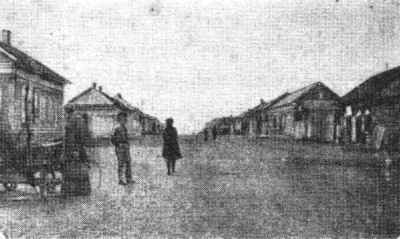
The town's houses, with their wooden walls and wooden shingles, were mostly built out of frugality, using limited means. Its streets were straight, fairly wide, and unpaved. Narrow wooden sidewalks for times of rain, melting snow, puddles, and mud existed only on its main street. On the other streets, the sidewalks existed only for a certain period and disappeared during the harsh winter. They were dismantled and hauled away by people in need of fuel for heating, or maybe by the owners themselves for the same purpose.
On the main street, there were about a dozen different shops, groceries, haberdashery, hardware and the like, two bakeries, and several small shacks whose width was two cubits and their length two. A kind of small shop that served as a source of livelihood for widows with children. The only pharmacy, two hair salons, five or six butcher shops for beef and veal.
Behind the railway station, and as the townspeople used to say, “beyond the line,” that is, the railway line, stretched an area of streets running in all directions, roughly the same size as the Jewish town, but they were inhabited by gentiles. These were laborers, railway workers, and various railway officials (only about six or seven Jewish families lived beyond the line, among the gentiles). There, the Orthodox church stood out, with its gleaming golden cross that caught the eye from afar. Its exterior was generously painted. It was surrounded by a spacious garden with trees and ornamental shrubs and enclosed by a wire fence. This was not how the Catholic Church at the edge of the Jewish town, near the railway workers' neighborhood, looked. It was a simple, elongated, and large-scale building, and if not for the bell tower that rose up, though not to any great height, topped by its humble cross, the building would have given the impression of an ordinary dwelling. Its doors and shutters were kept tightly closed throughout the week, except for Sunday.
In the middle, between the Jewish and Christian sections, the large railway station building occupied an extensive area and
[Page 752]
alongside its many railway tracks. They were always packed with various railcars, loaded and empty, along with two or three locomotives, and sometimes more. They were shunted from track to track, accompanied by loud blasts of escaping steam, whistles, and the shrill calls of the track switch men. Next to the station stood various large bulky warehouses, and workshops for carpentry, metalwork, engraving, etc. A large, two-story garage built of red brick, used for the repair and renovation of locomotives and railcars, which were hoisted up like toys. The water pump, with its water tank, rose proudly to a great height. One and two-story, residential buildings for the essential administrative staff, with the doctor among them. A factory for impregnating railway wooden sleepers with a preservative. Near it stood hundreds of wagons loaded with dry wooden sleepers awaiting their turn for impregnation, as well as sleepers that had already been treated. They were waiting for their transport, a place near or far, where they were needed. It was one of three factories in Greater Russia that supplied wooden sleepers for all the country's railways. Coal storage facilities and cars filled with coal (later, during the war when coal ran out, logs). This was the fuel for the locomotives whenever a train arrived, coal or logs to eat and water to drink.
During the First World War, the railway was under immense strain due to the transport of troops and ammunition to the front. Throughout the day, the sound of hammering, whistles, hissing, and thunderous blasts echoed across the railway station grounds… It was a world of labor, comprising a multitude of workers, clerks, laborers, and professional experts. There were track guards and telegraph operators across all shifts, a community of well over a thousand people. In addition to the local noise, there was the clamor of many wheels in contact with the iron rails, trains arriving, pausing briefly for inspection and resupplying, and speeding off again. They were accompanied by blasts and whistles that pierced the air for great distances, the mighty groans and wails of colossal locomotives, as they sped hastily toward far-off destinations.
Alongside this two-way transport artery, a Sambatyon[1] of workshops, locomotives, express and freight trains came and went in tremendous roar, resided a quiet town of Jews, with all their daily troubles.
Osipovits' land was owned by the town's influential man, R. Yaakov Eliyahu Rivkin, a wealthy Jew, owner of numerous properties and a timber merchant. The town's land was previously a forest that he cut down. Jews began to arrive and gather there, family after family, from the nearby cities and towns (Bobruisk, Berezino, Hlusk, Cholui etc.). They settled at the end of the previous century, drawn by the proximity of the railway and its workers, a source of livelihood. They built house after house, street after street, until, suddenly, an entire town was established.
The town's wealthiest man had a magnificent house at the southern edge of the town. The house was enclosed by a wooden-plank fence, which encompassed an area spanning two city blocks. The fence was solid and quite tall, preventing any prying eyes from peeking inside to behold the expansive ornamental garden, a landscape of lovely pathways, a grove of pine trees, and an orchard of fine fruit trees. A special gardener and his various assistants, who tended to the entire grounds, the vegetable garden, and the coop with its turkeys and fattened geese, lived there in a special house.
R' Yakov Eliyahu built a synagogue for his own convenience, and for the convenience of the neighborhood, situated opposite the street corner where his house stood, on the other corner of the street. Inside, the synagogue was painted in oil paints and adorned with eye-catching decorations.
The “Pristav” and the “Uriadnik” (police officers) were his frequent guests. In the event of a Jew's imprisonment, they immediately came to request his intervention.
R' Yakov Eliyahu Rivkin was known as a philanthropist who supported the newspaper, ha-Zeman [“The Time”]. It was published in Vilna by his son-in-law (husband of his beloved daughter Chana Malka), Feibel Margolin, of the first residents of Osipovits. He possessed extensive knowledge and was an enthusiast of the Hebrew language and literature. Rivkin's support amounted to 75,000 rubles, quite a substantial sum in those days. During the period he backed this literary enterprise, many Hebrew writers received assistance from him.
The author, Sholem Aleichem, visited his home from time to time, and he was inclined to be generous regarding his support of ha-Zeman. Furthermore, he advised him, and tried to persuade him, to sell all his property and, in his old age, to make aliyah to Eretz Yisrael. Had he heeded his advice,
[Page 753]
he could have redeemed a significant portion of Eretz Yisrael and would have ended his life in peace and tranquility, unlike the fate that actually befell him. All his property was confiscated by the Soviet authorities. The house had already been seized during the Polish period for the use of the city's military commandant, and later, the municipal council was established there. Rivkin spent his final days in destitution, living in a small house belonging to one of his former guards.
About half of Osipovits' Jews were various types of craftsmen: tailors, shoemakers, seamstresses, hatters, blacksmiths, knitters, barbers, stove-makers, wooden-structure builders, carpenters, painters, watchmakers, one chimney sweep, carters who transported timber logs from the forests, butchers…
There were two small factories in the town for producing cold drinks in the summer, and for filling beer bottles from barrels arriving by train. A small factory for the production of pearl barley. Two sawmills, along with flour mills, were situated at the edge of the town on either side of the railway tracks. Adjacent to them, additional rail lines were laid to accommodate numerous wagons loaded with timber. Here, various planks and boards were unloaded and loaded, prepared for shipment to their intended destinations.
Some Jews earned their livelihoods outside the town, at varying distances. They worked in forest administration, supervising, managing operations, keeping ledgers, and handling accounts, or as traders in timber, forests, and the like. Others were small-scale merchants who purchased animal hair for use in the brush-making industry and similar trades.
The livelihood of most of the town's residents depended primarily on the railway workers and the farmers from about two dozen surrounding villages, for whom the “city of Osipovits,” as it was officially designated, served as a center.
Apart from farmers, a few peasant women, who came to sell their agricultural produce mid-week due to an urgent need. Every Sunday many villagers gathered in the town center. Some came on foot, especially young women arriving to sell a rooster, a hen, or some eggs. Others arrived in a cart harnessed to a horse, carrying poultry, eggs, a calf only a week or two old, a pig or a piglet (intended for the population living on the other side of the railway tracks). The market had turned into a swirling mass of people and beasts, through which it was difficult to pass. It was filled with the din of talk and shouting, the haggling over the prices, the screeching of unclean animals, bleating, neighing, cackling, and various cries… The farmers sold vegetables and livestock, and bought tools, a lock, a rope, a bottle of kerosene, a liter of salt, sugar, salted fish, and tar for their boots, or new boots.
The young women bought a beautiful comb, ordered high-topped ladies' shoes with buttons, and various stylish ribbons to adorn themselves with for their weddings. Colorful fabric for dresses or headscarves, adorned with various colorful designs. They were treated to vodka by their grooms and finished off with white bread and salted fish that truly revived the soul.
The railway workers who needed a good suit, or a uniform, distinguished by its color and shiny buttons, boots, good and comfortable shoes, a garment or a dress for the wife, found two or three excellent craftsmen, with two or three assistants, who fulfilled the orders to their complete satisfaction. The simpler workers, who were not overly fastidious, found simpler craftsmen. There were also milliners who did excellent work for the railway workers, caps with their various stripes and shiny visors. The peasants, too, found craftsmen who met their requirements.
There were three bakeries that produced premium rye bread, challah, cakes, pretzels, rolls, and the like. There was a special bakery dedicated solely to baking bagels whose owner was known as “Leiba the bagel maker.”
Seven butchers, together with their sons-assistants, supplied choice meat. Each of them possessed a vehicle, a horse and wagon, used for traveling to the villages to purchase livestock, as well as for transporting animals to and from the slaughterhouse. The horses belonging to the butchers, and to a couple of the small-scale traders, were among the best, for they were not subjected to a constant, day-to-day yoke and received an abundance of food. For this reason, they served as an excellent resource for volunteer firefighters during a blaze. The horses would be seized, harnessed to the fire engines and water carriages, and then driven, with little regard for gentleness, to the scene of the danger.
Silence descended after the morning hours. In all the streets it was possible to meet a walker, or p two or three. All the boys were in the cheder of Kalman-Hirshel, the teacher whose wife was a peddler and helped him to provide for the children. She sold colorful fabrics in the villages, as week as from her home every Sunday through the back door every Sunday, a form of deception
[Page 754]
since it was not an official shop. Or the boys were at the home of the fat teacher whose wife was a thin, harried woman (who was often in an advanced stage of pregnancy). She was a seamstress, and her hands were full of work, both sewing and housework or caring for children. Or with the new teacher, a short, thin man with a goatee, who taught without sparing the rod. Or at the home of Raphael the teacher, where he lived with his family. He also served as a cantor, earning an additional two or three rubles a month, a supplement to his meager livelihood.
General studies were taught by tutors, and about ten boys and girls traveled to Bobruisk or Minsk to study in a gymnasium.
In time, Mrs. Lozinskaya, a fifty-year-old widow from Bobruisk, opened a private gymnasium. She was assisted in teaching by her two daughters and three Russian teachers from the railway school.
The amateur dramatic troupe of the volunteer fire brigade brought some life to the town, and after the overthrow of the Tsar, came the period of mass assemblies, freedom of debate and the emergence of the “Bund” and “Zeire Zion” in the town.
The volunteer fire brigade consisted of thirty-five men, most of them craftsmen and butchers. The commander-in-chief was a Russian, a former officer in the Tsar's army with the rank of polkovnik [colonel]. Two of his aides were Jews who had also served in the Tsar's army, though in lower ranks. One was Mendel the baker (Schimnavski), slender, with a mustache curled upward, as if to signify great importance. The second, Moshe Schiper the barber, a fat man with a potbelly and was clean-shaven. Throughout the spring and summer, they conducted drill exercises every week or two, and occasionally a firefighting maneuver. All the townspeople, young and old, came to look and see the spectacle.
This man or another, a quiet man, a tradesman, a cobbler, a tailor, a hatter, a painter or a butcher. In his everyday attire, he appeared quite drab, but his entire countenance was transformed the moment he wore his firefighter. Uniform. A gleaming emblem adorns his cap, which features red stripes, while sparkling buttons and red piping embellish his tunic and run along his trousers. His attire is clean and pressed, his boots are polished to a shine, and his entire appearance radiates dignity. More striking than the regular firefighters were the commanders, who wore an additional item: a thick, braided white cord hanging from the shoulder, or a broad sash running from the shoulder to the waist, a military decoration, and insignia on the shoulder straps. But most striking of all was Bobrovitch, the chief commander. In addition to more splendid uniforms, there were various decorations and different shoulder insignia. His face appeared healthier, alert, cheerful, smooth, and even-featured. He looked as delightful as a honey-cake, for he was unburdened by the struggle of earning a living or the troubles of the Jews, and his entire being radiated deep contentment and complete inner satisfaction.in his gait, his stride, and his supple uprightness.
At the onset of the exercises, he brought the water carriages out of the garage, a structure that, from the outside, looked like a large warehouse. The two fire engines with their long ladders, demolition hooks, and pickaxes were painted a glossy red, and conducted drills, an instructional talk, or a firefighting maneuver. At the commander's whistle, they stormed one of the houses, propped their ladders against it, and scrambled up quickly with pickaxes and demolition hooks, while mercilessly dousing it with water from the canvas hoses of the fire engines.
There were also grand, ceremonial parades, featuring a wind orchestra (brought in from the nearby city of Bobruisk), held to mark some occasion. Roll call, alignment, standing at attention, and marching in formation to the sounds of the orchestra. That same evening, they held a festive ball, or perhaps a play, and concluded with dancing until the break of dawn.
A sudden, wailing alarm, sounded by the solo of a single locomotive, or a duet from two of the train's engines, alerted the fire brigade. In the blink of an eye, they donned their outer garments, put on their hats, and grabbed whatever horses they could find at the market, unhitching them from their carts (for they were dressed in uniforms, much like police officers). They rushed to the fire station, harnessed the horses to the fire engines and water carriages, and sped off toward the blaze.
There were many fires in the surrounding villages, and the firefighters turned out in full force, working strenuously under conditions characterized by the proximity of the houses and thatched roofs. There were instances of fires within the town itself. On one occasion, Zimel Izikovitch's sawmill caught fire, and a year or two later, the sawmill belonging to Yaakov Eliyahu Rivkin, the town's leading citizen. Naturally, they were rebuilt before long.
The most outstanding members of the fire brigade were Efraim the Tailor, a thin Jew with a goatee, slovenly in his ways, and lazy in his profession. He charged in, shouting and speaking in a rapid-fire torrent, leaping into the thick of danger and working like a demon possessed., and Yashke Klaper the painter.
The drama club performed in the fire department
[Page 755]
garage once or twice during the summer. The entire town knew in advance what the play was about and who the actors were, and everyone looked forward to the event with great anticipation. A single notice in the town center was enough for everyone, from young to the old, already knew every single detail.
There was no need to travel to the venue, as there were no distances there. Two hours before the start, all the town's children waited around the building and were forced to settle in to observe what was happening from the outside. They watched the festively dressed arrivals enter and disappear inside the hall, and they dispersed to their homes as the performance began.
In time, things changed. The circle dispersed, traveling troupes, such as the Liss brothers from nearby Bobruisk, began to arrive, but not very often.
ith the February Revolution, the essence of Zionism was revealed to us, the younger generation in Osipovits for the first time, and Herzl's vision became immediate and tangible. Suddenly, we were confronted with freedom of speech, freedom of opinion, and mass assemblies. There were two political parties on the Jewish street: the “Bund” and “Zeire Zion.”
It should be noted that about fifty percent of the members were craftsmen and manual laborers. At the head of the “Bund” stood serious intellectual figures, such as the student Kosovsky, from the city of Kaunas, who had arrived together with the Jewish refugees during the war. The student, Frindland, who arrived here (or intentionally from the “Bund” center) from some large city. He earned a living by giving lessons in Russian and general subjects to students preparing for the first or second grade of the gymnasium. He had a sister, a dentist, who supported his actions. There was also a homeowner, not necessarily a craftsman, who was a member of the “Bund.” He was a well-to-do homeowner, the owner of the only tailoring workshop in the area, in whom the flame of the “Bund” burned with such intensity that it consumed his very soul…
The “Bund” managed to recruit slightly more than two dozen members from among the salaried employees. In the ranks of the Zionists, there were both craftsmen and wage earners who lived off their labor. Moreover, their numbers grew following the establishment of “HeHalutz,” which brought the voice of the Labor movement of Eretz Yisrael, which aspired to create a class of workers and peasants in Eretz Yisrael.
Almost all the students who studied far away, in Moscow and Petrograd, became interested in Zionism for the first time. However, upon encountering the propaganda regarding the “new world” that Communism promised to create, they found the idea appealing, viewing it as the only thing capable of bringing redemption to humanity, and to us Jews as well. There were 5 from the Lukomovitch family, four from the Berkovitch family, Azriel Melamed, Katz, Yoshe Berman and others.
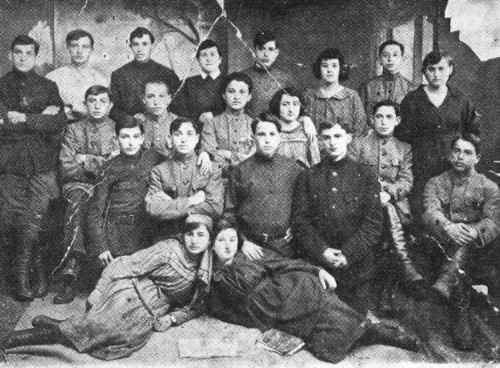
At the head of “Zeire Zion,” which later became “HeHalutz” organization, stood the student Leizer Ribin, who, due to asthma and changes in the regime did not continue his studies. He remained stuck in the place and worked as a chief clerk at a government supply agency. It seems as though a higher power decided that the grandson of one of the very first founders of Osipovits, R' Moshe Ribin, will be the leader of the revival movement in the town.
R' Moshe, Leizer's grandfather, was a hardworking Jewish man, father to twelve sons and one daughter, who earned a meager living by hauling stones with his horse and cart for the construction of the railway. As the sons grew older, they demonstrated a keen ability to navigate their surroundings and a talent for practical execution, whether in contract work, logging, or similar endeavors. They earned a great deal of money, ventured into the timber trade, and became affluent men. Fate has shown us kindness by leaving us this Leizer as a survivor. He is a man of great stature in the spiritual sense, possessing a broad and profound grasp of matters in general, and of the “Jewish question” in particular. A kindness was shown to us, a downtrodden youth, crushed in spirit, who felt their own rootlessness and experienced firsthand the hatred of the Gentiles seething all around. By bringing us the light of the Zionist movement's vision, by explaining the “Jewish Question” to us, and by opening our eyes to the fact that the promises of the ruling party are nothing more than a deceptive mirage of the promises of the ruling party. In time, those who have distanced themselves from us, from our path, will come to realize that they have stumbled and strayed onto a misguided course; they will then face their judgment, the verdict of history, which knows no mercy.
Leizer had done his utmost and organized a sort of seminar to provide us with a foundational education in Zionist knowledge, ensuring that we would possess a solid, unshakable grounding. To this end, he planned an entire series of lectures on various topics, a kind of political knowledge relevant to our path toward the building of Israel. Everyone was required to know, study, and memorize all of this, to master every detail and date, to provide justifications and explanations, and to answer the questions: why, for what reason, and to what end? The underlying reasons, the objective, and so on and so forth.
[Page 756]
The lectures included the Autoemancipation by Y. L. Pinsker, the “Hovevei Zion” movement, Bilu[2], Herzl and his call, his Medinat HaYehudim [“The Jewish State”]. The establishment of the First Zionist Congress in Basel, along with all subsequent congresses and the significance of each one. The False Messiahs movement, each messiah and his era. The establishment and essence of Keren Kayemeth LeYisrael [JNF], and the philosophy of Ahad Ha'am [Asher Zvi Hirsch Ginsberg]. Knowledge of Israel, and in addition to all this, ongoing Hebrew lessons in small groups.
A highly impactful initiative took place within the premises of Beit Ha'Am [community center] of the “Tzeirei Zion” movement, which was housed in a private residence. In time, Beit Ha'Am moved to a building where no partitions had yet been installed. This made it possible to set up a hall and a stage, to organize parties, to stage plays and perform with the Zionist choir.
Staging a play or organizing an evening event that included a one or two-act dramatic piece–complemented by a choir, a string orchestra, and recitations, was a cultural event that provided great satisfaction and spiritual nourishment to the townspeople. Once, a “living picture” was staged based on the Yiddish song by Warshawsky about the harvest in the renewing Eretz Yisrael, that the harvesters sing it as they work, taking great satisfaction in their good harvest and in their own lives. The song ends with these words:
Strike, O sun, strike with blazing heat.
It sends its blessing
The standing crop, behold, is abundant.
Do not, O brothers, do not recoil!
Among those participating in the live picture of the harvest on stage, who were dressed in neatly pressed blue-and-white attire rather than the work clothes of farmers, was one of our own members, Yehoshua Ritov, who was among the first candidates for making aliyah. He fulfilled his role fittingly and believed, with complete conviction, that he would be among those who work the soil of our country and nurture it, that he would make aliyah to Israel, work there, and defend it.
On the walls of Beit Ha'Am, slogans were displayed, painted in large, eye-catching letters running along the upper part of the walls: “Zionism strives to create a safe refuge for the Jewish people in Eretz Yisrael”- in Hebrew and also in Yiddish: Im Tirtzu, Ein Zo Agada [“If you will, it is no legend”] under the picture of Herzl. “The people of Israel live,” “If I am not for me, who will be for me?” and more.
Ours was the only choir in the town. We also had a string ensemble of five people, which, though not very large, brought us great pleasure with its performances.
We had an artist who painted posters for us. Moshe tried, to no avail, to offer him a generous payment. He was a sixteen-year-old student, and he needed the money. But, to paint an announcement for the “Bund” was a forbidden matter, idolatry and a vile betrayal for him. However, how great was the satisfaction when he saw his illustrated letters speaking to the hearts of the Jews: Jews, be aware of what lies before you; engage in a reckoning of your souls…
We had a drama club, the only one for a long time. We were the only ones who put on a stage performance for the town.
Public meetings organized by the Zionists, held at the fire station or the old synagogue, would take place amidst high tension between the two rival camps. Members of the “Bund” arrived, led by their leaders, to cause disruption and frequently interject. They shouted that Zionism is a disease. One speaker took the stage after receiving permission to speak from our chairperson. Here are a few words she said: “What will you do there in Zion? The ground there in Zion is hard, and you will have to cut into it and break it open with axes.”
Leizer always remained composed amidst the shouting, the disruptions and the various interjections. He was calm and self-possessed, for he was brimming with knowledge and confidence in his own strength. He stood dauntless, even welcoming the interjections and the interventions of his opponents in the debate; he would take the floor to refute their lies, reduce them to nothing, and expose them to infamy.
Guest speakers from outside also visited us. The one I remember was the member Eliyahu Dobkin. He once provoked the anger of the band members with a witty remark directed at them regarding their disruptive behavior. They pushed toward the stage, eager to lay hands on him, but there were others in the crowd, loyal to Zion, with stronger hands, and they did not let them get close.
Initially, the “HeHalutz” organization was established as a cell comprising several members from “Tzeirei Zion,” on the initiative of Yosef Trumpeldor in Russia. Three of his letters, concerning “HeHalutz,” were kept in the Zionist archive in Osipovits. The archive was lost after one of the members buried it in the ground during the searches and arrests . After the storm subsided, it turned out that he had not properly secured it against decay.
During the early stages of the “HeHalutz” organization, one of the members
[Page 757]
traveled on a special mission to consult with Trumpeldor regarding these issues during one of his visits to Minsk.
|
|
Apart from Leizer, the activists in “HeHalutz,” previously “Zeire Zion,” committee were: Hillel Wolfson and Yekutiel Levinson, Yahushua Ritov and Chaim Glenson. All of them are in Israel. In the following group: Bila Gittelband z”l, Nachman Gloman, Aryeh Zwik, Leah Nimark.
“HeHalutz” branch in Osipovits was among the first in the entire district to initiate practical activity, such as securing manual labor for some of its members in carpentry, welding, and logging the forest alongside gentile laborers. Two were assigned at the matzah bakery to turn the machine's wheel. The branch was also among the first to mobilize all its members to work in a vegetable garden, fertilizing, plowing, preparing and sowing garden beds, irrigation, care until harvest time and guarding. The garden produce was sold and eagerly snapped up by housewives, as there was no vegetable market in the town.
After the imprisonment of an entire meeting, which took place in secret at a matzah bakery that stood empty from Passover until Purim, five members were arrested and imprisoned (two of them are in Israel: Shmuel Katznelson and Shmuel Wolfson), and the proceeds from the garden served to support their subsistence and maintenance there. From time to time, we sent them food parcels and cash.
The garden also served as a source of encouragement as we watched it thrive, bloom and grow. The joint work also served as training for a life of shared work in Israel, training for life on a kibbutz, in accordance with Trumpeldor's teachings.
The Zionist truth prevailed. “HeHalutz” organization was extensive and strong. However, due to the power of the GPU [State Political Directorate], by means of arrests, interrogations, searches, and persecution, the flame gradually died down. Two members were exiled to distant, cold Siberia (Nachman Gelzman and Aryeh Zwik). The member, Leah Nimrak, remained imprisoned and languished in jail, far from her home, enduring torture during interrogations for many months until her release.
The Jewish Komsomol, which took control of the town with the help of the GPU, set up its cultural center at the home of the Orthodox priest in the Christian Quarter next to the church. A short time later,
[Page 758]
the cultural center was moved to the town's new synagogue, which was expropriated for this purpose. In time, the synagogue went up in flames, along with the new, impure new doctoring that had been placed inside it. In those days, Jewish pioneers were beaten by gentile youths while bathing in the river, which was located two kilometers from the town.
And one young man, a tailor from the town, was out for a solitary, casual stroll through the fields. A young poet seeking inspiration amidst the wheat, imagining that he was walking in his homeland, was seized by several farmers. They flogged his bare skin in the very same spot where the rabbi had whipped him on the bench in the cheder when he was a boy. It was a political lesson, a warning for the future.
With the spread of gangs and instances of raids on towns resulting in mass slaughter in them (Parychy, Pukhavichy etc.), a self-defense was organized in the town. Thanks to the efforts of the member, Yisrael Ritov (who was staying in the town at the time, before moving to Poland) with the authorities in Minsk, the capital of the Belarusian Republic, we obtained twenty-five rifles dating back to the era of Peter the Great. Their barrels did not feature a rifled bore, but rather a straight bore, and were called Berdan (compared to Vintovka). These rifles held only a single round in the chamber and required their own special ammunition, which we received in limited quantities.
The defense commander was a Russian man who was a member of the Communist Party. Representing the town was Chaimke Aiziks, who was an active member of “HeHalutz” and “Zeire Zion” committees. Through his aides, he notified those who were scheduled to appear that evening at the appointed time at headquarters, at the arms' depot, to head out for guard duty.
In addition, he went every day to the office of the garrison force commander (who was stationed there to guard the railway station) to receive from him the nightly password. It given in a whisper and in secrecy to the pairs who left to stand guard on the outskirts of the town.
Sometimes, two soldiers from the garrison force came for a visit at night. They walked along one of the streets and returned to their post. The constant guard duty was in the hands of the Jews.
At that time of panic and fear of the gangs, and the beginning of the organization of self-defense, military exercises were organized in the town's streets. They were led by Shepsil the butcher, who was a Nicholas soldier[3], and Mendel, the baker who served in the Russian army during the First World War.
In this way, bearded Jews, shopkeepers and artisans dressed in long tunics, learned to stand in a line, to advance, and to spread out in a chain formation, “drop to the ground” etc., in the Russian language, as befitting, well-known and customary. Yet these were maneuvers born of a desire to be strong, to do something, for, in the end, they did not hold their weapons in their hands during the maneuvers.
It was a period that left a somber memory in the heart, depression and soul-searching for our bitter fate.
In the center of the town, the old synagogue towered above the other houses. Its gray roof, mottled with patches of moss, had the symbol of a sacred place in the Diaspora. Here they came to weep before the Holy One, blessed be He, over the destroyed Temple and the bitter exile; and an eternal prayer was ever on everyone's lips, that He save them from all their troubles. This was the place for the community's notables and leaders. Most of the common people came to the old synagogue where they felt comfortable. They could hear words of Torah, a Talmud lesson, a study session on Ein Yaakov, or a reading of the Mishnah delivered by R' Yakov Simcha, who spoke words of wisdom and filled the Jewish heart with light. There were always two or three yeshiva students there, and no one knew where they had come from. They ate yamim[4] in the town and studied day and night. Wandering beggars also came there, and on Friday evenings they were taken in by local homeowners for the Sabbath evening and midday meals. It was the center for providing support in times of distress to the needy among the local poor, a place for acts of loving-kindness etc. This was the place of the rabbi, the ritual slaughterer, R' Eliyahu the watchmaker who was considered to be one of the “Lamed-Vav Tzaddikim” [the thirty-six hidden righteous ones]. He was constantly immersed in prayer and study, followed closely in the rabbi's footsteps, trailed after him, and drank in every single word that he said with intense thirst. Itche the bathhouse attendant, the doctor, and all those who attend to public needs were also there. The second synagogue was, as mentioned, Yakov Eliyahu Rivkin's new synagogue.
There was a minyan of craftsmen who were not satisfied with the two synagogues, where the “East” and the best places outside the east were all taken. Their minyan consisted only ordinary people, not wealthy individuals, people of high lineage, or prominent homeowners. This minyan was located at the edge of the town, and for those who prayed there, it was worth adding another fifteen minutes of walking to enjoy praying in their own corner.
In time, in the first years of Soviet rule, these Jews established a synagogue for themselves (at the initiative of David Shlomo Katzenelson, a Jewish carpenter who was a
[Page 759]
carpentry contractor for the railroad. He also set up a mechanized matzah bakery in his home, whereas previously, the Jews had to endure the arduous labor of baking matzah themselves in their own home ovens). The Jews of the town called this synagogue “the synagogue of the workers and the farmers,” hinting at the rule of the workers and the farmers. It seems this synagogue did not wish to bear this name, and it went up in flames five or six years after its establishment.
Another minyan, in other words, a kind of small synagogue in a private home, used primarily on the Shabbat and holidays (much like the previous one), was located at the house of the second wealthy man (who did not even come close to the stature of the first). R' Zimel Isacowitz, owner of the sawmill and the flour mill on the other side of the railway tracks, so that he would not have to trudge a long distance from his home on the Shabbat and holidays. He appointed Kalman Hirshel to be his shamash and cantor. He was an elderly man who still possessed his full strength, a burly Jew and a fisherman. His fame spread among all the people in the surrounding area, in every village, and even reached the ears of the nobleman, thanks to his heroic deeds, nobility of spirit, and integrity. In his old age, he did not turn down the opportunity to show his strength and prowess in reading the Torah (and the scroll on Purim), as a cantor and reciting “He who blessed” appropriately and more. Such delight, coupled with a multitude of mitzvot related to sacred service, and all the more so when accompanied by a modest livelihood, was truly a wonderful thing. It was a great privilege that fell to the lot of a Jew such as Kalman Hirshel.
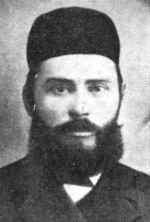
R' Yakov Simcha Ritov was a descendant of rabbis who had held the rabbinical seat for fourteen generations. In his youth, the rabbi wished to cast off the yoke of the rabbinate, the yoke of generations. He wanted to be a kind of Yochanan HaSandlar [“Yochanan the Sandalmaker”], the integration of Torah study with manual labor. He set out to learn tailoring, but the endeavor did not succeed. The chain of generations held fast to him, refusing to let him break away. A new settlement, Osipovits, began to grow and develop; new houses appeared, and more Jews arrived. The community grew, yet it lacked a rabbi to keep the flame alive and exalt the Torah. His pangs of conscience did not allow him to resist the demands of Torah scholars from the outside. Arise! Continue the chain, continue bearing the yoke of the Torah…
The rabbi was lean, taller than average, and his face was adorned with a medium-length, dark-brown beard. He was full of seriousness, and the sorrow of the Diaspora weighed upon him, the sorrow of generations. The persecution of the Jews and their suffering gave his soul no rest. Gone were the days of hatred of Beilis and the days of war arrived. Jews were expelled and stripped of everything, forced empty-handed into freight cars along with their children, wives, the elderly, the sick, and women in labor. They were transported deep into Russia, far from the front, like cattle, for the Tsarist regime viewed them, the Jews, as the cause of its failures at the front. They were spies, the enemies of Mother Russia.
Then, the rabbi found no rest or peace. He organized the collection of loaves of bread and challah, potatoes, sugar, and various other food supplies, and distributed them to the starving refugees while the trains were delayed at the railway station. In a time of dire need, when supplies had run out, permission was granted to dig up potatoes from the gardens on the Shabbat, in order to sustain the lives of suffering Jews. Furthermore, at the risk of his own life and with his active participation, he removed sick individuals and women who had just given birth from the train cars, saving them from certain death, despite a strict prohibition issued by the authorities.
As regimes changed, he risked his life more than once to save the lives of others. On two occasions, he was led out to be executed by military personnel because of these interventions, but he was saved by a miracle. The rabbi felt the pain of his community, as well as the pain of the entire Jewish people. Throughout the region, he was known for his radiant personality, the greatness of his spirit, and the richness of his soul.
During a period of suffering and persecution, in the days of Polish rule, a conference of community leaders from across the entire district took place in Minsk, where they gathered to discuss the situation. Representatives from many communities were present, and for this reason, speaking privileges were limited. R' Yakov Simcha could not give expression to the anguish in his heart or describe the situation within this framework. He began his remarks by noting how fortunate the distinguished conference leaders, Jews from Minsk, were to possess watches. But what was he to do, now that his own watch had been stolen? He then launched into a spirited discourse, skillfully weaving in speeches and teachings of the Sages to illuminate his points and ensure they would resonate in the hearts of his listeners. The community leaders of the big city did not stop him because they were unaware of just how dire the situation was in the provincial towns.
On Shabbat eve and holidays, the streets were empty. Everyone was in the synagogues. From the old synagogue shone the light of the large kerosene lamp, unlike on weekdays, when prayers were usually conducted by the light of the candles at the lectern and a flickering lantern near the table, close to the stove. The synagogue was packed to capacity. Every seat was taken, and people stood crowded together.
On Yom Kippur, the synagogue is wrapped in the sorrow of prayer
[Page 760]
and supplications for the community and the individual. Afterward, came the holiday of Sukkot, which instills a unique festive atmosphere characteristic of the autumn. On Simchat Torah, the prayer is chanted in a special melody that evokes an uplifting mood.
On the bimah[5], the Cohen, R' Itche, the bathhouse attendant, takes his place to the right of the table, as is the custom year after year. An old man, about 65–70 years of age, whose vigor and strength have not abated. Tall and thin-bodied, his gaunt face framed by a sparse, small beard, whitened by advanced age and hardship. His black cloth hat had slipped back, owing to his intense enthusiasm. A fabric undershirt, the only one on his skin, is clean and spotless, and over it a sirtuk[6], worn out from the passage of years. He looks like a prince. And to us, the children, it seemed that was the appearance of a High Priest in ordinary times, when the Temple was still in existence. The shamash handing out the verses of Attah Horeita Lada'at [“You have been shown to know”] with an announcement and a festive invitation. Each of the invitees ascends the bimah and reads his verse, and when they reach the Cohanim verse, there is no formal invitation, nor do they wait for an honor to be extended. As a matter of course, R' Itche pounces on it like a lion, as if it were something of his own, bound up with his very soul, belonging to him and him alone, and no one is more important than him. And he reads in a way that differs vastly from his predecessors, from his toothless mouth, in a loud and powerful voice: “Let Your priests be clothed with righteousness and let Your devout ones sing praises.” His voice rolls out in a great echo, as always, year after year. And we, the children, were certain that every single one of his words rolled upward and was carried higher and higher, all the way to the Throne of Glory. For his voice was powerful, thundering like thunder, with great power, and from the depths of his heart. We believed that his voice was bound to reach the very dwelling place of the Creator of the world.
And now the hakafot[7] begins: Jews circle the bimah in a kind of procession held in honor of the Torah. In honor of the Creator of the World, who gave us his Torah, which they hold with love and reverence, as if to say: “Behold and see, look down from heaven and see,” and who doubted that He does not look down from on high and see? How we rejoice in it, in Your Torah, a Torah of truth and justice, this Torah You have bequeathed to us… and not the slightest, faintest glimmer of doubt, nor any impulse to challenge or complain regarding the Diaspora and the suffering of the Jews, ever crossed anyone's mind.
At the head, walking slowly, the reader recites from the prayer book verses in honor of the Torah, which is light and delight, and which Moses bequeathed to us from Mount Sinai.
Darkness all around. A heavy cloud descends upon the Jews' persecutions and troubles, yet the Jews are the chosen people and during Simchat Torah it is a commandment to rejoice. You must scrub, wash, polish, and thoroughly wipe the glass of the large kerosene lantern, and light many candles, let there be light. They forget everything. Dancing, spinning, their arms embracing Torah scrolls. Hands from all around reach out toward the Torah scroll, touching it, then kissing the fingertips that made contact. Women, young women, children, and babies…
And they dance near the Holy Ark after each hakafa: “Bam - Bam-Bam… “Rejoice and be joyous on Simchat Torah.”
And here is R' Yakov Simcha, contributing his share, indeed, the main part of the joy. A time of trouble for the Jews? Everything faded from his mind, as if it had never been. He stands with eyes tightly shut, communing with the holiday prayer, lost in deep, inward reflection… Maybe he did not do enough for the God of Israel, for the sake of His Torah. It is a tree of life for those who grasp it, He bequeathed it only to us, the chosen people?
And here, as if it had suddenly appeared out of thin air… the familiar annual circle - the rabbi dances his dance with the children, the school children.
He is holding the Torah scroll in his arms, pressed firmly against his heart. Behind him, to his right and to his left, the children, a single, unified block, R' Yakov Simcha and the Jewish children. Everyone is holding onto one another, their hands clasped tightly together as a single unit. The rabbi's face expresses deep devotion and spiritual elevation, and his eyes are half-closed due to the magnitude of the event and its significance. Simchat Torah, and the children, school children who are raised in the spirit of the Torah for mitzvot. The next generation. “So that the light of Israel shall not be extinguished.” “Am Yisrael Chai, the chain has not yet been broken…”
The holy flock! The rabbi cries out and calls, Holy flock! In other words, he thinks and hopes in his heart, Master of the Universe, for the sake of these pure souls, have mercy upon the Jews, whom You brought out of the land of Egypt, to whom You gave the Holy Land, and from which You subsequently exiled them. Now the situation has become unbearably difficult. Have mercy on the Jews. Grant them the right to exist and a life of subsistence. Do not afflict them with various decrees, time and time again. Protect them, these pure little goats, from the predatory wolves that bare their tongues, seeking to swallow them alive. Guard them until the Redeemer, the Messiah, will come. “Have mercy, please, upon the children of Israel Your people.” “You brought them out of the land of Egypt to serve You in truth.”
- Tzeigelach [little goats] me-h-h - dozens of mouths of innocent, tender children, pure and spotless souls answer all at once.
The rabbi dances, little ones hold onto him, he dances and praises: Master of the Universe, act for the sake of the schoolchildren. What was their sin, the holy flock? And he hovers in the upper worlds, amidst the elevation of the soul and forgot what around him. Here he unites with the God of Israel, speaking to Him, whispering his pure prayer: “Master of the Universe, act in Your abundant kindness, for it is great.”
[Page 761]
But, amidst this swimming dance in the upper realms, surrounded by waves of children pressing in from every side, he faltered slightly, slipped, and one of his feet gave way…What is this? The rabbi is falling, with the Holy Torah in his arms? The breath stops among the worshipers, who are dancing and rejoicing in the joy of the Torah.
He would be forced to, God forbid, fast for forty days and forty nights.
But no, no! The rabbi sank onto one knee, he sank down, then steadied himself, and the Torah came to no harm. He rises and continues his dance with even greater intensity. Dancing before the Holy One, blessed be He: “Master of the Universe, do it, if not for our sake, then for the sake of the innocent schoolchildren. Act, O Lord, and save us, please.”
The rabbi, who had always helped his community in times of distress and served as a shield for them, succumbed to typhus and passed away in the prime of his life and at the height of his strength, at the age of forty-three. The grief over his death was unbearable; from the young to the old, women and children alike, the entire town accompanied him on his final journey to his resting place.
They carried him on their shoulders, and a cantor and singers walked after his coffin, chanting only a single, mournful verse: “Righteousness shall go before him…”
Far, far, outside the town, he was carried to the cemetery, and there he was laid to rest with profound sorrow by his congregation, now orphaned from their spiritual father and their sole pillar of support.
The rabbi was laid to rest, never having lived to see the fruits of his labors. Yet, a great merit fell to his sons and daughters, who made aliyah to Israel and were among the builders of the country and its courageous defenders. His youngest son, Gershon Ritov, wrote a glorious chapter in the history of the defense of the population from murderers and in the War of Independence. One of his grandsons, Yakov, named after his grandfather, was among those who risked their lives to sink an Egyptian ship that was approaching the shores of Israel during the War of Independence with the intent to destroy us.
The October Revolution arrived. Times changed, the regime changed. The Poles arrived, then Bolsheviks again, Poles once more, and then Bolsheviks again.
Battles, shells, bombs, and casualties, casualties from shells, from the bullets of combatants, and casualties following the conquest.
During the lifetime of the rabbi, R' Yakov Simch, were murdered R' Yeshaya Levanda, R' Leib Meboroza and the young man Leizer Betzer, Zelia the burly blacksmith and another one along with another that the men of Poznań sought to cut off his beard with a drawn sword. Along with his hair, a portion of the skin from his face was also torn off, and he died of blood poisoning.
With the return of Soviet rule, fate intervened and following a long period during which the community was left without a spiritual leader, a rabbi was brought in to fill of the late rabbi's place. He stayed in the place for a short period and set out to fulfill his mission in America, following a journey marked by hardships and dangerous routes. He was one of the scholars steeped in the Torah, whose brief stay in the town brought healing to the wounded hearts of Osipovits' Jews.
After the rabbi's departure, the town remained without a rabbi for some time, until fate brought Rabbi Zwik, may he live for a long and good life, Amen. He served as the Rabbi of Osipovits for about four years and taught the Torah and tradition with perseverance and dedication. Through the power of his inspiration, the rabbi strengthened the hearts of the Jews in their faith. The old synagogue was always full, much like it was in the days of R' Yakov Simcha during his sermons on the Shabbat.
Rabbi Zwik merited to make aliyah to Eretz Yisrael. Four of his sons are among the builders and defenders of the homeland. One of his sons, Aryeh Zwik, was among those exiled to Siberia for his work for “HeHalutz” in Osipovits.
The town lived its life in the shadow of an economic situation that had taken a turn for the worse, with no salvation in sight.
During the second, third, or fourth watch of the night, a Jew awakens, he cannot fall asleep… What is this terrifying siren? Could it be an air-raid siren?
Danger to Jews…
But where to flee?
The people of Osipovits forgot Leizer's sermon, he explained Herzl's prophecies time and time again. He drummed it in, over and over, putting the words into their mouths, hammering them into their heads: we are on the brink of the abyss, on the mouth of a volcano's crater. Herzl spoke, and Leizer explained, and repeated and explained again, and spoke words of rebuke.
And suddenly, the decree struck, swift and unexpected. A breach erupted like a storm, rolling to Osipovits. Hitler's soldiers arrived, halted in the center of Osipovits and stood their ground, gazing with the terrifying eyes of beasts about to pounce upon their prey.
Jews! Jews standing tall, just like all other human beings on earth… and madness entered the very marrow of their bones. They stormed in, tortured and killed, committing atrocities in a state of frenzied madness, and unleashed upon them the full essence of their sadistic souls. As written in Hitler's doctrine: to kill God's people, to torment them, and to intensify their suffering, and the more you have, the better.
Abandonment was done with God…
Translator's footnotes:
[Page 762]
Translated by Sara Mages
R' Yakov Simcha Ritov was born in 5632 (1872), son of the Rabbi of Pohost near Berezina on the Berezina River. A descendant of a rabbinical dynasty, whose genealogy leads to the Ritba [Rabbi Yom Tov ben Avraham]. He studied at the Volozhin Yeshiva, after its closure by the authorities, in Lida before a yeshiva existed there. There, he was the devoted student of HaRav HaGaon Y. Y. Reines, who ordained him as a rabbi. The student admired his rabbi, and the rabbi loved his student, and this bond of love and admiration remained between them throughout their lives. The student
|
|
visited his teacher even after he had begun serving as a community rabbi. And the rabbi, who was famous in Russia and throughout the Diaspora, also came to visit his student, and his visit was a great celebration for Osipovits and its surrounding area.
Rabbi Ritov was a renowned scholar, and all the rabbis of the surrounding area had the privilege of learning Torah from him. He was also a learned man. Driven by a thirst for knowledge and aided by a memory that never forgot a thing, he delved deeply into a wide variety of subjects and attained complete mastery over them. He knew all the Hebrew literature across all its generations and branches, including poetry, and possessed a remarkably beautiful Hebrew style. He was also well-versed in Russian literature and had a command of the language and extensive knowledge of history, geography, and mathematics.
The rabbi was an active Zionist. He absorbed the idea during the period of Hibbat Zion in Volozhin, among a group of yeshiva students that included Hayim Nahman Bialik. His Zionism took on a solid, definitive form in Lida under the supreme inspiration of Y. Y. Reines. With the emergence of Herzl's political Zionism, he dedicated himself to it with absolute devotion. Ahead of the First Zionist Congress, he purchased three Zionist Shekels[1], one in his name, in the name of his wife[a] and the name of his two-year-old eldest son. Since then, he purchased Zionist Shekels in preparation for each congress, corresponding to the number of people in his household. He was active in distributing the Shekel among all the city's residents, securing subscriptions for shares at the Jewish Colonial Trust, raising funds for Keren Kayemet LeYisrael [JNF], and teaching Zionist doctoring in public.
In 1902, he participated in the famous Zionist conference in Minsk. For many, in Osipovits and its surrounding area, the rabbi's eulogy for Herzl at the memorial gathering in the synagogue was long remembered. The day after Herzl's passing, the entire population of the city took part in a memorial gathering. They were deeply shaken by the rabbi's words regarding the state of the nation, the movement for redemption, and the tragedy of Herzl's death. It was a quintessentially Zionist speech, and the echoes of his words reached as far as Bobruisk.
From his first day in Osipovits to the last days of his life, the rabbi stood at the head of his community as a father and patron, elevated above the rest by virtue of his exceptional qualities and noble attributes. He was the one who established and built all the public institutions and engaged in them faithfully. He sat days and nights at the homes of the sick, climbed on the roofs of burning houses alongside the firefighters and participated in the extinguishing of the blaze. Together with his righteous wife he engaged in giving charity in secret. Throughout his life, he remained destitute, for every small coin that came into his hands was immediately passed on to someone in greater need than himself.
His entirety was love for the Jewish people and love of humanity. One
[Page 763]
of the most illustrious chapters in his life, a life marked by significant achievements, was his work assisting refugees during the First World War. Most of the refugees who were expelled from the regions of Courland were transported via the Libava–Romny Railway, one of the major arteries of the Russian rail network. They were transported to Kaunas, Vilnius, and the central and southern provinces, and along this arduous journey the convoys stopped for an hour or two, or even longer, at the Osipovits railway station. Before the arrival of the first convoy, the rabbi was notified in advance by a telegram from the community activists of Minsk. And this was the practice until the end of the expulsions and the convoys. As fate would have it, the first convoy was due to arrive in Osipovits in the early hours of Shabbat morning. The rabbi went out to the city, summoned the residents, and instructed them to prepare whatever they could to welcome the refugees. When it became clear that the prepared food was insufficient, they were permitted to bake and cook, as this was a matter of saving lives. And so it was. As the train arrived, carrying dozens of freight cars packed with refugees, including men, women, and children, exhausted and tormented by the hardships of the journey, hunger, thirst, stifling conditions, and despair, the Jews of Osipovits, under the order of R' Ritov, rushed toward them. Under the leadership of R' Ritov, they fed them, gave them something to drink and showered them with an abundance of love and brotherhood. Dozens of refugees were secretly taken off the train cars and taken to the town. Then the competition began, everyone insisted on housing the refugees in their homes. The convoys arrived in rapid succession, one after another, and the rabbi set aside all his duties and occupations, devoting himself entirely to aiding the refugees. It reached the point where he joined the convoys and accompanied them over great distances, as far as Penza in central Russia, and even as far as Tiblis in the Caucasus.
And those days were days of profound distress, the days of the First World War and everything associated with it and stemming from it. Death and destruction, ruin and revolutions, hopes, disappointments, and despair, and so on and so forth. The same was also in the small world of Osipovits, which fought for its existence and for the lives of its Jews, and at whose gate stood the rabbi.
1919, after numerous battles, the city fell into the hands of the Poles, to the notorious men of Poznań. Immediately, acts of destruction, looting, rape, and a pogrom began. It was reported to the rabbi that one of the local Jews had been taken to the headquarters of the occupying army to be hanged. With all his might, the rabbi rushed to the headquarters to plead for the Jew's life, but he did not succeed. Instead, he received what he deserved for his actions: he was beaten, his beard was cut off, he was humiliated before a large crowd and sent away.
1920, the city was once again in the hands of the Poles, or others. A Polish battalion, which deserted its camp, joined the Red Army and on its way captured Osipovits and carried out pogroms. The rabbi hurried to the scene and arrived at the shop where the rioters were rampaging, looting everything they could lay their hands on. The rabbi stood up to them and declared: “I will not allow the lives of honest people to be destroyed!” The Poles immediately fell upon him, bound him, and took him to headquarters: we have brought a criminal, one who rebels against the authorities! A trial was held on the spot, and a death sentence was handed down. The news spread through the entire city with lightning speed, and throngs of people, Jews, Russians, and Poles alike, flocked to the headquarters, declaring: This atrocity must not be committed. The rabbi must not be murdered! The railway stationmaster, a Christian named Bobrovich, approached the commander and said, “Shoot me, and kill the rabbi on my body!” The occupiers were deterred, but not completely. They replaced the sentence with flogging, and so they did.
The humiliation took its toll. The rabbi was overcome and fell ill and with his remaining strength, he continued his activities.
The regular Polish army recaptured the city from the Red Army, and immediately, as was customary, began acts of looting, searches, and the arrest of individuals suspected of communism. Eleven “suspicious” young men were arrested and taken to headquarters. They faced the threat of execution. Once again, the rabbi rushed to the headquarters. A lengthy conversation took place between him and the commander, whose name was Kulesh. The detainees were released and returned to their homes; as for the commander, about whom it was whispered that he was of Jewish descent, he became deeply attached to the rabbi and was one of his admirers. There was no request from the rabbi, whether small or large, that the commander did not hasten to fulfill.
During that period, a gathering of community representatives from the Polish-occupied territory took place in Minsk. At the heart of the gathering were the words of Rabbi Ritov, who recounted everything that he and his community had gone through. R' Nissan Telushkinm, the Rabbi of Dukora wrote (in the book “Pride of the People,” Minsk): “As Rabbi Ritov stepped up to the podium and uttered his first words, all boundaries between those present were blurred. A heavy cloud descended upon the hall; every face darkened, and the delegates, old and young alike, wept bitterly. And the speaker himself did not shed a single tear. On the contrary, his speech, filled with pain, sorrow, bitterness, and protest, was laced with a subtle humor that only intensified the horror of his shocking account.”
It was his last speech. Shortly after that he fell ill, and on the following day, 7 Tamuz 5680, he died in a state of holiness and elevated spirituality.
All the townspeople, both Jews and non-Jews, took part in his funeral. Many came from the surrounding area, and even from far away. A heavy mourning descended upon Osipovits, the crown had fallen from its head.
His second wife, Fruma-Leah made Aliyah (with all her family) to Israel and here she passed.
Translator's footnote:
Original footnote:
|
|
JewishGen, Inc. makes no representations regarding the accuracy of
the translation. The reader may wish to refer to the original material
for verification.
JewishGen is not responsible for inaccuracies or omissions in the original work and cannot rewrite or edit the text to correct inaccuracies and/or omissions.
Our mission is to produce a translation of the original work and we cannot verify the accuracy of statements or alter facts cited.
 Bobruisk, Belarus
 Yizkor Book Project
 JewishGen Home Page
Copyright © 1999-2026 by JewishGen, Inc.
Updated 24 Nov 2026 by JH