 |
|
|
[Page 465]
by Alexander Melechson
Translated by Susanne Kaplowitz
Edited by Yocheved Klausner
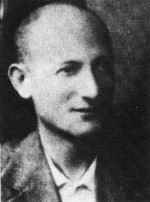
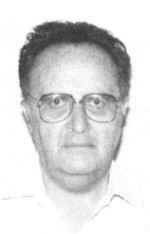
It has been 10 years since he left us forever–the Yiddish folk–poet and writer, Efraim Auerbach z”l (blessed be his memory), a plant from the healthy and full blooded Bessarabian earth, from the town of Beltz. He belongs to the chain–the Chut Hameshulash [“the eternal triangle,” lit. the triple cord] of the other two Bessarabian Jews, also from Beltz, Yakov Fichman and Chaim Greenberg, and just like them, Auerbach is rooted in the soil of Yiddish folk–life, in the song of hardscrabble Yiddish life. These chords echoed in all his poems, in all that he created. He is the quiet Borchi Nafshi prayer singer, who beneath his emotions and glittering fantasy stands with a fanatic faith in Man.
Auerbach's poems are really festive, part of them from real prayers, like Modeh Ani, Krias Shma, Ashrei Yoshve, Vayiten Locho, Elake N'tzor, V'eschanan, Bamme Madlikin, Lecho Dodi and on and on: “The body is Yours and the soul is Yours/ even the yearning for You in the morning/ the dust that covers my life/ is my Modeh Ani” (I thank You). With such lyric and still–voiced melody he brought to the Yiddish poetry the wonderful synthesis of Chabad's inner enthusiastic joy with Bessarabian simplicity, with the smell of wheat and corn and the Wallachs' joy and sorrow. He takes his heritage from the Chabadniks to Rashi.
Efraim Auerbach z”l was born, as I mentioned before, in Beltz, Bessarabia in the year 1892. In 1908 he made his debut in literature. He lived for a while in Warsaw and in 1912 in Eretz Israel. He was recruited to the Jewish Legion in the brigade Nehage Hapredot in Gallipoli. He went through the war; after a difficult illness, as a result of the hard fighting on the front, he had to leave the Land and he established himself in America. He published about 15 books, poems and essays. In all of the 55 years that he lived in America, he stood at the apex of the Yiddish printed word; was one of the editors of the “Tog–Morgen Journal” where he wrote a daily column, “On the Scale” about literature and culture problems, criticism and memories.
After the establishment of the State (Israel) he came often on a visit to the Land and wrote tens of poems and articles for the “Tog–Morgen Journal” about Israel. Among his works was the well–known poem “The White City” which was translated into Hebrew. In 1970, the family moved to Israel: Efraim, his wife, Chana (may she live a long life), their daughter, Ada with her husband and children. Auerbach z”l passed away in Tel Aviv. The family lives in Eretz Israel. Efraim Auerbach wrote more than 15 books. I will mention here the greater part in chronological order: “Caravans,” “The Red Thread,” “From the Old Well,” “Pure is the Old Spring,” “The Voice of the Turtledove,” “Ada's Songbook,” “In the Footsteps of Redemption,” “Jacob's Tents,” “Thought with Hebrew Translation.” “Golden Sunset,” “In Late Autumn,” “Awake in the Steppe” and an anthology of his poems with the title “A Life Between Tablets,” which he was able to publish before his death. Some of his books were translated into Hebrew by the writers: Eliyahu Maitus z”l and (may they live a long life) Shimshon Meltzer, Israel Zmora, K.A. Bertini, L. Kupferstein, Avigdor Hameiri, Yochanan Twersky and others.
From his “Ani Ma'amin” [I believe]: “I believe that Justice will come. Even if it tarries, I will wait for it every day, in difficult nights, in days of bloody storm, and will say like I say now: ”Ani Ma'amin.” I believe with my ancestors in faith and with the purity of my parents, that Evil will pass from this world, and the end will come with clear thoughts and will uncover the Good alone–Ani Ma'amin.
With great mastery, the writer expresses the various nuances of his feelings and experiences in his lyrical, deep–felt poems. The tremendously rooted love for the hardworking Bessarabian, which identifies, of course, with Jewish simplicity and his unique and authentic way, the so–called “Bessarabian Way”, remains with us forever in memory. His poetry from the purest spring gave a healing to the dispersed Bessarabian Jewry which was so earthy and fertile, and a vital support to the Jewish culture, to the Hebrew and Yiddish literature, and to the building of the State of Israel. In his poems of Israel, the writer sings in his lyrical mode about his feelings and experiences on the earth of Israel, the same earth on which he worked in his youth in the colonies of Judah and bled as a Legionnaire on the front, when the Jewish homeland was still hunted and threatened from all sides; his Israel poems shine with his warmth.
Together with the whole nation in Zion, the writer suffers on the thorny way to Redemption, the obstacles to a complete Redemption. Everything that he saw in the land, in towns and villages, in the kibbutz and by the sea, in the Galilee and in the Emek, in near–far South and in Jerusalem, he preserved for generations, in a lyrical way, lines that breathe, with gentleness and delightful rhythm that reads like the “Song of Songs:”
And here I am, paging with satisfaction through the letters that Auerbach and I exchanged through the years and I find a few lines with which I will end my eulogy.
“…for now you feel that the time is short and there is yet so much to do. But for whom? For the few special ones. There is a strength, however, that is stronger than the common sense.”
“…what else can I say, my dear and beloved Sender; I admit, I would say more, but I remember how you chided me and think that perhaps you are right.”
“…perhaps your word will one day bloom on a stone, with your sad mood, perhaps a little sand will guard you from a Jew of a future generation.
by A. B. Yaffe
Translated by Jerrold Landau
|
||
| A. B. Yaffe – the literary critic | ||
As we apply the nickname “Wandering Singer” to Zelig Bardichever, it does not come to evoke, by way of metaphor, “the Bohemian type”, who does not find a place for himself in the settled, organized society, and therefore wanders afar a great deal. Zelig Bardichever was “the wandering singer” by both his nature and way of life. He wandered all his days, since he was looking for some echo of his song, an echo that would extricate him from excruciating solitude – and he wandered because his livelihood was not to be found in the place where he was. A Jewish songwriter in Romania could never earn a livelihood through his writing. He could also earn a livelihood with great difficulty through teaching. Nevertheless, Zelig Bardichever was not a bitter person. This was because his connection with those of his fellow people, with the poor people, was so complete that he never would have thought of seeking for himself a more prestigious status, or greater material or spiritual rights.
He was born in Beltz in the year 1898. His father was a kerosene salesman who would pass through the city streets with his wagon to provide kerosene to the Jewish homes. From the day he reached self-awareness, Zelig Bardichever began to compose poetry and verses. He wrote the words and even “invented” tunes that he would sing with his mouth, since he did not know how to write musical notes. At the time he reached maturity, after he became friendly with the poet Yaakov Sternberg and got to know the serious, artistic Jewish theater, he even attempted to write and produce plays. (Among others, he produced in his characteristic way “Bontshe Shvayg” [Bontshe the Silent] by Peretz.) He never tried to publish his writings. He did not send his poems to the editors of publications in the Diaspora, and did not even try to publish them as an anthology. Therefore, almost nothing of his appears in print during his lifetime, and posthumously, only a thin booklet including nine songs with musical notes was published. The rest of his writings, which filled tens of notebooks with his fine, well-formed handwriting, remained with his stepbrother, who was a tailor in Beltz. Who knows if they were preserved at all during the years of the Holocaust that overtook Bessarabia and its Jews during the Second World War.
Zelig Bardichever died on December 30, 1937.
The nine songs included in the booklet Lieder Mit Nigunum [Songs with Melodies] perhaps are insufficient to testify regarding the songs of Zelig Bardichever in general – for they were variegated and richly sonorous – but they do have something of the unique character of his way in song. The folk spirit was the firm foundation of his creativity. Even during his adulthood, after he broadened the horizons of his general knowledge and culture, Bardichever remained close to the spirit of the people, close to the simple man, to the day-to-day Jew. In his songs, laden with the sorrow and suffering in the lives of the impoverished of the Jewish nation, there is also the opposite side, the joy and cheerfulness through which the Jew succeeded in overcoming all his tribulations, both material and spiritual. Zelig Bardichever himself included as the motto line of this booklet of songs, the following lines from his song Payatzan (Clowns): “Mir
[Page 468]
filn a viln dem veitik tsu shtiln / mit a lidl, a tentzl / a bissele shpil” (We feel the need to quiet the pain with a little song, a little dance, and a bit of play).
|
||
| Zelig Bardichever | ||
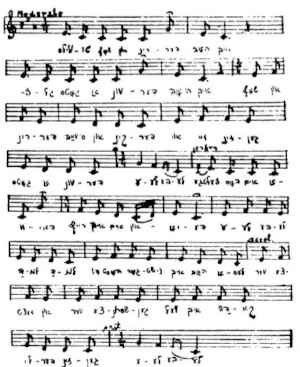
This motif repeats in many of his songs. The poor tradesperson, who earns his meager bread with backbreaking work, seeks to forget his bitterness with joyful song and dance: “Hey, lebedik freilich! Lebedik freilich!” [Hey, lively and merry! Lively and merry!]. Only with this power could the Jew overcome his tribulations, and this is not a question of logic. Even he knew that “there is no meaning in this life.” He continued to live with the force of this contradiction and contrast: “chotsh ich hob kein fis nisht, / kein eiver nisht kein gantzen, muz ich zich amol doch / hostik-vild tzetantzen”… (even though I have no feet and there is no wholeness in me, I must burst forth from time to time in stormy-wild dance)[1]. The joy of the beggar is his only way to defy it. He describes the “wealth” of the beggar, sevenfold greater than the wealth of the tycoon: “Vilstu milionen – hob ich. Vilstu gramaphonen – hob ich. Yeder kind iz vert milionen, oi, zeier shpiln – gramaphonen! Ele Bele!” (You want millions – I have; you want gramophones – I have; each one of my children – is worth millions, and their games – are like gramophones! Ele Bele!) The refrain of this song expresses the intention of the poet in clearer fashion:
|
Gefelt dos im avadei, Reiz ich im un yede: Ele Bele, dalus dalus, Du hos gornisht, Ich hob ales! Ver tzezets un ver tzeshprungen,[2] Vel ich davka lidelech zingn! Ele bele! |
(It is obvious that he senses this; I accuse and scold him: ele bele, poverty, poverty – you have nothing and I have everything! Burst out in a jealous rage, for your wrath and for your fury I will specifically sing songs. Ele Bele!)[2]
In the song “Lomir oich nisht leidik zitzn” (let us not sit empty), Bardichever returns to this motif, and gives it a
[Page 469]
local style: “Undzer lebn vi noch a regn oif Bessaraber roye vegn. Eider chakarenen un zorgn, besser chusenen biz morgn.” (Our lives are like rain on the Bessarabian potholed roads. Instead of immersing oneself in deliberations and worries, it is better to endure until tomorrow).[3] The refrain of this song says:
|
Freien zich iz gut, Freien zich iz gut. Lomer zich fargesen Chotsh oif ein minut! |
(It is good to rejoice; it is good to rejoice. Let us forget ourselves, at least for a moment!)
Zelig Bardichever did not distance himself from his community: He wrote about topics that were close-by, day-to-day. He chose as “heroes” of his songs those simple, good Jews that he knew, the small-scale tradespeople, all those who bore the yoke of their difficult lives, lives of tribulations and persecution. In his song “Melacha-Melucha” [Work-Kingdom] he portrays a carpenter, a shoemaker, and a tailor, but he envelopes them with much love. He uses diminutives about them that imply both smallness and love together (a stoliarl[4], a shneiderl), to the point where they lose their essence and seem like dear children or heroes of a marionette performance: “Bin ich mir a stoliarl, ruft men mich Reb Fishel – c'moch a tir, a fentzterl, / a benkele, a tishl.” [I am a little carpenter, people call me Reb Fishel – I made a door, a little window / a little bench, a little table.] However, even in the midst of this joyful, mischievous atmosphere, the place of reality is not lacking: the carpenter is tired and hungry, the tailor sews a fine garment for the son of the wealthy person, but his own son is “mumche lera'av” [an expert at hunger]. The shoemaker does not even have a home to live in, and he sleeps in a ruin… The Jewish tavern owner who became rich (“Eileh Toldot Noach”) eventually loses his fortune after the sons of Vayzata[5] steal his livelihood from him (“s'hobn im di bnei Vayzata / tzuneme di parnosa” [the sons of Vayzata from him / took away the livelihood]). If previously he had sent his sons to schools and wanted to turn them into doctors or lawyers, at the end his daughters remained “yoshvot” [sitting] without grooms, and the street youth began to hurl stones at his house… Regarding the tribulations of the small-scale Jewish merchant, the poet tells us in the song “Az a yid iz a kremer” (when a Jew is a shopkeeper): His mouth is full of complaints and vexations over his lot, his daughters have no clothes to wear, and only poverty pervades in his house… Whereas the wagon driver, the hired “whip-man” (der shmeiser), complains about the Moshke who rented him the wagon and horses, and even about his gentile customers, who not only force him to find a lodging, but also a woman for their company, at a time when he himself had to be outside, both in the sun and in the cold – “ich muz shtendik umetum / zuchn naye vegn.” (I must always search for new routes in every place). This expression ends the poem with a double entendre.
The lyrical thread permeates in many of these songs of Bardichever. He moves from the sadness to the feeling of the inevitable end. The shepherd in his “doyna” [melody] sees death as the solution to all his problems: “Nisht kein shaf un nisht kein bindze, / un kein korme far der midze, / seydn nor a grub oiyfn tzvinter – / iberkumen dort dem vinter.” (No sheep and no cheese, no fodder for the colt, but only a pit prepared in the cemetery – to go there somehow in the winter).
One lone song is found in this anthology in which Bardichever sang his personal-lyric song without concealment and without disguise. “Shkia” [sunset] is perhaps the only remnant that remains from his refined lyrics. Therefore, we will bring it down in full:[6]
|
In my small, dark room I sit lost in thought and alone. I am jealous of you my brother – Your bird demands food.
In a corner hangs a spider
You may advise me to
Doves, white doves
Oh, the clouds and the spiders! |
Bardichever's song of the cricket, does it not come as an inheritance from Bialik? And is this song not a sort of key to understanding the Zelig Bardichever's path in his life of creativity, the path of a man sensing in heart the storm that was approaching, the unpreventable Holocaust?
[Page 471]
 |
|
Do you want sheep and cattle – I have. Birds, G-d's wonder – I have. Sheep and cattle Are wives and children. Oh, they sing – G-d's wonder! Ele Bele!
It is obvious that he senses this. | |
[Page 472]
|
|
|
You want millions – I have. You want gramophones – I have. Every child is worth millions Oh, their play – gramophones! Ele bele! / Refrain: it is obvious that…
You want a string of pearls – / Refrain: it is obvious that…
Naches [contentment] from the children – / Refrain: it is obvious that… |
Translator's footnotes:
by Sholom Sudit
Translated by Pamela Russ
( ) author's remarks
[ ] translator's remarks
|
||
| Hersch Leib Kazhber | ||
[He was] born in the village of Kazhba (Bessarabia) to poor village settlers in the year 1910, and his correct family name is Vaynshteyn. He completed his studies in the Baltsi gymnasium, and when he began writing and publishing he took on the pseudonym of Kazhber named after his place of birth, the village of Kazhba. With that name, he entered into Yiddish literature.
My acquaintance with him came about in the Baltsi Yiddish culture center, where I was an active member.
He suffered from a physical handicap: one deformed foot, and when walking, he was hunched over. Whether this was from birth, or whether this was a result of some terrible fall, I do not know. I know and remember that this handicap was painful for him and he suffered a lot from it. There were moments when a seriousness would spread across his face, a silence; a deep, distant sadness would emanate from his large, grey, intelligent eyes. It's possible, that in these moments he would turn to the Creator with questions and complaints, saying: “My Almighty, You have blessed me, the son of poor villagers, with writing talent. But you endowed me with a blemish that has given me a lot of bitterness and anguish … Why did You do that to me?” He was an avid reader, and in the culture center library in the 1920s and 30s, there was a lot to read there, beginning with the Yiddish classics and ending with many different translations of foreign writers, such as: Henri Barbusse (The Fire), anecdotal reports (on the western front without any amendments); Romain Rolland (Jean-Christophe), Anatole France, Maxim Gorky, and so on.
He was very fond of the justice seeker Y.L.Peretz, the world renowned Sholom Aleichem, whose creations reflect the entire Jewish nation as a mirror, and the white-bearded elder, the grandfather of Yiddish literature Mendel Mokher Seforim…
Of particular inspiration was the foolish, misguided and later murdered great Yiddish prose writer Dovid Bergelson. Bergelson's style, direction, narration, education, actually inspired him [Kazhber]. And the effect of Bergelson's creations on the
[Page 474]
Bessarabian young prosaist H.L.Kazhber was tremendous.
He published the greatest number of stories in the weekly “Czernowitz Bletter” [“Czernowitz Leaves”] whose editor was the amazing, dear, erudite Shmuel Abba Sofer (editor of the dictionary of Aramaic, Hebrew, and Syrian words, phrases, and names that have been incorporated into the Yiddish language, 1921 Czernowitz) who encouraged young Kazhber and helped him publish his first work, the book “Kazjone Gimnazia” [“Commonplace High School”] (available in “Czernowitz Bletter” 1937, Czernowitz).
This is a rich autobiographic novella about the gymnasium years in the Baltsi gymnasium.
I remember once, that one summer, as I was going out on my regular stroll in the city garden, from time to time I would meet Kazhber who always carried a thick notebook and a book under his arm. He would spin his creations there, forming his novella “Kazjone Gimnazia.”
He was also the author of a larger novella “Khaverte Tanya” [“Friend Tanya”]. This novella was published with sequels in the literary monthly journal “Aufgang” [“Uprising”] (editor and publisher Y.D. Israel, in the city of Sighet). The journal ceased publishing in January 1938, when the Rumanian fascist government of Goga-Koza terminated all Yiddish publications along with the Rumanian Democratic Press … In the novella “Khaverte Tanya,” he tried to provide a portrait of a Baltsi Jewish revolutionary who, along with a group of young people, was arrested in the year 1923 and released in 1924. She later went to the “land of her dreams where the people could breathe freely,” and how any trace of her was forever gone. Kazhber's creation was very dear to me. I treasured it and remember that his first publication, “Kazjone Gimnazia,” was successful with everyone.
In my archives, there were the newspapers “Aufgang,” “Czernowitz Bletter,” as well as other Yiddish writings.
In the year 1931 or 1932, Kazhber, along with two other young writers, Yankel Jakir and Hertz Rivkin-Geisener, put forth serious efforts, and published a literary booklet by the name of “Onzog” [“Announcement”], but no more than one issue was published (the one responsible for the publication was the young Khaim Zelcer, today a Yiddish writer in Israel).
H.L. Kazhber earned his living through teaching and literary lectures; and for a long time he was the teacher in the Morgenroyt shul of the “Bund.” He also had a connection with the “shul society” of the Czernowitz “Federation of Yiddish Culture.” Materially – life was difficult, but he always maintained human dignity and value.
In my memory is etched an episode of the month of September, 1939, when we met on Praparzhesku (today Dostoyevsky) Street. This was after the Nazi Germany attack on Poland, when the Polish state was divided between the Soviet Union and Germany. He was embittered, depressed, and with a strained voice, he said: “My dear friend Sudit, a great tragedy has happened to Polish Jewry, a tremendous destruction is going to befall them… and who knows what waits for us Jews from Rumania in the near future.” …
When World War Two broke out in 1941, fate threw him into the distant Uzbekistan, Samarkand, where he died in 1943.
by Mendel Geventer[i]
Translated by Pamela Russ
( ) author's remarks
[ ] translator's remarks
|
||
| Mendel Geventer | ||
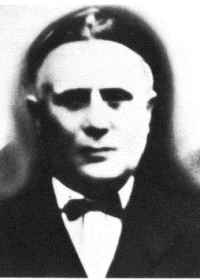
| Once again Purim, again Purim, Honey fluden [multi-layered cookie], hamentashen And the old Jewish street Begins to come alive again.
Housewives are baking, cleaning, being busy,
In the shul, school-aged boys are
May the wondrous Purim |
He wrote many songs in Hebrew and Yiddish, some of which were published in children's papers and in the former Hebrew anthology “Hadibur Haivri” [“Hebrew Speech”]. He even received a congratulatory letter from Dovid Frishman, “The spark of the poem burns in you. Continue on.”
For all kinds of reasons, he did not publish his songs in book form.
At the beginning of the Second World War, in July 1941, the Baltsi hooligans, Moldova murderers, killed Mendel Geventer and his wife.
Original footnote:
by Sholom Sudit / Nahariya
Translated by Pamela Russ
| As a butterfly, a memory now flutters, Touches my breath, so tenderly, so quietly… Opens a page of the lost past, And I become imprisoned in a nostalgic feeling…
Thet start slowly, as in a kaleidoscope
Here, before my eyes, stands my hometown of Belz,
My town of Belz made itself famous
The Vilna troupe with its famous actors
And Yakov Shternberg with Sidi Tal,
From the busy –[“femintener” - not sure about this word] train station, they carried
I cannot forget the hundreds of performers
Culture leagues … Tarbut... the Jewish drama circles –
Already they are beginning to fall out of my life's diary
Also, now in Moldova there is a city |
| January-February 1986 |
|
|
JewishGen, Inc. makes no representations regarding the accuracy of
the translation. The reader may wish to refer to the original material
for verification.
JewishGen is not responsible for inaccuracies or omissions in the original work and cannot rewrite or edit the text to correct inaccuracies and/or omissions.
Our mission is to produce a translation of the original work and we cannot verify the accuracy of statements or alter facts cited.
 Bălţi, Moldova
 Yizkor Book Project
 JewishGen Home Page
Copyright © 1999-2026 by JewishGen, Inc.
Updated 03 Sep 2026 by JH