|
|
|
[Pages 110-116]
By Munya (Nachum) Fuks
Translated by Rachel Karni
Edited by Lynne Tolman
When the Red Army entered Shumsk in 19391 I read an announcement posted in the town that a technical school had opened in Podvolochisk. I was then 16 years old. I enrolled and began my studies.
Although doing this was against the wishes of my father – who did not want to be separated from me – I convinced him to allow me to go. He knew that, due to his difficult financial circumstances, I would never be able to continue studying, in spite of my strong desire to do so – and I would certainly never be able to obtain a technical education. And so he agreed.
Leaving Shumsk with me were Todros Mazur, Avraham Geilichen from the neistadt2 and another fellow, Lazar, whose last name I do not remember.
This was a beautiful period for me. We were well fed and clothed and our living accommodations were in railroad cars that were not in use. Four boys lived in each railroad car and we were pleased with our living arrangements.
The first thing we learned was how to lay railway tracks .We quickly reached a high level of competence in our work and we lay the Lvov-Kiev track almost by ourselves. Our feeling of satisfaction knew no bounds. Who dreamed that one day we would be saved from the future awaiting a boy from Shumsk – that of a petty merchant, struggling all his life for a livelihood.
But suddenly, when we had gone too far from our home with our traveling school, in a childish way we began to miss our mothers and fathers, our homes and our town, Shumsk.
The old border that ran between Volochisk, which had been a part of Soviet Russia since 1917, and the Polish town Podvolochisk, which had just been transferred to the Soviet Union in the Molotov-Ribbentrop agreement, was heavily guarded and it was impossible to cross it. We were stuck there without work. Our homesickness grew, especially because we were not busy. We decided to go to Shumsk even without the permission of our supervisors.
On the seventh of June, two weeks before the outbreak of the war between Germany and Russia, we set out for Shumsk. We planned to go there and then return to our studies. We just wanted to see our parents – just that – only to feel the warmth of our homes and then to return.
We reached Shumsk and were there for four days. Our formal school uniforms were very impressive and we were received warmly. We were a sensation in town and propaganda for the new regime which enabled children from poor families to study. These were days in which we felt pride and good feeling in our beloved town that bestowed such warmth on us.
After four days we were notified that we had to return to school, and so we started back. My father accompanied me to Krelitz on foot. We walked without speaking, but when he took his leave from me he said, “In the case of war, come back to us to Shumsk. Don't remain alone, separated from your family. It's not good for you.”
It was early morning. From the hilltops of Krelitz, Shumsk looked as if it were sleeping, waiting for my return. For some reason the thought crossed my mind, “Would I ever see Shumsk again?”
We walked until Lanowitz where we boarded a train for Ternopol. There we were supposed to change to the line going to Podvolochisk. We didn't have any money and we wanted to continue traveling, that is, to board a different train and get on with our trip. Suddenly we noticed a soldier with a bayoneted rifle standing tensely in the corner of the railroad car, counting people. We entered the car and were included in his head count. The door of the car shut and we found ourselves locked in a kind of prison.
We began to ask people in the railroad car what was happening and they explained that they were prisoners who had been arrested by the Russians and that they were being sent deep into Russia to pay for their misdemeanors in the form of forced labor.
We began to bang on the train doors to let someone know that we had been jailed mistakenly. At the sound of the noise a soldier approached and said, “You young criminals, keep quiet, damn it!” But I didn't give up and continued banging on the door until one of the NKVD3 people, who wore green hats, approached. When he understood what had happened he opened the doors, freed us and took us into his office, which was in the same railroad car. He questioned us to understand how we had come into this car. We told him our story including our error of entering this car, and during his lengthy interrogation the train started to move. When he checked our school reports he said that we had to get to a different car on the same train but that this would have to be done while the train was moving. But since there was no passage between carriages in a prison train we would have to go out and jump from place to place carefully so as not to fall and be killed. I was frightened to do this and began crying but the man demonstrated to us how to move while jumping. With pounding hearts we moved from car to car until we reached an open car, and from that car to yet another one.
In the second carriage we were asked for our tickets. We didn't have any so we were ordered to get off at the next station. It was one o'clock at night, very foggy, pitch black and terrifying. We knew that if we remained in this place we were doomed. We jumped back on the train from which we had been ejected. The same soldier was there. He took pity on us and told us how to behave when a conductor arrived. We traveled to Podvolochisk, sitting on the train floor, concealed and quaking.
At 2 a.m. we reached our destination.
The next morning we were already at work. During the nights I sensed the increased movement of troops. During the day I discerned armed civilians, moving in a never-ceasing flow near us. It was clear to me that we were on the brink of war.
On the morning of June 21, 1941, we heard Molotov's speech on the radio announcing that the Germans had betrayed Russia and declared war on her.
Our hearts were heavy. We continued working but it became more and more difficult. The roads were jammed with heavy weapons and tanks. Enormous horses pulled cannons and our work was constantly interrupted.
When we went into the dining room we saw wounded people lying on stretchers and next to me, at the place where I ate, there was even a corpse covered with a blanket, his bare feet exposed.
I felt nausea and couldn't continue eating. In the meantime we were urged to stop everything and begin to transfer the wounded,who arrived that day in wave after wave.
While I was carrying a wounded man I began to question him. Has war broken out? Where were you wounded? Did you see any Germans?
His answer was shocking, “One can not see anything because waves of fire have covered the entire area and panic is spreading rapidly.”
The next day I saw an air battle with my own eyes in the sky above Podvolochisk. I saw airplanes fall and go up in flames along with the pilots who were burned alive, having crashed with their planes.
In our school there were over 300 students, but among these we were only 12 Jewish students. From their airplanes the Germans threw handbills which spoke about the necessity to kill all the Jews, “a parasite nation, instigators of war, blood suckers, etc.” This influenced our schoolmates and our situation deteriorated from minute to minute. We felt we were in a life-threatening situation and sensed that something ominous was being planned by our gentile classmates.
On the evening of July 1, 1941, the principal of the school appeared and announced at an assembly that the school was being evacuated and that we were to be transferred to the area of the Don.4 Whoever wished could join the evacuation but it was not compulsory to do so.
He said that the plan was to join a locomotive to our sleeper carriages and to continue in them on our way east.
We were afraid to remain among our classmates any more, but the presence of the principal eased our anxiety.
We lay tracks with our own hands so that we would be able to move our dormitory cars to the general tracks.
When the train began to move the Christian students began to leave, one by one, for their homes. Only we, the Jewish students, remained, and we were joined by some 50 gentiles, who were not students.
We traveled day and night until we were a few kilometers from the Festov station just before Kiev.
The railroad cars were packed, the temperature was very high and it was difficult to breathe. Todros and I decided to climb up on the roof of the car so as to be more comfortable in the clear air.
It was now morning. We were lying on the roof when suddenly I saw two airplanes flying very low. I didn't panic at all. I thought that we were deep in Russian territory and that these were our planes. But when I looked up I saw people running in terrible panic in the direction of the nearby forest. We also jumped off the train. I suddenly heard a terrible explosion. I fell down and waves of dust piled up on me. I was certain that I had been killed. I was a child and didn't know how one is killed. My head was in shock and my ears were blocked. (For about a month after this I couldn't hear in one ear.)
I knew that there was no going back to the train. I ran in the direction of the forest together with Todros.
On our way to the forest a plane flew low over us and someone uttered a cry, “Lay flat!” We lay down and the plane rained waves of machine gun bullets. Fortunately the plane aimed at the train and we were saved.
In the forest we ran for three kilometers in shock. We weren't hungry. We wanted only to run, to run and escape, but the forest was full of red wild berries. They made us forget the horrors and we picked them and gobbled them down as we walked on.
In Festov we found our railroad cars which had meanwhile also arrived there. In my car I found the soup pot upside down and the car full of bullet holes. I found a Jew there and asked him why he had not escaped with us. He explained that he had decided to live or die with all the other passengers. My suitcase was so full of bullet holes that it looked like a beehive and to this day I do not know how that man succeeded in surviving among the hail of bullets.
In Kiev we were not allowed to disembark and we continued on to Donbas. In the the town of Sergo, a coal mining town, we got off the train and were ordered to work in the coal mines, although, being students, we were immediately assigned to the PZO school, the same type of school we had attended previously.
We worked there for two or three weeks. In the meantime the German front advanced and came closer to us. We were secretly transferred one night to the area of Krasnov, which is near Charkov, to dig defensive trenches.
It was now fall. Rains fell non-stop, the trenches filled with water and became a growing swamp, the dampness and cold affected our strength and the thunder of the cannons reached us. I saw that Russian soldiers passed us in panic-stricken retreat and none of them used our trenches, but we were forced to continue digging them because there was no one to rescind the order.
After some days I noticed that only a few of our group remained. Most had fled. We too decided to escape and we hid in an overcrowded train and again reached Donbas. I didn't recognize the place. The city was full of the military, completely dug up and covered with trenches.
The municipal supervisors ordered us to unload a cargo of wood from a train so that we would be able, in his words, to “travel in these railroad cars to Kazakhstan, to the city of Karaganda.” When I looked at a map I saw that this was a distance of 7,000 kilometers.
But after unloading these railroad cars they were taken from us to be used for a different purpose. We walked to Stalingrad on foot. For two weeks we walked day and night, from Voroshilov to Stalingrad. We used side roads for fear of the bombings and we ate in Kolchoz5 that were on the way.
During this trek we felt worse from day to day. The local population showed signs of hatred toward us, ridiculed us and made fun of our Jewish fear. They said that we were evading places of danger, and that we only needed “a bent gun,” the kind that shoots others. But we couldn't react and we didn't want to answer because at the time these were only words of hatred, unaccompanied by blows
Stalingrad had already been bombed before our arrival and there was nothing for us to do there. We boarded a train and continued to Kazakhstan. We traveled for two months in the same carriages, without changing trains, but we were unable to sleep. When the train stopped we would get off, steal something and share it. Once I opened a sack of flour from one of the last carriages of the train. I filled my pillowcase with the flour, which was a rare, precious find. We kneaded the flour with water and made dough and I stuck the dough to the chimney of the locomotive. When the dough was dry we had a feast.
These were very strange days. Orders changed from day to day and so did the news. Each time we were ordered to go in a different direction, but the train continued on its way as if it were not asking any person what to do – and did its own thing.
And so we reached Chelyabinsk.
On the way to Chelyabinsk 50 passengers fell ill with typhus and 28 of them were taken off the train. We remained with those who were left. People in the train car got lice, layer upon layer of lice on a human body. It was possible to take fistfuls off a person. Every morning the counselor who accompanied us from our school would come into our car and order us to undress and kill all the lice we could find.
In the meantime a most difficult winter had arrived. Our clothes were too light. We wrapped our feet somehow in rags, but our bodies were exposed to the bitter cold and our hands froze. There were moments, and hours, when we cried from pain, unable to control ourselves. When we reached Karaganda it was a most terrible winter. There were endless snowstorms and it was doubly hard for anyone to take two steps outdoors without being blinded by the snow or without choking from the pressure of the swirling snows.
We were taken off the train and taken to a public bathhouse where we were given different clothing. Then we were transferred to a dormitory which was entirely underground, a kind of a cave covered by a roof, called Zmerianka by the Russians. We slept on wooden berths.
Immediately after we got settled we were sent to work in coal mines, 150 meters underground.
In the meantime some of us were conscripted into the Red Army, among them my friends from Shumsk and a few other of my Jewish friends. I remained alone. Actually, I was left behind because I had contracted a lung disease. I was now constantly among Ukrainians who had also come from far away and they made my life miserable. Their hatred of Jews was so great that they would even knock the soup pot out of my hands. Once when one of them approached me and said I had no right to eat there, I hit him very hard and they all ganged up on me and wanted to kill me. I was saved miraculously. Nearby was an iron shovel for the stove which I grabbed. I stood there like a crazy person shouting, “Anyone who comes near me will get killed.” They were frightened off, but I had to transfer to a different dormitory that housed Russian adults. There I was not mistreated.
I was also forced to change my place of work to a different coal mine because my being Jewish began to cause me problems at work too.
I fell ill and lay in hospital for three months. I couldn't eat because of my high temperature and weakness. But after six weeks I felt better and I was supposed to leave the hospital.
The hospital was three kilometers from the city Karaganda in Maikodor. A municipal doctor would come to the hospital to check on things. She was the head doctor. In the course of time it became clear to both of us that we were both Jews. She would examine me at length and ask me many questions. She didn't tell me that she was Jewish and her appearance was not Jewish but her last name, Malkina, made me understand that she was a Jew. She discharged me from this hospital, transferred me to the municipal hospital and ordered that I be given better food. When I wanted to leave the municipal hospital she said, “What's bad here? Stay here until the spring when it will be a little warmer.” In the meantime she found out that I was completely alone here and she asked if I would receive her mother nicely if she came to bring me some gifts. Her mother arrived punctually each day and brought me very good food and I got much better. When I had to leave the hospital this doctor forbade me to work in the coal mines and I was given work as a guard outside the mine.
She gave instructions that I was to come to her medical center for a checkup each month. She also gave me her home address so that I could come to visit her at home. At her home I would eat lunch with her parents and her son and she would give me a checkup each time.
When the war ended in 1945 she was sent back to Varonesh, her birthplace, to reorganize the ministry of health there. I accompanied her to the train and helped her board it. On the train she remembered to give me some food for a last time and to give me instructions about how to behave so as not to fall ill again.
I received a few letters from her from Varonesh but our exchange of letters stopped suddenly for some reason.
After a while I met a fellow from Lanowitz, Segal, who was a cousin of Shalom Segal and Malka Segal. He told me that he was working in one of the Kirov mines and invited me to come to visit him at his workplace. I was very happy with this chance to meet another Jewish boy and went there. At his dormitory I asked for him and they showed me his sleeping berth where I sat waiting for him to return. By the evening he hadn't come back. When I asked what had happened I was told that he had been killed in a landslide in the coal mine. They didn't allow me to see his body and to this day I do not know exactly how he was killed.
In 1945 the war ended. I married and continued to live with my wife. After three years we both decided to leave in order to live among Jews and to see what happened to our relatives. We first traveled to Bender (in Serbia), where her sisters and relatives were. We saw that there was no possibility of remaining there since we had no place to live and there was real famine in Bender. My wife agreed that I would travel to Shumsk to reclaim our house and then to build our family.
I reached Lanowitz at night. There was no transportation. The Ukrainians walked everywhere but I was afraid to join them because the roads were full of Bandarovtze6 who murdered Jews. Their fellow Ukrainians would inform the Bandarovtze of every Jew or person suspected of being Jewish.
I slept in the train station on a bench and in the morning I started out early, walking along the railway tracks to Shumsk. I didn't know the way but asked frequently and was pointed in the correct direction. I arrived on foot at a spot just before Shumsk. My feet were swollen from walking so much. A wagon passed and I stopped it. I spoke in Russian and was answered in Ukrainian. I continued speaking in Russian until one of the passengers turned to me and in Russian invited me to join them in the wagon. I told him that I was going to look for my parents and my brothers. Then it became clear that he was the present governor of Shumsk and the surrounding area. He didn't know of my family. The wagon driver interrupted us and said that he had known Jews but to the best of his knowledge there are no Jews today in Shumsk and many are missing. My heart foretold me the worst. I wanted to get up and run away but my town pulled me with a hidden magical power and I continued on.
In Shumsk I got off near the Kostziel and from there looked down on the town. The church had been abandoned, its leaning cross looking down at the neglect around it. My feet moved of their own accord and I started walking around. I met a Jew and it became clear to me that he was Azriel Dundik. I remembered that he had been the best football player in Shumsk. He was living here and said he was managing the market. He suggested that we go together to meet other Shumskers. On the way he left me and told me to walk alone in the direction of the market. As I was walking I met another Jew, Moshe Kopyt from Rachmanov. I extended my hand to him, but he did not recognize me from my father's name. We got to know each other and he did not leave me and pulled me to “his” home. I went happily.
He was living in the house of Yitzchak Chelbin. He introduced his wife, who was Ukrainian, and it turned out that I knew her from Karaganda. I slept there. In the evening Azriel Dundik arrived. He promised to take me to see all the Shumskers the next day. In the morning he came and we walked to Boris Kessel, to Krakowiak and to another person whose name I have forgotten. The latter was not a Shumsker but from Androshivka.
These were all the Jews who had remained in Shumsk. I asked Azriel to show me the graves and he led me to the way to Krelitz. He stopped on a little hillock between two hills and said, “Here are three pits. Here are your relatives and mine.” Horses and cows were grazing there, desecrating the dust of our holy ones. Two of the pits were for the adults and one for the children, the precious, innocent, holy children of Shumsk. Azriel said that they had plowed around the area so that the animals would not be able to approach but it had not helped.
I looked down, unable to comprehend how so many men had fallen like children.
But when I walked on the hill I saw thousands of bullet shells. I was told that here our relatives were told to stand under threat of death and a hail of bullets and were forced to go toward the graves themselves. I cried like a child. Afterward I received confirmation that this was what happened, and this is how the Jews of Shumsk fell.
Azriel said that according to what the non-Jews had told him, the rabbi, Reb Yossele, spoke and said that this was their fate and that they should die believing in the fate of the Jewish people. He fell first.
After all this I went to the Christian cemetery of Shumsk. There I was shown two graves and was told that these were of Jews from Shumsk who had returned here to their pitiful homes after the war. One of them was Bryk and the name of the other was not known. Banderovtze stabbed them to death on the road. On their tombstones Russian stars were carved but no names were inscribed.
Near these graves were also the graves of Banderovtze leaders whom the Soviets had caught and buried like dogs, in their clothing.
I remained in Shumsk for two days and could not bear it any more. Before I left I told Azriel that he should leave Shumsk. I begged him to leave and warned him of the danger but his answer was, “I am remaining here to avenge the death of the Jews of Shumsk.”
A few months later I learned that he had died in the hospital, ostensibly from a dog bite. But rumors were that he had been poisoned.
And so the last of the Jews of Shumsk died and I was cut off from my beloved town.
Translator's Footnotes
[Pages 117-122]
By Avraham Krejmer
Translated by Rachel Karni
| Translator's Note: The author of this article, Avraham Krejmer (1923-1986), was born in Shumsk to David Beer and Perel Krejmer, who perished in the Holocaust together with their children Sarah, Yerachmiel, Yitzchak and Breindel. Avraham Krejmer established a large business in Haifa and was active in the Shumsk Society in Israel, being instrumental in the publication of this Yizkor Book and in the erection of a memorial to the destroyed community of Shumsk in the Holon Cemetery. |
When the Soviets entered Shumsk1 they came as saviors and defenders of the lives of the Jews in the town. But one sensed that if they were saving our bodies they were not saving our souls.
Jewish life in the town, with its traditional religious observance and its hopes for a future, was put in a vise. Religious observance became something one did in private, and Zionist sympathies were something one denied to ensure survival.2
There were Jews who prayed secretly, alone at home, where no one saw them, thus being in no special danger, and in this same secret fashion Jewish religious practices were observed. But it was impossible to maintain Zionist affiliation in secret, because the strength of Zionism lay in public identification and activity. And if there was no Zionist public activity, where would Zionist identification come from?
Zionists, even those who had been active in the Zionist endeavor, accepted this situation and did nothing to change it. The general feeling was that an end had come to all the things that had been accomplished over decades, and all the results of Zionist education would disappear, leaving no trace. No way was found to make Zionist activity legal, and no one dared risk disobeying the law.
Worst of all was the situation of the young people. Suddenly the vision of the future to which they had been educated was shunted aside.
|
|
Many young people who up to now took pride in, and saw meaning in, the differences between the ideologies of the various Zionist groups with which each had been affiliated were now united in their common concern for their movements. But the majority changed and grew indifferent.
Even discussions about the situation were dangerous and members made an effort not to meet with each other so as not to stand out and arouse the suspicions of those in power and their supporters. Still, young hearts could not be suppressed.
Before long the best of the youth were to be found in activities of the Komsomol without their being aware of this and with no possibility of extricating themselves from this situation. Everything went down the drain, all the Zionist education, all the willingness to fulfill Zionist ideals. Everything was cast in doubt and there was no one to lead the young people in a fashion that would fit the new situation. The older people were too concerned with their own problems and we young people could not demand help or advice with our new dilemmas, dilemmas which we had never faced before and which previous generations had not known.
This situation continued until the end of 1940.
In the last months of this year changes occurred in the hearts of young people in Shumsk. Those who had tasted the Komsomol activities saw that the Komsomol4 was a movement that fostered the obliteration of national identities and of principles that were dear to our young people. Young hearts began to rebel and to feel that they had become traitors to their beloved past, a past that had been full of content and activity. They looked for a way of extricating themselves from this predicament.
The Komsomol organization did not speak to their hearts and the differences deepened, repelling them and creating no desire to continue. And those others who had not been swept up into the Komsomol walked about with an empty feeling and a lack of all vision, without which the life of young people is no life at all.
Here and there a word was uttered that instilled hope and gave encouragement to action. In addition, it was hinted, and these young people hinted to each other, that there were things that should be done, that it was possible to do them, and it would be good if they began to act immediately.
I don't know how this change developed in the other Zionist movements in our town, but I can relate what happened in our movement, Hechalutz Haztair. It is worthy that these things should be written in the Shumsk book and be preserved for future generations.
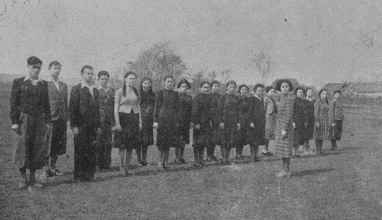
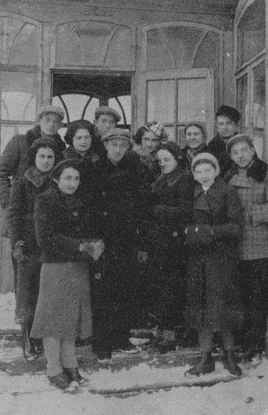
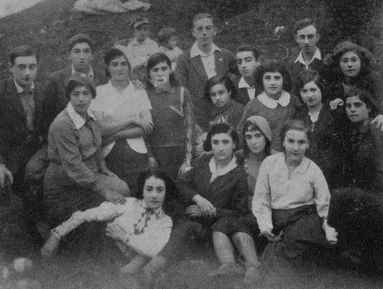
With the outbreak of the war in 1939 the members of Hechalutz Hatzair5 in Shumsk numbered 110 members, from the ages of 10 to 17. The organization had a “snif” (a meeting place) of its own, which was spacious and in which activities were held for all ages, some for each age group separately and some for all of the members together. With the arrival of the Soviets it was hinted to us by those who were chosen by the Soviets as “kosher” that it would be best if our activities stopped and there be no address for Zionist sinners and their young supporters.
At first we accepted this as a decree and as part of the change that occurred in the life of the town. Afterwards we began to miss the “snif” and the evenings became empty and lost their meaning. When we added up all of these feelings we saw that they were not a mere childish search for enjoyable evening activities. There was something more substantial here; we were missing the striving for a more desirable life, a clear Jewish identity and preparation for the future, which we had learned about in years of education.
We didn't want to become part of Communist life. We didn't know why we had to give up our own national character. In our hearts the decision ripened to continue our movement's activities, without an address, and to gather around the movement as many members as we could, even though it was impossible to maintain a meeting place at a specific place and with regular hours for meetings.
As a practical matter we reached the conclusion that we had to maintain the Hechalutz Hatzair as an underground organization.
From the one hundred and ten members, close to sixty people from the older age groups joined together.
Our discussions took place in the homes of members, in open fields, in wooded groves, during hikes outside the town, and during games at the homes of members. We knew that we were not doing this as an action against the regime and our desire was simply to continue the education to aliyah6, which had stopped for reasons beyond our control but which was not illegal. And yet, it was clear to all of us that we were engaging in something which was forbidden and endangered us and our families, but we couldn't act in any other way. There are circumstances where the simplest and most commonplace of activities which are done when they are forbidden and dangerous become holy activities that one must do even at mortal danger.
We organized into 12 groups, each one consisting of 5 members. Members of each group were not to know who was in any other group. The leader of each group received instructions for an activity from someone who truly was unknown to the other members of the group, and the meeting took place.
Twice a week each group met for a discussion on topics which were brought up by the group leader. The meetings were never held on the same days or in the same place. The discussions were lively and full of vision. Each small detail from Israel excited us and created hope. We did not even feel that the group itself was small and the range of members was limited. Eyes sparkled, hearts beat and the imagination soared to distant places and times. And yet often we felt our hearts twinge when we remembered those evenings when the meeting place was full of members, tens of young people meeting up with tens of others, and our feet wanted to start up a fiery dance like we danced on those evenings. But knowing that this was forbidden was enough to calm us down. What was forbidden became an object of longing.
|
The groups were composed of members of the same age or of friends who had “gone out together” previously. The town was small, everyone knew who was friendly and spent time with whom, and any change in the composition of such groups of friends was sure to arouse suspicions, which were undesirable and even dangerous.
The safest place for discussions was in the classrooms. Near the wall map it was possible to talk about values and Israeli social principles, to give clear explanations about the difference between a kibbutz, a moshav and a moshava and all the while to pretend that one was examining the longitude and the latitude on the geography maps.
From among the group leaders two leaders were chosen – one for each 6 groups. Each of these leaders met with a special person, but they never met together. These two leaders learned of the time and place of the meeting with this person through an agreed-upon code.
The discussion with this person was committed to memory, as one would memorize school material in which each detail is essential, and this served as the basis for the discussions held that week in all of the groups.
We knew that this person met with “shlichim” (emissaries) from Eretz Yisrael (the land of Israel) and with members of the central leadership of Hechalutz Hatzair which had been disbanded. We heard that written materials were transmitted secretly, but we never were able to learn how or when the people from “outside” met with our person.
At the head of the Hechalutz Hatzair in Shumsk was a secretary who knew everyone and saw everything that we were doing, but we did not know who he was.
Two girls were his assistants. One would go to his home “by chance” in any case where there was a serious problem and she would see to it that the meetings would be held regularly and according to the instructions of this person. Her exactness and her flexibility seem rare to me even today and I think that few are blessed with these attributes to the degree that she was. The task of the second girl was to maintain a diary, recording all of the activities, which she wrote up after receiving the reports from the first girl.
The diary reflected the activities of the groups in great detail. The decisions made by those responsible, with relevant background information, were also recorded in the diary. But the diary was written in such a way that it appeared to be the naïve diary of a schoolgirl. Every detail was coded in such a way that only those who were in the know could decipher it. If someone else read it they would think it was a harmless diary listing dates, homework assignments, name of teachers, subjects studied, hours – outwardly nothing innovative. But each word was the agreed-upon code for something that was very important to us.
The diary was a way of contact between people, between topics, between one day and the next. Since there was a diary, a person who needed to do so could take it from the place where it was kept, read it and know what was happening without any extraneous personal meetings. So the diary played an important role.
Thanks to the diary, and thanks to those who kept it, the diary served as the glue that held the chain of our organization together, and those who were planning aliyah succeeded in joining together and doing so, thus preserving the goal of our pioneering education.
A short time before the Holocaust one felt the impending catastrophe in the air. We tried to the best of our ability to fortify ourselves so that we could withstand what was about to happen, but our means were poor, the time was short and the environment hostile.
|
|
Only a few of those who were in the movement during those difficult days survived. I will not relate their names, even the name of one who is far, far from us behind the iron curtain, but I would like to tell about a few who are no longer alive, who were murdered together with our parents, our brothers and sisters and the rest of the people of our town, and in this way to honor their memory.
If I could only put on paper my feelings toward them, toward their deeds and their personality, I would certainly be able to write at great length, but I do not have the skill to do this. Therefore I will write briefly. I feel it is a great privilege to be able to keep their memory alive.
First, with great awe I wish to honor Moshe Szpric8 of blessed memory. Since he was older than us, he was not able to meet us regularly, but from him we imbibed advice and encouragement. I will always remember my nighttime meetings with him in secret spots. His interest and guidance helped us in our dangerous work. Many of us who are here in Israel were influenced by him. Moshe was the ideal leader in his self-effacing behavior and his extremely wide knowledge.
We considered him to be a genius, we respected him as a scrupulously honest friend, devoted to helping others and always ready to listen, to advise, to assist. May he always be engraved in our memory.
The second person whose memory I wish to honor is Shayndel Zilber9, the daughter of Itzik Zilber.
Shayndel was a very active member of our organization, endangering herself for the success of our underground activities. Shayndel was the person who met regularly with the two leaders, receiving reports, giving advice, correcting, guiding and explaining how to continue the activities until the next meeting. May her memory be blessed.
The third person whose memory I wish to honor is Chana Bat10, the daughter of Pesach Bat, who kept the diary. Chana, who was burdened at the time with work in her family's restaurant, supporting herself and her sickly mother, found the time, after long hours of hard work, to keep the diary with great diligence and attention to endless detail in spite of the great danger involved in this task. The entries in the diary took many hours of work and she did this task with love. May her memory be blessed!
Translator's Footnotes
Additional biographical information: Moshe and Motel Geler were the leaders of this Hechalutz Hatzair group. They were first cousins of Yitzchak Geler. In 1937 Motel Geler and Penina Dorfman left Shumsk for hachshara, a training farm for those preparing to emigrate to Palestine. Later they were transferred to the Hechalutz Hatzair center in Warsaw, and from that position they were able to influence the parents of others in Shumsk to allow their sons and daughters to join the training farm at Grochov. When war broke out in 1939, all these young people returned to Shumsk. Moshe and Motel Geler and their parents did not survive the war. The Prilucki family had a relative who was the Palestine correspondent for a large Yiddish newspaper in Poland. This relative arranged for British entry permits to Palestine in the late 1930s, and Rachel Prilucki and her family immigrated to Palestine and lived in Haifa. Zelda Zilber's father, Baruch Zilber, was a teacher in the Shumsk cheder (school). Zelda returned to Shumsk from the hachshara farm when the war broke out, and she and her family were killed in August 1942. Return
Additional biographical notes: Moshe Geler and his brother, Mordechai-Motel, born in 1915, were leaders (madrichim) in Hechalutz. Hatzair. Their father had a carpentry workshop. The Geler brothers and their parents were killed in Shumsk. The Geler brothers' uncle Chaim Geler and Chaim's sons, Yaakov and Yitzchak, contributed chapters to the Shumsk Yizkor Book. Fruma Kaczurec's father, Szaja, had a bakery. Fruma's older brother Asher, born in 1919, was a teacher in Ostrog, where he lived with his wife, Bebe-Miriam (Offengendler), who was born in Shumsk to Yisrael and Rivka. Asher Kaczurec died in battle in the Red Army during World War II. Fruma Kaczurec and her parents were killed in Shumsk. Return
By Aharon Zilber
Translated by Rachel Karni
At the end of 1939 refugees from Germany began to arrive in my hometown, Krakow. This was a bad omen, and I came to the conclusion that Krakow was not a safe refuge from the Germans and it would be wise to move as far as possible from the German border. I fixed up a bicycle and headed toward the border with Russia, and that's how I arrived in Shumsk.
I found the townspeople deeply distraught. They walked about like shadows. The synagogue was the most attractive gathering place. Jews always want to be together, to listen and not to miss out on any bit of information that might shed light on the situation.
I, as a member of Hashomer Hatzair1 and as a person from a large city, saw them through different eyes. At first I thought that this was a remote town at the end of the world, surrounded by ignorance and primitiveness. I would stay a few days and then move on.
But as the days progressed and I continued to stay there, I discovered a completely different picture.
From my conversations with people it turned out that these were people with progressive views. Their seeming “backwardness” was a carefully considered armor against Polish assimilation. The attachment to tradition of the older generation and the welcome Zionism of the youth were nothing but a strong stand concerning Judaism which not many in the Polish cities took.
The shock, the confusion and the depression that one saw on the faces of so many did not allow for much analysis. And I didn't come here for that purpose. But there was something in these people that could be called: ideology. These people began to arouse in me admiration and their culture seemed to me deeper than I was able to fathom.
Don't forget that I was a refugee with no financial reserves and my concern was for myself, to find work, food and an income. This was hard to obtain in Shumsk. The town was going through a retrenchment, there were fewer places of employment, and there was no opportunity for the next generation, the generation that was growing up, getting married and looking for homes of their own. I became depressed, didn't know how I would live or survive – and these were things that took precedence over all of the things that I wrote about above.
And here I come to the great affection I carry in my heart for your town, dear Shumsk, may its memory be blessed.
When I arrived in Shumsk I was not the only refugee. Approximately twenty other frightened refugees with a desire to live, like me, were walking the streets of the town. You could immediately recognize them since they differed from the people of Shumsk. We, the refugees, met and spoke guardedly with each other, because we were all on the face of it “competitors” for the concern of the same people. In spite of this we spoke at length about the town, its deep solidarity with each Jew and its willingness to share its bread with a brother from far away. This is not to be found in other places.
At the beginning I lodged at the home of Ojfe2, whose parents had recently come from the United States. He was a person of many good qualities, and his intelligence was superior. He took care of all of my needs. I was missing nothing. It was as if he felt compelled to do this in order to fulfill the dictates of his deep Jewish worldview.
Afterwards I was “invited” – truly invited – to the home of the engineer Shreiber and his wife the dentist3. And again, the same relationship, the same care for my needs, as if they were repaying a debt – a debt to something deep and most basic. The house was cultured, every conversation within the family, every corner of the house, the daily schedule, their manners and behavior were evidence of the highest culture.
I cannot forget the lesson that I learned in dear Shumsk, small in her dimensions, yet deep in her culture and lofty in her relations with human beings, with Jews who needed her help.
When I sometimes remember my deeply tragic experiences during my wanderings until I came here, my experiences in Shumsk appear as the most fascinating. In moments of crisis in my trust in human beings I repeatedly tell myself, perhaps one day we will return to “Shumsk,” not the geographical Shumsk but the one of humanity and of deep culture – and I feel better.
My deepest gratitude is extended to Shumsk, and on this occasion I wish to repay my debt to you, the survivors of Shumsk, whose pupil I am in heart and in thought.
My short time in your town, of blessed memory, has not been erased. Shumsk was a university for the heart and a seminar for the soul of all who were there.
Translator's Footnotes
By Avraham Krejmer
Translated by Shulamit Berman z”l
| Note: In Hebrew these verses are in rhyme. The author, Avraham Krejmer (1923-1986), also wrote “From One Hell to Another,” beginning on page 87 of this yizkor book, and “The Zionist Underground in Shumsk,” beginning on page 117. |
| After traveling for hours in heavy tanks, We were tired of chasing the fleeing Germans. The order was given: Halt! Stop! Resupply! Prepare for a stop!
Forests all around. Destroyed, cut down by those in retreat
Tank crews sit in groups and eat.
The tanks stand ready. |
|
|
| Tightly sealed within the tank Shmuel and I sit face to face All is quiet around us, But we argue and bicker.
What are we sacrificing our lives for
Didn't you hear the epithets yesterday?
And haven't you heard from Jews
Why don't you answer, my good friend?
But before Shmuel finished speaking
Noises, banging, preparing to aim.
My heart is like stone, my body shrinks
How are you? A Jew from Lodz asks over the wireless,
My friend, will you remember the extreme self-sacrifice
Tell our brethren, both far and near,
We do not want to die “to sanctify God's name”
We're doing this only for our brethren who were burned in the ovens,
… Suddenly, the beating of drums and red flares.
The man from Lodz was burned at the onset of battle
The battle ended in complete victory |
Translator's Footnote
|
|
JewishGen, Inc. makes no representations regarding the accuracy of
the translation. The reader may wish to refer to the original material
for verification.
JewishGen is not responsible for inaccuracies or omissions in the original work and cannot rewrite or edit the text to correct inaccuracies and/or omissions.
Our mission is to produce a translation of the original work and we cannot verify the accuracy of statements or alter facts cited.
 Szumsk, Ukraine
 Yizkor Book Project
 JewishGen Home Page
Copyright © 1999-2024 by JewishGen, Inc.
Updated 24 Oct 2023 by LA