 |
|
|
[Page 203]
by Yitzkhak Ganuzovitch (Ganuz)
Translated by Janie Respitz
Words, expression, phrases and witticisms outlive the people who created and used them. An ironic folk saying would go around Lithuania: “Yankl the shoemaker is buried and his shoes are buried with him”. This creation outlived its creator. However, some words and expressions are forgotten and disappear as if in the swirl of a river's current. This happens during quiet times when things are normal. Of course, now there is danger, when our blood enemy annihilated the people that created and used these words and expressions.
I remember the words and forms of the words which are listed in the upcoming list from Lida, Navahrudak (under Polish rule). Lida was a well-established respected Jewish community, equidistant (approximately 90 kilometres) from Vilna and Grodno. I am sure that not only Jews from Lida used the words on this list. Some of these words were probably known throughout Lithuania and perhaps over a broader region. However, I did not find them in Alexander Harkavy's Yiddish – Hebrew – English dictionary. So I thought, given that the words are unfamiliar or were overlooked by the great lexicographer who came from Navahrudak which is only 35 kilometres from Lida, it is worthwhile to jot them down. If these words were known throughout large parts of Lithuania and even beyond its borders, their original uses as they were used in my hometown are very interesting.
I am not occupying myself with the exact characteristics of speech in Lida, only a few traits: you never heard “Yo” (yes) only “Yeh”; and for “tzurik” (return) “Korik”; there were problems with the sound “ה” (H) which was not always pronounced or used where it did not have to be used; there were many words from White Russian (Belorussian) and a few from Polish and Russian. In Lida we clearly pronounced the sounds of “ש” (Sh) and “ס” (S). When we wanted to laugh at Lithuanian Jews who confused these sounds we joked about the Jew who came to Lida and spoke like that, mixing up his Sh and S.
And now the list:
Eynovirn – Eyngevoynen: To bring in, to bring something for someone to do.[Page 212]Ongepigevet – Ongepikevet in other places: Stuffed, full.
Aroyskorabsken zikh – Aroyskarabken zikh: we used this as: to extricate or escape from danger.
Bobke – small little black pieces of dirt under your nose. In Volhynia this was called “Kozes”. I don't remember if this also used for goat droppings as Harkavy suggests. By the way, in central Poland they would say: “It is spreading like “Koze Bobkes” and in Lida: Goat's Bobkes.
Boneh – the only word for a female supervisor, teacher, camp counselor, one who watches over children. The word governess was not known.
Bareneseh – Not Baroness. Obviously used ironically. “To me she is totally a Bareneseh”.
Berne – instead of the widely used Lithuanian version “Barneh” (Pear).
Giderim – not Gederim or Gederem (intestines).
Daysteven – to make noise, turn the world upside down, fighting among children, not adults. “The children “Daysteven” are fighting so much my head is spinning”.
Daykeh – instead of Davke, none other than, as it is used in Lithuania. Here we see the influence of spoken Belorussian.
Derkazhen – In Harkavy: Derkozn and Dokazhen. To receive something with great difficulty. It absolutely does not mean: simply received something.
Haymenik – a swindler, a bad person, often used in good spirit with love about a mischievous child. (Yudl Mark pointed out that the word originates from Gehenomdik, hellish).
Varmes -This word only meant lunch. “Have you already eaten “varmes”?”
Varemes, Varims – something that is warm. Give me something “varemes” to drink”. (Give me something warm to drink).
Vidlung – a scoundrel. “He's growing up to be a “Vidlung” (Scoundrel)”.
Zokh – used only with the meaning bad daughter. The word was said with mockery or hatred. No one used this word about their own daughter, however they would say: “He's suffering from his “Zokh”, bad daughter”. B. Gorin (Y. Goydo) who was born and raised in Lida wrote in “Forgotten Melodies”, New York, 1919, about the daughter of a kidnapper that converted: “The Kidnappers Little Zokh”.
Tudlikes – an expression: it is laughable. Or: to ridicule.
Teltze – instead of Telitzeh. Heifer). “She is a fat telitzeh (cow). A rude way to refer to a fat woman.
Trontchen – to sprain, like a hand.
Yushen – to bubble, to be in a rage, to make wild noises. In Harkavy this is only connected to blood.By the way, as we see in this list, people speaking in Lida often pronounced “Sh” when it should be an “S”and the palatalization of consonants is missing in words borrowed from Slavic languages.Yekhilau – this is how the Hebrew word “yakhluhu” was pronounced. It's doomed; it's over and nothing more can be done.
Kholoyen – this was the form used instead of Khalyayen or Kholyen. To be sick. Said about a person you don't like.
Khaluze – A nothing. He is a nothing.
Kholeymes – an upheaval, a loss, used in the expression: He caused the upheaval. This had no connection to “Khaloymes” which means dreams.
Khloyne – This has the same meaning as nikhloye, see below.
Lampondz – a stupid idiot.
Loneh – instead of Loyneh. Mood.
Lak – instead of Lyak. A small jug or pitcher made of clay.
Laken - Always singing under one's breath: la- la -la. Used in the expression: Singing away his time, wasting time.
Lem – Always used instead of “lebn” or “nebn” meaning near. He lives near the Synagogue”.
Mogeyteh – maiden, old maid. This was used only to poke fun. (It comes from the Lithuanian word mergaite which means girl).
Mloshchet – to tug. In an expression: it tugs at my heart, it weakens my heart.
Nakher – Often used instead of “dernokh” or “nokh dem” meaning after.
Nikhloye – one who is neglected. Used both for men and women. “One so neglected will never find a bridegroom”. (It comes from Polish).
Stukan – a long piece of wood, a stick. “He is standing like a stretched-out stick”, meaning he is a dummy.
Stibun – anything that is overgrown, overripe and can no longer be used. Used with the meaning: a tall person with the intelligence of a child. Harkavy wrote: an overgrown hardened onion.
Strineve – instead of Stearineve, made of stearin. Unkosher as candles made of stearin.
Engbern – used to mean: to bother or annoy, to demand without stopping.
Podker – in a hurry, dynamic; someone who makes decisions quickly.
Portekehes – another word for shmates, rags.
Poyteke - instead of Aposiki, meaning a sum of money.
Petchen – to speak very quietly and unclearly with disdain. “He speaks so quietly we have no idea what he is trying to say”.
Pendzieh – not Pendzhe nor Penze. Used as: to ridicule, make fun of someone.
Farvorfn zikh – to become angry. “Why have you become angry?”
Farkandritchen – to press against the wall; turning someone into nothing. To confuse; to repudiate.
To make someone feel totally worthless.
Pintiplushek – a frivolous woman who wastes money.
Tsuchekl – instead of Tsutsikl, a youngster.
Katcheres mit Pomeles - writing unclearly, badly, instead of the widely used expression “Kotcheres mit Lopetes” which translates loosely as chicken scrawl.
Karapuz - a chubby child.
Kodim un Vrudim – this is how they pronounced “nikudim v'brudim”. Meaning a) with all kinds of colours, b) tumult, noise, mishmash.
Kukseh – a freak, used especially for ugly women.
Kaymele – this was how they said “Kaymelon”, an established fact or the total of something. “What is the total? One hundred rubles”.
Kroye – it is the same word as “Kro” which means crow.
Shachtchen – means to waste, but not money. “He is wasting away his health”.
Sholke – instead of “Solke”. A loft.
Shupeh - Harkavy writes Shup. A push or shove.
Shibere Kli - instead of Shivrei – Kli (broken vessel) meaning a weak, broken person. “He is a broken vessel, he can barely stand on his own two feet”.
Shrayer – literally a screamer. Also used as a gragger (noisemaker) on Purim. Let's buy the children “Shrayer” to beat up Haman”.
Okazevet – Revealed, proved.Until this point, this list was published in the journal “Yidishe Shprakh” (The Yiddish Language), YIVO, New York, Vol. XXVI, number 2, September, 1966.Ongebezimt – to shout at someone or to curse.
Ongeputchket – to gently spank a child.
Ayngenadziet – to be accustomed to, to feel at home.
Ongnem – Harkavy writes ongenemen. To accept.
[Page 213]
Opanevet – Dominate, control, but only pertaining to flies, bees and ants.[Page 214]Aseser – One who gives advice. In Tsarist Russia he was the government employee who would decide the amount of taxes to be paid.
An oysgeblozene ay – literally a blown-out egg, meaning it is worthless. In central Poland they would say “an oysgeblozene Shishke”, a blown-out pine cone.
Ongebotn - to propose a higher price.
Ongebeykert di beyner – to give a thrashing to.
Oysgevikhniyet – to sprain as in a sprained hand.
Bolkeh – (the L is soft). A small cut or scrape, mainly used by children.
Bruluyet – shiny, very clean, tidy. Also used to describe someone's appearance.
Brilyok – (In Hebrew Mitzkhiya) a visor. Harkavy writes Brilik.
Bobe's Yerushe – Grandmother's inheritance. The expression is: He added to his grandmother's inheritance, in other words, he added nothing, it did not cost him anything.
Bentch – a slap, always on the head.
Bukhtch – a slap or a push.
Blaukh – one who is aloof, not successful.
Britan – a big mouth, always fighting with others, always cursing. Harkavy calls this type of person a dog.
Gret – Laundry.
Gdoylim – The prominent ones. This is what they called the Soviet army during their occupation of Lida during the Second World War (wanting to disguise the meaning). It was an attempt to translate the Russian word Bolshevik (which also means big). Jews saw this as an improvement from the Polish authorities and protection from the Germans during the Second World War, who occupied Western Poland. They would add in a good-natured way: The prominent are actions of our God (from the prayer book of the High Holidays).
Glezl – little glass. He walks well under the little glass. He drinks a lot of whisky and does not get drunk, holds himself.
Garelke – a rubber or glass hot water bottle used to ease pain. (It comes from the Russian word Grielko).
Dzhashke – a leather belt to hold up your pants. The teacher would use it to whip his pupils.
Dzieroye – a simple blanket, handiwork of peasants.
Huzhet – noise.
Holobliyes – the two wooden stakes in a wagon between which you harness the horse. Also, the two arms that hold your eyeglasses on your ears.
Holoveshke – a burnt piece of wood which remained in the oven after cooking. Used to describe dark black; black as a “holoveshke”. (From Russian)
Hargenen – to beat some one up. Comes from the Hebrew “Laharog” (to kill) however, in this case it does not mean beaten to death.
Hotzn Plotz – Harkavy writes Hotzeplotz. To go astray far from town.
Haltn Bay Oseh Sholem – He is on his deathbed. This comes from the first words of the last section of the Kaddish (mourner's prayer). “Oseh Shalom bimromav, hu yaaseh shalom aleinu ve al kol Yisrael ve neamar Amen”.
Vaser oyf kasha – literally water on barley. He earns water on barley. (He earns very little).
Viliye – The Vilija River runs through Vilna. The Viliye is burning. Ironically it means there is no hurry.
Viperedke – One should not prevail over another.
Vitke – a rod of a broom, a thin stick. During the First World War a German officer would walk around Lida with a “Vitke” in his hand in order to hit people.
Zdzietsnieyet – to become childlike, a grown up who acts silly.
Zhaverl – one who is bothersome, annoying.
Khai Sho – (18 hours). 18 hours is enough, life is temporary.
Tchuflod – a box in a closet or room which can be taken in and out and holds various objects. A drawer in a table.
Tazherke – a book shelf. Comes from the Russian word “Etazherke”. (Etagere)
Tareptchn – to climb
Tchukes – (once also Tchukesnales) – a fool, mentally deficient, immature, oddball.
Trontchen – a sprain, used for hands and feet.
Taygelekh – small pieces of sweet baked dough, baked with nuts and honey. A holiday treat served on Rosh Hashana and Sukkot.
Yuksh – quarrel, to become angry. This word is used only by children. “Yokshi” – get out of here! “Aroysgeyokshet” – chased out.
Yatshikhe – The female version of Yat. (Guy and gal).
Yayles – screams and cries. Possibly derives from the Hebrew “Yelalot” (Wailing), or it derives from the Yom Kippur hymn
“Ya'aleh Takhnunu Mi Erev” which is recited in a loud voice.The motif of using tearing the hem of a jacket as an expression means to tear oneself away, separate oneself. We see this in the bible in the Book of Samuel I, chapter 16 lines 27 – 28.Ya Tebya dam – From Belorussian. A big shot, a know it all.
Khitchken mitn meser – clumsily cut with a knife. Not well cut.
Khmolay – a smack. A smack from a violent man, a brawler. I will give him such a smack he will have to collect his teeth.
Khasdes – Always accompanied by the word Mayses (Stories). Mayses and Khasdes. (Translator's note: no definition provided for Khasdes, perhaps it derives from Khesed which means gracious).
Khadokes – slippers. (A humorous children's song: I lay eggs, I walk barefoot, buy me a pair of slippers).
Kheptzes – caprices
Labendzie – awkward, unsuccessful.
Lapotkes – the bones on both sides of the shoulders. I placed him on my shoulder bones: I squeezed him, I forced him.
Malbush – During the Holocaust, Jewish partisans in the surrounding forests (Nolibok and Pushtch), this term was used to refer to someone who came to the detachment without weapons and not prepared to fight.
Moyakht Zikh – derives from the Hebrew word Moakh -brain). To think, contemplate. Pronounced Mayakh.
Malakh Khaytchik – mainly used by children. A small devil or demon. Derives from “Malakh Khay” (living angel).
Matzeptche – neglected, dirty, a neglected animal.
Mednitze – a large copper bowl used to make jam.
Maykhldik – delicious. Not only used for tasty food but also to describe a fine pleasant person.
Maydim – one who is skilled, talented.
Mazepe – an ugly girl.
Mikhe – stale Challah left over from the Sabbath, soaked in hot water and cooked with fat or butter (in times of hardship without). A poor man's bread, not to be thrown away. In Polish and Belorussian this word means a bowl. In central Poland it means a watery soup.
Noyedok – one can become full, satisfied.
Nakher – after.
Natkhozhe – (Translators note: the meaning provided is “Ubikatzie”, I was unable to find the translation).
Smoren – to snort, to sling, to throw.
Skletchke – a broken piece of glass.
Skavoyen – to cry, whine. To whine like a dog. Harkavy writes: Skavautchen.
Sanozantz – a meadow.
Poleh – the hem of a coat or a jacket. “You can't cut his coat hem”. You can't get rid of him.
We also find this motif in the tradition of shaking the hems of your garment and the blessing on the new moon.
Farkvetchn – literally means to clench. Here it means to be arrested. This term was created during the Soviet occupation of the city in 1940-41, hoping non -Jews would not understand the word. (It is possible the term was used earlier).[Page 215]Poliushkayt – Extremely clean.
Pigire – a corpse. He's lying like a corpse.
Poren – to match up, to couple, to bring two together. God sits above and makes matches below.
A story circulated in Lida about a local matchmaker who stood before a tribunal. The judge asked him about his occupation and he replied: “Ya Pureh di Pareh” (Translates as: I bring together steam). “Pureh di Pareh” remained his nickname.
Fanaberieh – he became popular through kindness, pride. (This is also a Jewish Polish family name).
Pimsnaholtz – gopher wood. It is used ironically to say something is out of the ordinary.
Pludern – wide baggy pants.
Polushken – to splash, play is water.
Porske – a snort. He answers with a snort. A sharp reply.
Petchere – unclear or illegible handwriting, usually referring to a child. Also means an oven. Ruven can light Shimen's stove, meaning he can be his servant. This was used to emphasize Shimen's talents in comparison to Ruven's. Not my goat, not my oven, meaning: I don't care.
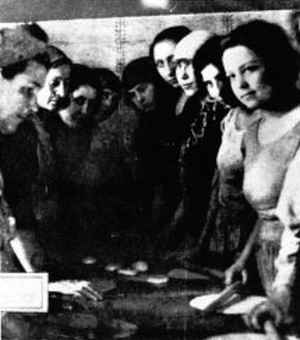
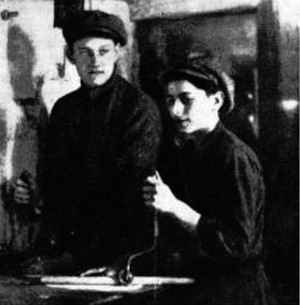
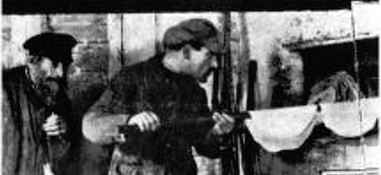
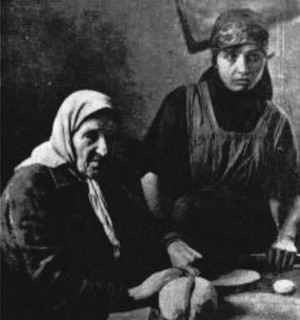
Podrat – a Matzah bakery which would be built on the eve of Passover. Derives from the Russian word “Podriad” (public service contract) taking on a new meaning.
Pokrase – a beauty. Often used ironically about an ugly woman. “She is a remarkable beauty”.
Pomunitze – (Harkavy writes: Pomaynitze). A pail with filled with filthy water, sewage, slop.
Prisok – burnt coals, embers. He stands as if on hot coals. He's in a hurry.Farmotzeven – to strengthen the thread, the seam. To thread the button a few times to strengthen it so it won't fall off.
Plokher – without energy, without courage, uncommunicative.
Fosfelitke - half – black flour (Fossilized). Used to make farfl (little square noodles).
Pirozhkes – small three-sided cakes steeped in honey. Served on holidays.
|
|
Fartzoygn – covered or veiled. He speaks a veiled Yiddish. This is what they would say about Jews from Congress Poland or Galicia since they spoke a different dialect than the Jews of Lithuania.Farkrotchet – filthy, dirty.
Pinal – a wooden dish to hold writing instruments, used mainly by school children.
Farsmarodziete – smeared, dirty, not dressed, ragged. Mainly used about children.
Farstamayet – literally means blocked. Refers to someone who has become foolish, stupid. (Possibly derives from the word “Stam” meaning ordinary).
Tzeyner – teeth. The expression “Faredn di Tzeyner” means to distract. He wants to distract me so I will forget.
Tzespuzhet – to bolt, as a frightened horse. In other districts they would pronounce it “Tzepuzhet”. See: “They Bolted” a monologue from a local wagon driver, “Letzte Nayes” (The Latest News), Tel Aviv, May 27, 1966.
Tznotes – pretenses or mannerisms. He has strange mannerisms, peculiar customs. (Meant in a negative way).
|
|
|
| “Podriad” – the Matzah bakery in Lida
Photographed by A. Kaczyne and the beginning of the 1920s |
by Aba Lande
Translated by Phillip Frey
A Lida expression and its source:
“Tshekai Na Yurie” (“Yuriev Dien”-A Russian date upon which contracts for rented dwellings began and ended)-A Lida Jewish expression, despite its being expressed in the local gentile parlance—whose origin the people remembered. And the story went this way:
A respectable Lida gentleman, a rich widower brought a new wife down, a member of the “aristocracy”, who spoke Russian…on her side, it is to be understood, lineage and intelligence, and on his side—Wealth. He had promised her before the wedding a lovely dwelling, fine furniture and the like. A while after the wedding, she began to remind him of his promise. He used to repeatedly defer the matter with a pretext, that there not yet any available dwellings: “Tshekai, Milenkaia, Na Yurie”, he used to tell her-wait until “Yurie” time, when neighbors, who have ended their contract, changed dwellings.
Lida wiseguys needed nothing more. They were continually wisecracking about the wealthy “intelligent” with his peasant Russian, of course, and his generous promise, which was continually deferred, heeaven knows how long…so a saying remains: “Tshekai Na Yurie”, which means—you have to wait a long time.
Munie tsukernik (The founder of the Tsukernik family in Lida) in his day was know as Lida”s Motke Chabad (A folk-hero whose antics were comic-Ed. Note) His “Shtiklekh” (the word “shtick” has made its way into English=antics) consisted mostly in prankish acts, with the single purpose, to cheer himself up, creating comic situations, often it cost him money, because he had to pay the naïve victims of his fooling-around.
One time he bought at market a load of “moss” (which was used in wooden houses, to be stuffed between the wooden timbers of the walls, so that no open cracks might remain, so that cold could not penetrate, and similar purposes.) He brought the cart to the communal bath, opened the window to the Mikveh (ritual bath), telling the carter to dump the moss inside. When a considerable pile of the light moss had collected on the surface of the water, Munie tells the carter to go inside and stuff the moss ….Nu, one can just see the surprise of the carter over this sort of involuntary kosher immersion…..for the wagonload of moss Munie had naturally paid, perhaps with a drink of whiskey in addition. Meanwhile people were convulsed with laughter. Back then people were sane…. (said ironically)
When Munie Tsukernik got older, he called his friends together, because, he wished to write a will... He starts to dictate: for Yoel—thirty thousand roubles; for his second son, twenty-five thousand roubles, etc., with a broad hand tens of thousands. When his friends opened their mouths: “Munie, where are you going to get all this money?” he anwered with a straight face: “If there won't be, then don't give…”
A False World
About one of the religious judges the people of the city used to murmer under his breath, that he at times stumbles into receiving bribes, may the merciful one forbid….and they used to tell this sort of story”
Once there came two householders to the religious court for a religious court judgment before this very judge. One of the litigants gives him a broad handshake, and the judge feels a coin in his hand. By is size it had to be a tenner (five kopikes). Our judge lifts his hand, as if by accident, upward, the coin drops into his broad sleeve and he feels it slipping downward over his body straight through his trousers, which were stuffed into, according to the fashion, into his high boots. Having heard both pleadings, the judge reflects, having well considered the matter, as was customary, and reached a decision---in favor of the litigant of the coin…
Came home in the evening from the religious court building, he calls his wife and magnanimously allows her to pull his boots off, to surprise her with his earnings…shook out his boot and out fell a great big copper sixer! (three kopikes) one of the big old style sixers, which were as big as the new tenners. For such deceit the “honest” judge had not been prepared!
--Oy, says the judge—a world of falsehood!…We needn't be suspicious of Lida judges that one of them might be dishonest, God forbid. A few of them had other failings, about which we've had the opportunity to tell elsewhere…but as far as we have heard about them, they were all honest Jews. But this is a lovely story on a source of moral education…
King David's Yohrzeit (Memorial of his day of death)
Jewish village-dwellers had for generations, dwelt in the villages around Lida. Innkeepers, leasees, who would lease “courts” from the landowners and cultivate them, or on their own tiny landholdings (From the time of Alexander the Second—as long as the Tzarist government allowed them to remain there). They were robust persons, unsophisticated, slightly naïve, generally also magnanimous. The city dwellers often used to amuse themselves about the villagers, who were generally far from learned…
A villager rides into town at Shavuot-time (The feast of weeks-after Passover) to spend the holiday and stays with one of his relatives. On the holiday morning before dawn, he hears knocking on the relatives' shutter: “Awaken to recite Psalms, King David's Yohrzeit!” The villager asks: “Whose Yohrzeit is it?” The relative explains that Shavuot is King David's Yohrzeit. The villager scratches himself behind his ear: “That's how it is, King David has died? I didn't even know that he was ill…”
Nachman's Signature
Nachman was a wealthy villager and for his children he maintained a young tutor, a learned man and a scholar, with fine innovative methods. Since Nachman was engaged in considerable business with the landowners and very often had to sign contracts and the like. The tutor taught him how to sign his name (in Yiddish naturally). Nachman used to demonstrate for his gentile acquaintances the “wisdom of writing” which his tutor had taught him:
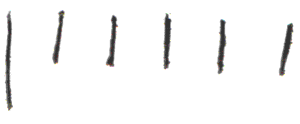
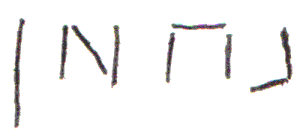
“Treba Postavit Shest Kolov” he used to explain, that means: You have to set down, first of all, six marks (vertical strokes). Then he would set down five strokes one next to the other like the letter “vav” and a sixth like the letter “nun”. And further: “Tu nozshku treba”. Here, it means, one needs a foot—and he places a foot beneath the first stroke and it suddenly becomes a clear “nun”. “Here”, he continues, “Kraizshki treba”. In Yiddish: here we need a little roof- and he sets down a (horizontal) line over the next two strokes, and the emerges an accurate “Khet”. And finally (between strokes 4 and 5) a diagonal stroke, and it becomes a letter which is similar to a “mem”---“Ee vot tiebie lachman”, he ends with a proud chapter ending!—and what you have here is, that is to say---Nachman (Gentiles used to pronounce it “Lachman”).
The Yeshiva Student in the Village
The villagers from their vantage point often used to ridicule the weak citified creatures, which at times don't know how that which they eat grows.
A young groom-to-be travels to his father-in-law-to-be, the rich villager. The cart travels through a field covered entirely in white—what is this? The young bridegroom asks, and the father-in-law explains to him, that its is “Retshke” (i.e. the buckwheat grain eaten as kasha) (“gretshikha” in Russian) The Yeshivah lad exclaims in amazement: This Retshke is Kasha with milk.
Reb Moishe Ber and His Ideas
Reb Moishe Ber the teacher (Vaismanski) was very learned. Generations of students were taught Gemara (Talmud) by him. Behind the gray strict external figure (which, incidentally, is reminiscent of Isachar Ber Ribak's cubist painting “The Elder”)was hidden a “juicy” soul, which loved a flower, a tree, with enthusiasm for God's nature, in addition a quiet humor, which was capable of ridiculing his own small-town ideas.
He once related to his students his impressions of a cart trip to Vasilishok (several tens of kilometers from Lida): One rides, and one rides and one rides! And I think to myself—and this is still Russia!…
This was told with a jokesterish smile in his eyes. But he truly believed it, that the Nieman was the largest of all Russian rivers. When we told him, that the Volga for example is bigger than the Nieman, he remarked filled with wonder: but the Volga also falls into the Nieman?
He used to say: Of all the towns ending in “Shok” (Vasilishok, Oisishok, Yurazishok, etc) I care the most for Kilishok…(and it was true…).
Reb Moishe Ber was, as we have said, a great scholar, but in addition-had imagination, but, was a believer. We heard many stories from him about ghosts, in which he believed: about his dead brother whom he suddenly saw enter the room of his (Moishe Ber's) mortally ill son with a big wreath of flowers (and the son quickly recovered!) He also used to avert (via speech formulas) “evil eyes” (as in “Kein Ayin Hora Nisht” or ”Kinahore”) He also believed in “Zugot” (pairs), this means, all those things which in twos can do harm (He would add: those who believe in it). Therefore he would never drink two glasses of tea: either one, or three, or five. In his elder years his mouth was twisted (probably from a stroke), it happened, as he told us, because one time he forgot his rule and he downed four shots of whiskey—forgetting to drink a fifth, it should be (an odd number) “and”…
Yidl Gilmavski was one of the Lida jokesters of the new time. A one-time student in the Mirer Yeshiva, a Torah scholar, a Hebraist, good with numbers, with good hands for different kinds of work, but to prosperity, he did not come. A pauper all his life,- but always joking.
One time he was standing in the merchants bank watching the cashier counting money. They ask him: Reb Yidl, is there something you need?---He answers: No, my wife sent me to see (to getting) a bit of money” for the Sabbath. Nu, so I've already seen…
For Passover, he used to say, I have to worry, actually, only about a chicken. I don't have to worry about matzot: Would people let a Jew be without matzot on Passover?
---A gentile woman, who is buying a piece of fabric from him bargains arguing, that the fabric is narrow. He answers her: “Ale Dlugi” (But it is long….)
Yidl is interested in all sorts of “antiques”: a sort of arty lamp with a tall green marble base which fits with great difficulty into his few and humble furnishings, a writing desk with a “secret lock” which takes up half a room, and the like---all bargains, acquired by barter or at some other opportunity. Once during the German occupation, during the first world war, much loss of business by the local merchants, who promptly rode off to Russaia. Somewhere Yidl scrounged out of the abandoned business of an acquaintance who was a salt merchant, a meter high glass (measuring) graduate which had served as an advertisement of sorts for the business. A young man, seeing Yidl “schlepping” his “bargain” on his shoulder, called to himfrom across the street: “Reb Yidl, what need have yuou for such a piece of glass?—“For doing (chemical) analysis—answers Yidl from across the street.”
They say, that in the ghetto, Yidl was still making jokes. But no details about that tragic “gallows humor” never made their way to us.
Parliamentarism
In the years 1918 to 1920, on the Jewish street meetings abounded. Debates without end, about the construction of the future Jewish community etc, lectures by people with axes to grind, obstructionism, counter-arguments. The president wishes to have parliamentary order, but who is listening to him. L. is a constant oppositionist. He is a solid business, with a fine little stone wall, with a factory, where several apprentice tailors were already working, yet he still remained the sworn opponent of the old community businessmen, the “fat-bellies”, the “blood-suckers”. At a meeting, when the president doesn't wish to allow him to speak out of turn and argues at him: Friend L. “You don't have the “word””- L. interrupts him: “What are you telling me, I don't have a word-I have more words than all of you.”…
A Thrifty Person
To be hatless inside your house had long been accepted by the very deeply religious in Lida. However, going hatless in the street, still appeared to be extraordinary (During the 1920s). Our friend M.., of a strong revolutionary character, was, so to speak, of the pioneers of going hatless in the street. Suddenly it became known, that M. was going to Erets-Yisroel!
On the Krumer(not straight) street, the matter of the pioneer was bandied about: what might such a lad do in Erets-Yisroel, without a trtade, sans money (In those days it was thought that to go to the land of Israel one needed to be either a tradesman or a capitalist) R. \Isaac Lande did not agree with that opinion: Why not? He said, it will actually not be difficult for him there: He is very thrifty: He doesn't need a hat.
Recited Goiml (The prayer “Asher Gamalti” thanking the almighty for his grace in allowing one to live as after a severe illness)
Reb Shoul Krasnoshelski, prayed in the “Metaskim Kloiz” (a prayer house for those who “occupy” themselves with Torah study), where he was a regular worshipper (He had a “city” (was important) there). He was honored with the Maftir (reading of the portion of the Prophets) and was given well wishes for his departure. In reply to the blessings Reb Shoul began: First I must recite Goiml that I have departed alive from the hands of the “gang” of Metaskim.
|
|
JewishGen, Inc. makes no representations regarding the accuracy of
the translation. The reader may wish to refer to the original material
for verification.
JewishGen is not responsible for inaccuracies or omissions in the original work and cannot rewrite or edit the text to correct inaccuracies and/or omissions.
Our mission is to produce a translation of the original work and we cannot verify the accuracy of statements or alter facts cited.
 Lida, Belarus
 Yizkor Book Project
 JewishGen Home Page
Copyright © 1999-2024 by JewishGen, Inc.
Updated 7 Aug 2022 by LA