![dab178.jpg [40 KB] - “Freiheit” and “Poale Zion”](images/dab178.jpg) |
[The banner reads: The “Freiheit” should live]
|
by Cwi Kozuch
Translated by Dr. Hannah Berliner Fischthal
The Zionist-Socialist movement in Zagłębie dates its activities to after the
first World War with the founding of various groups, such as
“Hechalutz,” “Hashachar”, “Poale Zion,” and
“Tzirei Zion.”
The goal of the Zionist-socialist minded workers, members of assorted groups, first became crystallized in 1920, after the split of the “Poale Zion” party. That goal was to immigrate to Palestine. Already by 1920 the first Zionist groups in Dąbrowa had left Poland, travelling all routes, to make aliyah to Eretz Israel (the Land of Israel). These included Hersz-Lejb Liberman and later – Barzilay, Jakob Sliwka, Abram Grosfeld, and Jakob Federman. In 1925, when “Poale Zion” (right wing), “Tzirei Zion,” and other Zionist groups united, the foundation of Zionist-socialist activities in Dąbrowa was laid. The founders of the party were Noach Krempl, the brothers Siwek, Josef Izralewicz, Herszl Frajlich, Mordechai Ben Wolf Rozenblum, Pejsach Zygrajch, and others. The top leaders of the youth-party organization “Freiheit” [freedom], which had educated reserves for future party members, were Mosze Szwimer, Herszl Kozuch, and the Wajszalc brothers.
With consolidated work from both Zionist bodies in the areas of culture and
socialist and Zionist enlightenment, the party became an important factor in
Jewish life in Dąbrowa, resulting in: active participation in elections to
the Zionist congress; fundraising; participation in the Palestine workers fund;
creating symposiums about worker problems and topical political discussions,
led by local friends, such as comrades Szymon Gutman, Abram Tenenbaum, Josef
Izralewicz, and others. Visiting us from the “Poale Zion” chapter in
Warsaw were comrades Ritow, Rajs, Najtstat and Szpicman.
|
|
| The “Freiheit” youth movement with the “Poale Zion”
political party in Dąbrowa
[The banner reads: The “Freiheit” should live] |
The participation of the party in the first May Day demonstration, in connection with the Polish Socialist party, resulted in Zionist prestige and influence over Jewish and everyday life in Dąbrowa.
In 1938, when elections were to take place in the Jewish kehila [Jewish community] of Dąbrowa, the party received, besides its limited number votes from the current half-Fascist and anti-Semitic Poland, a mandate in the kehila leadership, obtained with the help of the “Agudah.” Israel Klajman, the candidate of the party, represented its interests in the community. His representative became Lajb Wajszalc in the council. Their representations in both forums, in the spirit of the party, called forth recognition by the workers in Dąbrowa.
With the outbreak of the Second World War, party activities were interrupted.
Some of the comrades left the Polish realm, which according to the
Soviet-German pact, was incorporated into the Soviet Republic. Few of the
comrades I mentioned remained alive. A few survived German concentration camps
and are now located in Israel. All the others were cut down together with
Dąbrowa Jewry in the Auschwitz death camp.
[Page 180]
by Chava Kariti (Gurst)
Translated by Jerrold Landau
|
|
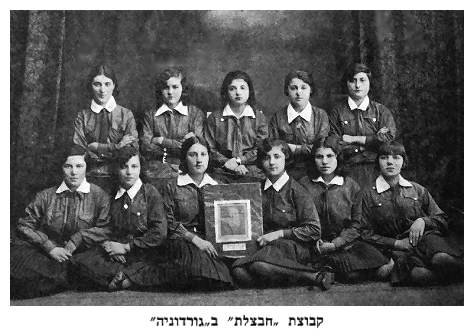
| The “Havazelet” group in “Gordonia” |
With the establishment of the Gordonia movement in Poland (and especially in Zagłębie) news of the movement even reached our town – Dąbrowa. The doctrine of A. D. Gordon enthused no small amount of youths from among us.
Even though many movements and parties (starting from the Revisionists and ending with the Communists) existed in our city, we saw the need to set up a chapter of Gordonia. Many youths gathered together from all sections of the city – from Reden, Huta, and Old Dąbrowa, and was as nearby Zagórze – from various groups and strata.
As I recall, a cultural center of P.P.S. existed on May 3rd Street, with splendid reading halls in which interesting lectures took place every evening. Many youths, mainly Jewish, would stream to this center. We saw our purpose as organizing this Jewish youth and to turn it to our path. Indeed, we succeeded in “drafting” to our ranks a significant number of girls from the middle class of enlightened people to the Chavatzelet Group. That group was well known for its beautiful girls, with intellectual abilities in the area of arts and organization, who gave a great deal toward the vibrant life of the entire chapter.
After the first difficulties of organization, we began to think about organizing additional children, even younger, to the organizational activities. Membership in a movement at this age was dependent on the agreement of the parents of the children. Even though most of the parents were Zionists, they were wary of giving over their children to our hand. We made the rounds to the houses in order to convince the parents and to discuss and debate with them about this topic – and we ourselves were youths… We did a great deal, with much sincerity, and indeed saw fruits of our labors. We succeeded in organizing the Nitzanim group, and later we even received the assent of the parents to send their children to the summer camp. This was considered a great achievement.
Obtaining a place for the group was no small problem. After much wandering, we obtained the great, spacious hall on Sienkiewicz Street. There was a large yard next to it. There, we began
[Page 181]
to develop a vibrant and joyous youthful life. I recall an interesting detail: Sienkiewicz Street was mainly populated by gentiles, and more than once, we encountered their surprised looks mixed with hatred, as they saw the Jewish youth bringing the somnolent street to life.
Our activities for the benefit of the Jewish National Fund stood out from among all our activities. We set up a nice “corner” in our large hall, and decorated it on that topic, and on everything related to the redemption of the soil of the Land of Israel. Every month, we emptied the blue boxes of the Jewish National Fund in the homes of the Jews and participated in many “flower days” for the benefit of this enterprise.
I will never forget the first time that I went with our member Naftali Rechnic to collect donations for the Jewish National Fund. This was on a Sunday, when the stores were closed, and their owners were at home. We knocked on the doors. There were those who refused politely, and others who responded generally. I recall the reaction of the matrons whom we recognized as fundraising workers. They were surprised to see us in this position – “How can you earn anything in these times?” – and we had to explain to them the educational value and the great good deed that we were doing in the enterprise of canvassing for the Land of Israel.
I recall one other incident. We collected money for the benefit of the Jewish National Fund at weddings as well. For this purpose, we prepared a large, beautiful ledger (similar to the Golden Book of the Jewish National Fund in Israel) in which every guest registered their name and the amount of their donation. I and a member of Hashomer Hatzair were given the task of going out first for this endeavor. The wedding took place in Litner's house on Sobieskiego Street. This was a wedding of religious Jews. We hesitated and then we went. We began to canvass, at first targeting those who were known to be supporters of Zionism… to our great surprise, not only did we meet with great interest from all the guests, but also a feeling of great arousal was sensed, and the name of the Land of Israel was talked about by everybody. We, two young girls, were surrounded by youths and adults, and slowly all began to sing Hebrew songs and songs of the Land of Israel. Finally, thy even started to dance the Hora.
Let this article serve as some sort of monument to the Jews of Dąbrowa, who are remembered for their good hearts, generosity, and great understanding – even among the non-Zionists – for our outlook and activity.
|
JewishGen, Inc. makes no representations regarding the accuracy of
the translation. The reader may wish to refer to the original material
for verification.
JewishGen is not responsible for inaccuracies or omissions in the original work and cannot rewrite or edit the text to correct inaccuracies and/or omissions.
Our mission is to produce a translation of the original work and we cannot verify the accuracy of statements or alter facts cited.
 Dabrowa Górnicza, Poland
 Yizkor Book Project
 JewishGen Home Page
Copyright © 1999-2024 by JewishGen, Inc.
Updated 13 Jan 2019 by OR