|
|
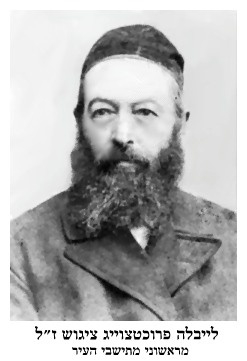
| Mosze Mitelman
the “Feldscher” that fought the typhus plague and dysentery during WW1, without seeking reward |
|
|
|
| Mosze Mitelman
the “Feldscher” that fought the typhus plague and dysentery during WW1, without seeking reward |
As a “feldscher” in the times of typhus plague and dysentery, he would trudge to
the Jewish homes in order to serve food and render assistance, he didn't take
money for his visits and there were instances that he even handed out
additional medicine. In cases where the medicine that he had prescribed had not
been purchased because of a lack of funds, he would take out money to give the
patient's family so that they could purchase it themselves. He was an
exceptional personality that the Jews of Dąbrowa could be proud of. His son,
Dr. Szmuel Mitelman passed away in Israel.
Generation upon generation saw the bringing of a bride to the “chupa” as a fundamental “mitzvah”. Our ancestors became very anxious when A daughter reached maturity and was still unmarried, fearing that she would miss the opportunity and, Heaven forbid, not obtain a husband, and forever remain single. Many legends amassed on this subject in Jewish folklore, on a single tear of a Jewish bride under the “chupa” which opened Heaven's gates and atoned for the iniquities of the society.
In Polish towns it was customary to give a dowry to the husband so that he would have the initial foundation for creating a source of income, and it was deemed inconsequential that the bride was endowed with special talents – there had to be a dowry ! More than one father broke his heart on seeing his daughters reach maturity without their having a dowry, and in several places in the town there were committees for this purpose and secret funds to save brides from disgrace. One of these funds was organized by Wawa Fajner, Jekutiel Kajzer, Akiba Wajnsztajn, Mordechai Fuks, Mendel Balicki and Emanuel Zilbersztajn. The fund that they ran was to secretly provide for the outlay of a wedding, to purchase bridal wear, and, sometimes, helped with sums of money for the dowry.
It is related that, more than once, the committee sent a messenger to town
councils, to meetings and to houses of learning in order to find an orphaned
groom to match him up with a poor bride from his town. The joy at this type of
wedding was great, and those that took part in its attainment were particularly
joyous.
The craftsmen were a special type of Jew. Their hands were coarse, they spoke
loudly and flamboyantly, they were broad shouldered and their hearts warm and
were mindful to every Jewish problem. In the town there were shoemakers,
tailors, blacksmiths, carpenters, milliners, locksmiths and a number of
builders. There were petty craftsmen that only dealt in repairs, whilst on the
other hand, there were craftsmen that worked for wholesalers in Bedzin and
Sosnowiec: these were shoemakers, tailors and milliners. There were a couple of
blacksmiths who worked for industry, and manufactured all sorts of accessories
for the factory.
[Page 53]
The craftsmen were connected to the Bedzin “Zach” organization (a type of
professional association), and each craftsmen that sought to be independent and
employ workers had to undergo an examination in the “Zach” association. The
diploma he received would grant him the title of a certified craftsman. The
craftsmen belonged to a union called “Handwerker Fareyn” (craftsmen union) and
their presence in the town was pronounced. They had a strong feeling of
communal responsibility: they had a benevolent fund which gave small loans for
the purchase of materials, a disciplinary court for internal matters, in the
case of trespassing or unfair competition in receiving tenders. They appeared
in the municipal elections as a separate party and achieved their own delegate.
The committee members were: Berl Fuks, Szlomo Wieer, Jekutiel Kajzer, Akiba
Rubinsztajn (chairman), Emanuel Zilbersztajn, Eliezer Rubinsztajn, Mosze
Zilbersztajn and Abram Lajtner. Representing the tailors were: Kanarek,
Wajszalc, Pomocnik and Josef Szymon. On behalf of the shoemakers: Jakob Fuks.
They had their own synagogue on “The third of May” Street and they would pray there on Shabbat and holy days only. Rabbi Jekutiel Kajzer would stand at the reading desk.
The rabbi of the craftsmen was Rabbi Shapira, who was the brother of Rabbi
Shapira from Bedzin. He was a tall Jew, with a small blond beard. They called
him “Der Plompel Rabbi”, since his home was next to the public water pump. Abe
Kalish lived in his house. The craftsmen liked their rabbi and any quarrel was
brought before him and his judgment was humbly received.
|
|
|
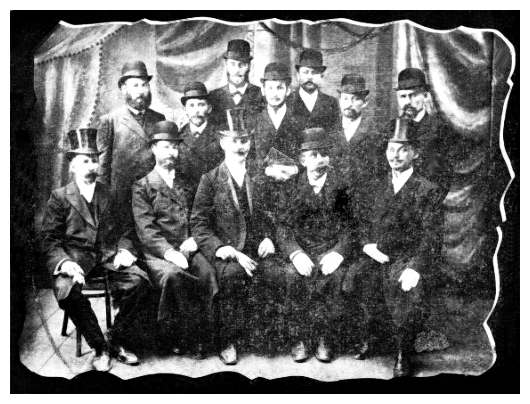
First row, standing from right to left:
Chaim Lewi, Israel Icchak Fajner
(Wawa's son), Zilbersztajn, Icchak Moneta, Jekutiel Kajzer. Second row, standing: Unknown, Chaim Ziszl Szwimer, Guterman, Emanuel Rubinsztajn, Unknown Zilbersztajn, Lajbl Grynbaum, Chaim Wekselman. Sitting: Josef and Szymon Pomocnik, Wawa Fajner, Ruwen Wekselman, Szymon Szwimer and Szlomo Winer |
We have presented a comprehensive review of the lengthy establishment of the Dąbrowa Górnicza Jewish community and efforts to create foundations there, the consistent and unrelenting battle against the eviction edict, the establishment of communal institutions, communal assistance, integrating into the town's life and its development. The material on which this document is based comes from encyclopedias, magazines, history books, and from Jewish newspapers that appeared in Zaglembia before the war. Above all, Rabbi Chanoch-Gerszon Szpilberg, of blessed memory, will be fondly recalled as taking an active role in the community and from him I heard a great deal of the material which is now before you. He was so afraid, that the community's annals would be lost forever, and I did as he requested and wrote down the words as he had related to them to me. The first Jews reached Dąbrowa when it was still a barren region, filled with swamps and forests of oak (“Domb”) trees. In 1931 there were 5,150 Jews making up14% of the total population. In 1940, before their deportation, there were 5,663 Jews (according to documents from the General Encyclopedia, New York).
We have skipped over the political parties that existed in the town, on the Jewish representation in the town council at the head of which were Bernard Rechnic and Lejbl Steschagowski. Over the Jewish trade and the war against anti-Semitic incitement, standing at the head of which were, Rechnic, Szpilberg, Waltfrynt, Najfeld and Zindband. Over the Lodovian Bank whose operators were Nachman Gutman, Herzl Liberman, Kalman Gurfinkel, Lipka Futerko, Ruwen Grosfeld, Chanoch Zalatnik, Lajbl Manela, Herszl Rivscztajn, Chanoch-Gerszon Szpilberg, Icchak Majer Luksenburg, Jakob Frydman, Jakob Parasol, Chaim Dawid Wajnreb, Israel Welner and Szmuel Malsztajn: (“Zagłębie Zeitung”, 1929). There was an institution that dressed those without clothing headed by Szlomo Zeywencz, Mendel Bielicki, Icchak Kraus, Icchak Hersz Rotsztajn, Cukrowski, Wawa Fajner and Szpilberg.
There was a women's society headed by Chawa Minc and active women like Leah Zygrajch and Saraleh Bajtner. There were also religious institutions with their organizations, youth movements and so on. We have not mentioned the tens and hundreds of anonymous characters who did not stand out in public activities, but their simple lifestyle glorified the landscape of this community.
On these pages we have given them an everlasting memorial.
[Page 54]
by Mosze Fajnkind
Translated by Dr. Hannah Berliner Fischthal
In the second quarter of the nineteenth century, Huta Bankowa, Ksawer, and so on, came into being. Later all the colonies were united under the general name of “Dąbrowa,” the settlement located in the center of the coal-mining complex.
Jews first settled in Dąbrowa in the second half of the nineteenth century. The Jewish population in Dąbrowa was less than 500 persons in 1897. The Jews in that neighborhood belonged to the Będzin kehila [Jewish community], where they paid Jewish community taxes, buried their dead, and so on.
When Reb Berisz Graubart, of blessed memory, took over the Będzin seat of Rabbis (1893), he appraised the revenue of all the neighborhoods in the town, including Dąbrowa. Because of the development of the iron industry in that region, the number of Jewish residents grew every day. They no longer wanted to be dependent on Będzin, and they wished to create an independent community. It happened like this:
Several leaders of Zagórcze, Józefów, Gmina Górna, Gołonóg and Ząbkowice, in 1908, directed a petition to the governor of Piotrków requesting to separate from the Będzin community and to create an independent one, together with Dąbrowa, under the name of “Dąbrowa kehila,” the Jewish community of Dąbrowa.
Formation of the petition was motivated by the fact that the Będzin community was far away as well as totally unconcerned that the Jews in Dąbrowa lacked religious necessities at their own location. Therefore, the Jews had to, unquestionably, form an independent community. They were ready to build a synagogue in Dąbrowa, and so on. The officers of the province sent this very request to the proper official in Będzin, so that he would express his thoughts about the matter.
The official answered that the Jews of Dąbrowa, and the other areas
listed, were the very poorest of the Będzin locale, and that it was very
difficult to force them to pay the small Jewish tax. If the Jews wanted to form
an independent community, they would end up having a great financial burden if,
for example, they needed to build a shul [synagogue], a mikve, or to buy
a place for a cemetery. Furthermore, they would have to include a budget of
several thousand rubles a year to pay the salaries of a rabbi, cantor, shochet
[ritual slaughterer] etc., which would cause enormous hardship on the impoverished,
small population, and it would make them even poorer.
[Page 55]
Separately, the majority of employers in that neighborhood turned to the
governor with their own request, that because of the above reasons, they should
not break away from the Będzin kehila, and so on.
Taking into consideration the official's points, the managing committee of the province, at a meeting held 23 June 1909, refused the request to create an independent Jewish community of Dąbrowa (ukase number 4592, 1 July 1909).
The small group of Jews did not let the matter end there. They asked the Senate in Petersburg to repeal the decision. As soon as the Senate received the document to consider, the genteel businessmen of Dąbrowa, Huta Bankowa, Reden, and Gołonóg, brought a second petition to the governor to break away from the Będzin community. The opposition was busy again campaigning against the “revolutionary” petition, declaring that they were happy with the activities of the Będzin kehila, which also concerned itself with the religious interests of their own areas. Principally, however, they were not strong enough to maintain independence by themselves.
In response, the managing committee of the province ordered the official to research, in every area and town, the number of those who wished to separate and the number of those opposed. He should also find out if those in favor of secession were willing to assume all the expenses involved.
Those in Dąbrowa, Huta Bankowa, and Reden who were earning salaries and paying taxes, promised to be responsible for covering all the expenses, including religious necessities, if the authorities would agree to not allow Zagórcze, Józefów, Gołonóg, and Ząbkowice to be a part of the Dąbrowa kehila.
There were more disputes: the governor received a complaint that the people were bribed. Hence those who were previously nay-sayers now supported the yea-sayers. Since a creative majority was created, the petition ought not to be considered because nobody would pay the taxes.
But it came out, that practically all the Jews who were the yea-sayers, suffered to pay the taxes on time in order to support a Rabbi and other religious necessities, securing them with all their own earthly goods. Thus the managing committee of the province, in a meeting on 10 September 1910, decided that the request of the majority of the Jews in the previously listed communities would be accepted. They would be permitted to establish a new independent kehila in Dąbrowa, which would include the colonies of Huta Bankowa, Reden, and Dąbrowa , as well as the village Gołonóg, all of which took financial responsibility to support their religious needs.
As a matter of course, the earlier petition to repeal the decision of 23 June 1909 was nullified.
On the basis of the concession, the Dąbrowa kehila was established 1 January 1911. In the struggle to break away from the Będzin kehila, those from Będzin were not opposed; they acted as though the matter did not interest them at all. This made the impression that they were happy with Dąbrowa's separation, because those Jews did not want to pay their taxes anyway, or because of other undetermined reasons.
That the Będzin Rabbi, Reb Graubart, was thereby greatly aggravated, was
only discovered when the Dąbrowa Jews voted for a new Rabbi, and Reb
Graubart had to take a cut in salary.
[Page 56]
As soon as the kehila was organized, the people voted for a Rabbi; the
candidate for the Rabbinical seat was Rabbi Alter Lewi of Peczniew.
Then the first real war between the nay and yea-sayers flared up. It was just discovered that a certain side led an intrigue against the Będzin Rabbinical Seat in Dąbrowa.
According to the visible protests of the nay-sayers, the Peczniew Rabbi had bought a house in Będzin three years before the separation, and he lived there after he left his shtetl. From time to time he came to Dąbrowa and took charge of the Jews' religious needs.
The Będzin Rabbi regarded this behavior as out of bounds. He referred the matter to the genius Rabbi Elijahu Chaim Majzel in Łódź, and to Rabbi Natan Nachum Rabinowicz of Kromołów. Both the genius of Łódź and the Rabbi in Kromołów were actually against this stepping out of bounds. But they could do no more than write letters. The Rabbi of Peczniew replied with a letter dated 5 November 1910, that this game had already cost him some 3,000 rubles. The nay-sayers took the letter from the Rabbi in Kromołów and attached it to their protest to the governor.
Libelous statements flew from one side to the other, and the end was, that the Peczniew Rabbi was elected by a majority to take the rabbinical seat, and 20 June 1911 the governor confirmed the votes. The Rabbi swore to be faithful to his country, and in July he officially took office, to the delight of the entire population, with the exception of the embittered nay-sayers.
The nay-sayers, however, were still not silent. They appealed again to the governor, repeating all their former complaints, asserting that the Jews in Dąbrowa were promised that they would not have to pay taxes for a period of time if the Rabbi was elected. Many nay-sayers were rebought and told to vote for Rabbi Lewi. They had other complaints, referring to the letters presented earlier about the Rabbis and to a large list of witnesses who would, supposedly, confirm everything.
But the authorities did not research the witnesses and they were not able to sort through the “overstepping of boundaries,” about which the Rabbis wrote. They also did not consider that, according to Russian law, a Rabbi who attended to religious matters in the city of a large province, needed permission from the Rabbi located in the province city, and he had to prove that he had the necessary qualifications to be a Rabbi. The nay-sayers protested, yet the governor general Skalan still confirmed the votes. The nay-sayers turned to the senate in Petersburg to repeal the decision of the governor general.
In the appeal, all the old arguments were repeated. Soon the World War ended the Dąbrowa war.
In the end, Rabbi Alter Lewi remained in the Rabbinic chair of Dąbrowa, a village which had recently become a shtetl. And nobody says a word…
Because of the war, the heads of the community were not able to produce a report to the province about their deeds in the first years of their term in office. They also did not present their budget for 1912-1914.
After the death of their first Rabbi, the feud about the Dąbrowa rabbinic seat flared up again.
[Page 57]
by Mordechai (Motek) Hampel
(Events, episodes, memories from various sources: stories, manuscripts, and popular stories)
Translated by Jerrold Landau
| Mordechai (Motek) Hampel (a former writer for the Zagłębier Zeitung of Będzin), is one of the editors of Pinkas Będzin and Pinkas Zagłębie, and one of the participants of the Hapoel Hatzair weekly, and other newspapers in Israel and the Diaspora. He was one of the activists of Gordonia, Hechalutz, and Tarbut in his native city of Będzin, and in Zagłębie in general. Mr. Hampel visited Dąbrowa frequently for Zionist matters. He knew its way of life, its occupations and sources of livelihood. He was close with the local members of the youth members, who recall the grace of his youth, as someone who worked to impart the Hebrew language and Zionist consciousness. |
The first Jews appear in Dąbrowa during the 18th century. In 1767, a Jew named Jakob Jozefowicz leased a tavern name (Pod Lwem) between old Dąbrowa and Będzin.
In 1818, the directors of the mines set a regulation prohibiting Jews from leasing inns and taverns in the area of the coal mines and factories. Anyone violating the regulation was liable to a serious punishment and the confiscation of the property. Similarly, Jews were prohibited from owning mines and quarries, and the permission to search for “black diamonds” – i.e. coal – was removed from them. The Jews were also forbidden to work in the mines. Nevertheless, a few years after the issuing of these laws against the Jews, when Dąbrowa suffered from a serious dearth of workers to the point where it was difficult to provide even for internal needs, the law was repealed, and it was permitted to employ Jews. The work of the Jews in the mines was restricted by the specific condition that they must be employed as hired day workers, in order to restrict their eligibility to social benefits given to permanent workers.[1]
During that period, we find the first Jewish family in Dąbrowa, living in the Reden suburb, which was populated solely by miners who lived close to their workplaces in the mines. This family was called Zeigen, and were also called by names similar to Zeigen. Eventually the name Zigusz stuck with this family.
As we mention the suburb of Reden, we should state that the first mine in Dąbrowa was called Reden. It was dug in 1796 by the government of Prussia, during the reign of King Friedrich the Great. The name Reden was taken from the director of the Prussian coal mines in Zagłębie, Baron Wilhelm Graf Reden.
In 1828, the Rozencwajg and Natan families arrived in Dąbrowa. The head of the family, Aharon Natan, knowing that it was forbidden for Jews to conduct business with liquor in the area of Reden, opened a stall for the sale of plum brandy mixed with honey, called med in Yiddish and miód in Polish. Since the drink was considered tasty by the customers, many minors would come to the stall of Natan, who was known by them as Miódownik, due to his miód that restores the souls… Natan himself got so used to the nickname given to him by the miners that he began to refer to himself as Miódownik. Indeed, the Miódownik family was known in Dąbrowa. (This writer studied in the Yavneh Gymnasja in Będzin with one of the members of the Miódownik family).
From 1864 onward, Jews came to Dąbrowa in large numbers, and found their livelihood in commerce and trades. The Bajtner, Gliksman, Glajcer, Grosfeld, Brynbaum, Domb, Halperin, Wajszalc, Liberman, Nagar, Nusbaum, Cytband, Kanarek, Rechnic, Szpigelman, Strzegowski families and other were among the first families.
Only a few of the Jews worked in the manufacturing enterprises, which employed thousands of workers, not only local ones. In the Hatzefira daily newspaper (April 1896), the following article by M. Z. Neufeld of Dąbrowa was published.
“The number of workers and officials in the workshops and factories of Zagłębie reached 10,000. There is no factory that does not employ hundreds of workers. Thousands of people work in Huta Bankowa and the factory of the manufacturers Szajn and Cyszal. Most are locals, but
[Page 58]
there are also workers who came here from Germany, France, and other countries. While we still note with satisfaction the development and growth of industry in Dąbrowa, we also notice the sad fact that there are very few Jews among these workers. To our dismay, Jews are occupied in commerce, and as agents, and in general earn their livelihoods from airy pursuits. The manufacturers, including Jews, claim that Jews are not fit for physical labor, therefore they avoid hiring Jews in their enterprises. It is therefore no surprise that we see among those who are bankrupt and who go from door to door, strong youths who are fit to work and earn their livelihoods in an honorable fashion, but to our great embarrassment, who prefer to stretch out their hands and ask for donations…”
At the end of the article in Hatzefira, Neufeld gives the statistics of the population of Dąbrowa and its neighboring areas. At that time, the population was approximately 40,000, including 33,707 Poles, 2,924 Germans, 2,554 Jews, 318 Frenchmen, 259 Russians, 6 Italians, and 6 Tatars. We note that in the 1921 census, 4,300 Jews are noted in Dąbrowa out of a general population of 40,000. Thus, the Jews comprised about 11% of the population. The census of 1931, in which this writer served as an enumerator for the Polish authorities, demonstrates that the general population of Dąbrowa dropped to 34,000 whereas the number of Jews rose to close to 6,000 – that is, close to 18%.
The Jews of Dąbrowa did not form an independent community until 1910, as they were affiliated with adjacent Będzin. They were subordinate to the Będzin rabbinate for religious matters. They did not have a cemetery, and the deceased of Dąbrowa were burned in Będzin until 1916.
There were Jews who wanted an autonomous community, without being dependent on the community of Będzin. There were also those who opposed this, saying that depending on Będzin made sense from a financial perspective, since the small Jewish community could not maintain its own institutions and finance its vital needs. An internecine battle took place among the Jews of Dąbrowa for many years. There were those who said yes, and those who said no; however those opting for independence were decisive. The two disputing camps turned to the gubernator (district minister), and presented their claims and reasons to him. When the opinion of the gubernator did not satisfy one of the sides, they were not satisfied and even brought their complaints before the high government in Peterburg.
Finally, the proclamation was made: on September 16, 1910, a conclusive agreement was made to found an independent community in Dąbrowa, that would stand on its own. At first, a “Dozor Bogszniczni” was set up, as a form of religious oversight. In time, after the First World War, it turned into a communal organization with authority, as all the communities in Poland that was freed from foreign rule. The first appointees of Dozor Bogszniczni were Jacob-Mendel Gliksman, Dawid Weber, and Szlomo Rechnic, who filled their roles voluntarily until 1916.
The establishment of an independent community required concern for fulfilling its needs, first of all: the appointing of rabbi, without which no religious activity could take place. (The communities had a religious orientation.) The heads of the community demanded their own rabbi so that they would not have to depend on the rabbi of Będzin, Rabbi Yissachar Berish Graubart. However, there were also those who opposed having their own rabbi. A dispute broke out once again among the Jews of Dąbrowa regarding the question of the rabbinate. Rabbi Alter Moshe Aharon Lewi of Peczniew, who lived in Będzin and came to Dąbrowa from time to time to organize religious matters, was recommended as a rabbi. Rabbi Graubart regarded Rabbi Lewi as a competitor, who entered into the bounds of his jurisdiction without his agreement. The two sides spared neither effort nor money, and did everything they could to achieve their goal – starting with an appeal to the gubernator, who decided in favor of Rabbi Lewi. Elections took place, in which Rabbi Lewi received the decisive majority. He entered his post on June 20, 1911.
The opponents were not quiet and did not rest. They approached the government institutions in Petersburg and proved that the elections were not valid. Thus, the “war of the rabbis” continued in the Dąbrowa community until the outbreak of World War I in 1914, which put an end to the dispute. Rabbi Lewi remained at his post as a pod-rabbiner (this is the term used for assistant rabbi). Rabbi Moshe Rapaport and Rabbi Abba Szlezinger were chosen as rabbinic teachers and decisors.
Through the active initiative and support of Kopel Koszenowski, Icchak Majer Luksenburg, Mordechai Lejb Miódownik, Mosze Mitelman, Berl Fuks, and Mordechai Hillel Ferenc, a synagogue was built in Dąbrowa in 1916, in the suburb of Mieski next to Orkzei Street. The philanthropist Berl Fuks donated the land for the building of the synagogue. That year, M. L. Miódownik, Icze Majer Nusbaum, and Lejbl Strzegowski were elected as Dozor Bogszniczni. Their alternates were Ruwen Grosfeld, Dawid Grynbaum, and the Feldscher (medic) Mosze Mitelman.
[Page 59]
With the establishment of independent Poland in 1918, the first community structure, certified by the authorities, was set up in Dąbrowa (replacing the Dozor Bogszniczni). The community was comprised of a council with an executive committee. The first chairman of the communal council was Herszl Tuwia Liberman, and the first chairman of the executive committee was Lejbl Strzegowski.
The Urząd leźnictwo (forestry office) gave a plot of land for free to the Polish population of Dąbrowa for a Christian cemetery. In order to not discriminate against the Jewish population, they also allotted a plot of land to the Jewish community for free on Jaworowska Street. (I heard from another source that the land was not given for free, but was rather purchased with communal money.)
One of the “last Mohicans” of Jewish Dąbrowa, who recalls it from its early years after its founding, the late Chanoch Gerszon Szpilberg (who made aliya to the Land of Israel in 1935 and died at a ripe old age in 1966) related to the author the following memories from years past:
|
|
|||
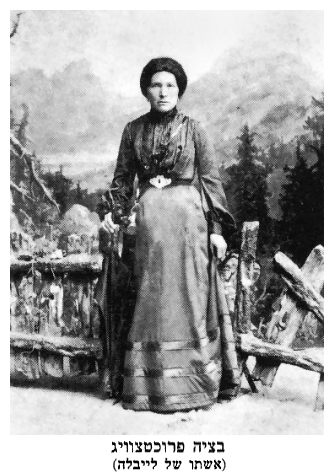
| Basia Frochtcwajg, Lejbl's wife | Reb Lejbl Frochtcwajg z”l, one of the first to settle in Dąbrowa |
According to the words of G. Ch. Szpilberg of blessed memory, communal activities did not take place in Jewish Dąbrowa until the beginning of the 20th century. Only in 1920 did several youths, headed by Szlomo Halperin and Szpilberg, arise and begin to organize societal life in various arenas. The first activity was the establishment of the Jewish fund for credit and loans. At first, the local municipal authorities refused to recognize this public financial institution, under the pretext that the Jews do not require a unique loan fund, since there was a general fund in the city for that purpose that could also serve the interests of the Jews. This pretext did not convince the Jewish activists, and they worked hard to realize their decision. The fund was certified in 1912 after a great deal of effort and numerous intercessions with the “high windows,” for the period of a decade. The fund grew quickly and earned an important place in the city.
In 1910, the bishop (head of the Catholic church
[Page 60]
|
|
Standing from the right: Sender Rajchman, unknown, Berl Fuks, Szlomo Rechnic, Chanoch Szpilberg, Josef Neta Szwimer, Eliezer Frochtcwajg Seated: Dawid Nirenbaum, Mosze Mitelman, Karpensztejn the photographer, Dov Ber Zygrajch, and Dawid Nower |
After a few trials and complaints by the two sides, and after lengthy negotiations with the government and the General-Gubernator in Warsaw (his name was Skalan), all areas and districts of Dąbrowa were authorized for settlement, as was Majeski, as city lands. Jews, just as any other resident, were permitted to live at their will in all sections of the city. The opposing side was not satisfied, and approached the evaluations office in. Peterburg, but the First World War broke out in the interim.
|
|
The Germans invaded the cities of Zagłębie, including Dąbrowa, from nearby Katowice in Upper Silesia. After a few months, the Germans left Dąbrowa, and the Austrians came in their place. The people of Dąbrowa were under their rule. The city marked the border between Austria and Germany. We recall the long bridge in Będzin that served as a border between the two countries. The German guard stood at one side of the bridge, and the Austrian guard on the other. It was forbidden to cross from one side to the other without a special permit from the military authorities, Nevertheless, there were a few breaches in order to allow for the entry to and exit from Dąbrowa.
The relationship between the Austrian occupation authorities and the Jewish population was generally good. This was because Jews served in high ranks in the army command, and they made sure that the Jews of Dąbrowa would suffer no ill. Indeed, representatives of Dąbrowa Jewry were able to influence the district commandant in order to attain benefits for their behalf.
|
|
|||
| [JDC – Joint Distribution Committee] | ||||
Since the aforementioned Dozor Bogszniczni, whose task it was to concern itself with the credit and loan fund, was not active, an approviziacia committee was set up by several activists to provide the poor Jewish residents with staples for free. The dentist Szternik, Dawid Ber Zygrajch, Jakob Szalom Fiszel, Nachman Gutman and others stood at the head of this committee.
A special committee of women (including Leah'le Rozen Klugman, who died in Russia during the Second World War; and Lesha Potrka, who wandered the far east during the war, and whose fate is unknown) were given the task of concerning themselves with the physical and spiritual needs of the Jewish children. However, the main work of the committee was expressed in the field of education: the study of the Hebrew language, Bible, and other Jewish subjects, so that Jewish children would not be distanced from the values of Jewish culture and a connection to the nation of Israel even during such troubled times.
Jewish Dąbrowa, like other communities in Poland, received during the war years significant aid from America Jewry, which continued to grow and became an important Jewish center of 3,000,000 (at the time of the outbreak of the war). It was the second largest Jewish community, after Russian Jewry.
[Page 63]
A committee was found in the home of the activist and philanthropist Lejbl Strzegowski, composed of Ahron Lemkowicz, Jakob Tuwia Kozuch, Szpilberg, and others, to ensure that all the children would benefit from food sent by the American JOINT (a special committee to distribute aid): baked goods made from white flour, rice, milk, condiments in boxes, cocoa, sugar, and other good food which at that time were considered “delicacies,” foodstuffs that restore the soul.
The students who studied in the cheders and the Mizrachi School received their portions in their schools. Students outside of school received their portions in the kitchen of the committee, where the meals were prepared.
We should note for praise the effective aid that the Jews of Dąbrowa received from the Aid Organization of German Jews of Berlin, headed by Dr. Paul Natan, who helped Jews of Eastern Europe and the Orient from an economic and spiritual position.
The Ezrat Moshe (named for the activist Moshe Hirschfeld) youth movement was active in the Reden neighborhood, which was involved in the collection of food for Sabbath and festivals, and the distribution among those in need of the poor of the population. In general, the volunteerism for social assistance among the Jews was very high.
In the social realm, we also know of the importance of an institution in the area of Huta Bankowa called Tei Halle (Tea hall) – a kitchen in which it was possible to eat various simple meals for a low price. Those active in Tei Halle included Mordechai Szwarcbaum, Rechnic, Mosze David Rajchman, and others.
A Bikur Cholim institution was created in the Reden suburb in order to provide medical assistance and medication for free to the Jewish population. This institution, which employed several physicians and even a midwife, maintained itself from monthly payments from the Jewish residents as well as various donations. Bikur Cholim also tended to those seriously ill, providing them with assistance and volunteering to care for them and to stand guard over them in their houses at night.
All Zionist activity was forbidden during the war. Nevertheless, weekly Zionist newspapers (the Hatzefira and Dos Yiddish Folke weeklies) published in Warsaw, were distributed, of course in an illegal fashion. Warsaw was ruled by the German conquerors, so the newspapers would be confiscated in Austrian Dąbrowa, and not be allowed to be brought in and distributed. However, as has been noted, Dąbrowa was situated on the border, and therefore the Zionist journalists from Będzin smuggled newspapers into Dąbrowa, from where they were even sent to other cities under Austrian rule. We should note that the well-known Zionist activist, Sejm representative and rabbi of Krakow, Dr. Yehoshua Tahon, obtained his Zionist newspapers from the Agudat Hatzionim of Dąbrowa.
With the rise of the new, sovereign Polish republic after the First World War, with 3,000,00 Jews (10% of the population of Poland at that time), anti-Jewish attacks took place in various cities. Dąbrowa, like the rest of the cities of Zagłębie, did not suffer from pogroms, aside from “minor” disturbances with attacks against Jews: the cutting of beards of Jews gathered in the streets by gangs of draftees and soldiers called Hallerczyks (named for the Polish general Haller), throwing of Jewish travelers off of trains, and other such attacks. The government of young, free Poland did not react appropriately to these attacks by their army, with the pretext that the soldiers were doing this to “have fun.” In truth, it should be said, that the democratic authorities of the city (Rada Miesko) concerned themselves with imposing order, and suppressed all types of mischief. Furthermore, the Polish workers, who were the majority in Dąbrowa, did not support the attacks against the Jews, and called on the Christian residents of the city to exercise religious tolerance, labor solidarity, and brotherhood among the nations; and objected strenuously to the Polish chauvinist circles.
Male and female youths organized in Hechalutz and other youth movements. The meeting places and chapters bustled with vibrant youth, songs of Zion, and Hora dances. Hebrew newspapers and books from the Land of Israel reached the youth movements, and even reached
[Page 64]
emissaries from the Land. Indeed, the deepening of Zionist thought and its penetration were fruitful. No small number of youths of Dąbrowa, with a holy fire burning in their souls, succeeded in making aliya to the Land of Israel at various periods, through legal immigration with certificates, and illegal immigration as Maapilim.
Religious vibrancy was also felt. Houses of prayer and kloizes arose, and the melody of Gemara rose up from within their walls. Enthusiastic Hasidim arranged Shalosh Seudot meals, and sung Hassidic hymns. They discussed sublime matters, and told wonderful stories of Tzadikim and their miracles. They would get up early on Sabbaths and festivals, and go to the synagogue to recite Psalms. Hassidim who had the means would travel to the Admors, participate in table celebrations in their courts, and derive pleasure from the words and countenance of the Rebbe.
Even the Bund workers' movement, which fought against Zionism for negating the Diaspora and preaching for the return to Zion and the restoration of the Hebrew language, was not absent from the Jewish street in Dąbrowa. Most of the apprentices who worked with the tradesmen, and the girls employed as maids in private houses joined that movement, since the Bund worked toward improving the status of the workers, and toward proper social conditions. Bund agitators would visit Dąbrowa and conduct political and educational publicity toward the Yiddish language.
|
|
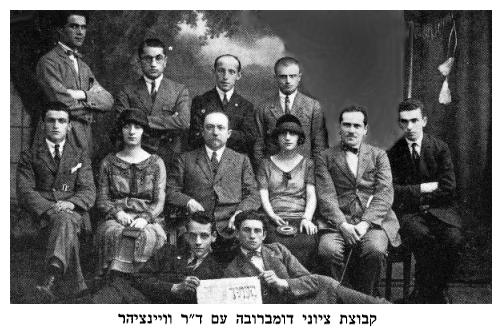
In the elections to the second Sejm in November 1922, Dr. Winciher was again elected as a representative of the Jews of Będzin, having received more
[Page 65]
than 17,000 votes. He remained in the Sejm until 1928. In the district elections of March 1928, six Sejm mandates were allotted to the district of Zagłębie-Zawiercie. The vast majority of Polish Jewry appeared on a single list with the rest of the national minorities (Ukrainians, White Russians, Germans, Jews), and generally managed recognizable success, especially in the border cities. However, it failed in Zagłębie. The national minorities list, which included the Zionist parties, and was identified by the number 18, obtained 11,362 votes in the Zagłębie-Zawiercie area; and the united list of Agudas Yisroel on the Folkists, called the Kirszbrojn-Prilucki Block (number 33), obtained 6,262 votes in our district. The six mandates in Zagłębie were taken by the Communists (3 mandates), Sanacja (government party) – 2, Polish Socialist P.P.S – 1. Thus, Zagłębie Jewry remained without a representative to the Sejm.
In Dąbrowa, the Jewish vote was broken down as follows in those elections: National Minorities List – 927, Kirszbrojn-Prilucki – 544; Poalei Zion – 196; Bund – 123. The results of these elections accurately portray the political affiliation of the Jewish community of Dąbrowa, and prove that the lion's share of the Jews of Dąbrowa were imbued with national consciousness, following after the Zionists.
In the following elections to the Sejm, the Jews were divided. Part of them (Agudas Yisroel and business people) voted for the government list. All Zionist parties were included in a separate list. The number of Jewish representatives to the Sejm declined each time. Just as the Jews were pushed out of economic and cultural life in Poland, they were also distanced from political life, based on the Polish law of 1935 that repealed the rights of the parties from presenting lists of electors to the Sejm. The rights of preparing lists of candidates was given to the electoral committee, comprised of representatives of the civic councils and economic and social organizations. Since most of the candidates were designated by the government, Jews did not appear on the lists in proper proportion to their population in the country. As a result of the plots directed against the Jews and other minorities, only four Jewish representatives were elected to the Sejm in 1935.
“The worshippers in the Beis Midrash in the Reden neighborhood of Dąbrowa began to speak strongly, demanding for themselves for the honor that those who sit near the Eastern Wall were accustomed to from times of yore… The impetus to the “movement of rebellion” was based on the “reactionary deeds” of the gabbai of the Beis Midrash, who honored one of those seated at the Eastern Wall with the recital of “Atah Hareita Ladaat.”[3] The people (in the source: the deed) were shaken. They got up and called loud: we demand equal rights with those who sit at the eastern wall.
Indeed, the threats were effective. Desiring to prevent additional revolutionary deeds in the Beis Midrash, the gabbai honored the simple folk with the recital of Atah Hareita on the morning of the festival, and even gave them honorable hakafot… As one of the rebels stated, they were not satisfied with this. They were not satisfied with this victory alone, and continued to battle for a democratic oversight of the Beis Midrash.
Indeed, the ice was broken.” Thus the author of the feuilleton concludes his works. “The common folk were satisfied…”
Indeed, a few days after the publication of this article, the Germans invaded the cities of Zagłębie and destroyed every one of its Jews.
He was born in the town of Pacanów (Kielce district) in the year 5632 (1872), where his father served as the rabbi. Rabbi Alter Moshe Aharon studied in various yeshivas. He excelled in his talents, and was ordained as a rabbi. He married a girl from a good, wealthy family of Krakow. He received a fine dowry and later a large inheritance. When his father died in 1906, he took his place as the rabbi in his hometown.
He came to Dąbrowa in 1910 to take over the rabbinate. At that time, the Jewish community of Dąbrowa affiliated with the rabbinate of Będzin, and regarded Rabbi Lewi as encroaching on the territory. There were disputes and arguments, but the adjudicators certified him as the rabbi in 1912.
Rabbi Lewi wrote two books: Ner Lameah, and Tvuot Adama, in which he deals with issues in Jewish law, principles, jurisprudence and commentaries.
When he built his home in Dąbrowa (42 Kołłątaja) adjacent to the building of the city council, he did not permit the Christian builders and other workers to work on Sabbaths, so as not to desecrate the Sabbath, Heaven forbid. He paid the workers full salary for their days off in order to prevent a loss for them.
Rabbi Lewi's daughter, Rebbetzin Hinda Blumenfeld of Tel Aviv, told me that when she went to visit the house of her grandfather in Będzin, he requested that she not collect rent from neighbors who lacked means. There were days when she even supported them at the bequest of her father, for e was a charitable man who gave his gifts discreetly.
Rabbi Lewi was among those Orthodox rabbis who opposed Zionism and aliya to the Land of Israel, stating that the time of the arrival of the Messiah has not yet come. When his son-in-law, Rabbi Yosef Blumenfeld of blessed memory (former rabbi of Kenigsuta in Upper Silesia and author of the book Kaftor VaPerach) wanted to make aliya to the Land of Israel with his family, Rabbi Lewi of blessed memory opposed this, and even influenced the rabbi of Radomsk (Rabbi Lewi was a Hasid of Radmoksk), to ask his son-in-law to retract the idea of aliya to the Land. Despite this, Rabbi Blumenfeld of blessed memory listened to his conscience, since he was a Mizrachi follower, and made aliya to the Land of Israel, to the dismay of his father-in-law.
|
|
Blessed be G-d.
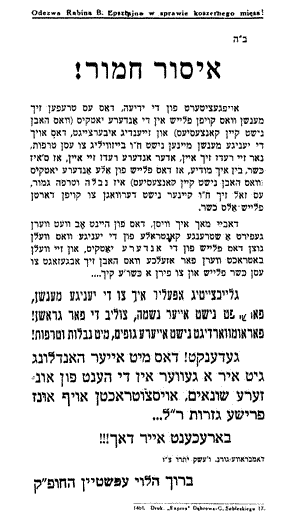
I tremble from the knowledge that there are people who purchase meat from other butcher shops (who do not have concessions), and being convinced that those people did not intend, Heaven forbid, to eat non-kosher food malevolently, but rather they were convinced, or others convinced them, that it is kosher – I inform you that the meat from all the other butcher shops that do not have concessions is completely non-kosher. Nobody should dare purchase meet there as kosher. Therefore, I inform you that from today onward, a stringent control will be imposed on those who use the meat from the other, and they will be considered as those who refuse to eat kosher food and maintain a kosher kitchen… At the same time, I appeal to those people to not sell out your souls for a few groszy! Do not desecrate your bodies with non-kosher food! Remember! With your business, you give support to our enemies, who will impose new decrees upon us, Heaven forbid… Pay attention to this!!! Dąbrowa Górnicza, Friday of the Torah portion of Yitro, [57]97 Baruch HaLevi Epsztajn, who lives here. |
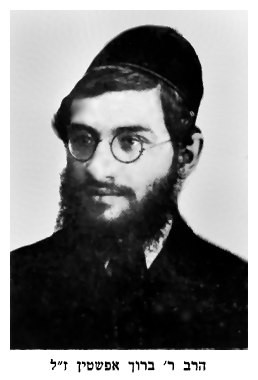
“As is known, our city (Dąbrowa) did not have an official rabbi since the death of Rabbi Lewi of blessed memory. The rabbi of Sczemiszice, as well as the son-in-law of Rabbi Lewi, Rabbi Baruch Epsztajn, filled his role in the interim. Finally, Rabbi Epsztajn was authorized by the High Instance as the rabbi of our city.
In this regard, announcements of the celebration that will take place on the Sabbath in the local synagogue were posted in all the Beis Midrashes and minyans. A large crowd came to the coronation ceremony of Rabbi Baruch Epsztajn. Rabbi Epsztajn delivered a sermon on issues of the times, on keeping the Sabbath, on strengthening the religion, and on his role as a rabbi.”
Rabbi Epsztajn, may G-d avenge his blood, only served as the spiritual shepherd of the Jewish community of Dąbrowa for a brief period. The war broke out, and he too was among the martyrs (in 5702 – 1942), who drunk from the goblet of poison until the end.
May the memory of the Jews of Dąbrowa and its rabbis be blessed.
|
|
Translator's footnotes
|
JewishGen, Inc. makes no representations regarding the accuracy of
the translation. The reader may wish to refer to the original material
for verification.
JewishGen is not responsible for inaccuracies or omissions in the original work and cannot rewrite or edit the text to correct inaccuracies and/or omissions.
Our mission is to produce a translation of the original work and we cannot verify the accuracy of statements or alter facts cited.
 Dabrowa Górnicza, Poland
 Yizkor Book Project
 JewishGen Home Page
Copyright © 1999-2024 by JewishGen, Inc.
Updated 23 Mar 2022 by LA
![Mosze Mitelman - dab052.jpg [16 KB]](images/dab052.jpg)
![dab053.jpg [31 KB]](images/dab053.jpg)
![[8 KB]](images/dab062.gif)
![[9 KB]](images/dab062a.gif)