|
|
|||
| Naphtali Lavie and his brother in 1945 after the liberation from Buchenwald. |
Many years later: Rabbi Lau, Senior aide to Moshe Dayan. |
|
The appearance of our Rabbi Lau, Shalita, on televistion on Saturday night, the Tenth of Tevet 5733 (1973), caused a great stir among our Piotrkow brothers and sisters and became a topic of conversation. Small wonder, since his words penetrated every sensitive heart, particularly the hearts of our Piotrkow Jews. The following is an excerpt from the rabbi's program, which he entitled “Ani Maamin” (I believe), recalling his life as a child in the Nazi hell.
Editor of Heidim
|
|
|||
| Naphtali Lavie and his brother in 1945 after the liberation from Buchenwald. |
Many years later: Rabbi Lau, Senior aide to Moshe Dayan. |
“I believe with perfect faith” – these words by the Rambam (Maimonides) became the hymn of those who died for Sanctification of the Name. Tomorrow is the Tenth of Tevet, the first day on which the calamity of the destruction of the Holy Temple started, leading to the Babylonian exile and the other exiles of Israel, the day chosen as the general memorial day for our six million martyrs who were lost in the Second World War in the most horrible of all the calamities that befell our people, without our knowing their place of burial, and without their having been given a Jewish burial as their ashes were scattered all over Europe, and with even their date of death having been unknown.
We shall not attempt in this program to investigate the Shoah. We shall perhaps attempt to touch on
one point which I consider central – the great faith and inspiration of those
millions, who appeared to be led like sheep to the slaughter, but whose
spirit was not broken. Their flesh was consumed by the flames, but their soul
remained pure and they could sing and hope even during the most difficult
moments of human life…
Piotrkow, my home town, was a city in Poland which had some 22,000 Jews at the
beginning of the Shoah. Students of Torah around the world will recall Piotrkow
because of the cover pages of many holy books which were printed in the Hebrew
print of that town. It had Jewish organizations from Agudath Israel to the
socialist Bund. It had vibrant Torah life and a great variety of activities.
I was about two years old when the war broke out. Despite my young age, I recall scenes of horror which I am sure will never leave me.
My father, Rabbi Moshe Haim Lau, HYD, was the last rabbi and spokesman of Piotrkow even in peacetime, when the attitude of the authorities was good. It was especially during the war and in time of trouble that my father's house became a center of public activity and a place for people to bring their personal problems.
It was in that home where I grew up that I first learned about life during the time of oppression and hardship. My mother was also active in the charitable organizations of the ghetto in Piotrkow.
I particularly remember the scene when I said goodbye to my father. It was in the deportation yard from where Jews were sent to Treblinka. Father was left in the yard. Mother, my brothers and I were thrust into the synagogue, from where the transport was to depart. We were able to escape from there at dawn, but my brother Shmuel, HYD, was forcibly separated by the Germans. Mother's screams reverberate in my heart to this day. But they were to no avail. The next time we had to line up in the yard to complete the quota for the Treblinka transport, father saw to it that we were not sent to the yard, hiding us instead in an attic.
Mother pleaded with father to hide with us, but he refused. He said that everyone knew him and of his existence, and if he was not seen in the yard they would look for him and find hundreds of Jews who were hiding throughout the ghetto.
When mother and I came out of hiding in the attic, we no longer saw father. It was his last journey to Treblinka, and only a few survivors who came back from there, from the gas chambers, were able to tell us about his last speeches, his last words; “For you shall go out in joy,” the confessional prayer he would recite in public, and the singing of Ani Maamin.
We were separated from our father and, a short time later, from our mother, who left us in the train station; only after the Shoah did we find out that she had died during the last months of the war in the Ravensbruck death camp, where she had died of hunger in the arms of a woman whom I met here in Israel.
I remained with a much older brother, who took the place of my parents, and wandered with him from Piotrkow to Czestochowa and from there to the death camp at Buchenwald, Germany, leafing behind the ruins of houses, synagogues, public places, with towns and villages in flames. Jewish Europe disappeared without a trace, with only the remains of walls bearing silent testimony to what used to be. As Gebirtig's poem, “Brother, Fire in the Village,” expresses it, “There is fire, brothers, the fire is burning.”
I was taken to Buchenwald by my brother inside a knapsack, for it was a camp for men, not for children. My brother took me there after he snatched me from a train that was going to Bergen Belsen so as not to leave me alone.
In Buchenwald we were first in Block 66, where Jews were kept. Conditions there were infernal. A Polish doctor, himself a prisoner, took pity on me and cut the letter “P” from a corpse of a Polish prisoner and sewed it on my clothes; thus I was transferred as a Polish child to Block 8, where Russian prisoners were kept, near the gate of the camp. There, conditions were much better. I met a Russian officer named Fiodor who took care of me like a son and made sure I ate cereal or potato soup every day.
One day, while I was in the yard of Block 8, I saw a group of exhausted prisoners in striped uniforms, known as Musulmen, being dragged toward the camp's gate. Suddenly I heard one of them calling, “Lulek” (diminutive for Israel). It was my brother, whom I had left behind in Block 66, who was now being brought over with the other persons to the train taking him to his last destination, the death train. He ran towards me, held out his hand across the barbed wire fence, and said, “I would like to talk to you openly. You are now a big boy (I was seven and a half); you are the last one remaining. I don't know if you will survive, or whether this hell will ever end. I am going away and I shall not return, but if it ever ends and you survive, remember that there is a place in this world called Eretz Israel, where you have an uncle. Ask them to take you there. Tell them your name and ask them to look for your uncle. They will find him by the name, and you will not be alone. I am going. Goodbye, Lulek.”
I did not know what to say. If I had the right words for him at that time, I would have said in Yiddish the words of the Song of the Partisans, which we know in Hebrew: “Do not say you are going on your last way.”
As I said before, I am not going to attempt an investigation of the Shoah. I would like to point out to you so that you may believe that Jews stressed their singing, their faith, and clung to their heritage as much as they could, more than they stressed their pain and tears.
My story ends in Buchenwald on January 9, 1945; then I arrived with my brother,
who was saved in spite of everything, in Eretz Israel, where I was born again.
I carry everything in my head, I see and hear everything, but above all I hear
the plea of the Martyrs: “Do not only remember six million dying to
sanctify the Holy Name. Remember them living to sanctify the Name, with Shema
Israel on their lips and Ani Maamin in their mouths, the voice of bursting
faith – I believe with perfect faith.”
|
|
|||
| Israel Meir, the Chief Rabbi of Tel Aviv Since 1989. |
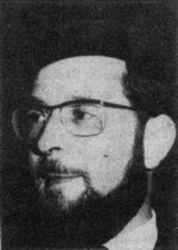
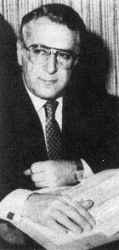
Ambassador Naphtali Lavie, Consul General in New York, In the early eighties |
| It is not a question of remembrance but a state of being… |
| Marcel Proust |
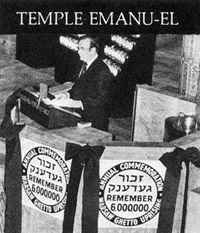
There were thousands listening silently in the Temple's sanctuary, and still thousands more standing outside Temple Emanu-El in the cold April wind, most of them survivors of the Holocaust. Many wept openly during the prayers of the memorial service for those who had perished in the death camps and who were killed fighting heroically in the Warsaw Ghetto uprising.
The moment New York's Governor, Hugh L. Carey, spoke, my curiosity was alerted at once. I had heard this timbre of voice before, with such distinctive diction that could be remembered even after many years. I was positive that when I had heard it, a long time ago, it had been only a fascinating sound without my understanding any of the words. I tried to explore the corners of my mind and to find out when and where I had heard this voice. Meanwhile, the Governor spoke:
“…We gather here today to commemorate the two momentous and heroic events in our modern history. This year marks the 30th anniversary since the US and Allied Forces liberated the Nazi concentration camps. And this year marks the 32nd anniversary of the Warsaw Ghetto uprising.
“Thirty years ago, as an officer in the US Army, I stood with other American soldiers before the gates of Nordhausen and witnessed the nightmarish horror of the slave camps and crematoriums. I inhaled the stench of death and barbaric, calculated cruelty… ”
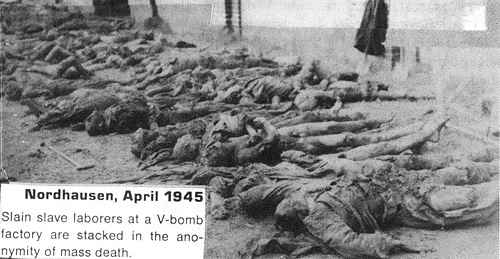
Nordhausen! A charming, red-roofed town in Turingen, Germany… . In the heart of the Hartz mountains – and in the middle of town an extermination camp, a long block of former military warehouses or garages surrounded by a barbed-wire fence.
I arrived there from K.L. Dora. No longer able to work, I was destined for extermination. Block No. 6 was a vast, bare structure where hundreds of subhuman beings with hollow faces and transparent bodies covered with striped rags were lying on the bare, concrete floor. There were no bunks, no blankets, not even straw or sand. Just cold concrete – day and night. Twice a day there was an “Appell” outside. After each “Appell,” the Kapos carried away the corpses of those who had died of exhaustion or were killed.
In block No. 6, I met some people from my home town, Piotrkow. They told me about the sad fate of so many of my friends. In November 1944, a large group of men from Piotrkow, including myself, was sent to Czestochowa. After a short transition, some were transported to Buchenwald, then to Dora and finally to Nordhausen.
I was lucky. I was allowed to stay in Czestochowa four more weeks before going the same route. Four important weeks – a matter of life and death.
In block No. 6, I was told by Leon Nusenowicz how hard they all worked breaking tunnels into the mountains, building future V1 and V2 sites. He told me of the atrocities, hunger and inhuman conditions. Strong, lion-like boys like Sioma Pikus or Leib Gliker perished there. Nordhausen seemed to have only one immutable law: “The only way out was up the chimney.”
A shadow of a man approached: “Do you recognize me?” he asked. I helplessly said “No.” He started to cry. This was “Red Isaac,” once a Samson- like man, and I knew him well.
I recognized a neighbor, Mendel Windman (called Szmukler). He also cried when I asked him about his son, who was my friend. During the time I met others; Moshe Rubin, Baier, Itzek Tennenbaum the restaurateur, the Szlamowicz brothers.
Meanwhile, the Kapos used fire hoses to clean the concrete of vermin and excrement. We had to wait until the floor was dry in order to lie down again. The late German winter of 1945 was vicious.
The end of March was still icy and frosty.
|
|
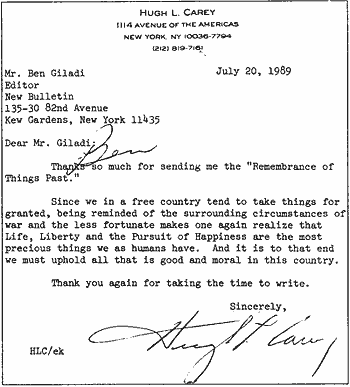
| Governor Hugh l. Carey |
|
|
|
|||
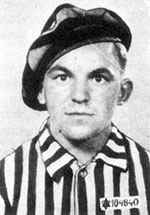
| Charles (Shapse) Salomonowicz after liberation. The survivor of K.L. Dora-Nordhausen |
A letter from the former Governor of New York State, the liberator of K.L. Dora – Nordhausen. |
One day, during the “Appell,” we were delighted to see the sky streaked by little metal crosses, which sparkled in the sun like diamonds set in platinum. The hum of engines sounded. The Liberators had arrived.
The wailing of sirens was interrupted by explosions. The bombers dived one by one, spreading destruction. Each bomb that fell devastated everything in sight, leaving only huge craters and a sea of flames. This was unbelievable! The Allied Forces had bombarded the camp!
One of the tragic mistakes of the cruel war was that, when the smoke had settled, about 90 percent of the inmates were buried under the debris.
I was alone, miraculously unhurt, half deaf from the explosions. Some of the buildings were still afire. The SS ran away. The camp became a no-man's land. I walked among the ruins looking for food. Some stronger survivors were already eating all kinds of things. They guarded their precious possessions closely. I was still hungry.
Suddenly, I stopped. The view ahead seemed like a fairy tale. A large SS Kantina building was split wide open by a bomb. Every floor was loaded with different victuals. A room full of bread; another one of cheese; still another of sausages. There were shelves loaded with margarine, boxes of conserved food, noodles, candles, jars of preserves, wines… The picture was the ultimate in surrealism.
“And to think” I said to myself bitterly, “All this was so near us all the time.”
Exhausted and hardly moving, I joined forces with a smart little peasant boy, who happened to be from Gazomia, a little village near Piotrkow, Poland. We found two blankets and, little by little, gathered all the necessary food. Pulling the blankets, we went a little outside the camp and settled in a hole created by a heavy bomb explosion. We covered the top of the hole with some wood and earth for camouflage. We were just in time: the SS returned from the municipal bunkers and rounded up the rest of the survivors who had not hidden. They were taken away to Dora. Those captured were to go through the deadly journey to Bergen-Belsen.
April 11, 1945. The day was ending and already the shadows of twilight cast a red tint on the naked, battered brick walls of the ruins. We crawled out from our hole and were standing with a few of the inmates from other bunkers near the main entrance of the camp. And then, all of a sudden, a convoy of jeeps, command cars and Red Cross ambulances appeared in the dark.
This was the first image of our liberation! –– The olive-drab shadows with spotted capes and helmets embellished with leaves and branches, moving cautiously from the vehicles, submachine guns in one hand, grenades in the other. They appeared stalwart, unafraid.
The GI's became aware of our presence. They saw the multitude of skeletons, a gigantic scene of death. One of them, apparently the commanding officer, gave orders rapidly to all the others.
The language sounded heavenly. There was a distinctive timbre of voice full of authority but also full of concern and compassion. A voice that could never be forgotten.
The army interpreter briefed us. In a matter of hours, all the survivors were carried by stretcher to an American field hospital and tended gently with magnificent devotion in order to bring us back to life.
“I made a vow as I stood there at Nordhausen, face to face with the survivors of death, that as long as I live, I will fight for peace, for the rights of mankind and against any form of hate, bias and prejudice…”
These words of Governor Carey, as he spoke, suddenly became very special to me.
So, Mr. Governor. You and your fellow soldiers had come at the risk of your lives, into an unknown country, for the sake of unknown people, bringing us the most precious thing in the world: the gift of freedom. Today, I finally know your name.
|
JewishGen, Inc. makes no representations regarding the accuracy of
the translation. The reader may wish to refer to the original material
for verification.
JewishGen is not responsible for inaccuracies or omissions in the original work and cannot rewrite or edit the text to correct inaccuracies and/or omissions.
Our mission is to produce a translation of the original work and we cannot verify the accuracy of statements or alter facts cited.
 Piotrkow Trybunalski, Poland
 Yizkor Book Project
 JewishGen Home Page
Copyright © 1999-2026 by JewishGen, Inc.
Updated 30 Apr 2010 by LA
![pit292a.jpg [13 KB]](images/pit292a.jpg)
![pit292b.jpg [10 KB]](images/pit292b.jpg)