 |
|
[Page 159]
[Page 161]
The Destruction of Piotrkow
Hell is above the firmament. Some say it is behind the mountains of darkness.
– The Talmud, Tamid 84
Hell will cease, but they will not cease.
– The Talmud, Rosh Hashana 17
On the night after Shabbat Shuva, fifty people, including a few agitated youth, convened for an open meeting in the rabbi's house. Several of those in attendance were members of the Jewish police, who distinguished themselves by exemplary service and allegiance to their Jewish cause. Particularly outstanding among them were two brothers-in-law from Lodz, Asher Landau and Michael Klausner, who, when the time came, voluntarily joined their parents in the transport to Treblinka, as did another three policemen, Kuba Wolkowicz and the Rokmanns, two sons of Tzine Rokmann, the shoemaker. At this meeting, for the first time, it was publicly suggested that the transports be resisted by force. Several participants with “ultra-Orthodox” leanings – Elazar Sheinfeld, Reuven Neifeld, Avraham Moses (from Kalisz), and others – shared this view. Others took exception, arguing that it was hopeless. They included Judge Borenstein, Dr. Brahms, R. Moshe Shapira (brother of the distinguished Rabbi Meir Shapira), R. Baruch Zilbershatz, and Dov Handel. The dayan, Rabbi Moshe Temkin, adamantly pressed the case for resistance. R. Moshe Nordmann, an activist among the “ultra-Orthodox,” presented the anti-resistance argument just as strenuously, insisting on responsibility toward those who had a chance to remain alive.
Many saw only one route to salvation: a place of refuge in or outside the ghetto until the storm had passed.
The tension reached unbearable levels. Women sewed rucksacks and packed them with needed items. Men working in vital industries married young women in the hope of protecting them this way. Outside the ghetto, the Poles lined up and bought Jews' possessions for a pittance.
The whole ghetto prayed on Kol Nidrei night. The sound of crying emanated from every house. Hundreds of people gathered at the rabbi's home for the emotive prayer. The next day, Yom Kippur, the rabbi gave the Piotrkow community a farewell address before Yizkor. It was an emotional speech, evoking rivers of tears. The worshippers expressed only one wish: that a few of their number would survive to bring their names to remembrance.
Czestochowa's turn was the very next day. Messengers sent from Piotrkow returned with terrifying report. The Nazis' special “Operation Reinhardt” detail then went on to Radomsk, the last stop before Piotrkow, and carried out their premeditated mass murder of the Jews of that city. Thousands in Piotrkow were transfixed, terrified and hopeless at the news.
As the death trains passed the Kara and Hortensia plants, the martyrs of Radomsk tossed slips of paper, bearing their names and warning of the tragedy that had befallen them, to the waiting Jews of Piotrkow who worked there. The latter, knowing that their town would face this tragedy in a few days' time, were as drained of strength and incapable of clear thinking as those aboard the train.
As the agony of the Radomsk transport proceeded, the Germans gathered the Jewish residents of the villages around Piotrkow into the ghetto. Scores of farm wagons, under heavy Nazi and Polish police guard, brought Jews from Srock, Tuszyn, Wolborz, Przyglow, Sulejow, Rozprza and Kamiensk, dragging along their property, housewares, and even chickens.
At this time it was discovered that two foreign SS officers had moved into the ghetto; one was the “expert from Lublin and Radom,” Hauptsturmfuhrer Willy Blum, who had come to prepare the operation. The first of the Ukrainians who belonged to the extermination unit appeared in town on October 12, 1942.
Those employed in the vital industries, whose safety had been assured, were ordered to bring their possessions to the factories, where they would have to remain during the deportation. Thus on Tuesday, Heshvan 2, 5703 (October 13, 1942), groups of workers, escorted by squads of firemen, marched from the factories to the ghetto and back, taking leave of their loved ones, abandoning their wives and children to the mercies of the murderers. Strong men cried like babies, unwilling to return to work. Horrifying sights occurred that day. Wives, mothers, and children pushed the men into the lines that returned to the factories, hoping that keeping them alive might somehow help the deportees in their new homes “in the east.” Some of the men, however, refused to part with their families, forfeited the privilege of remaining in the mini-ghetto, and boarded the death trains together with their relatives.
On Tuesday night, the night of Heshvan 3 (October 14, 1942), Ukrainian and German SS troops surrounded and sealed the ghetto. Even before they began their work, the murderers amused themselves by firing indiscriminately into the air and at any target in the ghetto. The annihilations began at dawn.
The aktion was planned to the minutest detail. First, numbers of Jewish police passed through the ghetto streets, relying on a map prepared especially for the day's activity, and ordered the residents to present themselves in a “deportation square” on the premises of the Franciscan barracks next to the Jewish hospital. The deportation area continued on both sides of the River Strawa. Whole families, men, women, old people, children, trekked across the square with their rucksacks and their possessions, some silently, some crying bitterly. After this death march, the SS men combed the houses, looted whatever they found, and shot any living creature they encountered. These corpses were dragged to the square, as were the sick and the disabled. Rabbi Avraham Dov Englard, who was blind, and Rabbi Michael Folman were towed to the train on flatbed carts.
In the center of the square stood the commanders of the operation, headed by an SS officer, the representative of Gestapo's Jewish department, 4B4, known as Sturmbanfuhrer Feucht, who, with great cruelty, had displayed his expertise in these operations in other towns. As soon as the victims had been formed into ranks, the Nazis examined the documents of those needed for labor, since they had not presented themselves beforehand, and selected those destined for transport. The day's quota of six thousand people, enough to fill the fifty-two available cattle cars. Once the quota was filled, all the others were freed until the next transport.
In a ghostly procession, the six thousand deportees marched to the new railroad station, where they were loaded onto the black train. Fatal blows with clubs and rifle butts accompanied the parade. Another SS bodysearch was conducted next to the train. The Ukrainians were especially thorough, stripping the victims of any nice boots, wristwatches, or valuables visible to them. Finally, the people were loaded into the train, more than one hundred to a car, each car marked “Maximum load: Thirty Persons or Six Head of Cattle.” This done, the death train lurched into motion.
The tracks were lined with workers from the glass factory, including the Jews who were housed there temporarily. At dusk they saw the train on its way and saw the trembling hands groping at the window gratings, witnessed the tearful eyes peering through. The survivors retained only these scenes, and the farewell cries emanating from the cars, as last reminiscences of their loved ones, whose terrible cries still reverberated in their ears.
They observed the passing of four such trains: on Wednesday of that week, the third of Heshvan; on Friday night, the fifth; on Monday, the eighth; and on Wednesday the tenth. Each transport exterminated a quarter of the Jewish residents of Piotrkow, leaving deep gashes in the flesh of the mute witnesses of this atrocity.
The three transports were completed in an “organized” manner, except for the scores of victims who were murdered en passant by the Germans, the Ukrainians, and the Latvians in the middle of the operation. Many inhabitants of the ghetto felt a kind of relief each time a transport was sent, imagining that they would be allowed to catch their breath until the next stage. They were incapable of feeling the terror of the nightmare that was taking place before their eyes. The pent-up anticipation of the unexpected, i.e., the deportation, was more excruciating than death itself.
On the day of the last transport, as the Nazis tried to fill the fourth train, they realized that several cars remained empty. The quota of six thousand had not been met! They rushed into the small ghetto and rushed its inhabitants to the square, where the commander of the operation, the murderer Feucht, passed among the rank and selected the three hundred victims he needed. In one of the groups stood several dignitaries of Jewish Piotrkow, community leaders in the pre-Holocaust years: doctors, lawyers, teachers, several public figures who had belonged to the “council of elders,” Judge Borenstein, and finally, the town rabbi, Rabbi Lau, who, alone among them, still kept his traditional dress and beard.
The leader of the murderers noticed the rabbi gesturing with his cane and approached. “The Jews need rabbis there, too,” he shouted. As the selection began, with the murderers abusing their victims, the rabbi called on those standing near him to attack their persecutors. “Pummel them. Don't be silent witnesses to this disgrace!” This was told by Dr. Abraham Greenberg, a survivor who later lived and died in Tel-Aviv, who stood near the rabbi at the time. But the angel of death had already made his decision and assured his victory. The rabbi was dislodged from his position and, clutching a small Torah scroll, joined the last transport of Piotrkow Jews. With their departure, the ancient community of illustrious Piotrkow was no more.
Friday, September the first
Soon, school would start again. Meanwhile, we had all returned from summer vacation and found Piotrkow in the mist of events that seemed like fun to us youngsters. The OPL (Civil Air Defense Board) was mobilizing people to dig zigzag trenches all over town. The windows, marked with long paper stripes in the form of an X, somehow looked grotesque. Bulbs in public places were painted blue. Polish Foreign Minister Beck said in his radio speech that the country's honor was at stake. Now we were to defend it. On every street corner hung huge placards announcing that “We'll not give up a button” and how “Mighty, consolidated and ready” we were.
Would there be a war? Many people didn't think so. “Nobody wants a war,” they said. Meanwhile, the army barracks of Szpitalna Street were swarming with more and more mobilized men.
The salesmen of peace told the world they had made a deal in a place called Munich. It had cost only the freedom of Czechoslovakia … not to mention Austria … and still before a land of black men with spears: Abyssinia. The rape of Spain was almost forgotten; just recently, the latest broadcast brought the news about the German-Soviet pact. And the weather was indeed beautiful, a real “zlota polska jesien.”
Saturday, September the second
Airplanes cruising in the clear sky since early morning. We were sure that they were our planes. In the afternoon, we went for a walk toward the Trzeciego Maja Avenue. Suddenly the sirens blew, but the bombardment had already started. People ran into the streets. Children cried and men cursed. The first raid lasted a good ten minutes and the houses on Slowackiego Street were in ruins. The very first bomb hit the Bernardynski garden. Romek Zaks and a few others were killed – the first fatalities of war in Piotrkow.
We ran towards home, glad to be alive. A large cloud of smoke came from the east side of town. Also, the military barracks lay in ruins. We waited in agony and suddenly we heard the bombers again. Moments later the house shook. Now the Stukas bombed for a long time and a great deal of damage was done. The Kopydlowski barrel factory just near us was in flames. We waited, praying, for the planes to leave and, as though in answer, the silence came.
The Polish cavalrymen on horses with their swords were no match for the Stukas' long-range machine guns. The old-fashioned Polish infantry could do nothing against the incredible speed of the vast German army on motorized wheels. A monstrous, mechanized war machine such as the earth had never seen, was roaming toward us.
|
|
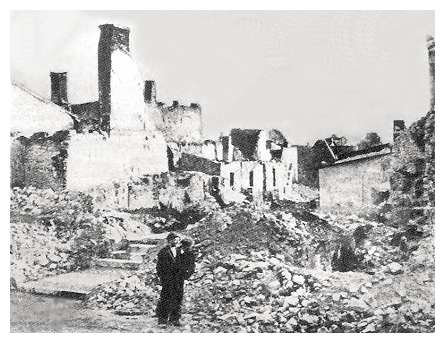
| Sulejow after the September 1939 bombardment |
The bombardment went on and on, soothed only by the silent prayers of the people. The Warsaw radio was playing military marches and, only occasionally, the program was interrupted by the familiar words, “Hello, Hello – Attention, Attention! It's coming… It's over…” In the afternoon an excited speaker reported the important news: England and France declared war on Germany! “Now our troubles are over!” everybody shouted.
Alas, they were not over. More and more bombing followed. Somebody spread a rumor that there was poisonous gas in the air. People started to panic. Luckily, the rumor was unfounded.
Several policemen were leading a handcuffed man across the street. We were told it was a captured spy, a Volksdeutch who was signaling the German bombers.
Toward evening, we'd decided to leave town. For a large fee, a droshke took us in the darkness to Przyglow, a village near our hometown.
Monday, September the fourth
Until afternoon there was silence. In the Przyglow forest, we felt somehow more secure. At about three o'clock we heard the planes again. The black-crossed vultures came diving and dropping firebombs just a little ahead of us. The target was Sulejow. A second wave of planes vomited a barrage of machine gun bullets into the town. The instant they passed, heavy bombs started to fall again. The town went up like a torch. Heavy clouds of smoke came from the distance, Sulejow on fire!
Later, in darkness, we passed through the ill-fated town. Most of it was in ashes; some houses were still smoldering. There was a smell of burning flesh and burning wood. Dead bodies of people and horses were scattered everywhere. All was havoc.
Humanity had been endowed by the Germans with their Beethovens and Schillers, and Bachs. Now the German people presented us with a horrifying new innovation of German culture, the Blitzkrieg.
Friday, September the eighth
We returned to Piotrkow. The roads of Poland trembled beneath the treads of hundreds of tanks moving eastward. These were followed by thousands of German soldiers moving with absolute precision. The Invaders were here!
On our way we met detachments of Polish soldiers, now Kriegsgefangene. We saw towns and villages leveled into smoldering rubble heaps.
In Piotrkow, we luckily found our home intact. Just a street away, the entire block of houses on Zamkowa Street had been destroyed. All that remained there were the chimneys. Now and then an entire wall stood out. A solitary sink hung in the air.
The Wehrmacht and the Luftwaffe were finishing their ultimate mechanized slaughter. Now, the time had come for the SS, the Shupo, the Sonderkommando and the Gestapo.
The first terrible chapter of war was on the verge of closing, with other, most horrifying, chapters still forthcoming.
|
JewishGen, Inc. makes no representations regarding the accuracy of
the translation. The reader may wish to refer to the original material
for verification.
JewishGen is not responsible for inaccuracies or omissions in the original work and cannot rewrite or edit the text to correct inaccuracies and/or omissions.
Our mission is to produce a translation of the original work and we cannot verify the accuracy of statements or alter facts cited.
 Piotrkow Trybunalski, Poland
 Yizkor Book Project
 JewishGen Home Page
Copyright © 1999-2026 by JewishGen, Inc.
Updated 30 Apr 2010 by LA