|
[Page 169]
[Page 170]
{Photo page 170} Farewell party for Cantor Rafael Gelman on the occasion of his immigration to the United States.
[Page 171]
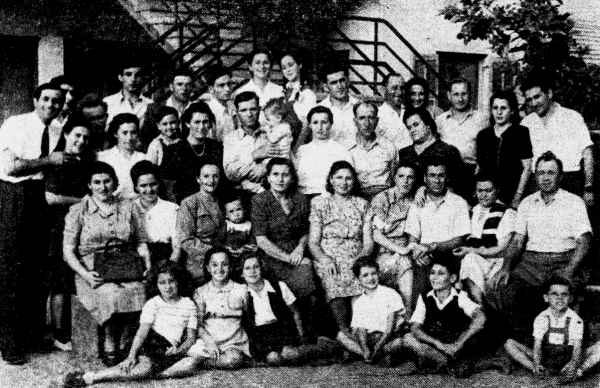
{Photo page 171} Family farewell party on the occasion of the aliya of Yosef Lozovski.
[Page 172]
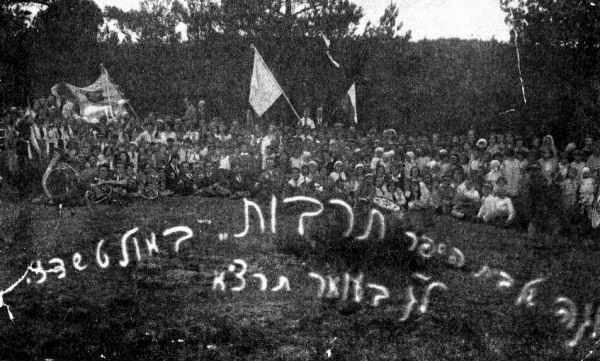
{Photo page 172} An outing of the Tarbut School of Maytchet, Lag BaOmer, 5691 (1931).
[Page 173]
{Photo page 173, top} A show at the Tarbut School.
{Photo page 173, bottom} Some of the descendents of Moshe Aharon Boretcky.
[Page 174]
{Photo page 174} A show at the Tarbut School
Names on the photo from the reverse side:
1. A teacher from outside. 2. Avraham David Zukovitzki. 3. A teacher from outside. 4. A teacher from outside. 5. Malka Zukovitzki. 6. Gunik (kindergarten teacher). 7. Chana Boyarski. 8. Chaya Esther Kaplan. 9. Reuven Berski. 10. Shmaryahu Sapir. 11. Moshe Tzvi Rabinovitch. 12. Yechezkel Ravitz. 13. Yaakov Gilerovitz. 14. Leibel Gilerovitz.
[Page 175]
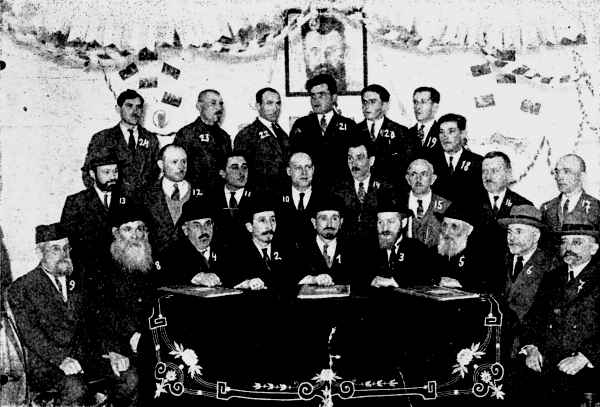
{Photo page 175} The Keren Kayemet [Jewish National Fund] committee.
[Page 176]
{Photo page 176} A performance of Shlomit by a group of amateurs to raise money for charity.
Maytchet, July 9, 1921.
[Page 177]
{Photo page 177} A reception for a government personality.
[Page 178]
{Photo page 178} Members of the Keren Kayemet [Jewish National Fund]
[Page 179]
{Two photos page 179 with single caption.} Classes in the Tarbut School
[Page 180]
{Photo page 180} A class in handiwork.
[Page 181]
{Photo page 181} {Uncaptioned in the text, caption from Photo list is: A teacher's group.}
{Photo page 181 top} 1. Mordechai Belski. 2. Mina Ravitz. 3. Shimon Gilerovitz. 4. Ethel Romanovski. 5. Pulchik (a teacher from outside). 6. Mina (the daughter of the rabbi of Sinyavka) . 7. Chaim Epshtein. 8. Libaka Izraelovitz. 10. Yehoshua Novomishiski. 11. Tzila Biteknski. 12. Nachum Gilerovitz.
{Photo page 181 bottom} 1. Malka Zukovitzki. 2. A teacher from outside. 3. A teacher from outside. 4. Tronski (a teacher from outside). 5. Yechezkel Ravitz. 6. Avraham David Zukovitzki. 7. Chana Boyarski. 8. A teacher from outside. 9. Tzila Bitenski. 10. Libaka Izraelovitz.
[Page 182]
|
|
| Row 1 - right to left: 1. Manya Novomisky 2. Etel Rubizewski 3. Teacher not from Maytchet 4. Teacher not from Maytchet 5. Gunik, a teacher Row 2 – right to left: 6. Katz, teacher at Tarbut School 7. Malke Zukovitzki 8.Chaim Novomiski 9. Nachum Gilerovitz 10. Rivke Novogrudsky 11.Teacher not from Maytchet Row 3 – right to left: 12. Teacher not from Maytchet 13. Alte Boretcky 14.Yehoshua Novomisky 15.Hana Boretcky Avraham 16. David Zukovitzki |
[Page 183] {Photo page 183} Sixth grade. 1937.
[Page 184]
{Photo page 184 top. Uncaptioned on page, caption taken from Photo List} Maytchet youth rowing.
From left: David Milchovski, Bracha Mlinikovski and Alter Ravitz, Tzerna Strolovitzki and Mordechai Motzkovski, Zelda Epshtein.
{Photo page 184 bottom. Uncaptioned on page, caption taken from Photo List.} A class in school.
Standing from right: the teacher Aharon Kravtzik, Alta Dvorzecky (mother of Chana Boretcky). From left: Yitzchak Liberman, Tzila Dvorzecky.
[Page 185]
They rented an apartment in the home of Sarah Kravtzik (The stalerke) on Podkrizh Hill, together with the youth movement Hashomer Hatzair, which had already formed a club in this house. Since they shared the space and in general believed in the same goals, they often held joint activities, such as bazaars on Chanukah and Purim, parties and fundraisers, and assembling on Simchat Torah. Actually the branch of Hehalutz was established by the initiative of the Zionist movement in Maytchet and its active support, so that it would encourage the policy of making aliya to Eretz Yisrael. However, after a time, Hehalutz became a distinct independent organization and as such was in contact with the district center of Hehalutz in Baranovichi and the main center in Warsaw from whom it received instructions for activities.
The local branch of Hehalutz took upon itself the fulfillment of Zionist aspirations (hagshama) sending its members to training centers in towns and locations near and far and even subsidized from its funds travel expenses to Eretz Yisrael for those without means. In order to raise funds and for the training of the members for manual labor, they worked at various jobs in town including cutting trees, cleaning, etc. Other members were sent to work on the roads, etc. and half of their income was given to the movement and the other half left for their personal living expenses.
Because the organization began late, it didn't manage to get very much done. Before it succeeded in developing fully and reaching fulfillment which was it's main purpose - training and aliya, the pre-war emergency conditions began and later the violence of the war itself disrupted all regular work. That is why there was just a small number of pioneers from Maytchet who succeeded in going to Eretz Yisrael and the small number of survivors of the holocaust from Maytchet. Nevertheless, the movement succeeded in sending members to far-off training camps from where they were somehow able to reach Eretz Yisrael in a legal way or an illegal manner.
[Page 186]
Picture Caption: Hehalutz members
[Page 187]
Translated by Esther Mann Snyder In 1934 I was sent for training to a training group (kibbutz) in the bloc Tel Hai founded by the center of Hehalutz in Bialystok. From there I was transferred to Milaytchitz, which was a small group of 12 members where we worked in a ceramic factory and were also sent from there to other places to organize more training groups. After a time the group in Milaytchitz dismantled and the members were transferred to Bielsk-Podlaski, a large group of 120 members, who worked in every possible job. Due to the large debts that had accumulated the members of the center in Bialystok came to dismantle it and to send the members to the various groups in Tel Hai. I was sent to the Shaharia group in Vilna. I remained there and worked during the two critical years, 1937 - 39. People already spoke openly that a war would soon begin and since there weren't enough certificates [to go on aliya] and time was running out, I decided to go on Aliya B (illegal immigration). In July 1939 I received a telegram to urgently prepare my affairs and to travel to Warsaw. Eight hundred people from all over the country were concentrated in a large hotel and we were told that they could not promise the success of the plan and anyone who was fearful or hesitant should return home.
During the night we climbed onto trucks that brought us to the train station where a train was waiting to take us to take us to Romania, posing as tourists. When we reached Constanta, Romanian police entered the train, arrested all of us and placed two guards by each coach for a whole week. One night a few members secretly left the train and set fire to nearby warehouses. Consequently, they moved the train to another location where we stayed another three days until a directive arrived to allow us to board a Greek freight ship that was carrying cattle. We had to make do with terrible crowding, but most importantly, we had finally departed towards our goal.
After the first week all our food was used up. We had thought that in this amount of time we would already have reached Eretz Yisrael and therefore brought food to last one week. In our distress we went down to the store rooms of the ship and took potatoes which we cut into small slices and divided among the members. As a result many became ill with dysentery and others died so we had to put the bodies into the sea. After that we suffered from a lack of water, which was spoiled, diluted with chlorine and distributed with a cup. In these terrible conditions we were worried about keeping up morale and chose a culture committee whose members went from bed to bed, sang songs, told jokes and encouraged the members as much as possible.
After a month of travel filled with suffering and travails, we were notified that passengers from a burning boat of ma'apilim (illegal immigrants) would be added to our boat and they had a large store of food. We made a bridge of ropes and helped 600 of them to leave their burning boat and come on to ours, which of course added to the unbelievable crowding but they brought much food with them. Our boat continued to wander around the sea for another month, travelling at night and hiding during the day because no port allowed us to anchor. When we reached the area of the port in Beirut we asked for fuel
[Page 188]
Picture Caption:
Standing from right: Malka Kostrovitzki, Shilem Rabinowitz, Shashke Strolovitzki, Pesach Mlinikovski, Tcharne Strolovitzki, Alter Ravitz, Chaya Rabinowitz, Leizer Volinski
Sitting: Noach Kostrovitzki, Nachum Gilerovitz, Bracha Melnikovski, Sara Margolin, Leibel Shmulovitz, Noach Dobkovski
Below: Noach Mordkovski, Mordechai Ravitz
[Page 189]
for the boat. They didn't allow us to come close to the port, but for payment that came from Eretz Yisrael, a petrol boat came out to us and refueled the boat.
From there we sailed to the area of Netanya that was known as a place for (illegally) entering Eretz Yisrael and signaled the shore that we wanted to debark. The English discovered the signal and shot their guns at the boat killing a few of us. This happened on a Thursday night and on Friday morning we assembled for a general meeting and in our great anguish we decided that we would reach the shore no matter what or we would sink the ship. We also swore an oath before the dead that were lying near us that we would not leave until we could bury them in the holy earth of Eretz Yisrael. At 12 noon, fifty persons were chosen from among those who knew how to swim and were told to notify the people on the shore that when the boat came close they should immediately come out to receive us.
On Sabbath eve, at 10 o'clock, the people started leaving the boat and some even carried others on their shoulders. About 250 people managed to leave until the English noticed what was happening and signaled us to stop or they would shoot at the boat. Eventually they boarded the ship and arrested everyone. Nevertheless, we received encouragement from the personnel of the Jewish Agency not to panic or be afraid. After they managed somehow to come to an agreement with the English, we climbed onto vehicles of the bus company Egged and were transferred to Sarafand. We stayed there for a whole week under the rule of a military camp until members from the kibbutzim came and brought us to the Borochov school in Givatayim where they divided us into groups to be sent to various kibbutzim.
I was sent to Ramat-Rahel where I worked for two years. After that I worked in a potash company in the northern part of the Dead Sea and other work in building the country and in its defense. Thus I earned for myself and my family the right to settle as citizens in the yearned for Eretz Yisrael.
Translated by Esther Mann Snyder In the middle of the night between the ninth and tenth of October 1939, I got off at the train station in Baranovichi from the freight train that arrived as usual. I had to wait for a few hours until early morning to get on the train that leaves Baranovichi to Vilna so that I could reach home - to Maytchet. At night Yakov Okun, May G-d revenge his blood, met me at the train station and asked in surprise, Nachum, what are you doing here, they said in Maytchet that you went to Eretz Yisrael?! These words were emphasized due to the
[Page 190]
unordinary atmosphere after 40 days of Soviet occupation. He told me that my young brother Moshe, May G-d revenge his blood, was also waiting for the train that would return him home from Baranovichi. I didn't find him at the train station because he had already boarded the train and was waiting for it to start.
The rumor that I was in Eretz Yisrael was only a successful ruse that I had planned a few weeks before the start of the war when no one even imagined that our town would be conquered by the Soviets. In order to understand this I must return to an earlier period. In 1935 I was studying in the Yeshiva Bet Yosef in Lahovitz. At that time a few friends got together and we founded the branch of Hehalutz HaMizrahi in town with the intention of joining training groups so we would be able to go to Eretz Yisrael, after a while. In general, during the 1930's, the youth from all the movements thronged to the training groups due to their enthusiasm for the idea of shivat Zion (returning to Zion) among the youth of Poland. Also the youth of Maytchet dreamed of going to Eretz Yisrael and a number of young people left the town and joined training groups.
I remember the youth, who during those years went to the groups sponsored by Poalei Zion and Hehalutz - Laibel Shmulovitz and Chaya Rabinovitz - both of whom succeeded in going to Eretz Yisrael and whom I met there; unfortunately both of them are no longer alive. Shilem Rabinovitz, Leibl Pintzinski and another few members did not make it to Eretz Yisrael and perished in the holocaust. In addition, Pesach Melnikovski and Yehuda Shevchik, may they live long lives, live today in Israel. Also the youth from Hashomer Hatzair joined the training groups and went to Eretz Yisrael, some before the holocaust and others after it. They include Hemda Lubrani nee Margolin, Sarah Biribis nee Boretcky, Hannah Mechtiger nee Boretcky, and Yachna Ezrahi nee Belski, Reuven Rabinovitz and Yitzhak Movshovitz - all of them in Israel today. Some youth from Poalei Agudat Yisrael went to the training groups: Dov Shlomovitz who managed to reach Eretz Yisrael and Shalom Romanovski zl, who didn't go to Eretz Yisrael, survived the holocaust, emigrated to the Unied States , raised a famly and passed away in 1968. Some of the youth of Maytchet also joined Hehalutz Hamizrahi and two of them succeeded in reaching Eretz Yisrael - Yitzhak Lublinski and the writer of this article.
In our town of Maytchet, despite it being a small town, the youth organized in various movements as was the case in other towns in the area. There was even a group from the Bund, however, most of the youth belonged to Zionist pioneer movements, and the intention was always to reach Eretz Yisrael. However, unfortunately, the process was very lengthy, the gates to Israel were locked, the Mandate government limited the immigration and did not allocate enough certificates for all the pioneers and thus many of them remained for many years in the training groups until they finally reached Eretz Yisrael. This was also my fate. In May of 1935, immediately after Pesach, I left the group
[Page 191]
Picture Caption: Activists of the Keren Kayemet
Standing, right to left: Etel Rubizewski, a teacher from out of town; Moshe-Tzvi Rabinovitz, Esther Epstein, Hannah Boretcky, Yehoshua Novomiski, Kayla-Rakhel Rabinovitz.
Sitting, right to left: Veiskind (a teacher from out of town), Malka Zukovitzki, Alta Safir, Shmaryahu Safir, Yehezkel Ravitz, Haya Dubkovski.
Bottom row: Alta Savitzki, Leibl Gilerovitz
[Page 192] in Brisk which is near the River Bug. I stayed at the kibbutz for six months and then moved to another kibbutz that was in Antopol near Kobrin. Again, I stayed for half a year and I then requested to transfer to a different kibbutz where there were young pioneers of my age. The situation of aliya to Eretz Yisrael worsened and I didn't see any chance of leaving for Eretz Yisrael soon. Therefore, I preferred - at least from a social aspect - to join a kibbutz more appropriate for my age and to live there and wait patiently until my turn would come to make aliya. Indeed, right after Pesach 1936 I transferred to a kibbutz named Ovadia, which was in the town of Slavkov, which was located between the cities of Olkush and Dombrova-Gornicha, in the area of Zaglembia. This kibbutz was the first kibbutz of Hehalutz Hamizrahi in Poland where the pioneers were organized in groups and cycles on a cooperative basis to go to Eretz Yisrael and continue kibbutz life there. The people were of a high standard and I found my place and full satisfaction there.
Picture Caption: Pesach Mlinikovski and Leibl Shmulovitz - the first pioneers from Maytchet
During the years I spent in kibbutz Slavkov, a number of cycles of members made aliya but due to the limited aliya and the scarcity of certificates, it was decided to make aliya in any way possible. And indeed, a number of members made aliya through Aliya B (illegal immigration) and thus my turn came in the summer of 1939. That summer I went to the district capital in order to undergo medical examinations before military service. When it was determined that I was capable of serving in the army, the kibbutz began to hasten the process of making aliya. Then it was decided that I would go to Eretz Yisrael at the end
[Page 193]
of August that summer. Thus, at the beginning of the month I traveled home to Maytchet to bid farewell to the family. At home, I didn't tell them and didn't reveal to anyone that I was about to go on Aliya B. I completed all the final preparations, they dressed me from head to toe, packed new clothes in a large new suitcase, and in mid-month I said goodbye to my family and went on my way to Warsaw. Since my wife Tzipora, who was then my girlfriend from the kibbutz, was also traveling to her home in Kopil to prepare for her legal aliya, we decided that on the way from Maytchet to Warsaw I would go to Kopil for a few days to meet her family. Then, in mid-August 1939 I reached Kopil; and there I awaited additional instructions from the center in Warsaw.
Picture Caption: Aryeh-Leib Margolin and his wife Badana nee Yorzkovski, May G-d Revenge their Blood.
During those days that I waited for the notice to arrive that I could start my journey, I sat down and wrote a few letters. I sent them to my friend Baruch M. who was already in Bitrat-Zvi, including letters to my parents and I asked my friend to send these letters according to the dates I had written on them so that the family wouldn't know that I was going on Aliya B and thus would save them from undue worry.
[Page 194]
On Tuesday, October 10, 1939, early in the morning, I left the train in the station of Maytchet, while my brother Moshe got off from another coach, while returning in the same train from Baranovichi home to Maytchet, this was because I hadn't been able to find him in Baranovichi. While we walked together from the station he told me that he had had a feeling that the letter he received from me from Eretz Yisrael was just a ruse, and that in reality it was written by me but not sent by me because he recognized that the handwriting on the envelope wasn't mine. He said that it was good that it was sent because his parents were very worried about their eldest son, Yaakov, who had been drafted into the reserves of the Polish army and they hadn't heard from him for six weeks after the defeat of that army. When my letter arrived it removed one worry from their hearts.
When we, my brother and I, entered our home and my parents saw me they couldn't believe their eyes. My brother's guess that I sent the letter in order to relieve some of the family's worries was correct and the plan succeeded.
Illustration Caption: The Perpetual Wanderer
[Page 195]
Translated by Jerrold Landau As we come to present an overview of the Organization of Natives of Maytchet and its Region in Israel, and its activities, it is appropriate to first describe the makeup of our organization in Israel, the people who belong to it, and how those people came to it. We can assume that in what was called the Old settlement [Yishuv Hayashan] in the Land, which included almost exclusively people whose prime goal was to fulfill the commandment of the settlement of the Land of Israel, there were some individuals during various periods who stemmed from the town of Maytchet. I can base this assumption on personal testimony from the elders of my family, who stated that one of the fathers of the family made aliya to the Land, died there, and is buried in the Mount of Olives Cemetery in Jerusalem.
To the extent that we all recall, and as is related in this book, the final two people who made aliya with the aims of the Old Settlement, that is for the purposes of fulfilling the commandment of the settlement of the Land of Israel [1], were Reb Yehoshua Aharon Lisovski of blessed memory, and Reb Yisrael Zalman Shlovski of blessed memory. The rest of the residents of Maytchet and its region who made aliya to the Land of Israel during the last fifty years came here for different reasons. Their main motivation for aliya to the Land was the idea of Chibat Zion [2]. Others made aliya under the rubric of the various Zionist pioneering movements, and still others came as tourists or students and remained in the Land. Holocaust refugees, who had gone through the various Zionist movements and preferred to set up their households in the Land of Israel rather than the Diaspora, arrived after the war.
The first founding meetings of natives of Maytchet and its region in Israel began in 1946, when the Holocaust survivors began to make aliya to the Land of Israel. I especially recall the first meeting that took place in the home of Shifra and Yosef Lozovski in Rishon Lezion, at which the first Holocaust survivors who began to arrive in the Land of Israel were present. Later, after the details of the Holocaust and the date of the final annihilation of our townsfolk became known, annual memorials for the Holocaust victim began to take place on Rosh Chodesh Av of every year. At first, various local memorials took place, for the most part in private houses of Maytchet natives, including Moshe Kleinshtov of blessed memory and his wife Miriam may she live, Shifra and Yosef Lozovski, Binyamin Stolovitzki, Nachum Rabinovitch and others. The members Miriam Kleinshtov and Chaya Chaikin were dedicated to the annual memorial. These two members also made sure to set up meetings between natives of Maytchet and its region in Israel with guests from the Diaspora. The first meeting of this nature took place at the beginning of the 1950s in the home of Miriam Kleinshtov in Tel Aviv. Mr. Ben-Zion Kobinski of Argentina was present.
[Page 196]
{Photo page 196 top: The expanded organizing committee with the guest Yechezkel Ravitz from the United States. Sitting from the right: Reuven Rabinovitch, Esther Lozovski, Tov Shomroni, Yechezkel Ravitz, Miriam Kleinshtov, Yosef Lozovski, Chaya Chaikin, Chaya Lubtzik. Standing from the right: Nachum Margolin, Moshe Korn.}
{Photo page 196 bottom: Maytchet natives hosting Yechezkel Ravitz.}
[Page 197]
Maytchet natives at the ceremony of the unveiling of the memorial tablet of the community of Maytchet in the Holocaust cellar.
[Page 198]
On Rosh Chodesh Av 5722 (August 1, 1962), after the annual memorial that took place in the home of Miriam Kleinshtov, a general meeting of the natives of the town was held, at which it was decided to work toward publishing this book. In the wake of this decision, an expanded organizing committee was chosen, consisting of nine members: Chaya Chaikin, Chaya Lubtzik, Yosef Lozovski, Esther Lozovski, Nachum Margolin, Moshe Korn, Miriam Kleinshtov, Reuven Rabinovitch, and Tova Shomroni. This committee acted in all areas: it maintained communication with all the natives of Maytchet and its region, initiated meetings for various events, disseminated the idea for the publication of the book also among the natives of Maytchet and its region in the Diaspora, organized and conducted various welcome parties for all Maytchet natives in the Diaspora who visited Israel, and worked toward strengthening the social connections among the natives of the town in the land. The crowning achievement of the activities of this committee was the setting up of a memorial plaque for the martyrs of Maytchet and its region who perished in the Holocaust. This monument is engraved upon a marble tablet located in the Holocaust Cellar on Mount Zion in Jerusalem. The veil was removed from the memorial plaque on the eve of Rosh Chodesh Av 5722 (July 9, 1964). At that time, the annual memorial event took place in the presence of most of the natives of Maytchet and its region in Israel. The memorial took place at the memorial monument in Jerusalem the following year as well. Starting from Rosh Chodesh Av 5626 (1966), the annual memorial ceremony for the martyrs of our town took place in a special hall in Tel Aviv or its area.
Among the Maytchet natives of the Diaspora who visited Israel were Mr. and Mrs. Marim Spencer (Pintzinski) of blessed memory and Mr. and Mrs. Alter Albert Kodovich, who visited Israel in 1963. As on all similar occasions, a warm, enthusiastic reception was arranged for them in the home of Esther and Meir Lozovski, with the participation of members of the organization. On that occasion, the guests gave over a sum of money to the organization, as a gift from the Committee of Maytchet Natives of New York and several private individuals, for use toward the charitable fund for the needy from among the natives of Maytchet and its region in Israel.
After the annual memorial ceremony on Rosh Chodesh Av 5726 (July 18, 1966), a general meeting of all the participants was conducted. Given that the activities for advancing the publication of the book had become more urgent, it was decided to spread the committee out further by setting up four smaller committees in order to involve a larger number of members in the communal efforts. The following people were chosen to the organizational committee: Sara Ahronovski, Yosef Lozovski, Nachum Margolin, Moshe Korn, Miriam Kleinshtov, and Moshe Ravitz. The following people were chosen for the charitable fund committee: Chaya Chaikin, Yitzchak Lubelinski, Mina Levin, Yosef Lozovski, and Pesach Mlinikovski. The following perople were chosen for the book committee: Chaya Lubtzik, Esther Lozovski, Yosef Lozovski, Chana Machtiger, Nachum Margolin, Moshe Korn, and Tova Shomroni. The following three members were chosen for the audit committee: Yerachmiel Brunitzki, Binyamin Stolovitzki, and Reuven Rabinovitch. Indeed, most of the members of the committees acted in accordance with their tasks.
The Organization of Natives of Maytchet and its Region in Israel is not different from other similar organizations, and its activities do not deviate from those of other similar organizations. Throughout no small number of years, the organization acted to perpetuate the town and the Holocaust that fell upon its
[Page 199]
{Photo page 199 top: Nachum Margolin eulogizing the martyrs of Maytchet.}
{Photo page 199 bottom: Cantor Yaakov Semak reciting Yizkor.}
{Note to htmller: the second photo is missing from the Photo list. It appears in the original. Please insert the above caption.}
[Page 200]
{Photo page 200: Maytchet natives in Israel connect with the memory of their martyrs.}
Jews during the Second World War. This objective reached its fulfillment with The Book of Maytchet in which these words are inscribed for memorial throughout the generations.
Finally, we should note the organizations of Maytchet natives throughout the world. They have a single purpose before their eyes: to form a common framework so that the natives of the city can meet together, to bring to the fore memories of the town and its dear ones, and to provide assistance and support for Maytchet natives throughout the world. The main point is to support any plan whose aim is to perpetuate the martyrs of our community with the honor due to them, and to conduct an annual memorial day for the martyrs.
In the first place, we must note the long-time Society in New York, which was founded at the beginning of the 20th century and maintains its own cemetery as is the custom with Landsmanschaften. The organization in Israel is in constant contact with them. A similar organization exists in Argentina, which also goes back a long time. We also maintain a constant connection with them. Aside from these, there are individuals and non-organized groups in Canada, Mexico and other countries. Maytchet natives in the Diaspora who visit Israel, or vice versa, enjoy an enthusiastic welcome party, which engenders mutual joy.
N. M.
|
JewishGen, Inc. makes no representations regarding the accuracy of
the translation. The reader may wish to refer to the original material
for verification.
JewishGen is not responsible for inaccuracies or omissions in the original work and cannot rewrite or edit the text to correct inaccuracies and/or omissions.
Our mission is to produce a translation of the original work and we cannot verify the accuracy of statements or alter facts cited.
Molchad, Belarus
Yizkor Book Project
JewishGen Home Page
Copyright © 1999-2013 by JewishGen, Inc.
Updated 06 Jan 2013 by JH