 |
|
[Page 311]
[Page 312]
[Pages 313-328]
By Moshe Rosenberg
[Pages 329-338]
Meir Becker
[Pages 339-340]
Byya Goldenberg
Yaacov Kagan
Translated by Pamela Russ
|
Our town Lanovits is etched deeply in our souls. If we want to know why, we only need to look backwards. There we discover a familiar world, a shtetl that has all the attributes to provide everlasting happiness. There are a number of such small places and locations.
At first glance, from Shalom Aleichem's perspective, it was a dirty town. Yet it had an honest society, pleasant summer days, and fragrant wildlife places, such as the “Zeide's shtikel” [“grandfather's piece of land”], the “blote” [the mud], the “Zwinterberg” [the hills with the non-Jewish cemetery], the seven wells, the ponds around the town and other places, all of which lifted the spirits and provided freshness and dreams.
Lanovits appealed to the older residents with its small synagogues and shtiebels, and with the Beis Midrash [study hall]. They had great pleasure as they ran at dawn's hours to meet with fellow believers, and then together have a discussion with the Creator of the Universe.
For us children, the holy places had a special meaning on the Jewish holidays, and particularly on the high holidays and on Simchas Torah. There was a feeling of being uplifted, great joy, and huge days with deep awe and judgment. On days like that, a nation grows in depth and in size.
Lanovits had a tendency to strive for spiritual greatness. The library, for example, was the largest in the surrounding area. Whatever we gained from there came from the great literary, cultural movement. We strove through that library to reach a greater and higher niveau, and tried to attain a broader horizon.
We had, I feel, a Tarbut school and cheders, unlike other places, with good teachers, open tasks, and an open social life. When I think of Motel Melamed, I know that it is hard to find a pedagogue of his caliber.
[Page 342]
He had a special level of understanding and an open heart for his students. We need not forget the other cheders and good teachers that we had. I remember them well as better than the typical angry teachers with clubs in their hands that I encountered elsewhere. There was a loving atmosphere in our cheders. Our rebbes [teachers] were tzadikim [like saints] as they tolerated us troublemakers.
Our town had no shortage of pious men and women, who did good deeds and tried hard to minimize the suffering of others.
We had no beggars in Lanovits, nor beggars in the corners. It was a town of respect and self-care, a town of happy people, who saw the good fortune in every situation.
This was so until 1940…
In 1940, the Soviets arrived, introducing their concept of “order” and spirit, with their understanding of good morale and joy, Christian, foreign, murderous, as the human being and human values became unnecessary, and fear and worry became the primary values of society.
During the Soviet period I came to appreciate what was Shabbath and what it meant to be a person, heartfelt and feeling. Everything disappeared and Lanovits Jewry became deeply depressed. They waited with clenched teeth hoping that this too would disappear, along with the regime.
I spent the war years in Russia. Part of the time I spent with Pessy Weitzman, Yosel Viener and Yisrael and Yaffa Kusiles. We were together for some time. Later, we separated.
While in the Red Army we experienced strong anti-Semitism. From time to time, they spread rumors that Jews occupied Tashkent (Uzbekistan), that Jews were responsible for the war, etc. When the Soviet radio broadcast the horrible murderous anti-Semitic statements, that the Jews supported the Nazis, our Ukrainian-Russian “fate brothers” enjoyed the remarks.
At times the going was difficult, but the thought that this would end soon, and I would meet my dear ones, with my fellow Lanovitsers and Lanovits itself, gave me courage. I fought, lived, and hoped.
In 1944 the Soviet radio indicated that the enemy was vanquished, and the Russian army was coming forward and liberating one town after another, among them Lanovits, our town, and my heart gave a leap.
I soon wrote a letter to my family but received no reply. Several months later I received a reply from Ita Kreper. She wrote that she was the only (Jewish) survivor in Lanovits.
I wrestled with impatience until 1946. When I was demobilized,
[Page 343]
I resolved to return to Lanovits, in the hope that maybe [some of my relatives survived].
On the train from Moscow I met Chaim Nosson Gitelman and Shalom Segal.
Upon nearing Lanovits, I could see from afar the destruction of our town. Local Gentiles met me, expressing wonder that I survived, as if I had no right to remain alive. They told me everything, with a cold-bloodedness, that my mother Faiga Sile and Laizer Katz (Charne's father) were found in a cellar a few nights after the ghetto's liquidation. Both were shot. Of the last ones to be liquidated were Tuvia and Aharon Millman, Chaim Pinchas, and Avraham Mates's.
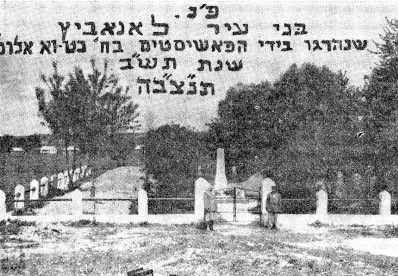
I went to our cemetery and found it also in disarray with gravestones turned over and laid in ruin. Cattle had been grazing there, also soiling the cemetery ground.
In the meantime, Yosel Marder, Mendel Brimmer, and Tzvi Meil also arrived. We sobbed together, and worked together to put a fence around the cemetery.
This was the only thing we could do for our dear ones in our lives.
Ours was a wonderful shtetl, what remains is a cemetery. And who knows what will become of the cemetery in the future.
|
|
JewishGen, Inc. makes no representations regarding the accuracy of
the translation. The reader may wish to refer to the original material
for verification.
JewishGen is not responsible for inaccuracies or omissions in the original work and cannot rewrite or edit the text to correct inaccuracies and/or omissions.
Our mission is to produce a translation of the original work and we cannot verify the accuracy of statements or alter facts cited.
 Lanovtsy, Ukraine
 Yizkor Book Project
 JewishGen Home Page
Copyright © 1999-2024 by JewishGen, Inc.
Updated 05 Mar 2024 by JH