 |
|
From the Book of Lithuanian Jewry, Volume III, published by the Mutual Benefit Organization of Lithuanian Natives in Israel, Tel Aviv, 5727 (1967)
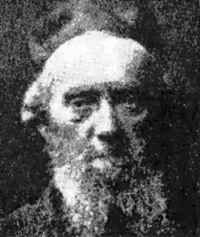
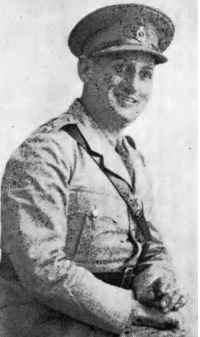
Eliashzon (Elizon) Rabbi Yehoshua Heshel the son of Rabbi Baruch
He was born in Yanova. He served as a rabbi in the communities of Sakiai, Yanova, ŽieŽmariai, Vilki, Švenčionys, and Seini. He was an opponent of the Musar movement[1]. He was a friend of Rabbi Leib Shapiro, the head of the rabbinical court of Kovno. A large dispute broke out during the time that he was serving as the rabbi of Yanova, and he was forced to move to Švenčionys. He was nicknamed “Rosh Barzel” (Iron Head) on account of his greatness in Torah and sharpness. He died in Seini.
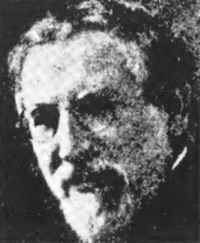
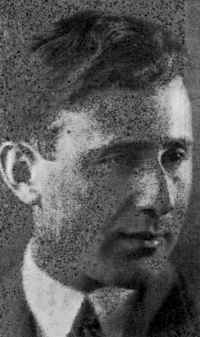
Segal (Chazan), Rabbi Chaim the son of Rabbi Avraham (Rabbi Chaim of Raczki)
|
|
He was born in Slabodka and studied in yeshiva there. He served as rabbi in Sudargas, Raczki (district of Suwalki), and Yanova (for 30 years). He authored the response book “Orach Chaim” (Vilna, 5639; 1879), and published articles in “Gathering Place of Sages” (of Rabbi Y. Ch. Deichus), and in other Torah periodicals. His own journals, the fruit of many years of labor, went up in flames during a fire that afflicted the town. He died in Yanova.
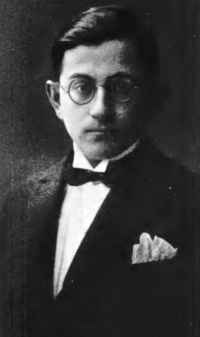
Shlomovitz, Rabbi Avraham–Abba the son of Rabbi Zeev–Mordechai
He was born in Yanova, one of the honorable people of Rabbi Avraham Abli of Krozh, a student of Rabbi Shmuel–Naftali–Hirsch HaLevi Epstein (the head of the rabbinical court of Girtakola, the author of the book “Imre Shefer” on the Song of Songs). He was one of the Perushim[2] of Kovno. He founded a Yeshiva in Utyana and was a friend of Rabbi Binyamin Eisenstat. He served as a rabbi in Svėdasai (5654; 1894). He wrote the book “Noga Eish,” which is glosses on the “Beer Heitev” book on Yoreh Deah[3] (Vilna 5656; 1896). Similarly, he authored additions and notes to the book “Pitchei Teshiva” as well as to the Talmud. He died in Vilna.
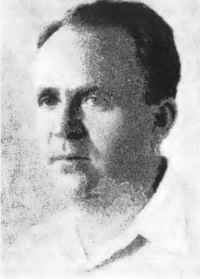
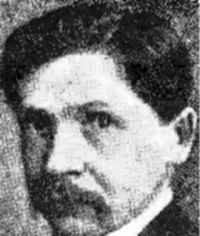
Winchevsky, Morris (Lipa–Ben–Zion) the son of Zissel Novokhovich[4]
|
|
He was a poet. He was born in Yanova. When still a child, his family moved to Kovno, where he received a traditional education and also attended the Russian government school. He settled in Vilna in 1870 and prepared for his entrance examinations for the rabbinical seminary. During that time, he also composed poems in Hebrew and Russian. In the meantime, he obtained a position in a business enterprise in Kovno, and was sent to Ural. There, he came in contact with radical circles and became familiar with the Socialist literature of that generation. He moved to Konigsberg in 1877, where he began Socialist publicity among the Jewish students who came from Russia. He founded the “Asefat Chachamim” [Gathering of Wise Ones] monthly as a supplement to the “Hakol” of M. L. Radkinson to clarify issues of the organization. He would sign his Hebrew articles with the name “Ben–Netz” [Son of a Spark]. He was expelled from Russia in 1879 on account of his Socialist activities. He went to Denmark, but he was also expelled from there. After a short sojourn in Paris, he moved to London, where he joined the Communist Workers Educational Society that was founded by Marcus Wanglass. He was a pioneer of Socialist journalism in Yiddish and English. He published the “Polish Ideal” newspaper. He wrote pamphlets on Socialism in Yiddish under the name
[Page 118]
“Yehi Or” [Let There Be Light] and also founded and was one of the first writers of the Arbeiter Freund. He immigrated to the United States in 1894 and edited “Emet” [Truth] – a family weekly of literature and culture. When the Forward[5] was founded, it became one of his principal occupations. He also served as the editor of the Zukunft weekly. He visited Russia in 1924 as a guest of the Soviet government, and was received there with great honor. An anthology of proletariat poetry “Kamfs Gezangen” was published in his honor in Minsk. He played an important role in Yiddish literature as a poet and a writer. Despite his Jewish topics and language, his creations had a cosmopolitan character. The primary principle was the idea of freedom of the group from the yoke of slavery. In his poems, imbued with deep lyric emotion, he presented the life difficulties of the worker. Many of his poems were translated into foreign languages. He wrote plays, parables, novels, and feuilletons. He translated some of the works of Koroleno, Ivesin, and Hugo into Yiddish. His anthologized writings were published in Yiddish in ten volumes in 1927–1928.
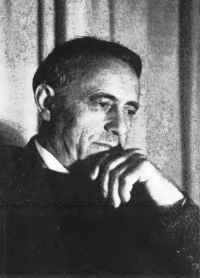
Davidson, Israel
|
|
He was a researcher in Hebrew poetry. He was born in Yanova and educated in the Slabodka Yeshiva. He emigrated to the United States in 1888. He served as a Hebrew teacher and taught in the City College of New York and Columbia University. He was a Talmudic advisor in the Jewish Theological Seminary of New York. In 1910, he was appointed there as a professor of Medieval Hebrew literature. He was a guest lecturer at the Hebrew University of Jerusalem. His magnum opus was the “Otzar Hasira VeHapiyut”[6] in four volumes (New York, 5685–5693; 1926–1933), which includes 3,500 religious compositions of 2,843 poets, and encompasses the entirety of Hebrew poetry from the end of the Biblical period to this day, as well as secular poetry until 1740. He won the Bialik Prize in 1936. He discovered the Machzor Yannai[7] – the work of an ancient Hebrew poet –– in a geniza [repository of worn holy books]. He published from splendid manuscripts research works on “Shalosh Halatzot” attributed to Rabbi Yosef Ibn Zabara (New York 5664; 1904); “Sefer Shaashuim” by Rabbi Yosef Ibn Zabara (New York, 5674; 1914); “Hymns and Poetry from the Geniza in Egypt” (New York 5681; 1921); “Milchamot Hashem” by the Karaite Salomon ben Yerucham (New York, 5694; 1934); the Siddur of Rabbi Saadia Gaon (Jerusalem 5701; 1941). He died in New York.
Silman, Rabbi Chaim–Yitzchak the son of Rabbi Moshe–Yechiel
He was born in ŽieŽmariai. He was the student of Rabbi Meir–Michel Rabinovitz of Seta. He served as a rabbi in Yanova, where he carried out broad and dedicated communal activity. People turned to him from all of Lithuania for Torah adjudications. He gave over all of his income to charity, and his household was sustained in a very meager fashion through the support of his father–in–law. During the time of the First World War, he served as a guarantor for any Jew who was suspected of treason. He moved to Vilna after the Jews were deported from Yanova in the year 5675 (1915). When he returned to Yanova, he found the city destroyed, and its Beis Midrashes and institutions in ruins. He put great effort into reestablishing communal life. He set up buildings for Bikur Cholim [tending to the sick], and for the Yavneh School. He also set up a charitable fund for the needy. He participated as a delegate in the Agudas Yisroel conventions. His book “Zera Yitzchak” with didactics and encores (Keidaniai, 5694; 1934) was published after his death.
Meirson, Avraham
He was a neurologist and psychiatrist. He was born in Yanova. He served as a professor of neurology at the universities of St. Louis and Harvard. He was the physician in chief at a hospital in Boston. He was the author of fundamental books that serve as textbooks for students. He was the joint author of “The German Jew – His Share in Modern Culture.” He died in Brooklyn.
[Page 119]
Ginzberg, Rabbi Nachum–Baruch the son of Reb Tzemach–David
(5642–5701; 1882–1941)
He was born in Ponovich (PanevėŽys). His father was a baker. He was a student of Rabbi Herzl Krechmer, the author of the book Noam HaMitzvot. He served as a rabbi in Upyna, Kybartai and Yanova. He was the last rabbi of the community of Yanova. He was the author of the two volume book “Mekor Baruch” (Keidaniai, 5685–5691; 1925–1931). He was the last president of the Rabbinical Assembly of Lithuania, was active in communal life. He was tortured by the Nazis, and died a martyr's death along with all the members of his community.
Chizka's, Pesach the son of Nachum
He was a sculptor. He was born in Yanova to a glassmaker. He was orphaned during his childhood. He worked as a baker. While he was still a cheder student, he displayed a tendency to drawing and sculpting, and his work inspired interest. At the age of 13, he worked at a lithography painter in Kovno. The artist Leon Antokolski uncovered his talent and guided him in his work. With the assistance of the family of A. B. Wolf of Kovno, he travelled to Max Liebermann in Berlin, and was accepted for work in his studio. He studied drawing under Hermann Struk and sculpting from Hugo Kaufmann. He returned to Kovno in 1913 and worked there in sculpting and drawing. He returned to Berlin in 1919 and joined the circle of young artists, which had great influence upon him. His artistic personality crystallized in Berlin, and he returned to Lithuania in 1920. His drawings include Abraham Mapu, Torganiv, and Mordechai Antokolski. His sculptures include an elderly Jewess, the loafer, the water drawer, and the horse of Mendele Mocher Seforim.
Kulvianski, Yeshayahu the son of Tovia
He was an artist. He was born in Yanova to his father, who was a carpenter. He was educated in the cheder and the primary school in the town. He was raised in the atmosphere of the Haskalah era. He displayed a talent in sculpting while he was still a child. He studied in the government school for the arts in Vilna in 1908. His first creation, (“Scholars”) was displayed at an artistic display there. He went to Berlin in 1912 and became a student of Hermann Struk and Hugo Kaufmann. He served in the Russian Army during the First World War. He returned to Berlin after the war where he continued his academic studies in art. He was a member of the “November Group”[8] of German artists. He displayed his pictures in various showings in Berlin, Prague, Vienna, Zurich, Amsterdam, and Kovno. He lived in Israel from 1933–1950. His pictures were displayed at various showings in Jerusalem, Tel Aviv, and Haifa. He won prizes from the Jewish Agency and the Tel Aviv city council. He lived in France from 1950. His art was displayed in the Salon Des Enfants and other places (Berlin, Vienna, Oslo, and Helsinki). His creations include: the Jewish Carpenter, the Death of a Carpenter, My Parents, and others.
Janosovich, Nathan the son of Yosef
He was an activist. He was born in Yanova and educated in the Knesset Yisrael Yeshiva (Slabodka). He later completed his education in Vilna and Libau. He was one of the finest of the intelligentsia in our city. He was modest by nature, and he avoided standing out in public. He directed the local youth. During the time of the First World War, he served for a brief time as the mayor of his hometown, but when his administrative character became known to the Germans, he was fired from his position. After the war, he served as the secretary to the Community Council (and later, “Azara”) in Kovno. He worked with great dedication on behalf of the Historical–Ethnographic Society. He published articles under the pseudonym “Yannai” –– the vast majority of which were dedicated to the history of Lithuanian Jewry. He published “Year In and Year Out” (1940) – an annual calendar dedicated to the folklore and history of the Jews of Lithuania. He perished along with his family in the Kovno Ghetto.
Gazit (Zisla), Dov the son of Tzvi–Yaakov
He was an educator. He was born in Yanova. He received a Torah education during his childhood and studied in the Knesset Yisrael Yeshiva (Slabodka) for four years. He completed his general studies and his teaching degree. He began to work as a teacher in Yanova in 1917. In 1919, he founded and directed in Pilvishok (Pilviskiai) the first Hebrew public school in Lithuania. He served as a teacher in the Hebrew Gymnasium of Mariampol, where he joined Hechalutz and became a member of its central organization in Lithuania. He also was involved with Kvutzat Brenner, and worked for two years in the “Kibush” cooperative group in Pelėdnagiai. He completed the upper school for agriculture in Berlin. He made aliya to the Land in 1924. He worked in agriculture in Tel Yosef, and served as the principal of a school for the children of workers in Tel Aviv. He served as a teacher in the Ben–Shemen Youth Village. Following that, he served for 15 years as the teacher and
[Page 120]
principal of the primary school in the Borochov neighborhood. In 1942, he set up and served as principal of the local high school. In 1943, he began to serve as a supervisor of higher education for the worker's stream, and served as vice chairman for the educational committee of the national council. He founded and served as principal of the teacher's seminary of the educational center, that later became the Seminary for Teachers and Kindergarten Teachers in Givat Hashlosha. From 1948 to 1950, he gathered together and directed the educational activities in the American Occupation Zone of Germany on behalf of the Jewish Agency. When he returned, he served as the director of the professional education division of the Ministry of Education (1950–1951). From 1953, he served in the agricultural education branch as the chief inspector of agricultural schools. He published many articles in “Davar”, “Haaretz”, “Hed Hachinuch”, “Hachinuch”, “Orim”, and “Chaklaut BeYisrael.” His compositions were: “Principles of Sorting and Developing Plants” together with Chana Nemlich (Tel Aviv, 1959); “The History of Agricultural Settlement in the Land of Israel” (Tel Aviv, 1962). He died in Tel Aviv. An anthology of his articles was published posthumously under the name of “Talmei Chinuch” (Tel Aviv, 1962).
|
|
Zisla (Lavie), Rachel the daughter of Tzvi Yaakov
She was a pioneer. She was born in Yanova. She was educated in the Russian public school and the Jewish–German Gymnasium of Kovno. When the pioneering movement arose in Lithuania, she stopped her studies and joined a hachshara group. She made aliya to the Land in 1919. She worked at planting in Hadera, with vegetables in Karkur, in building at Kfar Giladi, and in the hospital at Migdal. She became well–rooted in the Ein Harod Kibbutz, where she married Shlomo Lavie, and gave birth to two sons and a daughter. Her personality shone with light, love, joy, and faith. She was revered by all her friends and acquaintances. She died at a young age in Ein Harod. Her two sons fell in the War of Independence.
Kagan, David (Alter) the son of Yisrael–Yaakov
He was a painter. He was born in Yanova. He was educated in the cheder of his father the teacher, and grew up in a religiously Orthodox environment. He was a teacher in the Talmud Torah at age 20. He began to draw at an advanced age as an autodidact, and displayed serious talent within a short time. He travelled abroad for a brief time in 1927. Jewish artists in Berlin and Paris expressed great interest in his creations that he displayed there, and prophesied a great future for him. When he returned to Lithuania, he continued with his work in teaching, and continued to draw due to loneliness and a sense of being cut off from the outside world. Few saw his drawings. For the most part, the topic of his art was life in the Beis Midrash and his religious environment – the Talmud study group, Jews studying Mishnah, charity collectors, people of high moral standards, and simple Jews. He was noted for his simplicity and clarity. His style was realistic in form and color. He was one of the wonders of the artists of Lithuania of the latter period. He perished in Yanova during the Holocaust era.
Translator's Footnotes
by the sisters Sara Pinta and Mina Markusevich (nee Silman) of Tel Aviv
The Rabbi and Gaon Chaim Yitzchak Silman the son of Rabi Moshe Yechiel was one of the famous rabbis of Lithuania. His fame spread beyond Lithuania, to the rest of Europe and overseas. He was chosen for the rabbinical seat of Yanova when he was still young. Before that, he was supported for some time at the table of his in–laws, the honorable resident Reb Bentza of Sesik [Siesikai]. In his home in Sesik, he continued to fill himself with Torah and rabbinical decisions, without differentiating between day and night.
In addition to his great knowledge in Torah, he had many other talents that he used to serve the Jews of his city with his heart and soul. Even the Christians related to him with honor on account of his just judgments between man and his fellow. In any dispute between two Jews, or between a Jew and a Christian that was brought before the local government judge, that judge would first turn to the rabbi. Rabbi Silman was known as a man who pursued peace. His verdicts were famous, and people came to him from all of Lithuania. He used his money for communal needs. He concerned himself with the religious education of the children of the city. The Yavneh School, in which about 200 students studied, was established through his initiative and money. He was active in building the civic hospital, and he took interested in the building of the new bathhouse (Panske Bad) and slaughterhouse.
His house was open to everyone from the early morning until the late evening. Any person with a bitter soul would find help and support with the rabbi.
The political libel from the 1930s, in which a youth who was a member of the Revisionist party, Aver Unterschatz, was accused of the murder of a Christian agent, is remembered by the natives of Yanova. Rabbi Silman, together with the rest of the community notables, dedicated himself completely to the aim of saving Unterschatz from the death that was awaiting him. He gathered a large sum of money, and enlisted a staff of well–known lawyers, headed by professor Bliatzkin of Kovno in order to defend the innocent youth. He himself appeared as a witness in the district court of Kovno. His words and appearance had a great influence upon the judges, and the youth finally was released.
During the First World War, when the Jews of Lithuania were deported, the rabbi concerned himself with helping the poor of Yanova. He was the last one to leave the city.
His wife, the modest rebbetzin Chana Leah, should be remembered positively. She was his helpmate in all of his blessed endeavors. She forewent a more comfortable life in order to enable the rabbi to provide the necessary money for communal needs. After his death, with the help of the rabbi's late brother, Rabbi Aharon Eliezer Silman, she published one of his books, “Zera Yitzchak.” The rebbetzin perished in the Holocaust.
May their memory be blessed.
by Yeshayahu Kulviansky
“Yanova could be the pride of its sons” – thus writes Kulviansky's wife in her letter to us, in which she informs us that her unforgettable husband Yeshayahu passed away after a lengthy illness in London in November 1970.
In the continuation of her letter, she writes, “How fortunate could it have been if he were alive today and had heard about you and your intention to write a book on his beloved Yanova. You should know that Kulviansky had always been bound and faithful to his native town, in which he spent his childhood. There were many stories and depictions of his family, people of the town, its houses, its landscape, and its ways of life. He drew all of his influence from that place, which gave him the basis for his entire life in every place that fate took him. When, with the passage of years and his artistic development during various period of his life, he translated these impressions into the language of color and images, everything was influenced from the fruitfulness and richness of his beloved hometown.”
“His personality was dynamic and gifted. He did not know any compromise with anything related to his art. He was a very proud Jew, an upright person, with a hearty, refined, and loving relationship to his friends and to everyone worthy of such.”
“He wrote a great deal in Yiddish, particularly regarding Yanova. He would think and speak in a free manner and supple fashion.”
She further writes:
“Despite the various styles in his creations, several themes stand out:”
“His dedication and faithfulness to Jewish life and his hometown; his feelings toward color; his connection to the avant garde in his conceptions; his ideas and aspirations; and with all that, he was free. He did not want to be bound into a specific niche, and he would work on different projects simultaneously.”
“The following are some of his ideas on art:”
“Light is eternity, it is the primary source of color and form. It is the constant forger of spirit and physicality.”
“The world of vision is different from the spiritual world; Art is the spiritual pinnacle of creativity.”
“If we can do so, and pour richness onto creativity – we would decree upon you that you should find no rest, and that you would toil as long as your soul is within you.”
“The secret of true art is bound up with the power of imagination that comes to actuality.”
“The sole goal of art – spiritual truth.”
“This comes from itself, as a spontaneous revolution, and becomes an independent investigation of creativity.”
“Human creativity knows no bounds other than those of individual existence.”
|
[Page 123]
Regarding his exhibit in Tel Aviv in 1938, Noach Stern writes the following, among other things:
“Anyone who claims that a Lithuanian Jew does not know the crown of colors and strong vitality – should go to see the paintings of Kulviansky. Like other Jewish–Lithuanian artists who stemmed from the working class or the common folk, he belongs to a group that is full of vitality and rich in power, suffused with full, meaningful life. This is the typical thread in his creations…”
“… Kulviansky barely gives over the form, but he does give over the essence, both physical and spiritual as one. His impressions minimize the physical and stress the ethereal; he does not present the optical, form–based impression, but rather the internal, psychological one…”
(From the book “Between the Clouds – songs, translations and articles on Noach Stern,” published posthumously by Avraham Broides for the Writers Guild.)
From his many works, we will mention here the most prominent ones:
The Talmudist –– in the Jewish Museum of Moscow.
My Parents –– in the New National Gallery, West Berlin.
A Jewish Furniture Maker –– in the Jewish Museum of Berlin until lost in 1933.
The Death of a Jewish Carpenter–– formerly in the Jewish Museum of Berlin, today in Betzalel.
Silence –– owned by the Giladi family of Degania Bet.
The Image of the Actor Mischa Chernoff –– Lost in 1933.
The Houses of Kiki –– owned by Mrs. Kulviansky, West Berlin.
The Image of a Woman –– owned by Mrs. Kulviansky, West Berlin.
The Sea –– owned by Mr. Strauch, Stockholm.
The Concern –– presented by a Jewish organization to Bronislav Huberman, today owned by the Tel Aviv Philharmonic.
The Sand Wagon –– in the Tel Aviv Museum.
Many works are found in private collections in Israel, Paris, London, West Germany, New York, etc.
Yeshayahu Kulviansky (November 5, 1892 – November 27, 1970)
1892 – Born in Yanova
1908 – Studied with Antokolski in Vilna. Sold some works. Befriended Soutine.
1912 –Studied at the Academy of Arts in Berlin under Professor Hugo Kaufmann. Worked with Liberman and Hermann Struk. Worked primarily at sculpting.
1913 – In Paris. Became acquainted with Chagall. Renewed his friendship with Soutine.
1914 – Participated in an exhibit in the Gurlitt Gallery in Berlin.
1914 – Forced to return to Lithuania. Served as a soldier during the First World War.
1918 – Returned to Berlin to complete his studies. Dedicated himself to painting.
1920 –Joined the November Group and was selected to the group of Judges (Klein, Kandinsky, and others).
1922 –1924 – A member of the Union of Berlin Artists.
1923 – Participated in an exhibit.
[Page 124]
1927 –1928 – An art teacher in a school in Berlin
1927 –1929 – Illustrator for the Radio Weekly.
1927 –Invited to participate in an exhibit, in which he exhibited “The Jewish Prayer Room”.
1928 –Participated in an exhibit in Zurich on the occasion of the 16th World Zionist Congress (along with Pisarro, Libermann, Chagall, Modigliani, and others).
1929 –Participated in the “Humor in Art” exhibit in Berlin.
1930 –Participated in an exhibit in Prague: “Jewish Art in the 19th and 20th Centuries” – from Jozef Israëls until the era of modern art. He also participated in the “International Exhibit of Socialist Art” in a museum in Amsterdam.
1932 –A solo exhibit in Kovno.
1933 –Made aliya to the Land, leaving behind his works, which were lost.
1934 –1935 –Established an art school in Tel Aviv along with the sculptor Leshnitzer.
1934 – Among the founders and members of the “Professional Union of Artists of the Land of Israel.”
1937 –1940 –A counselor and educator of art in the Teachers Seminary of the Kibbutzim, Tel Aviv.
1937 –A large solo exhibit in the Tel Aviv Museum.
1938 –A second solo exhibit.
1938 –1939 –Participated in the World Exhibition in New York, in the Jewish Pavilion.
1940 –Awarded an artistic prize from the Tel Aviv city council.
1941 –A third solo exhibit in the Tel Aviv Museum. Also a solo exhibit in the Betzalel Museum. Awarded an artistic prize from the Jewish Agency.
1940 –1950 –Participated in various exhibits. Worked with Habima in painting the sets for Tevye the Milkman, Fedora, Children to their Borders, and the Mallet, as well as the “The Bartered Bride” opera of Smetana. Forced to leave Israel for health reasons.
1950 –Lived in France, West Germany, and England. Dedicated himself again to sculpting.
1952 –1968 –A member of the Jewish Artists Guild in Paris.
1956 –1968 –A member of the Salon of Independent Artists in Paris
1960 –Participated in an exhibit in Berlin, as well as in Vienna, Oslo, and Helsinki. His works can be found in the Museum of Modern Art in New York, the Tel Aviv Museum, Betzalel, the Jewish Agency in New York, and the New Art Gallery of West Berlin. He stopped working in his latter years.
1970 –Died in London.
“First and foremost, he was a Jewish artist,” Rabbi Y.D. Goldberg of London spoke about him in his eulogy. “He acknowledged his Jewish roots, and loved to recognize his childhood in Yanova, and life in the town, on canvas and in his words.”
“He dedicated his entire life to art. If he demanded a great deal of others, this was because he demanded even more of himself.”
“He was 78 when he died after 30 years of happy marriage. During his latter years, he was forced to abandon his work because of his illness.”
“His personality, his good heart, and his creative talents will not be forgotten.”
[Unnumbered page following 124]
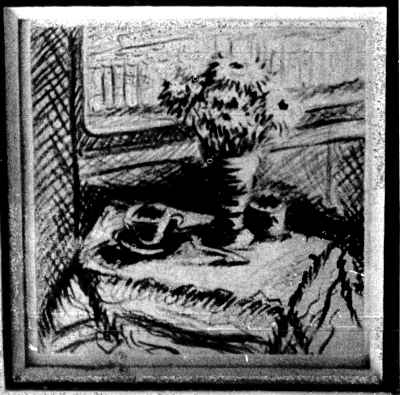
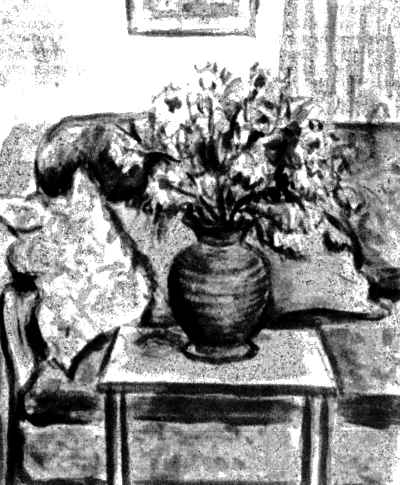
Shifra – The Amateur Artist by Ida Braun
Four years have already passed since we lost Shifra. Her noble spirit, her modesty and straightforwardness float before our eyes.
Shifra Lamiansky was a native of Yanova, and studied in the Hebrew Gymnasium of Kovno. From a very young age, her desire was to attend an art school. However, to her great dismay, this never materialized, and she was forced to compromise on the pure art and to choose the vocation of professional photography. Having no choice, she dedicated herself to this profession with her entire soul and means, and completed her education in that profession in the school of the professional photographer Tallat–Kelpša.
Shifra made aliya to the Land in 1933. There, she created countless professional photographs. In addition, since she was an artist from birth and the womb, she did not forgo the brush. She took private lessons in painting with the artist Hendler, and also attended an art school.
Shifra's amateur artistic creations excelled in their delicate and calm colors. For the most part, these were pictures of flowers and various inanimate objects. We all were happy when we received one of Shifra's paintings as a gift. Lovely paintings brought by Shifra as a gift and an expression of her warm feelings to a person or a family adorn most of the houses of her friends. She bestowed upon them the fruits of her creative spirit.
Shifra's sudden passing during the prime of her life was a great blow to us – her friends and admirers.
May her memory be blessed forever! Woe over those who have gone and will not be forgotten!
|
|
by Yitzchak Ben-David
|
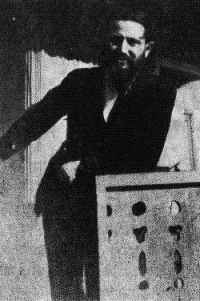
Moshe Ivensky was born in 1897 in the village of Geguzine near Vilna, 14 kilometers east of Jonava, into a traditional Jewish family. His father Reb David, known as David the miller, was a simple villager, straightforward in his ways, fearing Heaven, with fine character traits. His mother was a cultured woman who read a great deal in Yiddish and German. She believed that she would earn her reward in the world of truth in reward for her good deeds in this world.
Childhood Landscape
This family owned a flourmill driven by water and machines for working wool. The farmers of the region would come to them, and all of them honored Reb David and his wife. Livelihood was found in abundance.
David had two children, Moshe and Shlomo. David attempted to bring teachers in for his children and the other Jewish children of the village. When the children got older, Reb David sent them to Vilna in order to obtain education in modern cheders. They also attended the Russian school.
Moshe was graced with great abilities. He studied diligently and constantly read Hebrew and Russian literature. He displayed a tendency toward communal work already from his youth. He would gather the children around him, and tell them legends and stories from reading or from the imagination. He would organize various games, and was considered as the leader of the children. In the calm village, surrounded by the landscape of forests, meadows, ponds and the Vylia, and under the influence of his honest parents, a refined, dreamy soul developed in him from his youth.
During the Expulsion
The family wandered to Vilna as a result of the decree of expulsion during the First World War. As the front approached, the family decided that Reb David would remain in Vilna until the danger passed, while the mother and the two sons would continue their journey with the stream of refugees to central Russia. Reb David returned to his native village after the Germans conquered Vilna. There, in Geguzine, he reactivated the flourmill and the wool working machines. Business flourished. There was no news from the family. Contact with Russia was severed due to the revolution and civil war.
During the years 1916-1919, a great famine pervaded in Vilna and its environs. Many Jews dispersed to the towns and villages in search of food and work. David the miller housed refugee families in his home. His home was open to every passerby and guest, and many people ate at his table. He fed and clothed all of them, and also gave them money and provisions for the journey.
His wife and two children returned in 1919 and found the house filled with all good things. The boys had grown up in the interim. In Russia they had studied in a Russian school, and they also had not forsaken their studies of Hebrew, Bible and literature.
Mother Struggles with her Share in the World To Come
After thee return of Reb David's wife, the women and men praised her husband to her ears, and told her of his many charitable deeds. After she absorbed these stories, jealousy took root within her. How? From the knowledge that her husband had amassed so many good deeds, and she was not a partner to all this?! Her husband was to be forced to divide his reward for his good deeds, which made him eligible for the World to Come, equally with her. These thoughts gave her no rest. One day, she turned to her husband and said:
“David, I want you to declare in the synagogue in front of the community that you are prepared to share with me your reward for your good deeds that you performed in my absence so that I can also enjoy them in the World of Righteousness.”
Reb David was stubborn, and he was not willing to share. The peace in the home was disrupted. One Sabbath, when the Torah reader approached for the reading of the Torah, his wife girded herself with brazenness and interrupted the reading. She declared her claim with a loud voice and demanded the fulfillment of her demand. A long and tiresome discussion ensued. With the influence of the other householders, Reb David agreed to share, and to proclaim this in public. The Torah reading resumed, and the peace of the household returned.
Settling in Jonava and Immersion in Communal Affairs
Moshe Ivensky found the place too constricting, so he moved to Jonava in order to find work and communal activities. There, he had the opportunity to develop his talents and to broaden his knowledge by reading books and self study. He had the opportunity to sharpen his talents as an orator and public speaker. He had already demonstrated this talent in exile in Russia during the revolution. The young socialist was taken by the idea of the revolution, and he proclaimed his thoughts publicly with the enthusiasm of youth. The motto that he frequently stated with respect to those days was: “They wore a cloak for two weeks, but something was taking place.” Despair came quickly. The Yevsektsia[1] became despicable to him. They fought against nationalist tradition and the Hebrew language and literature.
In Jonava, he was hired as an official in the public bank. When he arrived, he joined Tzeirei-Zion – Hitachdut, which at the time numbered approximately 100 active members and many other supporters. After a brief time he was elected as the chairman. He took interest in the sporting activities of Maccabee, and he was elected to the cultural committee. He was one of the important orators, and the youth was swept along with his fascinating words. He was elected to the community council, which in those days of the flourishing of Jewish autonomy in Lithuania, fulfilled an important role in social life. He was active on the committees of the national funds and lectured often at all Zionist organizations about the building of the Land and Zionism. He even preached fiery speeches about current events on Sabbaths from the synagogue pulpit. He would often debate with his Yiddishist and Communist rivals.
Moshe Establishes a Family
His mother's health weakened during the first years of his activities. His father came to Jonava to search for a Jewish woman who would take care of her. Along with the stream of refugees from places afflicted by famine came a young maiden from Mejszago³a, Mina Abramovitch. Since she was alone, his acquaintances recommended to him to take her to Geguzine. She agreed.
At first, Moshe traveled to visit his parents almost every Sabbath. There, Moshe met the beautiful girl Mina and fell in love with her. After a brief period, he became engaged to her, and then married her. The wedding took place in Jonava with great splendor. All of his friends and admirers participated in it. The members of the couple were not equivalent in the cultural and intellectual sense, but he admired her for her straightforwardness and dedication, and she was proud of the man, who was considered number one in Jonava, who chose her. They had two sons and a daughter – Yeshayahu, Reuven and Nechama.
The Spiritual Leader of the Youth
Concerns of livelihood, care of children, and spending time with his wife forced him to cut back on some of his communal work. However he rejoiced at every opportunity to appear on the stage, to do battle with his combatants, and to see the larger community who thirsted for his words and would take in the stream of his orations. For 15 years, he was the spiritual leader of most of the Jonava youth who were sheltered under the banner of Tzeirei-Zion – Hitachdut, Gordonia, Hechalutz, Maccabee, Tz. S., Beitar and Mizrachi. He did not know of compromise. He did not vacillate. He correctly evaluated the hidden threat of Nazism to the physical existence of the Jewish people, and fought against this impurity to the best of his ability.
Throughout the 1930s, the Jews of Lithuania declared a boycott against products of Nazi Germany. He was tirelessly bound to this endeavor. He was the chief of the spokesmen and the supporters.
When the Soviets entered Jonava, he “folded up” completely and waited for better days.
Like the Lot of Many Others
With the Nazi invasion, he decided to escape to Russia along with his family. Somewhere along the way, they were caught up in an air raid. The family dispersed in the confusion of the bombardment. We do not know of his fate, and that of his wife and his daughter. The two sons continued to flee in the direction of the Russian border. Only the eldest Yeshayahu was miraculously saved from the satanic talons. Today he is in America, and he describes everything that happened to him in his memoirs that are published in the book.
An Exemplary Image
The image of Moshe Ivensky floats before my eyes again and again. I see him sitting next to the counter in the public bank of Jonava, with a long, reddish-brown beard. His black hair with a part on the right side was slightly unkempt. The outline of his face was straight, good and refined. I always compared his visage to that of Herzl. I see him chatting with a customer or engaged in a fiery debate with a disputant. He was not at all concerned about his external appearance. His white cloak was without a collar, open, one sleeve was rolled up and the other moved with every motion of his hand.
He was a modest man in his life. In his opinion, concern about externals was superfluous. The most important thing which he stressed was matters of the spirit. I worked at his side in the party for many years. We operated the Maccabee and the Hebrew library together. He was always an example to me.
I will never forget him and we will never forget him.
These impressions from the father's house were recorded from the mouth of Frank Sirek, United States.
Translator's Footnotes
by Sara Burstein
In my first meeting with him, I was surprised and astounded at his external appearance and personal charm. He was still young, but he nevertheless had a flowing beard. He had black, disheveled locks of hair, a penetrating gaze, and refined, sculpted wrinkles on his face.
His entire body was in perpetual motion, especially his hands, which he moved to emphasize his words.
I was astounded that his physical appearance was so similar to Herzl.
The second and strongest impression came when he opened his mouth to speak and debate. I was enchanted and silenced by his words. At times, I had the impression that I was listening to the words of a prophet of yore, reproving and preaching in the gate, delivering his words with emphasis and logic.
He lectured on various topics - literature, arts, culture, and politics. He was intelligent and inspired. Everything was clear to him, even though he was an autodidact. His bountiful knowledge was gleaned from a great deal of reading, which he absorbed and digested thanks to his blessed talents. He was modest and upright to the point of innocence. He never wavered from his path, the path paved and forged with a good heart, dedication, faithfulness and diligence.
When I got to know him better and he used to visit our house, he once came to me with the recommendation that I take on the task of the accounting for the funds. He brought two large ledgers, once for the Keren Kayemet [Jewish National Fund] and the other for the Keren Hayesod, which had recently been founded. He also brought cards with the names of “householders” who were willing to donate
[Page 128]
with monthly payments. At the end, he recommended sincerely that I myself deal with the small expenditures, such as paper, ink, pens, and sponges [1]. Of course, I agreed.
His words rang in my ears like the words of the living G-d. My awe and respect for him continually grew.
He led his private life discreetly. His low salary from the public bank was barely sufficient to meet his expenses. His wife was sickly, and his three children also had their requirements. He could have easily earned additional money outside his work hours, but his fruitful volunteer work for the land of Israel, that swallowed every free moment, prevented this. He did not want to turn this activity into a means of livelihood [2].
We would once again meet on occasion during my second winter in Jonava, during the vacation between study semesters in the Diaspora. One day, he appeared with a request, apparently in the name of the parents' committee, that I agree to give evening courses in English for the grade five students of the Tarbut School. I did not have the power to refuse, even though I was not a teacher or the daughter of a teacher.
I began as a “volunteer” teacher, and inexperienced teacher, who entered the classroom for the first time with trembling knees. However, Ivensky encouraged me and even offered me complements that I was successful, and that all my students were doing well…
Thanks to this, I benefited from my teaching experience when I came to the land. As a member of WIZO [3] in Kovno, I also joined WIZO and became a volunteer Hebrew teacher for new female immigrants. I did this for a few years until the Ulpan (school for new immigrants) stole my “livelihood.”
At times, when the memory of Ivensky comes before me, I offer a blessing in my heart that I knew him. I learned a great deal from him.
I have a small picture of him as a memento. He wrote something on it, and it served as a symbol to me for everything sublime in the world.
|
|
|
|
|
|||||
Translator's Footnotes
|
JewishGen, Inc. makes no representations regarding the accuracy of
the translation. The reader may wish to refer to the original material
for verification.
JewishGen is not responsible for inaccuracies or omissions in the original work and cannot rewrite or edit the text to correct inaccuracies and/or omissions.
Our mission is to produce a translation of the original work and we cannot verify the accuracy of statements or alter facts cited.
 Jonava, Lithuania
 Yizkor Book Project
 JewishGen Home Page
Copyright © 1999-2024 by JewishGen, Inc.
Updated 18 Jul 2019 by LA