![hly323c.jpg [19 KB]](images/hly323c.jpg) |
|
|
[Page 323]
Translation supplied by Eilat Gordin Levitan and Daniel Wainer,
grandson of Mayer Svirsky Z”L, the brother of the author
The Geographical Scene
Prior to World War II, the shtetl Dunilovichi formed part of the Vilna Region. Between the two World Wars, the region of Vilna was part of Poland. Today the region is split from Vilna and the eastern part of the former Vilna region, where Dunilovichi is located, is now in Belarus. Dunilovichi was situated about ten kilometers from the train station Varpaieve, where trains traveling through Vilna stopped. A highway passing through the shtetl connected the station with the town. Dunilovichi is situated about a hundred twenty kilometers from Vilna (Vilna is the Capital of Lithuania now) and thirty kilometers from Glubokie.
Two large lakes surrounded Dunilovichi. The young people of the shtetl would often go boating on the lakes during the summer and ice-skate on the frozen lakes during the winter. A river spanned by two bridges cut through the shtetl. One bridge crossed the river and the other linked the two lakes. Abundant with color, verdant and dense forests encircled the scenic town.
Dunilovichi up to the onset of the First World War (1914)
The Jews lived in the center of the shtetl. The Christians only lived on one street, the largest one in town. In the old days, the marketplace, encircled by Jewish owned shops, was located in the center of the shtetl, next to the White Church. Later,
the market was moved to the vicinity of the Town Hall. Every Tuesday, the peasants from the surrounding villages would gather in the market place, bringing their agricultural products for sale. They traded the money they earned to buy provisions from the Jewish stores. Examples of the provisions include salt, sugar, kerosene, haberdashery, metal products, pines, etc. The shopkeepers and grain dealers would sustain their families for an entire week from this one market day.
Although the owners of metal and fabric businesses tended to be better off then others in the community, few wealthy Jews resided in Dunilovichi.
[Page 324]
With no credited physicians in town, the barber-surgeon served as a doctor and the pharmacist was a Jew. Considering the size of the shtetl, too many poor Jews worked as wagon-drivers. If one of their horses fell dead, they would not allow Torah readings to continue on the Sabbath until one of the Gabbaim (beadles) promised to supply them with a new horse.
A significant number of tailors and shoemakers worked in the shtetl. Earning their daily bread with difficulty, they labored from the early hours of the dawn until the dark hours of the night. In comparison, the glaziers were better off since they were not stationary, traveling through the neighboring villages. Jews who sold soap, cartwheel grease and kerosene also earned their fill of bread.
There were three synagogues in Dunilovichi. There was a “mitnagid” synagogue (A traditional orthodox synagogue, as opposed to Hasidic). As the oldest and largest synagogue in town, the synagogue supported its own rabbi. Most of the poor Jews prayed in the small shul, the most strictly observant synagogue in town. The wealthy and not-so-observant Jews prayed in the “aristocratic shul.”
The only bathhouse belonged to the Jews. The well-off Jews would rent this place out. Much of the income used for such services supported the rabbi and the doctor. There was also a gmilut chesed society with a small fund dedicated to “free loans.” They loaned individual Jews a few rubles, which they could repay in small sums, free of interest.
There were three Heders (small schools) in the shtetl. Zalman was the Melamed (teacher of religious studies) for the beginners. He always carried a whip in his hand. The second Melamed was also named Zalman. He was nicknamed the “he-goat.” He would teach Humash and Gemara. He also supplemented his income by baking buns and bagels. The third Melamed was Pesach Leib Mushkat, a teacher that followed the modern fashion. Besides teaching Chumash and Gemara, he also taught classes to develop proficient writing skills in Hebrew and Yiddish.
The War Of 1914 (The First World War)
Soon after the war broke out between the Russian empire and Germany, many Russian soldiers of the Czar passed through Dunilovichi, part of the Russian empire. As was the custom then, soldiers were quartered in private houses. Soldiers who came to town on their way west to the front, were found in every home. Since there were no alternatives, they had to sleep on the floor. With the coming of the soldiers, commerce picked up and Jews earned a good livelihood. They had almost gotten used to the “benefits” of the war, as long as the front would remain far from them.
[Page 325]
However, on one nice day, the front suddenly came closer and shells began to fall on the shtetl. Amidst great panic and indecision, people asked each other, “Where should we go?” Others asked, “Should we remain here and hope that it will pass or should we run away to the east, away from the rapidly approaching front?”
We saw many of the Jewish people running into Shmuel-Yehudah's cellar. When we arrived there, we met numerous families, loaded with all of their bedding. There were a few amongst us who were sick with very high fevers. Covered only with white sheets, the afflicted lay like corpses on the bare earth.
Deathly silence reigned there. No one dared utter a word. In this way we spent several days and nights. We found ourselves stuck between two fires. When it momentarily got quieter, we ran back home to take a look, to see whether the peasants had robbed us of our humble possessions. Many of the non-Jews did not hide. After the Jews left to their hideouts, they used this opportunity to wander about the Jewish homes and steal whatever they wanted.
After a few days, the bombardment finally ceased. During the battle between the two armies, many homes were damaged. Curious as to whether the shtetl belonged to the Germans or the Russians, the Jews began to creep out of their hiding places. Suddenly, Yisroel-Laizer appeared in front of us. Everyone found their tongues and began asking him, “Who controls the shtetl?” He said that he knew nothing about this. He quipped, “I only know that Merke, my wife, is cooking “shtshav” (sour leaves) and eating it.” The crowd laughed at this sign
[Page 326]
that the danger was over and that we could allow ourselves a bit of fresh air. The children climbed out of the crypt. With their belongings in hand, everyone spread out onto the streets of the shtetl.
The War Between The Bolsheviks and the Poles
The community of Dunilovichi experienced much of the ways of war by the time that Germany was defeated and the Soviets took control of the Russian empire. Battles between the Bolsheviks and the Poles soon started over control of our area. Once again, the Dunilovichi Jews began to hide in the one suitable cellar, belonging to Shmuel-Yehudah. Some hid in the White Church, which belonged to the Russian-Orthodox. The bombardments were not as heavy as they had been previously, but we were still afraid to walk through the shtetl. Shells feel around every step that we made.
When it all quieted down, we came out and found that we were under Polish rule. The first meeting with them ended tragically. On the first day, the Polish soldiers seized a Glubokie Jew, who had all his life traveled through the villages and sold needles and soap. When they looked through his sack and found other merchandise, as well as a pair of Tphillin to boot, they were sure that they had captured an honest-to-goodness spy. They beat him brutally and then took him to the cemetery, where they shot him. This made a strong impression on everyone. It didn't take long before the Poles retreated from the shtetl and the Bolsheviks took over. The first person to come out of the hiding place and greet them was Tzire Gendel. She immediately ran back to the cellar and announced that “the comrades have arrived and there is no reason to fear them.” Upon hearing
[Page 327]
these words, everyone grabbed their bedding and returned to their homes.
Dunilovichi soon revitalized. The air was filled with proclamations, flowers and fiery speeches, which promised that good products were plentiful in Russia. People actually danced for joy in the streets. “An end to slavery arrived; everything belongs to us now: The forests, the fields, the lakes! All belong to the people. We are the proprietors of everything.” We indeed went out to the forests and brought back enough wood for heating our homes for the winter. Whoever didn't have a horse, borrowed one, and brought back dry twigs. A rumor spread later that anyone who wanted potatoes could go into the nobles' fields and dig out as many as he wished. For many days people lay in the fields and filled their sacks with potatoes. We, the insignificant ones, went into the fields of Graf Sod, shook the trees and pulled off apples and pears. We used the fruits to cook up a compote, the best treat to eat with bread.
|
|
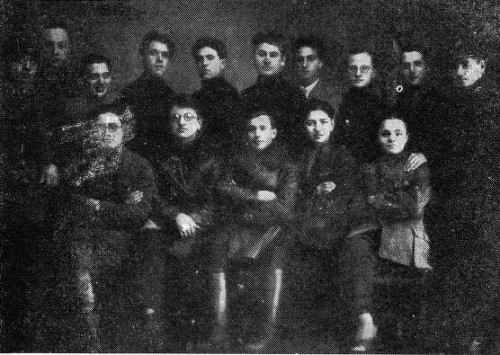
| A group of youth |
Once while sitting in the trees at the right height for putting apples into a sack or holding it in our bosoms, a non-Jewish boy ran up to us and began yelling at us to stop. But no one listened to him. Within a few days, nothing but leaves remained in the orchard. The Jewish-owned domestic animals
[Page 328]
also had a party. Previously they had the worst pasture, and now they pastured with the Graf's domestic animals.
Within a few weeks the Bolsheviks had to retreat and the Poles returned ( c 1920). The difference was immediately felt and the atmosphere changed. People lost their confidence and this was obvious on the faces of all. We found out that Mendl Abes had been shot for no reason while sitting on his own porch. Even though the front was now far from the shtetl, we were afraid to be on the street. The remaining few hooligans became the lords.
Slowly, life returned to normal. People began to work, stores opened again, peasants brought their produce to market on Tuesdays to sell and buy their necessities in the stores. The front had moved to the area of Glubokie-Disne.
At this point, I must recall a horrendous event. One early morning, I heard terrible screams piercing the quiet of the street. I ran out to see what had happened. Panicking people were running everywhere and filling the streets. What had happened? A soldier had passed by Michael the blacksmith's house and noticed a few girls on the porch. He had removed his rifle from his shoulder and shot one of them, hitting her in the head with a dum-dum bullet (which explodes), so that the entire wall was splattered with her brains. The town of Dunilovichi had never witnessed such a tragic funeral. They had to gather up pieces of the girl's skin and place it in a sack. Her uncle Shmuel-Yehudah Skiransky rolled on the ground and screamed with shrieking sounds. I had never before seen a whole shtetl cry with such anguish. When the public went afterwards to demand justice from the Commanding Officer (there was martial law and the military was in charge), the soldier excused himself by saying that he meant only to fool around and had not thought that his gun was loaded. The entire incident ended in this way. There was no one else to complain to. The fate of the Jews of the shtetl lay in the hands of a few hooligans. Since the border was far from the shtetl, it was there that trade (illegal trade with the Soviet Union) developed. There was a shortage of many products. Sugar, for example, couldn't be found at all. People started drinking tea with saccharine or dried fruits. There wasn't much of a supply of bread either. Salt was completely lacking. People struggled to sustain themselves
[Page 329]
until peace was declared between the Bolsheviks and the Poles and Dunilovichi became part of Poland.
The new Polish rulers without delay demonstrated their capacity to govern. In a short time, they set up a city council, a bailiff (judge) and a Jewish village magistrate. His name was Aron-Zelik Drutz, a shoemaker, who couldn't read or write. Nevertheless, he held the position for 4 years. When he had to deal with documents concerning taxes, he would touch them with his fingers and say, “Here, this must be for you!” Interestingly enough, he rarely made a mistake. It was often said in the shtetl that Aron-Zelik reads with his fingers better than the bailiff reads with his eyes.
|
|
| The Yiddish school in 1932 |
Dunilovichi became poverty stricken during the war years. The stores were empty and after being robbed so many times, the former wealthy had become poor. Many people left as the front came near and moved east to Russia. Some died during the war as soldiers, and a few remained as prisoners of war in Germany. In short, Dunilovichi was emptied of most of its populace.
The will to survive slowly caused people to forget the hard times. They started to look forward to the future. It seemed that everyone, each in his own way, set about looking for some source of livelihood. The Dunilovichi
[Page 330]
Graf, whose name was Tiskevitski, owned all of the walled stores, some houses and the well. Many of the buildings and homes were bought from those who had previously lived in them.
The new Polish rulers quickly set about converting this old White Russian area into a Polish community. The local inhabitants had spoken their White Russian language for hundreds of years. No one there spoke Polish or even understood it. In a short while, the White Russian Orthodox Church became a Catholic Church. This greatly angered all of the Belarusian villagers in the area. The root of the anger was the fact that the Holy Portraits had not been turned over to them in order to be transferred to the nearby village (Azun), 5 kilometers from the shtetl. In this White Church, many Jews had hidden during the crossfire that had taken place during the war.
Quickly a notice arrived from the government, announcing that a beginners' school would be set up to serve the entire population. The teaching would be done in the Polish language. Tuition would not be required and it would be free for all. Despite this, a very small number of children enrolled in the new Polish school. I don't know the reasons, but it is a fact that from the entire shtetl, only ten Jewish children enrolled. The remaining children continued their studies in the Heders with Peise-Leib and Zalman Razov. Rozov was by this time a qualified teacher and not just a “melamed” (Heder teacher). One could learn Yiddish, Hebrew and singing from him. I recall that one day during the period between the afternoon and evening services, Alter, the rabbi's son, told the group to take a break until the evening service. We all went outside. When we returned, the rabbi asked where we had all gone. When no one answered, he made us stand in a line and gave each one of us three heavy piles of logs to hold. Everyone kept quiet, but one kid by the name of David Skriansky threw the pile away. The rabbi “honored” us with a couple of smacks and sent us home.
Fulkshule (Yiddish School) In Dunilovichi
People began talking about setting up a Yiddish secular school. Notices were put up in all three synagogues, stating that all householders should gather for a meeting in the large synagogue. Since at that time no special political parties existed, it was unanimously decided to found a Yiddish school. The founders were Aron Ligumsky, Baruch
[Page 331]
Kolis, Moishke Lurie, Hirsh Barkin, Shalom Naratzky and Shmuel-Kalman Barkin. Two teachers were brought from Vilna, one a Rosenfeld, a student of Vilna University, and the second a Solomon, a graduate of the Vilna Gymnasia. Also Shmuel-Kalman Barkin and Baruch Kolis became part time teachers. It took only a few days, after a short exam, the children were divided into classes. The school began to function. The first and second grades met in the ladies' section of the synagogue, the third grade in the synagogue at the table where Jews used to learn Mishne, and the 4th grade in the meeting room.
|
|
As soon as the school began functioning, Dunilovichi changed her image and looked entirely different. Happy children's faces appeared on the streets. The youth revived, and something started to happen. Ploshe Lurie traveled to Vilna and brought back enough books, mostly textbooks for the children. Never had anything like this been seen in the shtetl. They ran to the library to grab a book as if running after “matzah water” (the special pure water used for the baking of matzos). The teachers had a difficult job in the school, because the children weren't graded properly and were behind in their studies. Many according to their ages should have finished school long before, but instead, they were in the first few grades
[Page 332]
and so forth. To top it off, there was poverty during those first few years. In fact, there wasn't even enough to cover the expenses of each day. At that time, in the entire Vilna province, there was a huge relief operation from North America. The school administration sent a delegation with Aron Ligumsky at its head to Vilna and it arranged for Dunilovichi to benefit somewhat from this help. On a fine morning, information arrived that a transport with clothing, mainly for children, had arrived. Entire days were spent standing until one got something and then it was “good for nothing”! Those who had hurried managed to get a pair of shoes or a few pairs of socks that the children could use, but those who were a bit late, got worthless things. A kitchen for school children was also established in the home of Shalom Naratzky. All the children, rich and poor alike, could eat a tasty lunch at that kitchen. The teachers had arranged this because of the poor children. At the beginning they had been ashamed to sit down at the table to eat, but when they saw the wealthy children, as well as the teachers, were all sitting around the table, they also sat down. The kitchen closed before the end of the school year because they stopped sending products from Vilna.]
In time, the teachers prepared a children's presentation, the first which Dunilovichi had ever seen. Children performed in Yiddish and Polish and it was a pleasure to listen to them. No one had believed that in one year, so much could be accomplished. The fathers and mothers were very proud of their children. They saw that the Yiddish school was a noteworthy achievement. If not for the school, the children education and social life would have been completely neglected. When the school year ended, the administration called a meeting of all the parents to deal with the question of whether to build their own building for the folkshule because the synagogue was not appropriate. Besides this, they weren't sure if the more observant would approve of boys and girls learning together in the synagogue from books that were not holy.
|
|
Jews considered the possibility of a separate building, and immediately appointed a building committee composed of Dan Feigl, Zise Klionsky, Shalom Naratzky, Baruch Kolis, Hirshl Barkin, Aron Ligumsky, Moishke Lurie, Yankel Abel, Motte Bergman, Flax Dratve, Yisroel-Chaim Gurvitsh and others. A large empty plot near the bathhouse was chosen and there the building was to be set up. The actual work began immediately,
[Page 333]
with the bringing of building materials. The singing of the builders could be heard and there was joy on everyone's face. When the building was completed, there was a dedication ceremony. It wasn't entirely comfortable since it had only two rooms, but all community activities were transferred there.
|
|
With the start of the 2nd school year, the shtetl undertook the expansion of the school, as if trying to make up for lost time. Evening courses were set up for adults and two teachers were added, Aronovitsh from Vilna and Abraham Weinstein from Zamoshtsh. They took over the running of the school, as well as community activities. Tuition was very low, so that anyone who had the slightest desire to learn something could attend. It was truly a great success. The courses were well-attended and the people learned math, Yiddish literature and Polish. A reading room was set up, packed with people every evening. They would gather there to live it up intellectually and read the newspapers which arrived, such as the Vilna
[Page 334]
Tog, the Folks Zeitung, Haint, Moment, the Literarishe Bleter, Der Folks-Gezunt and a few Polish newspapers. The teachers also began to give lectures. Weinstein, a former student of Bialik, used to lecture regularly about Peretz. So many people came to his lectures that if you came a bit late, you had to remain standing on the street because there was no room inside. The library grew steadily and the number of readers jumped. If an interesting book appeared, it was jumped upon. More than once somebody would run to a borrower's home, and sit and wait for him to finish reading the book so that he could borrow it. It also led to arguments. Public readings also took place. The leading reader was Aron Ligumsky, who was a former Yeshivah student and an expert in both Yiddish and Russian literature. He would read Peretz aloud and everyone sat glued to their seats. When he read Shalom Aleichem, they would roll with laughter.
Eventually, it was noticed that the building was too small for the school, since there had been an increase in the number of students. The people began to think about building a second building, larger and more comfortable. They also had in mind a larger plot, so that they could include an auditorium for theatre productions and children's activities. Until then they had had to use the Polish club, which wasn't at all suited for these things and not always available. Work started immediately. The people decided to turn to the Jews of Dunilovichi who immigrated to North America for financial help. The Americans contributed some money, but not enough to cover all expenses and we remained in debt. We began to search for ways to pay off the debts. Many helped with their own labor on the building. For example, Hirshke Trotzky and Elyakum Urevitsh rode into the forests to bring moss and other building supply.
A drama circle was founded under Hirshl Barkin's direction. Participants included Aron Ligumsky, Baruch Kolis, Liebke Tzefelovitsh. Abe Endel (today in Brazil), Rise Skiransky, Soke Tzefelovitsh (from Ostov), Sorke Feigel, the Eterise sisters, Rochke and Sonia Cho-osh. These two sisters were especially distinguished in their performances, singing and recitals. The first production was presented with great success. It was Yakov Gordin's play “Chasye the Orphan.” All profits went towards
[Page 335]
funding the school. When Zalman Reisin (author of a lexicon of Yiddish writers) once came to give a lecture in the shtetl, Eterise Chodosh presented a Sholom Aleichem monologue. He was very impressed by her presentation and he said that our little town had nothing to be ashamed of even in comparison to Vilna, when it had such talented artists. As a result of the great success, they consequently had several such evenings. Among other things, they presented “Motke Ganov” (Thief) and “Des Groise Gevins” (The Great Win). Hirshl Barkin, a conductor of sorts and a fiddler, formed an orchestra composed of Meir Svirsky, Yoshke Abel, Sayaiske Katzavitsh, Avrashke Cepelovitsh , Shmuel Barkin and Hirshl Barkin himself. Besides dance evenings for the youth, the orchestra played at weddings and the income went to the school.
Even with all these successes, there was still a lack of money to support the school. There were many children attending, but not all could afford to pay tuition. More teachers had to be brought in and they thought about setting up children's library, which was needed for the children's development. In order to establish it, money was needed and they decided to attempt something new, something the shtetl had never known before. A mock trial, regarding Shalom Asch's “Motke Ganov”, was planned. Announcements declared that anyone who intended to participate should prepare themselves
[Page 336]
and inform the organizers. Held in the second building, all of the rooms were packed. There were prosecutors and defense attorneys, among whom were Aronovitsh, Einstein, Abes, Ligumsky, Barkin, Kolis and others. The discussions continued for weeks until the matter was closed. Such evenings brought excitement to the monotonous life of the shtetl.
|
|
Suddenly, as if out of nowhere, there came about a split in the school. The new Hebrew teacher Hittelmacher with the support of Iruch Kolis, Rivke Feigel and others, planned to set up a modern “Tarbut school” were all subjects would be thought in Hebrew. They took away two teachers and about twenty children, and all of Dunilovichi went topsy-turvy. Immediately, two camps were formed: one loyal to the Yiddish culture and the other to Hebrew and Zionism. Unity disappeared. In the same way, all the parents and young people, who previously had been united on all matters of local community life, were now split into two sides. The same friends who had always worked together now suddenly became blood-enemies and there were frequent quarrels. They would run to the parents in order to get their children, each for his school. The “Tarbutniks” demanded a building for their school, and it had to be granted.
Fortunately, this disagreement brought hidden blessings since each side wanted to show what they could accomplish, and in this way drew more children into the schools. They appealed to the most poverty-stricken groups, pulling their children into the schools and giving them a fine education. Also, more youth were involved in various community projects. Hashomer Hatzair (Zionist, socialist Youth Movement) was founded, engaging in a broad spectrum of Zionist activity like founding hachsharot (farming communities to prepare young pioneers for life in Palestine). The Tarbutnikim had an influence on some of the orthodox Jews (they were called “beards”). They would support them as much as they could. For example, a Jew named Izik Dodkes, who used to get money from his family in North America, would pay $5.00 a month. (This was a very large amount at that time.) The only doctor in town, Dr. Brodny and the pharmacist were Zionists and supported the organization. The Zionists were a very happy and united group, self-confident and always ready to sing and dance.
[Page 337]
The hope of going to Eretz Yisrael gave them courage and aspiration. When they got together they were always lively and animated.
|
|
Meanwhile, the situation in the Folkshule worsened. They decided to look for children without charging a tuition fee. They had more children enrolled, but there wasn't enough money to support the school. They constantly had to search for new undertakings to raise money. It was hard because only a few hours before a performance, the police often would forbid its presentation. They could never be sure that they could complete an evening. The deficit grew. It also became obvious that many of the children attending the school were very weak. After a short investigation, they found out that this was due to improper nutrition. They then decided to provide a tasty breakfast each morning. A committee was formed which prepared a breakfast of coffee, bread and butter. In order to get these products, they had to go from household to household. The committee consisted of Shainke Yaffe, Itele, Rochke, Gesse Gurvitsh, Chana and Rochke Ginzburg. In short, it was very hard work; nothing came easy. Poverty was so great that they had to fire the woman who washed
[Page 338]
the floors and lit the oven. Her total monthly salary had been only ninety zlotys. The work was taken over by school alumni: Avrahamke Gurvitsh, Berge Zeitlin, Yona Kuritzky, Leibe Oks, Sheinke Kaminkovitsh, Rivke Oks and others.
A few years passed in this way. Most of the elderly leaders passed away and the youngsters became the community leaders. To have an idea of the influence and accomplishments of the drama circle, it is enough to mention that Avrahamke Ginzburg, a graduate of the Folk school crossed the border to the Soviet Union, where he performed in the theatre under the direction of Michael Weicherts. Also, the choir of the shtetl became famous throughout the area. Under the direction of Abraham Gurvirtsh, it would travel through the surrounding villages including the town of Glubokie, and give concerts.
Soon, however, the heavy hand of the reactionary Polish regime fell upon the shtetl. They began to persecute the Jewish Folkshule in every way. Still, Dunilovichi grew and with it, the accomplishments expanding cultural activities. In 1934, they already planned to build a large school with its own theatre auditorium. A large plot was bought not far from the slaughterhouse and a beautiful and comfortable building was put up. Not one of the surrounding shtetls had such a building.
It is worthwhile repeating what Nachman Maisel writes in his book “Once There Was a Life” about the Dunilovichi school. He writes that “it is interesting that the School Board of Dunilovichi told the emissary of the Vilna Central Education Committee, the writer Aaron Mark, 'We must have our own fireproofed building of stone and brick. Even if the government hadn't condemned our present location, we ourselves, for our children' sake, would have done something. The school in the last few years has grown in size and quality. We must push the narrow walls. We must have more room, more air and a broad horizon around the building.'” In this quote there is no date and no name is mentioned. All was done by an anonymous School Board.
From Yankale's Heder
They used to say that every cultural activity that took place in the shtetl started from Yankale's Heder. This meant that it was the spiritual inspiration of Yankel Abel that created the activity. He was the
[Page 339]
most intelligent and educated Jew in Dunilovichi. He was a Socialist and the first openly secular Jew in town. Thanks to him, the cultural organization was set up. Not a single cultural activity took place without his participation or his advice. He was the factual spiritual leader of Dunlovichi.
Soon, however, the joy of building and cultural flowering at the apogee of its ascent was suddenly hacked into pieces …….
Translator's note:Nachke Svirsky Z”L was born in Dunilovichi to Yoel Pinie (Pinchas) Svirsky and Ester nee Chanovitz of Vilna. In 1940 he immigrated to Argentina following his brother and his sister in law, Meyer Svirsky Z”L and his wifen Itke Z”L, daughter of Shmuel Ligumsky . Meyer and Itke arrived in Argentina in the 1920s. Nachke lived and worked with his brother. He was very attached to the family of his brothers' only daughter. There were two girls from the Svirsky family who survived the holocaust, they lived in the Soviet Union. The family, who mostly lives in Israel today, lost touch with them and wishes to reunite.
|
|
JewishGen, Inc. makes no representations regarding the accuracy of
the translation. The reader may wish to refer to the original material
for verification.
JewishGen is not responsible for inaccuracies or omissions in the original work and cannot rewrite or edit the text to correct inaccuracies and/or omissions.
Our mission is to produce a translation of the original work and we cannot verify the accuracy of statements or alter facts cited.
 Hlybokaye, Belarus
 Yizkor Book Project
 JewishGen Home Page
Copyright © 1999-2026 by JewishGen, Inc.
Updated 14 Mar 2021 by LA
![hly323d.jpg [19 KB]](images/hly323d.jpg)
![hly327b.jpg [14 KB]](images/hly327b.jpg)
![hly327c.jpg [16 KB]](images/hly327c.jpg)
![hly327e.jpg [32 KB]](images/hly327e.jpg)
![hly327d.jpg [19 KB]](images/hly327d.jpg)