«Previous Page Table of Contents Next Page »

[Page 91]

Gordz as She Lives in our Memory


Memories of Gordz

by Yehudis Lashem

Translated by Gloria Berkenstat Freund

This happened probably in the year 1908 or 1909.

At that time Russia was engulfed in a wave of pogroms. Wild hooligans, organized in bands, attacked Jewish houses, businesses, murdered and beat. There were many victims and wounded among the unprotected Jewish population, particularly in the small shtetlekh [towns] of the Jewish Pale of Settlement. Fear enveloped the Jews and this also had the effect that many Jews emigrated from Russia to distant nations and, particularly, to America.

This wave of pogroms also encouraged Gentiles in Gordz and the surrounding area. Thursday was a market day and Gentiles came from the surrounding villages and broke the windowpanes in the Jewish houses, robbed Jewish businesses and beat Jews. Fear reigned over the Jews in Gordz.

We then lived over the customhouse and, according to the idea of Gordz distances, this was far from the marketplace. I remember that many children were brought to our house to protect them from the pogromszczikes [those carrying out the pogroms].

*

A year or two later, after the event, this was on a Friday night when the Shabbos [Sabbath] candles were burning, we suddenly heard a strong knock on the door. We were very frightened. My father immediately took to his “weapon,” which consisted of a stick and prepared to open the door and go out against the thief or robber and “serve” him with the stick over

[Page 92]

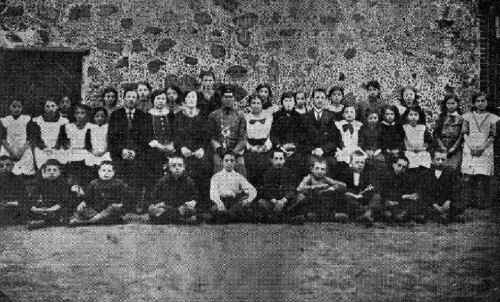
(Photo, caption: the German school at the end of the war, previously a Russian school. Following Lithuanian independence, it became a Lithuanian school)

his head, but how astonished my father was when approaching the door, he heard a Jew calling: “Save me!” This was a Jew from Petersburg, a revolutionary, who had escaped from the Tsarist police. He wanted to smuggle himself across the border to Memel, but he got lost and went in the opposite direction, not in the direction he needed to go; instead of going to the German border, by mistake he went back and seeing the candles burning in a Jewish house, he knocked on our door.

Understand, we let him come in; he spent the night with us, remained for Shabbos. Then my father went to the Jew who would go across the border and reached an agreement with him

[Page 93]

that he would immediately after havdalah [concluding Shabbos prayer] take the Jew across the border.

At the close of Shabbos, immediately after havdalah, the ferryman along with a Christian arrived and the Jew was taken back to the border of Gordz to Laugallen [Laugaliai] and arrived there in peace.

Sunday, my father went away to Laugallen and met with the Jew. Then the Jew left Memel on a ship to America and when he arrived in America he sent us a thank you letter for the mercy that my father had done in helping him in a time of trouble…

*

During the time of the First World War and in the years 1916-1917, the Germans brought young Jewish men from Poland as forced

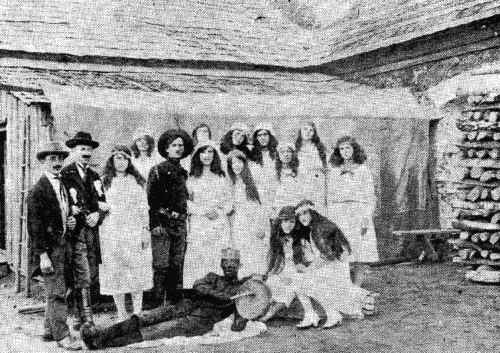
(Photo, caption: The theater presents Goldfaden's Shulamit during 1918 under the direction of Yitzhak Raman. Among the actors is Yehudis Lashem)

[Page 94]

laborers to build the railroad line from Lithuania to Germany. The young men suffered greatly from hunger and cold during their forced labor; their clothes were torn and they were barefoot and they were wretched.

Two of them came to Gordz on a Shabbos morning and hid in the attic of the beis-hamedrash [synagogue]. My father brought the news from the synagogue and the shtetl stirred… and as it happens, Shabbos afternoon my father went to sleep; I took a few pieces of fish and potatoes from my mother and sent them to the two Jewish forced laborers in the beis-hamedrash with my brother, Beni, so that they could eat and quiet their hunger. I also asked my brother to tell them that they should come between the two gardens of Zusa-Menda Uriasz at 4 o'clock.

At 4 o'clock I went to them and promised them that tomorrow they would have a room also teg tsu esn[1*] and they would be provided with clothing because they were naked and barefoot.

More forced laborers in addition to the two arrived and when the number was already 8 to 12, I did my best to give advice, but later when dozens arrived and the number reached 82, I took Mikha Melamer and Kalman Platus as helpers. We made a special book and everyone in the shtetl made a monthly payment to help the suffering forced laborers. I personally dedicated great efforts and energy in order to help the suffering forced laborers who were in need of our help and even more – a warm, human and hearty connection. At that time I went through a great deal, but I had the greatest satisfaction in helping unfortunate men at their time of difficulty and helped them to stand on their feet.

Several of these former forced laborers were very intelligent and educated men. Three of them later

[Page 95]

were married in Gordz, settled down and were incorporated into communal life in the shtetl. They were active in several communal institutions in Gordz.

They were freed in 1919. This was one of my happiest days.

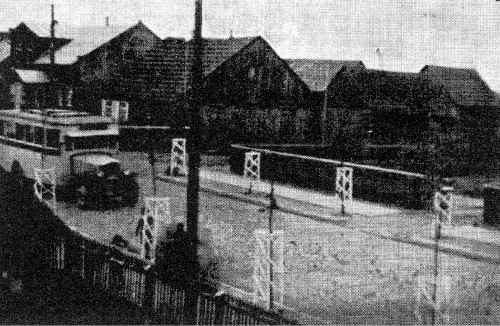
(Photo, caption: Blue Galen, the German school during World War I)

[Page 96]

*

The spring was a part of our sthtel's extraordinarily beautiful landscape. Behind the church, which stood at the very edge of the marketplace, began the road, overgrown with tall grass and trees, to the Minya [River], to the bridge that ran downhill on both sides. A small path turned on the mountain to the well. Young Gordzer would gather at the well in the summer, early Shabbos and at night, and drink the crystal-clear water that flowed without stop day and night and formed a sort of silver stream downhill and rinsed the shining stones that looked out from the entire road up to the Minya.

Not far from there, a large wooden wheel at the watermill turned without stop. The watermill belonged to a German who was named Freikop and he could always be seen with a long pipe in his mouth that he smoked without end.

Opposite the well stood the count's palace. The count was a chamberlain of Tsar Nicholas and from time to time he would come home to Gordz to see his wife, who was paralyzed and sat on a small wagon. The count would light a carbide lamp [gas lamp] (there was no electricity then in Gordz) and this illuminated the shtetl for a great distance.

Early Shabbos the count's garden was opened and, as children, we would be very curious to see the count's garden and mainly the baroness. The park was revealed to us as an enchanted corner, full of secrets and I remember that once the count's son, who was a child of our age, set a large dog on us. We then ran off in great fear to where the pepper grows…[2*]

During the later years, the count's garden was open for

[Page 97]

everyone and entry was free. We, the young Gordz Jews, used the place very well to spend our free time.

The forest began on the other side of the bridge. It stretched for great distances. The forest was thick, always dark and no road was seen there. When we went deeper into the woods we always had a strange feeling. Everyone felt a mystery and an anxiety. Stories and events were told about the forest, frightening stories about thieves and robbers in the forest and this made the forest more mysterious and full of secrets for us… Crossing the bridge and entering the forest was considered an heroic act and there were not many who were able to enter the forest fearlessly…

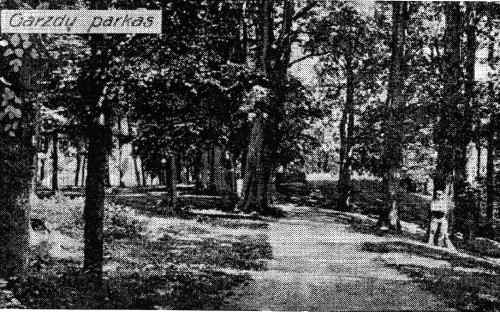
(Photo, caption: City Garden. On photo: Gordz park)


Translator's Footnotes

1*. teg tsu esn – days for eating. It was a custom for families in a city or town to provide meals for students in yeshivas. They would provide the meals for a day or a few days. Return
2*. “Where the pepper grows” is an idiom denoting a great distance, the end of the world. Return


[Page 104]

Gorzd Cultural Institutions

by Rashel Oysher

Translated by Gloria Berkenstat Freund

Our folks-shul [public school] was the only educational institution in Gorzd, but the school did not give us much knowledge. I remember that in later years when we, the former students of the school, would meet for a friendly conversation, we would laugh heartily remembering that even many years after the First World War they would still teach us geography about the “United Austria-Hungary” and various other curiosities. But the school and, especially the coming of the teacher, Chana Grynberg, laid the basis for our development.


gar104.jpg  Council of the Hebrew Library  [18 KB]
Council of the Hebrew Library
From right to left: Ben-Tzion Duks, Malka Ornshtein,
Yitzhak Gutman, Shoshana Usher, Ester Puret


[Page 105]

Our teacher, Chana Grynberg, was a talented pedagogue. She would transform each lesson in Talmud into a substantial conversation. We learned Hebrew not just in books, but also through various games, songs and performances.

After graduating from the school, we freely spoke Hebrew; much time was dedicated to the subject of Jewish history, Hebrew literature, Jewish holidays and Jewish traditions. An appropriate performance was prepared for each holiday and important date in history. Chana Grynberg, the teacher, planted a love of Zion in us. She was the founder of Hashomer haTzair [Zionist socialist youth movement] in Gorzd. This enabled many young people to go to hakhshore [preparatory training for prospective agricultural emigrants to Israel] and, later, to emigrate to Eretz-Yisroel.

Chana Grynberg was one of the innocent victims among the Gorzd Jews. Her bright memory lives in the remembrance of many of the young from our shtetl.


Our Library

Our library, which consisted of Yiddish and Hebrew books, was founded and supported by our landsman [man from the same city], Shmuel Zaks, who emigrated to America and from there he would send books as well as material help for the library.

There were two divisions in the library: books for adults and books for children. We arranged a joyous evening for the 10th anniversary of the library. Yitzhak Gutman, Ester Puret, Malka Ornshtein, Ben-Tzion Duks and I belonged to the committee that managed the library.

The library committee was involved not only with the book fund and giving out books to read; the library was a cultural institution that engaged in cultural activities. We would organize theater performances

[Page 106]

and the income from them would be dedicated to the library in order to supplement the library fund.

The library also organized cultural activities that included various cultural performances, such as literary trials, literary evenings, speeches, evening courses and others.

An Esperanto course was organized at the library with the help of Leibl Shoys. Many young people learned Esperanto and later carried on a wide correspondence with young people from various lands. This permitted us to enrich and broaden our thought process. Thanks to this we learned about various countries and people and became acquainted with their cultures.


Gorzder Lovers of Theater

There was no established theater in Gorzd; for many years only dramatic circles of lovers of the stage existed in the shtetl. The dramatic circles organized presentations almost systematically. The income would go to various charitable institutions, such as the Bikur-Kholem [society to visit the sick], Lines-haTzedek [poor house], for the volunteer firefighter team and also for the library.

The performances would be presented in Yiddish and Hebrew. How greatly I remember the active organizer of such performances, as well as the director, Zalman-Leib Rubinshtein. And, after his emigration to America, his place was taken by Ziwik (I do not remember his surname). Josef Blekh was always responsible for make-up.

The performances would take place in the so-called “folks-hoys” [people's house]. This was a very primitive wooden building that we would rent for a performance from the Lithuanian gemeinde [community]. In order to increase the income we would organize a donated buffet at the same time. Posters about the performance that would take place in Gorzd would also be hung

[Page 107]

in Meml and very often full buses with guests from Meml would come and this created excitement in the shtetl and a great interest in the performances.

The first performance that I was successful in seeing in the general rehearsal was Mirele Efros [play by Jacob Gordon, often referred to as the “Jewish King Lear”] and this made such an impression on me that I myself began to dream of being an actor, an actress. But understand, this remained only a dream, but without doubt this influenced me to later take part in performances.

The repertory of the performances often consisted of portraits of Jewish exile life and of emigrant life in America, of their American good fortune and troubles.

An important place in the selection of the repertory was taken by serious performances from the Jewish and Hebrew dramaturgy, as well as pictures from Jewish history – in the Tanakh [Bible], for example:


gar107.jpg  The Purim theater presentation  [17 KB]
The Purim theater presentation – the early years of the 1930s.


[Page 108]

Mekhires Yosef [The Selling of Joseph], Akedas Yitzhak [The Binding of Isaac], HaHashmonaim [The Hashmonaim - Maccabees], Megilus Ester [The Scroll of Esther], A Din-Torah mitn Wind [A Torah Judgment with the Wind], Shulamit [by Abraham Goldfaden] and others.

I do not remember the older generation of artist enthusiasts. I will recall as active participants: Ziwik; Mendl and his sister, Toyve Haz, Avraham Ornshtein, Ruchl Lan, Malka Ornshtein, Leibl Shoys, Yitzhak Goytman[1*], Ester Puret and many others.

I, myself, also took part in many performances, playing various roles. The very successful performance, Bas Yephthah [Jephthah's Daughter] performed by our school under the direction of Chana Grynberg, remains in my memory. I performed the role of Jephthah the Gileadite. In the main role, Ruchl Frydhajm took the part of Jephthah's daughter. Jephthah's five step-brothers were played by Ruchl Erman-Fyurski, Etl-Fig Baranow, Etel-Bine Frak, Sheyndele Joselowitz-Ornshtein and Dina Troyb.

The well prepared decorations, clothing, songs and dances created an impressive picture of Jephthah's tragedy.

In addition to the performances of plays that we presented, there was a wide program of sports, dance, a chorus and recitations. The performances were highly appreciated by the Jewish as well as the Lithuanian population.

No doubt our theater lovers had a great effect on the development of the population of the shtetl, which had perceptive young people with an understanding of art. Our performances brought much vitality to the Jews in Gorzd and also gave them much pleasure.


Our Tea Shop

That is what we would call Josef Shlumowitz's bakery cellar. It is very possible that not many in Gorzd even knew that active and highly interesting cultural work was being carried out here.

[Page 109]

Along with the three sisters, Sora, Yochl and Rayzl Shlumowitz, almost all of the young would meet there, Leibl Shoys, Yitzhak Gutman, Ester Puret, Malka Ornshtein, Mordekhai-Leib Ornshtein, Sheykele Gorn and also, me. We would jointly read various writers' works, deal with and discuss various literary works, organize collective walks. We would jointly go to Meml and attend the movies and theater performances there and work out plans about how to expand our activities among the Gorzd youth.

Until late in the night, often after the electric lights were turned off, we would sit in front of the fire of the heating oven during the long winter nights deep in reading and in animated discussions.

The tea shop was a good school of intellectual development for us.


Organizations and Communal Institutions in Gorzd

Various Zionist organizations, such as Hashomer Hatzair [Socialist-Zionist youth movement], Zionist Socialists, Tzeri Zion [young Zionists] and Mizrakhi [religious Zionists], carried on animated activity in Gorzd. There were also charitable, philanthropic institutions such as Bikur Kholem, Moes-Khitim [assistance for the poor for Passover] and Lines haTzedek and sports organizations such Makabi and HaPoel.

Hashomer Hatzair planted a love and deep longing for Zion in us and our wish and ideal was to emigrate to Eretz-Yisroel and take an active part in the building up of the country, of a Jewish land.

Mostly the children and young people of the working class belonged to Hashomer Hatzair. At our meetings we would discuss various Zionist problems, about the road that Hashomer Hatzair was taking to its goal. At the meetings we would read

[Page 110]


gar110.jpg  A group of Hebrew scouts  [22 KB]
A group of Hebrew scouts


various articles about the work that was being done in Palestine and the struggle for a Jewish land.

Hashomer Hatzair developed various moral characteristics in us: to be honest and modest, to help comrades and those weaker, to throw off all petit-bourgeois traditions, to love nature and to prepare ourselves for active physical work.

Every gathering would begin with the singing of Hebrew songs and end with a spirited hora [circle dance]. We would wear our uniforms with pride and we would wait impatiently for the summer colony when we would leave our homes for several days and find ourselves in the bosom of nature, live in tents with great multitudes of scouts who would come together from various cities and shtetlekh in Lithuania.

[Page 111]

There was a very beautiful landscape around Gorzd. Various hakhsore [training sites to prepare emigrants for life in Eretz-Yisroel] points were found in the villages and in the agricultural households. There were collectives and halutzim [pioneers] there who went through their preparatory training before their emigration to Eretz-Yisroel.

We would often visit them, looked with interest at their place of residence and animated conversations would develop with the halutzim. They would tell us about Eretz-Yisroel and about life and the building up of the country. Our group would also visit comrades from the primary leadership of Hashomer Hatzair and representatives from Eretz-Yisroel.

Our group existed officially, legally and we did not have any difficulties with or disturbances on the part of the local regime. But then in 1934 we were forced to switch to illegal work and it happened like this:

In that year, we moved our meeting hall (residence) not far from the Gorzd police. Our meeting on the 3rd of May [celebration of the Constitution of 1791] was dedicated to the international worker's holiday, the 1st of May.

While we sat engrossed in listening to the lecture by Yitzhak Gutman, the door suddenly opened and in fear we saw the chief of the police accompanied by two policemen and civilian witnesses. Whoever was able to orient themselves had time to escape through an open window. But a guard was immediately placed near the doors and windows and an investigation was started which lasted until late in the night.

We spoke among ourselves in Evrit [modern Hebrew] that we should tell the police that the meeting was dedicated to the Histadrut HaOvdim [Federation of Workers] in Eretz-Yizroel. We were allowed to go free after the investigation.

At that time I was the leader of our group. In addition to me, members of the council were Ben-Tzion Duks and Avraham Joselowitch. A week later after the above-mentioned meeting, all three of us

[Page 112]

were invited by the police chief and he officially gave us notice that for organizing a meeting without permission from the regime we were being penalized with a week in jail and that our further activities could only be carried out under the supervision of the police. That is, we had to give three days notice about every meeting that would take place and the police would send its representative to the meeting.

We, three, suffered the punishment in the Gorzd prison. At first we followed the regulations of the police, but later we were disillusioned with the undesirable guest and began to meet in secret in various places and avoided the supervision of the police.

We were invited to the police a second time and they gave us notice that the police knew that we had organized secret meetings and they warned us that if we continued our illegal work, our organization would be closed and the leaders would be severely penalized. However despite these threats we still continued our work until the police chief was changed. Then we again renewed our activities freely, without disturbance and supervision from the police and many of the young filled our meeting hall and we continued our cultural-educational work. Many of the young from our group went to the hakshore locations. But it was not possible for everyone to emigrate to Eretz-Yisroel.


Our Philanthropic Institutions

The Bikur-Khoylem [organization to aid the sick] had an important place in Gorzd. As in every shtetl, there were old and lonely people who were in need of help. These lonely people did not have any friends, any

[Page 113]

family and when they became ill there was no one to bring them help.

The Bikur-Khoylem assured that these lonely and sick people would not remain without supervision and provided for their medical help and material support. For this purpose


gar113.jpg  'Makabi' Gorzd  [26 KB]
Makabi Gorzd


[Page 114]

the Bikur-Khoylem made sure that each family would pay a certain fee each month for Bikur-Khoylem according to, it should be understood, the ability of each family.

Flower days and performances would be organized and the income would go to the fund. The needy would get medical help – free remedies and better food. Volunteers would all go to the sick to spend the night and to serve them.

Moes Khitim was a fund created with the aid of those who would help poor people with food and, mainly, with matzoh for Passover.

The voluntary firefighter team, at the head of which stood the untiring leader, Shepsl Bis, was very popular in Gorzd. Gorzd, which was built up with wooden houses, often suffered from fires and there was no lack of work for the firefighters.

The Makabi football team and, later, also Hapoel was well known by all of our Gorzders. The song with which the football players would march in the streets to the football contest still rings in the ears until today:

“We are the football team,
We are always ready for the match
We carry the flag of Makabi
We carry it with pride and with joy.”
Makabi and Hapoel had various sections for gymnastics.

Thus lived our shtetl, Gorzd, until the great calamity, when Jewish Gorzd was destroyed in the time of the Shoah.


[Page 117]

Jewish Social and Religious Life in Gorzd

by Arye Frak

Translated by Gloria Berkenstat Freund

A dynamic Jewish life pulsed in Gorzd, as in all other Jewish shtetlekh [towns], between both wars. This Jewish life was mirrored particularly in the framework of institutions, unions, organizations and a series of philanthropic groups, which bore the character of a kind of self help. However, the very distinct strength of the cultural center in the shtetl was unquestionably derived from the Zionist parties of all affiliations.


Zionist Parties

Their activities began in the second half of the 1920's until the capture of the Memel region by Hitler Germany on the 22nd of March, 1939.

The first party that was founded in Gorzd was the Ts. S. Party (Zionist Socialist) that was more active and influential than any other in Gorzd. Later, a split in the party took place that divided itself into Ts. S. Welt Farbund [Zionist Socialist World Union] (which was called the Linke [left]) and the Histahadut Ts. S. [Union of Zionist Socialists] – (the royte [red]).

The leaders of the Ts. S. Welt Farbund were:

Chairman: the Hebrew teacher Dovid Kutlubski.
Members of the Council: Ayzik Frydheim, the Vilna tailor (the son-in-law of Zisha the tailor), Mordekhai Leibovits, Shmeya Ilitovits and Shlomo Prak.
To the leaders of Histahadut Ts. S. belonged:
Mikhal Melamed, Sheinberg, his brother-in-law, Ayzik Wolfovits, Alter Ornshtein, the Gutmans' son Mikhal and others. Generally, both parts
[Page 118]


Picture
Tzeiri-Tzion [Youth of Zion]


lived together in peace and ran the large Jewish library together.

During those carefree years, many Gorzder emigrated to various countries such as America, South Africa and, mainly, to Eretz-Yisroel. This meant that as a result of the storm of emigration, the human potential of the parties was weakened. However, beginning in 1928 a certain revival of the party work with the influx of young strength was noticed. The religious party, Mizrakhi [religious Zionists], developed particularly animated work.

Halutzim [pioneers] from Mizrakhi, Agudas Yisroel [non-Zionist orthodox movement] and others worked in agriculture and other work. They went through hakhshore [training to prepare for emigration to Eretz-Yisroel] and prepared for a productive life in Eretz-Yisroel.

[Page 119]

The Mizrakhi organized Oneg Shabbos [Joy of Shabbat], Minyon Shabbos [group of 10 men to prayer on Shabbat], Kebalah Shabbos [welcoming of the Shabbat]; religious and popular songs from Eretz-Yisroel were sung, songs on Biblical motifs and they also spent their free time in collective dance. But all of this was interrupted by the capture of the Memel region by the Nazis. Then the terror for the Gorzd Jews, who found themselves near the German border, began.

Returning to Gorzd from Memel, the Jews lost their source of existence and the young tried to organize in the large cities in Lithuania: Kovno, Shawl and others. I, personally, did not see any purpose for remaining in Lithuania and looked for a way to emigrate to Eretz-Yisroel. As is known, the gates to Eretz-Yisroel were closed and I made my way to Eretz-Yisroel through illegal emigration, thanks to the help of my good friend in Memel, Shlomo Zilberstein and his brothers, Moshe and Josef. After an exhausting three and a half month trip through various lands I arrived on the shores of the country, but I was interned in a camp for a month by the English.


Sports Unions

During the above-mentioned period, major activities were carried out by the sports unions: Makhabi, Gigant and Tzeiri Hatakhia [Youth Reborn].

Makhabi had a large site at the sports area in the garden that during the war years, 1914-1918, belonged to Count Volmer. In this location, the Makhabi organized dance evenings, literary evening readings, discussions and so on.

Competitions would take place with the Memel sports union, Bar Kokhba, with the German sports union, with the Neustadt Makhabi, Skhod [Skuodas] and other shtetlekh.

The leaders of Makhabi were:

Zisl Markovits, the younger brother, Yudke Ornshtein, Aba Zusmanovits.

[Page 120]


Picture
Soccer team Makhabi Skuodas


Players: Leibl Luria, Ruwin-Leizer Beinigson, Feiwl Zusmanovits, Henakh Ban, Naftali Frak, who was an agile player and also a good sportsman with various sports equipment, Avraham Glojn, Josef Asherovits, Heshel Ornshtein and others.

In addition, the enlightened, educated youth founded a small sports union that was given the name Tzeiri Hatakhia. The leaders of Tzeiri Hatakhia were:

Zisl Shus (the son of Yankl Shus), Yitzhak Gutman, Avraham Ornshtein, Maks Wolfovitz and Asher Herc.

[Page 121]

Library

The organized youth also presented performances and the income from them would go in support of the Hebrew Library that was organized in Gorzd. Sam Saks took great interest in the library. The book fund was increased thanks to the large sums of money that he sent from America.

The librarians were: Malkala Ornshtein, Ruchl Zismanovits, Ester Furt, Ester Danishewski and Ida Erman. The library wandered from one room to another First it was in the public school; later with Hatsa Javshic. The third place was on the second floor with Mendl Luria near the Talmud Torah [school for poor boys] and at the end with the widow, Hena, across from Elihu Asher. (I do not know where the library was located after my departure from Gorzd.)


Philanthropic Institutions

The philanthropic institutions, Linas haTzedekh [accommodations for the needy], Bikor Kholem [help for the sick], Sa'ad LaAniyim [aid for the poor] had one purpose: to help the needy and sick people and they bore a self-help character.

Two men were sent for a night shift as soon as it was learned about a sick person in a family, in order to free the family members from a sleepless night and in order to serve the sick one. Food, free remedies and free medical treatment were brought to the houses of poor, needy families.

With Bikor Kholem – that was a branch of Linas haTzedekh, and Maos Khitin [matzo for the needy at Passover] was actually administered by the kehile [organized Jewish community], gabbaim [rabbi's assistant] and the rabbi of the Beis haMedrash [House of Study and Prayer]. It was a custom from ancient times that matzo and everything that was needed for Passover was sent to the poor. The money used for this purpose was from offerings and secret donations. The income from the theater presentations also supported this purpose.

[Page 122]

Dramatic Section

The founders of the dramatic section were Zalman-Leib Rubinstein and Josef Blech, both very bright talents for acting on the stage. Artists from Kovno, who appeared in interesting plays, would come to Gorzd many times.

The actors of the dramatic section were:

Shemya Ilitowitch, Rywka Man, Josef Osherowitch, Shmuel Ornstein and others. When Zalman Leib Rubenstein emigrated to America, Josef Blech replaced him as director. Sura Frak performed beautifully in various roles. Yehuda Leshem also excelled in various role and particularly as Avigil in the operetta, Shulamis [by Avraham Goldfaden]. Hantsa Glik played Shulamis, Avisholem was played by Chemes and the sorcerer was played by Ayzik Urias who was very successful with the audience. Other gifted artistic vigor was shown by Alter Ornshtein and Hantsa Akerman.
The income from the presentations would go to support needy, poor people, impoverished men who would be supported in secret.


Firefighter Command

In as much as Gorzd was built mostly of wooden houses, fires broke out often in the shtetl and the firemen had their hands full of work. Kalman Zilber was the fire chief, the second was Shepsl Blis and also the Zismanovitses. The Firefighter Command consisted of volunteer, young, healthy men, Jews and Lithuanians. The practice by the poszsharnikes [firemen] brought vitality to the shtetl when they would go out on the then old machines with full barrels of water in shining brass helmets with their uniforms and the public watched with great interest how the agile firemen

[Page 123]

climbed ladders and extinguished objects, as if they were putting out “a real fire.”


Religious Life

Gorzd was a pious shtetl. The most sacred spot for Gorzd Jews was the Beis-haMedrash [house of study and prayer] with a large room full of casks of holy books, Talmud, Khumishim [plural of Khumish – Torah] bound with parchment, books of Psalms, Mishnayos [rabbinical commentaries] and other sacred books. There were also a large synagogue, a Talmud Torah [religious primary school, usually for poor boys] and a small synagogue. (After the First World War, the synagogue and Talmud Torah were rebuilt with bricks after the fire, but the area of the small synagogue remained empty.)

There were many learned men in Gorzd. The head of the yeshiva was Reb Yitzhak Katsin; later he and his family emigrated to Eretz-Yisroel. (His daughter, Dora is there.) Young and old went en masse three times a day to pray collectively in a minyon [10 men required for prayer]. On Shabbosim [Sabbaths] and the Days of Awe and other holidays the houses of prayer were overflowing with worshippers.

We related to Rabbi haGaon [the sage] Shabatai Shapira with great respect and reverence and not only the Jews, even the Lithuanians related to him with great respect and when they would encounter him strolling in the garden they would greet him with great respect. His sermons were very rich in content, sharp and full of passion…

In Gorzd there were many of the righteous pious. Reb Leibe der weiser [the white one] (Yehudis Leshem's grandfather), Reb Leibe, der shwartser [the dark one]; Reb Elihayu the shoykhet [ritual slaughterer]; the Rebbe Brener (he later lived in Memel) and Feiwl Brener, his son, who was an important employee in the Memel People's Bank; Reb Betzalel and his son, the child prodigy; Reb Zabulun; Reb Gershon-Feiwe Faktor; Reb Bere Welwe Milner and the Rabbi, Reb Yakov Burshtein; Reb Flatus; Reb Shmuel Ben-Tzion; Reb Feite the Shamas [assistant to rabbi] of the Beis-haMedrash and Reb Josef-Elihu the Shamas with

[Page 124]

his son the child prodigy; Reb Hirshe Itse Shralovits; the “shtibl [small, one room synagogue] rebbe” and great sage, Reb Heshl and many others.

This was the old generation in Gorzd that had a great influence on the Jews of the shtetl.


Beli Tefillah

Particularly well liked were the Beli Tefillah [men who lead prayer- Baal Tefillah is the singular form] – messengers for the community. Their praying was full of heart and feeling. It is enough to enumerate several of them such as Reb Josef Furt, the shoykhet, Reb Yitzhak-Lieb Kac, a good Baal Tefillah with a beautiful voice (he was called Itse Leibele); Reb Yehoshua-Yakov Lurie (Shaya Yanke Lurie); Zalkind with his magnificent voice; Reb Moshe Osherovits – a good Baal Tefillah, Torah reader and later also the shoykhet and Reb Welwele Shtoch, who would pray with feeling and to this day I still cannot forget his Musef Yom Kippur praying. His liturgical poem from Aseret Harugei Malchut [Ten Martyrs] would evoke tears from the worshippers. I also remember the priestly blessing of the teacher, Dovid Lam and his son Yasha. (Here the kohanim [descendants of Aaron, the priestly class] sang solo and the community of worshippers repeated after them.) Yasha was among the enlightened young men. Later he studied at a Lithuanian gymnazie [secondary school] in Kovno and he gave a fiery speech in Lithuanian on the 16th of February, the day of the Lithuanian national holiday, and even the Lithuanians admired him. It is worth mentioning the khazan [cantor], Reb Yakov Bar Kohan on whose stamp was printed “ûber-kantor.” He actually was a good khazan with a magnificent voice and on the Days of Awe he prepared a good choir with superb voices and among them, Zivik, who had a strong bass voice, Shmuel Ornshtein, Mendl Man and others.

A kind of holiness reigned in the Beis-haMedrash when the khazan prayed with his choir and the crying and pleading from the women's section added to the holy atmosphere.

[Page 125]

There were various religious societies in Gorzd as in other shtetlekh in Lithuania, Khevre Gemara [society to study Talmudic commentaries], Khevre Mishnaius [society to study the compiled oral Torah], Khevre Tehilim [society to recite Psalms] and the Khevre Kadishe [burial society]. The Jews in these societies studied in the Bote-Medrashim [houses of study and prayer] and studied with authorities such as Reb Gershon Feiwe, sometimes also the Rabbi, Reb Shabatai, Reb Josef Puret, the shoykhet [ritual slaughterer], the head of the yeshiva, Reb Yitzhak Katsin and the Rabbi, Reb Yakov Burshtein. Jews reveled in his Talmud lessons; pearls truly poured from his mouth.

Those listening to the lessons were: Reb Eliezer-Moshe Wolwovits, a respected businessman, and his son, Ayzyk; Reb Hirshe-Itse Shrolovits; Reb Leibe-Hirsh – a respected Jew; Reb Mende-Falkes Frak, a Jew, a sage and a clever man and a giver of good advice; Reb Zisie Zusmanovits – a respected and very esteemed businessman. Dovid the lightmaker, Leizer Itsik's son, Reb Moshe Kurbman, a Jew, a God-fearing man; he would shout out his Shema Yisroel [Hear O, Israel – the central prayer of Judaism] with a strong voice so that the walls shook. He would give secret gifts to former Jewish businessmen, who later became impoverished. Only a few chosen ones knew of his support. Here in the land [Eretz-Yisroel], he was also a distinct Jew who was involved in the religious circles of the city.

Jews who studied a page of Gemara and Mishnaius privately could also be seen in various corners of the large Beis-haMedrash. Everyone was in his usual corner. Josef Hilel Shulman – a Jew, an owner of a building materials business; who in Gorzd did not know this good Jew? Yakov Gamzu – a Jew, a sagacious scholar of Talmud and a follower of the Enlightenment; Eliezer Shuster, a Jew, an artisan, but he was versed in the Gemara. Once I went into his house; I found him sitting at work and on the workstand lay an open Talmud treatise, Brokhus. Thus, he also learned while working. Elihu Ahser – a Jew, a sage and a scholar and a giver of good advice. Reb Yitzhak bar [son of] Welwe, Welwe's son Bere, Dovid Feil, Zev Shavel.

[Page 126]

Eliezer Akerman – Shakhne Akerman's son – was a Jew, a maskil [follower of the Enlightenment] and read many secular books. He was the chief bookkeeper for the People's Bank in Gorzd and a member of the Kehile [organized Jewish community], and a member of the Kehile council with the previous teacher, Dovid Kutlubski, Josef Furt and, I think, also Epharim Markovits.


Khevre Kadishe [Burial Society]

The gabbai [assistant to the rabbi] was Bere Wolf and also Ephraim Markovits. Reb Josef Ornshtein (the father of Avraham Ornshtein), Hirshe Ornshtein, the old Dovid Frak with his white beard had the duty to bring his purification tools from the poor house; he liked to perform the mitzvah [commandment]. During the summer he was an orchard keeper for his entire life and during the winter he dealt with hides. He died at the very old age of 90.

The Khevre Kadishe was greatly respected in the shtetl. The Jews of the Khevre Kadishe did their work with a great spirit of sacrifice and dedication in order to give respect to a Jewish burial.


Celebrations

The Jews arranged a large, kingly celebration every seven years after the Siem Shas [celebration of the completion of the study of the Talmud]. Klezmorim [musicians] played without stopping. The tables were full of all kinds of good foods like roasted goose, fish, herring, challahs and cakes and fruits of all kinds. Jews rejoiced and heard sermons from the gabbai and from the Rabbi, Reb Shabtai. The celebration of the Siem Shas was remembered for a long time

All of Gorzd came to the Bote-Medrashim on Simkhas Torah [fall holiday commemorating the completion of the yearly Torah readings]. Jews sang and the hakofus [circular procession with the Torah scrolls] in Gorzd had a good reputation. The Gorzd Jews were transported en masse by the joyful atmosphere in the shtetl; they permitted themselves to drink wine and whisky until they became drunk. They ate and drank as much as their hearts

[Page 127]

desired. The prayers and singing were heard far into the streets and alleys of the shtetl. It seemed that the entire shtetl was filled with Simkhas Torah


Tiferes Bokhurim [Splendid Young Men]

There was also a Tiferes Bokhurim [Splendid Young Men] in Gorzd who consisted of young businessmen. They had a separate minyon and studied a page of gemara together and did various work in the religious communal area.


Translator's Footnote

1*. Yitzhak Goytman is most likely the Yitzhak Gutman mentioned throughout the article. Return

«Previous Page Table of Contents Next Page »


This material is made available by JewishGen, Inc. and the Yizkor Book Project for the purpose of
fulfilling our mission of disseminating information about the Holocaust and destroyed Jewish communities.
This material may not be copied, sold or bartered without JewishGen, Inc.'s permission. Rights may be reserved by the copyright holder.


JewishGen, Inc. makes no representations regarding the accuracy of the translation. The reader may wish to refer to the original material for verification.
JewishGen is not responsible for inaccuracies or omissions in the original work and cannot rewrite or edit the text to correct inaccuracies and/or omissions.
Our mission is to produce a translation of the original work and we cannot verify the accuracy of statements or alter facts cited.

  Gargzdai, Lithuania     Yizkor Book Project     JewishGen Home Page


Yizkor Book Project Manager, Lance Ackerfeld
This web page created by Max G. Heffler

Copyright © 1999-2013 by JewishGen, Inc.
Updated 24 Aug 2011 by LA