|
[Pages 252-256]
I was eleven years old when I stubbornly insisted on going to study. My sister Chava accompanied me to the admittance exams. After I was accepted, she returned home and I stayed on in Utian (Utena).
There were three of us, friends from Dusiat: Itale Charit, Rachel Slovo and myself. Together we rented a room at Feiga Bak's. During the week we would eat from food packages that were sent from home, and on Shabbat I ate at our relatives in Utian, the Scharfstein family.
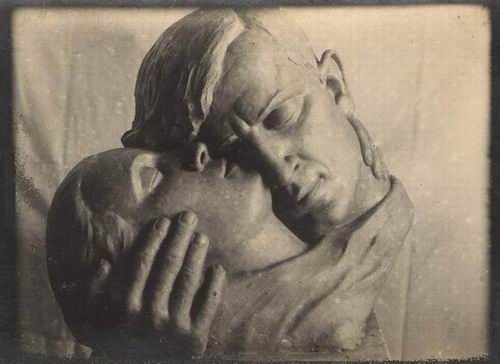
My memory of those days is one of a special experience. Across from our window lived the Jewish painter Yoffe who would look at us from his studio. He invited us over several times but we were afraid that he would ask us to pose for him On one occasion he came to Dusiat and asked for me. We met and took a stroll in the woods. All these years I have kept a picture of a sculpture of his that he gave me when we were in the woods. I remember how he stood there and just scribbled figures on the back of the picture. When I returned home, my father said that it would be better for this young man to look for a more mature young woman for himself
When the painter married - he was such a handsome young man - I was jealous of his wife Rivka who was the Lithuanian beauty queen. She was the daughter of Dr. Berman, a judge in Utian, whose brother was a well-known doctor in Lithuania.
The Lithuanian Gymnasia[2] in Zarasai
I very much wanted to study at the Jewish Gymnasia in Ponevezh (Panevezys). But, the tuition was too high, and instead, I was sent to study at the Lithuanian Gymnasia in Zarasai. The tuition there was minimal and students were exempt from paying if they had a justifiable reason.
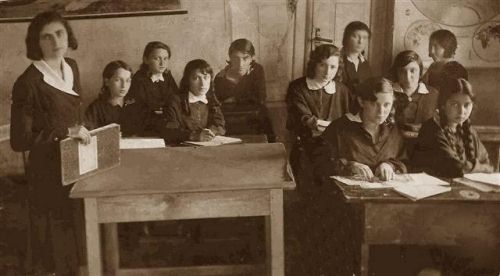
Itale Charit and myself were from Dusiat, while Tzipora Per and Yitzchak Shteinman were from Zarasai. I remember the uniform: a brown pleated dress with a white collar, and a black pleated pinafore
Naturally, the medium of instruction was Lithuanian. We also studied German and English. There were music and piano lessons, painting, and a huge gym
In the classroom we conducted debates on the books we were reading. I especially remember the debate over the book Salin Ginklos (in Lithuanian, Arms Away).
Of all of us, Yitzchak excelled the most in his studies and many a time Lithuanian students would come over to his house for assistance, and he was therefore very respected by them.
We were very involved in school activities, and I did not sense any anti-Semitism. I do remember one of the Lithuanian students remarking to a Jewish female student: Oh, you Jews, with the smell of garlic and onions
The gymnasium students had to be home by nine o'clock at night. The educators who felt responsible for us would go themselves and check if the students were indeed at home.
One time our class tutor came over and found Yitzchak in our room, but he promised not to take any action against us. Why? Because he found us reading a book He said to us, You are behaving in a civilized manner.
The fact that we had to be home at nine o'clock was a bother to us, especially affecting our activities in the Hashomer Hatzair movement. How could you leave at the height of the action? We had to find ways of getting around this decree and one could say we were getting ready for life in the underground
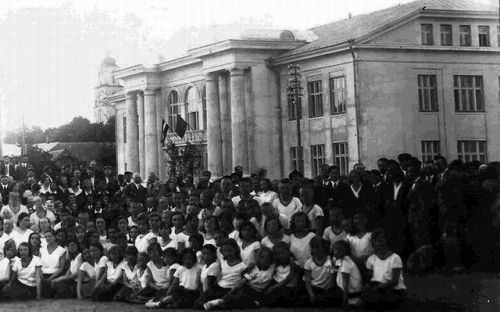
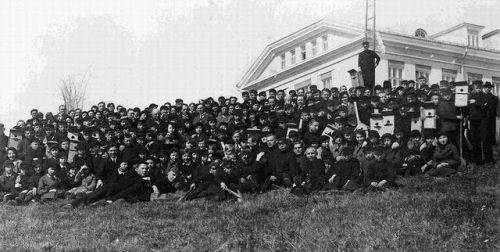
A special holiday was observed in the Lithuanian Gymnasia with the approach of spring. We welcomed spring with dances, songs and games. We planted trees near the gymnasia, and a special custom was to go out to the woods with birdcages and hang them on the trees
I remember that Itale and I once dressed up as old maids On another occasion it was suggested that we walk about with an umbrella to conceal our faces. But how do you walk with an umbrella on a clear day?
Occasionally, our class tutor would show up at our ken (cell) of the youth movement, but the rumor of his arrival would spread fast and we would evade his critical eye.
Youth movement activities prevented us from complying with the teacher's request of participating in social activities outside of the movement.
This was perhaps to the teacher's disliking, but we ignored it. The movement was first and foremost in our thoughts because it served as a training house towards aliya (immigration) to Eretz Yisrael.
I studied at the gymnasia for only three years and then went on hachshara (training) because my goal was to immigrate to Eretz Yisrael. My father was very grieved that I did not continue my fourth year and did not graduate from high school.
Hachshara in Kibbutz Chaim in Ponevezh[3]
When I received permission from the Hashomer Hatzair administration, I left home and went on hachshara. I remember packing my clothes myself, and thinking about my late mother who was not around to help me.
From Kovno (Kaunas), I was sent to Kibbutz Chaim in Ponevezh. Immediately, I was set to work in the kitchen and I was at a loss. This was not my area of expertise
Granted, conditions were difficult, but there was bread supplied by the Jewish baker. I think the local community also supported us.
I helped the teacher in the municipal kindergarten. Later on, I took care of a child who was talented but problematic, and I would take walks with him to see our young men who worked in the woods cutting trees. The young men would be on the roam looking for landlords who would employ them in cutting down trees for heating their houses. There was one woman, Mrs. Levine, who asked, How am I going to give such hard work to these young Jews? But after explaining to her that we must support and feed ourselves, she consented. They also worked in Hazan's flax factory.
We joined in the activities of Hashomer Hatzair in Ponevezh. We went to listen to speeches about Zionism, and enjoyed theater performances and artists from Eretz Yisrael. Everyone was curious to see the kibbutz hachshara and they would come and stay over with us. It was a great honor for us to host them. We were regarded as their unterferers.
All the members of the kibbutz lived in one apartment comprising one large hall, two bedrooms, and a kitchen. The landlord who lived on the floor below suffered greatly from the noise we made, from the shouting and dancing that literally caused the house to shake. One time, he burst in on us with a hatchet and threatened to hit us if we did not stop the commotion.
We were forced to leave and move elsewhere
When we wanted entertainment, to see a film or play, we had to save up for it and we would skip the butter We would drink only tea or kalipuntsen vasser: water mixed with coffee, but only just enough on the tip of a fork (to color the water)
Here is a picture perpetuating a moment on one Saturday when all the artisans in the hachshara got together: tree cutters, cleaning women, cooks, seamstresses and laundry maids This was after laundry day and we were getting ready to go out for the evening. I then went to the movies with a wet belly because I had no other change of clothing
Until I came on hachshara, a few months were sufficient to get a certificate[4]. But during my time, the number of certificates diminished; so I spent four years in hachshara until I decided to leave and go and acquire some sort of profession. With the help and recommendation of Dr. Druyan[5], my father arranged a place for me in the hospital where I was to study nursing. And just then a member of the movement leadership arrived at our commune. His name was Yisrael Zeeman. I pleaded my case before him. I knew that certificates had arrived and if I did not receive one, I would quit the hachshara. I owe my thanks to Yaacov Gottlieb[6] who convinced me not to leave, but rather to wait patiently for a certificate. When it finally arrived, I married Michka Davidov and together we made aliya to Eretz Yisrael.
Taking Leave of Home Forever
I left home. I got on a small truck belonging to Krut, which in addition to space for the luggage, had seats only for four, and so there was no seat left for my father who wanted so much to accompany me.
And now, I can see father before my eyes. We hug, we kiss, and I did not know that this would be the last time
My father had planned to close up the house and follow us to Palestine with Hene-Liebale, our youngest sister
I arrived in Palestine on March 12, 1938.
As we approached the port of Haifa, the city lights made a tremendous impression on me. But disappointment awaited me on the shore; the sight of the Horans (Arabs hailing from Horan), black as black can be, with their strange apparel. It was hard to understand how we would be able to live amongst them.
We were in the camp for new immigrants in Bat-Galim (a suburb of Haifa near the beach) when my sister Rachel and her husband Yashka Vitkin came to welcome me. Such excitement! Several years had passed since we took leave of each other, and I remembered Rachel as a full healthy young woman. But her appearance gave away the true conditions here in the land. Their clothing was also strange. It was a bright summer day and they had come in raincoats and muddy boots. I was shocked. It turned out that the day before it had rained, and they had made their way by hitchhiking on unpaved roads
They took us from the camp to see Kibbutz Yagur. This was the first encounter with a real kibbutz! I remember this visit as a special event. I was so excited. Here I was fulfilling the dream of a lifetime The next morning we went to our kibbutz, Mitzpe Hasharon. We waited near a store in Ra'anana for transportation to the kibbutz, and shortly a horse-drawn carriage arrived
My boy-friend Yitzchak Shteinman stayed to work in Kovno, according to the decree of the movement. He made his way to Eretz Yisrael via the illegal immigration together with the last ones who came from Lithuania
I then divorced Micha and married Yitzchak.
Footnotes
|
JewishGen, Inc. makes no representations regarding the accuracy of the translation. The reader may wish to refer to the original material for verification. JewishGen is not responsible for inaccuracies or omissions in the original work and cannot rewrite or edit the text to correct inaccuracies and/or omissions. Our mission is to produce a translation of the original work and we cannot verify the accuracy of statements or alter facts cited.
Dusetos, Lithuania
Yizkor Book Project
JewishGen Home Page
Copyright © 1999-2008 by JewishGen, Inc.
Updated 12 Apr 2008 by LA