|
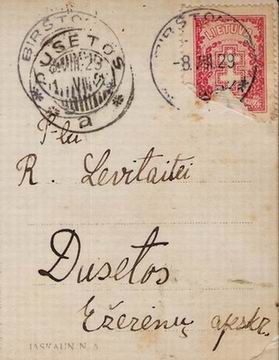
To R. Levitt, Dusetos,
District of Ezerenai
|
[Pages 119-120]
|
|
| Postmark Birštonas [Lithuania], 28.4.1929 To R. Levitt, Dusetos, District of Ezerenai |
The Levitt family, “Di Yuzinter”, who originated from Juzintai, owned the largest number of shops in Dusiat. They were very proud of their scholarliness and their pedigree.
We lived on Church Street. We had a metal shop, and my father spent most of his time there. He was a real craftsman! We used to “whiten” all the copper in the workshop for Pesach. I also remember that every tool was marked with an identifying sign on the handle, so as to know to whom it belonged.
We helped our father fix bicycles, prepare sleds for the winter, and together we would go out to the surrounding villages to install tin roofs. Pesach Reuvkes Scop, who was my father's apprentice and later immigrated to South Africa, also worked with us.
Our father was considered an expert in his profession, and was highly respected by all. Once there was a government competition. My father's bid was accepted and he was given the technical work. He invited the heads of the town council to celebrate the event at Ziv's inn, and he also took me, the youngest, with him. I remember that they didn't spare the drinks.
Batya Aviel: Father was also an agent for Singer sewing machines. I would assist him in the shop, and at the age of nine or ten I instructed people in how to sew with the machine.Yosef Yavnai: I remember that they also used to praise Moshe Levitt's son Berke, who had hands of gold.
Batya Aviel: As a child, my brother Berke was pale and skinny, and ate very little. My mother was worried that he might, G-d forbid, die, and was tempted to pay him one kopek each time, just so that he would taste a little soup. Berke was a talented young man. He put in a special lock on the post office safe, patented it and won a prize for it. Berke also taught himself to work in gold and silver.
Slovka Sarver: My wedding ring is one of his creations.
Lana Binder: How can I not remember Berke? We were a couple. He gave me a medal he had made himself as a memento, and in their home hung a portrait of me that he had painted. Berke was older than me, and I decided to leave and go to the big city. Many years passed until I understood what a beautiful and honest love ours was.
Batya Aviel: My mother ran a fabric shop, and regularly held a prayer book in her hand. When a Gentile came into the shop, he knew that it was forbidden to disturb my mother at her prayers.
Shmuel Levitt: My mother was more pious than my father. She was a believer, and she apparently also respected people of other faiths. Once, as was her custom, she hired a Gentile coachman to drive her out of town with her merchandise, and she noticed that when they passed the church the Gentile did not cross himself, as was customary among the Christians. She immediately instructed him to turn back. “I noticed that you didn't cross yourself, and so I have no faith in you,” she said to him.
Rachel Rabinowitz: Another shop owned by the Levitts – also a fabric shop – belonged to Tzive-Bashe and her husband, Eber Bernstein, who was a lawyer and a dedicated scholar. He and his wife immigrated to Florida. After the WWII we wrote to him from Germany and asked for help. He sent a gift and stated that he couldn't send money, as that was the domain of the public institutions…
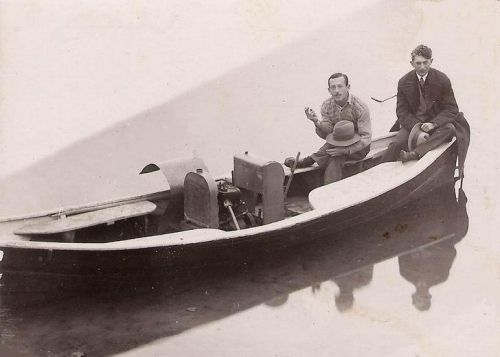
Dov-Berl Shub (right) with Shaul Levitt on the Motorboat… Shayke Glick: In my mind's eye I can see a motorboat with Dov Shub and Isserke Levitt sitting in it. I assume that the Levitts, who were talented, built it in their workshop. In the “heif” (yard) there was a gentile who built a motorboat. Several gentiles also assembled radios for themselves, and on Fridays we used to go to their house to listen to the news.
Tzila Gudelsky: I remember that we used to stop in the vicinity of the dairy to listen to the sounds of the music issuing from the Lithuanian's radio.
Malka Gilinsky: We did not have a radio, but we had a gramophone and records, and people would come to our house to listen to records of cantorial music. We also had a telephone, which belonged to the judge who lived in our house. When I was at school in Vilkomir (Ukmerge), I used to talk with my parents on the phone.
Zelig Yoffe: On Sunday, June 21, 1941, when the Germans invaded Lithuania, the telephone lines were cut off, and we were unable to find out what was happening outside the shtetl.
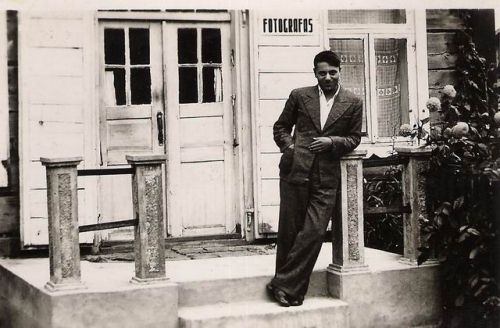
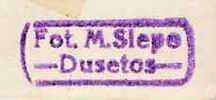
The Photographer Micha Slep Fot. M. Slepo, Dusetos
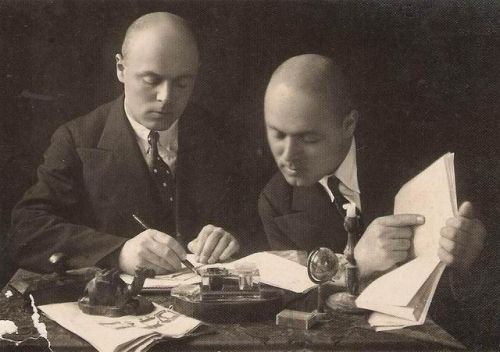
“To Yosef and Rivka from Yehuda and Yehuda …
Our brother Micha's masterpiece. Dusiat, 14.4.1936”
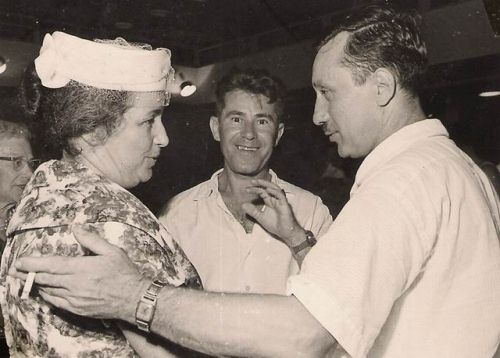
Photographer Chanan Schneiderman (center) from Rokiskis participating in the wedding of his student's daughter, photographer Naftali Sarver, with Slova (Segal), the bride's mother, and Chaim Slovo Many of the photographs in this book were taken by Micha Slep, who studied photography at Chanan Schneiderman's in Rakishok [Rokiskis], where Naftali Sarver also studied. Chanan Schneiderman now lives in Hadera.
Elka Slovo: My husband Chaim Slovo and Micha Slep were friends, with a left-wing outlook.
Rachel Rabinowitz: Micha read “The Communist Manifesto” with great interest, as though it were a thriller.
|
JewishGen, Inc. makes no representations regarding the accuracy of
the translation. The reader may wish to refer to the original material
for verification.
JewishGen is not responsible for inaccuracies or omissions in the original work and cannot rewrite or edit the text to correct inaccuracies and/or omissions.
Our mission is to produce a translation of the original work and we cannot verify the accuracy of statements or alter facts cited.
 Dusetos, Lithuania
 Yizkor Book Project
 JewishGen Home Page
Copyright © 1999-2024 by JewishGen, Inc.
Updated 23 Oct 2009 by LA