|
[Pages 45-49]
While Lithuanian Jewry had to compete against the growing Lithuanian intelligentsia for the support of the authorities in the spheres of commerce and crafts, the reactionary anti-Semitic stream strengthened among the Lithuanian public, and most of the privileges previously granted to the Jews were revoked. In 1924 the Ministry for Jewish Affairs was abolished.
In the winter of 1920 my brother Yosef made aliya (immigration) to Eretz Yisrael (Palestine) as a chalutz (pioneer). From that period on, we exchanged letters regularly, and I would receive detailed news about the life there.
In Lithuania conditions were worsening on a daily basis. Immigration took on the form of panic, and the shtetls were almost totally emptied out. Young people who received a drisha ("demand") from their relatives in Eretz Yisrael came knocking on the doors of the British consul in order to apply for visas to Palestine, however the British mandate allotted only a small number of certificates. Those who had money went to Palestine as tourists and simply stayed on. Many others joined the Zionist movement, Hechalutz[1]. One of them was myself, namely the young Avraham Slep.
I complied with all the requirements laid down by the central committee of Hechalutz; and after many months of anxious waiting, I was "called up" to the capital, Kovno (Kaunas). In my shtetl, Dusiat, they made a farewell party for me and wished me an early aliya to Eretz Yisrael.
"As compensation for losing Vilna (Vilnius), the Klaipeda (Memel) region was annexed to Lithuania in 1923. It had previously belonged to Germany. In this region that gained wide autonomy because of its mixed population, the Jewish community grew, especially in the city of Memel, and this community rapidly became a part of Lithuanian Jewry." [2]"In the 1920's, the agricultural hachshara (training) in Lithuania was concentrated mainly in the vicinity of Memel. Here the chalutzim were also employed by German estate owners." [3]
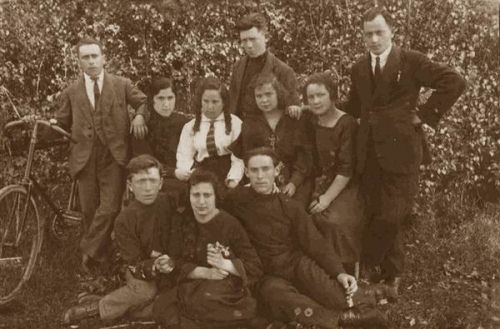
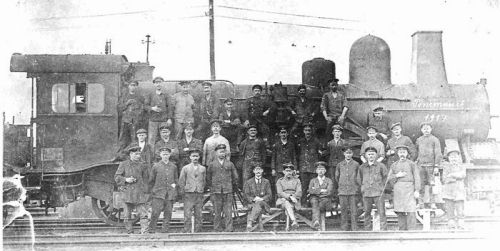
The Hachshara Group at Medikin
In Kovno I was assigned to a group of twelve young men and four young women. We did not know each other previously but we soon found a common language, and that language happened to be Hebrew! In Lithuania most of the young Jews spoke Hebrew, and that made first acquaintances a lot easier.
The Hechalutz central committee sent us to an estate called Medikin, about twelve kilometers from the city Memel. We left Kovno by train, with many chalutzim whose turn had not yet come, seeing us off in envy. There were also quite a number of people at the station, Jews who were anti-Zionist, who warned us that the Zionists in Palestine would sell us to rich Moslems ...
We boarded the train singing, in high spirits. The Gentiles on the train knew our final destination was Palestine and behaved in a very friendly manner toward us.
We arrived in Memel in the afternoon. We ate at the local municipal laborers' kitchen that also served the Jewish municipal workers, located near the Hechalutz branch in the area. Along with local chalutzim we toured the city. We found it to be very clean, with a beautiful view, many cultural places and beautiful parks, and a well-organized port.
Next morning we left on a kleinbahn (small train) belonging to the German owner of the estate. On entering the estate we were welcomed with "Guten tag, guten tag, unzere froind." (Good day, good day, our friends)
It was harvest time and there was quite a crowd in the field. The estate spread over an immense piece of land in a flat area, no valleys, no hills, and was a delight to behold!
We were assigned two houses for the men, one house for the women, a big kitchen and storage area, a shower and toilet.
We worked six days a week, eight to nine hours a day. Six young men trained in agriculture - plowing, sowing, grooming and feeding the horses. Six others learned how to use the milking machines, and how to fatten the geese. Three young women worked in the fields and stacked hay. One young woman cooked, did the laundry and took care of the house. I worked in agriculture - plowing, using machines for sowing, transferring of goods and taking care of the horses. The day passed by very quickly.
We were interspersed among the German laborers, who were in general good people and very friendly. Food was plentiful and varied. We would receive the best products from the manager; a Jewish butcher even supplied us with kosher food.
We, the Litvaks, were used to eating a lot of bread - soup with bread, hot cereal with bread, and even apples with bread... The owner's wife was a wonderful woman and she suggested that perhaps we would get off the bread and eat more roast potatoes and meat.
After the meal we would read literature about Eretz Yisrael, and on our own we became more fluent in Hebrew.
Almost every night we would meet the young local laborers and we would exchange visits. We would go dancing, to the accompaniment of a harmonica played by one of the laborers, and the German men and shikses (young gentile women) would join in with us for many hours. Each evening was very "rich" and interesting.
Every Saturday we would go to Memel, to the Hechalutz house where chalutzim from the different estates in the area would gather and report on the relationship between them and their employers, the food and the accommodation. We would also receive a report of what was happening at the Hechalutz center regarding immigration, and of events in Palestine. We heard lectures, Hassidic stories and music, and we would sing songs that originated in Eretz Yisrael, and dance, dance, dance
Today on thinking back to that period and recalling the spirit that throbbed within us - the excitement, brotherhood and friendship - the flame of youth ignites within me.
The estate owner was fond of us, but the manager, a young Latvian in his thirties, was a typical Jew hater, full of venom, who would not miss an opportunity to incite against us. On one occasion he happened to start up with me, and the story goes as follows:
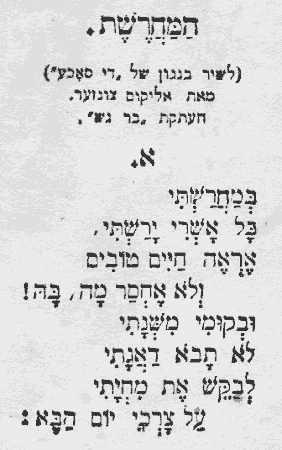
In the morning I had gone out to harness six horses in order to start plowing, and I noticed that one of the horses had been switched. The groom told me that this was the schedule for the day, and I kept quiet. I harnessed the horses in pairs to the carriage and rode out to the field, a distance of three kilometers from the estate. I loosened the horses and harnessed them to the plow, and dug a furrow a kilometer long. I made a few turns, slowly, peacefully, humming the song "B'machrashti"[4] to myself. When suddenly there was a loud bang, and then another bang! The horse that had been switched started going wild kicking left and right, and the other horses joined in this "game" until they all became entangled in the harness and fell on top of one another. I started using the whip, but the harness was so twisted they could not get up. Since I had no choice, I pulled out a knife and cut the straps. Immediately five of the horses stood up, but the sixth one was lying there as if dead, with his tongue hanging out. No lashing helped to get him up. I activated the alarm in the cart, and within a few minutes five riders came riding up, amongst them the Jew hater. The expert started yelling in the horse's ears, and suddenly a miracle! The horse got up as if nothing had happened.The oppressor started cursing me in German, adding, "Furfluchte Yuden" (cursed Jew). I was all upset and instead of answering him, chose to hit him. I hit him straight in the nose. He didn't react immediately, rather that evening I was summoned by the owner.
The groom testified that he was deliberately instructed by the manager to arrange for that particular horse to go out with me. I came out the winner, and since then the oppressor no longer dared to start up with us. He did not disturb our peace.
I worked on that estate for four months. It was an unforgettable experience the "Garden of Eden" on earth. The days were filled with trips, meetings, interesting work, and life was full of substance until I was given permission to immigrate to Eretz Yisrael.
Taking Leave of Lithuania
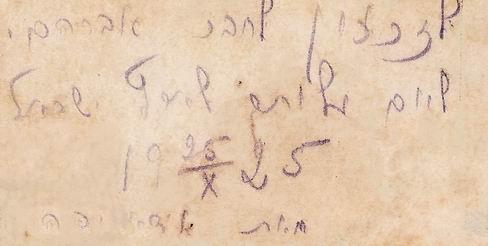
On October 27, 1925, I left Dusiat, the shtetl of my birth, which I loved so much. I took leave of all those who were dear to me - my parents, brothers, sisters and other relatives. The horseman, Zusl Napoleon, son of Ezra, put my suitcases on the cart, last kiss, and we were on our way on the dirt road about twenty kilometers to the train station.
Both male and female friends accompanied me on foot for about five kilometers. The cart stopped. They took out shnapps (brandy) and we drank "L'chaim" (a toast). We had very mixed feelings because of some discouraging news we had received from Palestine. I kept my head turned back until I could no longer see anyone. The trip was slow. The horse would stop occasionally to rest. We passed fields, woods, lakes, and I recalled "my" estate, the friends I had left behind. I noticed the church, and as if in a dream, I hear the ringing of the bell just as the horseman started murmuring: "We're passing the church. In a few minutes we'll reach the train station..."
That evening I left for Kovno by train. The next morning I arrived at the Hechalutz center and stayed overnight.
On October 29, 1925, we left Kovno by train on the way to Berlin and Marseilles. Many other chalutzim joined me. The food was shared among all. Everything was for everybody. The motto was: "Those who don't have, have plenty."
On the train we met "hozrim", namely, people who had left Palestine but were on their way back there, and that encouraged us. After a tiring ride (in an old train, three levels of benches on each side, and woe to the ones occupying the bottom level ), on Friday morning we arrived at the big hall of the Berlin train station, Bahnhoffstrasse, a hostel for chalutzim arranged by the Zionist leadership.
We toured the city under the guidance of the chalutzim of Berlin. There we found beautifully kept gardens, museums and gorgeous homes, and everything aroused my excitement and astonishment.
The next day, Saturday, we visited the synagogue. I was honored with an "aliya l'torah". I got a "mi sheberach," a blessing usually made for the person who is called up to read the Torah. They served wine for Kiddush, and wherever we went, we were given VIP treatment, and people looked upon us with envy.
At eight o'clock at night the train departed for Marseilles, where we arrived the next morning, and stayed at the "Hotel Tel Aviv".
The city had an eastern flavor. The people living there were of different nationalities; and here we met Arabs for the first time, mostly porters whose language sounded foreign to us.
There was mayhem at the Hotel Tel Aviv: chalutzim olim who were on their way to Palestine: chalutzim yordim who were returning. But a chalutz is always a chalutz (a pioneer is always a pioneer), like a Hassid traveling to his Rebbe: always happy, only happy!
We toured the city to its length and breadth. We did some shopping, looking especially for bargains. I bought my hand watch there, which just celebrated its forty-second birthday
On the Ship "Canada" to Palestine
On Tuesday, November 3, 1925, we boarded the "Canada" on our way to Eretz Yisrael, the land of our dreams for two thousand years. Many generations had recited the prayer: "May our eyes see the sights of Zion." We dreamt about the Western Wall, and here I am. I have the privilege that even the outstanding Jewish personalities for many generations have not attained.
On the boat there were about 250 passengers chalutzim, tourists and others. I found six beds in our cabin arranged in three levels. Immediately I chose the uppermost bed. I had learned my lesson from the ride on the train
We stood on deck, leaning on the barriers and measuring the vast sea with our eyes. Marseilles disappeared further and further into the distance. The sea was calm; the birds were twittering above us, as if blessing us with "Tzetchem l'shalom, malachei hashalom!" (Blessed shall you be in your goings, you angels of peace!) The atmosphere was quiet and peaceful. The excitement was wearing off, as if we had matured a few years.
Around noontime the tables were prepared and the sight of cherries caught our eyes. Cherries now? Was the summer not already behind us? It was already November! I was one of those who grabbed a handful and shoved them straight into my mouth. But, alas, these were not cherries! These were black olives
Later on the sun began to set. One by one, the stars appeared. Here is the "Big Bear" (Ursa Major) right over my head. Is the bear also accompanying me to Eretz Yisrael? Has he also had enough of the Diaspora?
I lay down in an easy chair and envisioned my shtetl, with its beauty, its lakes, its woods, its fields; all those who are dear to me; the chalutzim; and all those who accompanied me. All of a sudden the bell aroused me from my daydreaming.
I went down for dinner, again met everybody, and each time there were new faces.
After the meal, the mood started improving. The first dance on the deck attracted a big crowd. Even the older people joined in, and the circle got larger and larger. A distinguished bearded Jew wearing a kapota (coat) and leather boots entered the center of the circle, dancing the cossatchok (Cossack's dance). We were dancing the hora and he the cossatchok. His wife was standing on the side, clapping and saying, "Tzu gezunt, kinderlach." (To your health, children) Rich tourists handed out candy, and I remember that one of them spoke Yiddish with an English accent, saying, "Kinderlach, est. Ir daft hobn keyech tzu boyn dos land." (Children, eat. You need strength to build the land.)
On the third night I got seasick. The waves shook the boat and my insides at the same time, and those who slept in the bunk below me did not enjoy it at all... I went up on deck and felt a bit better, but not for long. Every heave caused me to throw up. I was not the only one.
There were many others in the same condition. The sighs and screaming got louder. One old woman was calling, "A leimene, a leimene. Ich gay ois!" (A lemon, a lemon. I'm dying!) And her husband pressed her forehead and she groaned, "Ahhh!..." In the meantime, the deck was filled with sick people and the "choir" grew larger and larger. Only Jonah the prophet is to blame - the one who's sitting somewhere there in the back of the boat
Early Thursday morning the sea calmed down and with it so did we, and the boat sailed on peacefully. We passed the islands of Sardinia and Sicily, and we were nearing Palestine.
On the November 10 we arrived at Alexandria in Egypt. The boat docked and some goods were unloaded. We stood on deck and saw hundreds of Arab porters carrying the loads on their shoulders, pushing, calling out, "Ya Allah! Ya Allah!"[5] (move on! move on!) They wore wide pants, old and torn, and long hair in braids. This was the first time in my life that I saw such faces, and I was thinking that if all the Arabs were like them, how were we going to live with them.
We continued on our way; we were just about to reach Eretz Yisrael. All the young people rose to their feet. The deck was shaking. Zionism ruled the boat. No song in any other language was heard, only Hebrew, only Hebrew!
"B e i r u t !" announced the captain. The boat docked. More goods were taken down. The young men who had no visas took advantage of this and embarked with the tourists in Beirut, planning to smuggle themselves into Palestine from there by land.
First Day in Eretz Yisrael
On the morning of Wednesday, November 11, 1925, we arrived in Jaffa. The sea was very wavy and the boat docked far away from the port. The Arabs arrived in little boats, and we climbed off the big ship by ladder into the little boats. The Arabs did not speak - they yelled. Later on, when our feet touched land and we saw a whole bunch of Arabs shouting and screaming, we understood that the Arab language is loud. I recited Shehechyanu (thank G-d who has kept us alive and sustained us to reach this day )
Clerks from the Zionist organization and from the British Mandate were there to welcome us. We were taken by carriage and put into quarantine (enclosures), where all the new arrivals to Palestine were washed and disinfected.
A Day's Work in the Port
After spending all the money I had, I decided to look for "unorganized" work.
I went to the port in Haifa where only Arab laborers worked. Like many others, I would stand outside the port. Every morning I would go down there and come back empty-handed. After a week I found out that a cargo ship was about to arrive in port for unloading of goods. I dressed in torn work clothes so that I would look like an experienced laborer, and stood as usual outside the fence.
Before noon the ship appeared on the horizon and we saw it drawing near. Many laborers, Jews and non-Jews, crowded near the gate. Everyone wanted to be first before the paunchy Arab "contractor". The gate opened and out he came, club in hand, waving it in the faces of the unruly crowd, especially in the faces of the Horans (Arabs hailing from Horan) with the braids and the shmattes. The "master" was walking to and fro, looking at everybody from head to toe, as if trying to measure his physical strength. I was one of those candidates. It was the first time that I had worked in the port unloading goods.
There were harder jobs and there were lighter jobs, depending on the type of goods. I worked about three hours loading coal into sacks. There were five Arabs and two Jews in our group. The Arabs were expert. They picked up the coal from the piles on the pier using their shovels, and we held the sacks. I was as black as coal. The dust entered our throats. The saliva dried out in our mouths, and the pile of coal stood in front of my eyes as high as Mount Tabor in the Valley of Jezreel. It seemed like it never got lower
Noontime arrived. One hour for rest, rinsing one's throat with a glass of "tamarind" and I ate "kuksuchen".
In the afternoon the manager switched the shift. This time I was sent to a group of six Arabs, carrying iron bars, literally - every pair sharing a bundle of iron on their shoulders. On my right shoulder I placed a folded sack, doubled over, went over to the pile of irons, and two Arabs placed the iron on each person's shoulder. We walked slowly, step by step, to the loud chanting of one the good-natured Arabs, "Ya Allah! Ya Allah! "
I did not think about the weight of the load. I only prayed that the work would last as long as the Diaspora! Just not to be unemployed, even though the wage was low, only fifteen grushim (piastre) for eight hours! But a piastre, a coin with a "hole", had great value.
I went back to my room and did not recognize myself in the mirror. My face was covered with ash and there were blisters on my shoulders, but this did not prevent me from going out in the evening to enjoy myself.
I worked at the port for about four weeks, earning enough to support myself and also managing to set some aside.
Once again, there was no work, but I didn't despair. The traditional hora is still danced and the timeless Hatikva still sung. The pioneering spirit and the love of the land did not subside, and hope was held for the coming of good times. And that day did arrive
An "Act of Creation" in Emek Yizre'el (Valley of Jezreel)
The Zionist leadership had approved a budget for irrigating the fields in Emek Yizre'el by laying a water pipe from Maayan-Harod to Beit-Alfa.
I also went to water the fields of the valley. We pitched our tents near the spring of Ein-Jilud in the vicinity of Ein-Harod. There were about a hundred laborers camped at the foot of the Mount Gilboa
For me, the work in the valley was the peak in the best of life. I felt the creation of a new world. I was changing the act of creation. In a place where there is no water - I deliver it. I dig the ditches deeper. I fill them with cement and dig again The line is a hundred people long. The sound of the hoes hitting the arid soil and the song of the workers here we have a combination of joy and an uplifting of spirits. One kilometer after the next, still the distance is great and in the meantime the fields are thirsty and dry The heat is oppressive, one is overcome with exhaustion; mosquitoes are loyal to their breed...
In the meantime, bad news reaches the camp: malaria! Someone sharing our tent notified us that his friend was "shaking" in bed. Dr. Hirshkowitz from the hospital at Ein-Harod below was called. He diagnosed this as malaria, and the patient was immediately hospitalized.
Fear was rampant. The medication - quinine was of no help. Each person infected the others and the concern was great. We were given mosquito nets, but they were of no avail. The mosquitoes penetrated especially at night. And during the day we were pestered by hordes of barhashim (midges). We washed our faces with kerosene but of no avail.
I tell it as it was: I had not yet been hit by malaria, and I was eaten up with jealousy. How would I be able to tell the next generation that I did not catch malaria even once? And as if I was tempting the devil, after a month of waiting, I too got the "shakes". The doctor diagnosed it as the kind of malaria that comes every third day. I lay in the hospital hut, and the nurse who took care of me was Chava Kivshani. She was a beautiful young woman, sort of dark and very cute. She passed away in Tiberias only a few months ago. Alas
I was one of those fortunate enough to have suffered malaria, but to my dismay it recurred every month, lasting for about four or five days, and again I would have to return to the hospital. Each attack would weaken me, but I would recover and my strength would come back.
That's how I spent the summer of 1927.
My life in the valley, the beautiful place I most loved, was always filled with light and gave me the strength to outlive all kinds of trouble and diseases.
At night I would stroll for many kilometers and I always had a sense of security that nothing would happen even if I were to meet a Bedouin riding his donkey.
We had no dining hall, but Shlomo Levkowitz (Lavi), a member of Kibbutz Ein-Harod, a most generous and splendid soul, made sure that we would eat in the dining hall of the kibbutz.
The irrigation work came to an end in the spring of 1928, and all the laborers dispersed. Ten friends, amongst them myself, remained, moving our tents to the hill of the new Tel-Yosef, Kumi Tel-Yosef, named for the Arab village Kumi. We commenced work in the building trade: houses, stables, chicken coops and others.
I did not want to leave the Valley of Jezreel, and prolonged my time until March of 1929. There was plenty of available work there, enough to make a livelihood, especially in the areas of the Jewish farmers: Kfar Taba'un (Kfar Yehezkel), Kvutzat Geva, Tel-Yosef, Ein-Harod, Heftziba, Beit-Alfa all of them, all as if they are right now on the "palm of my hand". That's where I met Shmuel Hafter, from Hashomer; Tuviyahu, who later became mayor of Beer Sheba; old Berski, who became a legend for sending his second son to Palestine, after his first son was murdered. All have a hand in the creation and revival of Eretz Yisrael.
I left the good land, which I helped to saturate with water and which is still now wet and will forever so remain.
I came back to Haifa full of impressions and bursting with energy, like someone who had given his strength and goodwill to his homeland. This is a true story, not fiction, without exaggeration and no words trying to beautify it. All that you read here is fact. I had beautiful and interesting periods. I was content with my lot. I was not envious of others. And the land gave me all the good that it could, and even more than that. I built my home. I raised a family. I was privileged to have good and lovely grandchildren.
I hope when the time comes and you will tour the country, you will remember that once, many years ago, Grandpa told you the story of the Galilee and of the Valley and all the other beautiful places with which our land is blessed.
"Turn it and turn it again for everything is in it " [6]

With lots of love to you, my grandchildren, Grandpa Avraham
42 years in Eretz Yisrael, 1925-1967.
Footnotes
[Pages 50-58]
Wednesday, November 11, 1925
I reached Jaffa on the Canada, at 8:00 a.m. on November 11, 1925.
My first view of Eretz Yisrael was disappointing. My feet had barely touched the soil of Eretz Yisrael when Arab and English policemen and several of the employees of the quarantine in Jaffa approached me. They treated everyone, including me, as if under suspicion of being a major criminal, and not as a chalutz (pioneer) who had come to take part in the building of the country. They lined us up, and brought us to the quarantine under military discipline
I wasn't sure what had become of my personal effects. Later I discovered that they too had been subjected to quarantine. I kept my money and documents on me, but left my luggage outside next to the guard. I went into the quarantine naked as the day I was born. One of the workers placed me under the hot water and I showered. Up until then, I felt good. After being cleansed, they sprayed me with a disinfectant that was not pleasant for one minute. After a short walk, they took me under guard for a smallpox vaccination.
A carriage driver came and asked who was going to the hotel. It was already dark. We didn't find any relatives. We sat in the carriage and tried to exchange a few words. We didn't know what the situation was. Our first impression was depressing. Our treatment by the Arab workers and the Zionist officials was also bad. Everyone's morale was low. We reached Tel Aviv. We came to the Haika Burak Hotel, where they gave us a place to sleep.
Tel Aviv, Thursday, November 12, 1925
I got up early. I went to the quarantine to collect my luggage. I met many other new immigrants there. There was a rumor that some items were damaged in the fumigation process, and in some instances, even scorched by the heat The clerk made "dust and ashes" out of my possessions. I managed to remove the better things, and the rest he gathered up like rags in a bundle and into the oven
I will always remember that day, because it resembled a "deportation", not in twenty-four hours but in two to three hours! The faces of the officials, both the Jewish and non-Jewish ones, were like the faces of Cossacks. They shouted, pushed and shoved. We were fenced in by barbed wire, like a prison yard. Policemen kept watch, and made certain that on no account would baggage requiring fumigation be removed. Everything was a mess. One person shouted: "What a tragedy! They didn't even let me take out the good things!"
When I finally got away from that hellish place, they loaded everything on a wagon and we drove to the hotel. It was about 11 a.m. We looked at Tel Aviv with distress in our hearts. The young people of Tel Aviv are never in a hurry, and when they had the opportunity to make fun of the "greenies" that was one thing! But one person known for being a buffoon, would take in a big sigh, and declare: "Pioneers, pioneers, you poor souls. Victims upon victims "
Tel Aviv, November 13, 1925
In the evening, people I knew from Ezerenai (Zarasai) and other places in Lithuania came to see me, among them my friend from Memel (Klaipeda), Shalom Wein. It was very nice. They invited me for dinner, and they didn't need to ask twice. We joined them and had our first real meal. It was quite jolly.
I went out to look for acquaintances. After several hours I succeeded in finding Alter Elbinger's[1] apartment... After tossing a "shalom aleichem" at me, he invited me to join him... He asked how his father and relatives were doing, and then began to tell me about the situation in Eretz Yisrael. I didn't say a word, just listened to what he was saying. It distressed me like a stone pressing on my heart...
I returned to my hotel late that night. My friends were still awake. In conversation, we asked one another what each had heard. We were well aware that the prospects were not bright. They had already mentioned that there were many jobless people. The atmosphere was very difficult. Everyone felt dejected. We forgot that we had come here as Zionists... We wanted to "have a good time" but we went to sleep dejected and disappointed.
Tel Aviv, November 15, 1925
I had no idea whether the situation in Haifa was better or worse. For some reason, I was attracted to Haifa. At eight in the morning I went to look for a porter to take my luggage to the train. I had just come out of the house when I saw Dov Zeligson[1]. He didn't notice me. I caught up with him and stopped him: "Shalom Dov!" The reader can imagine how joyous the meeting was. Dov took me to an eating-place, and afterwards took my luggage on his mules. I gave him regards from home, and he told me the local news, what he had been doing up to then. We decided that today I would not go to Haifa, but to Magdiel. The things he told me openly, along with the rumors, were enough to ruin my mood. However, the looks we exchanged somewhat relieved our loneliness
Magdiel, November 16, 1925
I strolled through Magdiel. It's a village with several huts, all told only a few years old... There was no sign of greenery in it. When I asked, I was told that they needed to wait. Their hope was that over time they would plant citrus groves, which would solve the problem of survival
Magdiel is the first village that I saw in Eretz Yisrael. There I learned about the country's economy, its resources and chances for success. In the afternoon Dov hitched up the mules and we went to Petah Tikva. From there I was supposed to go to Haifa. I went for a tour of the settlement. I barely recognized Yudel der Garber[1] (Yudel the tanner), who had been there for three months. He was coming home from work with a big beautiful straw hat on his head, and wearing blue glasses. He walked past me without noticing me, and when I followed him, he recognized me, and was simply happy to see me. I gave him fresh regards from his wife, and it was as though I had renewed his soul. I looked closely at his gaunt face and sunken cheeks. He looked like a scarecrow to me. When I asked him whether he was satisfied, he answered that at home he had had a better life, but considering that he was alone, without his family, he lived not badly
November 17, 1925
Haifa. I went to look for my friend, from my shtetl. I had the address but had difficulty locating it. I kept running back and forth, and I found it, but by a miracle
I was told that Chaim Levitt[1] would be right back. Our meeting was very warm. Half the day was spent on the question "What's new?" In the evening I met another friend, Yitzchak Toker[1]. Together we discussed what to do, whether it was a good idea to immediately rent a room. That night I stayed beside the station at Malamud's Jaffa Hotel.
Haifa, November 18, 1925
I urgently awaited the morning. I didn't sleep a wink all night. Hundreds of thoughts went through my mind. In the morning I went out to look for a porter, but it was too expensive. My friend Meir Levitt[1], who was with me, and I carried it all ourselves. [Meir returned to Lithuania after 7 months, and perished in the Holocaust.] It's hard for me to forget that half hour. In addition to the fierce heat, I felt the weight of the load. We had to go up the mountain, and then up one hundred and eighty steps. That was the first day that I felt the sweat of Eretz Yisrael. In the afternoon I began to look for furniture. I went into the city, to Chaim Levitt's place of work. I selected several crates, brought them to my room, and began working. Within an hour "it" was standing, and I called it a "table".
In the evening I went out with my friends to get to know Haifa
Haifa, November 19, 1925
This night was completely different. This time I fell like a stone
During that period, an economic crisis had begun in Eretz Yisrael. As a new immigrant, I felt foreign, as someone who was not yet rooted here. I registered as a member of the Histadrut [the worker's union] and also of Kupat Holim [the Histadrut health insurance, with its own clinics]. I was also registered for work. When I asked whether I could get work I was told: "Not at present. When something is available we'll let you know." With this hope, I walked out, and wandered through the city as a homeless person. It's superfluous to elaborate on this.
Haifa, Sunday, November 22, 1925
On Friday, near the time of the lighting of the Sabbath candles, my heart filled with memories of home, and I was overcome with homesickness. Thanks to a lot of "protektzia", I was able to get a little work with a carpenter. That day I was already happier. I bought myself a suede shirt
Haifa, Monday, November 23, 1925
I had not yet allowed myself to buy a primus stove for preparing tea. I went into a restaurant and ate something. At seven o'clock I began working installing doors and windows. This was work that I had learned at home. I didn't know what wages to ask for
In the afternoon I had to work outdoors. The sun burned like fire. I perspired profusely. I thought to myself: it's November now, what will I do in the summer?
Haifa, Tuesday, November 24, 1925
At the "worker's kitchen", I was told that two guys had been looking for me. I had just opened the door of my room when I saw my brother Yosef (Yavnai-Slep[1]). My first impression was not good. He had changed greatly. Even his voice was different. I couldn't talk to him I sat for five minutes, and left on the pretext that I would be late for work. I felt bad. When I returned from work, I had calmed down a bit. I started asking my brother questions... At night we walked through the streets of the city. We met acquaintances and had quite a good time
Haifa, Saturday, November 28, 1925
This afternoon, the Dusiater living in Haifa got together and went to have our picture taken: Yitzchak Toker, Chaim Levitt, Meir Levitt, Yosef and I. We went to the photographer; Faigin is his name.
We had a nice time on Shabbat. In the evening everyone came to my room and we reminisced about home. Those moments were very precious to me, especially when they recalled "a Dusiater Shabbes farnacht", a Dusiat Sabbath eve, walking through the street, or to the spring
Haifa, Wednesday, December 2, 1925
Today I bought a bed. Until today I managed without one, because I didn't have the money
Haifa, Sunday December 6, 1925
When I returned from work today I found a guest waiting for me, a fellow Dusiater, Faivish Milun[1]. I don't need to put in writing how he felt. In the evening I accompanied him to Bat-Galim, to the new immigrants house
Haifa, Saturday, December 12, 1925
I was tired from my week of work, so I slept late. I lay in my bed and thought about what they were doing now at home what was happening across the sea...
At 3 o'clock I went over to the sports field where two Haifa teams were engaged in a match: one Jewish, the other Arab the game ended in a draw 0:0.
In the evening we went to visit some friends, Chasl (Chasya) Zimmerman[2] and her sister Yehudit, and we had a great time there.
Haifa, Monday, December 14, 1925
I went to eat at the eating-place. It was approximately six o'clock. I noticed a familiar face. I went out and called his name, and I was right: it was Raphael Charit from Afula. "Shalom aleichem, shalom aleichem I was just coming to see you," he said. I spoke with him for half an hour, and then I went to work. We met again in the evening, and had a long conversation. There was no need to talk about his life in Afula; I could read it on his face
Yosef Yavnai: I met Raphael Charit, son of Zalman, when I was a boy, while I was in Abel (Obeliai). He was a student at the time. I met him again in Afula in 1925. He was already married. I entered his hut with his cousin Yitzchak Charit, son of Haskel, and found him in dire straits. We tried to help him with various jobs, but he couldn't make a go of it and returned to Lithuania.
Haifa, Friday, June 24, 1927
Like every other Friday, I got up early and rushed to get to the queue as early as possible so as to be the first to receive d'mei t'micha ("support" money). I found scores of people waiting in line. As time passed, the queue grew longer. It is impossible to imagine the commotion and the disturbances caused by the half-starved people
Haifa, Monday, June 27, 1927
Today is registration day for the unemployed. As usual, today we are also standing in line and the clerk lists the names of the unemployed
Haifa, Thursday, June 30, 1927
I devoted today to writing letters. Suddenly an Arab woman came into the house, stretched out her hand, and mumbled in Arabic: "Hawadja, atnini hubez" (Sir, please give me bread). "Ma fish," (I don't have any) I answered. She said that she would look at my hand and read my palm, and approached me with a smile... When she received some watermelon from me, she took my hand and told me my fortune: "In a few months you will receive some money "
Haifa, Saturday, July 2, 1927
After twenty months of living in the same apartment, I finally decided to leave and move to another place. My reason for leaving was lack of work, which made it impossible for me to continue paying the rent. The landlord and I didn't quarrel. The reckoning we made showed that I owed him three Egyptian pounds for six months, and I promised him that I would pay him when I had the money
Haifa, Friday, July 22, 1927
The entire week passed by the way it does for a permanently unemployed person, spent utterly in vain
|
JewishGen, Inc. makes no representations regarding the accuracy of the translation. The reader may wish to refer to the original material for verification. JewishGen is not responsible for inaccuracies or omissions in the original work and cannot rewrite or edit the text to correct inaccuracies and/or omissions. Our mission is to produce a translation of the original work and we cannot verify the accuracy of statements or alter facts cited.
Dusetos, Lithuania
Yizkor Book Project
JewishGen Home Page
Copyright © 1999-2008 by JewishGen, Inc.
Updated 5 July 2006 by LA