![czy0979a.jpg [5 KB]](images/czy0979a.jpg) |
among the first victims in Czyzewo
|
|
[Column 979]
Simcha (Seymour) Moncarz / New York
Translated from Yiddish by Dr. Jerry Sepinwall
Edited by Judie Ostroff Goldstein
From Czyzewo to Gross-Rosen
The first of September, when the Second World War broke out, the Nazi airplanes had suddenly hailed bombs down upon Czyzewo. Several friends and I came to the decision to flee from Czyzewo. We ran to Ciechanowiec.
On the eighth of September we heard that Czyzewo was burning. Together with Eliahu Wisocki, two others and I returned to Czyzewo.
Entering into the town we found everything in flames and one could not see any living persons; everyone had gone away to the Brak River, near the orchard [of a wealthy individual]. By backroads we were successful in getting
[Column 980]
back to that place, and there we already saw the tragedy of the Jews of Czyzewo. Mothers searched for their children, children sought their parents, old and young mourned for the destroyed town.
Until today I still hear the voice of the wife of Moshele the teacher, who lost her mind from fear and she ran around and with a wildness cried out “Shma Yisrael.” [1]
I, Chaim Visotsky and the Rav, Rabbi Levinson, Jakob Plocker, Chaim Judel, his brother-in-law Ben-Cjon, Surowicz's's son-in-law, and still others entered into the town, while we were hearing that there were many dead who needed to be buried. We began to look for the ones killed by the bombardment. The first victims were: Leibush Kac, Simcha Raczkowski, Avraham
[Column 981]
Yosel Maslo, his father-in-law and his wife Doba, Arke the baker's wife and Bluma Kitajewicz.
|
|
|
Simcha Raczkowski,
among the first victims in Czyzewo |
Night fell.
Those who knew gentiles ran away to them and the others ran away to the fields.I searched for my family and we divided up; I and my sister went away to thestation and we went in to Melech Rotman's. My parents went away to Rusz to a Christian they knew.
Sunday, the 10th of September, the Germans entered Czyzewo. The only building they found that had not burned was the synagogue. There hundreds of families had sought shelter.
A short while later, when the Russians entered Czyzewo, the Jews breathed a bit more freely. This did not last long, however, and the fighting flared up – Russians against Germans. Once again, bombs fell on Czyzewo, again [there were] corpses and we were once more under the rule of the Hitler murderers. Now there began the great calamity.
A Judenrat was established consisting of the following people: Zebulun Grosbard, Alter Wolmer, Shmulke Wengorz, Jakob Kitaj and Yehoshua Lepak.
[Column 982]
A decree was soon issued that all men had to go to work at the train station.The work was extraordinarily difficult and, moreover, the workers were beaten viciously for no reason. However, everyone had to put up with all of this. While everyone feared that when the work at the station would be completed things would take a turn for the worse, and that is indeed the way things went. The work lasted for three weeks. And when it had ended, the Judenrat let it be known that all people, craftsmen and women had to come out at 4:00 a.m. the next day and to assemble in the town square. This was the 28th day of the month Av, 1941. There was a great turmoil; people could not sleep that night. Everyone had the premonition that a black fate was about to befall the Jews of Czyzewo. A small number fled from the town. With broken hearts and fright, everyone came at the appointed hour, and to whomever did not come, the Judenrat came around to awaken them and to beseech them, “Everyone should come in order not to provoke the Germans, which might then, God forbid, bring a greater sorrow upon the town.” Children and people who were sick or too weak to work remained in their homes.
We had to stand in rows and the Official-Commissar selected out craftsmen, such as tailors, shoemakers, cabinet makers and blacksmiths.
|
|
|
The school in Sember where the Jews were kept.
From there they were taken away to be murdered. |
[Column 983]
The “selection” lasted until about seven o'clock. Gestapo forces from Lomza came with trucks and machine guns and ordered: all persons, women, children, old, sick, must come at once to the square.
I still feel today the horror and the pain from the sight when our great Tsadek and Gaon [2], the Rav Zabludower, was thrown unto a truck. I still hear today the wailing which broke out from the women who had seen this then. It is impossible to describe this horror. All the trucks with the packed-in people drove away in the direction leading toward Zambrów, via the blacksmith's street.
At three o'clock in the afternoon, the street was already cleared, save for us, the group of chosen craftsmen [were] still standing.
It was announced that for the craftsmen, among whom could be found several women, a ghetto was being made ready. This consisted of several houses fenced in by barbed wire. Everyone had to remain there until a subsequent order. The next morning, Polacks already began to tell us that all who had been taken away yesterday were shot in Sember.
We were made to put on yellow patches and herded to work. The craftspeople, who worked at their trades, had somewhat better conditions. My brother Izrael and I found strong favor with the Commissar because of the good furniture which we worked to make for him. In recognition for all this, he freed us from having to wear the yellow patch and ordered that we should be given better food.
On a certain evening, a rumor spread that there were covered wagons that would be arriving the following morning. There was a stampede. Anyone who knew of it ran away. My brother and I took the families
[Column 984]
and we remained in the cellar, there where we had worked. Remaining in the ghetto were people whose despair had made them indifferent to everything. They said: We do not wish to struggle any more for a life which has, in any case, no worth. At night, we heard a shooting in the street. Everyone was loaded onto wagons and driven to Zambrów. Whoever was found to try to run away was immediately shot. We remained in the cellar two days and nights. We resolved to flee to Sutik to a well known farmer named Andrzejtyk.
We gave him money and promised more if he would shelter us until after the war. We made a bunker at his residence, under the floor of a small room. There eighteen persons were hidden: I and my friend, Raizel Brukowski (eshet hayil [3]), my brother Izrael and his wife and children, Moshe Keizmacher with his family, Moshel Zylbersztajn, Feivel Niewad, Eliahu Wisocki, Zelig Gromadzyn's wife and children, Rochel Kachan, Rochel Lichtensztejn and Brocha Kirszenbojm.
Our food every day consisted of a bit of watery soup. Only two times a week did he also give us a piece of bread. It is hard to convey how our existence was in the filth. In the barn there were also hidden three youngsters: Judel Wengorz, Shmuelik Lepak and someone from Zambrów. One can also imagine the farmer's situation. The hardship he had in supplying food to us, even the little insignificant food; however this was also to come to an end.
After laying up in the filthy cellar for 21 weeks, it was on an early Shabbos morning March 20, 1943, the house was suddenly surrounded by police and gendarmes. The first to be found were the three youths
[Column 985]
and they were immediately shot, and right after them the farmer was shot. They then went to his daughter, they said to her: if she would reveal where Jews could still be found, she would continue to live: but if she would say only that she knew nothing of any more Jews, she would be immediately shot exactly like her father. Trembling and tearful she disclosed our bunker. We were all led out of the pit and we were sure that this was the end.
The chief of the gendarmes was one of those for whom we had made furniture. He recognized us, looked at us with strong pity. After a brief conference he ordered a wagon to be brought and we were all driven to Czyzewo to the Official-Commissar. We were all stuffed into a dark cell. We were all certain that these were our final minutes. Moshe Keizmacher already had made the final confession with us. We bid farewell to one another. The women and children cried bitterly. The only one who did not cry, rather who comforted everyone, was Rochel Kachan. She said: this is our our greatest good fortune, as we will soon be freed from our suffering. [For a long time already, we should not have been able to endure all of this.]
Around 12 o'clock noon the door to our cell was unlocked. The Official-Commissar appeared with his subordinates. After a brief silence and staring at each face, he turned to me and my brother and asked: “Why did you flee!” I replied: “We are sorry, but we are once more ready to work for the Official-Commissar.” After an exchange of words with his people, he decided that I and my brother should be placed into a special cell; all the remaining ones were taken away to Szulborze and there
[Column 986]
they were shot. Only Moshe Zylbersztajn outwitted the gendarmes and they brought him back and placed him in with us in the cell. He explained to us that the outer garments were stripped off of all of them, they were placed at the edge of a pit and they were all shot with machine guns.
The Official-Commissar from Czyzewo, dressed in a brown uniform with a black-white armband and a swastika on his left arm, had taken over the house of the General in Czyzewo together with a servant staff of ten people. It was continuously swarming with SS officers and gendarmes. There in the same building, in a room on the second floor, he decreed that we should work. I, my brother Yisrael and Moshe Zylbersztajn worked there for a whole year from March 1943 until March 1944.
|
|
| Second from left, sitting Moshele Zylbersztajn Standing on the right, Berel Melamed's grandson |
[Column 987]
Sunday the 21st of March, in the morning, the Commissar was still asleep. Gendarmes came into our room, chained us one to another and took us to prison in Lomza. We were taken out into the yard each day and beaten viciously. The dogs were incited against us and they [literally almost] tore pieces from us.
This is how it was for three weeks, and how it ended up was arranged by the Official-Commissar in Czyzewo, that we should be taken to the cabinetmaker's shop; there we worked for some seven months, our living conditions became a lot better and easier. Germans used to come to stare at us and couldn't believe that we were Jews and could not understand why we were allowed to continue living, while in Lomza and in its surrounds there was no longer a single Jew.
|
|
| Yisrael Moncarz and wife |
[Column 988]
Finally this too ended. The Russians having entered into Lomza, the prison was liquidated. About a 1000 Polacks and we three Jews were packed into wagons and transported to Germany to a concentration camp, Gross-Rosen.
The bitter life and the torment that we suffered in the camp is impossible to write down. Hunger, filth, sickness were there and people were literally trampled underfoot, experiencing various “tsoures.” [4] After this we were taken down to the Krupp ammunition factory. We worked there until the month of December, 1944 and then were returned again to Gross-Rosen. Only Moshe Zylbersztajn remained in “Funf-Teichen” [i.e. Five Rivers]; he was sick and could not walk. We were subsequently taken to Buchenwald; there I was separated from my brother. I worked after this in Bissingen and in Dachau. Later, in the camp “Allakh” we were liberated by the Americans.
|
|
| My sister Doba with her husband |
Translator's Footnotes:
by Shmuel (Wajsbart) Ben Zahavi
Translated by Gloria Berkenstat Freund
Bela from Janczewo came running to Czyzewo and said that all of the Jews, women and children, old and young had been shot there. Sender told her to disappear so that a panic would not break out.
Similar messages came from the area, but they were all suppressed. One morning it was learned in the shtetl [town] that Alter Wolmer had received a letter from his brother in Zembrowa who wrote: “No one should appear when an order comes to go out into the street.” We first learned of this after the great slaughter on the 28th of Menakhem Av. [1]
What would have happened if we had known earlier?
The Tragedy Begins
A cruel order was issued by the Angel of Death on a dark night of Wednesday going into Thursday: “All Jews onto the marketplace.”
The Angel of Death in the uniforms of the S.S. under the leadership of the murderer Obersturmbannführer [S.S. paramilitary Nazi rank] Getsler appeared in the streets. All of the Czyzewer Jews were assembled at the market, loaded into vehicles, driven on foot and brought to
|
|
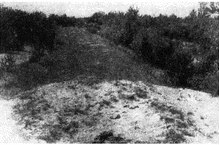
| The mass grave at Szulborze |
[Column 990]
Szulborze from which no one returned alive.
Two large mass graves were created on the field.
There was a heavy rain that day with thunder and lightening. It was as if the heavens were also crying at the mass destruction. Only the murderers carried on their trade calmly and they finished it with the well-known German precision.
The remaining Jews who stayed alive in various ways were divided among several houses behind Jatszak's mill and this was called the Czyzewer ghetto.
They went to work not knowing it they would return home. If yes, they wondered if they would find alive those they had left in the house. My son who had succeeded in escaping from the market during the aktsia [deportation] was still alive. Leaving every day for work I would prepare something for him to eat for a day and he would wait for me to return.
Ten days later, after the aktsia, the Hitlerist murderers again entered the ghetto and took about 30 children [and] Altke Sura, Misha's [daughter] and her grandchildren and took them to Szulborze and murdered them there. After this it was quiet for a long time.
The only Jew in Czyzewo who had contact with the commissar was Sender. After his mysterious death, the three members of the Judenrat [Jewish council created by the Germans], Alter Wolmer, Yehoshua Lepak and Shmulke Wengorz, became acquainted with the commissar. There was a certain relief in the ghetto.
[Column 991]
Several carpenters and I worked for the commissar and for the gendarmes. We received a salary of 10 marks a week and had permission to bring food products into the ghetto.
The Judenrat also extracted permission from the commissar to open a bakery in the ghetto and bring in meat. A shoykhet [ritual slaughterer] would come from Ciechanowiec once a week.
One day an important S.S. officer was supposed to come from Łomża. The commissar warned that people should be at their work and that they should be cleanly dressed. Neat. During the visit he actually told the officer that he needed all of the people for work and it all passed peacefully.
All three of us, Frydman's son and Moshe Rajczik and I worked for the commissar who had moved into the general's house. Once the Polish policeman Marcziniak came bringing a father and two children with him. We were sure that their death sentence had already been signed because they had come across the border from the other side, a crime for which the only sentence was death.
The commissar appeared on the terrace and Marcziniak asked him if he should shoot the three Jews.
– Quiet! – The commissar thundered at him. He remained quiet for a while. It appeared as if he was devising some kind of death with which to punish the “criminals,” but a few minutes later Yehoshua Lepak and Shmulke Wengorz fortuitously arrived. The commissar turned to them:They answered:– What should I do with your Jews?
– There is no room for them in the ghetto.
[Column 992]
– If it is this way then I will give them a permit so they will be able to go to another ghetto.He said that they should be given five marks and bread to take with them.
Later there was another case:
A Jew who had slaughtered a cow had been caught. This also was one of the crimes that was punished with nothing less than with death. Here the Jews again received a fine of four hundred marks.
Life in the ghetto already was seen as normal. The older Jews would come together every Shabbos [Sabbath] in Yankel Rajczik's [room] to pray; the young ones went to work. In they evening they would come together in a house where Lubelczyk and his two daughters lived [with] Sura Mishe's son Hershel and his sister Yehudis. Her husband and his brother had been killed. Utshe Malcman and her family and Frydman also lived there. They would spend several hours behind draped windows. Shayna Riba and her sisters Mirl and Esther and still others would also come in.
One day they began to say that ghetto would be closed and all of the Jews understood from this information that 40 train wagons had been ordered to take out the Jews.
But it was not believed that this was true. However, people began to escape from the ghetto, among them my sister and her child.
The news came on Thursday, but it was calm until Shabbos. On Shabbos night the ghetto was besieged by members of the Gestapo and Polish policemen with machine guns.
Those who attempted to escape were mostly shot on the spot. They were many of them.
[Column 993]
In the morning we were all taken to barracks in Zembrowa where they had placed the Jews according to their shtetlekh. We were together with the Wysok Jews. We shared the kitchen with them.
They began to liquidate the camp in January. Łomżer were taken on Sunday, Monday and Tuesday, Zembrower on Wednesday and Thursday, Czyzewer and Wysoker on Friday and Shabbos.
We arrived at Birkenau on Sunday at 9 o'clock in the morning. We were told to leave everything in the train wagons as we got off.
We were 2,400 people. Two hundred and fifty were chosen for work. This was permission to live for a while.
We were led away to barracks close to the gas chambers. We were led with music and Moshe Rajczik immediately received a blow to his face and he became covered with blood when he said, “What is this? They are taking us with music?”
We were led into barracks where a table covered with a blanket stood. A kapo [prisoner in a concentration camp assigned to carry out various tasks], a Jew, said:
“You, Jewish criminals, may your fathers be cursed, take our your gold things!”Everyone emptied out everything that they had. Then we were led to change our clothes.
They gave an order:
“Take off your clothes!”The shaving began after the undressing.
The shavers actually were Jewish, but the pains that we suffered during the shaving were unendurable. They did not shave, but simply plucked the hair. At first
[Column 994]
it was under the arms and in other parts of the body.
They took our winter clothing and gave us: a shirt, underpants, a man's jacket and a pair of pants, shoes and socks. Then we were taken to a second block.
There they began to break us physically and mentally. They beat us without a reason and we were not permitted to sit down.
This lasted until Wednesday. We were not given any food.
One of us grabbed a little food from a barrel. This was noticed by the block-elder; he told him to lie on a bench and he began to beat him with club on his bottom. The one who was beaten kept quiet, but when he received a blow over his back, he jumped up from his spot with a lamenting shout. Two porters immediately grabbed him and threw him on the ground. One stood with his foot on his chest and the other stopped his heart with his boot.
They suffocated him.
This was the first victim from our transport. The dead were laid out, crammed like cords of wood in the courtyard – four wide and four across.
Such piles were in the hundreds.
In the evening they put numbers on our arms. From then on we no longer had names, only numbers. Here Avraham Igla and his brother were torn away from us. Moshe Rajczik, Yankel the carpenter's son, Chaim the carpenter and his son and I remained together.
We were taken to Auschwitz.
[Column 995]
When we left Birkenau, the S.S. man said to us: “You are fortunate that you are leaving here.”
However, this “good fortune” did not make us happy because we already knew that the “Garden of Eden” named Auschwitz awaited us.
We were taken into a courtyard and immediately a hail of blows on us began. This is how we were taken to the bath. There our clothing was taken away and exchanged for camp clothing. From the bath we were taken to a block where remained for three days without any work.
During the fourth week we were sent for carpentry labor. During the three weeks many people had died. A selection took place every few days. The weak were sent to the gas chambers and to the ovens.
The selection was always done at night. We had to take off all of our clothing even during the greatest frosts. A drunk S.S. man would stand leaning against an electric pole with a thick cigar in his mouth and as we passed by him he would indicate with his hand – go right, or – go left. Right meant “gas chamber.”
Left – work.
I met Yehoshua Lepak there. He
[Column 996]
looked very bad. A week later I no longer saw him.
I also met Gonczar. He was sick with dysentery and he disappeared several days later. The same thing happened to son of Chaim the carpenter.
One day Moshel Rajczik became ill. I did all of his work then and he received his portion of food. None of the kapos noticed this. I did everything so that he would quickly become healthy. To our great joy he succeeded.
Here I also met Leibush Frydman and his son, who quickly disappeared. Leibush fought for his life until July 1943.
On the 18th of May 1944 another transport left for Gleiwitz [Auschwitz sub-camp]. On the 16th of January 1945 the so-called “death march” began.
We were marched out in a group of 4,500 people to Gross Rosen. Only 2,800 arrived there. The others were mostly shot.
We were taken to Buchenwald from Gross Rosen. I remained there for five weeks. Later we were taken to another camp.
On the 13th of April 1945 I was liberated by the Americans.
Translator's Footnote:
by Sura Ben–Ari. Camp number 33740/Haifa
Translated by Gloria Berkenstat Freund
I was still a young girl at the outbreak of the war in 1939. Therefore, I remember little of the hardships and tortures that Czyzewo Jews endured from the Nazi murderers. However, what I myself survived and saw is enough that
[Column 996]
I am horrified when I remember and imagine the terror that I experienced.
Avraham and Fruma Maslo, as well as the grandfather, Mordechai Frydman, fell during the first bombardment.
[Column 997]
Right after the bombardment my parents went from Czyzewo to Bialystok where my father rented a spot for a chemical laundry. Life was difficult in general and for a new person in a strange place in particular.
On a Friday in 1941, the Germans drove as many Jews as could be stuffed into the city synagogue and set it on fire.
Avraham Landa and Yosef Mendel, the baker with many children, were there and they were all burned in the synagogue.
When the entire area around the synagogue began to burn, we ran to Pesakh Maslo, who then lived in Bialystok.
The Germans quickly organized the ghetto. We entered the ghetto to visit Golda Bolender.
From Golda we learned that our uncle, Yankel [Yakov] Bolender, had been shot. My aunt immediately wanted to go to Czyzewo. We did not permit her to go. However, I went there as a Christian girl with a cross around my throat. In Czyzewo I did not meet any of my family. The shtetl [town] had been burned.
|
|
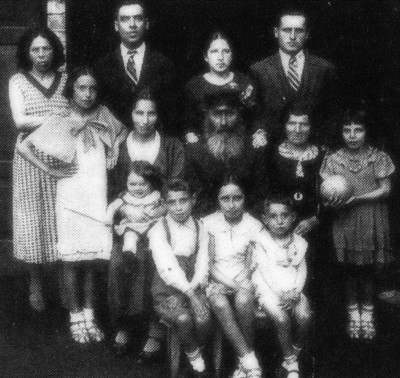
| Yakov Bolender, his wife, children, grandchildren, sons–in–law, Motl Smolowicz and Fiskha Zysman, standing on the left |
[Column 998]
I then put on my “Star of David” patch and went to the Czyzewo ghetto. There I learned that my brother, Yitzchak Frydman, his wife, Szayna–Bayla, their two children, Fruma–Rochel and Sura–Laya, already were no longer in Czyzewo with my aunt, Enya Bolender. Her daughter Zisl and her children and her son Sender and his wife all perished in the sadly famous village of Szulborze.
I learned that my brother, Yitzchak, and his family were in the village of Rosochate. I went again with the “cross” around my neck with great effort and arrived in Rosochate with swollen feet.
The joy was very great. However, we did not know what would happen tomorrow.
I left to return to Bialystok and brought the news to my mother that everyone was alive and healthy. I gave her the signs exactly as my brother had given them to me. But I told my sister Chana–Etka and Golda Bolender the sad truth. Golda Bolender had her father, Ziska, and her sick mother, Zelda Bolender, in Bialystok. They all perished in a terrible death.
Our entire family was driven away to the Pruzany ghetto and from there to Auschwitz.
We traveled in closed wagons, burning with thirst. Many people died en route.
The women were immediately separated from the men and children in Auschwitz.
Going in the ranks to death, I was separated from my beloved and dear ones forever.
[Column 999]
I met a friend of my sisters named Dina Farber and I went with her to the Auschwitz camp.
They took our clothing and shaved our heads. My number on my arm is: 33740.
Instead of food or drinks they gave us blows without cause. We were chased barefoot, without shoes, in the snow. There they treated us worse than cattle. Death would have been better than such a life.
[Column 1000]
Alas, I lived in these conditions for a year and a half. I was saved thanks to a Czyzewo Jew. His name is Chaim Berl Wiferownyk, may his memory be blessed.
He worked in the sonderkommando [death camp prisoners forced by the Germans into work units whose primary job was to dispose of the bodies of the victims]. He wanted to take revenge against the Germans for the death of his wife and children. He organized a group and they chopped down the barbed wire so the [prisoners] could escape. However, they were caught immediately and shot on the spot. I succeeded in escaping then.
by Moshe Rajczik, Kiryat Motzkin (Camp Number 88925)
Translated by Gloria Berkenstat Freund
These memories were written in blood and tears. A people perished before my eyes in horror and misfortune. The entire time that I unburdened myself, I had the feeling that these are not only memories of my personal experiences. With certain changes, they are characteristic for hundreds of thousands of other survivors of that horrible hell. However, all of those Czyzewer who were closest and dearest to me, who perished with such a cruel death, continue to hover before my eyes. I know from the start that I will not succeed in providing everything that I have gone through in those terrible days of unending pain and death. Not only because many events were lost and forgotten over the course of time. There simply are no words in human language that can reflect the horror of those days. However, I consider it my duty to record my experiences, which are certainly similar to many others people's. I will open-heartedly tell everything here that happened from the first day of the outbreak of the war. I will not hide anything bad and not add anything good, only the truth, as I saw it and lived through it.
On the 1st of September 1939 I was in Warsaw. Seeing the great danger, I decided to return home to Czyzewo.
I had no rest [because] I was afraid that I would remain separated from my home and the fate of all of those close to me.
[Column 1001]
Arriving in the shtetl I found it had burned. At the Catholic Church, Polish soldiers still stood, but their weakness and disorientation could be felt. There was no doubt for anyone that they would not be able to hold on for long.
The soles of my feet were scratched, callused and swollen from walking so long. My eyes and lips were dry from the heavy weariness. Despite all of this, when the Germans entered Czyzewo I left immediately for the village of Dmochy-Glinki. I had peasant acquaintances there and therefore wanted to see if they could help me.
A tired weariness lay over the village; doves looked for a place to hide from the gunpowder and the people mimicked them, leaving their cottages abandoned, and went out onto the narrow dirt roads between the fields.
On the road, I met the Chrapker miller, who consoled me that I did not have to be afraid because the Soviets would quickly be here. That is what a German soldier told him.
Meanwhile, the Germans calmly carried on their murderous work. They shaved off the beard of Moshel (Czak) and photographed him with the background of the burning houses. They hanged a sign around his neck, “I am the Jew who set fire to the city.”
The Czyzewo soldiers marched out and began to build small houses. I was a carpenter, was a member of the brigade at the workers' cooperative where the [female] representative of the high official was my comrade, Royza.
A kind of unrest already was felt in Czyzewo three months before the attack by the Germans. A Soviet officer, a political commissar,
[Column 1002]
had said to me then that the peace with the Germans would not have any longevity. The border was not far way and there was talk that new soldiers were mobilizing here. The attack hung in the air and sadness and fear prevailed in the Jewish houses in Czyzewo.
There were those who tried to console themselves and others after everything; they did not want to allow the idea that the cruel enemy of the Jews would again acquire the shtetl.
Suddenly shrapnel and bombs began to fall over the shtetl. There were those who were killed. And the battalion that incidentally consisted of many Jewish soldiers withdrew. The attack came unexpectedly for them and created disorder and chaos.
I ran with the battalion. Along the entire road I encountered disoriented soldiers and officers who were running, not knowing where. An officer tried to take over the leadership and, shooting in the air, stopped the running soldiers. He gave an order to leave the wounded, take their weapons from them and go into the woods. I lifted a rifle that had been thrown away and joined the ranks.
We sat down to eat deeper in the forest. Shooting was heard immediately. It was clear that these were the German parachutists. But we did not have enough bullets with which to be able to answer them.
We arrived in Minsk, but it was the same there, the same chaos. The Germans already had surrounded the city. I began retreating with a small group.
We arrived in Bialystok through back roads, among fields, forests, but we were caught here by a German patrol and
[Column 1003]
taken away to the headquarters where the German commandant cursed us with the worst words. That we were damned partisans and he ordered that we be taken out and shot. We were a group of six people, among whom only Moshe-Dovid Slikes and I were from Czyzewo.
The German soldiers led us out to the forest and began looking for a suitable place to place us for shooting. However, at the last minute a rider on a sweaty horse rode in and told them about an attack by the 10th cavalry regiment and they quickly led us back to the camp for war prisoners. I tried to convince them that I was a Ukrainian, but they later learned that I was a Jew and they led me with seven more Jews to the barracks where the Jews were located. Everyone was undressed, only in underpants.
On the first night we, several Jews, agreed among ourselves that we needed to dig through to the Russians. However, everyone else was apathetic to our plan and did not want to believe in the success of escaping.
We succeeded in getting clothing from somewhere and when everyone was asleep we sneaked out of the barracks and sneaked through the fence in the darkness up to the Polish barracks. The guard was weaker there and, when the patrolling guards sat down for a while, we forced our way out, jumping over a fence and began running in the direction of the forest.
However, we did not manage to run far and bullets began to fly over our heads from all sides. Seven Jews, among them Moshe-Dovid, fell from the bullets. Only three of us succeeded in reaching the forest. The Germans
[Column 1004]
continued to shoot. However, they did not want to come near us.
The shooting did not stop the entire night. We remained lying hidden behind the thin trees, trembling from the cold and fear. When it began to get light we crawled to the highest point, where we sat until it became dark. From afar we heard that the tumult and the uproar that had reigned in the camp had begun to end. The Germans had apparently given up on us.
We descended from the trees and began walking in the dark, without a goal, further away from the camp.
In the morning, [after] walking the entire night, we saw in the distance the cabin of the forest guard. His wife was busy at the entrance.
We held a short deliberation and it was decided that one of us, a blond lad, would present himself to her as a Pole who had escaped from the camp.
Seeing him, the woman crossed herself. She believed that he had escaped from the camp and warned him that the camp was very close by. Shooting was still heard and [the Germans] were still searching in the forest.
The Christian woman invited him in, but her words about the police search scared him. He said goodbye and returned to us.
We realized that we had gone the wrong way and began walking in the opposite direction.
The road continued difficult and long. Every rustle caused fear and there was the worry of doubt in our heads. Were we going in the right direction? We were afraid to meet anyone who might betray us.
[Column 1005]
We finally saw a solitary peasant woman walking by with a basket. The blond boy went over to her to ask her where we were.
She became very frightened. When he said that he had escaped from the camp, she became calm, gave him a piece of bread and told him that her son was also in the camp. She was taking food to him.
The peasant woman showed him how to go by a side road and also told him to be careful because there was great trouble in the area.
In the Destroyed Home
I finally arrived in Czyzewo. All of the Jews were at work, for which they were not paid. There were no S.S. men in the shtetl yet. It was only the military from the front and the military commandant had given the order that all Jews must work on the train line, which had to be transformed back into narrow tracks.
After two weeks a special department commissar came to Czyzewo, who began to “create order” among the Jews in the shtetl.
The condition of the Jews worsened even more. The commissar ordered the creation of a Judenrat [Jewish council}. Zebulun Grosbard was designated as the chairman. The commissar himself came to the gmina [community] office and gave Zebulun a slap, saying: “You are the elder. Therefore, everyone must be obedient to you, and you to me.”
My father had the surviving Sefer Torah [Torah scroll] and from time to time a minyon [quorum of ten men needed to conduct certain prayer services] came together [with him]. Zebulun also prayed in our house. They called to heaven for help, quietly, with a choked cry, behind hammered-shut doors and windows.
[Column 1006]
On a beautiful day, all of the Jews were called to appear at the market to register for work. The people no longer believed [what was being said], but they had to [go]. Everyone was then taken away to Szulborze where they all were shot.
The department commissar created the ghetto with those who had survived.
Once on a summer day the commissar approached me and said that everyone had to appear in the street in the morning. Only I and a list of carpenters would not be bothered. Turmoil began when I went to the ghetto and spoke about the list. I made a list of 30 people and the commissar signed it, adding:
– From tomorrow morning until night I will not be the boss of the city. It would be better if you hide until over night…I returned home with a heavy mood and repeated the commissar's words. Other Jews were present and everyone saw a hidden signal in the commissar's words that we should escape.
There was an uproar in the ghetto. Whoever could, hid. A rumor spread that Hitler himself was leading the deportation. No one appeared at the designated hour.
Sender, who was friends with the commissar, appeared in the street. He often had a drink with him. He went through the houses, said it was not a question of deportation, but only to register.
Little by little the people began to leave their houses and appear in the rows. I went to the department commissar, but he did not want to talk. Later, I succeeded in removing from the line Sura
[Column 1007]
Stuczynski. The department commissar later confirmed that he needed her as a cook.
I returned to the ghetto in the evening, where a deadly silence reigned. The Gelbards' three-year old son came out of the small garden near our house in which we had planted potatoes and pointed to the potatoes with his small, shaking hands:
– I hid here… I saw how they took out my mother, my aunt to be shot, so I hid…We kept the child with us until we were taken to Auschwitz.
Once on Shabbos [Sabbath] when a minyon had gathered in our house, a Jew, breathless, wild, shaven, came running in the middle of the praying. He barely could stutter: “Jews, give me a talis [prayer shawl].”
He cried for a long time wrapped in the talis. When it was dark enough, he took off the talis and in a quiet voice began to tell how he had escaped from Treblinka and all of the horrors he had seen there. He worked at sorting the clothing that had been taken off by the transported Jews. He changed into the clothing and succeeded in escaping.
We were a small group, veteran soldiers who decided to escape from the ghetto with weapons in our hands and go into the forests to the partisans. Shmulke Gelbard [the name “Gelbard” is spelled in various ways throughout this chapter], Sura-Misha's son Hershel (Zylberman), Shimon the son-in-law of the tailor, Yisrael-Shlomoka the shingler, Yakov Jakubowicz and two brothers who came to the Czyzewo ghetto from another shtetl, were in our group.
We contacted a Pole who would enter the ghetto to trade, and who traveled back and forth to Warsaw. Shimon, the tailor's son–in-law promised to pay with dollars
[Column 1008]
for weapons. The Pole promised to bring two pistols and two hand grenades and took a deposit of 50 dollars.
Several weeks passed in restless tension. Finally, the Pole appeared again and explained that he had encountered a police search on the way and had to throw away the weapons he had bought. He even wanted to return the money.
We again tried to make contact with a second Christian whom we promised to sew a suit without payment with the condition that he would connect us to the partisans. Again, nothing came of these contacts.
Another illusion vanished.
I saw many terrors during the ghetto days. However, there also were moments of moving humanity. Such was the moment when the Germans demanded of Zebulun Grosbard that he provide 30 people for work and he immediately answered that he had no one. They took him to be hanged and he had to carry his own rope to the gallows, which was made of an electric pole in the middle of the market across from the community building. The gendarme told him to throw the rope. Zebulun tried to throw the rope with his last strength and could not. Then the gendarme threw it. He waited a minute for the Jew to beg him to pardon his life and that he would obediently carry out all orders. However, Zebulun Grosbard stood calmly, ready for death, not giving in to the German murderers and handing over the Jews to them.
The gendarme hesitated for a minute, and finally he shouted:
– Run back to the ghetto.[Column 1009]
In Auschwitz
The day came of the last deportation and we were all taken to Zambrow, where the military barracks were located, the collection point for the Jews from all the surrounding shtetlekh, and from where we were taken to Auschwitz.
We were taken to the train on a frosty night, loaded in the train wagons. Each wagon was packed with people to the edges, without food and drink. Thus we traveled enclosed without a bit of air. We did not know where we were going. Some knew [enough] to explain that the Germans had erected ovens to burn people.
When the train stopped, the doors of the train wagons opened wide and the S.S. soldiers, with whips in their hands, shouted, cursed, drove us out and did not let us take our packs.
The tumult among the people was frightening. We were placed in rows, men separately, women separately. The square was a giant one and was lit by spotlights. We were in Auschwitz.
They immediately began to choose people who were capable of work. The weak ones were placed separately. The fate of these people was known. My uncle, who was among the rejected, tried to convince the Germans that he was still young and could work. He received a blow with a whip across his face and immediately was covered in blood.
We were then loaded into vehicles and taken away. The S.S. soldiers followed us on motorcycles. We arrived in the courtyard of Birkenau and had
[Column 1010]
to march to the beat of wild music and hysterical laughter from the Germans. We marched and were taken into a bath barracks. It was so crowded there that one literally stood on another and could not catch their breath.
The Czyzewers, Wengorz, Lepak, Shmuelka Gelbard, Chaim Stoliar and his son and Leibush Frydman were in this barracks.
When we were led into the bath we thought that they were going to gas us. We looked up to the ceiling from which the gas would stream out. Many Jews made their confession out of fear, but suddenly there was a spray of warm water. Can anyone imagine the wave of joy that the water brought with it?
For two weeks, we, the selected carpenters, did nothing. We received tea or coffee in the morning, a portion of bread with margarine or marmalade. When the bell began to ring we instantly had to be on the roll-call square. We were counted there. We were taught the rules of when to take off our hats. The kapo [concentration camp inmate assigned administrative tasks] shouted: “Cap off!” – everyone had to take off his hat – and bang his right foot.
The making of one's bed had to be abided by vigorously. Blows were received for the least inexactness.
There was a kapo, a German Jew, a former colonel, who had a Christian wife, over the 100 [people] to which I belonged. His son was a high officer in the Hitlerist Air Force.
Once he did not come to the barracks the entire day. In the morning he said that his son had turned to Hitler with a request
[Column 1011]
in which he pointed out that his father could be of great use to the German Army. As a result of this, he had been called to the camp commandant who asked him if he wanted to go free and enter the military. He answered that he wished to be with all of the Jews in the gas chamber. His son became hysterical and had fainted on the spot.
To enter work in the carpentry workshop I first had to pass an exam. I was assigned to make a complicated door with a transom.
The first piece of wood that I brought to the workshop from the warehouse was ruined for me by a Pole, cutting a bad length. It led to a scandal. I tried to tell the Pole nicely that he should not prevent me from surviving the war. As an answer, he slapped me.
I had nothing to lose and, determined, I went to the guard in charge of order, told him that I was being disturbed at work and I did not know how I could carry it out.
The German became furious and wildly ran to the Pole, warned him that if he tried to sabotage me, he would simply be shot. He must learn if the Jew could work…
The Pole shook with fear and no longer disturbed us. My work pleased the Germans and later I succeeded in drawing in Gelbard and Chaim Stoliars son. His father failed the exams also because the Poles had disturbed him.
Once they [the Germans] sent me to fix something at the crematoria. Going closer, I saw Ruwin, the chimney sweep, among the people who walked like shadows while burning the dead bodies that had been pulled out of the gas chambers.
[Column 1012]
Seeing me, he stood for a while as if welded to the spot. Suddenly a short shout of joy tore out of him. He murmured and his face again became human, “You are alive?”
At the same time, Berl the wagon driver approached. He also was happy that he saw a familiar person among the survivors. They placed a golden 10-ruble piece in my hand.
I met with them several times. We could not always stop and converse. We only communicated with glances, which quietly expressed the joy of the encounter. Another day of life, a weak point of hope glowed in our hearts: perhaps we would meet again tomorrow.
The Heroic Revolt at the Crematoria
Suddenly they stopped sending me to work at this crematorium. I learned later that a revolt of the kommandos [work units], who were employed with burning the gassed bodies, had taken place there
Usually the separate groups did not dare come together, could not talk to each other. The kommandos got drunk before taking the transport to be burned and they did their horrible work automatically.
I did not know the channels through which the people organized the contact and how they communicated among themselves. It is a fact that the initiative came from the group in which Chaim-Leib, the wagon driver, worked. They
[Column 1013]
were the first ones to grab an S.S. man and throw him in the burning oven.
This was the signal and together everyone ran like a hurricane to the remaining S.S. men, tearing the guns from them and shooting them on the spot. Individuals still defended themselves, but the machine guns that they had taken from the guards in the watchtowers already were in Jewish hands. This gave the Jews dominance and in half an hour the last S.S. defense point had been destroyed in the area around the crematorium.
The Jews began to run to the exit with weapons in their hands. However, the road was far away and the alerted camp commandant succeeded in sending out reinforcements, a large well-armed S.S. group, which immediately began shooting at the escapees from their cars.
A struggle developed that did not last long. The Jews staged a desperate resistance and fell to the last one.
Chaim-Berl, the Czyzewo wagon driver also fell then in the heroic struggle of the Jewish crematoria workers against the Hitlerist murderers.
From then on, I was no longer taken to work there; every day I went from Auschwitz to Birkenau, where different carpentry work had to be done. I was accompanied by an S.S. man with a machine gun. He walked behind me, ready to shoot if I made the slightest movement to escape or to communicate with someone.
The road was wide and tormenting enough. I searched with my eyes for a known
[Column 1014]
face. I was answered by fearful looks from tortured faces over which hovered imminent death.
Once I noticed a particular movement. The S.S. man accompanying me was in a tense mood that day. He hurried me so that I should go faster because he still needed to return to the camp, to accompany another transport.
I just tried to make the road last longer and all the while I was stopped by the passing vehicles packed with Jews. I knew the road well and knew that they were being taken to the crematoria. Particularly large transports arrived that day and many vehicles were mobilized. An armed S.S. man on a motorcycle followed each vehicle.
Suddenly a vehicle arrived with small children who lay thrown in, one on top of the other. Terrible crying tore from there. Suddenly I saw a child sliding down and she was standing on her feet. I remained riveted to the spot and I could not take my eyes off of the beautiful and genteel small face of a girl who looked all around desperately on all sides, searching for a person who would help her. She clasped a doll in her small hands.
An S.S. man on a motorcycle drove in. The child began to run toward him not letting the doll out of her small hands. It looked as if she was more concerned for the doll than for her own fate. Her childish, crying eyes had a motherly tenderness.
She ran to the S.S. man with childish trust. However, she did not manage to open her small mouth. The S.S. man's hand
[Column 1015]
had lightening fast pulled his revolver and its fiery voice immediately reached her small head. She fell down near his motorcycle, not letting the doll out of her small, convulsively gripping hands.
The S.S. man drove further.
I was at Auschwitz for two years and two days. When the Russians were getting closer, we were taken to Mauthausen.
From there they took me to Ebensee, an Austrian town in the mountains where we were employed at blowing up mountains and building tunnels.
I worked there for six weeks in inhuman conditions, swollen with half-paralyzed feet. I felt that these were my last days and I decided not to go to work any more. It would be better if they shot me on the spot.
I remained in the house and waited for death. Suddenly I heard my name being called. I was sure that these were my last minutes. But the S.S. man who appeared at the door of the barracks was calm this time, taking me to an office and, later, going down with me in an elevator deep into the ground where the disguised ammunition factory was located.
The noise from the various machines was deafening. But another regimen existed here, different from the one above. The people, mostly Hungarian specialists, walked around, fully satisfied, occupied. Each had his section, his machine. No one looked at me. Only the foreman hurriedly showed me what I had to do and went to the other end of the room.
After an entire day of work, the same master craftsman returned to lead me out above, where there already were other
[Column 1016]
camp inmates and a kapo led us to the barracks.
I worked in that factory until the liberation.
Salvation Arrived
This was on the night of the 4th of May 1945. The tension in the barracks turned into chaotic unrest. People walked around and said that there was a secret order to gas everyone and that this would happen after the morning roll call.
The apprehension grew. In the morning, no one wanted to go out to the roll call. The people stretched out on the ground and did not want to move from the spot.
Something was astir and we did not know what the Germans were thinking of doing to us. It appeared that the S.S. members did not want to leave anything over and, escaping, they left several Germans as representatives, who were to lead us away. But the several Germans were realistic. They saw that everything was lost and the camp leader himself came to us with the news that he was taking over and had opened the storehouses for us, let us take crackers, cigarettes and, whoever had the strength, left for the city.
We were free!
I cried, not knowing from where I had taken so many tears. My heart hurt for all of those fallen and burned, who did not live to be liberated with me.
I lay on a plank bed and sobbed. No one looked at me. I fell asleep. When I woke up, I no longer heard anyone speaking German.
Yisroelke Fenster – a son of Avrahamtshe Camp Number 89887
Translated by Gloria Berkenstat Freund
My Experiences of 1941
This was a Sunday in the month of June. They began to attack the city in the morning and the Hitlerists marched in on Monday. We were the first people who were taken to work. The “stationmaster” led us to work. They shot the weak ones on the way.
Thus we were sent to work every day. And in the evening we returned home. This lasted for a time, until an order came that in the morning all of the people aged 15 and older should appear at the market from which they would be sent to work.
At dawn, around four o'clock, the terrible truth was apparent. Men and women were separated and we were surrounded by Polish policemen and the Gestapo. There was a heavy rain, but we stood until eight o'clock, when a vehicle arrived from Lomza,
[Column 1018]
from which descended a Gestapo officer. He exchanged greetings with the municipal commissar and they began to count and select people who were placed on the side. Black trucks arrived and they began to load women and children and the men were told to go in the direction of the Zambrówer Road. The Polish policemen tried with all of their strength to search out the Jewish children and wanted to pull them out of their hiding places.
We, the survivors, about 50 people, were led back to the ghetto. In the morning, we learned the bitter truth, that all of those who had ostensibly been taken to work the night before had been shot in Szulborze.
The number of people in the ghetto quickly increased with the arrival of the escaping Czyzewer and [people] from other neighboring shtetlekh [towns]. We numbered around 300. Everyone was quartered in the small ghetto houses with a prohibition against moving from one house to another, under
[Column 1019]
the threat of being shot. The same day several victims did fall. The first was Czarna Silka's daughter; the second was Moshel, Pesha-Yuta's son, and so on.
Thus we lived in painful fear of certain death for 18 months until November 1942. One day there was a rumor that wagons were coming tomorrow to bring trees from the forest. There was panic in the ghetto. We already knew from experience what this meant. Many ran away and the remaining were taken to Zambrów, which was the assembly place for the transports to Auschwitz.
We remained in the ghetto for six months; my brother and I, glaziers by trade, two cabinetmakers and two saddle makers. But, as after the first deportation, abut 60 people returned and a short time later they were again sent to Zambrów. Only a few people remained.
Transports began from Zambrów to Czyzewo to the train station so that they could be sent to Auschwitz. Those who died on the way were given to us to bury. From that time on, none of the people in the ghetto could approach us or talk to us. They were shot immediately for transgressions. Dina Szwarc and the sister of Motl the watchmaker were shot, whom we buried immediately.
We were told to go with the last Zambrówer transport. This was my brother and I, Simkha Moncarz, his brother and two others. We were packed in the train wagons without food and without a drop of water.
The trip lasted not more than two days, but it was enough for hundreds of dead to accumulate.
[Column 1020]
Shooting was heard often on the way. Those who tried to escape were shot.
There was an immediate selection when the half-dead people descended from the train wagons at Auschwitz. Those capable of work remained on the spot and everyone else was loaded onto trucks – to death.
The entire work went with the greatest speed; everything was emptied in 10 minutes. Those capable of work were led with music to wash and trim their hair. Our clothing was taken from us and we were given camp clothing. And from then on everyone received a number. My number is “89887,” which I wear to this day and will remain with me for eternity.
We were led into the barracks.
I lived in Auschwitz for two and half years without hope of living to see freedom.
On a beautiful summer day, the noise of American airplanes was heard that rang in our ears like the most beautiful music and a hail of bombs immediately fell and I was wounded. I was taken to a hospital where I spent six months.
Every week the very sick were chosen and sent to the ovens. Suddenly an order came to liquidate the camp because the Russian Army was approaching. We were driven on foot, without rest, until we reached a “haven.” The weak fell on the road. The survivors were driven to various work.
We were freed by the American Army on the 5th of May. My wife and three children perished. May their blood by avenged!
by Avraham Kandel and Chaim Belfer/Tel Aviv; Gorzalczany/Petah Tikva
Translated by Gloria Berkenstat Freund
1st of September 1939
On this day we sent out a shipment of geese from Czyzewo to Warsaw. The stationmaster at the train station received the goods, but without assuming responsibility. It was not known how far the geese had travelled, but they returned to Czyzewo the next day.
The Czyzewo train station was bombed on the 7th of September.
The Germans entered on the 9th of September right on Erev [the eve of] Yom Kippur.
The shtetl [town] remained without food. The Germans opened the municipal food and bread warehouses. Everything already was moldy.
The holiday already was disturbed for the Jews. They spoke of Jews caught by the Germans outside the city; they were beaten on their legs and shouted at: “Crawl on all fours”… They were spit at in their faces.
“Your Chamberlains… Your [British Secretary of State for War Leslie] Hore-Belishas!”Younger people clenched their fists. A fire burned in their eyes; how could we endure this? Creator and Master of the Universe, how could You create such a hell?
The first initiative to escape was undertaken by the HaShomer HaTzair [Zionist-Socialists] organization.
Yosef Levi, a party messenger, came and connected us with a peasant. Yosef Levi spoke about the destruction being done by the Germans in the Jewish cities, about Warsaw, where entire streets were erased and people were lying in the streets near murdered horses.
One wanted to stop-up their ears and to not hear any more. Just leave, leave from
[Column 1022]
here, but very few moved from the spot. Their feet were as if riveted, their knees as if filled with heavy lead.
We were the first group that moved from Czyzewo. The two Ejnszic brothers and Yisrael Lew went with us.
We traveled to Bialystok by train and through backroads we reached Lida [in Belarus].
We were stopped at the border by a patrol. We barely escaped and again began to wander along the border. We lost our courage. We went from shtetl [town] to shtetl, from settlement to settlement.
Vilna went from hand-to-hand three times in the course of a month. The Red Army took the place of the Poles and then the Lithuanians came. Life became more difficult with each new owner.
To be frank, the Lithuanians were not in any hurry to take Vilna. Moscow Radio reported on the first days that the Soviets were withdrawing from Vilna and its vicinity, but the Lithuanian rulers hesitated in accepting the gift. This Lithuanian restraint was incomprehensible at first.
Jokers jested:
– They are ashamed to come during the day; they are afraid to come at night…However, it soon became clear that the Lithuanians were receiving Vilna as a present. But the military bases for the Red Army remained in various places in the country.
[Column 1023]
The tall Lithuanian policeman and the short soldier finally entered. A shudder went through the Jews:
– They are beating Jews.A pogrom!
People ran wildly through the streets, locked the gates of their houses and hammered shut the shutters. Everything grew louder and the screams came closer: “Death to the Jews.”
Heavy stones flew through the windows of the Jewish houses. Shops were forced open and Jewish possessions were looted.
Screams from the beaten and trampled Jews were mixed with the debauched laughter of those doing the beating.
Divisions of the Red Army were still in the city. The officers and soldiers watched what was happening and were silent.
In the morning, the new regime finally quieted the pogrom.
We met the Czyzewo Rabbi's son-in-law, Reb Pinchas Levinzon and his wife, Freidel, and their only child in the Vilna house of prayer.
He studied all day and received support from the Joint [Distribution Committee]. They lived well and even offered to lend us money.
We did not need any money because we were living in a kibbutz [community] and received food from the Joint.
There was a Council for Refugees (a committee for the homeless) in Vilna. The Vilna Jews welcomed the refugees. We would take a job at various work, even cutting wood. The [Vilna] Jews pitied and consoled us.
In Vilna we quietly dreamed of going to Eretz Yisrael. However it was too difficult
[Column 1024]
to obtain a visa. There were those who were not believers and were successful in not driving themselves crazy with hollow ideas.
They were clever and realistic, but our hearts rebelled. In addition, after a short time, they began to issue visas.
How many Jewish tears were spilled in the corridors of the American and English consulates! How Many Jewish hearts left [the consulates] like broken pottery!
The number of those who won the lottery and received an American visa was small. But we lived with the idea of going to Eretz Yisrael and this was easier to accomplish. The British consulate gave hundreds of visas, but we did not receive one.
Suddenly, people began to say that the Japanese Consulate was issuing transit visas. It did not occur to us to go there; what would Czyzewo Jews do in the country of the geishas? In addition, we knew that the small Japanese were too friendly with Hitler.
Therefore, we became disoriented and astonished when we heard that the Japanese Consul [1] began to throw visas right and left and almost for free.
This was suspicious. Jews knew that there are no bargains; we must pay dearly for everything. Therefore, the Japanese visas were considered with suspicion.
The relationship between Russia and Japan was strained. There already were rumors that Soviet agents were photographing everyone who went near the Japanese Consulate and that traveling through Russia they would be sent to Siberia.
[Column 1025]
Yes, we were sad, but we decided and later went to the Soviet Consulate for permission to travel through [the Soviet Union] to the Japanese border. So many miracles happened to us. Perhaps further wonders would also happen.
We came together with our Czyzewo comrades and wove the dreams of going, going…
At the Russian Consulate they demanded that we pay for the trip to Japan in dollars.
One of us sent a telegram to an uncle in New York and the necessary dollars arrived in a short time.
Sitting on the train, we did not feel any fear. Each one had a train compartment and a numbered seat, but the door opened hastily outside of Moscow and members of the NKVD [Narodnyy Komissariat Vnutrennikh Del – People's Commissariat for Internal Affairs – secret police] entered, sized us up with sharp, penetrating glances.
The first inspection and check of our documents had begun.
Everyone held their documents, the passport and the visas in their hands. Long months had passed until they had gathered them and here, suddenly, they were taken from us. One of the members of the NKVD gathered them altogether in a pile and did not even look at them. He crumpled them in his fists and pushed them into his pouch.
Leaving, they took Kandel with them.
It appeared as if he had been arrested and we remained confused and lost.
A person has such a feeling of being lost when his clothes are torn off in the middle of the street and he is left standing naked
[Column 1026]
and he must not move from the spot under the threat of an aimed pistol.
It did not take long and again we heard a knock on the door of the compartment. We all had the thought, “They finally have come for us.”
To our surprise, they brought back our documents, but Kandel did not return.
We traveled further on the train, which moved slowly to Vladivostok, with heavy hearts.
Kandel turned up unexpectedly after we had been in Vladivostok for several days. Until today he does not know what kind of imperfection they had found in his documents. He was summoned to the NKVD every day in Vladivostok and his papers were checked again.
The director of the hotel in which we lived was a Jew. He immediately began to shout, rant and curse when he learned that we were going to Eretz Yisrael. He made the pretense of being very strict and angry, but quietly, very secretly, he took an interest in the situation of each one of us and gave advice and helped with an intervention to speed up our departure.
We met many Jews during our time in Vladivostok, but none of them wanted to talk with us. They avoided us as if we had a contagious disease.
The days and weeks of half euphoria and half fear flew by. We were aware of how long we had been on an NKVD list. Various surprises could happen to us.
No one yet was sure of the accomplishment of their dream of arriving in Eretz Yisrael.
[Column 1027]
Finally we were on the ship that took us to Japan.
Representatives of the Jewish section of the refugee committee waited for us in the Japanese port city of Kobe. They brought new clothing, apples and other good things for us.
Kobe was a city with a population of one million… Hundreds of Jewish families. Jewish life existed only in their own club where they came together. The refugee committee was located there.
Our transit visa was valid for 14 days, but the government increased its term without any difficulties.
In general the relationship on the part of the government and on the part of the population was very warm. We felt this in both official offices and in the street where every passerby, despite the fact that we did not understand their language, tried to express their sympathy and understanding for our suffering in various ways.
In Kobe, new people, from every strata, Hasidim, yeshiva [religious secondary school] students, from Zionist youth organizations and even Bundists, arrived every day.
Here we also met our rabbi's son-in-law, Reb Pinchas Levinzon and his family. At every step we felt the help from
[Column 1028]
the Joint [Distribution Committee]. Finally we found ourselves on a Japanese ship going to South Africa.
On this road we felt the dispersion and simultaneously the great numbers of the Jewish people. Throughout the world, from Czyzewo to Vilna, from the frosty north to the warm south – there was no place where we did not encounter the sad, Jewish eyes that looked at us with so much warmth.
Meeting these Jews, everything took on a new life, a new light.
This was confirmed for us by the hidden Jews in Vladivostok into whose hands we stuck a red flag and warmed the earth beneath their feet! The few Jews in Japan who felt free there and yet exile did not fall from their shoulders.
We succeeded in calling out: “Jews from every land unite. Come with us to the Jewish land!”
We traveled from Cape Town on an Egyptian ship and at Kantara [Egypt] we were taken over by an English convoy, which accompanied us to Atlit [near Haifa].
Translator's Footnote:
|
|
JewishGen, Inc. makes no representations regarding the accuracy of
the translation. The reader may wish to refer to the original material
for verification.
JewishGen is not responsible for inaccuracies or omissions in the original work and cannot rewrite or edit the text to correct inaccuracies and/or omissions.
Our mission is to produce a translation of the original work and we cannot verify the accuracy of statements or alter facts cited.
 Czyżew-Osada, Poland
  Yizkor Book Project
 JewishGen Home Page
Copyright © 1999-2026 by JewishGen, Inc.
Updated 18 Nov 2020 by LA
![czy0979b.jpg [7 KB]](images/czy0979b.jpg)
![czy0979c.jpg [14 KB]](images/czy0979c.jpg)
![czy0979d.jpg [11 KB]](images/czy0979d.jpg)
![czy0979e.jpg [8 KB]](images/czy0979e.jpg)